Article Text
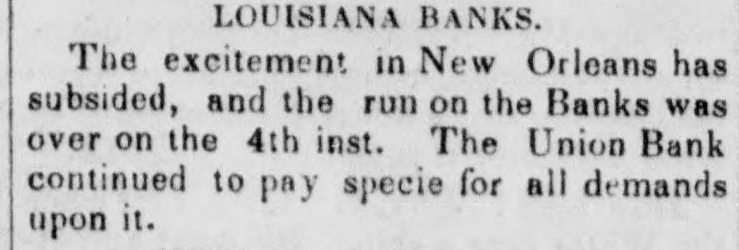
LOUISIANA BANKS. The excitement in New Orleans has subsided, and the run on the Banks was over on the 4th inst. The Union Bank continued to pay specie for all demands upon it.
346b67d2Accommodated withdrawals, Full suspension
Click image to open full size in new tab
LOUISIANA BANKS. The excitement in New Orleans has subsided, and the run on the Banks was over on the 4th inst. The Union Bank continued to pay specie for all demands upon it.

Click image to open full size in new tab
tisted by the General Government, provided the same shall, in their opinion, be consistent with the rights and interests the State. All the Banks in New Orleans have resumel specia payments. Later accounts state that they have again suspended. CONGRESS.-In the Senate, on Thursday,June 2, Mr. Miller presented 2 as will asking a petition such from revision citizens of of the New tariff Jersey, secure protection to the domestic industry of the country. Mr. Benton, from the committee on military affairs, reported a bill to provide for the armed occupation and settlement of the unsettled peninsula of East Florida. The consideration of the apportion, nt bill was resumed: an amendment pending offered by Mr. Wright, relating to districting the states. The debate was continued by Messrs. Crittenden, Woodbury. Preston, Benton, and Miller. On Friday, the debate on Mr. Wright's amendment was continued by Messrs. Bagby, Graham, Walker, Rives, and Henderson. On Saturday, the debate was continued on the apportionment bill, by Messrs. Morehead, Buchanan, Tallmadge, Walker, Evans, White, and others; but no question was taken. On Monday, June 6, a resolution offered some days since by Mr. Woodbury was adopted; and the Senate will therefore hereafter meet at 11 o'elock. The debate on the apportionment bill was continued by Messrs. White, Bates, Smith of Conn., and Kerr. On Tuesday. the debate on the apportionment bill was continued by Messrs. Wright, Tallaradge, Walker, Cuthbert, lann, and Berrien. The question was then taken on Mr. Wright's amendment, and decided in the negative-yeas 19, mays 29. On Wednesday, the apportionment bill being under consideration, a debate occurred in which Messrs. Linn, Bayard, Walker, King, Williams and Porter were engaged, on an amendment offered by Mr. Linn, providing that the provisions of this section shall noteffect the election of Representatives to the 28th Congress. The question being taken, the amend ement was adopted-yeas 23, nays 22. Mr. Allen then moved to strike out the 2d section, as amended; but the motion was rejected-yeas 21, nays 24. In the House of Representatives, OR Thursday, June 2, the day was occupied in the consideration of business for the District of Columbia. On Friday, Mr. Fillmore, on leave given, from the ways reported committee of and means " a bill to provide revenue for imports, and to modify existing laws imposing duties on imports, and for other which was to purposes;" refersed the committee of the whole ON the state of the Union, and 5,000 copies ordered to be printed. On motion of Mr. Fillmore, a resolution was adopted-yeas 93, nays 85-to terminate the debate on the army appropriation bill on Monday at one o'clock. of Md., on Mr. Kennedy, leave given. reported from the committee on commerce, a bill to establish reciprocity in the commercial regulations of the United States in their intercourse with certain British colonial ports: and also joint resolution concerning the termination of certain commercial treaties; both of which were severally read twice, and referred to the committee of the whole on the state of the Union. Mr. Stokely, on leave, reported from the committee on military a to affairs, the people bill for the protection of from Indian and provide of Florida depredations, for the of that then, in committee the The occupation house territory. of whole, again took up the army apprepriation bill; the question being on the amendment of Mr. Cave Johnson, pro-
Click image to open full size in new tab
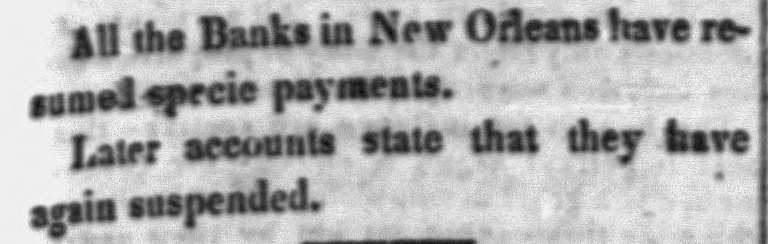
All the Banks in New Orleans have resumed specie payments. Later accounts state that they have again suspended.
Click image to open full size in new tab
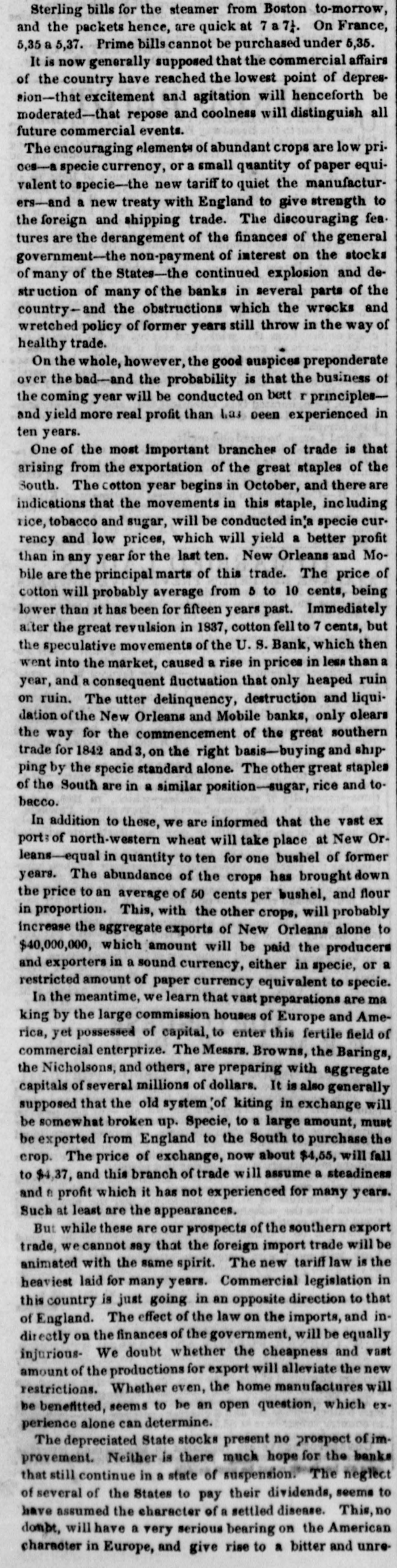
Sterling bills for the steamer from Boston to-morrow, and the packets hence, are quick at 7 a 7¼. On France, 5,35 a 5,37. Prime bills cannot be purchased under 5,35. It is now generally supposed that the commercial affairs of the country have reached the lowest point of depression—that excitement and agitation will henceforth be moderated—that repose and coolness will distinguish all future commercial events. The encouraging elements of abundant crops are low prices—a specie currency, or a small quantity of paper equivalent to specie—the new tariff to quiet the manufacturers and a new treaty with England to give strength to the foreign and shipping trade. The discouraging features are the derangement of the finances of the general government—the non-payment of interest on the stocks of many of the States—the continued explosion and destruction of many of the banks in several parts of the country—and the obstructions which the wrecks and wretched policy of former years still throw in the way of healthy trade. On the whole, however, the good auspices preponderate over the bad—and the probability is that the business of the coming year will be conducted on better principles—and yield more real profit than has been experienced in ten years. One of the most important branches of trade is that arising from the exportation of the great staples of the South. The cotton year begins in October, and there are indications that the movements in this staple, including rice, tobacco and sugar, will be conducted in'a specie currency and low prices, which will yield a better profit than in any year for the last ten. New Orleans and Mobile are the principal marts of this trade. The price of cotton will probably average from 5 to 10 cents, being lower than it has been for fifteen years past. Immediately after the great revulsion in 1837, cotton fell to 7 cents, but the speculative movements of the U. S. Bank, which then went into the market, caused a rise in prices in less than a year, and a consequent fluctuation that only heaped ruin on ruin. The utter delinquency, destruction and liquidation of the New Orleans and Mobile banks, only clears the way for the commencement of the great southern trade for 1842 and 3, on the right basis—buying and shipping by the specie standard alone. The other great staples of the South are in a similar position—sugar, rice and tobacco. In addition to these, we are informed that the vast exports of north-western wheat will take place at New Orleans—equal in quantity to ten for one bushel of former years. The abundance of the crops has brought down the price to an average of 50 cents per bushel, and flour in proportion. This, with the other crops, will probably increase the aggregate exports of New Orleans alone to $40,000,000, which amount will be paid the producers and exporters in a sound currency, either in specie, or a restricted amount of paper currency equivalent to specie. In the meantime, we learn that vast preparations are making by the large commission houses of Europe and America, yet possessed of capital, to enter this fertile field of commercial enterprize. The Messrs. Browns, the Barings, the Nicholsons, and others, are preparing with aggregate capitals of several millions of dollars. It is also generally supposed that the old system of kiting in exchange will be somewhat broken up. Specie, to a large amount, must be exported from England to the South to purchase the crop. The price of exchange, now about $4,55, will fall to $4,37, and this branch of trade will assume a steadiness and a profit which it has not experienced for many years. Such at least are the appearances. But while these are our prospects of the southern export trade, we cannot say that the foreign import trade will be animated with the same spirit. The new tariff law is the heaviest laid for many years. Commercial legislation in this country is just going in an opposite direction to that of England. The effect of the law on the imports, and indirectly on the finances of the government, will be equally injurious. We doubt whether the cheapness and vast amount of the productions for export will alleviate the new restrictions. Whether even, the home manufactures will be benefitted, seems to be an open question, which experience alone can determine. The depreciated State stocks present no prospect of improvement. Neither is there much hope for the banks that still continue in a state of suspension. The neglect of several of the States to pay their dividends, seems to have assumed the character of a settled disease. This, no doubt, will have a very serious bearing on the American character in Europe, and give rise to a bitter and unre-