Gold Exchange Bank (New York, NY)

Episode Information

Episode UID
7571999390837
Episode Type
Suspension β†’ Reopening
Bank Type
state
Bank ID
757199939 hash
Start Date
September 24, 1869
Location
New York, New York (40.714, -74.006)

Metadata

Model
gpt-5-mini (chosen from majority vote of a three-model LLM ensemble)
Short Digest
d06ec9591367e36e

Response Measures

None

Description

Events center on the Gold Exchange Bank's suspension of clearings, receivership, and later resumption; bank appears involved in speculative dealings.

Events (5)

1. September 24, 1869 Suspension
Cause
Bank Specific Adverse Info
Cause Details
Bank unable to settle Friday's balances after the gold speculation; officers declined to receive clearing statements, effectively closing clearings.
Newspaper Excerpt
The Bank will not receive any clearing statements from dealers to-day. The statements received yesterday are nearly all affected by the failures, and it is impossible, as yet, to learn balances.
Source
newspapers
2. September 27, 1869 Other
Newspaper Excerpt
The Gold Room was closed to-day, in consequence of the inability of the Gold Exchange Bank to arrange the transactions of Friday.
Source
newspapers
3. September 29, 1869 Receivership
Newspaper Excerpt
The deliberations of the committee at the Clearing House were interrupted this afternoon by the receipt of a process ordering that the Gold Exchange Bank be placed in the hands of a receiver, and appointing Augustus Hall ... such receiver.
Source
newspapers
4. October 11, 1869 Other
Newspaper Excerpt
Arrangements are stated to have been made, which will result in the formal removal of the Receivership over the Gold Exchange Bank on Tuesday next, and the affairs of the bank will then pass temporarily into the hands of the trustees ...
Source
newspapers
5. November 6, 1869 Reopening
Newspaper Excerpt
The Gold Exchange Bank receiver has been removed and the bank will to-day announce its readiness to resume clearings.
Source
newspapers

Newspaper Articles (24)

Article from The Evansville Journal, November 18, 1868

Click image to open full size in new tab

Article Text

NEW YORK. GO A Great Lawsuit Begun-August Belmont VS. the Erle Railroad Com. pany-What Gen. Grant has Done and will do. NEW YORK, November 19.-Emil Sturmfels, late United States Consul to Maracaibo, died on board the bark Ilvain on her passage here. A new suit against the Directors of the Erie Railroad Company was begun in the Supreme Court Chambers before Judge Suther to day, on application of August Belmont. The complaint is founded on affidavits by Frank Work and others, substantially setting forth that the money of the Erie Company has been used by Gould, Feek and Lane in the furtherance of stock speculations for their priyate interests. The affidavits further set forth that recently Lane was insolvent, and Fisk was an adventurer from New England. It is also alleged in the affidavits that Pike's Opera House had been purchased in the sole name of Fisk with the money o' the Company to the amount of $850,000. Fisk, Gould and Lane are further charged with having issued from $23,000,000 to $30,000,000 of spurious heres, with a view of creating a corner in Wall Street. Affidavits further allege that the above named individuals have denied their Direc tor access to the books, and, in fact, managed the affairs of the Company exclusively for their own interests and in a reckless manner. Judge Sutherland granted an injunction, which direats the officers and agents of the Company to refrain from increasing the capital stock of the Erie the Railroad Company beyond I amount now outstanding and in the hands of bona fide holders, and also orders that the defendants shall rea frain from removing any of the books, papers. securities or funds of the 0 Company from the jurisdiction of the Court; and directs that the funds shall be applied for no purpose but the payment of the legitimate debts and expenses of the company, the balance to be disposed of in such manner as the a court may from time to time direct. r The court also orders that the officers and agents of the company shall refrain from in any order obstructing any of the Directors from examining any of 1 the books of the said company. 8 Another suit has been begun by Chas. 1, McIntosh against the Directors and S August Belmont, in which an injunce tion has been obtained, but whether this is in aid or against the first suit, does not appear. d Gen. Grant, Horace Greeley, John y Russell Young and Gen. Badeau took breakfast at the Delmonico this mornf. ing. is General Grant drove out this afternoon to visit some friends in the city. m The programme of his movements y. for the remainder of the week is as : follows: To-night, dines at the Astor House with Attorney General Evarts: tto morrow, rides out to the Fashion st Course to see Dexter trot; dines with e A. T. Stewart at his house on Friday goes to Washington Saturday. as The latest development in Erie raffairs is to the effect that Jay Gould is was appointed Receiver of the Com epany last Thursday by Judge Barn nard. The report also says about an $7,000,000 in gold were taken out o the Gold Exchange Bank and taken to Jersey City. d A rumor is current of the failure of a large house in breadstuffs, but is not authenticated. ip 8. It is believed that the Government lly sold gold largely to day. The bul ar clique, also, were heavy sellers. nGeneral Grant attends the Maretzek Opera, at the Academy of Music to ranight. Mrs. Stone has issued a cill for Convention of the friends of woman no. suffrage, at Villande, New Jersey, the 2d of December In, nMr. Batassi, the Greek Consul, ha th issued a card asking contributions he money and clothing for the destitut Cretan refugees in Greece.


Article from Nashville Union and American, November 18, 1868

Click image to open full size in new tab

Article Text

3 water-front of 2000 feet the Venango Oil docks, in Weehauken. The transfer was made subject to a mortgage of $250,000 held by the Hoboken Land Improvement Company. The certainty that this locality at no distant day will be the great depet and terminus of the Western and Southern lines induced the Erie company to forestall any competition by securing this valuable water, In accordance with the will of the late Edwin A. Stevens, the Stevens' battery is to be completed at a cost not exceeding $1,000,000. Gen. Geo B. McClellan has been engaged to superintend the work at a salary of $10,000 a year. This engagement was effected in Paris by the late Mr. Stevens shortly before his death, Gen. McClellan and he having been negotiating with several of the European governments for the construction of a battery similar to the one projected by Mr. Stevens. According to the will this battery when completed shall be presented to the State of New Jersey, and in case it is not accepted, it shall be sold and the proceeds added to the estate. Eight buildings in Fulton avenue, Brooklyn, owned by S. J. Herman, were destroyed by tire yesterday. Loss, $22,000, including that of the occupants. NEW YORK, Nov. 16.-Emil Steumfels, late United States Consul to Maricaibo, died on the passage of the Ilvia to this pert. A new suit against the directors of the Erie Railroad Company was begun in the Supreme Court chambers before Judge Southerland to-day, on the application of Aug. Belmont. The complaint is founded on an affidavit by Frank Work and others, substantially setting forth that the money of the Erie Railroad Company has been used by Gould, Fisk and Lane, in furtherance of stock speculations for their private interests. The affidavit further sets forth that Fisk is an adventurer from New England. It is also alleged in the affi lavit, that Pike's Opera House had been purchased in the sole name of Fisk, with the money of the company to the amount of $83,000. Fisk, Gould and Lane are further charged with having issued from $23,000, 000 to $30,000,000 spurious shares, with a view of creating a corner in Wall street. The aflidavit further alleges that the above-named individuals have denied the other directors access to the books, and in fact managed the affairs of the company exclusively for their own interest and in a reckless manner. Judge Southerland granted an injunction, which directs the officers and agents of the company to refrain from increasing the capital stock of the Erie Railroad Company beyond the amount now outstanding and now in the hands of the bona fide holders, and also orders the defendants to refrain from removing any of the books, prpers, securities, or funds of the company from the juriediction of the court, and directs that the funds shall be applied for no purpose but the payment of the legitimate debts and expenses of the company, the balance to be disposed of in such manner as the court may from time to time direct. The court also orders that officers and agents of the company shall refrain from obstructing any of the directors from ex. amining any of the books of said company. Another suit has been begun by Charles McIntosh against the Directors and August Belmont, in which an injunction has been obtained, but whether it is in aid or against the Fisk suit does not appear. Latest developments in Erie affaire, accarding to reports, is that Jay Gould was appointed receiver of the company last Thursday by Judge Barnard. Report also says about $7,000,000 of gold has been taken out of the Gold Ex change Bank, and taken to Jersey City. A rumor is current of the failure of largehouse in breadstuffs, but not authenti cated. It is believed that the Government sold gold largely to-day. Gen. Grant, Horace Gresley, John Rus sell Young and Gen. Badeou, took break fast at Delmonico's this morning Ger Grant drove out this morning to visit som friends in the city


Article from The Daily Phoenix, September 25, 1869

Click image to open full size in new tab

Article Text

NEW YORK, September 24-Noon.Stocks very unsettled. Money not quoted. Sterling-long 41/; short 6. Gold 8976 62's 19. Owing to the excitement in the market, Southern securities are not called. At 12 o'clock gold was 62; fifteen minutes later it fell to 365/, and is now 35. Flour dull and drooping. Corn favors buyers. Pork 31.50. Cotton firm, at 291/4. Freights nominal. P. M.-Cotton opened firmer, but closed heavy with the advance lostsales 1,200 bales, at 29. Flour dull and declining-superfine State 6.00@6.15. Wheat2@3c, lower-winter red Western 1.50@1.53; Illinois 1.45; white Michigan 1.64. Corn closed 1@2c. lower-mixed Western 1.11@1.12. Pork unsettled, at 31.871/2. Lard irregular-kettle 183/4 @ 191/2. Whiskey a shade easier, at 25. Groceries quiet. Freights dull. After a day of unparalleled excitement in Wall street, the market closed comparatively calm. Money was unsettled at the close, but was quoted at 7. Gold closed at 33. The transactions were 80 enormous that the gold Exchange Bank could not settle at the regular hour, which caused great confusion. It is impossible to tell, at the present time, what large firms, if any, have failed. Several small firms are known to have suspended. BALTIMORE, September 24.-Cotton dnll. Flour dull and weak. Wheat dull and unsettled-prime red 1.50@1.55. Corn firm-white 1.28@1.30; yellow 1.20@1.24. Oats 60@66. Pork quiet. Bacon and whiskey in light demand. CINCINNATI, September 24.-Whiskey 1.15-held for higher prices. Pork steady, at 32.00. Lard steady, at 19. Bacon firn-shoulders 16; sides 19(@ 191/4. LOUISVILLE, September 24. --Provisions firm. Mess pork 32.50. Bacon shoulders 161/4; sides 193 with sales of 55,000 pounds. Whiskey unchanged. NEW ORLEANS, September 24.-Sales of cotton to-day 3,000 bales-middlings 261/2. Corn firmer-white 1.05. Oats 56. Mess pork 33.75@34.00. Gold 34. MOBILE, September 24.-Sales of cotton to-day 700 ales-market closed quiet with middling at 26; receipts 1,041. AUGUSTA, September 24.-Cotton market opened firm, at 26, and closed easier, but not quotably lower, with sales of 400 bales; receipts 45. SAVANNAH, September 24.-Receipts of cotton to-day 1,931 bales-market dull, at CHARLESTON, September 21.-Cotton active and steady-market closed firm, with sales of 650 bales; middlings 261/; receipts 962. LONDON, September 24-3 P. M.Consols 925. Bonds 82. LIVERPOOL, September 24-3 P. M.Cotton quiet-uplands 121/4; Orleans 121/2; sales of the week 56,000 bales; export 16,000; speculation 11,000; stock 442,000, whereof American is 69,000. Manchester advices less favorable; stock afloat 430,000, whereof American is 45,000.


Article from New-York Tribune, September 25, 1869

Click image to open full size in new tab

Article Text

bulling the gold, at once changed about and began to bear on the gold and bull on the stocks. A complete revolution took place within 20 minutes. The situation at nightfall was about as follows: Many of the houses alleged to have suspended are. perhaps. only perplexed with the complication of houses with which they have had dealings. If the main movers in the affair, Messrs. Fisk and Gould, come for ward and meet their engagements. and thus aid others everything will move harmoniously in the street to-day. There may be a little excitement in the morning, as the Gold Exchange Bank will be hardly ready to make a statement of the accounts before 1:30. If, however, the alleged managers fail to comply or settle, the scenes that will ensue may perhaps eclipse those of yesterday. The commission brokers of the street are openly delighted at the panic. for they say the thunder and lightning of the past few days will clear the sky, and drive from the street the irresponsible harpies who have formed "corners" and preyed upon the public generally. The moral presented by the sickening spectacle is that it may take merchants and other business men from the street, and they will learn that even sharp players can be beat at a game where loaded dice are used. There was no reason for the rout and tumult of the last few days. The whole story in a nut. shell is: A combination of powerful men boldly struck out for an object which they nearly attained, and everything that stood in the way was compelled to go down before them. Business was made to stand still, the poor to suffer, the nervous to experience alarms, while bulls and bears held high carnival. The following official notice from the United States Treasury will tend to restore harmony and allay the excitement. The country is not quite gone to the dogs. nor can Wall-st. smash the commercial prosperity of this great city. UNITED STATES TREASURY, NEW-YORK Sept. 24, 1869. NOTICE.-The Government reserves the right to accept all bids made its 12 to-morrow. even in excess of $4,000,000 for gold or bonds, in at discretion. By direction of the Honorable the Secretary of the TreasDANIEL BUTTERFIELD, Assistant Treasurer. ury, The following explains itself: To the Editor of The Tribune. SIR: The rules of the Clearing Department of this Bank require the payment of all balances to the Bank before the payment of any balances by the Bank. Owing to the failure of several dealers the adjustment of the accounts has been delayed. The Bank has a large surplus of both gold and currency ou the movements of the day, and will pay out to dealers as fast as the accounts can be settled. H. M. BENEDICT. President. New York Gold Exchange Bank, No. 58 Broadway, and No. 29 New-st., New York, Sept. 24. 1869. AT THE FIFTH AVENUE HOTEL. The Fifth-ave. Hotel last evening wascrowded with nearly as many brokers as Broad and Wall-st. during the day. Homes were deserted, their attractions overcome by a desire to know more of the day's panic. Everybody was in a state of unrest. The natty velvet coats clad nervous bodies, and the wellstarched chokers were pillories for the throats that breathed out denunciation on every one who could have an imaginable agency in the day's doings. To complain a to alleviate, and 80 the excited gold men ruin on Benedict, charged little, was their and said he they was the author of the mischief. Indignantly asked why he put an injunction on the paying out of gold? why he locked up the gold-room and why he didn't do something he didn't do Baring Brothers are charged with acting in behalf of the Government, and the $5,000,000 they ordered Duncan & Sherman to sell is thought to be the gold of the Government. It will all be known to-day at 10 o'clock; but time speeds too slowly. Until then, hope 18 to be strung to its utinost tension. During the night, men paced the walks in groups, wondering whether Gould, Smith, Martin had utterly failed, or whether they would resume to-day-whether other houses would survive their losses. It was a wanton provocation to console any one. Deep solicitude expressed for the ruined only caused deep agony. They hoped for the best: and many of the houses which suspended yesterday said they could go on to-day. Millions were talked of as though they were mills. But the men who intrusted their money to these houses for speculative use were wild, and their friends had well-grounded fears for their sanity. One man in pale unrest cried out he was lost! lost! lost! repeating in a dull, oblivious way his cry at short intervals through the evening. Others showed their frantic suspense by smoking venemently and drinking largely. To these men matters became mazily mixed. It was past midnight when the last group strolled away from the hotel.


Article from The Evansville Journal, September 27, 1869

Click image to open full size in new tab

Article Text

r on Turk word and stock Maratt. sy Telegraph.] NEW YORK, Sept. 25. The Gold Room was crowded early this morning. At ten the Board came to order, when the following note was re3 celved from the President of the Gold Exchange Bank: The Bank will not receive any clearing statements from dealerΓ‘ to-day. The statements received yes terday are nearly all affected by the failures, and it is impossible, as yet, to learn balances. Dealers must be prepared to take up the tickets of those in default, which they have sent in. That is the only mode of adjusting the movement. The Bank will use every exertion to bring accounts to a prompt setilement." The Board then passed resolutions to ad. journ illl Monday, to recognize no transac tions to-day, and appointed a committee of three to wait on the Assistant Treasurer, and request him to postpone the sale of $4,000,000 O1 gold ti . Monday, and the Board then adjourned There have been not ansactions in gold to-day. The As sistant Treasurer declined to accede to the request of the gold committee, but states that no awards for gold will be made until bids are telegraphed to Secretary Boutwell. The purchase of bonds will not exceed the sale of gold. The bank officials are straightening out accounts between the gold brokers and themselves. The clearings yesterday at the Gold Exchange Bank aggregated $500,000,000. Wm. Health & Co. nave not failed, and are pursuing business as usual. Iti stated that Smith, Gould, Martin & Co. will settle their accounts and have a balance of seyeral millions. 2:20 P. -Money almost impos-ible to get at any price; quoted at per cent.: 1@ 11/3 per cent is freely paid for tu ning stocks. The Tenth Nalio al Bank is in trouble. There has been a run on it all morning, and i is reported that is will havetosu pend unless other banks assist it. The day cios a quietly in Wall and Broad Streets, and everything now wears a calmer aspect. The run upon the Tenth National Bank ended about 3:15 P.M., the Ba K having met all demands upon it. It is pre unded the Bask, on Monday, wil cease to decline the acceptance of its checks The a ility of the Bank to satisfy all claims has materially checked the growing panic, and there is a marked recovery of confidence in the several departments of business. It now only remains to be seen what Mo day may bring forth from the disclosure or closely kept secrets of the Gold Exchange Bank. The Tenth e National held in deposits, this morning, 12 $1,100,000, and paid out, during the day, M about $1,000,000. Mr. Colender, the Bank V Examiner, inspected the condition of the o Bank to-day, and pronounced it satis ac89 P tory. Many banks were, this evening, throw14 ing out checks OL the Gold Exchange Bank, and some banks were served with G. injunctions and legal notifications against paying checks paid into the Gold Exchange Bank yesterday. These checks, however, were certified and came regularly through the Custom House this forenoon, and, of cou S , had to be recogrized. The bid to the Assistant Treasurer for gold to-day amou ted to $9,887,500, P ranging from 125 to 1341/2 The Secretary of the Treasury has inO1 structed Gen. Butterfield, by telegraph, to limit the purchase of gold o-day to and $2,000,- to unless bids should be over 134, reject 000, all bids under 132. The total amount bills soid is $2,000,000, at The tcfor Governments to the Sub Treasury at day amounted to 87,461,000. at 116 17:100@ ter 1213/4. Amount of awardsmade, $3 000,000, at eas 116 17-100@118 8-1000. Cable dispatches been refor that large amounts of gold have his port from the Banks of Enzland for Se wb opinion on those of fess The beyond and withdrawn general France, Albert&3373: shipment the to street and New is W. York. that H. S Belden, the feilures will be confined prin-


Article from Gold Hill Daily News, September 28, 1869

Click image to open full size in new tab

Article Text

Overland Dispatches [SPECIAL TO THE GOLD HILL DAILY NEWS BY THE WESTERN UNION TELEGRAPH LINE.] Earthquakes in the West Indica. HAVANA, September 27.-St. Thomas advices are to the 18th. Three shocks of an earthquake occurred. Seventeen stores had closed, and business suspended. No lives are known to have been lost. A general alarm prevailed. St. Domingo advices are to the 9th. Baez had defeated the rebels besieging Agua. From New Orleans. NEW ORLEANS, September 27.-The steamship Trade Wind was lost in the gale on the 24th. The passengers were saved, but part of the crew is missing. From New York. NEW YORK, September 27.-Several injunctions have been issued against the Gold Exchange Bank to-dav. Judge Clark also issued several against Wall street brokers. An order of arrest was issued against James Belden, on the suit of L. Hatch, for secreting property to defraud his creditors. Affairs on Wall street are still kept greatly in confusion by the block in business at the Gold Exchange Bank, which temporarily keeps the gold dealers out of large amounts of money, besides leaving it in doubt as to the standing of numerous firms and banks, who have not yet finished Thursday's business. Prince Arthur at Buffalo. BUFFALO, September 27.-Prince Arthur and the Governor General of Canada, visited Buffalo to-day, and drove about the city. They lunched with ex-President Fillmore.


Article from The Daily Dispatch, September 28, 1869

Click image to open full size in new tab

Article Text

WALL STREET ON Faturday.-Wall street is now occupied with the after-results of the great gold speculation. In gold itself there is an absolute subversion of business beyond a few petty transactions over the counter, which have been done between 132 and 136. The blockade at the Gold Exchange Bank still continues. The precise position of that institution we can state only on outside information, as the officers very brusquely decline to have any communication with reprΓ©sentatives of the press. This morning rumors were rife of the institution being in trouble; which may or may not be true, SO far as respects any information we have been able to get at the bank. The bank was debtor to the very large amount of $1,886,000 at the clearing house this morning; but this balance, as we learn from clearing-house banks, has been settled, or will be during the day. Owing to the inability of the bank to complete the clearings on yesterday's business the president declines to receive any clearing statements from dealers to-day. In consequence of this action of the bank the gold room found it necessary to formally adjourn until Monday. How far dealers may be involved by the failures of yesterday it is impossible to ascertain until the bank has completed its clearances; but the extent to which this has been done, as also the extent of failures reported at the bank, we are again unable to learn, owing to the reticence of the officers. The general opinion on the street is that, beyon those of Albert Speyer and W. H. Belden, the failures will be confined principally to small firms, whose engagements are not large enough to cause any serious trouble. The position of the leading "bull" operators is not regarded with much doubt. It is reported, apparently on good authority, that they effected settlements before noon yesterday upon $20,000,000 of gold at 148 to 150; the profit on which should go far toward offsetting any losses they may have made on purchases or failures; but even their fate must remain doubtful until the Gold Exchange Bank has effected its clearings. William Heath & Co., whose temporary suspension was announced yesterday, are conducting their stock business as usual, making settlements on all Stock Exchange accounts; and, though ignorant of the extent to which they may be affected by failures in the gold room, express confidence of their ability to honor all contracts when affairs are straightened at the Gold Exchange Bank. In the mean time they remain in suspension on their gold contracts. The Tenth National Bank, which has been extensively used in the gold speculation, and respecting which unfavorable rumors were in circulation last evening, was debtor at the clearing house this morning $723,000, but the balance, we learn, has been settled. New York Commercial.


Article from New-York Tribune, September 28, 1869

Click image to open full size in new tab

Article Text

MONDAY. Sept. 27-P. M. The Gold Room was closed to-day, in consequence of the inability of the Gold Exchange Bank to arrange the transactions of Friday. The Bank have 80 far arranged their affairs as to be able to pay out the differences due on Thursday's business, but are in a hopeless muddle; and it was proposed this afternoon that the brokers should use the Bank of New-York as & clearing-house until its affairs were arranged. Gold sold over the counter at 132@131, closing 1811@131}. The brokers in the Gold Room are as yet unable to tell where they stand. No new failures have been reported, and the solvency of a large number of firms depends upon the arrangement of the business of Friday. The whole busi= ness of the Stock Exchange is deranged in consequence of the failure of the Bank to make its clearings, and until its affairs are made public the Stock Exchange must remain in a chaotic state. At 6:30 p. m. we are informed that the Gold Exchange Bank will be able to meet all their liabilities. This announcement gave a more confident feeling in financial circles. Government bonds were strong at the First Board, but declined from 1 to 1 per cent. At the last call, in conse. quence of the active demand for money, the business was confined to cash transactions, and the large dealera were purchasers at the decline. State and Railway bonds shared the general distrust. and made a decline on small transactions. Miscellaneous shares and Express stocks were neglected. Pacific Mail opened at 71, sold at 65. closing 67 bid. Railway shares opened dull and under a pressure of cash sales made a sharp decline in prices. New-York Central sold at 184, 1741, closing at 1801; Hudson, 162), 155, closing 158; Reading, 94@918; Michigan Southern, Illinois Central, 135; Cleveland and Pittsburgh, 100@88;A Erie, 35@291; North-Western Common, 72@681; North. Western Preferred, 83@30; Rock Island, 1071@102}; St. Paul Common, 70@68; St. Paul Preferred, 81 @ 75; Fort Wayne, 8#1883. The lowest prices of the day were made at 2 o'clock upon a report that a leading stock house had suspended. The rumor was false, and upon its contradiction there was an upward turn in prices. At the close the market was feverish and unsettled. The following were the closing quotations of Govern. ment bonds:


Article from The Wheeling Daily Intelligencer, September 29, 1869

Click image to open full size in new tab

Article Text

MONDAY IN NEW YORK. General Confusion and Alarm-Great Stetugency in Money. NEW YORK, Sept. 27. To sum up everything, nothing has been done in the gold business in Wall to-day. It is certain that promi. nent firms are involved, and that crash will soon follow, which will be felt by the whole country. The Gold Exchange Bank has not yet settled Friday's balances, nor will It do 80 until It is forced to It. The brokers are fearfully indignant, and threaten to mob the place to morrow. The President of the bank Is a partner In the firm of Lockwood & Co., which is reported dead broke. There are good grounds for believing that the bank is interested in the operations of the clique, and that Friday's settlement has been postponed, so that the balances belonging to the sound firms may be used In bolstering up the broken parties, who are making an onset on the stock market, and creating panic; therefore, the purpose of cover. ing themselves. Lockwood & Co., to day, sold twenty thousand shares of Pacific Mail, cash delivery; for what they would fetch. This shows the desperate straits to which they have been reduced. The failure of Zeroga & Graves, Charles W. Keep & Co., and James Brown & Co., reported on the Gold Ex. change, to-day, will inevitably insure the failure of from ninety to one hundred smaller firms. This I have from the lips of two prominent officers of the Gold Exchange. It is now reported that William Belden has disappeared with over ten millions in gold. James Fisk, Jr., and Gould keep out of sight: Their lives would not be worth a rash If they would appear In Wall street. Some of the clique assert that Fisk is totally ruined, unless be repudiates all his verbal and written contracts. They also aver that Jay Gould has made millions of dollars by the transactions, as he played sharp on his comrades, and secretly sold out at 145, while Fisk was buying in. Everybody seems panic-stricken, and the approach of the morrow is dreaded. council of the clique was held, last Thursday evening, at which Fisk, Gould, Woodward and others were present. Mr. Woodward, an old, and of late successful manipulator. counselled a equeeze of the short Interest at the then price, 145, or thereabouts, he claiming that it would ruin the street to put it up higher. Mr. Fisk, however, was clamorous, and insisted upon putting it up to 160, on the ground that some one had 'gone back' upon the clique. The adoption of the course suggested by him has accomplished just what Mr. Woodward predicted, and when Friday's transactions come to be adjusted the result will be that one-half of the dealers in the Gold Room will not know where they stand, and probably will go under. The confusion in the money market continued during the morning, a general distrust prevailing in financial circles, and rates have been Irregular and unsettled. The stringency has been aggravated by the large balances, estimated at $12,000,000 to $14,000,000, locked up at the Gold Exchange Bank, and hence the street rates have ranged from 7 per cent. in gold to 1/21/1 per cent. per diem on the below par stocks, and as high as and 21/2 per cent on above par stocks, the latter being the rate on New York Central. Much caution has been observed dur ing the day by lenders, and at the close some balances were left with Government houses at the legal rate. The rate on stocks. however, was unchanged. In discounts, business is at an entire stand-still. Under the extreme strin. gency in money, and the want of confidence in business circles, as, also, general distrust existing pending the settlements at the Gold Exchange Bank, the railway share market has been heavy and lower, with a pressure to sell the more active shares. This pressure was further due to the report ed failure of a prominent house, which added to the existing confusion. In the afternoon, upon the denial of this report, and the easing up in money, more confidence was restored, and an advance was noted in the entire list; but at the close there was another reac. tion, and the market left off weak and unsettled. Harlem felt the pressure the worst of all, and declined sixteen per cent.


Article from The Evening Telegraph, September 29, 1869

Click image to open full size in new tab

Article Text

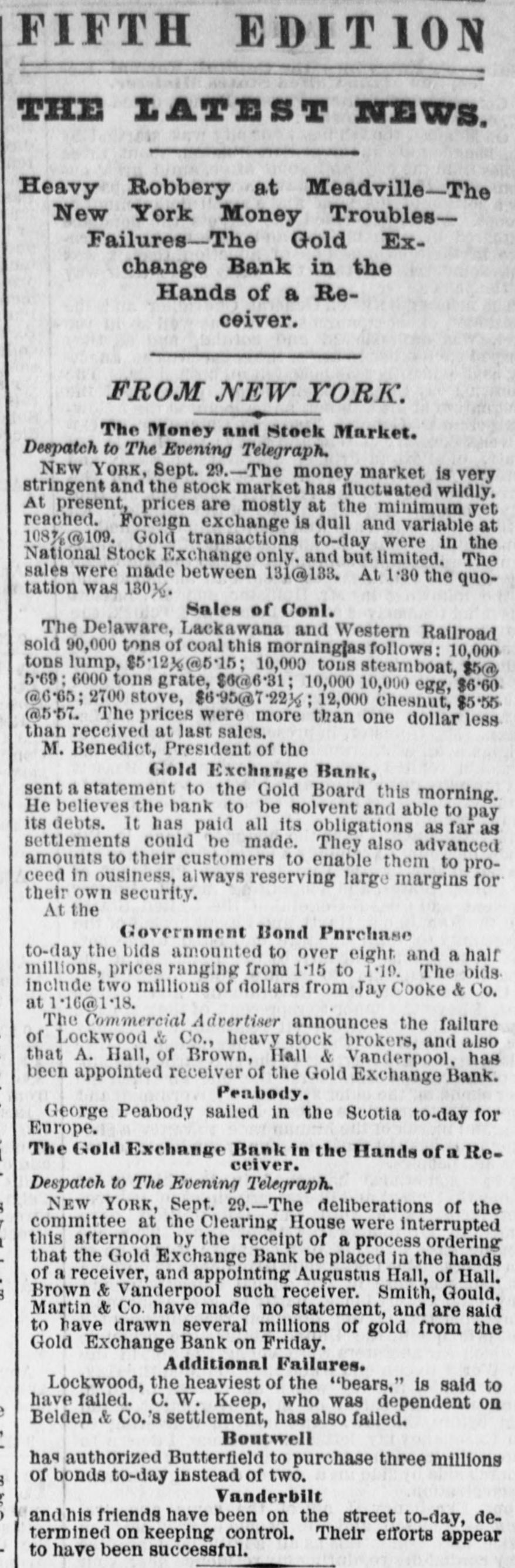
FIFTH EDITION THE LATEST NEWS. Heavy Robbery at Meadville-The New York Money TroublesFailures-The Gold Exchange Bank in the Hands of a Receiver. FROM NEW YORK. The Money and Stock Market. Despatch to The Evening Telegraph. NEW YORK, Sept. 29.-The money market is very stringent and the stock market has fluctuated wildly. At present, prices are mostly at the minimum yet reached. Foreign exchange is dull and variable at 108%@109. Gold transactions to-day were in the National Stock Exchange only. and but limited. The sales were made between 131@133. At 1:30 the quotation was 1301/2. Sales of Conl. The Delaware, Lackawana and Western Railroad sold 90,000 tons of coal this morninglas follows: 10,000 tons lump, $5.12%(55'15; 10,000 tons steamboat, $5@ 5.69: 6000 tons grate, $6@6.31; 10,000 10,000 egg, $6.60 @6.65; 2700 stove, $6'95@7.22% 12,000 chesnut, $5.55 @5-57. The prices were more than one dollar less than received at last sales. M. Benedict, President of the Gold Exchange Bank, sent a statement to the Gold Board this morning. He believes the bank to be solvent and able to pay its debts. It has paid all its obligations as far as settlements could be made. They also advanced amounts to their customers to enable them to proceed in ousiness, always reserving large margins for their own security. At the Government Bond Purchase to-day the bids amounted to over eight and a half millions, prices ranging from 1.15 to 1.19. The bids. include two millions of dollars from Jay Cooke & Co. at 1*16@1*18. The Commercial Advertiser announces the failure of Lockwood & Co., heavy stock brokers, and also that A. Hall, of Brown, Hall & Vanderpool, has been appointed receiver of the Gold Exchange Bank. Peabody. George Peabody sailed in the Scotia to-day for Europe. The Gold Exchange Bank in the Hands of a Receiver. Despatch to The Evening Telegraph. NEW YORK, Sept. 29.-The deliberations of the committee at the Clearing House were interrupted this afternoon by the receipt of a process ordering that the Gold Exchange Bank be placed in the hands of a receiver, and appointing Augustus Hall, of Hall. Brown & Vanderpool such receiver. Smith, Gould, Martin & Co. have made no statement, and are said to have drawn several millions of gold from the Gold Exchange Bank on Friday. Additional Failures. Lockwood, the heaviest of the "bears," is said to have failed. C. W. Keep, who was dependent on Belden & Co.'s settlement, has also failed. Boutwell has authorized Butterfield to purchase three millions of bonds to-day instead of two. Vanderbilt and his friends have been on the street to-day, determined on keeping control. Their efforts appear to have been successful.


Article from The Wheeling Daily Intelligencer, September 30, 1869

Click image to open full size in new tab

Article Text

TUESDAY IN NEW YORK. The Gloomy Outlook-Apprehensions of a General Crash. NEW YORK, Sept. 28. Everything portends to a grand crash, and one worse than that of 1837. The excitement in the street to-day has been as intense as at any time recorded during the last week. The money market has been in a state of confusion and distrust, and the rates have been flat to one-fourth of one per cent. on gold, seven gold to one-fourth of one per cent. additional on Government bonds, and as high as two per cent. on railway shares, and 80 must distrust and lack of confidence existed that money could scarcely be obtained at any rates. A number of city banks held over until 6 o'clock, for the purpose of certifying checks for the accommodation of parties who had failed to make good their accounts. There has been no regular price for gold to-day, but over the counters of the principal dealers it has ranged from 131 to 132, on small sums. Prominent men on the street assert that the banks will suspend to-morrow. The banks are close-reefed, and have looked up all their currency. The statement telegraphed yesterday concerning the operations of the Exchange Bank with outside parties,seems to be verified to-day. The New York Bank found itself unable to settle up Friday's business, and the Gold Exchange Bank refused to do so. It is believed that the Bank, which does business on a capital of $500,000, Is in. solvent. On this capital they did a daily business of $350,000,000. A $10,000,000 smash is expected to-morrow. A committee of the Gold Board is in night session at Jay Cooke's banking house, endeavoring to straighten out Friday's business. The statements of two hundred dealers are missing. The fact of the matter is, that nearly the whole Gold Board are ruined, and the Board is endeavoring to conceal the fact from the pnblic. Fsk and Gould are still missing. It is now known that Vanderbilt has gone back on his friends, and that he is reaping a harvest in the fearful decline in stocks.to-day. The evening Stock Exchange, at the Fifth Avenue Hotel, this evening, was than the of city more speculators crowded being ever, largely throng swelled by arrivals of operators from the rural districts, who have hurried down to the city to look after their imperilled margins. The corner in gold has ceased to be much talked about. The great fall on stocks 10-day, especially in those controlled by Vanderbilt, and the greater fall anticipated for to-morrow, absorb all minds. The despondent predict a universal crash, extending through all departments of trade and finance; but the opinion of the majority, is that the revulsion will be confined to the speculators on gold and faney stocks. The operations to-night, were of small magnitude. Bulls and bears both seemed Inclined to waitfor the morrow.


Article from The Wheeling Daily Register, September 30, 1869

Click image to open full size in new tab

Article Text

TRADE FINANCE AND New York Money Market YORK, September NEW in the Gold Room The stormy debates remarkable depression and and the buoyancy failures alternate and of the receiverships Stock events Exchange, and which instock group of the junctions, make the day form without a At an the equal early in session annals of of the Wall Gold street. Board the following was presented: OF THE NEW YORK GOLD STATEMENT EXCHANGE BANK. To the Committee of the Gold Exchange Board officer : of the Board went of into the Friday, God An Room on and the morning suggested clear to a few the the 24th would inst., be impossible to account of that it of that day on consideraan transactions attempted decided corner, it but was on the duty even at of tion it was make the attempt, the some the Board sacrifice. to The bank in the assumed usual manclearings received movement in payment gold of and balances cura ner very and large amount necessary of to restore to the a rency. It was these amounts large portion or wide-spread of disaster the would bank dealers followed. To do from this the rule of have forced to balances depart before paying a receiving was all went on paying dealers on their any, and the balance margin portion of reserving a safe to the statements, where practicable, make good and any trusting over payment was the dealers to settlement. This Saturday. ou the final on Friday and appointcourse pursued a committee was of the dealers Oa Saturday informal meeting directors, who ed to an with the extendto confer an investigation Sunday, went into Saturday and through nine on the from the the only rejected ing plan to declare good, clearing and dealers basis assume the rest they as deemed practicable. dealsettlements acted on this in paying of bank The emergency house on the clearing ers of The Monday with was the of settlement the banks on Monday and to the Tuesday committee by, a sufficient clearing due by the the balance its control, passed to the secure transferring house at amount House bank. after The bank has now the Clearing its settlement with from the amount of liquiBank, not and far surplus with which soon to as it capital dealers statements is as due from the be ascertained from the date can banks to the dealers what It and is the expectation dealand ers to the banks. results can be approximated now bank that these from all the evidence to be accessible, to-day, and we able believe to pay the all debts. except No solvent exist at present, The dealers' It on our failed or not its obligations as complications has statements. suspended. stated. clear- bank has It paid Monday's all obligations at the on Tueshas in gold, at par, and in securities day ing house $1,000,000 in gold and say $1,300,000 (Signed) H. W. BENEDECT, Pres't September committee 28, 1969. of twenty appointed steadily The Gold Exchange worked four by the statements of dealers since at one on the yesterday afternoon remained and to P. M. those of Smith. o'clock only two Statements Gould & Knickerbocker & Martin as far as ascertained net are short with be received, result and the Co. is Gold that The House Exchange of gold, the dealers Clearing which about Smith, one & no doubt in Gould at million 135. dollars There Martin succeed appears are offering effecting to sell them the the the committe will Friday's business, on the basis deupon clearings being made on The differsettlement termined 135 yesterday. and the actual between price ence between to be adjusted The com will remain themselves at 345. to the Gold dealers twenty reported that they mittee Room of in executive making session up of a state- & referred the Smith, Gould to requested Mar. had ment in from to , competent tickets be released of accountants from further and was duty. Their port was accepted. It of the transactions then agreed tha. Friday be settled. board adThe clearing house and has journed till 10-morrow. President of the Gold Room with an of Smith, Gould, been The the served application injunction granted as Martin on & Co., restraining him from selh ling gold on their account, according to f 1 rule. The following resolution was passed n by the New York Stock Exchange:


Article from New-York Tribune, October 4, 1869

Click image to open full size in new tab

Article Text

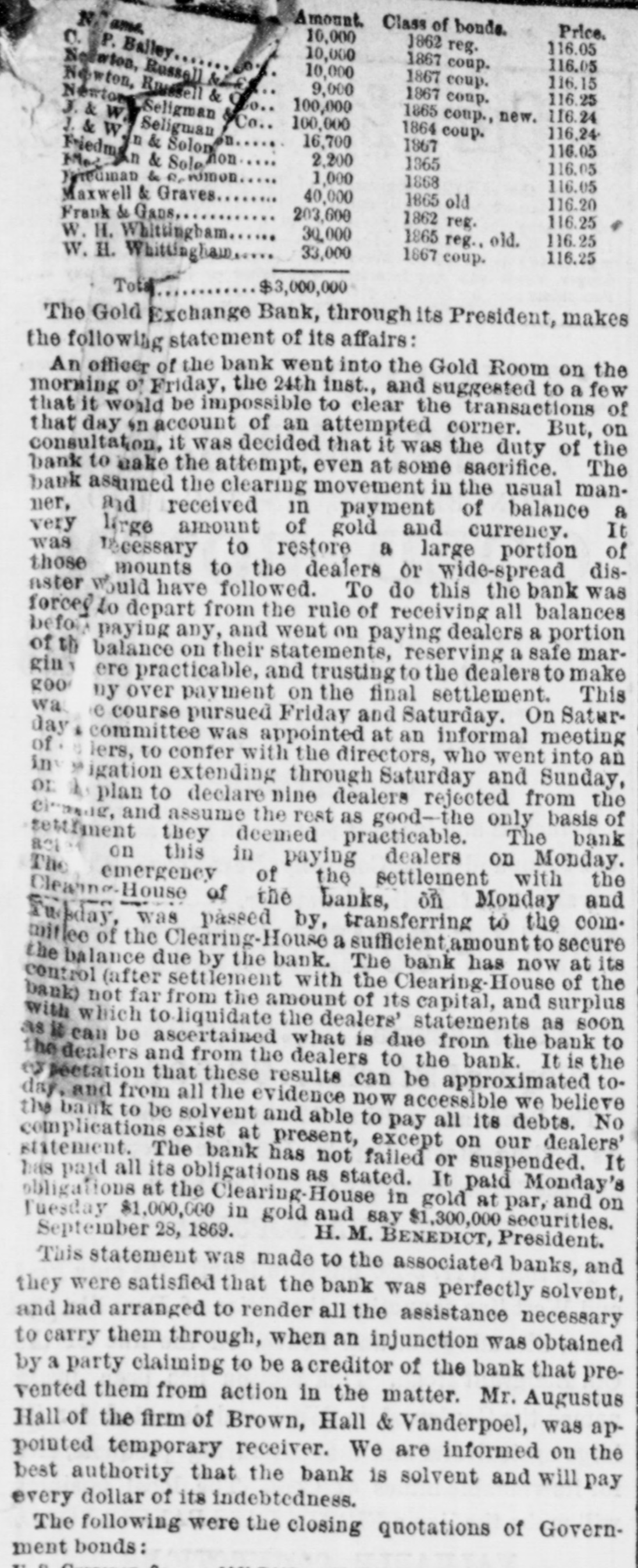
SATURDAY. Oct. 2--P. M. Gold opened at 1301, sold at 130g, 1291, closing 1201@1293. The transactions have been moderate, and the market "evoid of speculative interest. The settlement of the disputed gold accounts made some progress to-day, and It is anticipated that the Gold Exchange Bank will be in a condition to disburse the balances due brokers by Mon day or Tuesday. Should this hope prove true, the Gold Room will be reepened next week. Government bonds were firm under a moderate investment demand. State bonds were?generally higher. Tenthessee 6 per cent sold at 61; New bonds, 521@52}; Virginia New 6 per cent, 511@521; North Carolina 6 per cent, 50; New Special Tax bonds, 48@47; Missouri 6 per cent, 86; Louisiana 6 per cent, 681@70. Railway bonds were steady on moderate transactions. Miscellaneous shares were unsettled, with small transactions. Pacific Mail bold at 611@62); Express shares were dull and steady; Adams sold at 52; Wells Fargo, 17@17g: American, 801@ 31; United States, 511@52. Railway shares opened strong in sympathy with the advance in the Vanderbilt stocks, which were strongly supported and made a sharp advance on New-York Central, which sold at 172@178 Hudson sold at 166; Harlem. 133; Erie was steady at 84@333; Reading sold at 931; Michigan Central, 120 121; Fort Wayne. Chicago, Burlington, and Quincy, 165; NewJersey Central, 100; Hannibal and St. Joseph, 110; NewYork and New-Haven, 130. The North-Western and St. Paul shares were moderately dealt in but were without special interest. Rock Island sold largely at 1071@107 at the board, but was weaker at the close, selling at 106. The transactions in Michigan Southern have been large to the exclusion of the balance of the list. It is stated that a meeting of the directors will be held in this city on Monday to appoint a Treasurer in place of Mr. Legrand Lockwood, who has tendered his resignation; and also that a statement of the affairs of the Company will be made at the same time, showing to what extent the road will be a loser by the suspension of Lockwood & Co. No new facts have transpired in relation to the matter, and the public will receive the information when procured in an official shape. The failure of Messrs. Adams, Kimball & Moore was offieially announeed, as well asthat of Messrs. Puleston, Raymond & Co., who were forced to this step in consequence of a defalcation of a clerk for a large amount. These failures had an unsettling effect upon the market, and caused a depression of 1 @ 2 per cent in prices. The announcement of the Bank Statement gave a buoyant tone to the market. New York Central advanced to 180, and the Western list was from 1 to 1 per cent higher. At the close the market was steady. The following were the closing quotations of Government bonds:


Article from The New York Herald, October 8, 1869

Click image to open full size in new tab

Article Text

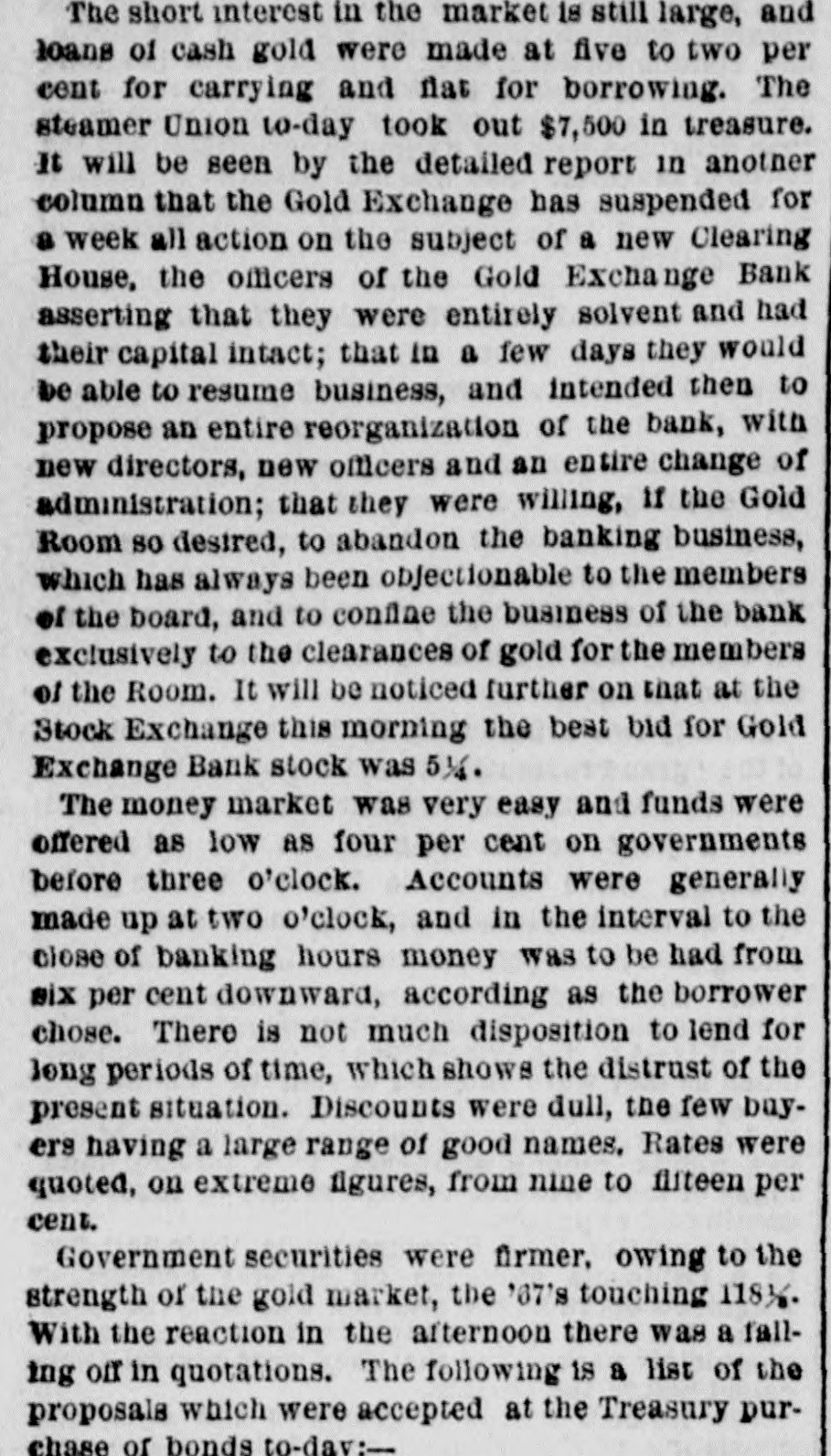
The short interest in the market is still large, and loans of cash gold were made at five to two per cent for carrying and flat for borrowing. The steamer Union to-day took out $7,500 in treasure. It will be seen by the detailed report in another column that the Gold Exchange has suspended for a week all action on the subject of a new Clearing House, the officers of the Gold Exchange Bank asserting that they were entirely solvent and had their capital intact; that in a few days they would be able to resume business, and intended then to propose an entire reorganization of the bank, with new directors, new officers and an entire change of administration; that they were willing, If the Gold Room so desired, to abandon the banking business, which has always been objectionable to the members of the board, and to confine the business of the bank exclusively to the clearances of gold for the members of the Room. It will be noticed further on that at the Stock Exchange this morning the best bid for Gold Exchange Bank stock was 514. The money market was very easy and funds were offered as low as four per cent on governments before three o'clock. Accounts were generally made up at two o'clock, and in the interval to the close of banking hours money was to be had from six per cent downward, according as the borrower chose. There is not much disposition to lend for long periods of time, which shows the distrust of the present situation. Discounts were dull, the few bayers having a large range of good names. Rates were quoted, on extreme figures, from nine to fifteen per cent. Government securities were firmer, owing to the strength of the gold market, the '07's touching 118% With the reaction in the afternoon there was a falling off in quotations. The following is a list of the proposals which were accepted at the Treasury purchase of bonds to-day:-


Article from The Evansville Journal, October 11, 1869

Click image to open full size in new tab

Article Text

New York Items. NEW YORK, October 9. / Arrangements are stated to have been made, which will result in the formal removal of the Receivership over the Gold Exchange Bank on Tuesday next, and the affairs of the bank will then pass temporarily into the hands of the trustees, under the direction of C. N. Jordan, cashier of the Third National back. Their chief business will be to settle the business of Friday the 24th ultimo, which, when completed, the Bank will resume business as usual.


Article from The New York Herald, October 13, 1869

Click image to open full size in new tab

Article Text

NEW YORK CITY. THE COURTS. UNITED STATES DISTRICT COURT-IN BANKRUPTCY. The New York Gold Exchange Diffenlty-The Petition Filed in Bankruptcy Against the Bank Dismissed. Before Judge Blatchford. Ernest Otten and Edward G. Taege, Petitioning Creditors vs. the New York Gold Exchange Bank, Defendants.-An - order has been signed by Judge Blatchford in the above entitled case, dismissing the petition of Edward G. Taege and Ernest Otten who Bought to place the affairs of the Gold Exchange Bank in bankruptcy. The order states that the petitioners, Otten and Taege, failed to sustain their allegations. which were that the Gold Exchange Bank. while insolvent, or contemplating bankruptcy or inscivency, had, during the recent panic in Wall street, made preference payments or transfers of money, in some instances of $1,000,000 or upwards, to certain creditors in fraud of other persons. Failure in the Far Trade. Before a Register in Bankruptcy. In the Matter of David J. & W. King. 1 This was the meeting for the choice of assignees and the proof of debts under this estate. The petitioners had carried on business as retail dealers in furs in Broadway; their Habitities are stated at $70,000, and assets about $20,050. Various creditors had placed attachments upon property in their store, and they filed their petition in bankruptcy to save the stock for division among their creditors. Edwin James, who, with Mr. J. Fletcher, appeared as council for the bankrupts, presented a written request on behalf of the creditors asking for an adjournment in order to effect a compromise which IS now in progress. Mr. McMahon, council for the creditors, consented, and the Register adjourned the meeting till Saturday next, at twelve o'clock.


Article from The Carson Daily Appeal, October 20, 1869

Click image to open full size in new tab

Article Text

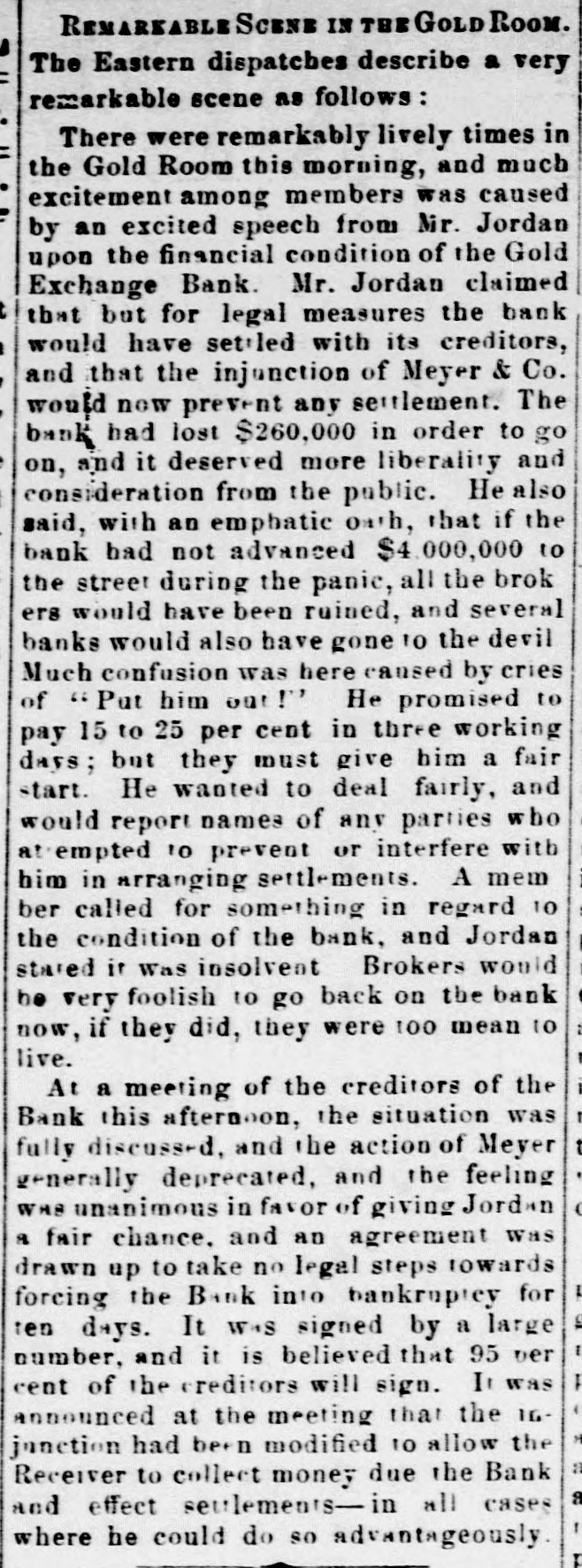
# REMARKABLE SCENE IN THE GOLD ROOM. The Eastern dispatches describe a very remarkable scene as follows: There were remarkably lively times in the Gold Room this morning, and much excitement among members was caused by an excited speech from Mr. Jordan upon the financial condition of the Gold Exchange Bank. Mr. Jordan claimed that but for legal measures the bank would have settled with its creditors, and that the injunction of Meyer & Co. would now prevent any settlement. The bank had lost $260,000 in order to go on, and it deserved more liberality and consideration from the public. He also said, with an emphatic oath, that if the bank had not advanced $4.000,000 to the street during the panic, all the brokers would have been ruined, and several banks would also have gone to the devil Much confusion was here caused by cries of "Put him out!" He promised to pay 15 to 25 per cent in three working days; but they must give him a fair start. He wanted to deal fairly, and would report names of any parties who attempted to prevent or interfere with him in arranging settlements. A member called for something in regard to the condition of the bank, and Jordan stated it was insolvent Brokers would be very foolish to go back on the bank now, if they did, they were too mean to live. At a meeting of the creditors of the Bank this afternoon, the situation was fully discussed, and the action of Meyer generally deprecated, and the feeling was unanimous in favor of giving Jordan a fair chance, and an agreement was drawn up to take no legal steps towards forcing the Bank into bankruptcy for ten days. It was signed by a large number, and it is believed that 95 per cent of the creditors will sign. It was announced at the meeting that the injunction had been modified to allow the Receiver to collect money due the Bank and effect settlements in all cases where he could do so advantageously.


Article from Memphis Daily Appeal, October 21, 1869

Click image to open full size in new tab

Article Text

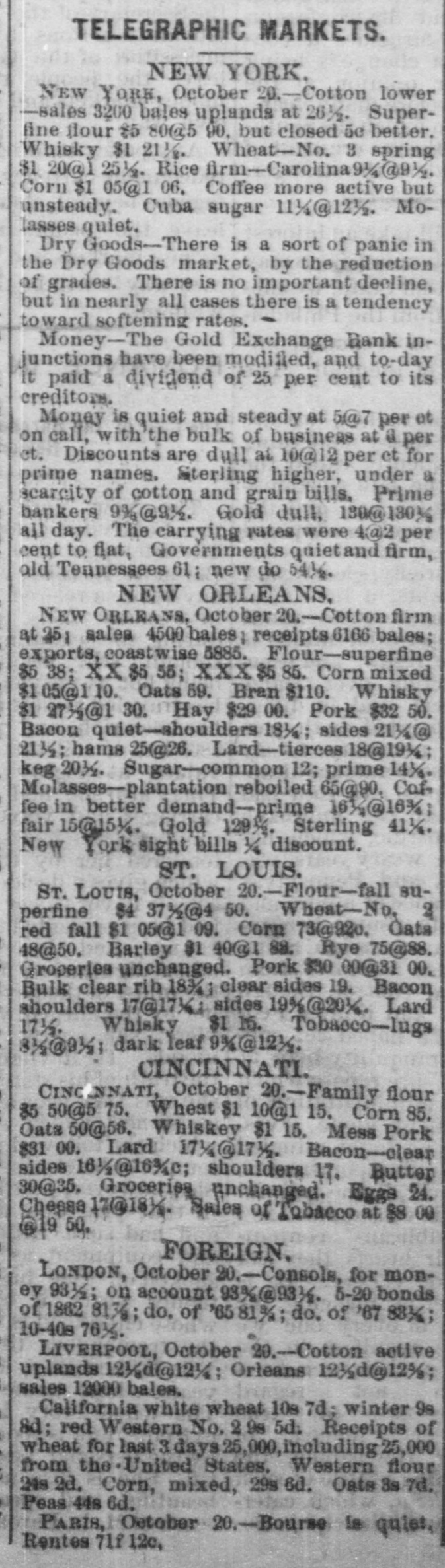
TELEGRAPHIC MARKETS. NEW YORK. NEW YORK, October 20.-Cotton lower sales 3200 bales uplands at 261/2. Superfine flour $5 80@5 90, but closed e better. Whisky $1.211/6 Wheat-No. 3 spring $1 20@1 251/2. Rice firm-Carolina914@912 Corn $1 05@1 06. Coffee more active but unsteady. Cuba sugar Molasses quiet. Dry Goods-There is a sort of panic in the Dry Goods market, by the reduction of grades. There is no important decline, but in nearly all cases there is a tendency toward softening rates. e Money-The Gold Exchange Bank injunctions have been modified, and to-day it paid a dividend of 25 per cent to its creditors. Money is quiet and steady at 5@7 per at on call, with the bulk of business at a per et. Discounts are dull at 10@12 per et for prime names. Sterling higher, under a scarcity of cotton and grain bills. Prime bankers 9%@91/2. Gold dull, 130@130% all day. The carrying rates were 4@2 per cent to flat, Governments quiet and firm, old Tennessees 61; new do 54% NEW ORLEANS, NEW ORLEANS. October 0.-Cotton firm at 35, sales 4500 bales, receipts 610 bales; exports, coastwise 5885. Flour-superfine $5.38; XXI XXX$5885 Corn mixed $1 05@1 10. Oats 59. Bran $110. Whisky $1 2734@1 30 Hay $29.00. Pork $32.50. Bacon quiet-shoulders 181/; sides 2114@ 2134; hams 25@26. Lard-tierces 18@191/4; keg 203/4. Sugar-common 12; prime 141. Molasses-plantation reboiled 65@90. Caf fee in better demand-prime fair 15@151/4. Gold 129% Sterling 411/4. New York sight bills 1/4 discount. ST. LOUIS. ST. Louis, October 20.-Flour-fall superfine 3 77/2@4 50. Wheat-No. 2 red fall 81 05@1 09. Corn 73@92o. Oats 48@50. Barley 81 40@1 88. Rye 75@88. Groperies unchanged. Pork $30.00@31 00. Bulk clear rib 1834 clear sides 19. Bacon shoulders 17@1716.1 sides 19%(20% Lard 171/5. Whisky $1.16. Tobacco-lugs dark leaf 9%@121/2. CINCINNATI. CINC NNATI, October 20.-Family flour 35 50@5 75. Wheat $1 10@1 15. Corn 85. Oata 50@56. Whiskey $1 15. Mess Pork $31.00. Lard Bacon-olear sides 161/41%%e; shoulders 17. Butter 30@35. Groceries unchanged. Eggs 24. Cheesa 17@18 Sales of Tobacco at $8.00 @19 50. FOREIGN. LONDON, October 20.-Consols, for money 933/2; on account 93%@93}6. 5-20 bonds of 1862 813 do. of '65 81 % ; do. of '67 88% : 10-40s 763 LIVERPOOL, October 20.-Cotton active uplands Orleans 123/d@12%; sales 12000 bales. California white wheat 10s 7d; winter 9s 8d; red Western No. 9s 5d. Receipts of wheat for last 3. days 25,000, including 25,000 from the-United States. Western flour 24s 2d. Corn, mixed, 29s 6d. Oats 3s 7d. Peas 44s 6d. PARIS, October 20.-Bourse is quiet, Rentes 71f 12c,


Article from The Evansville Journal, October 26, 1869

Click image to open full size in new tab

Article Text

Man taken out of East River He had been Robbed of a Sum of Money and Nearly Murdered. or BLITDER Pere Hyacintho to Visit Boston. NEW YORK -PVT The Affairs of the Lake Shore Company Discussed in Stock CirclesNominal Capital of the New combination to be Fixed at $50,000Gold Exchange Bank Affairs. NEW York, Oct: 25.-The affairs of the Lake Shore Company, so far as they have leaked out, were the subject of much discussion in stock circles to-day. It is announced on the authority of one of the Directors that the nominal capital of the new combination has been fixed at $50,000. This had a depressing influence on speculation in the shares. The combined capital of the Lake Shore and Wabash will represent $41,000.000, putting the Lake Shore at 100 and Wabash at 75, but when the Decatur and St. Louis is taken in the capital willabe raised to $42,500,000. This will leave a margin for the Company to sell $7,500,000 new stock, which it is stated will only be sold for the purpose of double tracking and equipping the road. The $50,000,000 share capital is, of course, exclusive and the bonded debt of the various roads embraced in the consolidation. The announcenient that the Lake Shore Company is empowered to sell SO much additional stock, created an uneasy feeling. There is to be a cash dividend of four per cent. on Lake Shore to be declared on the first of January, 1870, payable on February 1, 1870. The new Company will be called the Buffalo, Lake Shore, Chicago and Wabash Railroad Company. Mr. Jordan, Receiver of the New York Gold Exchange Bank, has notified the creditors of the Bank, that he will, to-morrow, begin payment of the additional 25 per cent. on all adjusted claims. This makes a total payment of 75 per cent. It was stated this afternoon, by some of Jordan's friends. that he would be able to pay the remaining 25 per cent. in a few days.


Article from Memphis Daily Appeal, October 29, 1869

Click image to open full size in new tab

Article Text

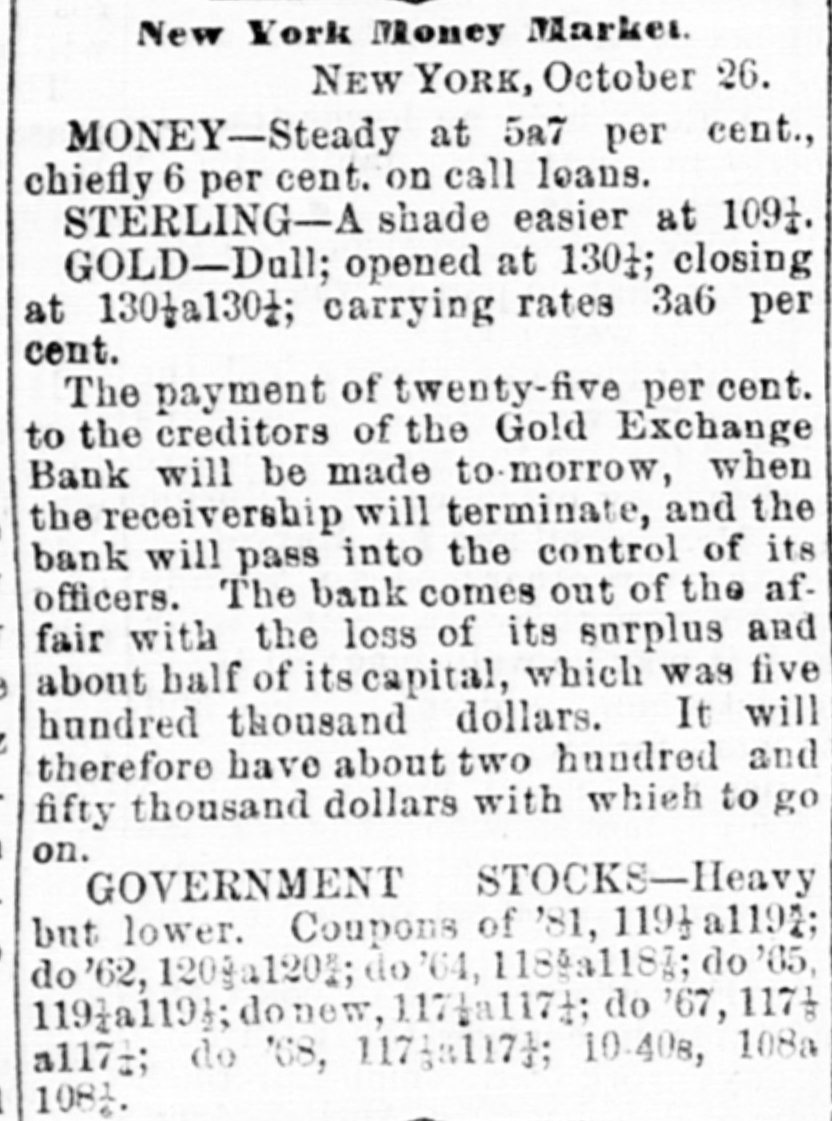
MISCELLANEOUS. Baltimore Gold Exchange Bank Elections, Etc. NEW York, October 28.-Receiver Jordon, of the gold Exchange Bank, made a statement to Judge Cordozo to-day, desiring to turn the bank over to the stockholders. The bank has $290,000 left of its $500,000 capital. It has claims on brokers amounting to $274,000, of which $98,000 are considered good. BALTIMORE, October 28.-At the municipal election yesterday, there were 12,000 votes cast for the Democratic candidates, 6120 for the Republican, and 750 for the West Virginians. The number of registered voters in the city is 34,211.


Article from The Evening Telegraph, November 6, 1869

Click image to open full size in new tab

Article Text

FROM NEW YORK. The Centre', Congregational Church, NEW YORK, Nov. 6.-At a meeting held at the Central Congregational Church last evening, Hon. Wm. Claflin, Governor of Massachusetts, was elected President, and Senators Wilson and Buckingham and Hon. S. D. Hastings, of Wiconsin, Vice-Prestdents of the Evangelieal Advancement Association. All these gentlemen are life members of that association. The Financial Situation. Despatch to The Evening Telegraph. NEW YORK, Nov. 6. -Money is easy at 4 to 7 on call, but it is said by prominent bank officers that never since the establishment of the national banking system has there been such a demrnd for discounts or such a disinclination to make them, This is, perhaps, consequent on the general feeling of insecurity which always precedes a meeting of Congress. Discount rates range from 12 to 20. The gold and stock markets are dull, the former showing considerable strength at the opening, but falling off at noon. The premium has ranged between 127%@127% The Gold Exchange Bank receiver has been removed and the bank will to-day announce its readiness to resume clearings. New York Produce Market. NEW YORK, Nov. 6.-Cotton declining; sales of 600 bales at 25%(22%%. Flour dull and declined 5@ 10c. ; sales of 7000 barrels State at $5.15@6.10; Western at $5.10@6.75; Southern at $6@10.25. Wheat heavy and declined 1@2c.; sales of 39,000 bushels No. 2 $1.27; amber State at $1.45; and winter red at $1.38 @1.40. Corn dull and lower; sales of 34,000 bushels mixed Western at 99c.@$1.033. Oat# dull and declined 1@2c.; sales (of 88,000 bushels at 61@64c. Beef quiet. Pork quiet; new mess, $29.75@30-00. Lard dull; steam, 17%(11%%c. Whisky quiet and nominal at $1.11.


Article from The Wheeling Daily Register, November 8, 1869

Click image to open full size in new tab

Article Text

New York Money Market. NEW YORK, November 6. MONEY-Closed easy at 4a6 per cent. on call. DISCOUNTS-Very stringent. The receivership of the Gold Ex. change Bank has been vacated. The bank statement is remarkable. The legal tender reserve is lower than for a long time. It is announced that the Assistant Treasurer has now a plentifal supply of c currency. STERLING-Quiet at 1081081. GOLD-Lower; opened at 1271, and closed at 12601261; carrying rates 7a4 per cent., the latter being the last quotation. Export for the week, $640,653. GOVERNMENT STOCKS-The market is firmer. Coupons of '81, 1181; do '62, 115ga115g; do '64, 1131all3g; do '65, 1131all3}; do new, 1154a115g; do '67, 1151al16; do '68, 1153a116}; 10-40s, 107ga 107#: currency 6s, 107 a108.


Article from The Portland Daily Press, November 17, 1869

Click image to open full size in new tab

Article Text

# New York Stock and Money Market. NEW YORK, Nov. 16-Evening.-The Money market was active this afternoon at 6@7 per cent. on Governments and Stock contracts. The demand for discounts continues, and the street rates remain at 10 to 15 per cent. for prime double name paper and 20 to 24 per cent. for single names. The project of starting a Bank of Discount with a large capital was much discussed to-day and meets with favor among the merchants. Foreign Exchange was quiet at 109 @ 109. Gold quiet and steady to the close at 127+. The rates paid for carrying to-day were 6, 6+ @ 7 per cent. At an executive meeting of the Gold Board this afternoon a communication was read from Mr. Jacob Russell, cashier of the Gold Exchange Bank, relating to the action of the Board yesterday. Mr. Russell said the Board of Directors considered it inexpedient to disclose the names of those dealers who had failed to make clearings on Sept. 24th, other than the nine already given, as these dealers had since been ascertained to be good and solvent. In regard to Rule 5, which ordains that none but full members of the Board shall be entitled to clear through the bank, Mr. Russell requested a reconsideration, since its adoption would expose the bank to a charge of breach of faith with certain dealers. Embraced in the communication was the following report of the condition of the bank:-Cash on deposit in the Metropolitan Bank, $134,496.05; on deposit in the United States Trust Company, $100,000; bills receivable, $25,900; New York State bouds with bank department, $11,000; 200 shares of bank stock taken in settlement by the Receiver, $12,000; vault and fixtures, $15,000; fines and commissions due, $4200; total, $302,596.05; claims as rendered by the settlement of C. N. Jordan, Receiver, $174,000; claims against the bank in dispute, $53,000. After the report was read a resolution was introduced to reconsider the action of the Board yesterday in restricting the privileges of the Clearing House to full members. This resolution was passed by a decisive vote. By its passage the Clearing House privileges are restored to all who have heretofore enjoyed them, including associate members and foreign bankers. Governments firm this afternoon, with rather more doing. Henry Clewes & Co. report the following 4.15 P. M. quotations:


Article from The Sun, February 19, 1870

Click image to open full size in new tab

Article Text

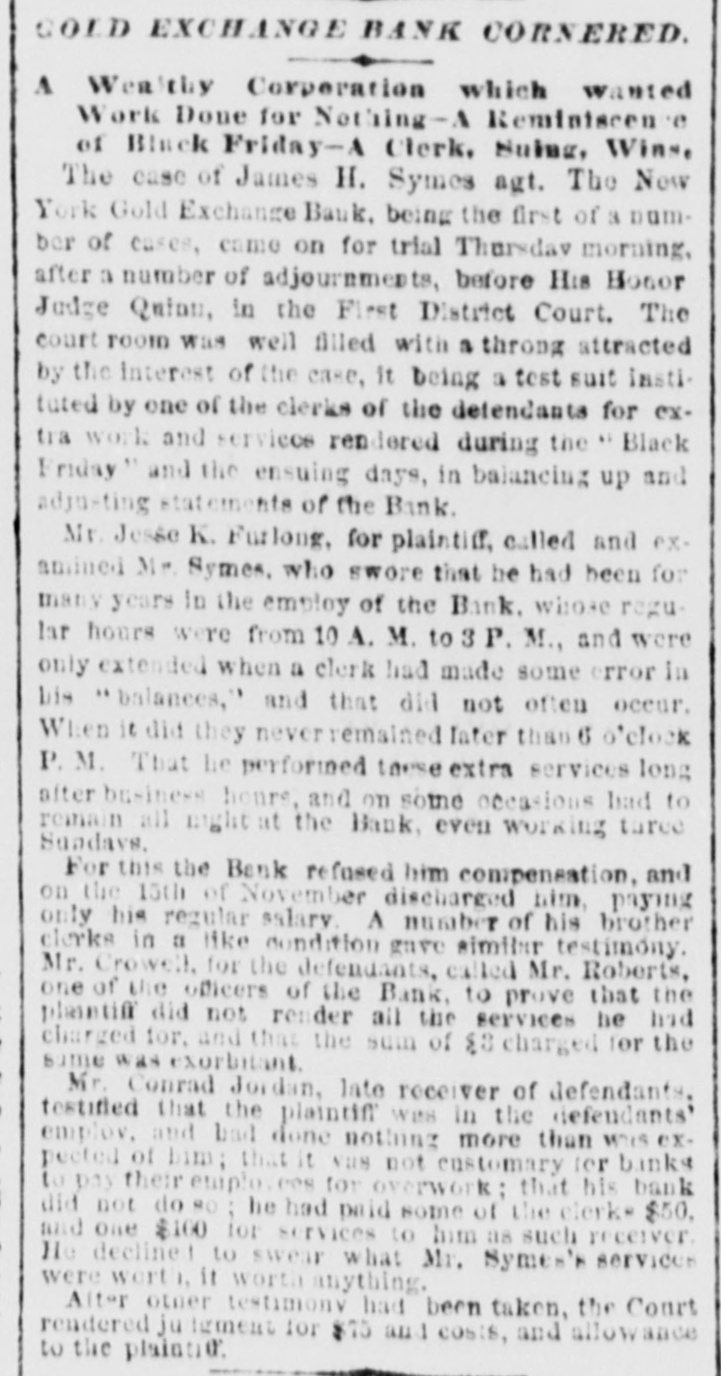
# COLD EXCHANGE BANK CORNERED. A Wealthy Corporation which wanted Work Done for Nothing-A Reminiscence of Black Friday-A Clerk, Suing, Wins. The case of James H. Symes agt. The New York Gold Exchange Bauk, being the first of a number of cases, came on for trial Thursday morning, after a number of adjournments, before His Honor Judge Quinn, in the Fiest District Court. The court room was well filled with a throng attracted by the interest of the case, it being a test suit instituted by one of the clerks of the defendants for extra work and services rendered during the "Black Friday" and the ensuing days, in balancing up and adjusting statements of the Bank. Mr. Jesse K. Furlong, for plaintiff, called and examined Mr. Symes, who swore that he had been for many years in the employ of the Bank, whose regular hours were from 10 A. M. to 3 P. M., and were only extended when a clerk had made some error in his "balances," and that did not often occur. When it did they never remained later than 6 o'clock P. M. That he performed these extra services long after business hours, and on some occasions had to remain all night at the Bank, even working taree Sundays. For this the Bank refused him compensation, and on the 15th of November discharged him, paying only his regular salary. A number of his brother clerks in a like condition gave similar testimony. Mr. Crowell, for the defendants, called Mr. Roberts, one of the officers of the Bank, to prove that the plantiff did not render ail the services he had charged for, and that the sum of $3 charged for the same was exorbitant. Mr. Conrad Jordan, late receiver of defendants, testified that the plaintiff was in the defendants' employ, and bad done nothing more than was expected of him; that it was not customary ter banks to pay their emplo.ees for overwork; that his bank did not do so; he had paid some of the clerk $50, and one $100 for services to him as such receiver. He declinet to swear what Mr. Symes's services were worti, it worth anything. After other testimony had been taken, the Court rendered ju izment for $15 and costs, and allowance to the plaintif