7559. Bank of New Orleans (New Orleans, LA)

Bank Information

Episode Type
Suspension → Reopening
Bank Type
state
Start Date
April 2, 1861
Location
New Orleans, Louisiana (29.955, -90.075)

Metadata

Model
gpt-5-mini
Short Digest
909057fd

Response Measures

None

Description

Multiple New Orleans Crescent notices (and reprints) state the Bank of New Orleans suspended specie payments on Sept 16, 1861 and thereafter accepted/paid Confederate Treasury notes and local bank notes. This was a coordinated suspension recommended by the Governor (policy/government action) rather than a depositor run. The bank was later allowed to resume (per reports in Dec 1862). Also an April 1861 counterfeit incident affected public confidence but does not appear to have produced a depositor run on the bank.

Events (4)

1. April 2, 1861 Other
Newspaper Excerpt
The Daily Dispatch (Richmond) Apr 2, 1861: rogues shoved counterfeit $20's on the Bank of New Orleans ... operators got off about $5,000 worth ... after they commenced the run on public confidence.
Source
newspapers
2. September 16, 1861 Suspension
Cause
Government Action
Cause Details
Suspension executed in conformity with Governor Moore's recommendation so banks could accept and circulate Confederate Treasury Notes; legal/constitutional constraints in Louisiana prevented voluntary suspension without risk to charters, but Governor recommended immediate suspension to facilitate use of Confederate notes and maintain credit.
Newspaper Excerpt
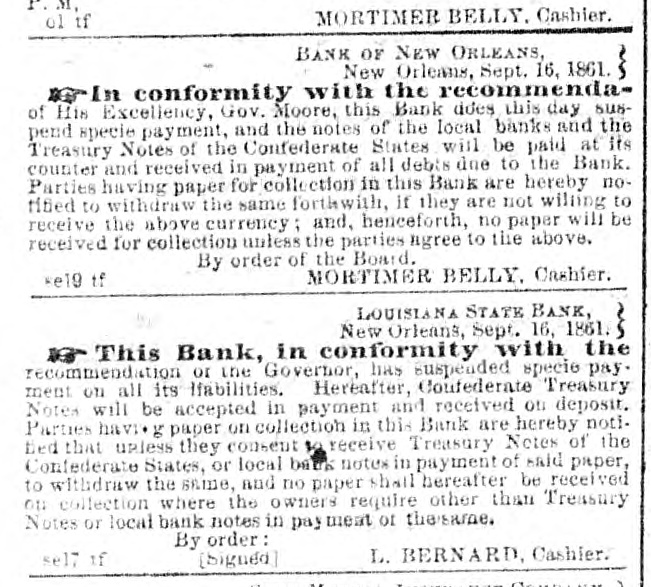
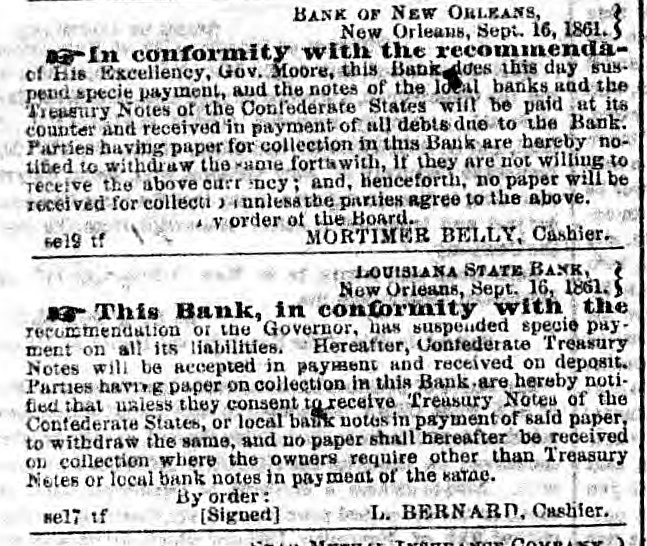
Bank of New Orleans, New Orleans, Sept. 16, 1861. In conformity with the recommendation of His Excellency, Gov. Moore, this Bank does this day suspend specie payment, and the notes of the local banks and the Treasury Notes of the Confederate States will be paid at its counter and received in payment of all debts due to the Bank.
Source
newspapers
3. September 20, 1861 Other
Newspaper Excerpt
Press reports describe large crowds and demand for small notes at Bank of New Orleans; bank signed many $5 issues to supply small change (Oct/Sept 1861 money market notices).
Source
newspapers
4. December 15, 1862 Reopening
Newspaper Excerpt
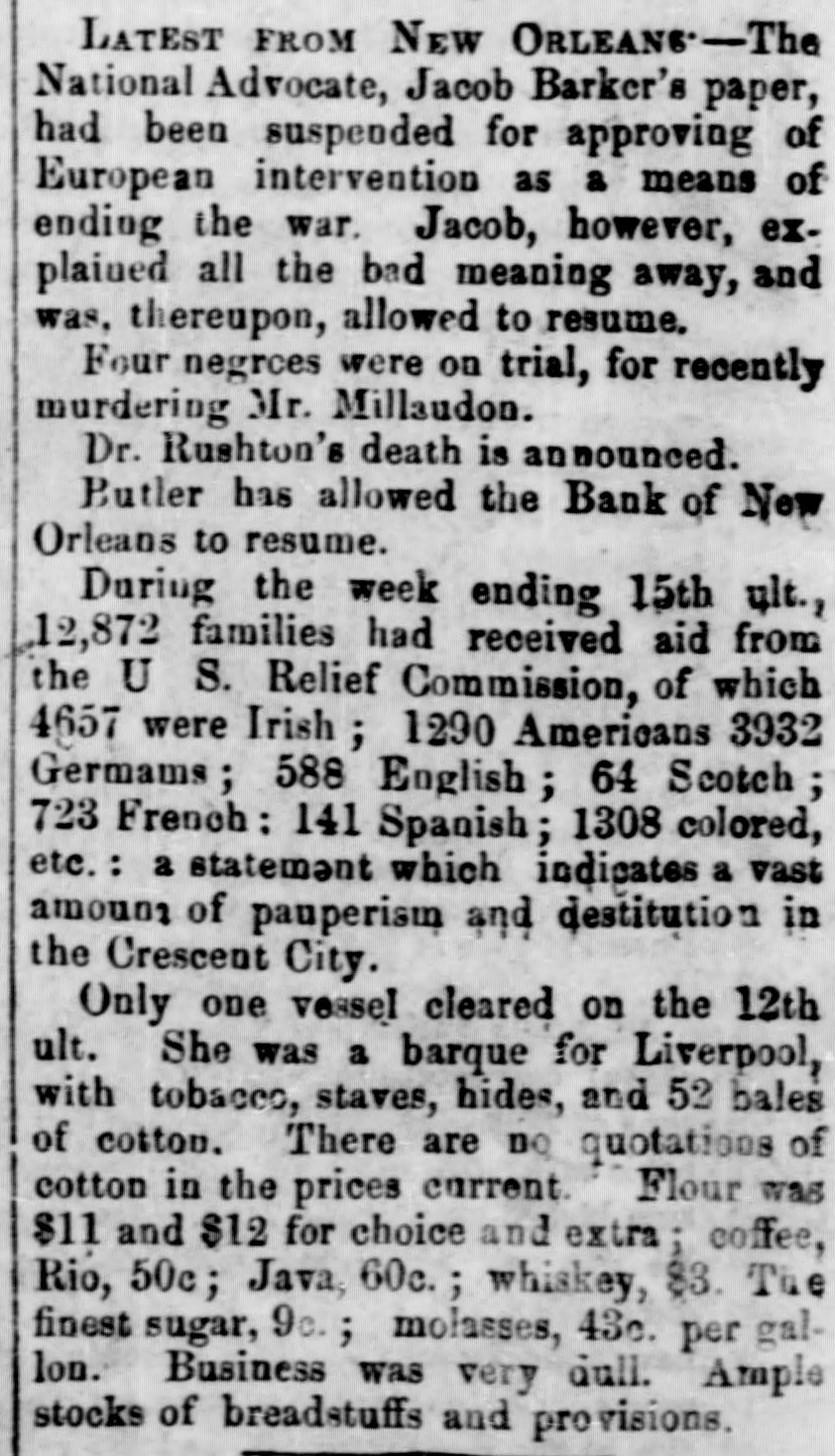
Washington Telegraph (Dec 31, 1862) — Butler has allowed the Bank of New Orleans to resume.
Source
newspapers

Newspaper Articles (25)

Article from The Daily Dispatch, April 2, 1861

Click image to open full size in new tab

Article Text

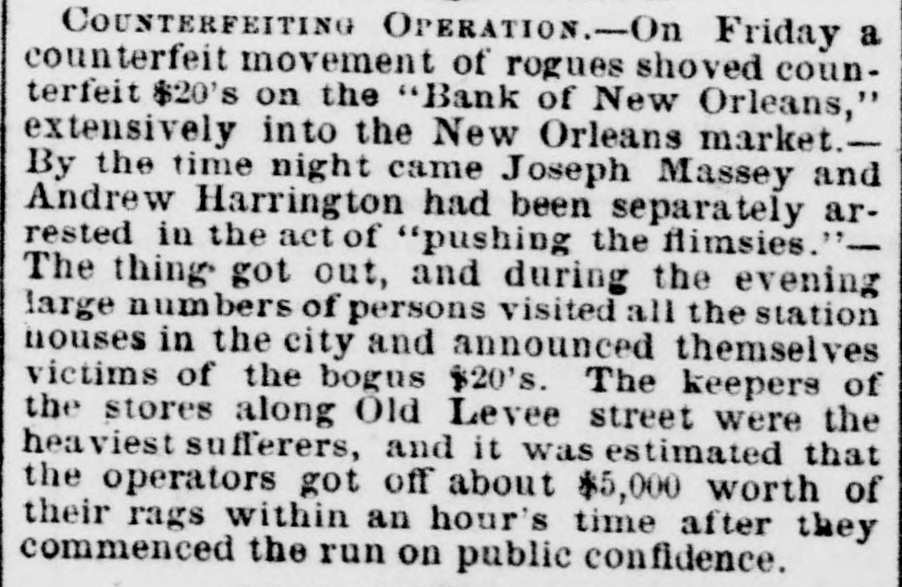
COUNTERFEITING OPERATION.-On Friday a counterfeit movement of rogues shoved counterfeit $20's on the "Bank of New Orleans," extensively into the New Orleans market.By the time night came Joseph Massey and Andrew Harrington had been separately arrested in the act of "pushing the flimsies." The thing got out, and during the evening large numbers of persons visited all the station nouses in the city and announced themselves victims of the bogus $20's. The keepers of the stores along Old Levee street were the heaviest sufferers, and it was estimated that the operators got off about $5,000 worth of their rags within an hour's time after they commenced the run on public confidence.


Article from New Orleans Daily Crescent, September 17, 1861

Click image to open full size in new tab

Article Text

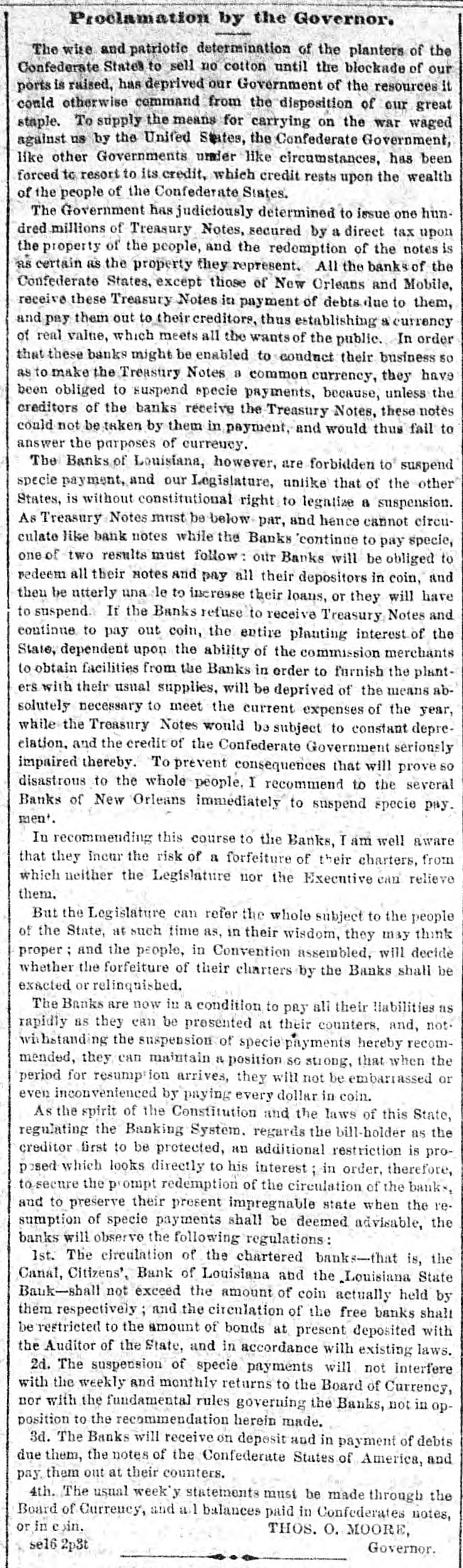
Proclamation by the Governor. The wise and patriotic determination of the planters of the Confederate States to sell no cotton until the blockade of our ports is raised, has deprived our Government of the resources it could otherwise command from the disposition of our great staple. To supply the means for carrying on the war waged against us by the Unifed States, the Confederate Government, like other Governments under like circumstances, has been forced to resort to its credit, which credit rests upon the wealth of the people of the Confederate States. The Government has judiciously determined to issue one hundred millions of Treasury Notes, secured by a direct tax upon the property of the people, and the redemption of the notes is as certain as the property they represent. All the banks of the Confederate States, except those of New Orleans and Mobile, receive these Treasury Notes in payment of debts due to them, and pay them out to their creditors, thus establishing a currency of real value, which meets all the wants of the public. In order that these banks might be enabled to conduct their business so as to make the Treasury Notes 8 common currency, they have been obliged to suspend specie payments, because, unless the creditors of the banks receive the Treasury Notes, these notes could not be taken by them in payment. and would thus fail to answer the parposes of currency. The Banks of Louisiana, however, are forbidden to suspend specie payment, and our Legislature, unlike that of the other States, is without constitutional right to legalize a suspension. As Treasury Notes must be below par, and hence cannot circuculate like bank notes while the Banks continue to pay specie, one of two results must follow: our Banks will be obliged to redeem all their notes and pay all their depositors in coin, and theu be utterly una le to increase their loans, or they will have to suspend. If the Banks refuse to receive Treasury Notes and continue to pay out coin, the entire planting interest of the State, dependent upon the ability of the commission merchants to obtain facilities from the Banks in order to furnish the planters with their usual supplies, will be deprived of the means absolutely necessary to meet the current expenses of the year, while the Treasury Notes would be subject to constant depreelation, and the credit of the Confederate Government seriously impaired thereby. To prevent consequences that will prove so disastrous to the whole people, I recommend to the several Banks of New Orleans immédiately to suspend specie pay. men't In recommending this course to the Banks, T am well aware that they incur the risk of a forfeiture of their charters, from which neither the Legislature nor the Executive can relieve them. But the Legislature can refer the whole subject to the people of the State, at such time as, in their wisdom, they may think proper; and the people, in Convention assembled, will decide whether the forfeiture of their charters by the Banks shall be exacted or relinquished, The Banks are now in a condition to pay all their liabilities as rapidly as they ean be presented at their counters, and, not withstanding the suspension of specie payments hereby recommended, they can maintain a position SO strong, that when the period for resumption arrives, they will not be embarrassed or even inconvenienced by paying every dollar in coin. As the spirit of the Constitution and the laws of this State, regulating the Banking System. regards the bill-holder as the creditor first to be protected, an additional restriction is proposed which looks directly to his interest in order, therefore, secure the prompt redemption of the circulation of the banks, and to preserve their present impregnable state when the resumption of specie payments shall be deemed advisable, the banks will observe the following regulations: 1st. The circulation of the chartered banks-that is, the Canal, Citizens', Bank of Louisiana and the Louisiana State Bauk-shall not exceed the amount of coin actually held by them respectively; and the circulation of the free banks shalt be restricted to the amount of bonds at present deposited with the Auditor of the State, and in accordance wilh existing laws. 2d. The suspension of specie payments will not interfere with the weekly and monthly returns to the Board of Currency, nor with the fundamental rules governing the Banks, not in opposition to the recommendation herein made. 3d. The Banks will receive on deposit and in payment of debts due them, the notes of the Confederate States of America, and pay them out at their counters. 4th. The usual week'y statements must be made through the Board of Currency, and all balances paid in Confederates notes, or in coin. THOS, O. MOORE, sel6 2p3t Governor.


Article from New Orleans Daily Crescent, September 18, 1861

Click image to open full size in new tab

Article Text

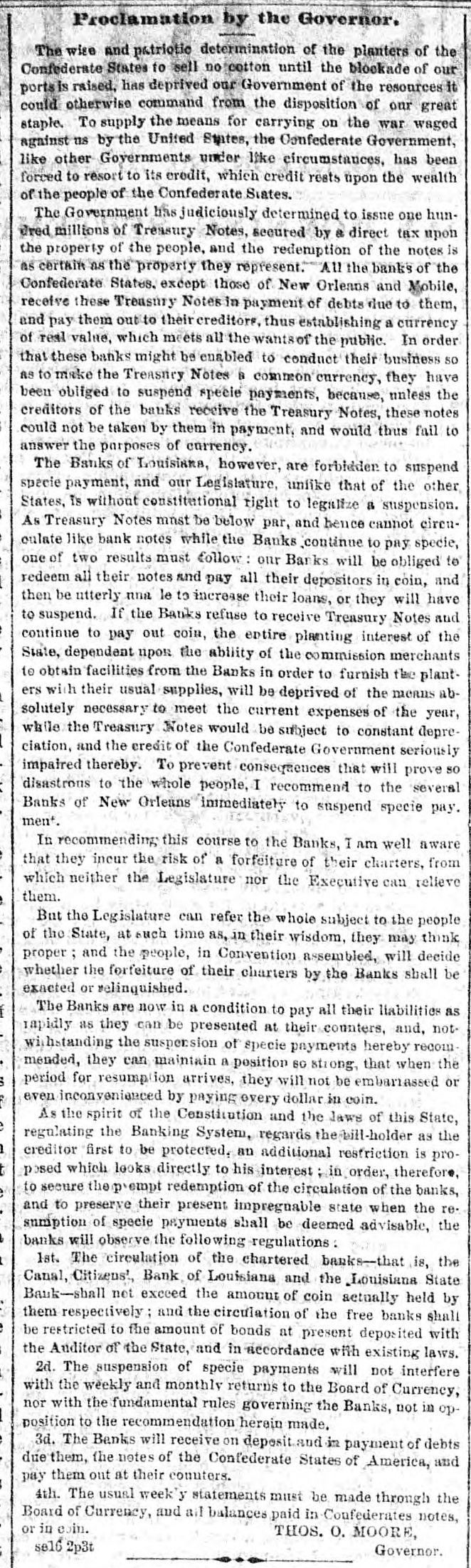
Proclamation by the Governor. The wise and patriotic determination of the planters of the Confederate States to sell no cotton until the blookade of our portsis raised, has deprived our Government of the resources it could otherwise command from the disposition of our great staple. To supply the means for carrying on the war waged against us by the United States, the Confederate Government, like other Governments under like circumstances, has been forced to resort to its credit, which credit rests upon the wealth of the people of the Confederate States. The Government has judiciously determined to issue one hundred millions of Treasury Notes, secured by a direct tax upon the property of the people, and the redemption of the notes is as certain as the property they represent. All the banks of the Confederate States. except those of New Orleans and Mobile, receive these Treasury Notes in payment of debts due to them, and pay them out to their creditors, thus establishing a currency of real value, which meets all the wants of the public. In order that these banks might be enabled to conduct their business so AS to make the Treasney Notes B common currency, they have been obliged to suspend specie payments, because, unless the creditors of the banks receive the Treasury Notes, these notes could not be taken by them in payment. and would thus fail to answer the purposes of currency. The Banks of Louisiana, however, are forbidder to suspend specie payment, and our Legislature, unlike that of the other States, is without constitutional right to legalize a suspension. As Treasury Notes mnst be below par, and hence cannot circuculate like bank notes while the Banks (continue to pay specie, one of two results must follow: our Banks will be obliged to redeem all their notes and pay all their depositors in coin, and then be utterly nna le to increase their loans, or they will have to suspend. If the Banks refuse to receive Treasury Notes and continue to pay out coin, the entire planting interest of the State, dependent upon the ability of the commission merchants to obtain facilities from the Banks in order to furnish the planters with their usual supplies, will be deprived of the morns absolutely necessary to meet the current expenses of the year, while the Treasury Notes would be subject to constant depreI ciation, and the credit of the Confederate Government seriously impaired thereby. To prevent consequences that will prove so : disastrous to the whole people, I recommend to the several Banks of New Orleans immediately to suspend specie pay. men't In recommending this course to the Banks, I am well aware that they incur the risk of a forfeiture of their charters, from which neither the Legislature nor the Executive can relieve them. ) But the Legislature can refer the whole subject to the people of the State, at such time as, in their wisdom, they may think proper ; and the people, in Convention assembled, will decide whether the forfeiture of their charters by the Banks shall be exacted or relinquished. f The Banks are now in a condition to pay all their liabilities as rapidly as they can be presented at their counters, and, notwithstanding the suspension of specie payments hereby recom mended, they can maintain a position 60 strong, that when the $ period for resumption arrives, they will not be embariassed or F even inconvenienced by paying every dollar in coin. As the spirit of the Constitution and the Jaws of this State, ) regulating the Banking System, regards the bill-holder as the 1 creditor first to be protected. an additional restriction is prot posed which looks directly to his interest in order, therefore, e to secure the prempt redemption of the circulation of the banks, and to preserve their present impregnable state when the resumption of specie payments shall be deemed advisable, the / banks will observe the following regulations : 1st. The circulation of the chartered banks-that is, the Canal, Citizens!, Bank of Louisiana and the Louisiana State Bauk-shall net exceed the amount of coin actually held by : them respectively ; and the circulation of the free banks shall e be restricted to the amount of bonds at present deposited with the Auditor of the State, and in accordance with existing laws. 2d. The suspension of specie payments will not interfere 1 with the weekly and monthly returns to the Board of Currency, nor with the fundamental rules governing the Banks, not in opposition to the recommendation herein made. : 3d. The Banks will receive on deposit and in payment of debts due them, the notes of the Confederate States of America, and pay them out at their counters. : 4th. The usual week'y statements must be made through the Board of Currency, and all balances paid in Confederates notes, or in coin. THOS. O. MOORE, self 2p3t Governor.


Article from New Orleans Daily Crescent, September 19, 1861

Click image to open full size in new tab

Article Text

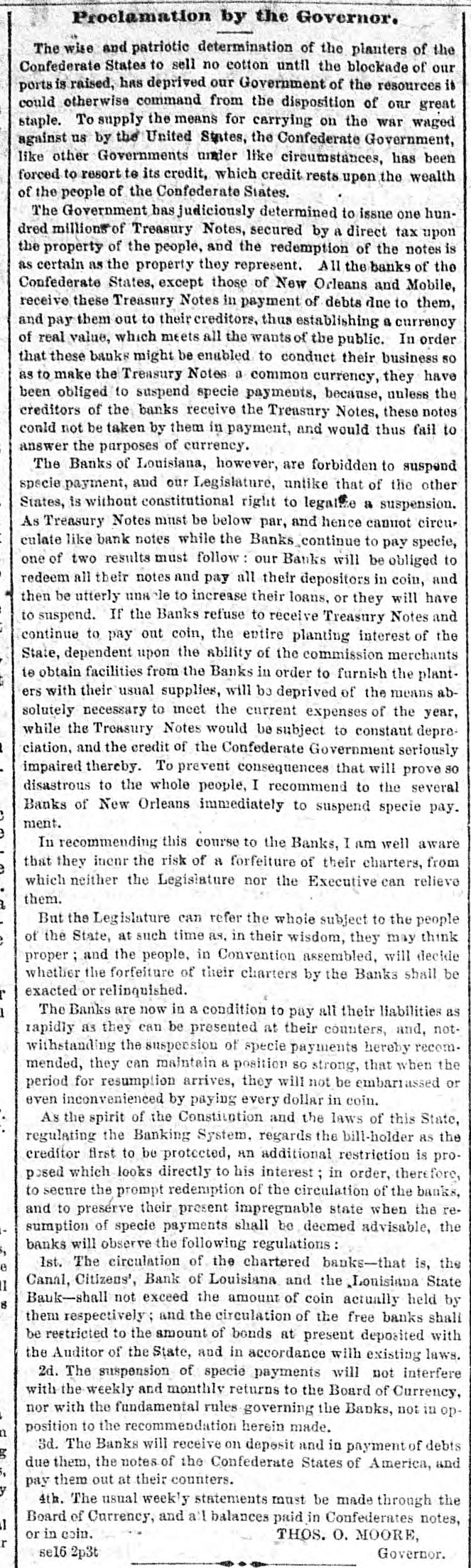
Proclamation by the Governor. The wise and patriotic determination of the planters of the Confederate States to sell no cotton until the blockade of our ports is raised, has deprived our Government of the resources it could otherwise command from the disposition of our great staple. To supply the means for carrying on the war waged against us by the United States, the Confederate Government, like other Governments under like circumstances, has been forced to resort to its credit, which credit rests upon the wealth of the people of the Confederate States. The Government has judiciously determined to issue one hundred millions of Treasury Notes, secured by a direct tax upon the property of the people, and the redemption of the notes is as certain as the property they represent. All the banks of the Confederate States, except those of New Orleans and Mobile, receive these Treasury Notes in payment of debts due to them, and pay them out to their creditors, thus establishing a currency of real value, which meets all the wants of the public. In order that these banks might be enabled to conduct their business so as to make the Treasury Notes a common currency, they have been obliged to suspend specie payments, because, unless the creditors of the banks receive the Treasury Notes, these notes could not be taken by them in payment, and would thus fail to answer the purposes of currency. The Banks of Louisiana, however, are forbidden to suspend spscie payment, and our Legislature, unlike that of the other States, is without constitutional right to legalize a suspension. As Treasury Notes must be below par, and hence cannot circuculate like bank notes while the Banks continue to pay specie, one of two results must follow our Banks will be obliged to redeem all their notes and pay all their depositors in coin, and then be utterly unacl to increase their loans, or they will have to suspend. If the Banks refuse to receive Treasury Notes and continue to pay out coin, the entire planting interest of the State, dependent upon the ability of the commission merchants to obtain facilities from the Banks in order to furnish the planters with their usual supplies, will be deprived of the means absolutely necessary to meet the current expenses of the year, while the Treasury Notes would be subject to constant depre1 ciation, and the credit of the Confederate Government seriously impaired thereby. To prevent consequences that will prove so disastrous to the whole people, I recommend to the several Banks of New Orleans immediately to suspend specie pay. ment. In recommending this course to the Banks, I am well aware that they inenr the risk of 8 forfeiture of their charters, from which neither the Legislature nor the Executive can relieve them. But the Legislature can refer the whole subject to the people of the State, at such time as. in their wisdom, they may think proper ; and the people, in Convention assembled, will decide whether the forfeiture of their charters by the Banks shall be exacted or relinquished. The Banks are now in a condition to pay all their liabilities as rapidly as they can be presented at their counters, and, notwithstanding the suspersion of specie payments hereby recommended, they can maintain 8 position SO strong, that when the period for resumption arrives, they will not be embarrassed or even inconvenienced by paying every dollar in coin. As the spirit of the Constitution and the laws of this State, regulating the Banking System. regards the bill-holder as the creditor first to be protected, an additional restriction is proposed which looks directly to his interest; in order, therefore, to secure the prompt redemption of the circulation of the banks, and to preserve their present impregnable state when the resumption of specie payments shall be deemed advisable, the banks will observe the following regulations: , 1st. The circulation of the chartered banks-that is, the e Canal, Citizens', Bank of Louisiana and the Louisiana State 11 Bauk-shall not exceed the amount of coin actually held by 8 them respectively and the circulation of the free banks shall be restricted to the amount of bonds at present deposited with the Auditor of the State, and in accordance wilh existing laws. 2d. The suspension of specie payments will not interfere with the weekly and monthly returns to the Board of Currency, nor with the fundamental rules governing the Banks, not in opposition to the recommendation herein made. n 3d. The Banks will receive on deposit and in payment of debts g due them, the notes of the Confederate States of America, and pay them out at their counters. y 4th. The usual weekly statements must be made through the Board of Currency, and all balances paid in Confederates notes, I or in coin. THOS. O. MOORE, r Governor. se16 2p3t


Article from New Orleans Daily Crescent, September 20, 1861

Click image to open full size in new tab

Article Text

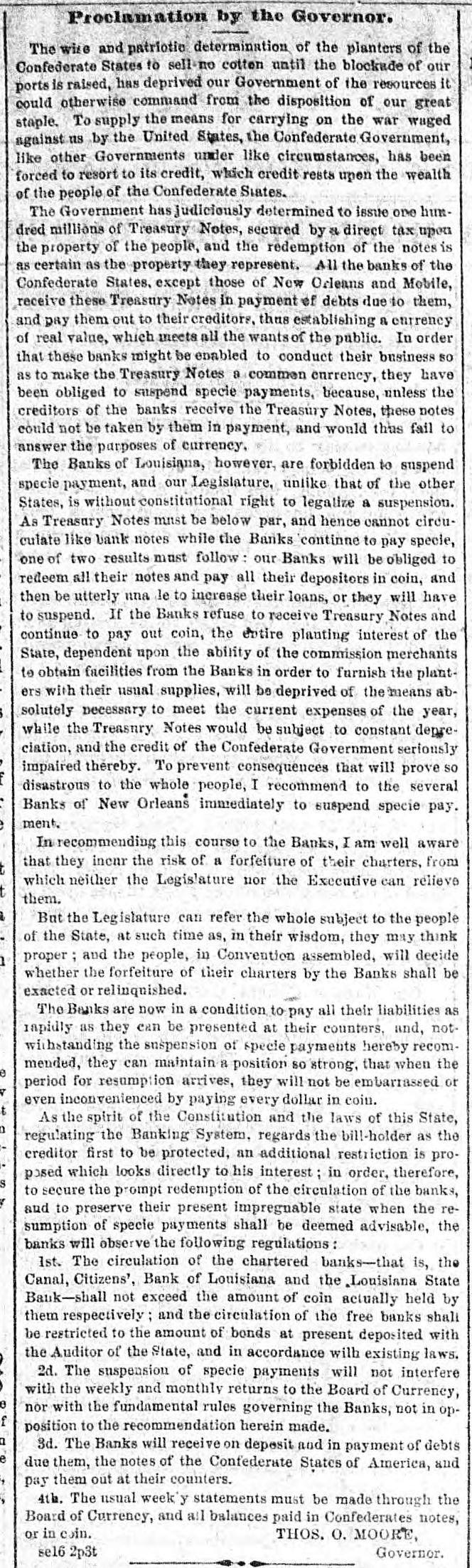
Proclamation by the Governor. The wite and patriotic determination of the planters of the Confederate States to sell-no cotten until the blockade of our ports is raised, has deprived our Government of the resources it could otherwise command from the disposition of our great staple. To supply the means for carrying on the war waged against us by the United States, the Confederate Government, like other Governments under like circumstances, has been forced to resort to its credit, which credit rests upon the wealth of the people of the Confederate States. The Government has judiciously determined to issue one humdred millions of Treasury Notes, secured by a direct tax upon the property of the people, and the redemption of the notes is as certain as the property they represent. All the banks of the Confederate States, except those of New Orleans and Mobile, receive these Treasury Notes in payment of debts due to them, and pay them out to their creditors, thus establishing a currency of real value, which meets all the wants of the public. In order that these banks might be enabled to conduct their business so as to make the Treasury Notes a commen currency, they have been obliged to suspend specie payments, because, unless the creditors of the banks receive the Treasury Notes, these notes could not be taken by them in payment, and would thus fail to answer the purposes of currency, The Banks of Louisiana, however, are forbidden to suspend specie payment, and our Legislature, unlike that of the other States, is without constitutional right to legalize a suspension. As Treasury Notes must be below par, and hence cannot circuculate like bank notes while the Banks continue to pay specie, one of two results must follow: our Banks will be obliged to redeem all their notes and pay all their depositors in coin, and then be utterly una le to increase their loans, or they will have to suspend. If the Banks refuse to receive Treasury Notes and continue to pay out coin, the entire planting interest of the State, dependent upon the ability of the commission merchants to obtain facilities from the Banks in order to furnish the planters with their usual supplies, will be deprived of the means absolutely necessary to meet the current expenses of the year, while the Treasury Notes would be subject to constant depreciation, and the credit of the Confederate Government seriously impaired thereby. To prevent consequences that will prove SO disastrous to the whole people, I recommend to the several Banks of New Orleans immediately to suspend specie pay. ment. In recommending this course to the Banks, I am well aware that they incur the risk of a forfeiture of their charters, from which neither the Legislature nor the Executive can relieve them. But the Legislature can refer the whole subject to the people of the State, at such time as, in their wisdom, they may think proper; and the people, in Convention assembled, will decide 1 whether the forfeiture of their charters by the Banks shall be exacted or relinquished. The Banks are now in a condition to pay all their liabilities as rapidly as they can be presented at their counters, and, notwithstanding the suspension of specie payments hereby recommended, they can maintain a position so strong, that when the e period for resumption arrives, they will not be embarrassed or even inconvenienced by paying every dollar in coin. t As the spirit of the Constitution and the laws of this State, b regulating the Banking System. regards the bill-holder as the creditor first to be protected, an additional restriction is proposed which looks directly to his interest; in order, therefore, S to secure the prompt redemption of the circulation of the banks, and to preserve their present impregnable state when the resumption of specie payments shall be deemed advisable, the banks will observe the following regulations 1st. The circulation of the chartered banks-that is, the Canal, Citizens', Bank of Louisiana and the Louisiana State Bank-shall not exceed the amount of coin actually held by them respectively ; and the circulation of the free banks shall be restricted to the amount of bonds at present deposited with the Auditor of the State, and in accordance wilh existing laws. 2d. The suspension of specie payments will not interfere with the weekly and monthly returns to the Board of Currency, nor with the fundamental rules governing the Banks, not in opf position to the recommendation herein made. a 3d. The Banks will receive on deposit and in payment of debts e due them, the notes of the Confederate States of America, and pay them out at their counters. 4th. The usual weekly statements must be made through the Board of Currency, and all balances paid in Confederates notes, or in coin. THOS, O. MOORE, Governor. se16 2p3t


Article from New Orleans Daily Crescent, September 21, 1861

Click image to open full size in new tab

Article Text

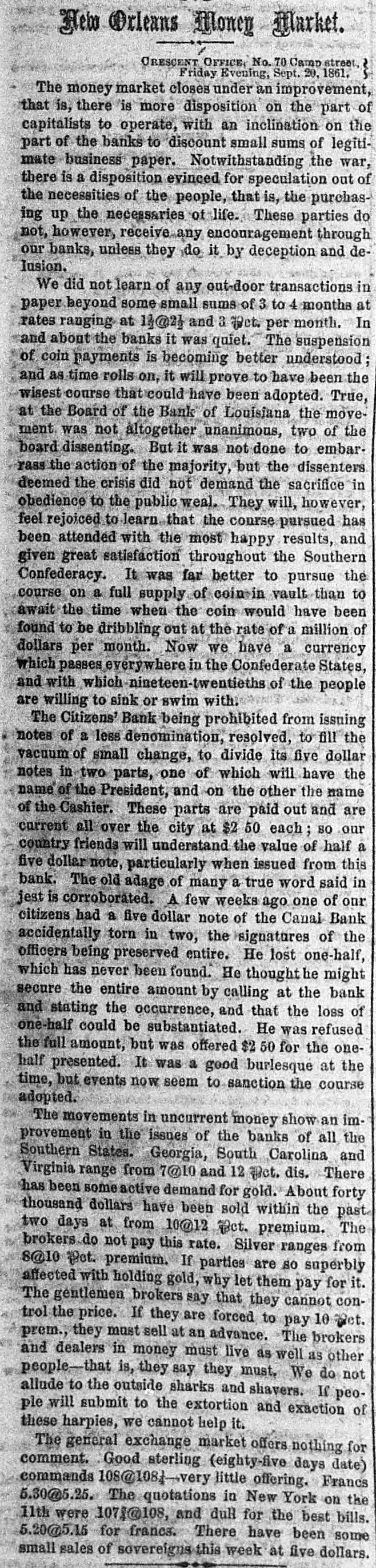
Hebo Orleans Money Market. CRESCENT OFFICE No. 70 Camp street, Friday Evening, Sept. 20, 1861. The money market closes under an improvement, that is, there is more disposition on the part of capitalists to operate, with an inclination on the part of the banks to discount small sums of legitimate business paper. Notwithstanding the war, there is a disposition evinced for speculation out of the necessities of the people, that is, the purchasing up the necessaries of life. These parties do not, however, receive any encouragement through our banks, unless they do it by deception and delusion. We did not learn of any out-door transactions in paper beyond some small sums of 3 to 4 months at rates ranging at 1122 and 3 Pet. per month. In and about the banks it was quiet. The suspension of coin payments is becoming better understood and as time rolls on, it will prove to have been the wisest course that could have been adopted. True, at the Board of the Bank of Louisiana the movement. was not altogether unanimous, two of the board dissenting. But it was not done to embarrass the action of the majority, but the dissenters deemed the erisis did not demand the sacrifice in obedience to the public weal. They will, ho wever, feel rejoiced to learn that the course pursued has been attended with the most happy results, and given great satisfaction throughout the Southern Confederacy. It was far better to pursue the course on a full supply of coin in vault than to await the time when the coin would have been found to be dribbling out at the rate of a million of dollars per month. Now we have a currency which passes everywhere in the Confederate States, and with which-nineteen-twentieths of the people are willing to sink or swim with. The Citizens' Bank being prohibited from issuing notes of a less denomination, resolved, to fill the vacuum of small change, to divide its five dollar notes in two parts, one of which will have the name of the President, and on the other the name of the Cashier. These parts are paid out and are current all over the city at $2 50 each SO our country friends will understand the value of half a five dollar note, particularly when issued from this bank. The old adage of many a true word said in jest is corroborated. A few weeks ago one of our citizens had a five dollar note of the Canal Bank accidentally torn in two, the signatures of the officers being preserved entire. He lost one-half, which has never been found. He thought he might secure the entire amount by calling at the bank and stating the occurrence, and that the loss of one-half could be substantiated. He was refused the full amount, but was offered $2 50 for the onehalf presented. It was a good burlesque at the time, but events now seem to sanction the course adopted. The movements in uncurrent money show an improvement in the issues of the banks of all the Southern States. Georgia, South Carolina and Virginia range from 7@10 and 12 Oct. dis. There has been some active demand for gold. About forty thousand dollars have been sold within the past two days at from 10@12 Pct. premium. The brokers do not pay this rate. Silver ranges from 8@10 Pot. premium. If parties are so superbly affected with holding gold, why let them pay for it. The gentlemen brokers say that they cannot control the price. If they are forced to pay 10 Pet. prem., they must sell at an advance. The brokers and dealers in money must live as well as other people-that is, they say they must. We do not allude to the outside sharks and shavers. If people will submit to the extortion and exaction of these harpies, we cannot help it. The general exchange market offers nothing for comment. Good sterling (eighty-five days date) commands 108@108.-very little offering. Francs 5.30@5.25. The quotations in New York on the 11th were 107 @ 108, and dull for the best bills. 5.20@5.16 for francs. There have been some small sales of sovereigns this week at five dollars.


Article from New Orleans Daily Crescent, September 26, 1861

Click image to open full size in new tab

Article Text

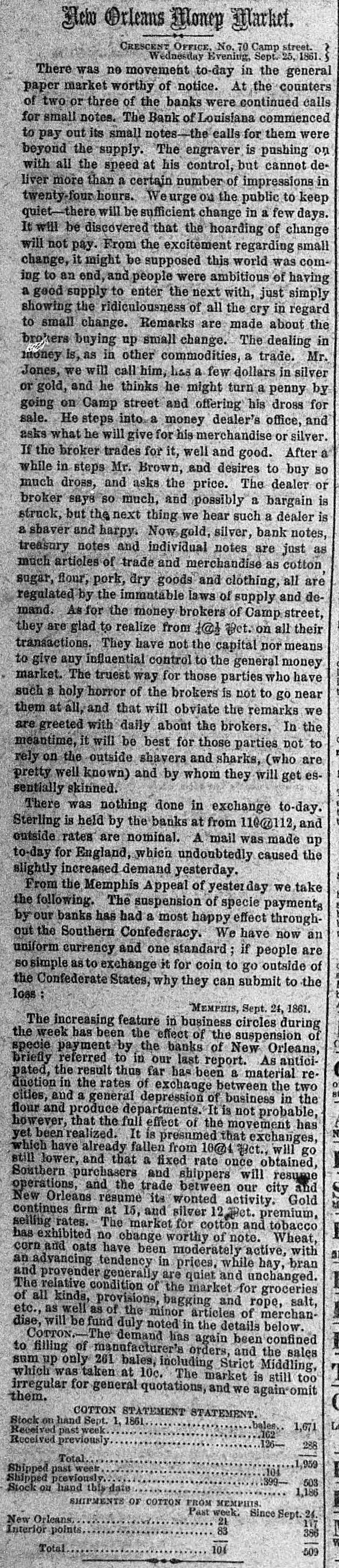
Hew Orleans Money Market. CRESCENT OFFICE. No. 70 Camp street. Wednesday Evening, Sept. 25, 1861. There was no movement to-day in the general paper market worthy of notice. At the counters of two or three of the banks were continued calls for small notes. The Bank of Louisiana commenced to pay out its small notes-the calls for them were beyond the supply. The engraver is pushing on with all the speed at his control, but cannot deliver more than a certain number of impressions in twenty-1 hours. eurge on the public to keep quiet-there will be sufficient change in a few days. It will be discovered that the hoarding of change will not pay. From the excitement regarding small change, it might be supposed this world was coming to an end, and people were ambitious of having a good supply to enter the next with, just simply showing the ridiculousness of all the cry in regard to small change. Remarks are made about the brokers buying up small change. The dealing in money is, as in other commodities, a trade. Mr. Jones, we will call him, has a few dollars in silver or gold, and he thinks he might turn a penny by going on Camp street and offering his dross for sale. He steps into a money dealer's office, and asks what he will give for his merchandise or silver. If the broker trades for it, well and good. After a while in steps Mr. Brown, and desires to buy so much dross, and asks the price. The dealer or broker says so much, and possibly a bargain is struck, but the next thing we hear such a dealer is a shaver and harpy. Now gold, silver, bank notes, treasury notes and individual notes are just as much articles of trade and merchandise as cotton sugar, flour, pork, dry goods and clothing, all are regulated by the immutable laws of supply and demand. As for the money brokers of Camp street, they are glad to realize from @ Oct. on all their transactions. They have not the capital nor means to give any influential control to the general money market. The truest way for those parties who have such a holy horror of the brokers is not to go near them at all, and that will obviate the remarks we are greeted with daily about the brokers. In the meantime, it will be best for those parties not to rely on the outside shavers and sharks, (who are pretty well known) and by whom they will get essentially skinned. There was nothing done in exchange to-day. Sterling is held by the banks at from 110@112, and outside rates are nominal. A mail was made up to-day for England, which undoubtedly caused the slightly increased demand yesterday. From the Memphis Appeal of yester day we take the following. The suspension of specie payment by our banks has had a most happy effect throughout the Southern Confederacy. We have now an uniform currency and one standard; if people are simple as to exchange it for coin to go outside of the Confederate States, why they can submit to the loss MEMPHIS, Sept. 24, 1861. The increasing feature in business circles during the week has been the effect of the suspension of specie payment by the banks of New Orleans, briefly referred to in our last report. As anticipated, the result thus far has been a material reduetion in the rates of exchange between the two cities, and a general depression of business in the flour and produce departments. It is not probable, however, that the full effect of the movement has yet been realized. It is presnmed that exchanges, which have already fallen from 10@4 Oct., will go still lower, and that a fixed rate once obtained, Southern purchasers and shippers will resume operations, and the trade between our city and New Orleans resume its wonted activity. Gold continues firm at 15, and silver 12 Pet. premium, selling rates. The market for cotton and tobacco has exhibited no change worthy of note. Wheat, corn and oats have been moderately active, with an advancing tendency in prices, while hay, bran and provender generally are quiet and unchanged. The relative condition of the market for groceries of all kinda, provisions, bagging and rope, salt, etc., as well as of the minor articles of merchandise, will be fund duly noted in the details below. Corron.-The demand has again been confined to filling of manufacturer's orders, and the sales sum up only 261 bales, including Strict Middling, which was taken at 10c. The market is still too irregular for general quotations, and we again omit them. COTTON STATEMENT STATEMENT. Stock on hand Sept. 1, 1861 bales L 1,671 Received past week 762 Received previously 126288 Total 1,959 Shipped past week I 104 Shipped previously 399 503 Stock on hand this date 1,186 SHIPMENTS OF COTTON FROM MEMPHIS. Past week. Since Sept. 24 New Orleans 21 117 I 83 Interior points 386 W Total 104 509


Article from New Orleans Daily Crescent, October 3, 1861

Click image to open full size in new tab

Article Text

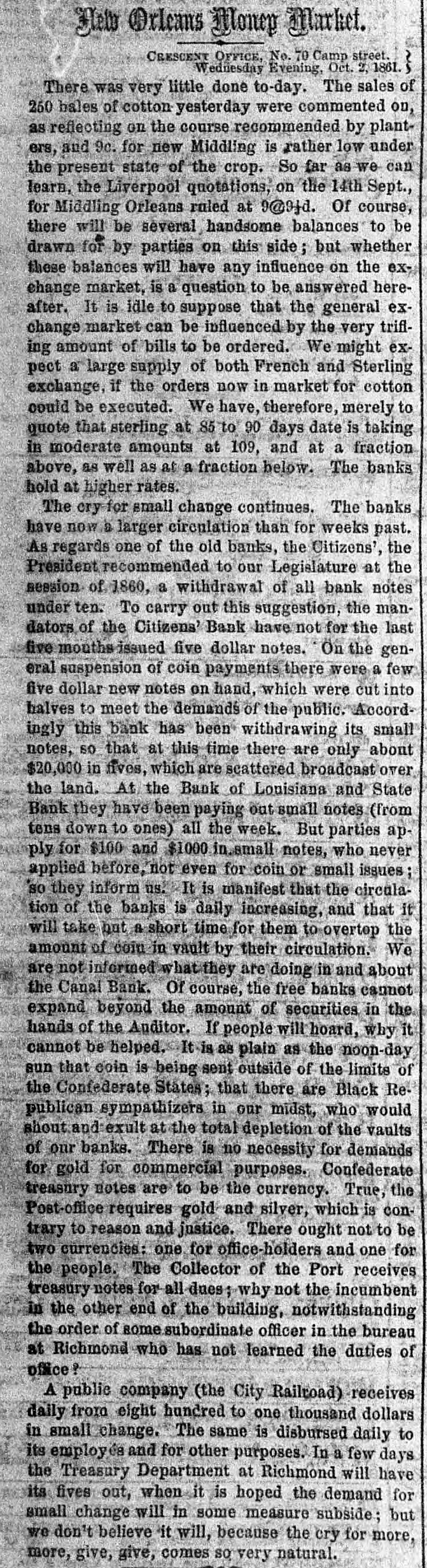
# New Orleans Money Market. CRESCENT OFFICE, No. 70 Camp street. Wednesday Evening, Oct. 2, 1861. There was very little done to-day. The sales of 250 bales of cotton yesterday were commented on, as reflecting on the course recommended by planters, and 9c. for new Middling is rather low under the present state of the crop. So far as we can learn, the Liverpool quotations, on the 14th Sept., for Middling Orleans ruled at 9@9fd. Of course, there will be several handsome balances to be drawn for by parties on this side; but whether these balances will have any influence on the exchange market, is a question to be answered hereafter. It is idle to suppose that the general exchange market can be influenced by the very trifling amount of bills to be ordered. We might expect a large supply of both French and Sterling exchange, if the orders now in market for cotton could be executed. We have, therefore, merely to quote that sterling at 85 to 90 days date is taking in moderate amounts at 109, and at a fraction above, as well as at a fraction below. The banks hold at higher rates. The cry for small change continues. The banks have now a larger circulation than for weeks past. As regards one of the old banks, the Citizens', the President recommended to our Legislature at the session of 1860, a withdrawal of all bank notes under ten. To carry out this suggestion, the mandators of the Citizens' Bank have not for the last five mouths issued five dollar notes. On the general suspension of coin payments there were a few five dollar new notes on hand, which were cut into halves to meet the demands of the public. Accordingly this bank has been withdrawing its small notes, so that at this time there are only about $20,000 in fives, which are scattered broadcast over the land. At the Bank of Louisiana and State Bank they have been paying out small notes (from tens down to ones) all the week. But parties apply for $100 and $1000 in small notes, who never applied before, not even for coin or small issues; so they inform us. It is manifest that the circulation of the banks is daily increasing, and that it will take but a short time for them to overtop the amount of coin in vault by their circulation. We are not informed what they are doing in and about the Canal Bank. Of course, the free banks cannot expand beyond the amount of securities in the hands of the Auditor. If people will hoard, why it cannot be helped. It is as plain as the noon-day sun that coin is being sent outside of the limits of the Confederate States; that there are Black Republican sympathizers in our midst, who would shout and exult at the total depletion of the vaults of our banks. There is no necessity for demands for gold for commercial purposes. Confederate treasury notes are to be the currency. True, the Post-office requires gold and silver, which is contrary to reason and justice. There ought not to be two currencies: one for office-holders and one for the people. The Collector of the Port receives treasury notes for all dues; why not the incumbent in the other end of the building, notwithstanding the order of some subordinate officer in the bureau at Richmond who has not learned the duties of office? A public company (the City Railroad) receives daily from eight hundred to one thousand dollars in small change. The same is disbursed daily to its employés and for other purposes. In a few days the Treasury Department at Richmond will have its fives out, when it is hoped the demand for small change will in some measure subside; but we don't believe it will, because the cry for more, more, give, give, comes so very natural.


Article from New Orleans Daily Crescent, November 21, 1861

Click image to open full size in new tab

Article Text

MORTIMER BELLY. Cashier. 01 if BANK OF NEW ORLEANS, } New Orleans. Sept. 16, 1861. In conformity with the recommendaof His Excellency, Gov. Moore, this Bank ddes this day suspend specie payment, and the notes of the local banks and the Treasury Notes of the Confederate States will be paid at its counter and received in payment of all debts due to the Bank. Parties having paper for collection in this Bank are hereby notified to withdraw the same forthwith, if they are not willing to receive the above currency: and, henceforth, no paper will be received for collection unless the parties agree to the above. By order of the Board. MORTIMER BELLY. Cashier. se19 LOUISIANA STATE BANK, New Orleans, Sept. 16, 1861. This Bank, in conformity with the recommendation or the Governor, has suspended specie pay. ment on all its liabilities. Hereafter, Confederate Treasury Notes will be accepted in payment and received on deposit. Parties having paper on collection in this Bank are hereby notiBed that unless they consent receive Treasury Notes of the Confederate States, or local bath notes in payment of said paper, to withdraw the same, and no paper shall hereafter be received ou collection where the owners require other than Treasury Notes or local bank notes in pay meat of therearne. By order L. BERNARD, Cashier. sel7 if (Signed


Article from New Orleans Daily Crescent, January 22, 1862

Click image to open full size in new tab

Article Text

BANK OF NEW ORLEANS, New Orleans, Sept. 16, 1861. } n In conformity with the recommendaof His Excellency, Gov. Moore, this Bank does this day suspend specie payment, and the notes of the local banks and the Treasury Notes of the Confederate States will be paid at its counter and received in payment of all debts due to the Bank. Parties having paper for collection in this Bank are hereby notitled to withdraw the made fortswith, If they are not willing to receive the above our ency; and, henceforth, no paper will be received for collecti unlesathe parties agree to the above. y order of the Board. MORTIMER BELLY, Cashier. self LOUISIANA STATE BANK, New Orleans, Sept. 16, 1861, This Bank, in conformity with the recommendation or the Governor, has suspended specie payment on all its liabilities. Hereafter, Confederate Treasury Notes will be accepted in payment and received on deposit. Parties having paper on collection in this Bank are hereby notified that unless they consent to receive Treasury Notes of the Confederate States, or local bank notes in payment of said paper, to withdraw the same, and no paper shall hereafter be received on collection where the owners require other than Treasury Notes or local bank notes in payment of the sarae. By order: L. BERNARD, Cashier. sel7 if [Signed]


Article from New Orleans Daily Crescent, February 6, 1862

Click image to open full size in new tab

Article Text

MI, MORTIMER BELLY. Cashier. 01 if BANK OF NEW ORLEANS, New Orleuns, Sept. 16, 1861. In conformity with the recommendaof His Excellency, Gov. Moore, this Bank does this day suspend specie payment, and the notes of the local banks and the Treasury Notes of the Confederate States will be paid at its counter and received in payment of all debts due to the Bank. Parties having paper for collection in this Bank are hereby no. Uted to withdraw the same forthwith, if they are not willing to receive the above ener ency; and, henceforth, no paper will be received for collecti ) unless the parties agree to the above. y order of the Board. MORTIMER BELLY, Cashier. 5619 if LOUISIANA STATE BANK, New Orleans, Sept. 16, 1861. NET This Bank, in conformity with the recommendation ot the Governor, has suspended specie payon all its liabilities. Herenfter, Confederate Treasury ment Notes will be accepted in payment and received on deposit. Parties having paper on collection in this Bank are hereby notifed that unless they consent to receive Treasury Notes of the Contederate States, or local bailk notes in payment of said paper, to withdraw the same, and no paper shall hereafter be received on collection where the owners require other than Treasury Notes or local bank notes in payment of the same. By order: L. BERNARD, Cashier. self [Signed]


Article from Memphis Daily Appeal, April 26, 1862

Click image to open full size in new tab

Article Text

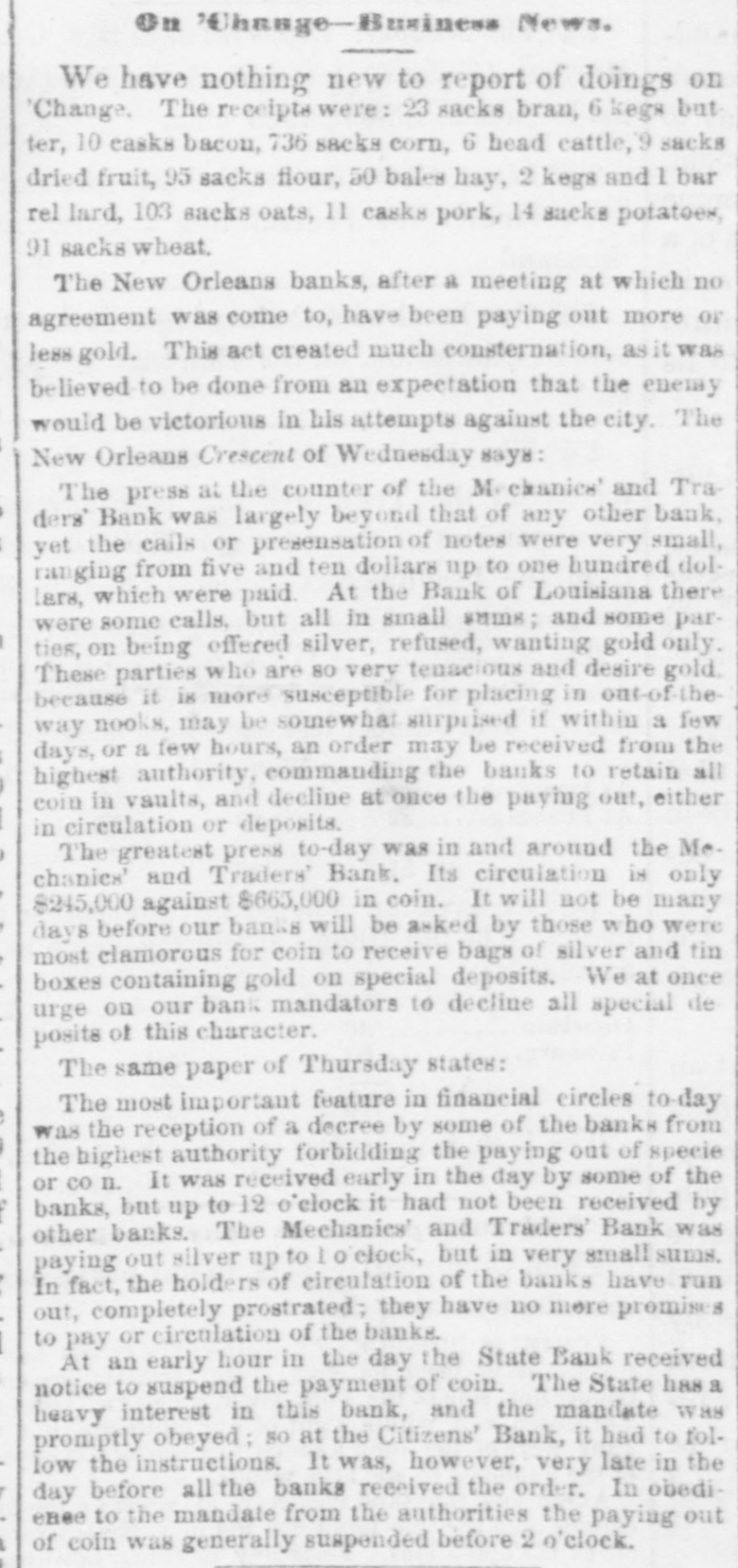
On Phaage-Business News. We have nothing new to report of doings on 'Change. The receipts were: 23 sacks bran, 6 kegs but ter, 10 easks bacon, 736 sacks corn, 6 head cattle, sacks dried fruit, 95 sacks flour, 50 bales hay, 2 kegs and 1 bar rel lard, 103 sacks oats, 11 casks pork, 14 sacks potatoes, 91 sacks wheat The New Orleans banks, after a meeting at which no agreement was come to, have been paying out more or less gold. This act created much consternation, as it was believed to be done from an expectation that the enemay would be victorious in his attempts against the city. The New Orleans Crescent of Wednesday says: The press at the counter of the M. chanica' and Traders' Bank was largely beyond that of any other bank, yet the cails or presensation of notes were very small, ranging from five and ten dollars up to one hundred dollars, which were paid. At the Bank of Louisiana there were some calls, but all in small amma; and some parties, on being offered silver, refused, wanting gold only. These parties who are 80 very tenacious and desire gold because it is more susceptible for placing in out-of the way nooks, may be somewhat surprised if within a few days, or a few hours, an order may be received from the highest authority, commanding the banks to retain all coin in vaults, and decline at once the paying out, either in circulation or deposits. The greatest press to-day was in and around the Me. chanies' and Traders' Bank. Its circulation is only $245,000 against $663,000 in coin. It will not be many days before our banks will be asked by those who were most clamorous for coin to receive bags of silver and tin boxes containing gold on special deposits. We at once urge on our bank mandators to decline all special de posits of this character The same paper of Thursday states: The most important feature in financial circles to-day was the reception of a decree by some of the banks from the highest authority forbidding the paying out of specie or CO n. It was received early in the day by some of the banks, but up to 12 o'clock it had not been received by other banks. The Mechanics and Traders' Bank was paying out silver up to I bleck, but in very small sums. In fact, the holders of circulation of the banks have run out, completely prostrated; they have no more promises to pay or circulation of the banks. At an early hour in the day the State Bank received notice to suspend the payment of coin. The State has a heavy interest in this bank, and the mandate was promptly obeyed; so at the Citizens' Bank, it had to follow the instructions. It was, however, very late in the day before all the banks received the order. In obedienee to the mandate from the authorities the paying out of coin was generally suspended before 2 o'clock.


Article from New Orleans Daily Crescent, May 7, 1862

Click image to open full size in new tab

Article Text

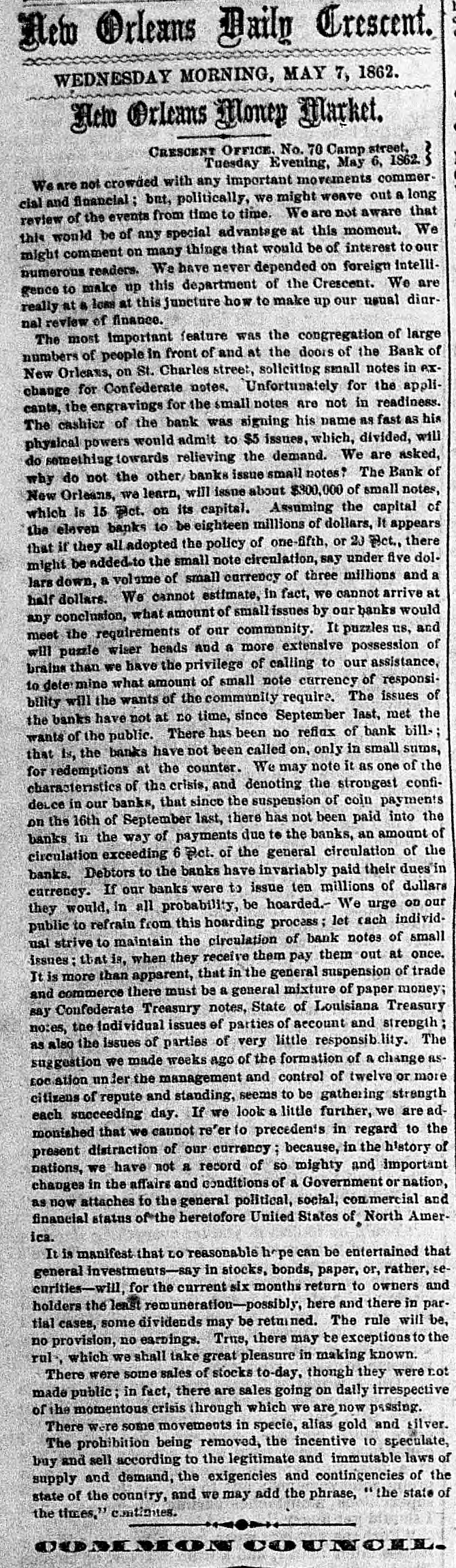
New Orleans Daily Crescent. WEDNESDAY MORNING, MAY 7, 1862. # New Orleans Money Market. CRESCENT OFFICE, NO. 70 Camp street, Tuesday Evening, May 6, 1862. We are not crowded with any important movements commer- cial and financial; but, politically, we might weave out a long review of the events from time to time. We are not aware that this would be of any special advantage at this momout. We might comment on many things that would be of interest to our numerous readers. We have never depended on foreign intelli- gence to make up this department of the Crescent. We are really at a loss at this juncture how to make up our usual diar- nal review of finance. The most Important feature was the congregation of large numbers of people in front of and at the doors of the Bank of New Orleans, on St. Charles street, soliciting small notes in ex- change for Confederate notes. Unfortunately for the appli- cants, the engravings for the small notes are not in readiness. The cashier of the bank was signing his name as fast as his physical powers would admit to $5 issues, which, divided, wili do something towards relieving the demand. We are asked, why do not the other banks issue small notes? The Bank of New Orleans, we learn, will issue about $300,000 of small notes, which is 15 ct, on its capital. Assuming the capital of the eleven banks to be eighteen millions of dollars, it appears that if they all adopted the policy of one-fifth, or 20 ct., there might be added to the small note cirenlation, say under five dol- lars down, a volume of small currency of three millions and a half dollars. We cannot estimate, in fact, we cannot arrive at any conclusion, what amount of small issues by our banks would meet the requirements of our community. It puzzles us, and will puzzle wiser heads and a more extensive possession of brains than we have the privilege of calling to our assistance, to dete mine what amount of small note currency of responsi- bility will the wants of the community require. The issues of the banks have not at no time, since September last, met the wants of the public. There has been no refiux of bank bills; that is, the banks have not been called on, only in small sums, for redemptions at the counter. We may note it as one of the characteristics of the crisis, and denoting the strongest confi- dence in our banks, that since the suspension of coin payments on the 16th of September last, there has not been paid into the banks in the way of payments due to the banks, an amount of circulation exceeding 6 ct. of the general circulation of the banks. Debtors to the banks have invariably paid their dues in currency. If our banks were to issue ten millions of dollars they would, in all probability, be hoarded. We urge on our public to refrain from this hoarding process; let cach individ- nal strive to maintain the circulation of bank notes of small issnes; that is, when they receive them pay them out at once. It is more than apparent, that in the general suspension of trade and commerce there must be a general mixture of paper money; say Confederate Treasury notes, State of Louisiana Treasury nozes, the individual issues of parties of account and strength; as also the issues of parties of very little responsib.lity. The suggestion we made weeks ago of the formation of a change as- Location under the management and control of twelve or more citizens of repute and standing, seems to be gathering strength each succeeding day. If we look a little further, we are ad- monished that we cannot re'er to precedents in regard to the present distraction of our currency; because, in the history of nations, we have not a record of so mighty and important changes in the affairs and conditions of a Government or nation, as now attaches to the general political, social, commercial and financial status of the heretofore United States of North Amer- ica. It is manifest that to reasonable hope can be entertained that general investments-say in stocks, bonds, paper, or, rather, se- curities-will, for the current six months return to owners and holders the lenst remuneration-possibly, here and there in par- tial cases, some dividends may be retained. The rule will be, no provision, no earnings. Trus, there may be exceptions to the rul, which we shall take great pleasure in making known. There were some sales of stocks to-day, though they were not made public; in fact, there are sales going on dally irrespective of the momentous crisis through which we are now passing. There were some movements in specie, alias gold and silver. The prohibition being removed, the incentive to speculate, buy and sell according to the legitimate and immutable laws of supply and demand, the exigencies and contingencies of the state of the country, and we may add the phrase, "the state of the times," continues. 003EMON COUNCIL.


Article from New-York Daily Tribune, May 30, 1862

Click image to open full size in new tab

Article Text

alone, we dare to raise the velce of condemnation against the second spoliation meditated by these corrupt and unprincipled corporations. On the memorable day of Bank dishonesty, the 16th of September, 1861, when the banking concerns of this place with the exception alluded to, declared their doors oclosed against the just claims of bill-holders, and with an effrontory without precedent, undertook to paste in the pass books of their cepositors a notice to the effect that the deposite them due would be paid to each and all on the resumption of specie payments, provided that the same had not been previously drawn for, we implored them to pense in the flagitious work, and not ruin this community by their insane infidelity to every honorable duty. We pointed out the heinousness of the pase-book notice, which claimed the use of depositors' money at the pleasure of the banks without interest, and we protested acainst an act which only the ples of national necessity and national relief could possibly or reasonably justify. Had the money of which this people was thus defranded been taken for the support of the revolution, the conduct of the banks would not, as we maintained at the time, have been justifisule, although the people would doubtless have approved it; but they pre-cipitated bankruptcy for no object conceivable to educated or opright minde, and now they avail themselves of the order of Gen. Butler to consummate their wickedness. The banks were even in advance of the popular disposition in the revolutionary cause; but we have yet to hear of sny unusual sacrifices their directors have made out of their own pockets for the support of the cause. It is a remark bie fact, too, that on the morning of their suspension they all seemed to possess an unlimited supply of that Confederate paper they then forced the public to receive, and of which they now set the first example of repudiation. We neither approved their first operation nor this of repudiation, their last; nor their la-termediate endeavors to put their property by every species of contrivance, beyond the resca of its legitimate owners. There are principles of right and justice so incontrovertibly obvious and supreme that no law or code, civil or military, can ignore or deny them; and such principles are now in-volved in the monetary affairs of this people. If one military power can absolve banking institutions from the redemption of their obligations solemnly guarantied, and another eaables them to complete the iniquitous work in the way most con-ducive to their own interests, any country under Heaven would be a paradise of justice compared to such a place. But we have no apprehension of any such resuit. and we would advise the banks not to presame too far upon the pe-tienae, good nature and forbearance af this public. If the po-sition they assume be sustained, revolution will be the chronia condition of every American commonwealth. If banks aud bankites are to be the only parties in social conflicts who are surete make a profitable business of such work the key te their boisterous patriotism is furnished. And that this view of their prospects is the one entertained by the public the following published statement of a sale of some ne of their stocks on Saturday last, will indisputably confirm. The sale is publiated as that of Palfrey & Co. Bank of New-Orleans.... $107 Crescent City Bank $00 Mechanics Bank. 121 Union Bank 110 Louisiana Bank.. 221 Citaens' Bank 209 Merchants' Bank.. 102 Baok of Americs... 198 This result will surprise no one who has watched the course of these institutions. They first procure the suspectsion of specie payment, under a patriotic pretext wholly beyond any human being's perceptions of its necessity. Then, avaiting themselves of the public necessities, they cause the price of foreign exchange, of which they have a monopoly, to advance two or three hundred per cent; seil bonds bought under ex-trenfe depression, or below par in every instance, for two or three times their nominal value; place their specie in hiding places unknown and insccessible except to themselves and their agents, and now undertake to close in a grand finale of cheatery by paying off in a currency they themselves com-pelied the people to accept, both the old cash deposits of the latter and all their accretions since the memorable epoch of suspension! They first force Confederate paper into circulation, and proit enormously by the operation, and then depreciate it by repudiation after it has been made to serve their sordid and dishonest purposes. In these proceedings the people will see the clue to the motive of these bank men in pusning this State into the issuance of war bouds in such toordinate amounte They wanted to make of the State credit a sponge for the ab-sorption of the surplus Confederate paper in their hands, and so nicely have they made their calculations, that at this mo-ment every device is in requisition to obtain even the Confed-erate bills necessary to meet the demand of resens depositors! We have no concealments to make in presence of Federal or Confederate authority; our record has no stains upon it; is enallenges examination We never hesitated, during the pe-riod to which we are referring, in proclaiming our opicion that, if the Richmond Government deemed the specie in the banks of this city absolutely indispensable to the revolution-ary cause, to which the country had committed itself, it was competent to it to take it. This we admitted, qualifying t however, er, with the opinion that to take unduly from one por-tion of the people, or to burden one class of citizens dispropor-tionately in this or any similar or dissimilar mauner, was an act of oppression for which extreme necessity only, which overrules all law, could be a justification. THURSDAY May 29, 1862. Markets-CAREFULLY REPORTED FOR THEN. Y. TRISCES ASHES are in improved demand, and the market is firm; antes of 50 bbis. Pots at $5 75, and 60 do. Posris at $6. COTTON-The advices from New Orleans to-day have been rather unfavorable to the prospects of speculators, and as thه manufacturers who were in the market have, in a great meas-ure, supplied themselves, the business has been less scrive, and at the close prices are heavy-31c. for Middling Uplands is quoted, though one or two lots sold a trifle below this figure. Sales of 900 bales. COFFEE-We hear of no sales in any description, and prices are nominally unchanged. FLOUR AND MEAL-The demand for Western and State Flour is less active, owing partly to the absence of a good as-sortment of Extra State, which is preferred to Western by shippers. The medium grades are insctive and quite irregu-lar: Trade" brauds aro quiet yet steady; the sa es are 12, 100 bbis, at $4 250 $4 40 for Superline State and Western; 455 @$480 for the low grades of Westera Extra; $45506465 for Extra State; $470@$480 for fancy do.; $500/520 for shipping brands of round-hoop Extra Ohio, and 35 36 66 25 for trade brands do. Canadian Flour is less abundant dand is quiet; the arrivals are moderate and consist mainly of the better grades; sales of 850 bbls. at $4 552 $4 75 for ship-ping brands of Spring Wheat Extras, and $4 802 $6 25 top Extras Southera Floar is in fair demand, especially good and choice Extras, but the low grades are dull yet steady ta price; sales of 1,630 bbls. at $5 100 +5 70 for wixed to go Superfine Baltimore, &c, and $5 75256 75 for trade brands ado. Rye Flour is steady and in fair request; sales of 260 bbia. at $2 152 64 05 for Superfine and Extra. Corn Meal is in moderate request and steady; sales of 400 bols. at $290 for Jersey, and 63 15 for Brandywine. GRAIN-The Wheat market is less active, and though the receipts are less liberal, prices of most kinds are 122e bush. lower, except prime, which is scarce and wanted; the inquiry is mainly for export, and notwithstanding the decline in the rates of freight, prices favor the buyer at the close; the trans-actions include 191.000 bush.. consisting of 46,000 do. Chicage Spring at 850.@$1; 60,700 do. Milwaukee Cub 90.@+1; 36.300 do. Amber lows at $102@$1 04: 12.400 do. North-Western Club at 870.@$1; 17.6% do. Red Western at $108@$1124, the inside rate for foul, and 17,700 do. Amber Michigan at $1 15@$118. Barley and Barley Mait are less active, but prices are unchanged. Onts are scarce and a shade firmer: salemof Canadian and Western as 3422440, and State at 44@44jc. Rye is in fair demand, and is of firmer; sales of 6,700 bush. at 6320ije, for Wes eru and 70e. for State. Corn is less active, and a shade easier, the demand alis mainly for the East; sales of 73,000 bush. at @4io. for new Mixed Western, and 4712 48te. for old do. HOPS are steady and in moderate request; sales of 100 bales e New at 14 @18c., as to quality. HAY-The supply is larger, and the market is heavy; sales e of 900 bales at 602650 100 1b. MOLASSES-There has been a moderate inquiry for home nee, and prices are maintained; sales of 45 hids Porto Rico eat 372 127 do. Cuba Mu covado at 272., and 60 do, at 3 je. NAVAL STORES generally are quiet, but prices are well maintained, sales of 100 bols. Common Rosin at $7 15, and e 100 do. No, 2 at 8252$350 280 10. OILS The market is inactive for most kinds, and prices are without essential change. PROVISIONS There has been only a moderate inquiry for Pork, and with continued large receipts the market is heavy sles of 700 bbls., at $12 25 for less, $12 for Unta-espected Mess, and $9 621@$975 for Prime Beef is inse motive, and priors are beavy; sales of 175 bbla, at $1225@$19 50 for Fisin Mesr, and $14@$14 87 for Extra do. Bacon is doll, and we have only to notice sales of 36 boxes Short-ribbed Western, at 44c. Cut Meats are in good request, at about me former rates: sales of 900 boxes, tes, aod hhds, at 31 @ijo. for ar Shoulders, and 44@5jc. for Hams. Lard seils only to a mod-erate extent, without material change, in prices; sales of 500 bois, and tes, at 7428jc, the inside rate for quite dark. RICE-Carolina is quiet, but holders stil demand full for at mer rates; East sells moderately at steady rates; 300 bags Rangoon were taken at 50ője. SUGARS-The sales of itaw to-day are very fair, being chiefly to refiners and city grocers, and prices are still main-dtained. The transactions embrace some 200 ahds. Porto Rico at 70810.700 Cuba at 747jc.; 37 bxs. Havana at The, and 13.500 bags Mantila at 70. SEEDS-Rough Flax Seed is in fair demand, and the mar-ket is firm at $2 1002 30 bush. Clover Seed is quiet at y 6. @ite. Timothy Seed is in fair request at $1750$ bush. TALLOW is in good demand, and holders are firm; sales of 520,000 15 Prime City at Dc., cash. Rough Fat is in fair request at 6c., essh WHISKY-A. very fair demand prevails, and prices are a

Article from Memphis Daily Appeal, June 14, 1862

Click image to open full size in new tab

Article Text

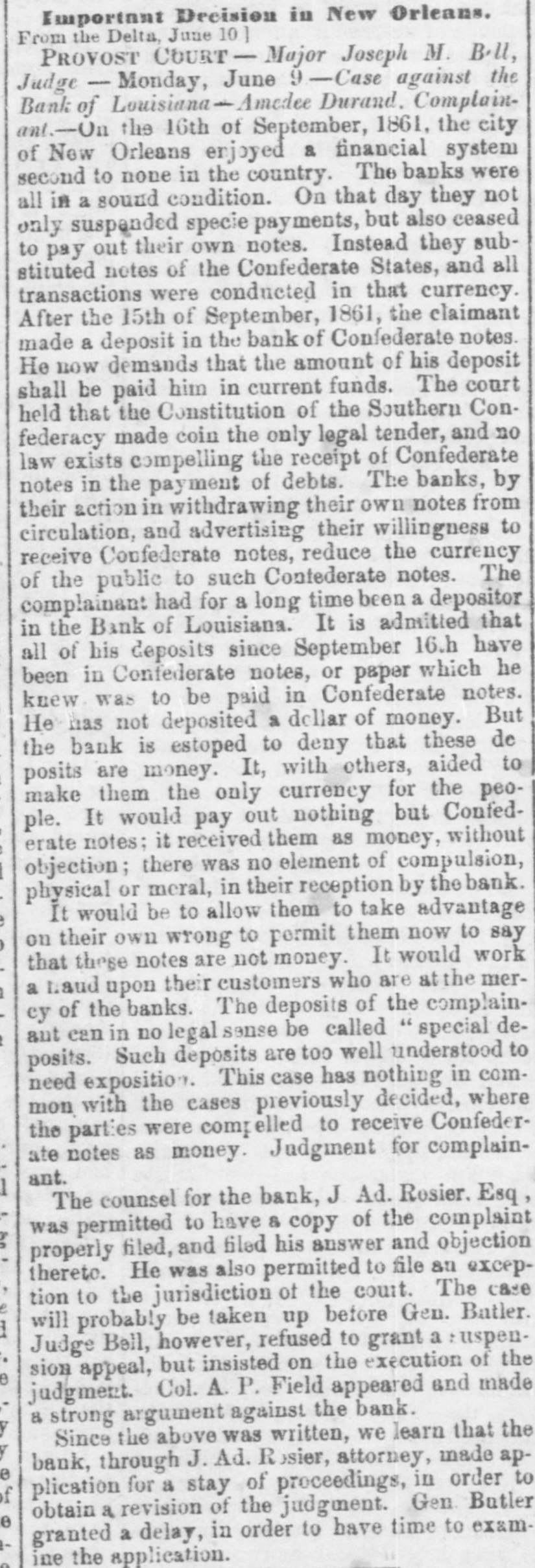
Important Decision in New Orleans. From the Delta, June 10 PROVOST COURT - Major Joseph M. Bill, Judge - Monday, June 9 -Case against the Bank of Louisiana-Amcdee - Durand, Complainant.-On the 16th of September, 1861, the city of New Orleans enjoyed a financial system second to none in the country. The banks were all in a sound condition. On that day they not only suspended specie payments, but also ceased to pay out their own notes. Instead they substituted notes of the Confederate States, and all transactions were conducted in that currency. After the 15th of September, 1861, the claimant made a deposit in the bank of Confederate notes. He now demands that the amount of his deposit shall be paid him in current funds. The court held that the Constitution of the Southern Confederacy made coin the only legal tender, and no law exists compelling the receipt of Confederate notes in the payment of debts. The banks, by their action in withdrawing their own notes from circulation, and advertising their willingness to receive Confederate notes, reduce the currency of the public to such Contederate notes. The complainant had for a long time been a depositor in the Bank of Louisiana. It is admitted that all of his deposits since September 16.h have been in Confederate notes, or paper which he knew was to be paid in Confederate notes. He nas not deposited a dollar of money. But the bank is estoped to deny that these de posits are money. It, with others, aided to make them the only currency for the people. It would pay out nothing but Confederate notes: it received them as money, without objection; there was no element of compulsion, physical or meral, in their reception by the bank. It would be to allow them to take advantage on their own wrong to permit them now to say that these notes are not money. It would work a Laud upon their customers who are at the mercy of the banks. The deposits of the complainaut can in no legal sense be called "special deposits. Such deposits are too well understood to need exposition. This case has nothing in common with the cases previously decided, where the parties were compelled to receive Confederate notes as money. Judgment for complainant. The counsel for the bank, J Ad. Rosier. Esq, was permitted to have & copy of the complaint properly filed, and filed his answer and objection thereto. He was also permitted to file an exception to the jurisdiction of the court. The case will probably be taken up before Gen. Batler. Judge Bell, however, refused to grant a : uspension appeal, but insisted on the execution of the judgment. Col. A. P. Field appeared and made a strong argument against the bank. Since the above was written, we learn that the bank, through J. Ad. R sier, attorney, made ape plication for a stay of proceedings, in order to of obtain a revision of the judgment. Gen Butler e granted a delay, in order to have time to examine the application.


Article from Chicago Daily Tribune, November 29, 1862

Click image to open full size in new tab

Article Text

as 07 ply the planters in the making of the crap sup- which supplies will be charged against the crop manufactured and shall constitute lien thereon. VIII. The Commissioners are authorized to the for work account the of United States such plantations as deserted by their owners, or are held by yai owners, as may seem to them exthe for of the purpose pedient, saving crops. IX. Any persons who have not been actually in arms against the United States since the occupstion of New Orleans by its forces, and who shall remain their moda praceably afford plantations, 16g no aid or comfort to the chemies the United vho shall and States, return to their allegiance, and who shall, by all reasonable methods, aid the States called when United be upon, may ere by the Commission to work their own plan- empowtheir to make to tations, and ownerop, retain session of their own property, except such as 18 posnecessary for the military uses of the United States. And toall all such persons the Commission to means furnish of authorized transportation for their crops and supplies, at just and equitable prices. Section X authorizes the commissioners to hear and determine questions of loyalty, Se. Gen. Butler has issued an order suppressing the Daily Advocate for tressonable utterances. Gen. Butler has also issued an order forbidding the arrest of alaves and confluing them in prison, to be held for their masters, unless it is positively known that the master is a loyal citizen. HON. REVERDY JOHNEON-STRANGE DEVELOPMENTS. [From Orleans Correspondence N. Y. Times.] In one of my recently written letters, endeavored to give you Some slight Idea of the external history of Hon. Reverdy Johnson's visit to this city. The internal consequences are beginning to develop themselves. Among the seizures of specie made by Gen. Batler of amount SEM of claimed large propecia by French citizens, end of course was taken posof Butler Gen. session under by for protest the French Consul. This case was one event. uslly referred to the astute, Union-loving Commissioner, and advised the government to pay back the money to the French Consul. now appears that developing nistory justi fics the action and the sugacity of the Commanding General, for it now appears that this W38 money belonging to to-New Orleans citizens and was taken in charge by the French Consul to pay for cloth now in Havana, awaiting to run the blockade, to be used by the Contederate Government. The money ($495,000) four bundred and five thousand dollars, released by Mr. Johnson's recommendation, was actually sent from this city to Havana within the last forty days, on board the Spanish war steamer Blascode de aud that the Garay, was money borrowed from the Bank of New Orleans by J. D. B. De Bow, agent for the Richmond Government, 08 will appear from the following correspondence: NEW ORLZANS. April 14, 1862. The undersigned having been requested to farQuartermaster this post withthe means of settling Ed. Gantherin' bill for army supplies, $405,000 to amounting hundred (four and five thousand dollars.) desires to borrow that amount from the Bank of New leans, in coin, without interest, on the credit of the Confederate States, and makes this applicction for the same. J. D. B. Dr. Agent Produce Loan. BANK OF NEW ORLEANS, April 14, 1862. J. D. B. De Bow, Esq., Agent Produce Loan: SIR: This bank has received your application for a loan of $405,000 (four hundred and five thou esnd dellars) in coin, to the Confederate States government, for the purpose of paying the bill of Gautherin & Co for army dothing, and hereby accede to your proposition. Respectfully yours, 30. BELLY, Cashier. The French Consul, you will remember, was one of the active agents and friends of Mr. Johnson, while he was here, interfering with Gen. Butler's Department, and, as will now be seen, innocently we trust, playing into the hands of the secessionists. The said French Consul, finally fearing lest he should be discovered in his dishonest interference, and thereby implicate his government, withdrew the original receipts given, and substituted other names, French subjects here, Messrs. E. Gautherin & Co., and two gentlemen of the name of Le More, que of whom, by the order of Gen. Butler, is at Fort Jackson, the other at Fort Pickens. Davis, the President of the bank, and Howall, the bank director,sre now in prison, prison,awaiting trial for theircrimes. The present board of directors, all of whom are believed to be innocent of any complicity the in and not of transaction, one whom even suspected its nature, until informed of it by Gen. Butler. The bank, from a temporary suspension, has again resumed its business. Thus the world will now understand what Gen. Butler probably knew all the while, that the astute Johnson has been completely humbugged and deceived, and the citizens of the United States Government, by his unhappy inteff rence with things he could not undersisnd, have been robbed of nearly S half & million dollars for the benefit of the government at Richmond. CONGRESSIONAL DELEGATION. Brig. Gen. Shepley, Military Governor of Lonisiane, has isued proclamation calling an election for Members of Congress from the New 1st District, of composed and Orleans and the parishes of St. Bernard and PI aquemine, and the 2d District, composed of a portion of the City of New Orleans, and the parishes of JefSt. St. the John ferson, St. Charles, Baptist, James, Ascession, Assumption; Lafourche, Terrbonne, St. Mary and St. Martin. In order to secure to the loyal electors of these parishes their appropriate and lawful representation in the House of Representatives of the United States of America, and of enabling them to avail themselves of the benefits secured by the proclamation of the President of the United States to the people of any State, or part of State, who shall on the 1st of in January be, next, day faith, good represented in the Congress of the United States, by members chosen thereto, at elections whereina majority of the qualified voters of such State have participated. Seven prisoners belonging to the Sth Vermont, had been shot by the rebels at Bavon der Allemand, because they had been enlisted in New Orleans. REMARKBLE SPEECH. Gen. Pemberton who was in the serives of the Union when the rebellion broke out, but who turned traitor, went into the rebel army, and has superseded Van Dorn, recently made a speech, of which the following is & copy. reference to Lovell, formerly of New York, as a street scavenger, is pungent: SOLDIERS: In assuming command of so brave and intelligent an army as that to which President Davis has assigned me, desire at once to win your confidence by frankly de claring that am a Northern man by birth; but have married, raised children, and owned negroes in the South, and, as such, shall never consent to EEG my daughters esting at the same table, or intermarrying with the black race, as the Northern teachers of equality would have them. I take command of you as & soldier, who will not fear to lead where any brave man can follow. am no street scavenger-no General Lovell. [Cheers. If any soldier in this command is aggrieved by any act of his superior officer, he must have no hesitation in applying to me personally for redress. The doors of my headquarters shall never be closed against the poorest and humblest soldier in in my my command. Come to meifyou suffer wrong, as fearlessly as you would charge the enemy's B battery, and no Orderly shall turn you off, or tell you, 08 the case has in too our much been that army, a General cannot see nor hear the complaints of his soldiers. Applanse.] In regard to the question of interference by Europs, we want no interference in our private quarrel. [Great


Article from Washington Telegraph, December 31, 1862

Click image to open full size in new tab

Article Text

LATEST FROM NEW ORLEANS-The National Advocate, Jacob Barker's paper, had been suspended for approving of European intervention as a means of ending the war. Jacob, however, explained all the bad meaning away, and was, thereupon, allowed to resume. Four negroes were on trial, for recently murdering Mr. Millaudon. Dr. Rushton's death is announced. Butler has allowed the Bank of New Orleans to resume. During the week ending 15th ult., 12,872 families had received aid from the U S. Relief Commission, of which 4657 were Irish ; 1290 Americans 3932 Germams; 588 English; 64 Scotch ; 723 French: 141 Spanish; 1308 colored, etc. : a statement which indicates a vast amount of pauperism and destitution in the Crescent City. Only one vessel cleared on the 12th ult. She was a barque for Liverpool, with tobacco, staves, hides, and 52 bales of cotton. There are no quotations of cotton in the prices current. Flour was $11 and $12 for choice and extra; coffee, Rio, 50c; Java, 60c.; whiskey, 83. The finest sugar, 9c.; molasses, 43c. per gallon. Business was very dull. Ample stocks of breadstuffs and provisions.


Article from Alexandria Gazette, February 28, 1863

Click image to open full size in new tab

Article Text

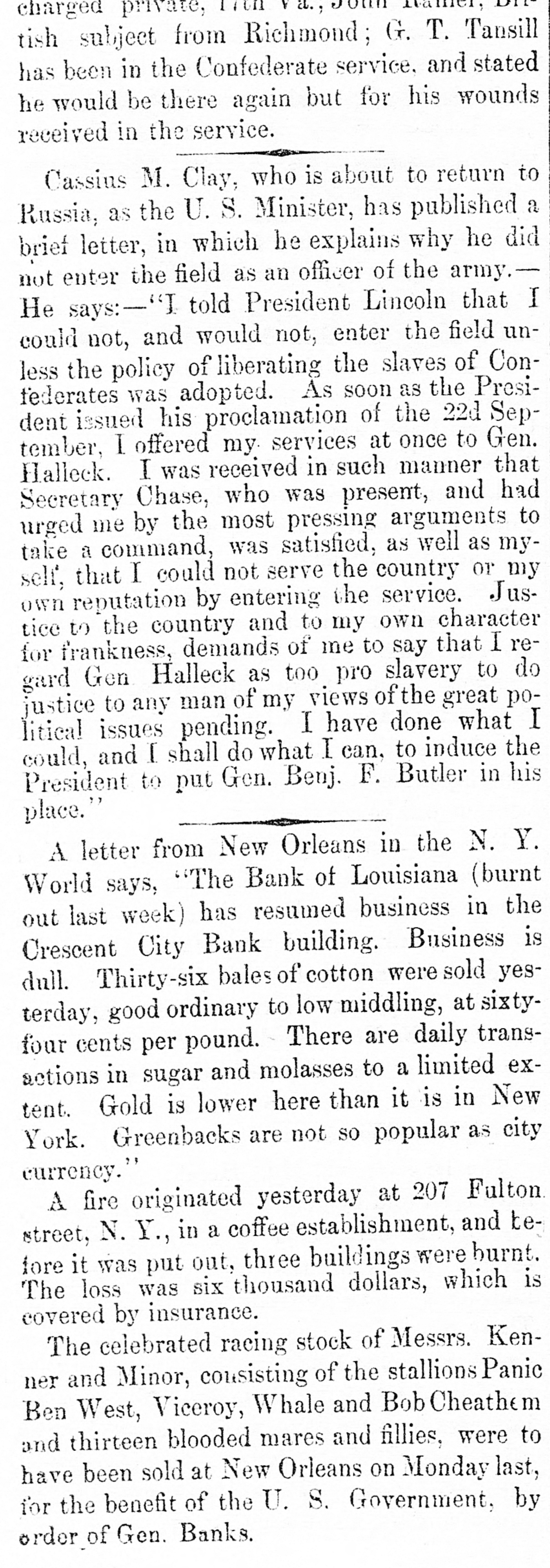
private, charged tish subject from Richmond; G. T. Tansill has been in the Confederate service, and stated he would be there again but for his wounds received in the service. Cassius M. Clay, who is about to return to Russia, as the U. S. Minister, has published a brief letter, in which he explains why he did not enter the field as an officer of the army.He says:-"I told President Lincoln that I could not, and would not, enter the field unless the policy of liberating the slaves of Confederates was adopted. As soon as the President issued his proclamation of the 22d September, I offered my. services at once to Gen. Halleck. I was received in such manner that Secretary Chase, who was present, and had urged me by the most pressing arguments to take a command, was satisfied, as well as myself, that I could not serve the country or my own reputation by entering the service. Justice to the country and to my own character for frankness, demands of me to say that I regard Gen Halleck as too pro slavery to do justice to any man of my views of the great political issues pending. I have done what I could, and [ shall do what I can, to induce the President to put Gen. Benj. F. Butler in his place." A letter from New Orleans in the N. Y. World says, "The Bank of Louisiana (burnt out last week) has resumed business in the Crescent City Bank building. Business is dull. Thirty-six bales of cotton were sold yesterday, good ordinary to low middling, at sixtyfour cents per pound. There are daily transactions in sugar and molasses to a limited extent. Gold is lower here than it is in New York. Greenbacks are not SO popular as city currency." A fire originated yesterday at 207 Fulton street, N. Y., in a coffee establishment, and before it was put out, three buildings were burnt. The loss was six thousand dollars, which is covered by insurance. The celebrated racing stock of Messrs. Kenner and Minor, consisting of the stallions Panic Ben West, Viceroy, Whale and Bob Cheathem and thirteen blooded mares and fillies, were to have been sold at New Orleans on Monday last, for the benefit of the U. S. Government, by order of Gen. Banks.


Article from New-York Daily Tribune, June 27, 1863

Click image to open full size in new tab

Article Text

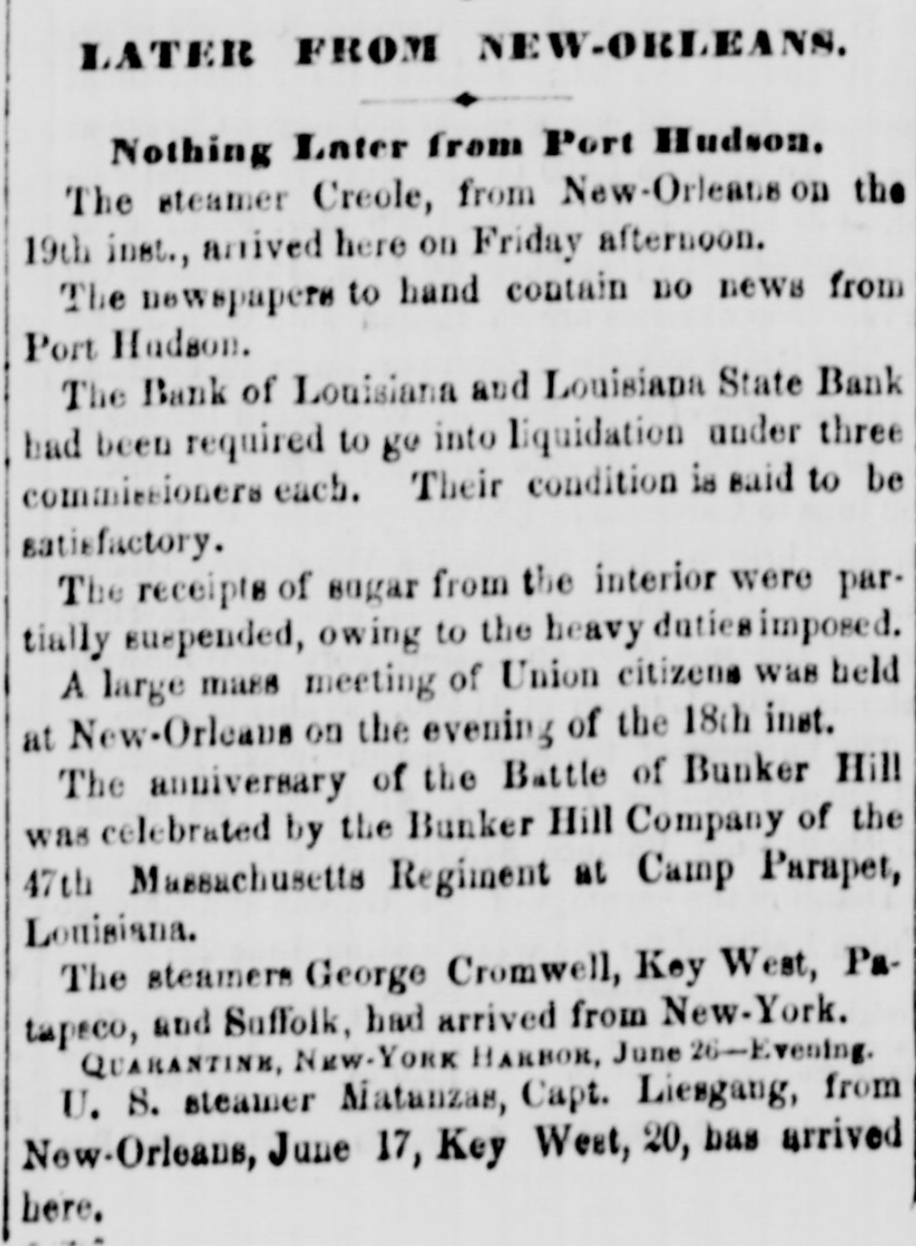
LATER FROM NEW-ORLEANS. Nothing Later from Port Hudson. The steamer Creole, from New-Orleans on the 19th inst., arrived here on Friday afternoon. The newspapers to hand contain no news from Port Hudson. The Bank of Louisiana and Louisiana State Bank had been required to go into liquidation under three commissioners each. Their condition is said to be satisfactory. The receipts of sugar from the interior were partially suspended, owing to the heavy dutiesimposed. A large mass meeting of Union citizens was held at New-Orleans on the evening of the 18th inst. The anniversary of the Battle of Bunker Hill was celebrated by the Bunker Hill Company of the 47th Massachusetts Regiment at Camp Parapet, Louisiana. The steamers George Cromwell, Key West, Patapsco, and Suffolk, had arrived from New-York. QUARANTINE, New-York HARBOR, June 26-Evening. U. S. steamer Matanzas, Capt. Liesgang, from New-Orleans, June 17, Key West, 20, has arrived here.


Article from Evening Star, June 27, 1863

Click image to open full size in new tab

Article Text

From New Orleans. NEW YORK, June 26.-The bark Creole, from New Orleans on the 19th inst., has arrived. The papers contain no news from Port Hudson. The "Bank of Louisiana" and the "Louisiana State Bank" have been required to go into liquidation under three commissioners each. Their condition is said to be satisfactory. The receipts of sugar from the interior has been partly suspended, owing to the heavy duties imposed. A large mass meeting of Union citizens was held at New Orleans on the evening of the 18th.


Article from Alexandria Gazette, June 27, 1863

Click image to open full size in new tab

Article Text

THE SIEGE OF VICKSBURG. MEMPHIS, June 23, via CAIRO, June 25.---Official intelligence from Grant's army to the 20th has been received. Johnston is said to have withdrawn his forces from across the Big Black, moving towards Clinton. About a thousand Texans attacked Lake Providence on the 10th but were repulsed with loss by the negro troops who fought bravely. Colonel Phillips with eight hundred cavalry, was attaked by two hundred Cofederate infantry and one thousand cavalry under Rockerford on the Tallahatchie. The fight was severe. Phillips lost seven killed and ninety wounded. He cut his way out and came in yesterday. The Cofederates are in force at Boonville, Generals Roddy, Ruggles, Chalmers, and Biffiers, threaten the lines and troops are reported moving north from Okolona. Stirring news may be expected from this section. The Baltimore American says:-"All the turnpike roads leading to the city are now not only thoroughly guarded, but pretty well barricaded, in order to prevent any advance to the town by the Confederates. Inconsequence of these preparations, and the peculiar state of affairs which now exists, it has been deemed wise and prudent to per nit no citizens to leave the place without first securing passes." The N. Y. Times says, that when the New Jersey troops reached Po., they we. refused acceptance unless they would be sworn into the U. S. service for six months, under the President's proclamation. The Governor of Penn., moreover instructed his transportation agents at Philadelphia to forward no troops to Harrisburg who would not enter the U. S. service under the six months' call. This was not what the New Jersey troops had offered to do, nor what Gov. Parker had called on them to do nor what he had, any authority by State law to require them to do. And, therefore, he ordered them home, the entire expense of his volunteer services, it seems, falling on the State of N. Jersey. The New Orleans papers contain no news from Port Hudson. The Bank of Louisiana and the Louisiana State Bank have been required to go into liquidation, under three commissioners each. Their condition is said to be satisfactory. The receipts of sugar from the interior have been partly suspended, owing to the heavy duties imposed. A large mass meeting of Union citizens was held in N. Orleans on the 18th inst. Gen. Butler, arrived in Washington yesterday evening, and is stopping at Willard's. It is rumored that the object of his visit is to look after his interests in the question of seniority between himself and General Fremont, now pending before a military commission. Rev. Dr. Leacock, of New Orleans, recently


Article from Cleveland Morning Leader, June 27, 1863

Click image to open full size in new tab

Article Text

FROM NEW ORLEANS. NEW YORK, June 26. The steamer Creole, from New Orleans on the 19th of June, has arrived. Papers come to hand contain no news from Port Hudson. The Bank of Louisiana and the Louisiana State Bank had been required to go into liquidation under three commissioners each; their condition is said to be satisfactory. Receipts of sugar from the interior were partially suspended owing to the heavy duties imposed.


Article from The Weekly Register, July 2, 1863

Click image to open full size in new tab

Article Text

From New Orleans. NEW YORK, June 26.-The steamer Creole from New Orleans on the 10th has arrived. The papers contain no news from Port Hudson. The Bank of Louisiana and Louisiana State Bank, had been required to go into liquidation under three commissioners each. Their condition is said to be satisfactory. Receipts of sugar from the interior was partially suspended owing to the heavy ties imposed.


Article from The Weekly Register, July 2, 1863

Click image to open full size in new tab

Article Text

From New Orleans. NEW YORK, June 26.-The steamer Creole from New Orleans on the 19th has arrived. The papers contain no news from Port Hudson. The Bank of Louisiana and Louisiana State Bank, had been required to go into liquidation under three commissioners each. Their condition is said to be satisfactory. Receipts of sugar from the interior was partially suspended owing to the heavy due ties imposed.


Article from The New Orleans Crescent, March 16, 1869

Click image to open full size in new tab

Article Text

# SIXTH DISTRICT COURT. Important Decision Relative to Bank of Louisiana Notes-The Bank Compelled to Receive its own Notes in Payment of all Dues, In the Sixth District Court, Judge W. H. Cooley, the following decision was rendered yesterday: It appears that in 1861, M. A. Becnel and L. Becnel subscribed a promissory note to their own order and indorsed it, for the sum of twenty thousand three hundred and forty-five dollars eighty cents. That said note was the property of the Bank of Louisiana at the time the forfeiture of its charter was judicially declared, and is now in possession of the commissioners appointed to liquidate the affairs of the insolvent bank. M. A. Becnel having applied to the commissioners to pay said note, tendered them bills of the Bank of Louisiana, which they refused to receive in payment of the note due by him. Hence the present proceeding on the part of Becnel to compel the commissioners to receive the bills tendered by him in payment of his note and the delivery to him of the note. The commissioners thus brought into court, before urging any defense to the merits, have thought proper to take exception to the form of the proceeding. I cannot conceive what interest these commissioners, who are presumed to be acting for the benefit of the creditors and not for themselves, can have in contesting the mere form of the proceeding. It is the interest of the creditors, and the holders of the bills of the bank are preferred ones, that if there be any doubt on the point raised by the rule, it should be decided promptly and without any unecessary delay. Those who hold the notes of the Bank of Louisiana are entitled to know at once whether the bills they have can be used as effects against the debts due to the bank, and this appears to be a matter of vital importance to them, as the law under which the commissioners act, makes the bill holders creditors by preference. It does seem to me that skirmishing on the outside, when it can accomplish no other purpose than that of delaying the decision of the main and only important question involved, is in conflict with the best interests of the bill holders. The question raised by the rule is whether the commissioners are obliged to receive the bills of the Bank of Louisiana in payment of the notes due to it, and the question can be met and satisfactorily argued and decided on a rule as well as in any other form of proceeding. But the technical plea besides being in fact to some extent prejudicial to those whose interests it is the first duty of the commissioners to protect, is in law totally untenable. It is predicated upon the idea that debtors of the Bank of Louisiana are third persons to the insolvent proceedings. Considering for the sake of argument that they are third parties, they have none the less interests involved in the matter, and whenever it becomes necessary for their protection, like all others, they may make themselves parties to the suit. But without any act of theirs they are parties and necessary parties to the proceedings for the liquidation of the bank; which are nothing but insolvent proceedings after all. In the letter and spirit of the act of 1842 all the creditors and debtors of the bank become parties in the proceedings instituted with the view of its liquidation. So much for the technical objection. The denial of the commissioners that they are bound to receive the notes of the Bank of Louisiana in payment of notes due to the bank, and the corresponding assertion that they have the power to compel the payment of such debts due the bank in legal currency of the United States, is not only unfounded in law, but considering how plain the law is to the contrary, the claim put forth by them is strange in the extreme. The whole contest finds a ready and easy solution by the following words contained in the act of 26th March, 1842, amendatory of another act of the same year: "Provided. That nothing contained in the act to provide for the liquidation of banks or other laws of the State, shall be so construed as to deny to persons having notes to pay in banks in liquidation, the right of paying said notes in the bank notes of saidliquidating banks, except when said notes may have been transferred to the other banks as security for receiving the circulation of the said liquidating banka." See Bess, acts of 1842, page 454. It is not pretended that the note due by Becnel is in the possession of the other banks as security for receiving the circulation of the Bank of Lou-isiana. I cannot conceive what language the Legislature of 1842 could have employed to make the obligation of a liquidating bank to receive its own notes, more clear, plain and emphatic. But if this law be not explicit enough the act of the 5th April, 1843, certainly is. The proviso in the second section of this act says: "* And that it shall be the duty of each of the banks of the State at all times to receive in offset or part offset of debts due to it, its own debts when liquidated and past due, whether for circulation, deposits, or arising from any other source whatever, and whether such banks be or not in liquidation, and without reference to the date at which the debtor offering such tender may have acquired the claim offered by him in offset. *" The object of the Legislature was to insure the payment of the bill holders, and the lawgiver was so solicitous to accomplish this object that in the act of 1842 reviving the charters of the several banks which had suspended specie payment, one of the conditions imposed upon the several banks as a consideration for the revival granted was that they should receive each others' circulation. The language is plain and full of meaning: "And it shall be the duty of the banks not in liquidation under the provisions of this act, and as a condition for the restoration of their charters to receive at par at their respective counters in payment of all debts and obligations due and owing them respectively the circulation of the bank or banks that may enter into liquidation voluntarily or otherwise under the provisions of this act." See 8th section of the article of 5th Feb. 1842, Sess. acts page 48. This act was subsequently amended, but only to limit the amount of the circulation of a liquid-ating bank which the others were bound to receive, and to fix the terms of their reception. The extent of the first obligation was limited, but the obligation pro tanto still exists. Thus, when it is very plain that even the other banks may, for a certain amount and upon certain conditions, be compelled to receive at their counters at par the circulation of the liquidating bank, it is contended that the liquidating bank itself is not bound to receive its own notes. The language is not only plain, but has received the sanction of judicial interpretation by the Supreme Court in several cases. The first is that of "The Commissioners of the Exchange and Banking Company of New Orleans vs. Mudge et al.," reported in 6 Robinson's reports, page 397. In that case it was urged that the intent of the Legislature was that the bank should be liquidated in the same manner an insolvent estate was administered; that the rules governing the last were applicable to the first; and that if the commissioners were compelled to receive of the liquidating bank in payment, that the bill holders would be the only creditors paid, as the bank was notoriously insolvent. These objections were met and refuted in a very able manner. I quote one of the concluding paragraphs of the very able opinion delivered by Judge Bullard, as the organ of the court: "It appears to us, therefore, clear that the Legislature intended to make special provision for the bill-holders, and to make the circulation of the bank always a good offset to debts due to the liquida-ting banks. The justice or policy of particular laws does not concern the judicial department; but it would appear but just that those who received the bank notes as money, under the sanction of the Legislature, should be particularly favored." The obligation to receive its own notes in payment on the part of the liquidating banks, so decided in the case already quoted, has been uniformly adhered to by our Supreme Court. See cases of Citizens' Bank of New Orleans vs. the Levee Steam Cotton Press Company, 11 Rob., 286.; Saunders et als., commissioners, vs. Smith, administratrix, 4 A. R., 232; J. R. Marshall vs.