7542. Atchafalaya Bank (New Orleans, LA)

Bank Information

Episode Type
Run → Suspension → Closure
Bank Type
state
Start Date
March 5, 1842
Location
New Orleans, Louisiana (29.955, -90.075)

Metadata

Model
gpt-5-mini
Short Digest
cf330e13

Response Measures

Accommodated withdrawals, Full suspension

Other: Bank was placed in liquidation/sequestration by the Attorney General; cashier absconded and officers sued.

Description

Newspaper articles from Mar–Apr 1842 describe a run on several 'discredited' New Orleans banks including the Atchafalaya, followed by legal actions: closed by the Attorney General, sequestration/writs, and placement in liquidation/receivership. Cause of run is bank-specific adverse information (discrediting, alleged excess issues, cashier absconding). Suspension/closure resulted from government action (sequestration/liquidation).

Events (4)

1. March 5, 1842 Run
Cause
Bank Specific Adverse Info
Cause Details
Bank was 'discredited' among depositors; reports of excess issues and misconduct (cashier absconding) undermined confidence, producing heavy withdrawals.
Measures
Exchanged current bank notes for its own notes (attempt to meet redemptions with in-kind note exchanges).
Newspaper Excerpt
There is a good deal of excitement in the streets to-day against the four discredited banks, and of course a general run upon them... The Atchafalaya Bank gives current bank notes in exchange for her own.
Source
newspapers
2. March 22, 1842 Other
Newspaper Excerpt
The Exchange, Atchafaya and Orleans Banks have been closed by the Attorney General and their assets are now in the hands of the Board of Currency... The Cashier of the Atchafalaya had absconded, owing but small sum, $500 to $2,000, unless a larger deficiency should be discovered.
Source
newspapers
3. April 5, 1842 Suspension
Cause
Government Action
Cause Details
Closed by writs of sequestration / Attorney General actions and placed into liquidation by court order.
Newspaper Excerpt
the Exchange, Orleans and Atchafalaya Banks have been closed by writs of sequestration, issued by the District Court on application of the Attorney General.
Source
newspapers
4. June 18, 1842 Other
Newspaper Excerpt
When the Board placed the Exchange, the Orleans, and Atchafalaya Banks in liquidation, with a circulation of near two millions of dollars, after the first ... (Board commentary that these banks were placed in liquidation).
Source
newspapers

Newspaper Articles (6)

Article from Baton-Rouge Gazette, December 25, 1841

Click image to open full size in new tab

Article Text

EXECUTIVE DEPARTMENT. New Orleans, 18th December 1841. Sta-1 have the honor to acknowledge the receipt of the letter which has been addressed to me yesterday, in the name of the Board of Directors over which you preside, to express their regret that, in my late annual mesange to the general assembly, "the Carrollton Bank has been classed an one of the institutotal which has encreased its liabilities during the last two years." No one could have experienced more uncasinces than I would, if through any error contained in the communication to which you allude, the Carrollton Bank, or any other, had been made undeservedly to suffer. I therefore feel happy in being able to stato and to prove that this has not been the case. In the discharge of what I considered a dutv. I have informed the legielature that the Board of Presidents have postponed the resumption of specie payments until November 1842, in order to enable the weak banks to change their position. It is not through any act of mine that your institution has been classed as a weak bank. It has been done by a resolution adopted by the Board of Presidenta in the following words: "Resolved, that the aid which may be necessary to enable the improvement, the Exchange, the Atchafalaya, the Orleans and the Carrollton Banks to resame payment in specie with the other banks, be furnished to said banks immediately, &c." Wishing to prove, by what had already taken place, that those weak banks could not expect to be benefited by a continuation of the suspension, I have given the position of each of them in October last, and in November, 1839, immediately after the second suspension; and I have shown that during the last two years, their collective cash liabilities have increased more than $780,000, and their collective cash assets have decreased $300,000. The statements on which my calculations were based, have been extracted from a document submitted officially by the Citizens' Bank to the Board of Presidents of the banks of this city, which has since been laid by that institution before the general assembly.These were the only data on which I could safely act, because the information on the situation of our monetary institutions which had requested officially from the Secretary of the Board of Presidents, could not be communicated to me, notwithstanding the willingness of that gentleman to do so, before the inceting of the legislature. In neither of the statements quoted in my message, can you find a cause of complaint, for in both of there your liabilities are smaller than those now given by yourself. Your classification with the institutions that have augmented their liabilities could not be avoided, for having undertaken to show the effect of srspension on all the banks which the Board of Presidents intended to relieve. I could not help classing you with them, without making a distinction which might appear invidious between the banks which they had thought proper to connect. I learn with much pleasure that the Carrollton Bank is preparing to resume specie payments, "at as early a period as a majority of the banks of this city may do so." I hope that the time is not far distant when the country shall be relieved from the calamities which necessarily follow the circulation of an irredeemable paper currency. Respectfully, Your obedient servant. A. B. ROMAN. (Signed) G.C. DUNCAN, President of the Carrollton Bank.
Article from Richmond Enquirer, March 5, 1842

Click image to open full size in new tab

Article Text

THE NEW ORLEANS BANKS.-There - is a good deal %'excitement in the streets to-day against the four discredited banks, and of course a general run upon them been the consequence. The Exchange Bank, finding that her fires were all -ing sent in for redemption, has refused to give any thing in exchange for her notes, of whatever denominaLon. The Atchafalaya Bank gives current bank notes in exchange for her own. The Bank of Orleans and Improvement Bank generally give current notes in redemption. [N: Orieans Advertiser, Feb. 24. The panic is on the increase. The note-holders have taken alarm, and considerable sacrifices have already been submitted to, on the circulation of the four banks noticed in our last paper as having been discredited by the others. We confess our utter inability to predict the result of the crisis. If there was any spice of misanthropy at the bottom of the late movements in relation to the currency, it at least has no oceasion to feel satisfied at the extent of the mischief before us. There has been no violence, and we have every reason to hope that there will be none.-Bre. BALTIMORE BANKS.-The Baltimore Bapks, in conreation, have adopted resolutions to the effect that they will be ready to resume specie payments on the 1st of August; or that they will be able to resume in sixty days, if the Legislature will allow an issue by them of SI and 82 bills, to the amount of 5 per cent. of their capital. A communication setting forth this, was sent to the Legislature. FROM HARRISBURG.-The action of the Senate Monday upon the Resumption bill, sent it back to the House. Tuesday the House adhered to its position, and voted down a motion for a committee of conference-it was supposed to let the Senate make the movement, that the complexion of the Senate's committee might be ascertained (Last night's mail states, that a Committee of Conference has been appointed. The result uncertain.)


Article from New-York Tribune, March 22, 1842

Click image to open full size in new tab

Article Text

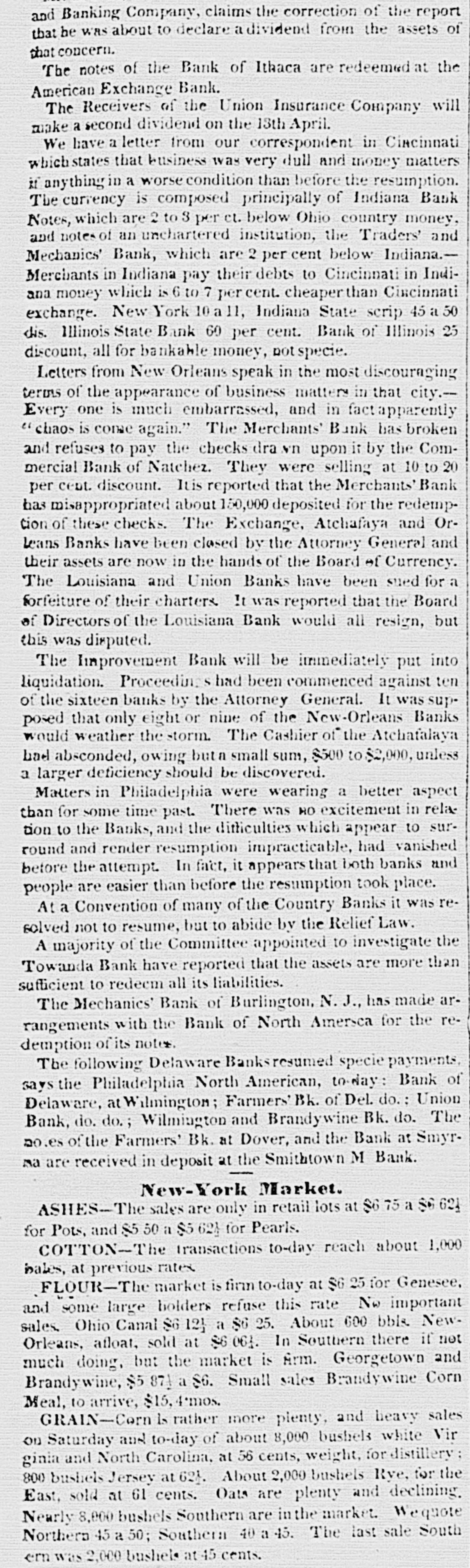
and Banking Company, claims the correction of the report that be was about to declare a dividend from the assets of that concern. The notes of the Bank of Ithaca are redeemed at the American Exchange Bank. The Receivers of the Union Insurance Company will make a second dividend on the 13th April. We have a letter from our correspondent in Cincinnati which states that business was very dull and money matters anything in a worse condition than before the resumption. The currency is composed principally of Indiana Bank Notes, which are 2 to 3 per ct. below Ohio country money, and notes of an unchartered institution, the Traders' and Mechanics' Bank, which are 2 per cent below Indiana.Merchants in Indiana pay their debts to Cincinnati in Indiana money which is 6 to 7 per cent. cheaper than Cincinnati exchange. New York 10 a 11, Indiana State scrip 45 a 50 dis. Illinois State Bank 60 per cent. Bank of Illinois 25 discount, all for bankable money, not specie. Letters from New Orleans speak in the most discouraging terms of the appearance of business matters in that city.Every one is much embarrassed, and in fact apparently "chaos is conse again." The Merchants' Bank has broken and refuses to pay the checks dra vn upon it by the Commercial Bank of Natchez. They were selling at 10 to 20 per cent. discount. Itis reported that the Merchants' Bank has misappropriated about 150,000 deposited for the redemption of these checks. The Exchange, Atchafaya and OrLeans Banks have been closed by the Attorney General and their assets are now in the hands of the Board of Currency. The Louisiana and Union Banks have been sued for a forfeiture of their charters. It was reported that the Board of Directors of the Louisiana Bank would all resign, but this was disputed. The Improvement Bank will be immediately put into liquidation. Proceedings had been commenced against ten of the sixteen banks by the Attorney General. It was supposed that only eight or nine of the New-Orleans Banks would weather the storm. The Cashier of the Atchafalaya had absconded, owing butn small sum, $500 to $2,000, unless a larger deficiency should be discovered. Matters in Philadelphia were wearing a better aspect than for some time past. There was HO excitement in relation to the Banks, and the difficulties which appear to surround and render resumption impracticable, had vanished before the attempt. In fact, it appears that both banks and people are easier than before the resumption took place. At a Convention of many of the Country Banks it was resolved not to resume, but to abide by the Relief Law. A majority of the Committee appointed to investigate the Towanda Bank have reported that the assets are more than sufficient to redeem all its liabilities. The Mechanics' Bank of Burlington, N. J., has made arrangements with the Bank of North Amersca for the redemption of its notes. The following Delaware Banksresumed specie payments, says the Philadelphia North American, to-day: Bank of Delaware, at Wilmington; Farmers' Bk. of Del. do.: Union Bank, do. do.; Wilmington and Brandywine Bk. do. The 20.08 of the Farmers' Bk. at Dover, and the Bank at Smyrna are received in deposit at the Smithtown M Bank. New-York Market. ASHES-The sales are only in retail lots at $6 75 a $6 621 for Pots, and $5.50 a $5.62 for Pearls. COTTON-The transactions to-day reach about 1,000 hales, at previous rates FLOUR-The market is firm to-day at SG 25 for Genesee. and some large holders refuse this rate No important sales. Ohio Canal $6 12} a $6 25. About 600 bbls. New. Orleans, afloat, sold at $6.061. In Southern there if not much doing. but the market is Arm. Georgetown and Brandywine, 5 871 a $6. Small sales Brandywine Corn Meal, to arrive, $15,4*mos. GRAIN-Corn is rather more plenty, and heavy sales on Saturday and to-day of about 8,000 bushels white Vir ginia and North Carolina, at 56 cents, weight, for distillery 800 bushels Jersey at 62k About 2,000 bushels Rye, for the East, sold at 61 cents. Oats are plenty and declining Nearly 8,000 bushels Southern are in the market. Wequate Northern 45 a 50; Southern 40 a 45. The last sale South ern 2,000 bushels at 45 cents.


Article from The New York Herald, April 6, 1842

Click image to open full size in new tab

Article Text

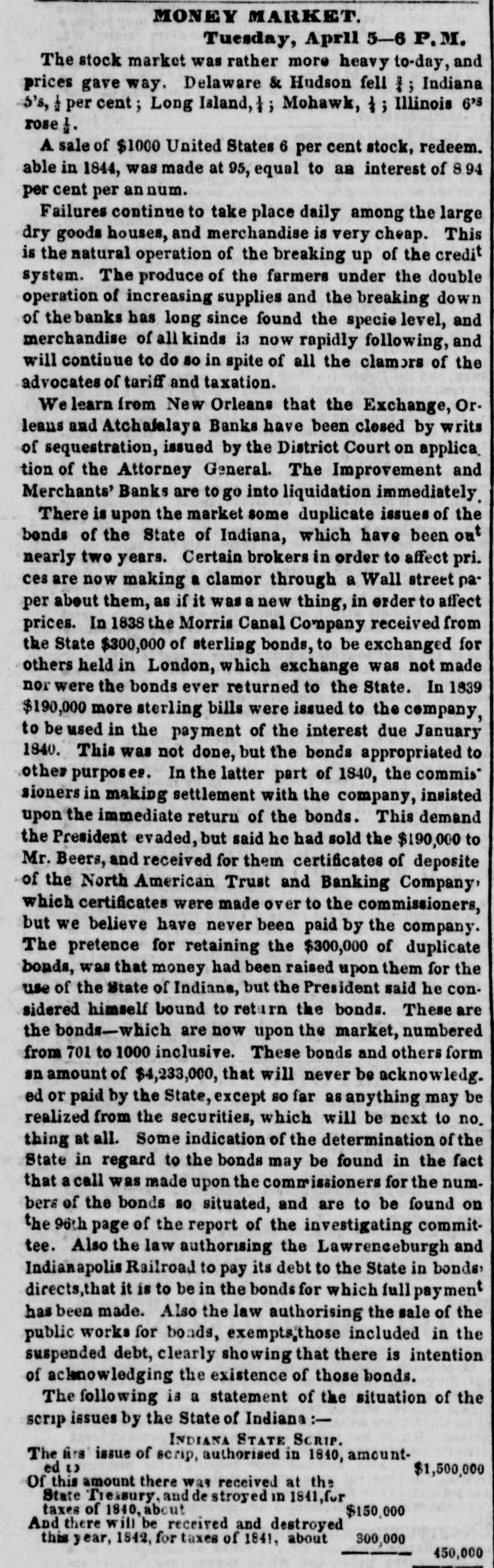
MONEY MARKET. Tuesday, April 5-6 P. M. The stock market was rather more heavy to-day, and prices gave way. Delaware & Hudson fell 1; Indiana 5's, 1 per cent; Long Island, Mohawk, 1; Illinois 6's rose 1. A sale of $1000 United States 6 per cent stock, redeem. able in 1844, was made at 95, equal to an interest of 8.94 per cent per an num. Failures continue to take place daily among the large dry goods houses, and merchandise is very cheap. This is the natural operation of the breaking up of the credit system. The produce of the farmers under the double operation of increasing supplies and the breaking down of the banks has long since found the specie level, and merchandise of all kinds i3 now rapidly following, and will continue to do so in spite of all the clamors of the advocates of tariff and taxation. We learn from New Orleans that the Exchange, Orleans and Atchafalaya Banks have been closed by writs of sequestration, issued by the District Court on applica tion of the Attorney General. The Improvement and Merchants' Banks are to go into liquidation immediately There is upon the market some duplicate issues of the bonds of the State of Indiana, which have been out nearly two years. Certain brokers in order to affect pri. ces are now making a clamor through a Wall street paper about them, as if it was a new thing, in order to affect prices. In 1838 the Morris Canal Company received from the State $300,000 of sterling bonds, to be exchanged for others held in London, which exchange was not made nor were the bonds ever returned to the State. In 1839 $190,000 more sterling bills were issued to the company, to be used in the payment of the interest due January 1840. This was not done, but the bonds appropriated to other purposes. In the latter part of 1840, the commis" sioners in making settlement with the company, insisted upon the immediate return of the bonds. This demand the President evaded, but said he had sold the $190,000 to Mr. Beers, and received for them certificates of deposite of the North American Trust and Banking Company, which certificates were made over to the commissioners, but we believe have never been paid by the company. The pretence for retaining the $300,000 of duplicate bonds, was that money had been raised upon them for the use of the State of Indiana, but the President said he considered himself bound to return the bonds. These are the bonds-which are now upon the market, numbered from 701 to 1000 inclusive. These bonds and others form sn amount of $4,233,000, that will never be acknowledg. ed or paid by the State, except so far asanything may be realized from the securities, which will be next to no. thing at all. Some indication of the determination of the State in regard to the bonds may be found in the fact that a call was made upon the commissioners for the numbers of the bonds so situated, and are to be found on the 96th page of the report of the investigating committee. Also the law authorising the Lawrenceburgh and Indianapolis Railroad to pay its debt to the State in bonds, directs,t it is to be in the bonds for which full pay ment has been made. Also the law authorising the sale of the public works for bonds, exemptsthose included in the suspended debt, clearly showing that there is intention of acknowledging the existence of those bonds. The following is a statement of the situation of the scrip issues by the State of Indiana:INDIANA STATE SCRIP. The first issue of scrip, authorised in 1840, amounted 1) $1,500,000 Of this amount there was received at the State Treasury. and de stroyed in 1841,fun taxes of 1840, about $150,000 And there will be received and destroyed this year, 1842, for taxes of 1841, about 300,000 450,000


Article from Richmond Enquirer, July 1, 1842

Click image to open full size in new tab

Article Text

NEW ORLEANS, June 18. The Board of Currency- The Expedients.-The Board has announced that they can do nothing. It cannot make the depreciated paper of the Citizens' Bank equal to par- it cannot make the specie-paying banks suspend- it cannot make the sound banks rotten. The Board undertook too much-and being composed of mortals, we must not be surprised that their efforts have produced a most disgusting abortion. The Board of Currency has a plain, straight forward duty to pursue. The Citizens' Bank, and others in a similar condition, should be placed immediately in liquidation. The longer the performance of this imperative duty is delayed, 80 long shall we have an unsettled currency, and all the embarrassments and fluctuations which now extend through every branch of trade and commerce.When the Board placed the Exchange, the Orleans, and Atchafalaya Banks in liquidation, with a circula. tion of near two millions of dollars, after the first fev


Article from The New York Herald, October 13, 1842

Click image to open full size in new tab

Article Text

New Orleans. (Correspondence of the Heraid.] NEW ORLEANS, Sept. 30, 1842. Texas-Morals-News-Bankers-Cotton-SilverTheatricals,&c DEAR BENNETT:Yours is the most extraordinary paper in the universe. It knows and publishes every thing in advance of all other papers. We think we get Texas news first, but we had hardly finished reading our cracked paper, the Bulletin," last Tuesday, when your spirit came over us, and announces the invasion of the Mexicans, twelve days in advance! although we say we had just received it the night before. If this is not necromancy or witchcraft, I don't know what is; and take care you are not burnt for it yet. San Antonio, with her lawyers and judges, is certainly taken, and no joke. But Houston is out with his troops, and will make another San Jacinto affair of the Mexicans. So prepare to announce a victory. This is .a great city for newspapers. We are about to have another called the " Tropic," with the flag of Harry of the West flying at the masthead. The financiers have hitched their boat to her, and abandoned the poor Bulletin." Alas, for the shade of Yorke! (now in France); it is a pity that he is not here to join the ranks of those who once wielded the destinies of the Merchants', Exchange and Atchafalaya Banks. He certainly has shown more delicacy of feeling than the rest, who are determined to brew beat the community and trample the laws under their feet. It IS said that Yorke will shortly land somewhere on Staten Island, and 80 look out, Mr. High Constable, catch him and bring him here, and the Governor will give you $500, and all expenses paid. Look out, too,for other absquatulators about leaving these parts sure, for the goodly city of Gotham to take passage for la belle France. The President and Cashier of the notorious Atchafalaya Bank have lately been sued for nearly three hundred thousand dollars excess of issues, and will shortly, no doubt, be making tracks. This beats old Nick himself. I have always told you that this was the city for financiering with a vengeance. Morality is at an end here, unless Parson Clapp can bring it back. We are going to advertise for a dozengood preachers with strong lungs, to preach here this winter, as the place needs it. Roguery and rascality appears now to be the order of the day, but if we could only get a little morality and religion shoved in edgeways, I think the city would yet be saved. As she now stands, I don't think ten righteous men could be found in it. I want to leave this winter, if I can raise the wind, for I am sure it is a doomed city. Some of our banks are in a little better condition, but not much. Few will be able to open their vaults on the 5th December, and those few will not dare to do much business, for fear of a run for specie. Capitalists from the North, if they will only bring the silver dollars here this winter, will do a strong business. But I would' advise financiers to come out, unless they want a coat of tar and feathers. The cotton that has been sent to the city is of an but I am afraid the heavy rains are to do a excellent going quality, great deal of mischief. For this article the demand is yet very limited, and there is now a fine field for speculators. Goods and strangers are arriving every day by the ship load. We shortly expect a French operatic company. Caldwell leases the American, and, with Celeste, he expects to do a profitable business. He deserves it. If he will only let politics alone, and stick to theatricals, he will yet make another fortune. We shall have a host of stars here this winter. Yellow fever is now dead, and we are going to bury him to-morrow. Strangers call now come with impunity into the city. The Citizens' Bank is, (and one or two others it is said will be,) enjoined not to issue any more notes. What is going to come next I can't tell, but as soon as I hear I will let you know.