Commercial National Bank (Washington, DC)

Episode Information

Episode Type
Run → Suspension → Closure
Start Date
February 27, 1933
Location
Washington, District of Columbia (38.895, -77.036)
Bank Type
national
Charter Number
7446

Metadata

Response Measures

Accommodated withdrawals, Fed/other loan, Capital injected, Full suspension, Books examined

Receivership Details

Depositor recovery rate
70.0%
Date receivership started
1933-02-28
Share of assets assessed as good
42.6%
Share of assets assessed as doubtful
50.5%
Share of assets assessed as worthless
6.8%

Notes

Bank closed by Controller and placed in receivership; closure followed heavy withdrawals.

Events (5)

1. October 19, 1904 Chartered
Source
historical_nic
2. February 27, 1933 Run
Cause
Macro News
Cause Details
Abnormal withdrawals amid wider bank closings and panic fears across states led depositors to withdraw funds.
Measures
No specific protective measures reported prior to closure; depositors withdrew funds and placed cash in safe deposit boxes.
Newspaper Excerpt
he had personal knowledge that there had been abnormal withdrawals from the Commercial National Bank. On the morning of February 27 he became apprehensive ... and withdrew about $9,000 ... and later on the same day withdrew the $20,233.42
Source
newspapers
3. February 28, 1933 Suspension
Cause
Government Action
Cause Details
Bank doors were closed by order of the Controller of the Currency following heavy withdrawals and precarious condition.
Newspaper Excerpt
On the morning of February 28 ... he went to the bank for work as usual, and found it closed by order of the controller of the currency.
Source
newspapers
4. February 28, 1933 Receivership
Newspaper Excerpt
Commercial National Bank, which is now in receivership ... Robert C. Baldwin, receiver for the bank, filed an answer ... withdrew the funds on February 27, the day before the bank was closed, and placed it in a safe deposit box. ... Robert C. Baldwin, receiver of the bank, issued a formal statement ... Baldwin, receiver of the bank, announced ... payment of dividends ... was made by the receiver, Robert C. Baldwin, and the bank closed its doors on February 28, the largest of the insolvent institutions in this city, and the payment of this first dividend ... the Commercial National Bank, which closed its doors on February 28, is the largest of the insolvent institutions in this city, and the payment of this first dividend, which Receiver Baldwin has made available ... said the bank closed its doors on February 28, it the largest of the insolvent institutions in this city, and the payment of this first dividend, which Receiver Baldwin has made available ... releases to the city more than $1,000,000. (combined references).
Source
newspapers
5. February 28, 1933 Receivership
Source
historical_nic

Newspaper Articles (20)

Article from The Washington Times, March 17, 1933

Click image to open full size in new tab

Article Text

EXECUTOR SUES JULU CLOSED BANK A fight was begun in District Supreme Court today by Thomas B. Smith, assistant cashier of the Commercial National Bank, to recover $29,000 from a safe deposit vault in the bank. The money represents a trust fund of which he is executor. Smith, as executor, withdrew the money from his checking account the day before the bank was closed. According to the petition filed today, he withdrew the money because he "became apprehensive that all banks in the District might close." The fund belonged to the estate of Gertrude L. Hoffman, who died in March, 1931. In compliance with provisions of the will, Smith said, he sent a check for $20,233.42 to the Domestic and Foreign Missionary Society of the Protestant Episcopal Church against the money on deposit in the bank. Before the check was honored he withdrew slightly more than $29,000 from the checking account, representing the entire fund he had on deposit as executor, placing it in the safe deposit box. Subsequently he learned that the check had been returned from the missionary society marked "unpaid," Smith said. Robert C. Baldwin, receiver for the bank, refused to give him I ermission to take the money from the box to pay the missiontry legacy, Smith says, on the theory that the banking law governing transfers and withdrawals with a view to giving preference to one depositor over another was violated.
Article from Evening Star, March 17, 1933

Click image to open full size in new tab

Article Text

BANK OFFICER SUES FOR FUNDS PLACED IN SAFETY DEPOSIT (Continued From First Page.) requiring the receiver to show cause why the money should not be turned over to him as executor and to decide whether the bank or the society is entitled to the funds. Justice Daniel W. O'Donoghue set March 28 as the date for the hearing on the petition. The will directed that $20,000 be paid to a hospital at Fort Yukon, Alaska, but the hospital was not incorporated and could. not accept the money. Withdrew Funds. The court ordered it with interest turned over to the society which operates the hospital. After drawing the check Smith transferred the amount it called for from his savings account as executor to his checking account as executor. In his petition, Smith said: "For many years your petitioner has been employed by the bank in charge of the savings department with the title of assistant cashier. He had knowledge of the fact that banks in several States had been closed, and was informed that there had been abnormal withdrawals from certain banks in the District and had personal knowledge that there had been adnormal withdrawals from the Commercial National Bank. On the morning of February 27 he became apprehensive that all banks in the District might close and in order to protect the interest of the beneficiaries of the estate withdrew about $9.000 in cash, the same being the entire balance to his credit as executor in a savings account. and later on the same day withdrew the $20,233.42 from the checking account." Both sums were placed in the safe deposit box which already contained various notes and other property of the estate. Found Bank Closed. Smith told the court he was not a general executive officer of the bank. that he was not a member of the board of directors, that he was not informed as to the bank's policies and that on the day of the withdrawals he did not know the bank was insolvent, nor that its closing was in contemplation. On the morning of February 28. he said. he went to the bank for work as usual, and found it closed by order of the controller of the currency. Some time later. he said. he learned that the check had been returned unpaid to the missionary society. On March 13. he applied to Baldwin for access to the box, but this request was refused. The refusal was on the theory that the transfers violated a section of the United States code relating to transfers made in contemplation of insolvency, or with a view to preferring one creditor to another. Smith says the transfers were made. not with any intention of violating the law. but to carry out an order of the court to safeguard the trust funds. The petition was filed through Attorneys G. B. Craighill and B. D. Boteler.


Article from Evening Star, March 27, 1933

Click image to open full size in new tab

Article Text

ELLIS TO ANNOUNCE DEPOSITORS' GROUP Col. Cooper Says Commercial National Bank Committee Will Be Named Soon. Col. Wade H. Cooper, president of the Commercial National Bank, which is now in receivership, stated this afternoon that the names of those who will compose the Depositors' Committee of the bank will be announced by Wade H. Ellis. chairman of the recent mass meeting at the Mayflower Hotel, within the next day or two. Mr. Cooper added that he and Chairman Ellis had received many suggestions during the past few days and would be glad to receive further suggestions. either as to the personnel of the committee or as to any particular plan which any depositor may have in mind. The mass meeting of depositors lot the Commercial National was held on Saturday evening, March 18. The meeting was addressed at length by Col. Cooper and it was voted that Depositors' Committee be formed to work for the reorganization and reopening of the bank. The committee was to be namedaby Chairman Ellis.


Article Text

COMMERCIAL BANK STATEMENTS DUE

Depositors With Checking Accounts May Obtain InTomorrow.

Baldwin. receiver of the Bank, the depositors statements of their commercial accounts. tomorrow these the the cancelled checks will turned to the customers time. daily for the taken the here these now be called for in the near statement today, Receiver of the Commercial National Bank Thursday April doors the bank will o'clock, the the depositors the depositors checking accountspurpose of obtaining February of Statements only are be "nished and the canceled checks will be for present savings departwill given balancing their passbooks and their claims, other Bank of Advanced Stage Reached. was taken the financial district mean that an stage closed just before the wide was declared by PresiRoosevelt Commercial National had about 20,000 but checking accounts concerned day's will be before claims can filed liquidation point where the first payment to depositors Wade Cooper president of the Commercial at the time the bank reopened, action receiver shows that progress has been made toward any resumption of business.


Article from Evening Star, April 13, 1933

Click image to open full size in new tab

Article Text

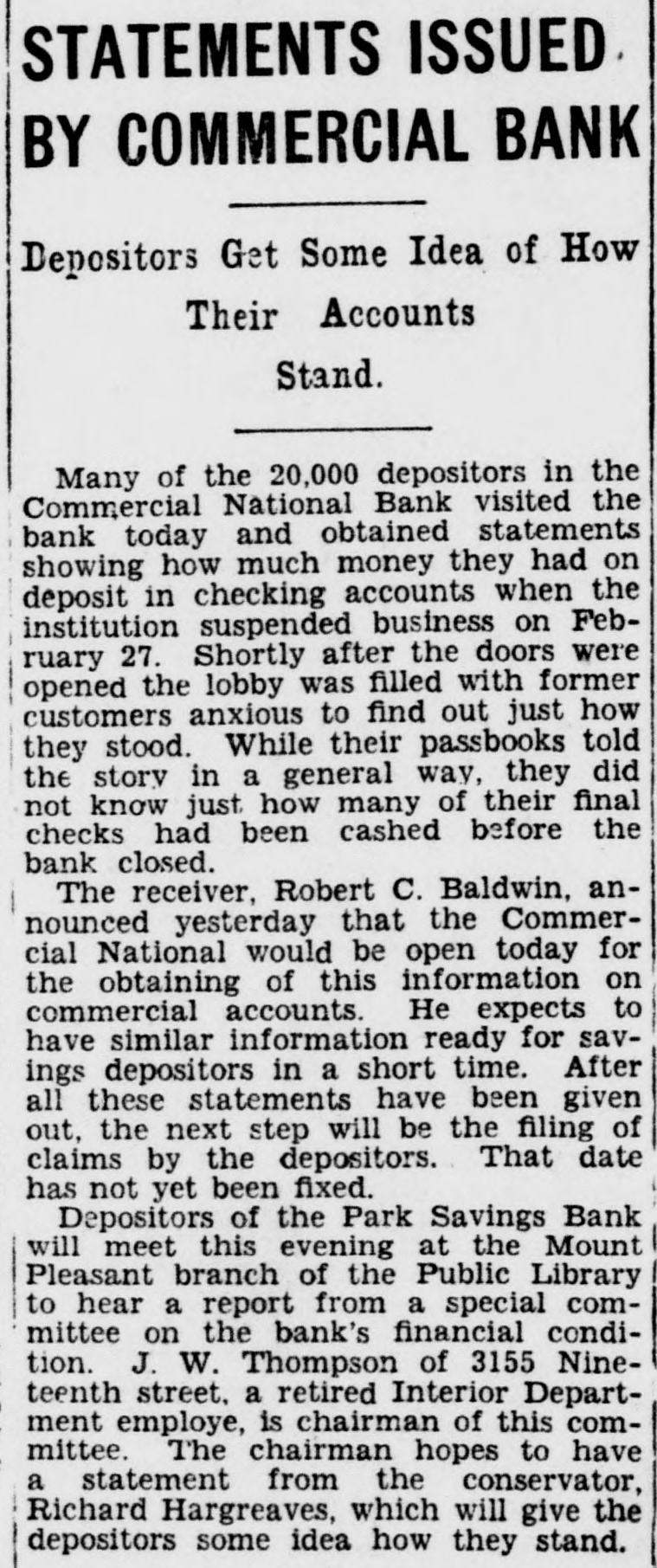
STATEMENTS ISSUED BY COMMERCIAL BANK Depositors Get Some Idea of How Their Accounts Stand. Many of the 20,000 depositors in the Commercial National Bank visited the bank today and obtained statements showing how much money they had on deposit in checking accounts when the institution suspended business on February 27. Shortly after the doors were opened the lobby was filled with former customers anxious to find out just how they stood. While their passbooks told the story in a general way, they did not know just how many of their final checks had been cashed before the bank closed. The receiver, Robert C. Baldwin, announced yesterday that the Commercial National would be open today for the obtaining of this information on commercial accounts. He expects to have similar information ready for savings depositors in a short time. After all these statements have been given out, the next step will be the filing of claims by the depositors. That date has not yet been fixed. Depositors of the Park Savings Bank will meet this evening at the Mount Pleasant branch of the Public Library to hear a report from a special committee on the bank's financial condition. J. W. Thompson of 3155 Nineteenth street, a retired Interior Department employe, is chairman of this committee. The chairman hopes to have a statement from the conservator, Richard Hargreaves, which will give the depositors some idea how they stand.


Article from Evening Star, April 15, 1933

Click image to open full size in new tab

Article Text

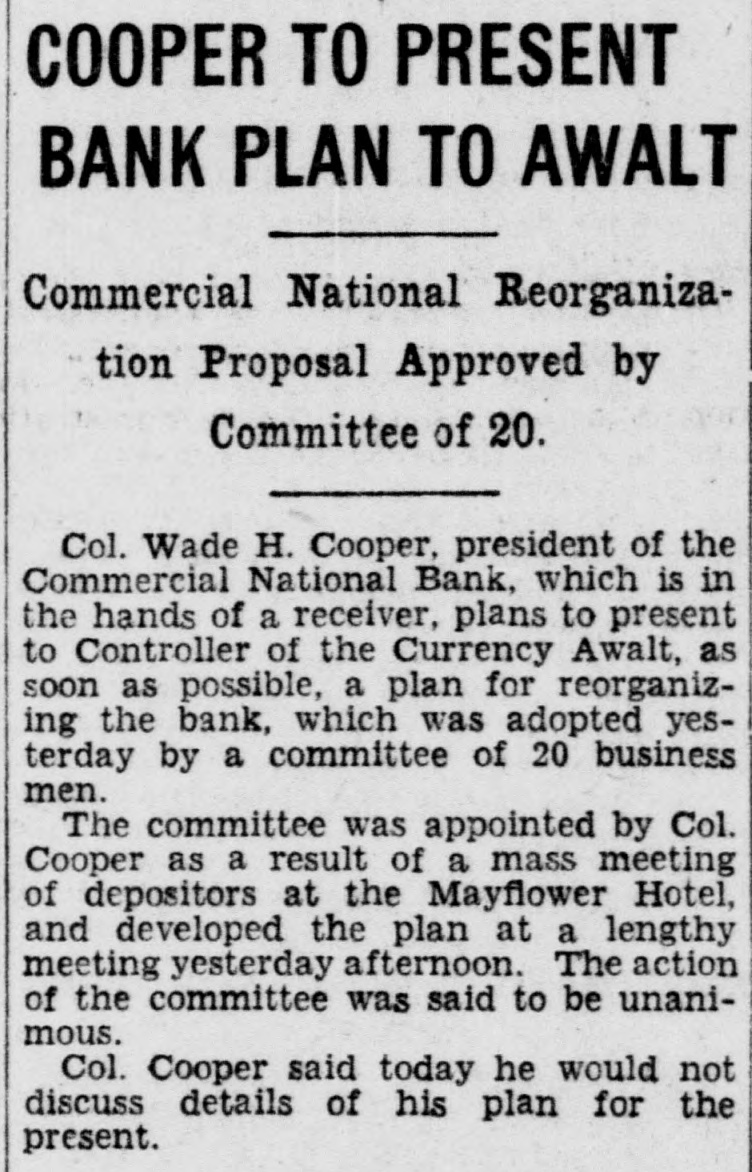
COOPER TO PRESENT BANK PLAN TO AWALT Commercial National Reorganization Proposal Approved by Committee of 20. Col. Wade H. Cooper, president of the Commercial National Bank, which is in the hands of a receiver, plans to present to Controller of the Currency Awalt, as soon as possible, a plan for reorganizing the bank, which was adopted yesterday by a committee of 20 business men. The committee was appointed by Col. Cooper as a result of a mass meeting of depositors at the Mayflower Hotel, and developed the plan at a lengthy meeting yesterday afternoon. The action of the committee was said to be unanimous. Col. Cooper said today he would not discuss details of his plan for the present.


Article Text

BANK TO FIGHT $30,000 SUIT

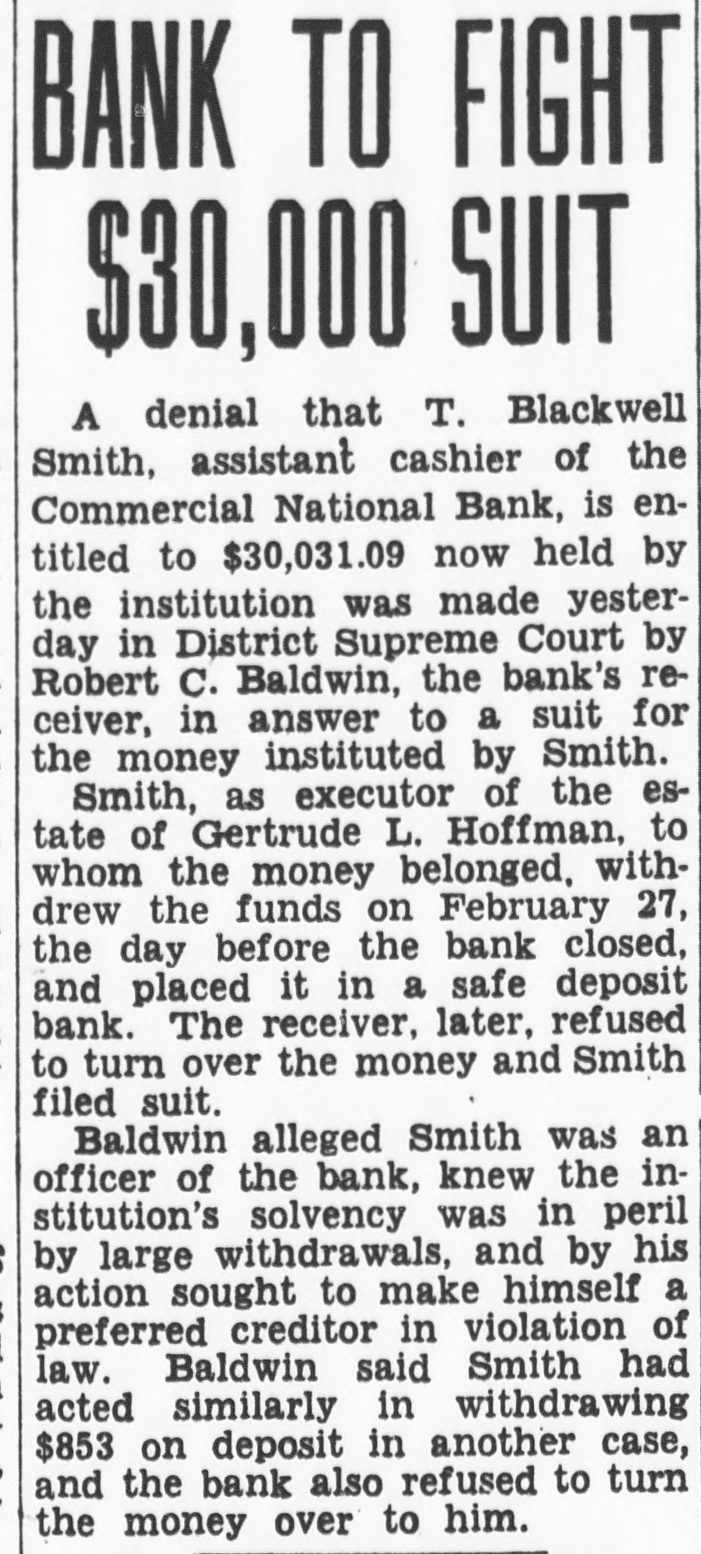
A denial that T. Blackwell Smith, assistant cashier of the Commercial National Bank, is entitled to $30,031.09 now held by the institution was made yesterday in District Supreme Court by Robert C. Baldwin, the bank's receiver, in answer to a suit for the money instituted by Smith. Smith, as executor of the estate of Gertrude L. Hoffman, to whom the money belonged. withdrew the funds on February 27, the day before the bank closed, and placed it in a safe deposit bank. The receiver, later, refused to turn over the money and Smith filed Baldwin alleged Smith was an officer of the bank, knew the institution's solvency was in peril by large withdrawals, and by his action sought to make himself a preferred creditor in violation of law. Baldwin said Smith had acted similarly in withdrawing $853 on deposit in another case, and the bank also refused to turn the money over to him.

D. C. CADET PRAISED

Edgar Morris, jr., of 5242 Colorado Ave., cadet colonel in the Clemson College military corps, was commended by Major William Spann, as the result of a review of drills at Clemson, it was announced yesterday.


Article from Evening Star, April 28, 1933

Click image to open full size in new tab

Article Text

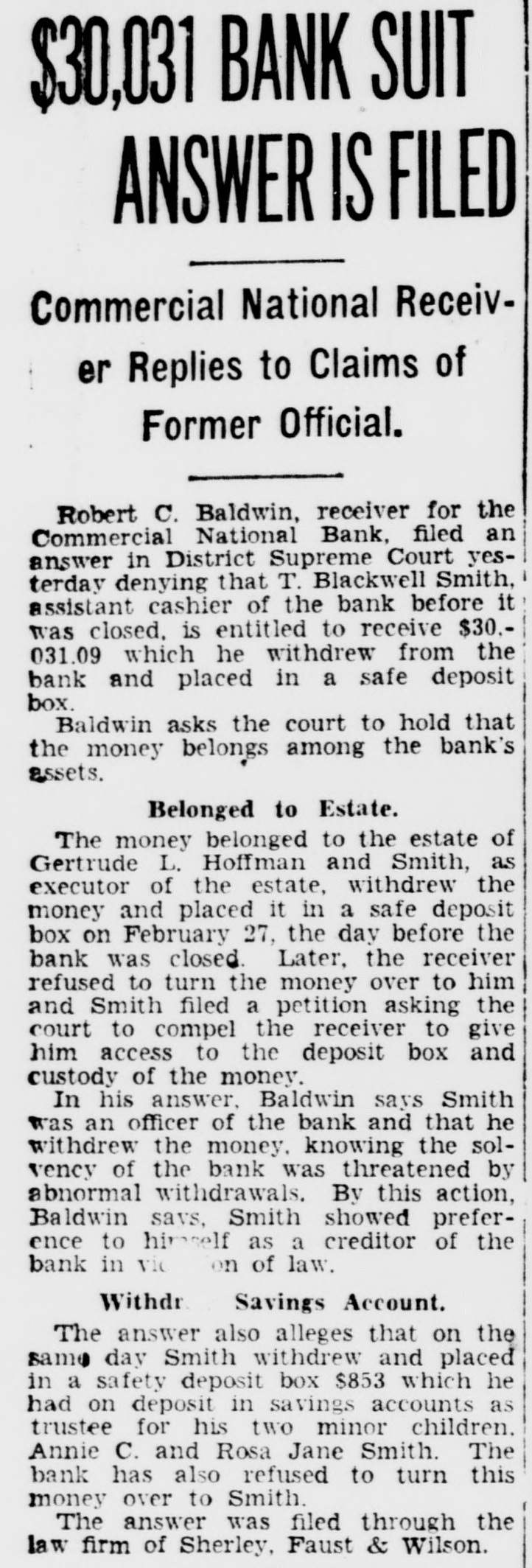
$30,031 BANK SUIT ANSWER IS FILED Commercial National Receiver Replies to Claims of Former Official. Robert C. Baldwin, receiver for the Commercial National Bank, filed an answer in District Supreme Court yesterday denying that T. Blackwell Smith, assistant cashier of the bank before it was closed. is entitled to receive $30.031.09 which he withdrew from the bank and placed in a safe deposit box. Baldwin asks the court to hold that the money belongs among the bank's assets. Belonged to Estate. The money belonged to the estate of Gertrude L. Hoffman and Smith, as executor of the estate, withdrew the money and placed it in a safe deposit box on February 27, the day before the bank was closed Later, the receiver refused to turn the money over to him and Smith filed a petition asking the court to compel the receiver to give him access to the deposit box and custody of the money. In his answer. Baldwin says Smith was an officer of the bank and that he withdrew the money. knowing the solvency of the bank was threatened by abnormal withdrawals. By this action, Baldwin savs, Smith showed preference to himself as a creditor of the bank in vic on of law. Withdr Savings Account. The answer also alleges that on the same day Smith withdrew and placed in a safety deposit box $853 which he had on deposit in savings accounts as trustee for his two minor children. Annie C. and Rosa Jane Smith. The bank has also refused to turn this money over to Smith. The answer was filed through the law firm of Sherley, Faust & Wilson.


Article from The Washington Times, April 28, 1933

Click image to open full size in new tab

Article Text

BANK TO FIGHT $30,000 SUIT A denial that T. Blackwell Smith, assistant cashier of the Commercial National Bank, is entitled to $30,031.09 now held by the institution was made yesterday in District Supreme Court by Robert C. Baldwin, the bank's receiver, in answer to a suit for the money instituted by Smith. Smith, as executor of the estate of Gertrude L. Hoffman, to whom the money belonged, withdrew the funds on February 27, the day before the bank closed, and placed it in a safe deposit bank. The receiver, later, refused to turn over the money and Smith filed suit. Baldwin alleged Smith was an officer of the bank, knew the institution's solvency was in peril by large withdrawals, and by his action sought to make himself a preferred creditor in violation of law. Baldwin said Smith had acted similarly in withdrawing $853 on deposit in another case, and the bank also refused to turn the money over to him.


Article from The Washington Times, May 9, 1933

Click image to open full size in new tab

Article Text

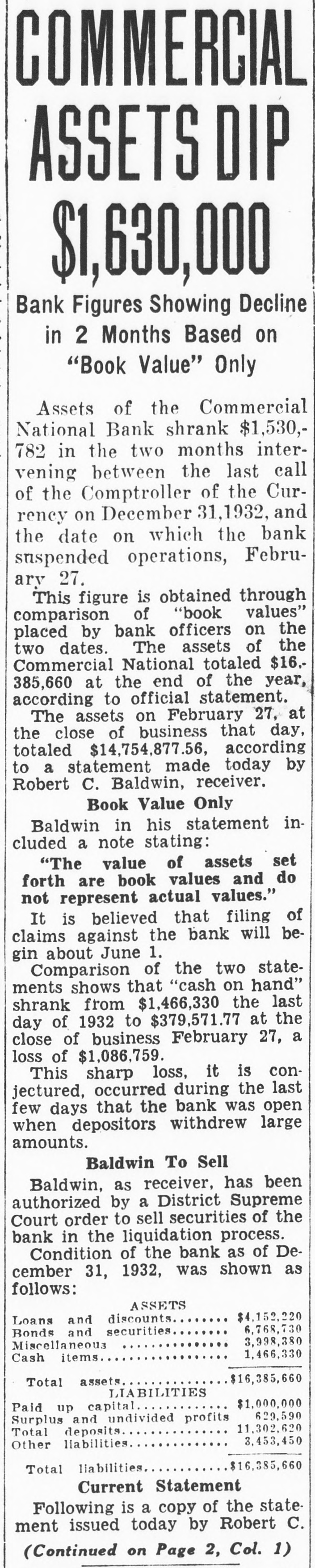
COMMERCIAL ASSETS DIP $1,630,000 Bank Figures Showing Decline in 2 Months Based on "Book Value" Only Assets of the Commercial National Bank shrank $1,530,782 in the two months intervening between the last call of the Comptroller of the Currency on December 31,1932, and the date on which the bank suspended operations, February 27. This figure is obtained through comparison of "book values" placed by bank officers on the two dates. The assets of the Commercial National totaled $16.385,660 at the end of the year, according to official statement. The assets on February 27, at the close of business that day, totaled $14,754,877.56, according to a statement made today by Robert C. Baldwin, receiver. Book Value Only Baldwin in his statement included a note stating: "The value of assets set forth are book values and do not represent actual values." It is believed that filing of claims against the bank will begin about June 1. Comparison of the two statements shows that "cash on hand" shrank from $1,466,330 the last day of 1932 to $379,571.77 at the close of business February 27, a loss of $1,086,759. This sharp loss, it is conjectured, occurred during the last few days that the bank was open when depositors withdrew large amounts. Baldwin To Sell Baldwin, as receiver, has been authorized by a District Supreme Court order to sell securities of the bank in the liquidation process. Condition of the bank as of December 31, 1932, was shown as follows: ASSETS $4,152,220 Loans and discounts 6,768,730 Bonds and securities 3,998,380 Miscellaneous 1,466,330 Cash items $16,385,660 Total assets LIABILITIES $1,000,000 Paid up capital 629,590 Surplus and undivided profits 11,302,620 Total deposits 3,453,450 Other liabilities $16,385,660 Total liabilities Current Statement Following is a copy of the statement issued today by Robert C. (Continued on Page 2, Col. 1)


Article from Evening Star, June 4, 1933

Click image to open full size in new tab

Article Text

of an extra hour in the late afternoon during which the bank will be open for them, it was announced yesterday. Robert C. Baldwin, receiver of the bank. issued a formal statement in which he said that "for the convenience of Government employes only. who are depositors in the Commercial National Bank of Washington, the doors of the bank will be re-opened from 4:30 p.m. until 5:30 p.m., the first five days of


Article from The Washington Times, July 13, 1933

Click image to open full size in new tab

Article Text

PERCENTAGE OF PAYMENT NOT KNOWN (18,000 Depositors Will Get Share of Funds From Closed Institution Payment of a dividend to the approximately 18,000 depositors of the suspended Commercial National Bank will be made about October 1, it was learned today. Amount of the dividend was not made known. In a report to the Treasury Department by Roger C. Baldwin, bank receiver, the condition of the bank as of June 30 was disclosed. Cash collected from assets amount to $3,697,646. Assets at date of suspension, February 27, were $14,754,877.56, while total assets accounteld for June 30 were $15,756,276. On that date cash collected on stock assessments of $1,000,000 amounted to $88,334.58 and the sum total remaining of uncollected assets was $11,702,079.49. Dividend payments in October will follow the 90-day advertisement for claims of depositors now being carried on.


Article from The Washington Times, July 21, 1933

Click image to open full size in new tab

Article Text

MRS. M'LEAN
SUED BY BANK

Mrs. Evalyn Walsh McLean, estranged wife of Edward B. McLean, former publisher of the Washington Post, as executrix for the estate of Carrie B. Walsh, and the American Employers Insurance Co., have been sued in District Supreme Court for $14,431 by Robert C. Baldwin, receiver of the Commercial National Bank.

The suit alleged that Mrs. Walsh on February 8, 1932, gave the bank a promissory note for $14,431 and failed to pay the note.

The insurance company was sued as surety for the bond which Mrs. McLean posted when she was appointed executrix of the estate.


Article from Evening Star, September 26, 1933

Click image to open full size in new tab

Article Text

COMMERCIAL BANK PAYS 1ST DIVIDEND Checks for 20 Per Cent Are Ready, but Depositors Arrive in Small Numbers. The insolvent Commercial National Bank today began the payment of its first dividend under direction of the receiver, Robert C. Baldwin. The dividend checks for 20 per cent of deposits were all ready, but the depositors came in small numbers early in the morning with no signs of any crowd or long lines forming. The Commercial National Bank, which closed its doors on February 28, it the largest of the insolvent institutions in this city, and the payment of this first dividend, which Receiver Baldwin has made available in an unusually short time, releases to the city more than $1,000,000. Controller of the Currency J. F. T. O'Connor in recently signing the charter for the Hamilton National Bank merger indicated that open banks in the city had requested him to delay the payment of the first dividend of the Commercial National Bank until after the Hamilton was opened. so that all banks could have an equal chance at the released funds. This was done, as the Hamilton opened yesterday and the first dividend checks from the Commercial were payable today. Baldwin is understood to have been commended by the Treasury Department for his efficiency in liquidating the Commercial National Bank and the early time at which he was able to make payable the first dividend. The bank will be open each afternoon until 5 o'clock, Baldwin said, for the convenience of depositors. This will give Government employes a full half hour after closing time to get their checks out of the bank.


Article from Evening Star, November 7, 1933

Click image to open full size in new tab

Article Text

DEFAULT JUDGMENT A default judgment against Ayoob M. Rizik, 1213 F street, for $126,299 in favor of the Commercial National Bank, was ordered in District Supreme Court by Justice F. D. Letts. Robert C. Baldwin, receiver for the bank, brought the suit on five promissory notes. He was represented by the firm of Sheriey cut & Wilson


Article from The Washington Times, November 11, 1933

Click image to open full size in new tab

Article Text

COMMERCIAL TO PAY AGAIN Robert C. Baldwin, receiver for the Commercial National Bank, Monday will commence the payment of the second dividend of $1,850,000, representing 30 per cent, to depositors. This will make a total of 50 per cent in dividends to be paid out since the bank closed last March. Baldwin warned depositors that there probably will be considerable congestion about the teller's windows during the first few days, and requested all who can conveniently do so to postpone claiming their divideds for the first few days as the checks can be obtained at any time during the month. Claimants must take their receiver's certificates, as no dividend checks will be paid without a certificate or the orange colored receipt. Comptroller's checks will be given for each receipt so surrendered.


Article from Evening Star, April 1, 1934

Click image to open full size in new tab

Article Text

dating assets, it is generally admitted that there will be considerable losses, whereas under the McLeod bill, a slow orderly liquidation extending over a period of 10 years would, it is believed by the best authorities, eliminate any possibility of loss." Expanded to State Banks. The McLeod bill provides for payment to depositors of 100 per cent on their deposits, in the case of certain specified banks. The bill first included national banks, then was expanded to State banks which were members of the Federal Reserve system, and now is proposed to include also banks which borrowed from the R. F. C. Col. Cooper has been the center of prolonged litigation since he started the fight which kept the United States Savings Bank from joining the proposed Hamilton merger. At present, Col. Cooper is under an indictment growing out of his presidency of the now insolvent Commercial National Bank. Another Cooper case involving the United States Savings Bank is now pending before the Court of Appeals. in which he still is endeavoring. after a decision against him in District Supreme Court. to force the Treasury to reopen the bank. This bank is now one of the 15 banks in this city in the hands of a receiver, and is one of those understood to be under consideration for a 100 per cent stock assessment. Meantime, the complex case of the Park Savings Bank. still is pending in District Supreme Court before Justice Jesse C. Adkins. In that case. the Treasury Department's receiver, John F. Moran. has joined with the depositors committee in an attempt to sue directors for the complete losses in the bank, exceeding $2,500,000. According to reports from the reorganization committee of the Industrial Savings Bank, colored institution, the campaign to raise the $65,000 required capitalization for the new Industrial Bank will be completed during the coming week. More than 95 per cent of the stock has now been sold and plans for the reopening are being worked out.


Article from Evening Star, August 14, 1934

Click image to open full size in new tab

Article Text

RECEIVER OF BANK ACCUSED IN SUIT Commercial Official Faces Charge of Illegally Paying Deposits. Robert C. Baldwin, receiver for the Commercial National Bank, was accused of paying in full deposits of two quasi-governmental agencies and a private corporation while the majority of the bank's depositors were receiving only 50 cents on the dollar, in a suit filed in District Supreme Court today by Thomas E. Rhodes, Southern Building. Rhodes charged this action by the receiver was "unlawful, illegal and unconscionable and to the prejudice of the rights and in fraud of the interests of this plaintiff as well as all other creditors of the bank." Pledges Held Illegal. The deposits paid in full, it was alleged, had been illegally secured by officials of the bank before the receiver took charge. The suit said the former officials induced the three agencies to open the accounts by pledging assets of the bank to guarantee their payment in full. Rhodes declared this was in violation of the banking laws and a fraud on the other depositors. The alleged preferential payments, it is alleged, were made to the alien property custodian, the United States Shipping Board's Merchant Marine Fleet Corp. and the Philippine-Manila Railway Co. The plaintiff said similar action was taken in the case of other depositors, whose names he does not know. Security Totaled $1,683,377. Rhodes said he does not know the amounts of the several deposits, but that the security given the Merchant Fleet Corporation aggregated $1,683,377.08. Through Attorneys Robert H. McNeill and Philip H. Marcum, he asked that a receiver be appointed to take charge of the moneys so paid out and that Baldwin be required to make full disclosure of the identities of the creditors receiving full payment and the amounts paid to them.


Article from Evening Star, October 11, 1934

Click image to open full size in new tab

Article Text

COMMERCIAL BANK INCOME $328,685.51 Quarterly Figures Released by Receiver Shows Reduction of R. F. C. Loan. Current income of the insolvent Commercial National Bank, including interest, premiums and rents, amounted to $328,685.51 at the end of the quarter, September 30. The cost of receivership was placed at $114,354. These figures were disclosed today in the quarterly report by Receiver Robert C. Baldwin, which shows the loan from the Reconstruction Finance Corporation to the bank, amounting to $3,327,400, had been reduced by $2,059,400. Out of a total of assets to be accounted for amounting to $15,902,919.73, including a stock assessment of $1,000,000, there has been collected a total of $11,910,265.67, including the R. F. C. loan. Collections on the stock assessment were $218,338.43, while total cash from assets and stock assessment was $8,228,288.84. Offsets were allowed totaling $556,758.96, and losses have been charged off including $743,851.52 on assets, and $2,500 on stock assessment. Total remaining uncollected assets, including the stock assessment, stand at $6,371,520.41. Secured and preferred liabilities paid in cash were $6,834,206.60. Unsecured liabilities for which receivers' certificates have been issued total $5,572,833.41, and dividends of 50 per cent have been paid to unsecured creditors amounting to $2,786,854.56.


Article Text

Appeals to Crime Committee to Investigate Reasons Therefor

The special House committee investigating crime conditions in the District today was asked to delay its report long enough to investigate the postponement by Dist. Atty. Garnett of the trial of Col. Wade H. Cooper, indicted former president of the defunct Commercial National Bank.

Col. Cooper this morning conferred with crime committee investigators and left correspondence between himself and Garnett, in which he repeatedly asked for a speedy trial.

It is believed this move is too late, however, as the committee's report

(Continued on Page 26)