7395. Union Trust Company (Baltimore, MD)

Bank Information

Episode Type
Run → Suspension → Reopening
Bank Type
trust
Start Date
October 19, 1903
Location
Baltimore, Maryland (39.290, -76.612)

Metadata

Model
gpt-5-mini
Short Digest
f92137ed02e3a744

Response Measures

None

Description

Union Trust Co. (Baltimore) suffered a depositor run triggered by the failure/announcement of the Maryland Trust Company on Oct 19, 1903; receiver Miles White Jr. was appointed and the company suspended, but it resumed business on Dec 23, 1903. Classification follows that chronology (run → suspension/receivership → reopening).

Events (4)

1. October 19, 1903 Receivership
Newspaper Excerpt
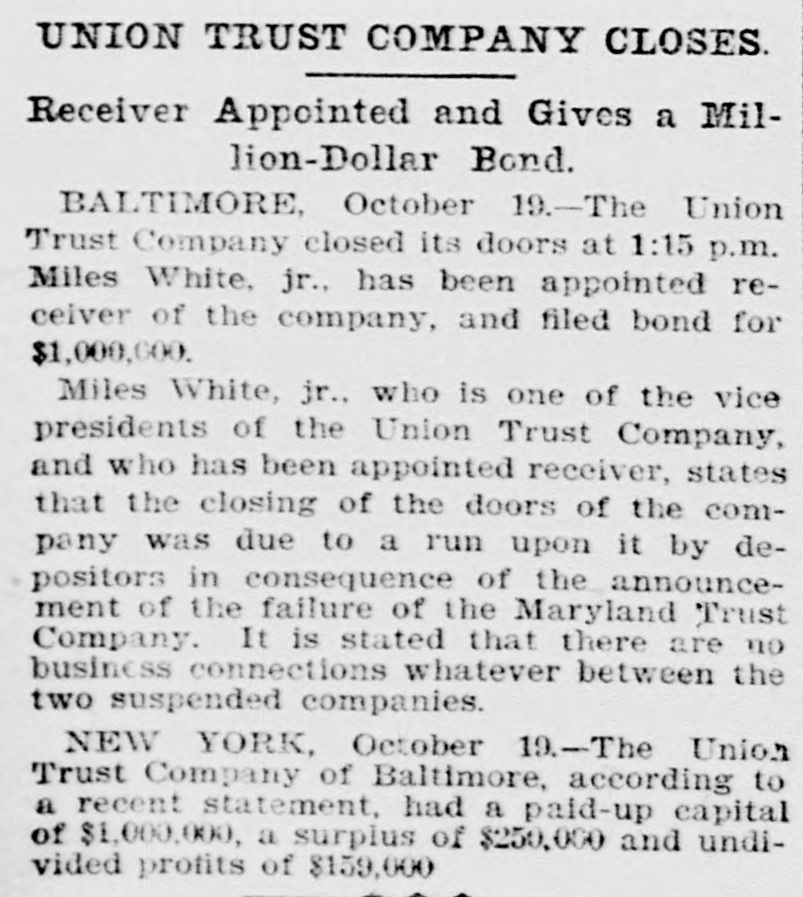
Miles White, jr., has been appointed receiver of the company, and filed bond for $1,000,000.
Source
newspapers
2. October 19, 1903 Run
Cause
Local Banks
Cause Details
Depositors withdrew funds in reaction to the announcement/failure of the Maryland Trust Company earlier that day.
Measures
Heavy withdrawals; suspended payments pending appointment of receiver; receiver later appointed (Miles White Jr.).
Newspaper Excerpt
the closing of the doors of the company was due to a run upon it by depositors in consequence of the announcement of the failure of the Maryland Trust Company.
Source
newspapers
3. October 19, 1903 Suspension
Cause
Local Banks
Cause Details
Suspension/closing followed the depositor run caused by the Maryland Trust Company's failure; receiver Miles White Jr. filed bond.
Newspaper Excerpt
UNION TRUST COMPANY CLOSES. Receiver Appointed and Gives a Million-Dollar Bond.
Source
newspapers
4. December 23, 1903 Reopening
Newspaper Excerpt
The Union Trust company, which went into the hands of a receiver on Oct. 19, opened its doors today and resumed business. The managers announce that the company is in a position to promptly meet its obligations and pay all depositors.
Source
newspapers

Newspaper Articles (23)

Article from The Topeka State Journal, October 19, 1903

Click image to open full size in new tab

Article Text

IN THE HANDS OF A RECEIVER Big Maryland Trust Company in Financial Difficulties. Tried to Float a Loan for $2,000,000 and Failed. DEPOSITS $5,873,817. Concern Was Capitalized for $2,125,000. Last Year It Paid a Dividend of 18 Per Cent. CLOSES ITS DOORS. Union Trust Co. Is Forced to Suspend Operations. The Receivership Maryland Started a Run. Baltimore, Oct. 19.-Allan McLane was today appointed receiver for the Maryland Trust company. Mr. McLane gave bond for $2,000,000. The receiver was appointed on application of John S. Gittings & Co., bankers of this city. The officials of the Maryland Trust company are preparing a detailed statement of the failure of that company which they will make public later in the day. It is understood that the embarrassment is due chiefly to an effort to finance the Vera Cruz & Pacific ralroad. New York, Oct. 19.-The Maryland Trust company was capitalized at $2,125,000, and in a recent report the surplus was said to be $2,437,500, and undivided profits $587,632. The deposits were $5,873,817. The company made an effort last week to float a loan of $2,000,000 in London. In 1902, the company paid 18 per cent dividend.


Article from Evening Star, October 19, 1903

Click image to open full size in new tab

Article Text

UNION TRUST COMPANY CLOSES. Receiver Appointed and Gives a Million-Dollar Bond. BALTIMORE, October 19.-The Union Trust Company closed its doors at 1:15 p.m. Miles White, jr., has been appointed receiver of the company, and filed bond for $1,000,000. Miles White, jr., who is one of the vice presidents of the Union Trust Company, and who has been appointed receiver, states that the closing of the doors of the company was due to a run upon it by depositors in consequence of the announcement of the failure of the Maryland Trust Company. It is stated that there are no business connections whatever between the two suspended companies. NEW YORK, October 19.-The Union Trust Company of Baltimore, according to a recent statement, had a paid-up capital of $1,000,000, a surplus of $250,000 and undivided profits of $159,000


Article from The Fargo Forum and Daily Republican, October 19, 1903

Click image to open full size in new tab

Article Text

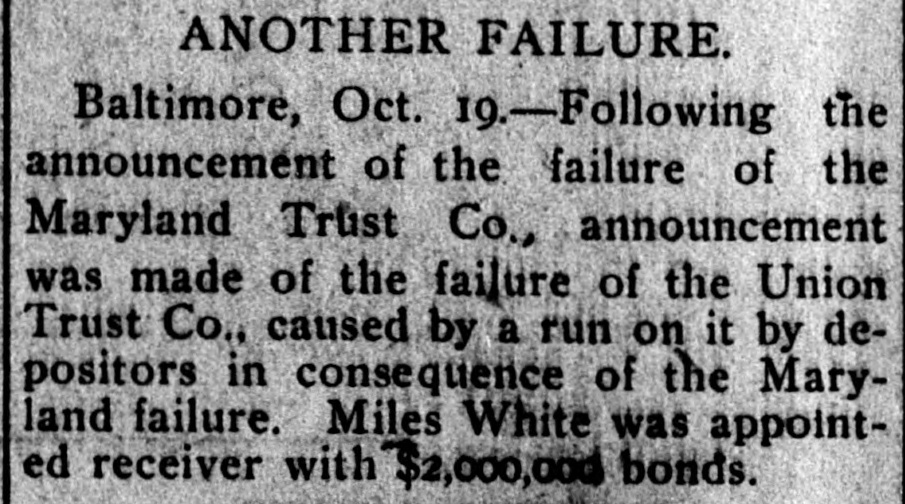
ANOTHER FAILURE. Baltimore, Oct. 19.-Following the announcement of the failure of the Maryland Trust Co., announcement was made of the failure of the Union Trust Co., caused by a run on it by depositors in consequence of the Maryland failure. Miles White was appointed receiver with $2,000,000 bonds.


Article from The Roswell Daily Record, October 19, 1903

Click image to open full size in new tab

Article Text

TRUST COMPANY QUITS. Another Baltimore Concern Closes Its Doors. Baltimore, Md., Oct. 19.-The Union Trust Co. closed its doors this afternoon. Miles White, Jr., is appointed receiver. The Union Trust Co. had a paid up capital of $1,000,000, surplus $250,000 and undivided profits 259,000. The Union Trust Co. had on deposit at last statement, $1,935.000; loans were $1.418.000. Gorge W. Blackstone is president of the company. Receiver White said closing was due to a run of depositors in consequence of the failure of the Maryland Trust company. There were no business connections between the companies.


Article from Arizona Republican, October 20, 1903

Click image to open full size in new tab

Article Text

There Was a Financial Crash in Baltimore GAME WITHOUT WARNING Two Trust Companies Overladen With Securities Go to the Wall. Great Anxiety in Financial Circles for the Future. Baltimore, Md.. Oct. 19.-This has been a day of marked excitement and subdued anxiety in the financial and business circles of Baltimore. Luckily a dozen reports well calculated to start a wholesale run on the banks did not reach the great army of depositors throughout the city, thus giving ample time for conservative leaders of business to allay popular apprehension before it reached dangerous proportions. The day began with the announcement of the failure of the Maryland Trust company, and except to a few the news came as a bolt out of the sky, spreading consternation in all directions. To these few it was known that the trust company had long been struggling with "undigested securities," that it had sustained heavy withdrawais of deposits and that, finally, on Satruday last it had failed in its efforts to negotiate a $2,000,000 loan in London. The suspension of the Union Trust company which happened at a late hour in the day, gave an impetus to many baseless rumors as to other financial institutions, which might well have created a panic had they been given currency early in the day. It was agreed among leaders and so given out that there is nothing alarming in the general financial situation in this city and that the mere fact that temporary difficulties overtook one or two concerns is no reason why the other institutions should be regarded with suspicion. One of the most prominent bankers in Baltimere said: "It all depends on how the people of Baltimore act. If they don't lose their heads the trouble will blow over in time and nobody will be hurt; but if they become panic stricken the consequences will be serious. This is a time for calm judgment." Allan McLane, third vice president of the Maryland Trust company, was appointed to take charge of the affairs of that company. Miles White, jr., first vice president of the Union Trust company, was appointed receiver of that institution. Mr. McLane gave bond in the sum of $2,000,000 and Mr. White gave bond in the sum of $1,000.000. The last statement of the Maryland Trust company. issued on June 30, 1903, showed a capital stock of $2,125,000, a surplus of 2,437,500 and undivided profits of $677,998.86. The company has demand and time deposits amounting to $5,773,817.15. The Union Trust company had deposits amounting to nearly $2,000,000. The filing of the first applications for


Article from The Times Dispatch, October 20, 1903

Click image to open full size in new tab

Article Text

No More Likely Failures Runs. Heavy Unless AND UNION MARYLAND TO UP HAVE CLOSE of to the Due Former Embarrassment in Mexican Securities, Investments of the and Its That to Latter to the Place Inability Securiand West South ties Virginia of Railroad MD., -This (By Associated October press.) a has been and in the anxiety subdued of day circles BALTIMORE day of marked financial and full bus- of of and events irresponin sible. the rumors streets damaging and given over marts transmonetary a Fully well calactions. reports. to on culated run provoke wholesale no got the banks. further precincts of and South German Streets, Baitimore Wall not Street reach the of great army districtions throughout the city, thus the for time giving tive of to allay conserva leaders business It before reached popular apprehension dangerous proportions The day began of of the announcement Trust failure and except company initiated news or bolt new the ail clear sky. Apreading To was known directions that the Company Maryland long been with Struggling that with heavy curities: of on and that, drawals finally deposits, in suIts last, failed the bridge preme yawning by loan chasm $2,000,000 LondonTrust Urion Suspends Company the in While and their offices, bankers in clusters corners brokers and and busidealers money in the ness men still were of the citedly collapso discussing another Maryland Company. bolt of out susof the and Union pension Company it this was Jatter which event, at happened day, late that gave of to a thember impetus baseless to other rumors Institutions well which financieated panic might in had been earlier given currency a assumed and howeverthere. well trust another day. they these shape rumors, than the the request name ot or which of the office Circuit the One more definite about the clerk open an hour later than time to one for modate the applicant But not day with only de ended to its two and with credit ded the the linan a assurance of cool-header ciers the city, panic and ssed. had note would of the to-morrow and every por of dissipation tend trouble. ling the most furtheaker. in all "It deBultimore prominent of how pends Haltimo upon If do act. the they heads and trouble hobod will blow but hurt, panicbe will be the Sent is strick This calm judge ment.' Are Heavy Failures The facts plain to-day's TWO their trust these: closed companies was Trust Company the first this by was later few hours followed of the the the doors Un! closing third Allan the Company Trust Maryland take charse appointed Company of of the Miles frairs Union Trust White, company of was pointed receiver company of sum McLane in the bond and 000,000 of sum The last Maryland instatement Trust Company $2,437. capital 998 of $3,125,000. and 500, studdivided has time produced deposit comp The Union of amounting the business Trust 31. stock had 1903. capital March of urplus $250.000 $1,000,000 of The Truyt Union profits to has deposits unounting Company nearly Ten Over Millions. liabilities the of filing for the for celver of two the billties the two The deposit The Mex Maryland be mar which ratted keted. de of been But by ican run to-day above had of the of the troubless origin vir Railroad Western ginga which The of was the the Company Ridiroad rollowvie thoush two and the Jointly no had bear


Article from The News & Observer, October 20, 1903

Click image to open full size in new tab

Article Text

One the Maryland, the Other the Union, Both of Baltimore. THE FAILURES DISTINC The Total Liabilities of the Two Companies Exceed Ten Million Dollars--- To Many the Annou cement Came Like a Thunder Clap. (By the Associated Press.) Baltimore, Md., Oct. 19.-This has been a day of marked excitement and subdued ciranxiety in the financial and business cles of Baltimore a day full of momentous events and of wild. irresponsible, |damaging rumors in those streets and marts over to monetary transactions. a dozen reports well to Luckily given calculated a wholesale run on banks got no than the precincts of and further provoke South Street streets, Baltimore's Wall and did not reach the army district, erman great city, thus depositors throughout the ime for the of giving ample popular conservative leaders of business to allay apprehension before it reached dangerous proportions. The day began with the announcement the failure of the Maryland Trust Comand except to only an few, news came like a bolt out a of pany, the initiated of clear sky, spreading consternation in all direc- that tions. To these few it was known the Maryland Trust Company had long with undigested securities, of sustained heavy and that, finally, on to deposits that been struggling it withdrawals Saturday last it had failed in its supreme effort nebridge over the yawning chasm by gotiating a $2,000,000 loan in. London. While the bankers in their offices, and in- elusters the dealers generally and brokers money street and business corners, in the exchange were still excitedly the collapse of of there came another discussing men Company, the bolt Maryland of out the a transparent sky, the suspension this Union Trust Company, and it was latter event which happened at a late hour in the day, that gave impetus to a varied number of baseless rumors as to other financial institutions, which might been well have created a panic had they given currency earlier in the day. One of these rumors, however, assumed and more definite shape than the others, a it is well known that at the request of another trust company the name of which the was freely bandied out, the clerk of circuit court kept his office open an hour later than the accustomed time to accommodale one more applicant for a receiverBut the applicant did not the day ended ship. ialize and with with only mater- two the to its credit and of of the cool headed that all peril of a suspensions assurance the city financiers panic had passed, and that tomorrow would note the of dissipation of every sign and portend further trouble. A leading banker, perhaps, the most prominent n Baltimore, said: "It all depends upon how the people of act. If they do not lose their the trouble will blow over in and will be hurt; if heads, time altimore nobobdy but they become panic stricken the conse- time quences will be serious. This IS a to use calm judgment. The plain facts in today's history are as follows: Two trust companies closed their doors. The Maryland Trust Company was was the first to announce its suspension. This followed a few hours later by the clo. ing of the doors of the Union Trust Company. Alian McLane, third vice-president of the Maryland Trust Company, was appointed to take charge of the affairs first of that company Miles White, Jr., of the Union Trust Comwas appointed receiver inpany, vice-president bonds of that in the stitution. Mr. McLane gave sum of $2,000,000 and Mr. White gave bond in the sum of $1,0000,000. The last statement of the Maryland Trust Company, issued on June 30, 1903, showed capital stock of $2,125,000, surplus $2,437,500, and undivided profits of $677,998.86. The company has demanded time amounting to $5,773,817.15. Trust Company at The deposits Union has the close of business on March 31, 1903, a capital stock of $1,000,000, surplus of $250. 000 and undivided profits of $159,687.55. Trust Company to nearly two amounting The Union millions. has deposits The refiling of the first applications for ceivers for the embarrassed companies was followed by petitions for co-receivers for both companies. The total liabilities of the two companies exceed $10,000,000. cause of the Maryland Trust Com failure was due to the assessments of the company in pany's of The the investment Mexican Railway securities which could not be marketed. The Union Trust Company failed because of a run on its banking department, about $150,000 having been withdrawn by depositors today, but real troubles of the company bad in the of the their the origin organization Virginia South and Western Railway in in which a capitalization of about $11,000,000 was contemplated. The Union company was the fiscal agent for the Virginia enterprise just as the Maryland Company was the fiscal agent for the Western Railway. Though these two failures followed so
Article from Ottumwa Tri-Weekly Courier, October 20, 1903

Click image to open full size in new tab

Article Text

BIG FIRM BANKRUPT MARYLAND TRUST CO., CAPITALIZED AT $2,125,000. IN RECEIVERS' HANDS. Baltimore, Oct. 19.-Allan McLane was today appointed receiver for the Maryland Trust Co. The company is capitalized at $2,125,000 and in a recent report the surplus was said to be $2,437,500, the undivided profits, $587,632 and the deposits $5,873,817. Attempts Big Loan. The company made an effort last week to float a loan of $2,000,000 in London. In 1902 the company paid an eight per cent dividend. McLane, who was appointed on application of Git-tings & Co., bankers, gave bond for $2,000,000. Railway Caused Failure. The trust company is preparing a statement of the causes of the failure but it is understood the embarrassment is due chiefly to the efforts to finance the Vera Cruz & Pacific railroad. Another Firm Fails. The Union Trust Co. closed its doors at 1 o'clock this afternoon. In Good Conditions. Miles White Jr., was appointed receiver for the Union Trust Co., filing bonds of $1,000,000. According to a recent statement the company had a paid up capital of $1,000,000, a surplus of $250,000 and undivided profits of $159,000. Run on Company. Receiver White, who is one of the vice presidents of the Union Trust Co., states the closing of the doors of the company is due to the run upon it by depositors in consequence of the failure of the Maryland Trust Co. There is no business connections between the two concerns.


Article from Spirit of Jefferson, October 20, 1903

Click image to open full size in new tab

Article Text

Two Baltimore City trust companiesthe Maryland and Union-closed their doors yesterday and went into the hands of receivers.


Article from New-York Tribune, October 20, 1903

Click image to open full size in new tab

Article Text

New-York Daily Tribune TUESDAY, OCTOBER 20, 1903. THE NEWS THIS MORNING. FOREIGN.-A draft of the decision reached by the Alaska Boundary Commission was signed by a majority of the commissioners, Mr. Aylesworth and Sir Louis A. Jetté refusing to adix their names: the award of the tribunal will be read in public to-day. John Morley, speaking at Manchester, made a spirited attack on the policy of protection, and upheld the measures of Cobden and Bright; Sir Robert Finlay, the Attorney General, spoke in opposition to Mr. Balfour's plans. A dispatch from Yokohama said that the Russo-Japanese negotiations had again temporarily ceased; a majority of the Russian warships left Port Arthur, and the Japanese squadron sailed from Masanpho. An indictment against Alonzo Cruzen, Collector of Customs at San Juan, P. R., was made of no effect by the action of the District Attorney. The freedom of the city of Waterford was bestowed on Andrew Carnegie. A satisfactory trial of M. Santos-Dumont's new dirigible balloon was held near Paris. The British battleship Prince George, injured in a collision with the Hannibal, was beached at Ferral. DOMESTIC.-The Maryland Trust Company and the Union Trust Company, both of Baltimore, went into the hands of receivers; there were also failures of two banks in Wisconsin and one in Washington State and one in California. President Roosevelt is expected to issue his proclamation to-day calling Congress to meet in extraordinary session on November 9. The President has directed that men removed from the Philadelphia Mint for political reasons be reinstated. The Immigration Bureau has discovered evidence of extensive violations of the Contract Labor law, by which hundreds of Welsh miners are being brought to this country. Eight men were killed and five seriously injured by an accident at the new Wabash Bridge in Pittsburg. William Carthew was arrested in California charged with embezzling $100,000 from a bank in this city. CITY.-Stocks were down 1 to 3 points. "Boss" McLaughlin triumphed over Senator McCarren at the meeting in Brooklyn of the Kings County Democracy General Committee. W. S. Devery intimated that Charles F. Murphy was receiving protection money from a disorderly house. Mayor Low was enthusiastically received at four fusion meetings which he addressed on the East Side. Colonel McClellan spoke at two Democratic meetings in Brooklyn, at one of which Controller Grout told how his bargain was made with Tammany, and at one meeting in Manhattan. THE WEATHER.-Indications for to-day: Fair, fresh southwest winds. The temperature yesterday: Highest, 58 degrees; lowest, 44.


Article from New-York Tribune, October 21, 1903

Click image to open full size in new tab

Article Text

ALL RIGHT IN BALTIMORE. More Failures Not Feared-Millions Rushed There. [BY TELEGRAPH TO THE TRIBUNE.] Baltimore, Oct. 20.-It is estimated that $5,000,000 in currency was poured into the banks of this city from New-York and Philadelphia between last midnight and 10 o'clock this morning. It was a precautionary measure on the part of the great banking interests in those cities to safeguard their associates here from a panic of depositors and uphold the general financial situation. There was no need of the money, however, as there was no run on any of the banks or trust companies to-day. The withdrawals from a couple of the big trust companies were heavy but easily met. A meeting of the clearing house officials was held yesterday afternoon, at which officials of every trust company in the city were present. After careful inquiries the clearing house determined to give any assistance that should be required, being assured of the stability of the companies. It was feared, though, that there might be a run on some institutions to-day which would cause more trouble, and the trust companies and banks at once took steps to strengthen their cash resources. Millions in gilt-edged securities were sent to New-York and Philadelphia, and in return currency was received. The express companies delivered the money to the banks and trust companies early this morning. One bank received a clear million, and one trust company $600,000. When depositors hurried to one trust company's office they found $1,000,000 in gold and notes piled up on the tables in full view. This concern's resources were further strengthened by the receipt of $500,000 from a New-York bank that is allied with the Rockefeller interests. Numerous other assurances of support were received. George J. Gould, among others wiring that he would help. No outside aid was required, however, and withdrawals were not heavy. Leading bank officials to-day talked hopefully and confidently, but some felt that conditions were still uncertain. The executive committee of the Clearing House considered the situation. and after the meeting President Ramsay of the National Mechanics' Bank said that the facts presented to the committee showed the financial situation here to be strong. It was stated today that a meeting of the directors of the Union Trust Company would be held to-morrow to consider a proposition to enable it to resume business. It is understood that New-York and Philadelphia interests are back of this move, much of the stock being held in those cities. It now appears that the Union Trust Company had about $2,500,000 of assets regarded as good. Heavy withdrawals. like $50,000 by one depositor, took the company by surprise. President Blakistone was a funeral. and before he returned the company had suspended payment, pending the appointment of a receiver. Comment in financial circles is that it was a radical step, and should not have been taken, as other Institutions were strong and willing to render it aid. As one man put it, "It was simply a case of those in charge losing their heads."


Article from Arizona Republican, October 21, 1903

Click image to open full size in new tab

Article Text

Hardly an Echo Was Heard of It Yesterday Banking Institutions Put in the Night Fixing for Runs by importing Money From Other Cities. Baltimore, Md., Oct. 20.-All the banks and other financial institutions in Balthwore were opened promptly at the customary hour today. Among financiers generally there was a uniform expression of confidence that no other suspencions are now probable. and that whatever of panicky feeling was manifested yesterday, over the failure of the Maryland and Union companies has practically disappeared. On the stock exchange the sentiment during the whole day has been optimistic, and in the closing hours there was evidently net a members who feared further trouble. A factor in allaying apprehension was the knowledge that many of the financial institutions had strengthened their resources during the night. A large amount of currency from New York, Philadelphia, and Washington was sent to Baltimore during the right and this morning. How much was received is not defibetween $3,000,000 and $5,000,000 is in the between $3,00,000 and $5,000,000 is in the vaults of the bank and trust companies which was not there yesterday. One of the reassuring incidents of the day was the announcement that the Union Trust company, one of the suspended companies would resume business in a few days.


Article from The Times Dispatch, October 21, 1903

Click image to open full size in new tab

Article Text

THE CRISIS IS PASSED Financial Atmosphere in Baltimore Cleared Up. MONEY ON EVERY TRAIN Four Million Dollars Comes by Express from o her Cities-No Further Trouble Anticipated Among Financial Institutions. (By Associated Press.) BALTIMORE, M.D., Oct. 20.-Four millions of dollars, which arrived here early this morning by express from New York, Philadelphia and Washington, cleared the financial atmosphere and at the closing time of the various monetary institutions this afternoon there was every confidence that the cris's in the financial district of the city had been safely passed. Every incoming train during the afternoon and evening brought packages of money to the banks and trust companies and to-night it is estimated that there is at least $8,000,000 of currency in the vaults of the financial institutions of the city. Conferences were held during the evening between various interests. and it was stated late to-night by a prominent banker that no further trouble among the banks or financial institutions of the city was probable. The directors and the receiver of the Maryland Trust Company, the first to close its doors on Monday, held a conference to-day and d'scussed ways and means, but late to-night Receiver Allan McLane said he had nothing to make public, although he expressed the opinlon that the company would in the near future be in position to pay dollar for dollar to depositors and creditors. The directors of the Union Trust Company also hel da long session during the day. While the statement of assets and l'abilities of this company is not ready to be presented to the courts, Receiver White expressed the opinion that the company will in a few days resume bus. iness. Other banking and trust companies have been well fortified with currency, and no further trouble is expected from any quarter.


Article from Daily New Dominion, October 21, 1903

Click image to open full size in new tab

Article Text

Poured Into Baltimore by Banking Houses Throughout the Country. FINANCIAL CRISIS IS PASSED Maryland Trust Company Will in Time Pay Dollar for Dollar-Union Trust Company to Resume Business Soon. Other Institutions All Right. Baltimore, Oct. 21.-Four millions of dollars which arrived here by express from New York, Philadelphia and Washington cleared the financial atmosphere and at the closing time of the various monetary institutions there was every confidence that the crisis in the financial district of the city had been safely passed. Every incoming train during the late afternoon and evening brought packages of money to the banks and trust companies, and it is estimated that there is at least $8,000,000 of currency in the vaults of the financial institutions of the city. Conferences were held between various interests and it was stated by a prominent banker that no further trouble among the banks or financial institutions of the city was probable. The directors and the receiver of the Maryland Trust company, the first to close its doors on Monday, held a conference and discussed ways and means, but Receiver Allan McLane said he nothing to make public, although he expressed the opinion that the company would in the near future be in position to pay dollar for dollar to all its depositors and creditors. The directors of the Union Trust company also held a long session. While the statement of assets and liabilities of this company is not ready to be presented to the courts, Receiver White expressed the opinion that the company will in a few days resume business. Other banking and trust companies have been well fortified with currency and no further trouble is expected from any quarter.


Article from The Evening Statesman, October 21, 1903

Click image to open full size in new tab

Article Text

Suspension Was Not Necessary. Baltimore, Md., Oct. 21.-It is common talk in financial circles that the closing of the Union Trust company was entirely unnecessary, being simply a case of lost nerve. Receiver White expects the bank to re-open for regular business next Monday.


Article from The Spokane Press, October 21, 1903

Click image to open full size in new tab

Article Text

BALTIMORE, Md., Oct. 21.-It is common talk in financial circles that the closing of the Union Trust company was entirely unnecessary-a case of lost nerve. Receiver White expects the bank to reopen for regular business on Monday.


Article from Alexandria Gazette, October 21, 1903

Click image to open full size in new tab

Article Text

The Baltimore Trust Companies. Baltimore, Oct. 21.-It is common talk in financial circles that the Union Trust Company's closing was entirely unnecessary. It seems to have been a clear case of lost nerve. Receiver White is making an attempt to get things in shape for an early reopening. The fright over the Belvidere bonds soon passed when it was given out that an insurance company was ready to take them at par. The crash of Monday, followed by the efforts of all financiers to get in readiness for a run, has left these gentlemen nearly exhausted. Their efforts were successful and it is estimated that a total of four million dollars was rushed into the city between noon Monday and opening hours this morning. Two meetings have been held by the clearing house executive committee, and arrangements made with the subtreasury for the shipments of $1,250,000 from New York. Allan McLane, receiver of the Maryland Trust Company says the Maryland had in the Vera Cruz and Pacific Railway aboutsix million dollars.


Article from Alexandria Gazette, October 21, 1903

Click image to open full size in new tab

Article Text

THE BALTIMORE TRUST COMPANIESThe financial situation in Baltimore, it is said, was considerably improved yesterday and a better tone prevailed. Some four or five millions were received from out of town in anticipation of runs, but the precautions taken to avert danger were found unnecessary. An inquiry into Union Trust Company affairs tends to show that a receivership need not have been applied for. Not less than 17 bills for co-receivers were filed against the two companies. The city took action looking to the safety of the deposit of $300,000 with the Maryland Company. Suit was filed to establish the double liability of stockholders and to remove the Union Trust Company as trustee under the mortgage of the Arling-Brooke Real Estate Company. It is said that the Union Trust Company will probably resume business shortly, and that the depositors of the Maryland Trust Company will undoubtedly be paid in full and the stockholders will lose little, if anything. The expected heavy run on trust companies and banks failed to materialize.


Article from The Savannah Morning News, October 21, 1903

Click image to open full size in new tab

Article Text

FINANCIAL TROUBLES IN BALTIMORE. There was undoubtedly a feeling of relief in business circles in Baltimore yesterday when there were no indications of a run on the banks. On Monday it was feared that the failure of the Maryland and Union trust companies would so impair confidence in the financial institutions of the city that there would be a rush of depositors on Tuesday to get their money, and that a bad financial situation would be made a great deal worse. Depositors in savings and other banks, however, seem to have understood the cause of the failure of the trust companies and that the banks were in nowise affected by their misfortunes. The indications now are that in a few days the shock which the failures gave the business interests of the city will have practically disappeared and only those immediately concerned will give the failures much attention. The cause of the failures are of course well understood. The trust companies, relying upon the ability and willingness of the public to take an unlimited amount of securities, backed enterprises that perhaps would have turned out well if the money market had remained easy until they were completed. In this way the trust companies became loaded with securities which they could not dispose of. The result was they had to close their doors. It would not be surprising if there are other trust companies in various parts of the country which have more undigested securities on hand than they can carry with comfort. No doubt they took them in good faith, believing they would be able to market them at a price that would yield a handsome profit. If they are to be criticised at all it is for being too anxious to get rich quick, for not being more conservative. Promoters of enterprises of various kinds did not seem to realize that there was a limit to the capacity of the public to absorb securities, and some trust companies and underwriting syndicates encouraged them to increase the volume of stocks and bonds. The failure of a trust company, a bank, or a stock broker here and there does not, however, indicate the approach of a period of hard times. In about all parts of the country business is good. The farmers have good crops and they are getting good prices for them. There is of course a little depression in the iron and steel trade, but with that exception the industrial plants have about all they can do. The signs, therefore, are for a continuance of prosperity rather than for a period of business depression. Of course there will not be much for promoters to do for a good while to come. It will take the public several years to absorb the securities already on the market, and it may be that a great many of the undigested securities will be eliminated altogether, but it ought not to be very long before securities of real merit begin to show an improvement in price. No longer ago than last week there was a strong impression in Wall street that the upward turn had taken place in the price of such securities would be permanent, and that it would not be long before they would be bringing about as much as they brought before the period of liquidation began. The failure of the two trust companies in Baltimore, however, is having a dampening effect on the security market and may even further depress the prices of the best securities.


Article from The Globe-Republican, October 22, 1903

Click image to open full size in new tab

Article Text

le LATEST NEWS IN BRIEF. iThe Colombian government is still d considering the canal question. er Alaska is the first tochoose delegates to the republican national convention. A number of Kansas City priests attended the funeral of Bishop Kain a St. Louis. e The American investment in religious and educational institutions in Turkey is $6,500,000. e The battleship Maine made the trip from the Virginia coast) to Cape San Juan light in 9 hours. The great fire at Aberdeen has been estimated, showing losses of $382,000, with $183,000 insurance. A fire at Abcrdeen, Wash., caused four deaths and destroyed property worth a million dollars. The Ohio state board of health is to prevent the sale of "toy pistols and other explosive appurtenances." Alvin Richards, of Des Moines, Iowa, is on his way to South America with his family, traveling in a wagon. Republican France gave a royal reception to King Victor Emmannel and and Queen Margherita, of Italy. The Illinois State Federation of Labor convention has refused to adopt a resolution boycotting the state militia. Cases of death are again being reported which are caused by the poison in the dyes with which stockings are colored. The American Royal Live Stock show at Kansas City had perfect weather, a fine exhibit and large attendance. Ir is generally believed in Pekin that Russia will hold all she has gained in Manchuria and let Corea alone for the present. Oaganized labor, especially in Chi t cago, is facing a wage resulting in retrenchment by railroads and other large employers. V Rev. J. J. Kain, archbishop of St. t t Louis, died of a disease of the heart at a sanitarium in that city, where he had n been since May 12. 11 The Maryland Trust Company of Baltimore, followed by the suspension of the Union Trust company caused much excitement in Baltimore. is Minneapolis, Minn., mills are now ta di grinding Kansas wheat and find it CI profitable to openly sell the flour as tl as the product of Kansas wheat. Heretofore they called it Minnesota wheat lit flour. The farmers and stockmen say that they are being robbed by the packers; W that the packers puy less for cattle and le hogs, and at the same time raise the tr prices of meat to the retailers. The m stockmen claim that the western states tie stock producers have lost, by the CO scheming of the packers, $100,000,000 sta during the past three months. sh Jacob Baer, employed by a Denver A of packing company, dressed a 1,200 steer in 3 minutes and 48 seconds; rene ducing by 20 seconds the world's reean ord. ne The National Retail Liquor Dealers CO ma association has adopted a revised constitution with provisions for raising a fund every year for defense of their interests in the state legislatures and in clu Le congress. General Ian Hamilton, of the British tio army, will attend the army maneuvers der at Fort Riley upon invitation of Genof erals Corbin and Young. fan The American board of commissioners an for foreign missions are in annual sessol sion at Manchester, New Hampshire, of TO planning for another year. The Dowieites have elosed a deal for I 32,000 acres of land in southwest North are Dakota. They propose to colonize the or land and establish a Zion there. sch The Farmers' Co-operative Associasche tion, commonly called the farmers' The 492. trust, which started in Kansas has entered Nebraska and is incorporated there. Ci During the strike of the employes of Sor the Pacific Express company all jewels She and other valuables, live stock and poir perishable property was refused for islar shipment.


Article from The Coalville Times, October 23, 1903

Click image to open full size in new tab

Article Text

TWO BALTIMORE BANKS sus. PEND BUSINESS. Liabilities of the Two Will Reach in the Neighborhood of $11,000,000. Monday was a day of marked excitement and subdued anxiety in the financial and business circles of Baltimore, Md. Luckily a dozen reports well calculated to provoke a wholesale run on banks did not reach the great army of depositors throughout the city, thus giving ample time for conservative leaders of business to allay popular aprehension before it reached dangerous proportions. The day began with the announcement of the failure of the Maryland Trust company, and except to a few the news came as a bolt out of a clear sky, spreading consternation in all directions. To these few it was known that the trust company had long been struggling with "undigested securities," that it had sustained heavy withdrawals of deposits, and that, finally, on Saturday last. It had failed In its efforts to negotiate a $2,000,000 loan in London. The suspension of the Union Trust company, which happened at a late hour in the day, gave impetus to reany baseless rumors as to other financial Institutions, which might well have created a panic had they been given currency early in the day. The total liabilities of the two companies ceed $10,000,000. The cause of the Maryland Trust company's failure was due, as set forth in the statement of Receiver McLane, to the Investment of the assets of the company in Mexican railway securities which could not be marketed. The Union Trust company failed because of a run on its banking department, about $150,000 having been withdrawn by depositors today, but the real troubles of the company had their origin in the organization of the Southwestern railway in Virginia, in which a capitalization of about $11,000,000 was contemplated.


Article from The Salt Lake Herald, December 24, 1903

Click image to open full size in new tab

Article Text

RESUMED BUSINESS. Baltimore, Dec. 23.-The Union Trust company, which went into the hands of a receiver on Oct. 19, opened its doors today and resumed business. The managers announce that the company is in a position to promptly meet its obligations and pay all depositors.


Article from The Big Stone Gap Post, February 23, 1905

Click image to open full size in new tab

Article Text

# RAILROADS Fighting to Gain Control of This Section. In the suit which is now pending in New York concerning the control of the South and Western Railroad, if it is decided one way the property is that of the Seaboard Air Line and if in another way it is that of the Southern Railway. In other words, if Geo. L. Carter wins, it means that the Seaboard Air Line wins but if Zimmerman and Hollins win it means the Southern Railway wins. It has now fully developed that Zimmerman and Hollins did not represent the Chicago, Hamilton and Dayton Railroad, with which they were closely identified, but the Southern Railway. This suit is said to be one of the most interesting in New York, being an energetic fight between the Seaboard Air Line and two Wall Street syndicates. Back of the Present conflict is the fact that the Clinchfield Corporation owned the South and Western Railroad and 112,006 acres of coal land. This company was formed after the Union Trust Company, of Baltimore, went into to the hands of a receiver, for the express purpose of managing the railroad and coal land properties. Geo. L. Cater was at the head of the company. Then there came an urgent need of money. The property was offered for sale in New York. The Southern Railway at once came forward with a proposition to pay $2,500,000, provided that an option was given, but Geo. L. Carter came forward with a cash proposition of the same amount. This bid not being raised, Mr. Carter came into the possession of the railroad and coal interests by making the cash payment for the property. No sooner was it known that the contract was about to be closed than Zimmerman and Hollins Co. began to buy outstanding shares for the Southern Railway. A majority of the outstanding stock was thus secured by the Southern Railway interests and an attempt was made to set aside Mr. Carter and the Seaboard Air Line's interests. But no sooner had Geo. L. Carter paid the directors of the Clinchfield Corporation for control of the property than Carter in turn sold to a syndicate of the Seaboard Air Line people composed of T. F. Ryan, N. B. Ream, T. J. Coolidge, Jr., and Blair & Company. It has been given out that if the Southern Railway wins in this fight that Seaboard Air Line will go ahead and build a road from the coal fields in Virginia to its lines in the Carolinas and of course get the tidewater that is desired for coal. Recently it was decided that the South & Western's Charter rights had been lost in Virginia, so that last week a new charter was granted by the state. By forfeiting its charter right however, the South & Western road lost its only feasible route for reaching the great coal acreage in South and Western Virginia. The Virginia and Southwestern Railway, which has taken charge of the right of way along the Clinch river and its Tributaries which the South & Western claimed, now holds the key to the situation. In a sense the Virginia and Southwestern road is a dog in the manger. Neither the Seaboard Air Line nor the Southern Railway can do very much in getting to the coal lands without the permission of the Virginia and Southwestern road. The most vital matter is, who will get charge of the Virginia and Southwestern Railroad. That road has turned the shrewdest trick of all. Evidently there should be a grand rush of the two roads mentioned to acquire the Virginia and Southwestern Railroad. Yet in its recent reorganization there intimations Virginia and Southwestern road has gone into the possession of the Wabash road. If that is true, then the Wabash has the block to both the Seaboard Air Line and the Southern Railway. - Knoxville Journal and Tribune.