7391. New Farmers Bank (Mount Sterling, KY)

Bank Information

Episode Type
Run → Suspension → Closure
Bank Type
state
Start Date
July 27, 1893
Location
Mount Sterling, Kentucky (38.056, -83.943)

Metadata

Model
gpt-5-mini
Short Digest
6dece7e8

Response Measures

Accommodated withdrawals, Full suspension

Description

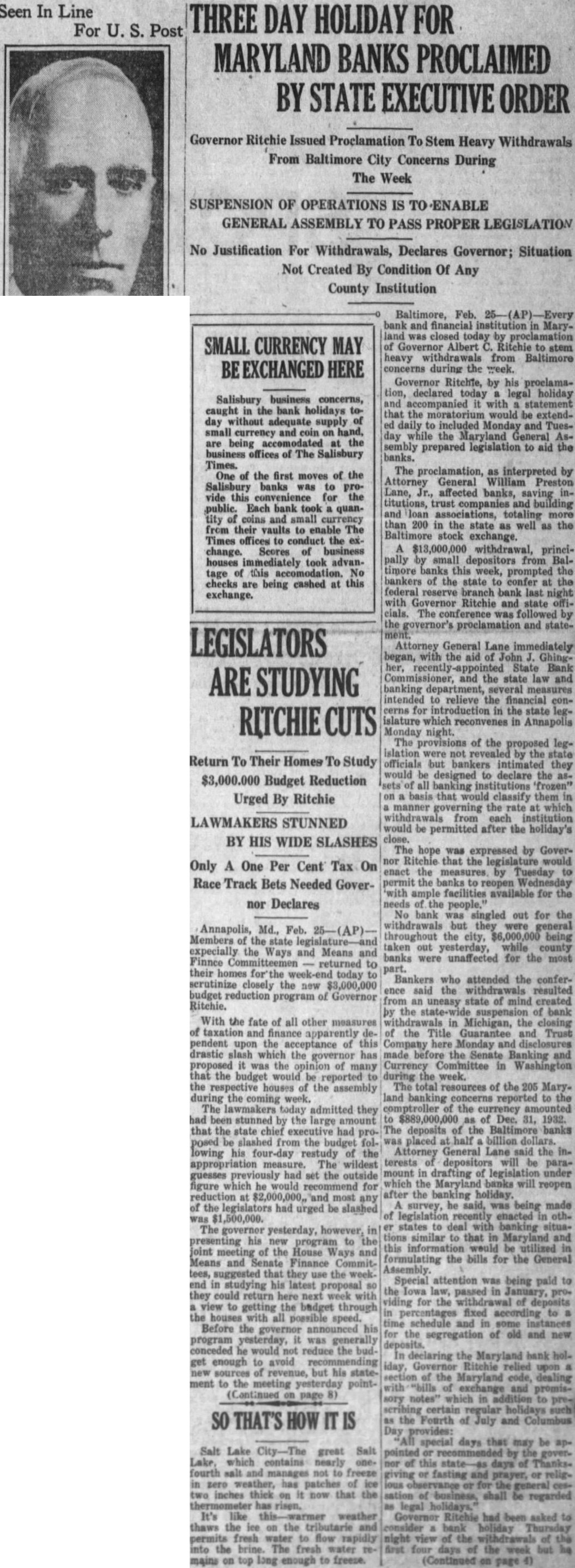
New Farmers Bank failed to open and was subjected to heavy withdrawals (a run) on July 27, 1893; officials suspended payment and made an assignment the same day. Contemporary articles attribute the suspension/run to widespread rumors. A trustee/receiver was later appointed (Columbia Finance & Trust Co.), and the bank remained in receivership; later accounting (1895-1896) shows settlement activity, indicating it did not resume normal operations. Bank type not specified in articles.

Events (5)

1. July 27, 1893 Receivership
Newspaper Excerpt
The deed of trust was made at 5:40 o'clock to James M. Bigstaff. Thus in one day M. Sterling saw two of her staunch business enterprises driven to the wall.
Source
newspapers
2. July 27, 1893 Run
Cause
Rumor Or Misinformation
Cause Details
Articles state the suspension and run were clearly traceable to a number of rumors and withdrawals driven by circulating rumors about the bank.
Measures
Tellers paid out deposits all day; officials resisted but later suspended payments and made an assignment.
Newspaper Excerpt
The closing of the doors of the New Farmers Bank was the signal for a run on the other banks. The drain on all of them was heavy...
Source
newspapers
3. July 27, 1893 Suspension
Cause
Rumor Or Misinformation
Cause Details
Immediate trigger reported as heavy withdrawals following rumors; inability to meet sudden drain forced suspension and assignment of bank's business to an assignee (deed of trust).
Newspaper Excerpt
The New Farmers bank closed its doors this morning. Inability to realize on paper. Depositors will be paid in full.
Source
newspapers
4. September 26, 1893 Other
Newspaper Excerpt
The Columbia Finance & Trust Company of Louisville Appointed Trustee ... The appointment meets the general disfavor it merits.
Source
newspapers
5. February 10, 1894 Other
Newspaper Excerpt
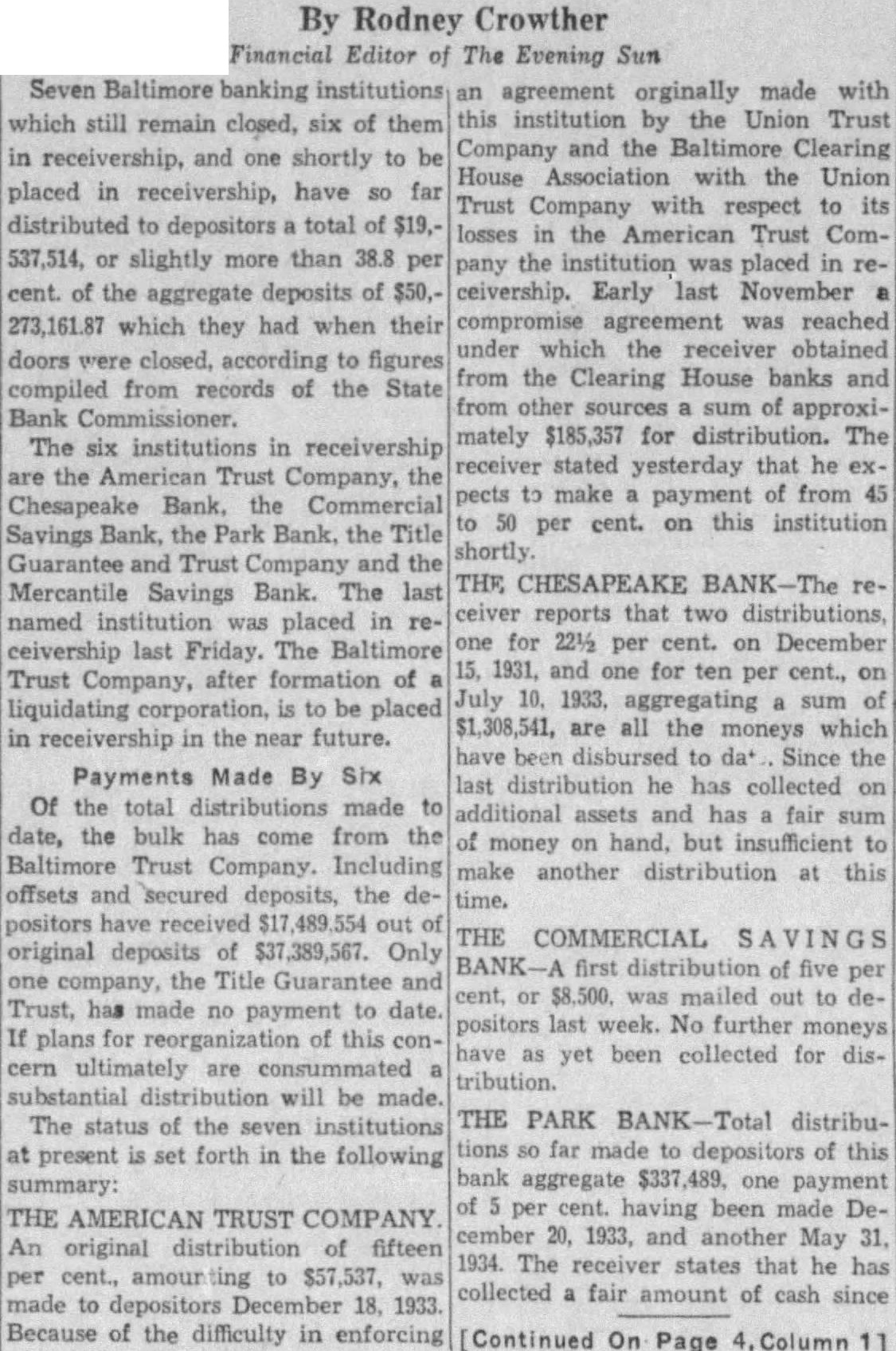
Ira Mitchell, cashier of the suspended New Farmers Bank, of Mount Sterling, was convicted of the charge of false swearing in regard to the bank's conditions and sentenced to one year in the penitentiary.
Source
newspapers

Newspaper Articles (10)

Article from The Mt. Sterling Advocate, August 1, 1893

Click image to open full size in new tab

Article Text

On mers Bank failed to open its doors for business. The news quickly spread over the city and created no little excitement. The steady drain on the ready money of the bank by depositors was more than it could stand and finally it had to succumb to the pressure of circumstances and suspend pay ment. For the last four months there has been a shrinking of the deposits, and since it seemed impossible to realize on its paper. There was nothing else left to be done but to close its doors. The liabilities of the bank reach $300,000, and it has in available assets over $600,000. There can be no question but that every depositor will be paid in full, and there is good ground for the belief that the stockholders will lose little or nothing. This bank has been the special favorite for the deposit of the fund of widows, guardians and estates, and has always enjoyed the confidence of the community. It was a heavy blow to the more helpless portion of the community when it was forced to the wall. The scenes were pitiable when women looked the situation in the face and felt their strong rock of business defense was taken from them. The closing of the doors of the New Farmers Bank was the signal for a run on the other banks. The drain on all of them was heavy, but the Traders Deposit seemed to be the special point of attack. All day long the tellers stood at the counters and paid out the money in a steady strèam till the hour for closing. Not one sign ef weakening was seen in the face of any official of the bank; but after closing hours the directory thought it better to suspend payment than to face the certainty of the continnation of the run of the day. No bank, however strong, could stand such a drain on its available cash. Therefore the officials reluctantly decided to give up the unequal fight and make an assignment. The deed of trust was made at 5 :40 o'clock to James M. Bigstaff. Thus in one day M. Sterling saw two of her staunch business enterprises driven to the wall. The condition of the bank is in every respect good. It has $390,000 of good paper and liabilities to the amount of only $150,000There is no reason in the world why this bank should not be on its feet again in a very short time.


Article from The Mt. Sterling Advocate, August 1, 1893

Click image to open full size in new tab

Article Text

Prompt Action and Cool Management Won the Day and Both Outride the Storm Unhurt. The Excitement Entirely Subsided and Confidence Seemingly Completely Restored. The Traders Deposit Already well on the Way to Reopen, and Steps Being Taken to Reopen the New Farmers Also, If the scenes of Thursday were On Tuesday morning the New Farstartling those of Fridaymorning were mers Bank failed to open its doors for widely alarming. We have heard and business. The news quickly spread read of runs on a bank, but never wit over the city and created no little exnessed one in its wild reality till Fricitement. The steady drain on the day last-truly "Black Friday" in Mt. Sterling's history. ready money of the bank by deposAs soon as the two remaining banks, itors was more than it could stand and the Mt. Sterling National and the Exfinally it had to succumb to the presschange Bank of Kentucky, opened, a ure of circumstances and suspend pay rush was made for the doors of the ment. For the last four months there institutions and the scene simply beggars description. Men lost their reahas been a shrinking of the deposits, son in a mad rush for the counters. and since it seemed impossible to realAt the Exchange Bank the Marshal ize on its paper. There was nothing and his assistants held the crowd at else left to be done but to close its bay whilst every check was paid in doors. The liabilities of the bank full. In the meantime Ex-Chief Jusreach $300,000, and it has in available tice Peters, the President, of the bank, appealed to the men in the crowd to assets over $600,000. exercise a little reason and common There can be no question but that sense. Others aided the venerable old every depositor will be paid in full, man in his brave efforts to still the and there is good ground for the belief tumult. For a time nothing availed that the stockholders will lose little or but as the crowd came out with their money the police saw that they moved nothing. This bank has been the speoff, and as the throng saw the money cial favorite for the deposit of the being paid SO promptly the words of fund of widows, guardians and esthe Judge began to have their effect tates, and has always enjoyed the conon the mob. In the meantime some fidence of the community. It was a of our business men had edged their way into the crowd with money to heavy blow to the more helpless pormake deposits ostentatiously displayed, tion of the community when it was and this, too, tended to call the party forced to the wall. The scenes were to their sober senses. After a couple pitiable when women looked the situof hours the crowd began to show ation in the face and felt their strong signs of disintegration, and in a short while thereafter the doors of the bank rock of business defense was taken were deserted. from them. Whilst this scene was being enacted The closing of the doors of the New a similar scene with variations was Farmers Bank was the signal for a beheld at the Mt. Sterling National run on the other banks. The drain Bank, only a block away. When the on all of them was heavy, but the doors were opened and the rush came Traders Deposit seemed to be the spethe Cashier and several directors, who were with him, retired for a moment's cial point of attack. All day long the tellers stood at the counters and paid consultation. Quickly Judge French, the Cashier, reappeared, his face white out the money in a steady stream till the hour for closing. Not one sign ef with firm set determination. He sprang weakening was seen in the face of upon the counter and announced that if one of those who were clamoring for any official of the bank; but after their money for the simple purpose of closing hours the directory thought it better to suspend payment than to withdrawing it presented his check to face the certainty of the continnation the teller for payment, he would close of the run of the day. No bank, howthe bank and that not one would get a cent till the bank examiner passed ever strong, could stand such a drain on its available cash. Therefore the upon the condition of the bank. He announced that the bank was able officials reluctantly decided to give up the unequal fight and make an assignand ready to pay any and all deposiment. The deed of trust was made tors who wanted their money for leat 5 :40 o'clock to James M. Bigstaff. gitimate business; but it would not submit to a run. This sobered the Thus in one day M. Sterling saw two of her staunch business enterprises maddened crowd, and ex-Chief Justice driven to the wall. The condition of Holt seconded Judge French's efforts in a timely talk. In the meantime, the bank is in every respect good. It money was being paid out as rapidly has $390,000 of good paper and liabilities to the amount of only $150,000as could be done and deposits were made by some of the cool-headed busiThere is no reason in the world why ness men as fast as could do so. this bank should not be on its feet By 11 o'clock the lobbies of both banks again in a very short time.


Article from The Mt. Sterling Advocate, August 1, 1893

Click image to open full size in new tab

Article Text

THE PEOPLE AND THE BANKS. The financial squall that struck our city on Thursday was a bitter one, but it soon expended its force. Nothing can better illustrate the folly of people than the senseless attack upon the credit of institutions that are perfectly sound and that are able to meet all the obligations of a legitimate busimess, 26 they shall accrue, with absolute promptness. The suspension of the New Farmers Bank was clearly tracable to a number of rumors, started no one could tell how, reflect-


Article from The Mt. Sterling Advocate, August 1, 1893

Click image to open full size in new tab

Article Text

WHO WILL BE HURT?. The foolishly excited people who have aided to bring about the suspension of the*two banks, in Mt. Sterling, may thank their stars, if it shall not yet redound to their own deadly hurt, in a financial sense. The New Farmers Bank holds $600,000 of paper, a large part of which, of course, belongs in this county. The Traders Deposit holds nearly $400,000 more. Suppose because of the foolish thoughtlessness of some who should know better, that these two banks were to go into liquidation and the people of this county be called upon to take up this $1,000,000 worth of paper. Upon the present state of the money market, tell us, please, how much would the property that must be sacrificed to pay this vast amount bring Who is to blame for this threatened state of affairs? From whom, pray, must this money come From the banks? No sir, but from you, Mr. Panic-Stricken-Depositor,from your father, your brother, you son and your neighbor. You may injure the bank by writing your check in a time like this, but it will prove a boomerang whose rebounding stroke will be more deadly than the first cast. Your land is worth to-day $60. $80 or $100 per acre; force the collection of this $1,000,000 and tell us what it will bring ninety days hence. Mr. Big-Land-Owner, you would be a much richer man with your money on deposit, all lost, and the bank solid, than with the bank broken and forced to collect at once its debts in the county and your money in your pocket. Don't hold a silver dollar so close to your eye that it will hide the great broad acres of goodly heritage that lie all around you. There are many evils chargable to the banks, we grant you, but they have rights that for own sake, if for no higher motive, we are bound to respect. All this is said along the line of honest banking. We have presumed that the officials were honest in their dealings and that they were entitled


Article from The Austin Weekly Statesman, August 3, 1893

Click image to open full size in new tab

Article Text

THE FINANCIAL SITUATION. Banks and Commercial Failures Throughout the Country Yesterday. TWO OREGON INSTITUTIONS. PORTLAND, Ore., July 27.-The Oregon National bank and Northwest Loan and Trust company, kindred institutions. failed to open their doors this morning owing to withdrawal of deposits and inability to realize on securities. Geo. R. Markel is president of both institutions. Capital stock of the Oregon National, $200,000; surplus, $40,000; average deposits, $500,000. Capital of the Northwest Loan and Trust company, $250,000; surplus, $25,000. RARESTED FOR EMBEZZLEMENT. PORTLAND, Ore., July 27.-Rev. O. G. Taylor, manager of the Interstate Investment company of Dallas, has been arrested on the charge of embezzlement. It is said he is short $50,000 in his accounts. NEW HAMPSHIRE BANK. EXETER. N. H., July 27.-The National Granite state bank suspended payment this morning. It is declared perfectly sound and present embarrassment is caused by withdrawals of deposits. NATIONAL CORDAGE COMPANY. NEW YORK, July 27.-It is officially stated that the re-organization committee of the National Cordage company is working on details of a plan for the formation of a new company. This is rendered necessary by the fact that unanimous consent has not been received to the re-organization plan. WISCONSIN BANK. PORTAGE, Wis., July 27.-The City bank of Portage closed its doors today. It is capitalized at $25,000; H. Brees, ex-secretary of state, is president of the bank. The directors of the bank guarantee all deposits. LUMBER DEALERS SUSPEND. PHILADELPHIA, July 27.-S. H. Morrison, dealer in lumber, has suspended business. Liabilities and assets about $100,000. JEWELRY MANUFACTURERS CLOSE. ATTLEBORO. Mass.. July 27.-Owing to dullness of the jewelry trade, the manufacturers in Plainville, North Attleboro and Attleboro are compelled to close their shops. Six thousand workmen are affected. LEAD MINES CLOSE. SPRINGFIELD, Mo., July 27-On account of an increase in the price of coal and decrease in the price of mineral, caused by financial stringency, nine of the largest lead mines at Aurora closed this morning. KENTUCKY BANK CLOSED. MOUNT STEELING, Ky., July 27,The New Farmers bank closed its doors this morning. Inability to realize on paper. Depositors will be paid in full. CLEARING HOUSE CERTIFICATES. CHICAGO, July 27.-The clearing house this evening decided to issue clearing house certificates. Woaking Short Hours


Article from The Mt. Sterling Advocate, September 26, 1893

Click image to open full size in new tab

Article Text

NEW FARMERS BANK The Columbia Safety Vault and Trust Company of Leuisville Appointed Trustee. The Appointment Meets the Gen eral disfavor it Merits. The case for the appointment of a permanent receiver for the New Farmers Bank has been on trial in the Montgomery Circuit Court the past week, and the interest manifested has been very great. There were a num ber of suits growing out of the matter in hand, among them one for the hearing of a writ of mandamus that had been sworn out before Circui Judge John E. Cooper, to compe County Judge Lewis Apperson to ac cept the bond offered by R. B. Young as assignee of the New Farmers Bank In this case Judge Apperson filed an affidavit stating that he believed he could not get justice at the hands o) Judge Cooper. Judge Cooper, after a statement in his own defense, vacated the bench and Mr. Jo L. Eiliston, who had been elected about the beginning of the term to serve as Special Judge took his place. The mandamus case was tried and dismissed. Then came the case for the appoint ment of a permanent Receiver. In this case R. Reid Rogers filed an affidavit to cause Jndge Cooper to again vacate the bench. This case was fought till Friday even ing, and was given into the hands of the Special Judge at that time. On Saturday morning Mr. El liston, as Special Judge, rendered hi decision, appointing the Columbia Finance and Trust Company o Louisville Trustee for the Bank. No more deadly blow could have been struck at, Montgomery county' interests. Nothing that has beer done in this case has received such sweeping and unreserved denuuciation If the sitting Judge had exercised hi greatest ingenuity to select that which would have been the very worst thing for our county's financial interests, he


Article from The Mt. Sterling Advocate, September 26, 1893

Click image to open full size in new tab

Article Text

just dues from all the depositors of the Bank for an indefinite time. For a man to make such a decision as this he must be possessed of either small foresight or must be Vanderbilt's "me too," and echo his sage and famous aphorism, "the public be d--." It is no kind of defense, nor is it any good reason, for the Special Judge's actions to say that the warring factions in the Bank could not and would not agree upon any one man to settle their differences. That large class, the depositors, were not heard, nor does their interests seem to have been considered by the Judge. If he could not have appointed any one of those suggested to him, nor could have seen his way clear to continue Mr. J. Green Trimble, he need not have gone from the county to seek a Receiver who would honestly and speedily adjust the affairs of the Bank -adjust them, too, more satifactorily than it will be possible for the Trust Company to do, under the existing State of things. Much as we may condemn the Special Judge, and little as we may think of his judgment in this matter, we are entirely unwilling to be considered a party to any accusation of crookedness on his part. The mere fact that Mr. Attilla Cox was sent for to come here before the case was decided does not give grouna sufficient for so grave a charge. Besides it must be recollected that Mr. Elliston has long known Mr. Cox and has a most unbounded opinion of his financial ability. We are too prone to charge dishonest motives to those who have the administration of the laws in their hauds. Judges are only such stuff as the common run of mankind are, and whilst we may may criticise their errors in judgment, let us be very careful that we are not too hasty to charge them with dishonesty. Ab far as the rumors that are afloat are concerned, that certain attorneys sold out in the case, we have nothing to say, beyond the statement that we are not prepared to believe it as yet. Of course, any one of them who should value his professional reputation so low as to accept a fee from the Trust Company in any of the cases growing out of the New Farmers Bank, would be virtually admitting to this community that he was guilty as charged, and then it will be time enough to give expression to the contempt in which such a man who would do such a thing is held by the community and his professional brethren.


Article from The Mt. Sterling Advocate, October 10, 1893

Click image to open full size in new tab

Article Text

NEW FARMERS BANK. The State Takes a Hand in the Settlement of the Vexed Question As to Who Shall Serve as Receiver For the Bank. Proceedings have been instituted in the Montgomery Circuit Court by Secretary of State, Headly, for the-vacating of the late order of the Court, appointing the Columbia Finance and Trust Company, of Louisville, Trustee for the New Farmers Bank. This suit is brought under the new Corporation law, which gives the State supervision of the banks of the State, and is the first of its kind. The suit has the approval of the Attorney General, and its progress will be watched with interest. Under the new act it is claimed the State has the right to institute proceedings when the Secretary of State shall become satisfied that the capital of the bank has been impaired, etc., for the appointment of a Receiver to take charge of the bank's affairs, and the Receiver must be a resident of the county in which the bank is situated. Acting upon the representations made to him by numerous stockholders, the Secretary of State brings this suit. It was to be heard by Judge Cooper (who is now engaged in the Bath Circuit Court) yesterday. We sincerely hope those engaged in oringing the suit may succeed in their purpose, and thus rid the bank and the people of the county of the Trust Company that now has its grasp upon the bank's affairs. The Trust Company may be ever so honest in its conduct of affairs; we are not assailing the integrity of its management; but it has no interest in common with our people. Its mode of doing business, too, is better suited for a commercial than for an agricultural community, as ours is, and its management is, in our judgement, ill suited to deal with the questions arising under the state of financial matters with which we are dealing. The Receivership, as we see it, clearly should be placed in the hands of one is thoroughly acquainted with our people, their needs, resources, etc. It would be unwise to place the Receivership of a Louisville bank in the hands of a man whose business experience has been almost entirely confined to an agricultural section. Just so it is unfair to force upon us an institution with its peculiar methods of doing business. -There are any number of wholesale men that make a magnificent success who, if placed, with their city experience, in a cross-roads store, would find they did not have sense sufficient to run it without loss. The framers of the law evidently had some such thought before them when the Corporation act was passed.


Article from The Times, February 10, 1894

Click image to open full size in new tab

Article Text

Telegraphie Brevities, Attorney-General Olney has appointed James F. Hawkins, of Birmingham, asststant United States District Attorney for the northern district of Alabama. The Indian school building at the Pine Ridge Agency, Neb., was totally destroyed by fire Thursday evening. The fire was started by the accidental overturning of a Jamp. This school was the largest building on the reservation and the loss will be at least $50,000. In the Circuit Court at Clinton (Ky.) Thursday Ira Mitchell, cashier of the suspended New Farmers Bank, of Mount Sterling, was convicted of the charge of false swearing in regard to the bank's conditions and sentenced to one year in the penitentiary.


Article from The Mt. Sterling Advocate, February 25, 1896

Click image to open full size in new tab

Article Text

The Columbia Trust Company. The Columbia Finance & Trnst Company, Trustee of the New Farmers Bank of this place, made a statement of the affairs of their trust during the late term of the Montgomery Circuit Court. The Trustee says there was collected up to Dec 11, 1895, notes to the amount of $219,138.21, of which sum $14,704.45 was in offsets. leaving the net amount collected $204,343.76. Disbursed and paid out up to Dec. 11, 1895, $182,771.24. Leaving in their hands $21,572.52. On this $204,343.76 the Trustee was allowed the modest sum of $10,217.18, this being 5 per cent. on the amount collected. The attorneys rate their services "somewhat high also. They asked for and received an allowance of $20,000 for services rendered and $3,000 additional for work in the Court of Appeals. The total for attorneys fees to February 12, 1896, being $23,000. Thus the Trust Company and the lawyers get $33,217.18 to say nothing of court and other items of expenditure. The settling of the affairs of this bank has been a dear lesson to the people of Montgomery. The assets when bank assigned July 27, 1893, were over $600,000. A committee composed of some of the best business men in this entire section was appointed to examine and report on the assets. They said unhesitatingly there was $325,000 of gilt edged paper. There was $229,000 of what they denominated the Mitchell paper, that is paper on which the name of R. A. or Wm Mitchell appeared, and upon which they did not make any report, for reasons at the time stated. This same committee also scheduled sòme $50,000 of bad or doubtful paper. Some of the best judges of what could be done with the bank S affairs, stated that every depositor could be paid in full and something left for the stockholders. The Trust Company has had the matter in hand over two years, has paid the depositors 50 per cent. and in the meantime has not forgotten to feather its own nest and help the poor lawyers along as well. But to all seeming it has not exhibited that keen interest in what pertains to the profit of creditors of the bank that could be reasonaAy expected of it,