7379. Old Town Bank (Baltimore, MD)

Bank Information

Episode Type
Run โ†’ Suspension โ†’ Reopening
Bank Type
state
Start Date
December 26, 1900
Location
Baltimore, Maryland (39.290, -76.612)

Metadata

Model
gpt-5-mini
Short Digest
6b5da91e92fe5106

Response Measures

None

Description

Articles report that the Old Town Bank (a state institution) incurred heavy losses due to unauthorized acts of its cashier, causing depositors to withdraw funds (runs) and directors to ask for a receiver (Dec 26, 1900). A mob/runs occurred Dec 27; the bank was placed in receivership Dec 26 and later resumed business Jan 8, 1901. Sequence: adverse bank-specific information -> run -> suspension/receivership -> reopening backed by clearing house. Dates taken from article timestamps.

Events (3)

1. December 26, 1900 Suspension
Cause
Bank Specific Adverse Info
Cause Details
Bank admitted it could not meet current obligations after incurring heavy losses from cashier Wilcox's unauthorized transactions; directors consented to appointment of a receiver to protect assets.
Newspaper Excerpt
Roger T. Gill ... was late this afternoon appointed receiver for the Old Town Bank by Judge Stockbridge. The appointment was made with the consent of the president and officers of the bank.
Source
newspapers
2. December 27, 1900 Run
Cause
Bank Specific Adverse Info
Cause Details
News of heavy losses and alleged bad faith by cashier Theodore Wilcox (unauthorized loans/advances to United Milk Producers Association and Isaac Robinson) circulated and prompted large withdrawals.
Measures
Directors asked for a receiver; police guarded the building. (Other local banks extended hours and waived notice to meet withdrawals.)
Newspaper Excerpt
The Old Town bank was surrounded by a vast crowd of disappointed depositors today, who demand their money...The mob that surrounded the Old Town bank at midnight clamoring for deposits dispersed at an early hour this morning.
Source
newspapers
3. January 8, 1901 Reopening
Newspaper Excerpt
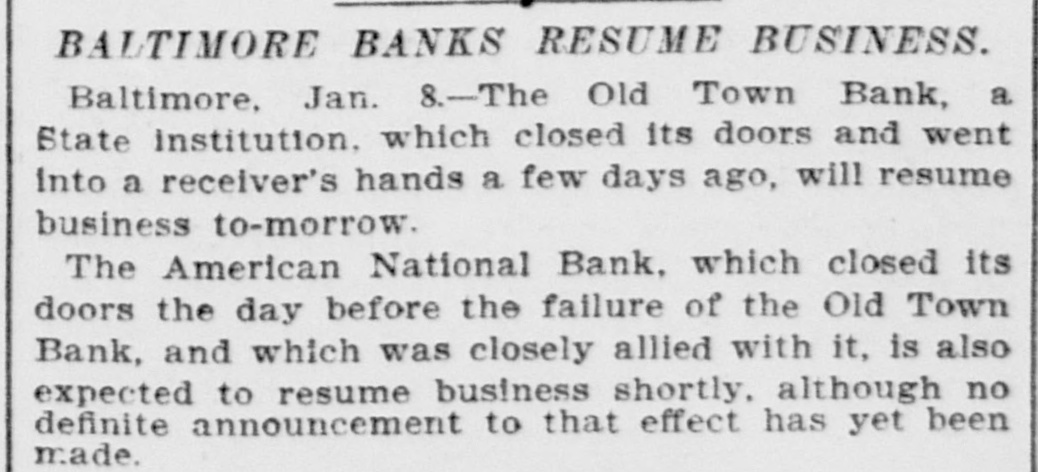
The 'Old Town' Bank, a state institution, which closed its doors and went into a receiver's hands a few days ago, will resume business tomorrow. The only change ... is the substitution of Milton B. Williams as cashier in the place of Theodore Wilcox.
Source
newspapers

Newspaper Articles (22)

Article from The Indianapolis Journal, December 27, 1900

Click image to open full size in new tab

Article Text

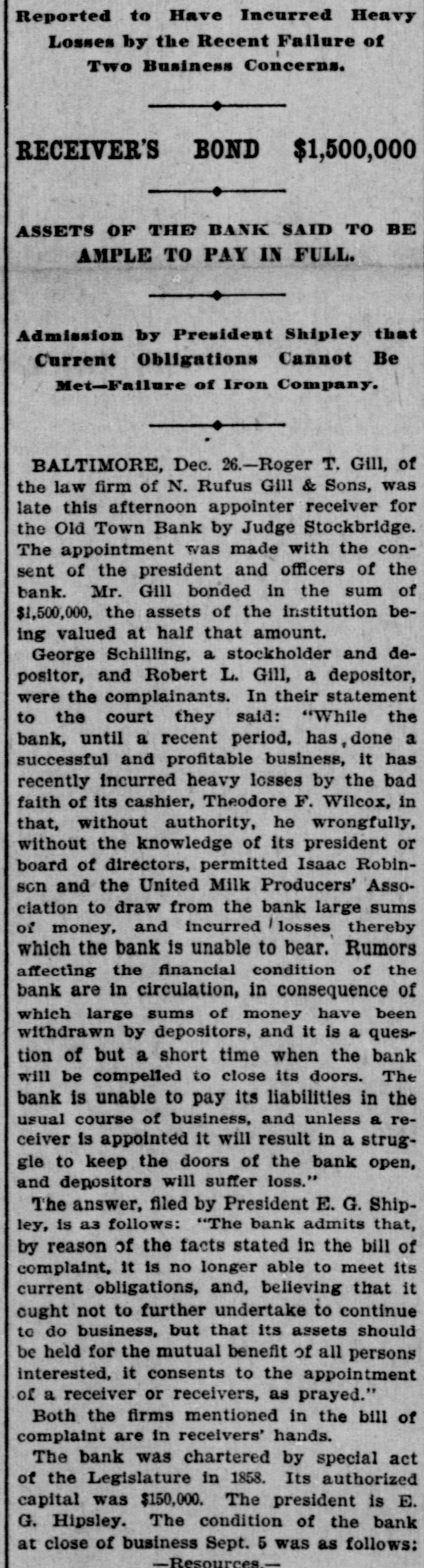
Reported to Have Incurred Heavy Losses by the Recent Failure of Two Business Concerns. RECEIVER'S BOND $1,500,000 ASSETS OF THE BANK SAID TO BE AMPLE TO PAY IN FULL. Admission by President Shipley that Current Obligations Cannot Be Met-Failure of Iron Company. BALTIMORE, Dec. 26.-Roger T. Gill, of the law firm of N. Rufus Gill & Sons, was late this afternoon appointer receiver for the Old Town Bank by Judge Stockbridge. The appointment was made with the consent of the president and officers of the bank. Mr. Gill bonded in the sum of $1,500,000, the assets of the institution being valued at half that amount. George Schilling, a stockholder and depositor, and Robert L. Gill, a depositor, were the complainants. In their statement to the court they said: "While the bank, until a recent period, has, done a successful and profitable business, it has recently incurred heavy losses by the bad faith of its cashier, Theodore F. Wilcox, in that, without authority, he wrongfully, without the knowledge of its president or board of directors, permitted Isaac Robinson and the United Milk Producers' Assoclation to draw from the bank large sums of money, and incurred / losses thereby which the bank is unable to bear. Rumors affecting the financial condition of the bank are in circulation, in consequence of which large sums of money have been withdrawn by depositors, and it is a question of but a short time when the bank will be compelled to close its doors. The bank is unable to pay its liabilities in the usual course of business, and unless a receiver is appointed it will result in a struggle to keep the doors of the bank open, and depositors will suffer loss." The answer, filed by President E. G. Shipley, is as follows: "The bank admits that, by reason of the facts stated in the bill of complaint, it is no longer able to meet its current obligations, and, believing that it cught not to further undertake to continue to do business, but that its assets should be held for the mutual benefit of all persons interested, it consents to the appointment of a receiver or receivers, as prayed." Both the firms mentioned in the bill of complaint are in receivers' hands. The bank was chartered by special act of the Legislature in 1858. Its authorized capital was $150,000. The president is E. G. Hipsley. The condition of the bank at close of business Sept. 5 was as follows: -Resources. -
Article from Daily Camera, December 27, 1900

Click image to open full size in new tab

Article Text

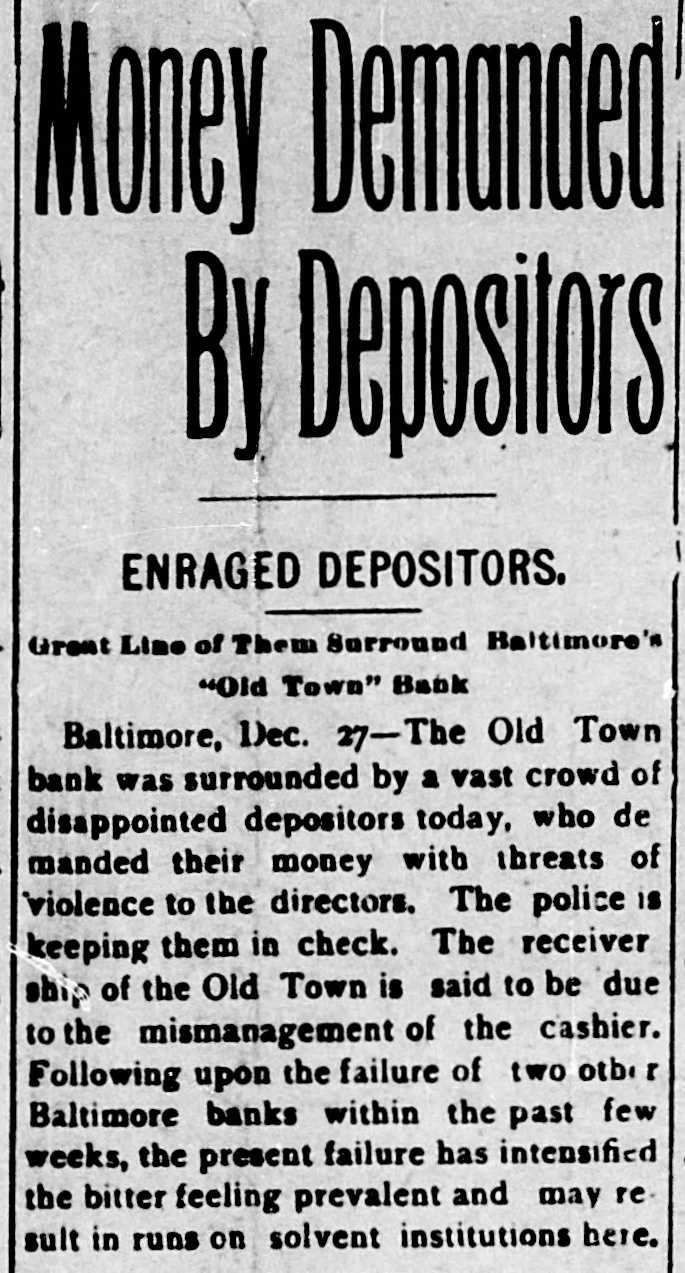
Money Demonded By Depositors ENRAGED DEPOSITORS. Great Line of Them Surround Haltimore's Old Town" Bank Baltimore, Dec. 27- The Old Town bank was surrounded by a vast crowd of disappointed depositors today, who de manded their money with threats of violence to the directors. The police is keeping them in check. The receiver ship of the Old Town is said to be due to the mismanagement of the cashier. Following upon the failure of two other Baltimore banks within the past few weeks, the present failure has intensified the bitter feeling prevalent and may re. sult in runs on solvent institutions here.


Article from Bismarck Daily Tribune, December 27, 1900

Click image to open full size in new tab

Article Text

RUN ON BANKS UNEASINESS CAUSES RUN ON SEVERAL SAVINGS BANKS AT BALTIMORE. Baltimore, Dec. 27.-The mob that surrounded the Old Town bank at midnight clamoring for deposits dispersed at an early hour this morning. The uneasiness which the recent bank failures has caused increased this morning and runs on several banks commenced. The panicky feeling is almost entirely confined to depositors in savings banks.


Article from The Times, December 27, 1900

Click image to open full size in new tab

Article Text

A RECEIVER APPOINTED. The Old Town Bank, of Baltimore, Closes Its Doors. BALTIMORE, Dec. 26.-Several of the directors of the Old Town Bank, of this city, asked for a receiver for that institution this evening and Roger T. Gill, counsel for the bank, was appointed. The announcement created consternation among the business people in the vicinity of the bank, as it was one of the oldest and most reliable in the city. Up to 3 o'clock deposits were received, notwithstanding that there was a run 0 nthe bank at the time. Immediately after the doors were closed the executive committee of the clearing house held a meeting at which the condition of the bank was investigated. According to the statements submitted by the directors, the bank's surplus of $154,000 was obliterated, but the capital stock of $150,000 is unimpaired. The losses are attributed to the unauthorized acts of the cashier, Theodore Wileox, who, it is charged, loaned large amounts to Isaac Robinson, the packer, who failed recently for $800,000. Money was also invested in the United Milk Producers' Association which is also in trouble. These facts became public several days ago and many of the depositors becoming alarmed withdrew their money today. Fearing that the run would be continued, the directors asked for a receiver. In the last statement of the bank, the deposits were $960,000, all of which were secured. The proposition is now made to merge the bank into a national bank. E. G. Hipsley, one of the oldest residents in East Baltimore, is president of the bank.


Article from The Florence Daily Tribune, December 27, 1900

Click image to open full size in new tab

Article Text

People Demand Their Money. Baltimore, Md., Dec. 27-All last night and today a mob of excited depositors have surrounded the old town bank that was placed in the hands of a receiver last evening. They were demanding their money and threating to do violence. A large force of police surrounded the structure to protect it against any riotious act of the crowd.


Article from Alexandria Gazette, December 27, 1900

Click image to open full size in new tab

Article Text

# ALEXANDRIA GAZETTE AND VIRGINIA ADVERTISER NGTON. [Alexandria Gazette.] December 27. se government to comply with ers, as set forth ded to Prince question that Senator Platt joining in the recommen- dation. Senator Lodge, of Massachusetts, called at the White House this morning to introduce to the President George Van L. Meyer, the newly appointed Ambassador to Italy. In the answer to the notice of contest for his seat, Representative Rhea of the Abing- don Virginia district, denies specifically # VIRGINIA NEWS. Colonel Robert H. Logar, a promi- nent lawyer of Salem, died suddenly yesterday. S. G. Jamison, of Marlboro, Fred- erick county, died suddenly yesterday from heart disease. Rev. Henry Grady Ferguson, former- # TO-DAY'S TELEGRAPHIC NEWS Foreign News. London, Dec. 27.-Lord Armstrong, the distinguished engineer and inven- tor of the Armstrong gun, is dead, aged 80 years. A company of 200 Catholic priests and distinguished members of the Cath- being made on the Savings Bank of Baltimore, the oldest and most solid in- stitution of the kind in the city. De- positors will all be satisfied. A run is a so being made on the City Savings Bank. These runs are results of the failure of the American National Bank, the Old Town Bank and the closing of the Economy Savings Bank.


Article from Gloucester County Democrat, December 27, 1900

Click image to open full size in new tab

Article Text

A BALTIMORE BANK FAILURE. Depositors Charge Cashier Wilcox With Bad Faith. Baltimore, Dec. 27.-Roger T. Gill, of the law firm of N. Rugus Gill & Sons, was late yesterday afternoon appointed receiver for the Old Town bank by Judge Stockbridge. The appointment was made with the consent of the president and officers of the bank. Mr. Gill bonded in the sum of $1,500,000, the assets of the institution being valued at that amount. George Schilling, a stockholder and depositor, and Robert L. Gill, a depositor, were the complainants. They declare that "while the bank, until a recent period, has done a successful and profitable business, it has recently incurred heavy losses by the bad faith of its cashier, Theodore F. Wilcox, in that, without authority, he wrongfully, without the knowledge of its president or board of directors, permitted Isaac Robinson and the United Milk Producers' association to draw from the bank large sums of money, and incurred losses thereby which the bank is unable to bear."


Article from The St. Louis Republic, December 28, 1900

Click image to open full size in new tab

Article Text

Failure of the Old Town Bank Caused Depositors to Become Wildly Alarmed. DREW OUT $250,000 IN A DAY. Three Strongest Savings Institutions in City Were the Most Importuned-Had No Trouble in Meeting the Demands. REPUBLIC SPECIAL Baltimore, Md., Dec. 27.-Bank failures. of which there have been three in rapid succession in this city within a week. culminating yesterday In the suspension of the Old Town Bank, had an alarming effect upon depositors to-day. Long before 9 this morning hundreds of depositors gathered at the doors of three of the leading savings banks of the city and clamored for their money. The officers of the banks were apprised of the fact that runs were imminent. and were prepared for the rush when it came. Those alarmed for the safety of their funds were nearly all working people whose deposits, while not large individually, amounted to a large sum in the aggregate. Most of them were Poles. who live in the section in which the defunct banks are 10cated. Wildly excited they flocked to the banks. where they had deposited their surplus earning : are when the doors opened. scrambled for places at the paying tellers' window They would not listen to the advice of friends, who pleaded with them not to sacrifice their interest for the year ending April 1. From 9 this morning until 6 this evening, there was a steady run. All of the banks waived the right to ask for thirty days' notice and extended the banking hours in order that all might be accommodated. Speculators Cashed Bank Books. Singularly enough, the three strongest savings institutions in the city were most importuned. Leading these is the Savings Bank of Baltimore, which has $23,000,000 in its vault, more than $5,000,000 of which is represented by Government bonds. There was no necessity for converting any securities into cash, more than enough money being in the safe to meet a run of a week's duration. Unlike the others, this bank paid all who withdrew their deposits interest up to December 1. Some sharp speculators, who heard of this, cashed all books of those who were far back in the line at their face value bank. and then collected the interest in the The City Savings Bank is another solid institution upon which a run was Inaugurated. which extended throughout the day. Offers of assistance came from everywhere, but It was not needed. Here the excited Poles, forming a line 200 yards long, waited their turn. At the Hopkins Place Savings Bank, the rush did not last SO long. By 4 the run petered out. The amount drawn from all three banks was about $250,000. There were runs on other savings banks, but these did not last. The alacrity with which the money was paid out had the desired effect and by 3 they all closed. The excitement has died out now and the indications are that there will be no further withdrawals. All sorts of rumors are flying about concerning other banks that are in trouble, but apparently there is no foundation for such stories, and the four banks that have suspended will, It is stated, pay creditors in full.


Article from The Times, December 28, 1900

Click image to open full size in new tab

Article Text

SCARE AMONG DEPOSITORS. Runs Made on Several Banks In Baltimore. (By Associated Press.) BALTIMORE, Dec. 27.-A scare among timid depositors of the several savings banks of the city resulted to-day from the failure, on Wednesday. of the Old Town Bank. Runs occurred on nearly all the savings institutions, but the most noticeable were upon the Savings Bank of Baltimore, the City Savings Bank, and the Hopkins Place Savings Banks. Crowds of persons were assembled upon the sidewalks in the vicinity of these banks long before "bank hours" this morning, and the doors were opened before the usual hour.


Article from The Semi-Weekly Messenger, December 28, 1900

Click image to open full size in new tab

Article Text

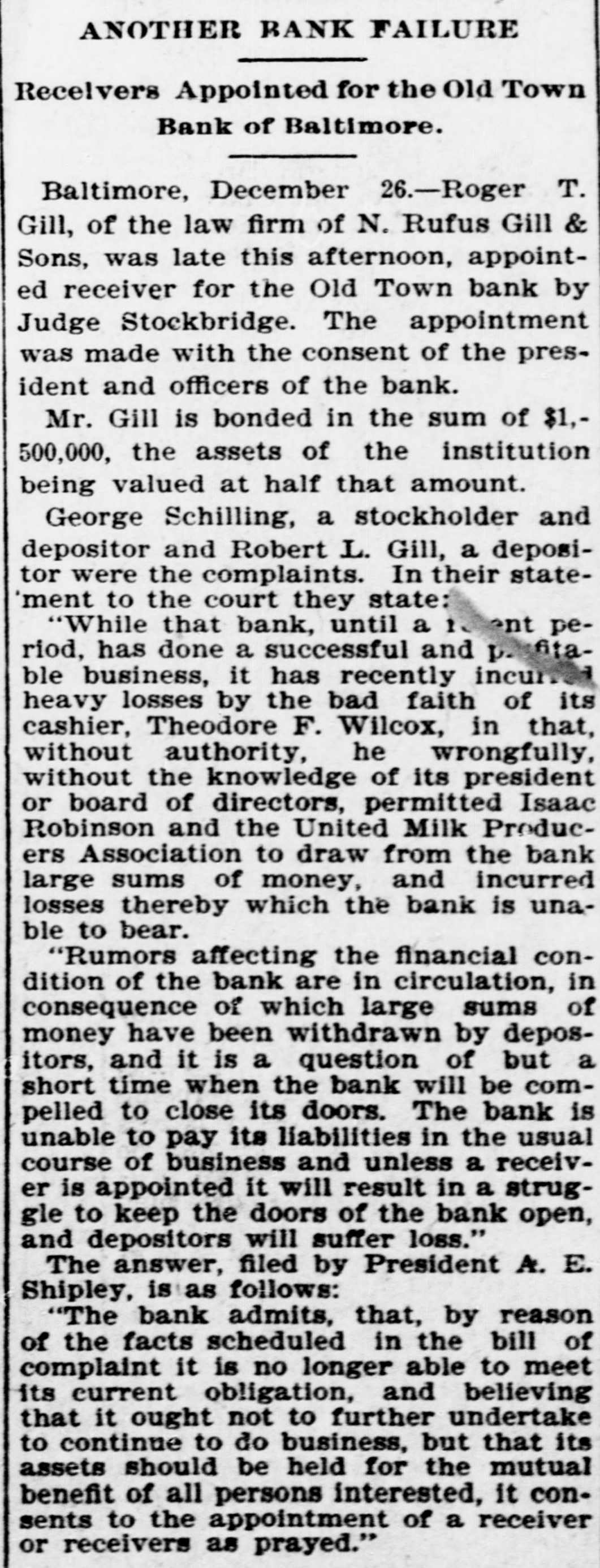
ANOTHER BANK FAILURE Receivers Appointed for the Old Town Bank of Baltimore. Baltimore, December 26.-Roger T. Gill, of the law firm of N. Rufus Gill & Sons, was late this afternoon, appointed receiver for the Old Town bank by Judge Stockbridge. The appointment was made with the consent of the president and officers of the bank. Mr. Gill is bonded in the sum of $1,500,000, the assets of the institution being valued at half that amount. George Schilling, a stockholder and depositor and Robert L. Gill, a depositor were the complaints. In their state'ment to the court they state: "While that bank, until a 1. nt period, has done a successful and p. fitable business, it has recently incurred heavy losses by the bad faith of its cashier, Theodore F. Wilcox, in that, without authority, he wrongfully, without the knowledge of its president or board of directors, permitted Isaac Robinson and the United Milk Producers Association to draw from the bank large sums of money, and incurred losses thereby which the bank is unable to bear. "Rumors affecting the financial condition of the bank are in circulation, in consequence of which large sums of money have been withdrawn by depositors, and it is a question of but a short time when the bank will be compelled to close its doors. The bank is unable to pay its liabilities in the usual course of business and unless a receiver is appointed it will result in a struggle to keep the doors of the bank open, and depositors will suffer loss." The answer, filed by President A. E. Shipley, is as follows: "The bank admits, that, by reason of the facts scheduled in the bill of complaint it is no longer able to meet its current obligation, and believing that it ought not to further undertake to continue to do business, but that its assets should be held for the mutual benefit of all persons interested, it consents to the appointment of a receiver or receivers as prayed."


Article from The Billings Gazette, December 28, 1900

Click image to open full size in new tab

Article Text

RECEIVER FOR BANK. Baltimore, Dec. 26-Roger T. Gill of the law firm of N. Rufus Gill & Sons, was late this afternoon appointed receiver for the Old Town bank by Judge Stockbridge. The appointment was made with the consent of the president and officers of the bank. Gill is bonded in the sum of $1,500,000, the assets of the institution being half that amount.


Article from The Aegis & Intelligencer, December 28, 1900

Click image to open full size in new tab

Article Text

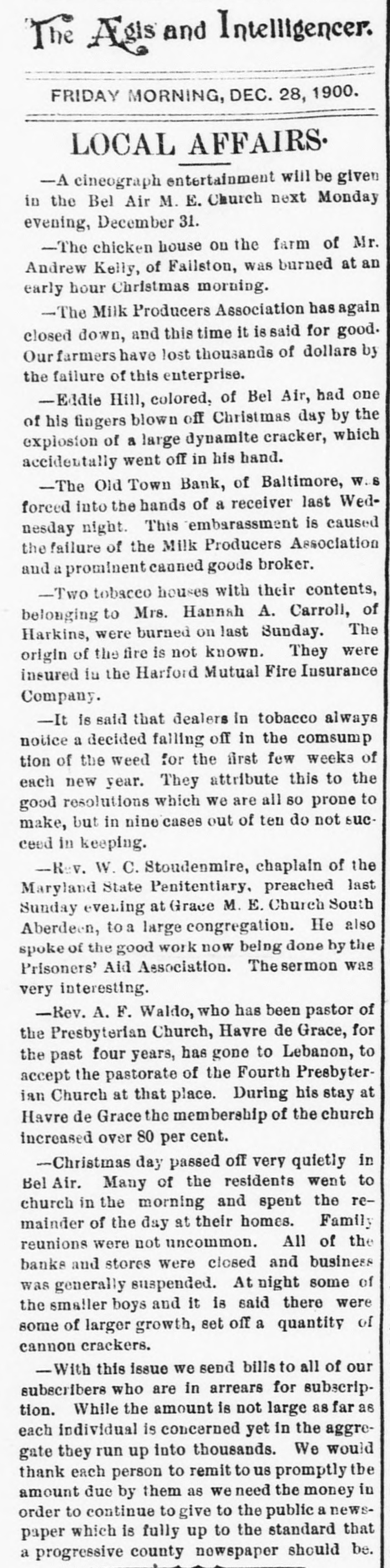
The Agis and Intelligencer. FRIDAY MORNING, DEC. 28, 1900. LOCAL AFFAIRS. -A eineograph entertainment will be given in the Bel Air M. E. Church next Monday evening, December 31. -The chicken house on the farm of Mr. Andrew Kelly, of Failston, was burned at an early hour Christmas morning. -The Milk Producers Association has again closed down, and this time it is said for good. Our farmers have lost thousands of dollars by the failure of this enterprise. -Eddie Hill, colored, of Bel Air, had one of his fingers blown off Christmas day by the explosion of a large dynamite cracker, which accidentally went off in his hand. -The Old Town Bank, of Baltimore, W.S forced into the hands of a receiver last Wednesday night. This embarassment is caused the failure of the Milk Producers Association and a prominent canned goods broker. -Two tobacco houses with their contents, belonging to Mrs. Hannah A. Carroll, of Harkins, were burned on last Sunday. The origin of the fire is not known. They were insured in the Harford Mutual Fire Insurance Company. -It is said that dealers In tobacco always notice a decided failing off in the comsump tion of the weed for the first few weeks of each new year. They attribute this to the good resolutions which we are all 80 prone to make, but in nine cases out of ten do not succeed in keeping. -Rev. W. C. Stoudenmire, chaplain of the Maryland State Penitentiary, preached last Sunday eveLing at Grace M. E. Church South Aberdeen, to a large congregation. He also spoke of the good work now being done by the Prisoners' Aid Association. Thesermon was very interesting. -Rev. A. F. Waldo, who has been pastor of the Presbyterian Church, Havre de Grace, for the past four years, has gone to Lebanon, to accept the pastorate of the Fourth Presbyterian Church at that place. During his stay at Havre de Grace the membership of the church increased over 80 per cent. -Christmas day passed off very quietly in Bel Air. Many of the residents went to church in the morning and spent the remainder of the day at their homes. Family reunions were not uncommon. All of the banks and stores were closed and business was generally suspended. At night some of the smaller boys and it is said there were some of larger growth, set off a quantity of cannon crackers. -With this issue we send bills to all of our subscribers who are in arrears for subscription. While the amount is not large as far as each individual is concerned yet in the aggregate they run up into thousands. We would thank each person to remit to us promptly the amount due by them as we need the money in order to continue to give to the public a newspaper which is fully up to the standard that a progressive county newspaper should be.


Article from The Democratic Advocate, December 29, 1900

Click image to open full size in new tab

Article Text

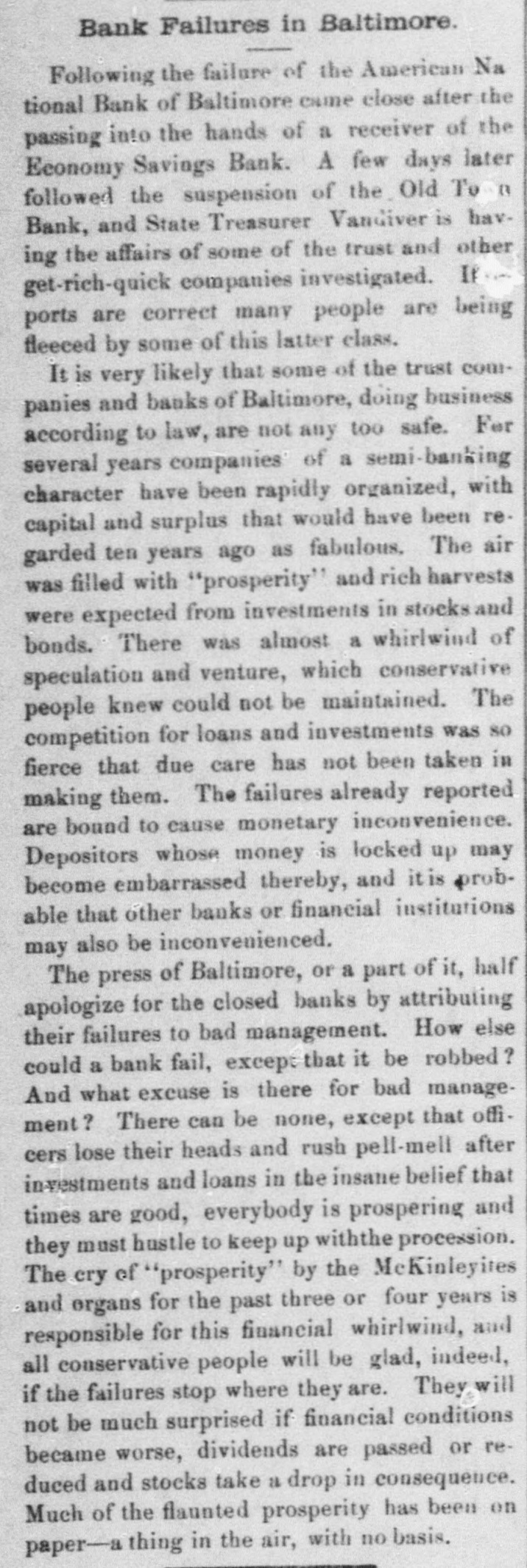
Bank Failures in Baltimore. Following the failure of the American Na tional Bank of Baltimore came close after the passing into the hands of a receiver of the Economy Savings Bank. A few days later followed the suspension of the Old To 0 Bank, and State Treasurer Vandiver is having the affairs of some of the trust and other get-rich-quick companies investigated. If ports are correct many people are being fleeced by some of this latter class. It is very likely that some of the trust companies and banks of Baltimore, doing business according to law, are not any too safe. For several years companies of a semi-banking character have been rapidly organized, with capital and surplus that would have been re. garded ten years ago as fabulous. The air was filled with "prosperity" and rich harvests were expected from investments in stocks and bonds. There was almost a whirlwind of speculation and venture, which conservative people knew could not be maintained. The competition for loans and investments was so fierce that due care has not been taken in making them. The failures already reported are bound to cause monetary inconvenience. Depositors whose money is locked up may become embarrassed thereby, and it is probable that other banks or financial institutions may also be inconvenienced. The press of Baltimore, or a part of it, half apologize for the closed banks by attributing their failures to bad management. How else could a bank fail, except that it be robbed ? And what excuse is there for bad management? There can be none, except that officers lose their heads and rush pell-mell after investments and loans in the insane belief that times are good, everybody is prospering and they must hustle to keep up withthe procession. The cry of "prosperity" by the McKinleyites and organs for the past three or four years is responsible for this financial whirlwind, and all conservative people will be glad, indeed, if the failures stop where they are. They will not be much surprised if financial conditions became worse, dividends are passed or reduced and stocks take a drop in consequence. Much of the flaunted prosperity has been on paper-a thing in the air, with no basis.


Article from The Democratic Advocate, December 29, 1900

Click image to open full size in new tab

Article Text

Bank Failures in Baltimore. Following the failure of the American Na. tional Bank of Baltimore came close after the passing into the hands of a receiver of the Economy Savings Bank. A few days later followed the suspension of the Old Town Bank, and State Treasurer Vandiver is having the affairs of some of the trust and other get-rich-quick companies investigated. Ifreports are correct many people are being fleeced by some of this latter class. It is very likely that some of the trust companies and banks of Baltimore, doing business according to law, are not any too safe. For several years companies of a semi-banking character have been rapidly organized, with capital and surplus that would have been regarded ten years ago as fabulous. The air was filled with "prosperity" and rich harvests were expected from investments in stocks and bonds. There was almost a whirlwind of speculation and venture, which conservative people knew could not be maintained. The competition for loans and investments was so fierce that due care has not been taken in making them. The failures already reported are bound to cause monetary inconvenience. Depositors whose money is locked up may become embarrassed thereby, and it is probable that other banks or financial institutions may also be inconvenienced. The press of Baltimore, or a part of it, half apologize for the closed banks by attributing their failures to bad management. How else could a bank fail, except that it be robbed ? And what excuse is there for bad management ? There can be none, except that officers lose their heads and rush pell-mell after investments and loans in the insane belief that times are good, everybody is prospering and they must hustle to keep up withthe procession. The cry of "prosperity" by the McKinleyites and organs for the past three or four years is responsible for this financial whirlwind, and all conservative people will be glad, indeed, if the failures stop where they are. They will not be much surprised if financial conditions became worse, dividends are passed or reduced and stocks take a drop in consequence. Much of the flaunted prosperity has been on paper-a thing in the air, with no basis.


Article from The San Juan Islander, January 3, 1901

Click image to open full size in new tab

Article Text

LATER NEWS. The Scranton street car strike has been called off. The kaiser is contemplating a visit to the United States. Seattle has started a movement to suppress vice in that city. Soldiers may have to be called out to quell a fued in Kentuoky. Coming Oregon Legislature will be asked to found normal school at Burns. Edwin Bedforde, a noted Kentucky cattle breeder, is dead, aged 68 years. According to advices from Dawson another rich strike has been made near there. Many Luzon insurgents have been by captured as a result of scouting Americans. Kitchener reports that no progress in is being made against Boer inavders Cape Colony. The Boers captured the British out posts at Helvetia. taking 200 prisoners and killing 50. In an altercation over a game and of cards, a South Carolina sheriff two other men met death. The report that Germany is negotiat- is to purchase the Danish Antilles denied ing in official Denmark circles. The empresa dowager will not be the al lowed to have anything to do with naming of the new emperor of China. Fire in Kanfas City, Mo., for a time threatened several business blocks, loss. but was got under control with smal Severe snow storms prevail in Colo Missouri. Iowa, Kansas and No is rado, braska. In places railroad traffic badly hampered. The United States government has made an offer of $3,000,000 for high the Danish Antilles. This price is as as the officials. will go. A bill will be introduced at the coming session of the Oregon legisla from ture to reduce the railroad fare 4 to 3 cents per mile. The Philippine commission has added to the pending school bill a pro- 600 vision for the employment of American teachers, at salaries ranging from $75 to $100 a month. A train on the Henderson road was wrecked two miles east of Henderson, and five persons striously injured switch Ky., coupling pin placed in the the A frog apparently by weckers caused wreck. Rumors of a cabinet crisis in Spain increase. Senor Sagasta, ex-premier who has finally broken silence, declares that a change of ministry is inevitable in the account of the differences cabinet, on as well as in the ranks of its supporters. Three children at Olympia were cremated alive. There are said to be 30,000 lepers in the archipelago. Massacress of native Christians in China continue. Clements cannot force the Boera from Magalies Berg. The lumber industry in Eastern Ore gon is rapidly growing. A squadron of Yeomanry is said to have been captured by Boers. of Whitmarsh, the new governor Benguet, is a British subject. Stocks of wool in the United States exceed 350,000,000 pounds. the A receiver was appointed for Old Town bank, at Baltimore. The trial of Alvord, the defaulting note teller, has been postponed. The grandson of ex-Attorney-General Miller was abducted by his nother. Kitchener is making little progress Colony. in driving the Boers from Cape Robert Taylor, a well known suicide. resident of Ashland, committed York The bolliday rush at the New known. postoffice was the greatest ever Three hundred students have been arrested in St. Petersburg for propagating Socialist doctrines Fontela, a Filipino refugee, succeed says the in United States will never subduing the Philippine islands. Congress will be asked to recognise Mer Hobson's gallantry in sinking the rimac in the harbor of Santiago. Fire partially destroyed the Method- ProvEpiscopal church (colored) of fatally idence, ist Mo. The pastor was burned. In the event of England rejecti may the Ray-Pauncefote treaty a new one of be negotiated at the next session congress. Boxers numbering 2,500 men were at tacked a French column. They be repulsed with heavy loss, leaving hind them 1,000 dead and wounded. Inquiries into quarters most likely that be correctly informed show justify nothing to is known in Paris to United the report circulated in the pianist, States that Paderewski, the was killed in a duel in France. A band of probably 50 men forced III., entrance to the Green county, an jail, with the intention of lynching a prisoner, but were foiled. The prison- aner had been secry removed 10 other jail. King Victor of Italy had a viewing narrow escape from drowning while the flood in Rome. a ALA 11


Article from The Butler Weekly Times, January 3, 1901

Click image to open full size in new tab

Article Text

A PANIC IN BALTIMORE. Three Bank Failures Caused Runs on Other Institutions. Baltimore, Md., Dec. 27.-Baltimore saving bank depositors are in the throes of a financial panic as a result of the failure of three banks, the American National, the Old Town bank and the Economy Savings bank. The Old Town bank, the last of the three to go down. went into the hands of a receiver yesterday. When the news got around, a mob surrounded the bank buildingand howled for their money. They kept it up till a late hour, but finally dispersed. This morning the uneasiness which the failures have caused developed into a run on several banks The Savings bank of Baltimore, one of the oldest and most solid institutions of the kind in the city, and the City Savings bank were thronged with depositors, who withdrew their money. All demands were met, and depositors, it is said, will all be satisfied. The panicky feeling isalmostentirely confined to depositors in savings banks.


Article from Evening Star, January 8, 1901

Click image to open full size in new tab

Article Text

BANKS TO RESUME BUSINESS. "Old Town" and American National of Baltimore So Decide. BALTIMORE, January 8.-The "Old Town" Bank, a state institution, which closed its doors and went into a receiver's hands a few days ago, will resume business tomorrow. It is announced that the only change in the management of the bank which will be made at this time is the substitution of Milton B. Williams as cashier in the place of Theodore Wilcox, who formerly held that position and who is accused by the directors of the bank with having caused the failure of the bank by bad management. The American National Bank, which closed its doors the day before the failure of the "Old Town" Bank, and which was closely allied to it, is also expected to resume business shortly, although no definite announcement to that effect has yet been made.


Article from The Hawaiian Gazette, January 8, 1901

Click image to open full size in new tab

Article Text

# WORLD NEWS CONDENSED The Samoa is to be made a transport. Giacomini's comet has been seen again. Lord Roberts has arrived at Gibraltar. The Queen of Holland will wed in September. Andree has at last been given up for lost. There is a corner on the bean market now. Hank Haff will sail the Boston cup defender. Russia will take over the Manchurian railroads. New York is to have an orthodox Russian church. The Colombian rebels have met with more reverses. Jules Riviere, a famous musical conductor, is dead. There is a strong anti-foreign movement in Corea. Depressing weather marked the English Christmas. Prof. Moses Coit Tyler of Cornell University, is dead. Dr. Alfred Momerie, the noted English churchman, is dead. The value of the Pullman estate has increased to $13,000,000. Dreyfus vigorously demands the reopening of his case. Secretary Hay is again at his desk in the State Department. The Great Northern telegraph operators threaten a strike. Glasgow has established a work-house for habitual drunkards. The prune men of San Jose have failed to reach any conclusion. Representative Hull thinks the Army reorganization bill is safe. The corn crop of 1900 was one of the four largest ever gathered. Turkey has signed the ship-building contract with the Cramps. Claus Spreckels will invest $5,000,000 in a San Francisco gas plant. Gold has been found in the crop of a wild goose from Pitt Lake, B. C. There is a plan on foot among prominent Democrats to depose Bryan. De Wet failed in his attempt to break the British lines and escape south. Joseph Owen, six years ago a mill hand, has received a fellowship at Oxford. The Duke of Westminster is to marry the beautiful Miss Cornwallis-West. A heavy snowstorm occurred near Albuquerque, New Mexico, December 28. Booz' brother declares that former Cadet Oscar L. Booz was not a coward. A new Emperor of China is said to have been appointed by the Dowager. The ship Lodore was struck by a squall off Newcastle and turned side up. Thirty-five thousand new men began business in the United States during 1899. The Italian bandit Mussolino has been cornered and will either be taken or killed. Mrs. Lulu C. Jenkins, widow of a lynched man, has recovered $4,000 damages. The new Panama Canal Company on December 27 held a lively meeting in New York. The British have reoccupied Ficksburg which has been in the hands of the Boers. A Mexican bank has failed for over two millions owing to financial stringency. The Southern Educational Convention met in session December 27, in Richmond, Virginia. One lone bandit stopped an Arizona stage and rifled the contents of the express box. H. A. Seymour, a New York broker, has failed, with liabilities of $688,630, asset $750,695. Diamonds, or what closely resembles diamonds, have been found near Capitan, N. M. A wealthy Oakland, Cal., citizen has left the bulk of his property to the Salvation Army. Sydney Miller, the kidnaped 7-year-old grandson of Attorney General Miller, has been returned. Members of the English Embassy were grossly insulted at Constantinople by the Sultan's troops. Crowe, the supposed abductor of young Cudahy, is supposed to be escaping in woman's dress. Great Britain is building eleven battleships, nineteen cruisers and fourteen smaller vessels. Owing to general starvation, human flesh is being offered for sale in the province of Shan-si. Decision has been given against Kipling in regard to the elephant's head as a copyright mark. A run on all the banks of Baltimore followed the announcement of the Old Town Bank failure. Roosevelt refuses to extradite Rockefeller to Texas for alleged violation of the anti-trust law. Wesley Dugan, a public school teacher in Petersburg, Ind., was brutally hazed by his pupils. The Tugari tribe from Dutch New Guinea raided the English possessions there on December 27. The Methodist and Baptist churches of Illinois and adjoining States are preparing for a great revival. Senator Allison says the Senate Committee on Finance will grant no hearings on war revenue matters. Postal robbers on the Michigan Central made a haul of $100,000 in negotiable paper. A pouch was stolen. It is rumored that Mrs. Phoebe Hearst has left the Episcopal Church and taken up with Christian Science. Americans on December 28 joined a British and German expedition to clear the country east of Peking. W. L. Fletcher of the Missouri Pacific says San Francisco is developing faster than any city in the Union. Alfred Harmsworth, the London editor, says he sees no reason why America should not control the canal. W. F. H. Fickstone of San Jose has been engaged by Cecil Rhodes to cultivate his acres in South Africa. Mystery shrouds the shooting of a prominent Masonic Indiana official, William H. Smythe, on December 27. British cavalry en route to South Africa are discarding the lance and carbine and taking rifles and sabers. Owing to the Lindley disaster last May several British yeomanry officers, including Colonel Spragge, have resigned. The Senate Committee on Relations with Cuba will consider the question of irregularities under the Cuban service. A woman of seventy, who married a man of twenty-three and gave up to him her estate, now claims she was deceived.


Article from The Sun, January 9, 1901

Click image to open full size in new tab

Article Text

The Sherman In a Typhoon. San Francisco, Jan. 8.-The United States transport Sherman was caught in a typhoon off the Japanese coast on Dec 18. The waves broke SO high that the hurricane deck was flooded. One of the port lifeboats was smashed into kindling wood and another had to be out adrift. All the windows on the port side were stove in and the roof of the cabin was taken off bodily and piled up around the smokestack. The ends of the staterooms were stove in and tons of water almost filled the rooms. J. R. Duff was hurled with great violence against a chair, sustaining a fracture of three ribs and some of the bones of his right hands besides several bruises. "Old Town" Bank to Resume. Baltimore, Jan. 8.-The "Old Town" bank, a state institution which closed its doors and went into a receiver's hands a few days ago, will resume business at once. It is announced that the only change in the management of the bank which will be made at this time is the substitution of Milton B. Williams as cashier in place of Theodore Wilcox, who formerly held that position and who is accused by the directors of the bank with having caused the failure of the bank by bad management.


Article from New-York Tribune, January 9, 1901

Click image to open full size in new tab

Article Text

BALTIMORE BANKS RESUME BUSINESS. Baltimore, Jan. 8.-The Old Town Bank, a State institution. which closed its doors and went Into a receiver's hands a few days ago, will resume business to-morrow. The American National Bank, which closed its doors the day before the failure of the Old Town Bank, and which was closely allied with it, is also expected to resume business shortly. although no definite announcement to that effect has yet been made.


Article from The Democratic Advocate, January 19, 1901

Click image to open full size in new tab

Article Text

days. Wm. C. Volans, aged 93 years, died in Annapolis last Saturday. House burglars and sneak thieves are very industrious in Baltimore. Isabella, wife of ex-Judge Lynch, of Frederick, died Monday. Diphtheria and grip are on the increase in Cecil and Harford counties. A receiver is asked for the Crown Savings and Loan Association of Baltimore. Five persons and firms applied for bankruptcy proceedings in Baltimore Monday. The Old Town Bank of Baltimore has reopened. It is backed by the Clearing House. A receiver has been appointed for the Atlantic Trust and Deposit Company of Baltimore. Rockville is to have a manual training school for which the State appropriates $1,500 each year. Boonsboro has been selected as the place of holding the 82d annual synod of the Lutheran Church this year. Navigation on the Chesapeake and Delaware Canal was closed Saturday by the sinking of a SCOW loaded with pigiron. Receivers have been appointed for the Columbia Hydraulic and Engineering Co., Baltimore; also for T. A. Fitzpatrick & Co. Last year there were 604 deaths in Frederick city and county, 137 persons dying in the city, and 467 in the county. The Baltimore and Ohio Railroad has ordered 100 new engines and expects to spend $1,500,000 in new piers at Locust Point. Mrs. Elizabeth Bond, aged 93 years, died in Belair on the 13th instant. She retained all her faculties to a remarkable degree. Owing to the recent report of the grand jury, the directors of the Baltimore Female House of Refuge have asked for a full investigation. John Willis Brubaker, proprietor of the Taylor Hotel, Winchester, Va., died suddenly on Monday. He was a native of Frederick county, Dr. David Caldwell, aged 57 years, and Cornelius Howard Shipley, aged 76 years, well-known citizens of Baltimore, died from the grip on Monday. George A. Buckey, aged 61 years, one of the oldest engineers of the Western Md. Railroad, died in Williamsport last week. He leaves a wife and four children. Owing to sickness the attendance at the public schools of Baltimore county has fallen below the average, and some schools are closed because of the illness of teachers. Mrs. Susannah Hall, aged 83 years, died in Beltsville, Prince George's county, Monday. She was prominent in M. E. Church work. She was of that courtly school that is now nearly extinct. John Minnis, aged 92 years, died in Baltimore last week. He was greatly respected. In early life he was a slave in the family of Henry Clay, and others in the South, and was proud that he belonged to the quality. Burglars attempted to rob the German Savings Bank at Cumberland at an early hour last Sunday morning, but they were driven off by the watchman and a policeman. Two snspects were arrested in West Virginia, near Cumberland, Monday, who had fresh bullet wounds. Baltimoreans who invested about $100,000, Washingtonians who invested $375, 000 and others who bought stock in R.C. Flower's Arizona Eastern and Montana Smelting, Ore Purchasing and Developing Company are very anxious to find Mr. Flower, the "promoter." Bon Sonburg, a Student at the Maryland Medical College, Baltimore, was SO severely "hazed" Thursday night of last week that he was ill for several days. If he had "hazed" some of the villians with a knife they would have received their just deserts, and until a few examples are made hazing will be continued. Peter B. Small, Jr., of Washington county, was arrested Monday on the charge of forgery, and in default of bail was sent to jail. His arrest caused a decided sensation, as he had heretofore born an excellent character, was magistrate under Gov. Lowndes, and had been a trusted employe in the sub treasury, Baltimore. il The new six-mile extension of the Altenwald Cut-Off, Western Maryland railroad, was finished Tuesday. The work d has taken 18 months and the cost of the six miles of road will exceed $150,000. The greatest cut was 39 feet, at Grindstone Ridge. The force of workmen employed averaged 200, the majority of which were negroes. Robinson & McGraw, of Baltimore, sued Col. Calvin R. Nutt of Frederick, on a


Article from The Evening Times, October 15, 1901

Click image to open full size in new tab

Article Text

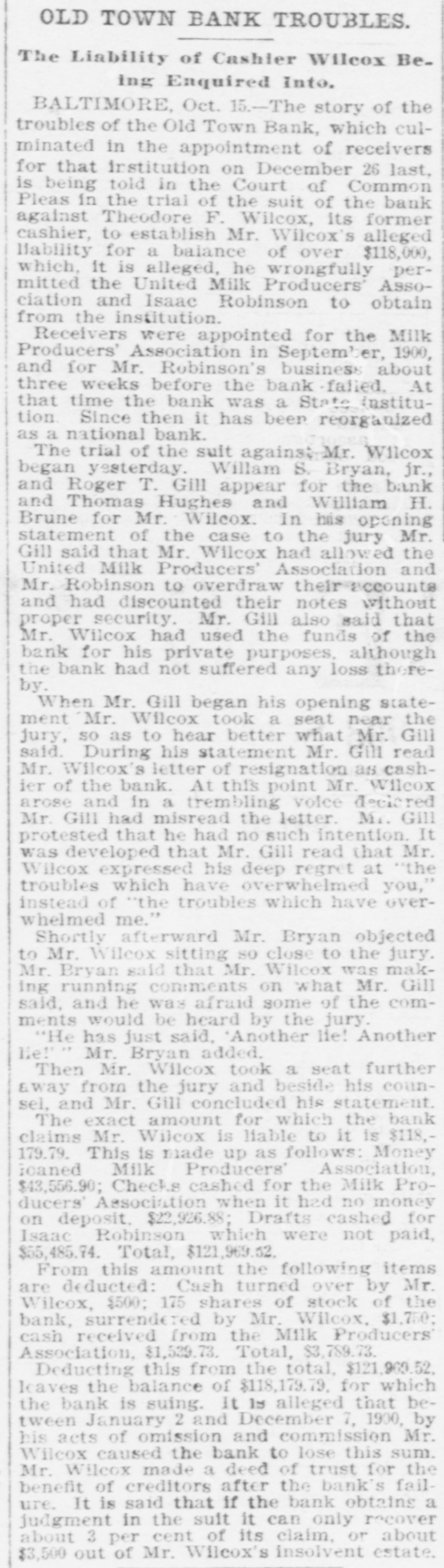
OLD TOWN BANK TROUBLES. The Liability of Cashier Wilcox Being Enquired Into. BALTIMORE, Oct. 15.-The story of the troubles of the Old Town Bank, which culminated in the appointment of receivers for that institution on December 26 last, is being told in the Court of Common Pleas in the trial of the suit of the bank against Theodore F. Wilcox, its former cashier, to establish Mr. Wilcox's alleged liability for a balance of over $118,000, which, it is alleged, he wrongfully permitted the United Milk Producers' Association and Isaac Robinson to obtain from the institution. Receivers were appointed for the Milk Producers' Association in September, 1900, and for Mr. Robinson's business about three weeks before the bank failed. At that time the bank was a State institution Since then it has been reorganized as a national bank. The trial of the suit against Mr. Wilcox began yesterday. Willam S. Bryan, jr., and Roger T. Gill appear for the bank and Thomas Hughes and William H. Brune for Mr. Wilcox. In his opening statement of the case to the jury Mr. Gill said that Mr. Wilcox had allowed the United Milk Producers' Association and Mr. Robinson to overdraw their accounts and had discounted their notes without proper security. Mr. Gill also said that Mr. Wilcox had used the funds of the bank for his private purposes, although the bank had not suffered any loss thereby. When Mr. Gill began his opening statement Mr. Wilcox took a seat near the jury, so as to hear better what Mr. Gill said. During his statement Mr. Gill read Mr. Wilcox's letter of resignation as cashier of the bank. At this point Mr. Wilcox arose and in a trembling voice declared Mr. Gill had misread the letter. Mr. Gill protested that he had no such intention. It was developed that Mr. Gill read that Mr. Wilcox expressed his deep regret at "the troubles which have overwhelmed you," instead of "the troubles which have overwhelmed me." Shortly afterward Mr. Bryan objected to Mr. Wilcox sitting so close to the jury. Mr. Bryan said that Mr. Wilcox was making running comments on what Mr. Gill sald, and he was afraid some of the comments would be heard by the jury. "He has just said, 'Another lie! Another lie!" Mr. Bryan added. Then Mr. Wilcox took a seat further away from the jury and beside his counsel, and Mr. Gill concluded his statement. The exact amount for which the bank claims Mr. Wilcox is liable to it is $118,179.79. This is made up as follows: Money loaned Milk Producers' Association, $43,556.90; Checks cashed for the Milk Producers' Association when it had no money on deposit. $22,926.88; Drafts cashed for Isaac Robinson which were not paid, $55,485.74. Total, $121,969.52. From this amount the following items are deducted: Cash turned over by Mr. Wilcox, $500; 175 shares of stock of the bank, surrendered by Mr. Wilcox, $1,750; cash received from the Milk Producers' Association, $1,539.73. Total, $3,789.73. Deducting this from the total, $121,960.52. leaves the balance of $118,179.79, for which the bank is suing. It is alleged that between January 2 and December 7, 1900, by his acts of omission and commission Mr. Wilcox caused the bank to lose this sum. Mr. Wilcox made a deed of trust for the benefit of creditors after the bank's failure. It is said that if the bank obtains a judgment in the suit it can only recover about 3 per cent of its claim, or about $3,500 out of Mr. Wilcox's insolvent estate.