Article Text
lic one, derives additional weight from the fact that the preference has been inflexibly persisted in, notwithstanding three general bank suspensions—in 1814, 1837 and 1857— and the bank failures which occurred at those periods, and which have now and then occur- red on other occasions.
This fact shows that, in the settled judg- ment of the people of the United States, great as have been the inconveniences and losses sustained by them in consequence of occasional bank failures and suspensions, this inconvenience and these losses have not been so great, by a good deal, as the hard-money declaimers would make them out to be—not so great as to induce the people to abolish the system, or so great as even to shake their confidence in its utility.
In regard to the extent and universality of the injuries inflicted by bank failures, very erroneous estimates and very incorrect state- ments are not unfrequently made. Of the entire population of Tennessee, for instance, the number is small, relatively speaking, who ever lost anything by bank failures!
Similar errors prevail in regard to the class of persons who are the greatest sufferers by reason of the failures of insolvent banks. The poor laboring men, it is often said, are the greatest sufferers. This is as great a fallacy as ever was uttered. Are the pockets of the laboring poor ever stuffed with bank notes? Are they holders of bank stocks? Do they make deposits in banks? How, then, is it possible that they should be the greatest sufferers from bank failures?
But it is said, that the loss of one dollar to a poor man, being all he has, is relatively as great as the loss of a thousand dollars is to a man a thousand times richer. Not so. The poor man can, by a day's work, make an- other dollar, but the thousand dollar man will have to labor long and industriously be- fore he can replace the thousand dollars he has lost.
Clearly it is upon the monied classes of society, or those which from the nature of their business pursuits are compelled to keep considerable amounts of money always on hand, and for daily or frequent use—it is up- on these classes, which constitute but a small portion, relatively speaking, of the commun- ity, that the losses occasioned by the break- ing of banks chiefly fall.
Money is too valuable to be kept long idle. You don't find the farmers and planters, as a general thing, keeping enough on hand ever to be seriously injured by a bank failure. It is the merchants and traders, and the monied men generally, that are the chief sufferers on these occasions.
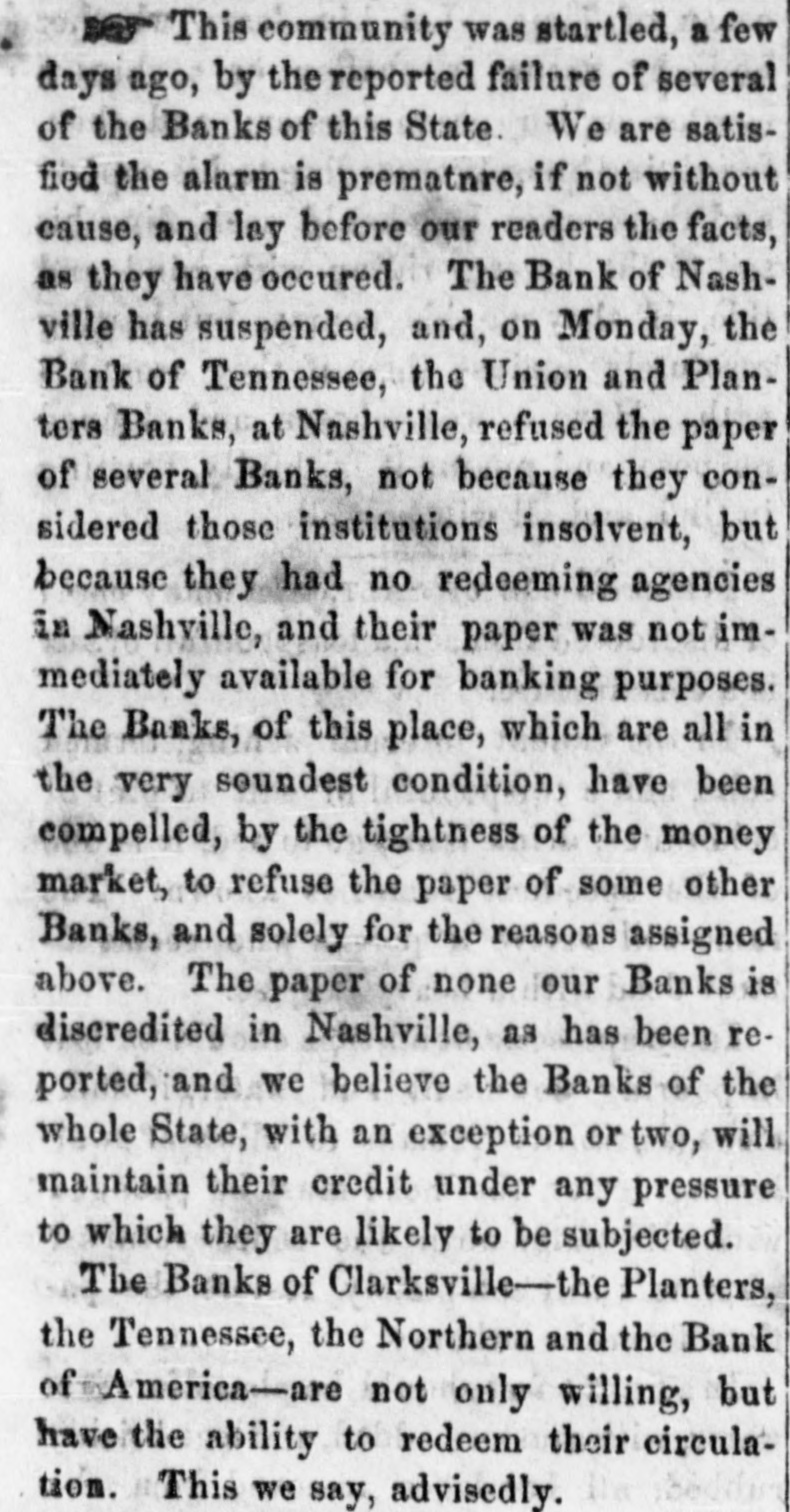
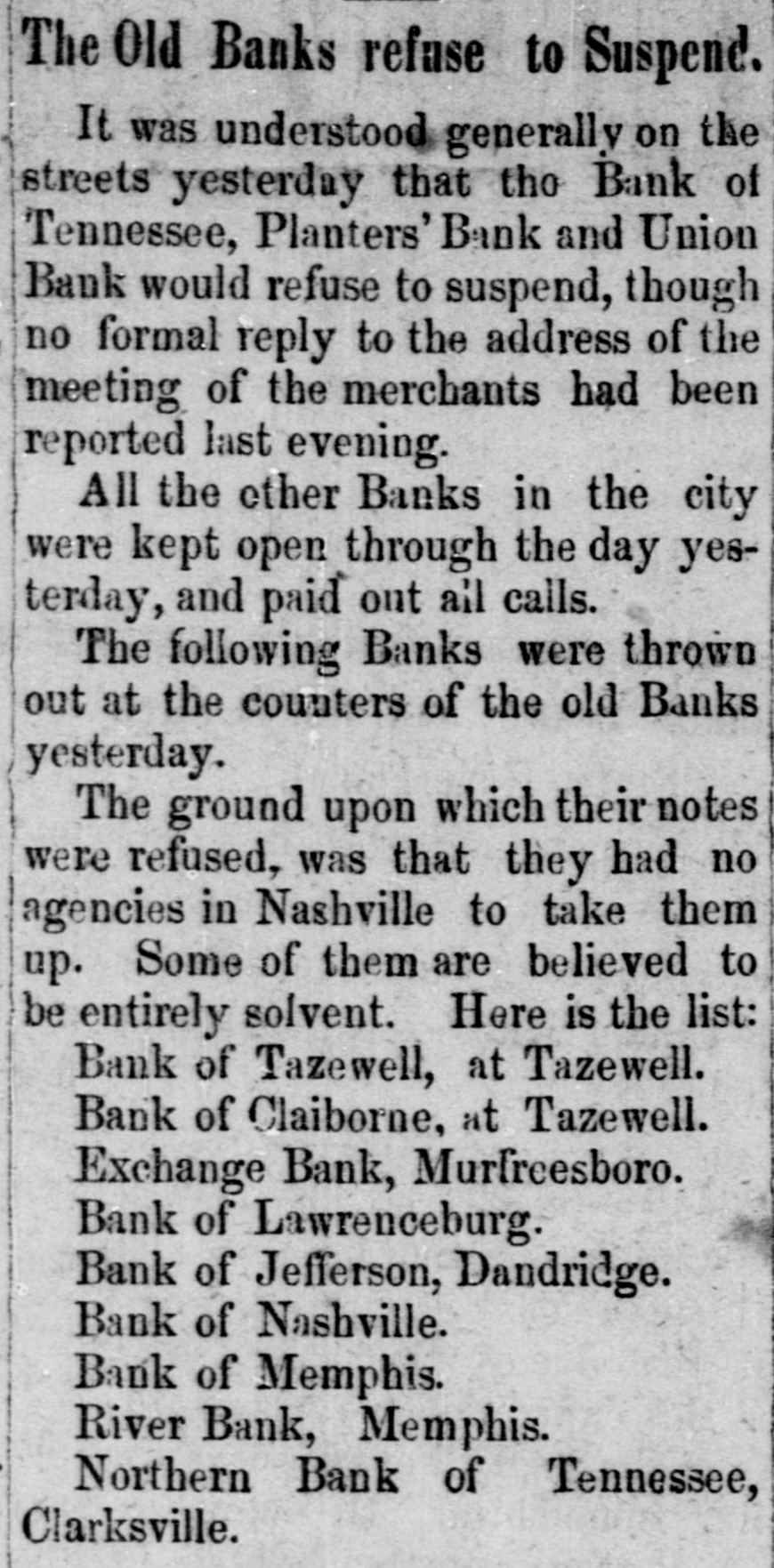
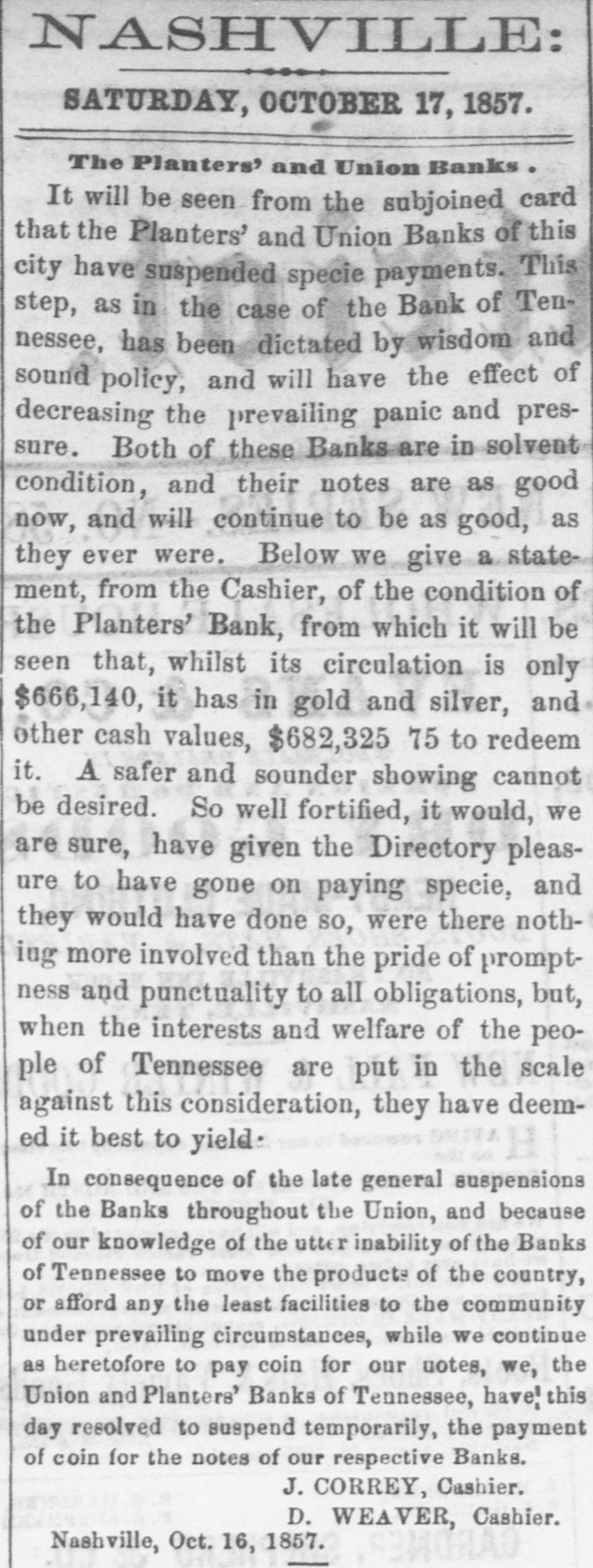
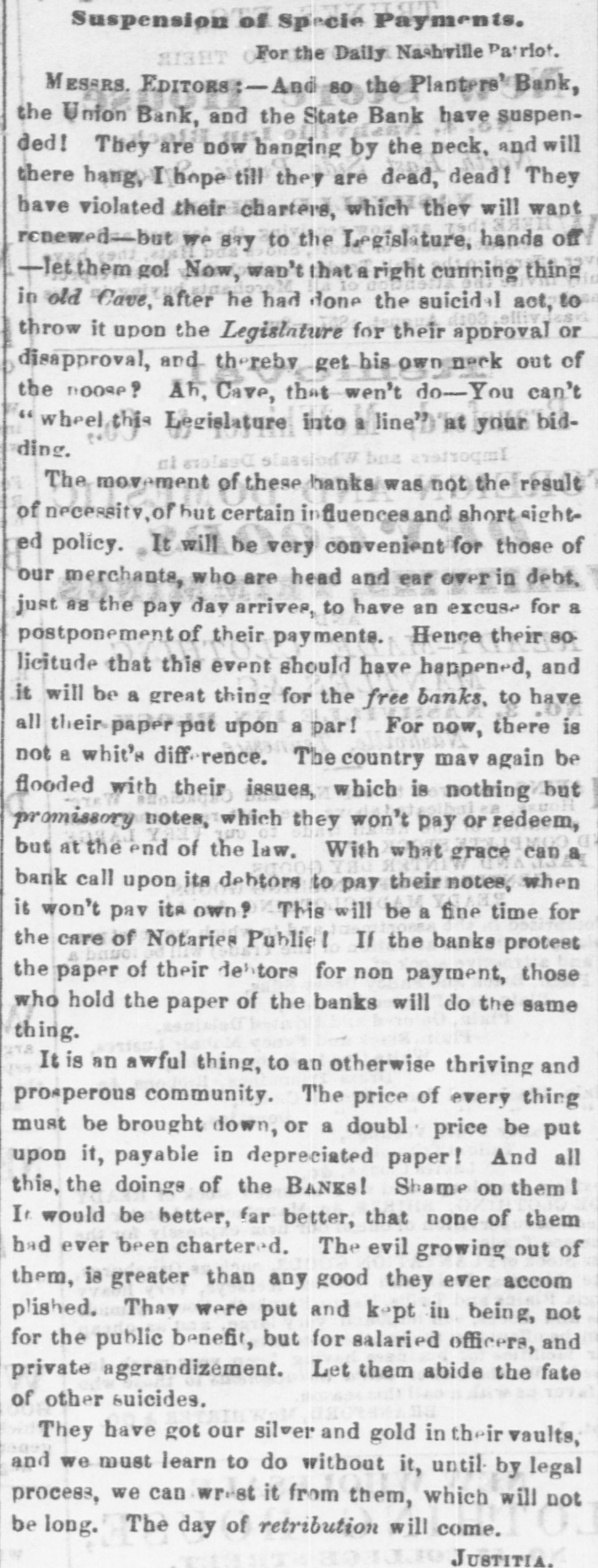
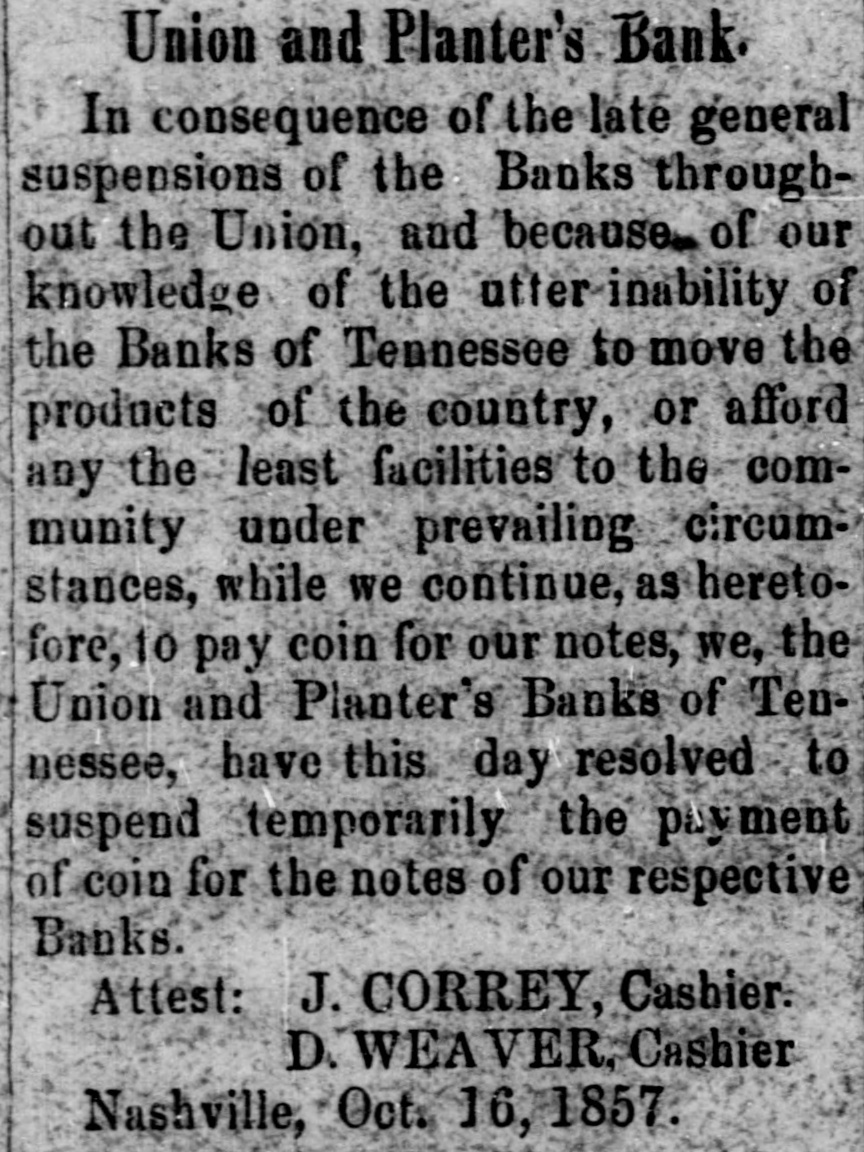
It may with truth be asserted, that but a small portion, compared with the whole pop- ulation, of the people of Tennessee, have ever sustained any loss whatever by a bank failure—that of that small portion, the loss to the greater part, has not been such as seri- ously to incommode them—and that the whole aggregate loss sustained in Tennessee, since the first bank was chartered, by bank fail- ures, has been, to the community generally, insignificant, compared with the vast and in- calculable benefits which every class of socie- ty, farmers and planters, manufacturers and mechanics, merchants and traders, and espe- cially the poor laboring classes, have derived from the paper currency, which has been in use among them—benefits, I mean, over and above all which a purely metallic currency could by any possibility have conferred. If the injuries, and I would not underrate them, which have been sustained by the coun- try by reason of the failures of insolvent banks, be, as I have shown, greatly exag- gerated by the anti-bank writers and speakers, much more are the inconvenience and losses which have resulted from the temporary sus- pensions of solvent banks. Take, for illus- tration, the late suspension by the solvent banks of this State, particularly of the three old banks of this place, whose issues consti- tute the bulk of our circulating medium. A continued drain of gold from Europe had caused a drain thither from New York and other importing points on the Atlantic. The demand for gold for shipment to Europe at New York, caused a flow of gold from the in- terior of this country to that city. We were in debt to New York, and the gold in the vaults of our banks was wanted at that period, to be sent to England and France, from those countries to be sent to others far away in the East. Now, suppose our banks had had in their vaults a dollar in specie for every paper dollar of theirs in circula- tion, and had gone on to redeem all their notes by paying in exchange for them all their specie, what would have been the conse- quence? Why, the gold thus drawn out of the banks would not have remained in the coun- try and taken the place, as a circulating medium, of the bank notes that had been previously in circulation. Instead of remain- ing here, it would have gone out of the State, and we should have been left literally without any circulating medium at all—without either gold or bank notes. And what would have been the result of that operation? Wide- spread ruin—the like of which the people of this State have never seen, and which Heaven forbid they ever should see.
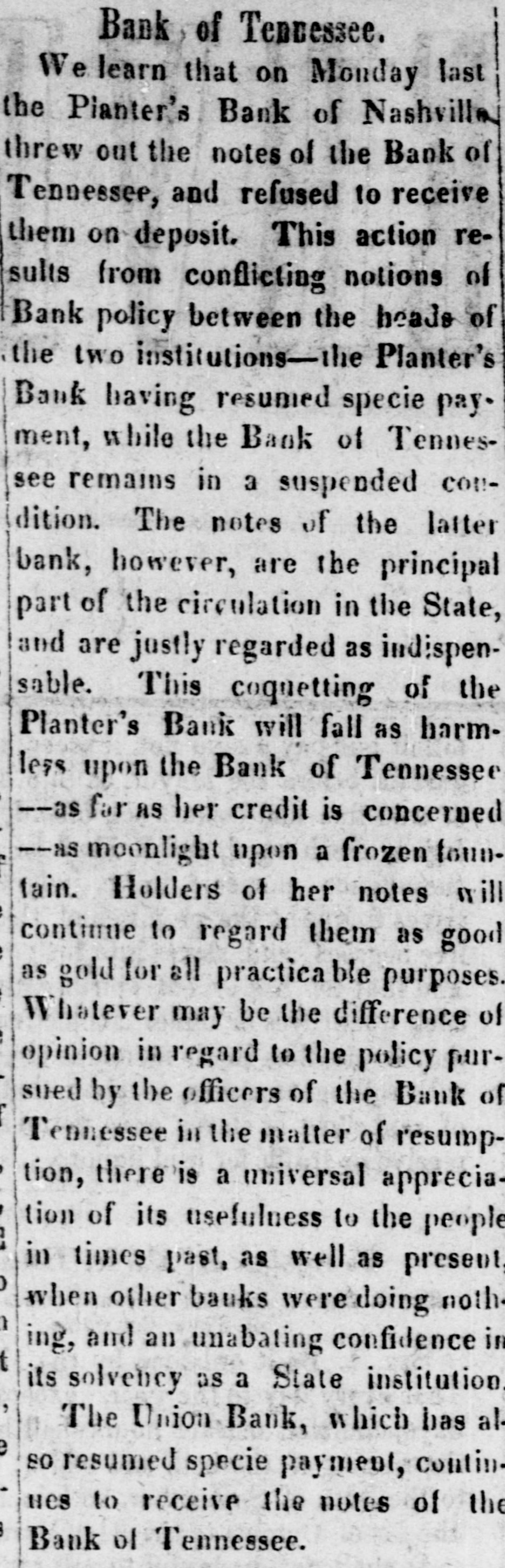
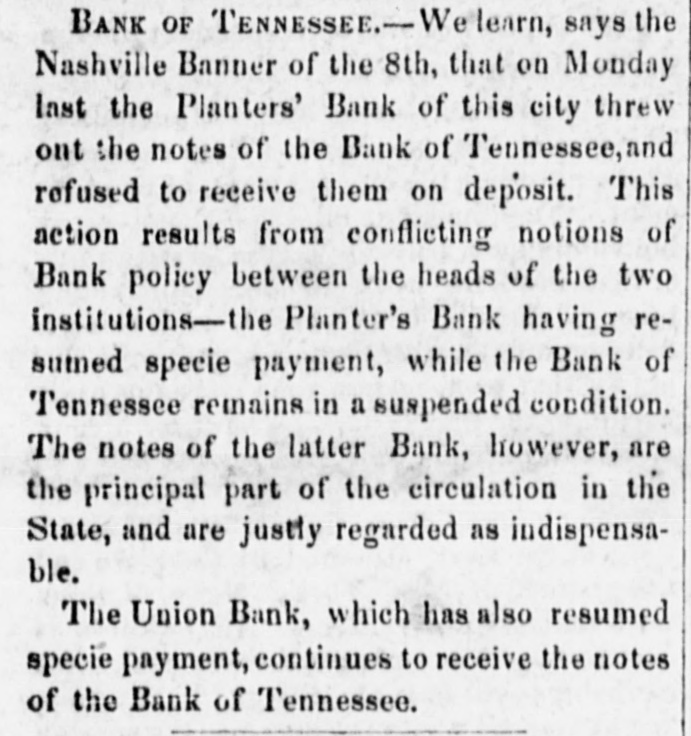
By suspending, therefore, under the cir- cumstances which existed, our banks were enabled, by means of their notes then in cir- culation, to prevent a great calamity, and to preserve for the people a circulating medium, which answered all the domestic purposes of a medium of exchange—the purposes, that is, of purchasing property, paying debts, &c. Except when gold or exchange was wanted to pay a debt out of the State, the notes of the State, Planters', and Union banks, during the suspension, were just as useful, just as good, as they were before the suspension, or since the resumption of specie payments. Their suspension, under the circumstances, was imperatively demanded by the best in- terests of the people. It prevented wide-spread ruin. The inconveniences and losses occa- sioned by the suspension, when composed with the disastrous results that would have followed a refusal to suspend, are not worth a moment's consideration.
So that, though a general suspension by the banks of any country be confessedly a great evil, the governments, the statesmen.