7358. Tobacco Exchange Banking Company (Louisville, KY)

Bank Information

Episode Type
Suspension → Closure
Bank Type
state
Start Date
July 28, 1875
Location
Louisville, Kentucky (38.254, -85.759)

Metadata

Model
gpt-5-mini
Short Digest
cf0da366

Response Measures

None

Description

Multiple contemporaneous newspaper reports (dated July 28–29, 1875) state the Tobacco Exchange Banking Company closed its doors / suspended on July 28, 1875. No articles describe a depositor run, reopening, or receivership/transfer; because the bank is described as having been in a precarious condition and closed its doors with no later reopening reported, I classify this as a suspension that resulted in closure. 'State' chosen from the name Banking Company and typical state-chartered nomenclature; if uncertain, could be 'unknown'.

Events (1)

1. July 28, 1875 Suspension
Cause
Bank Specific Adverse Info
Cause Details
Bank had long been regarded as in a precarious/weak condition; suspended/closed its doors on July 28, 1875. Articles explicitly deny connection to the Duncan, Sherman & Co. failure in New York; no specific external shock given.
Newspaper Excerpt
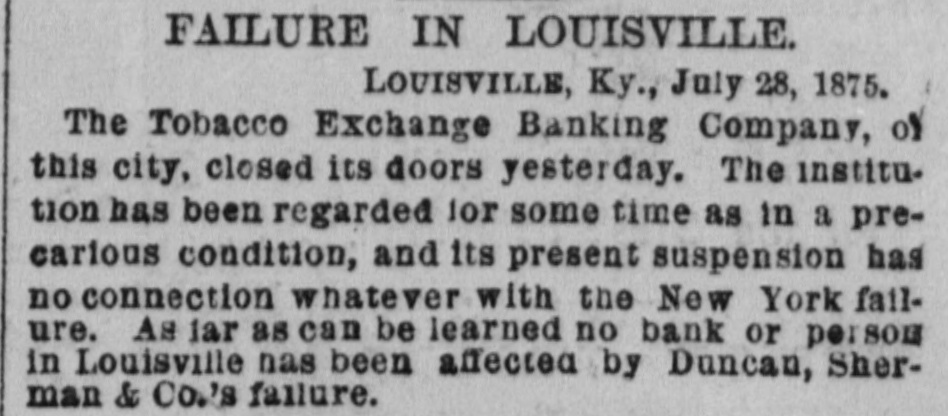
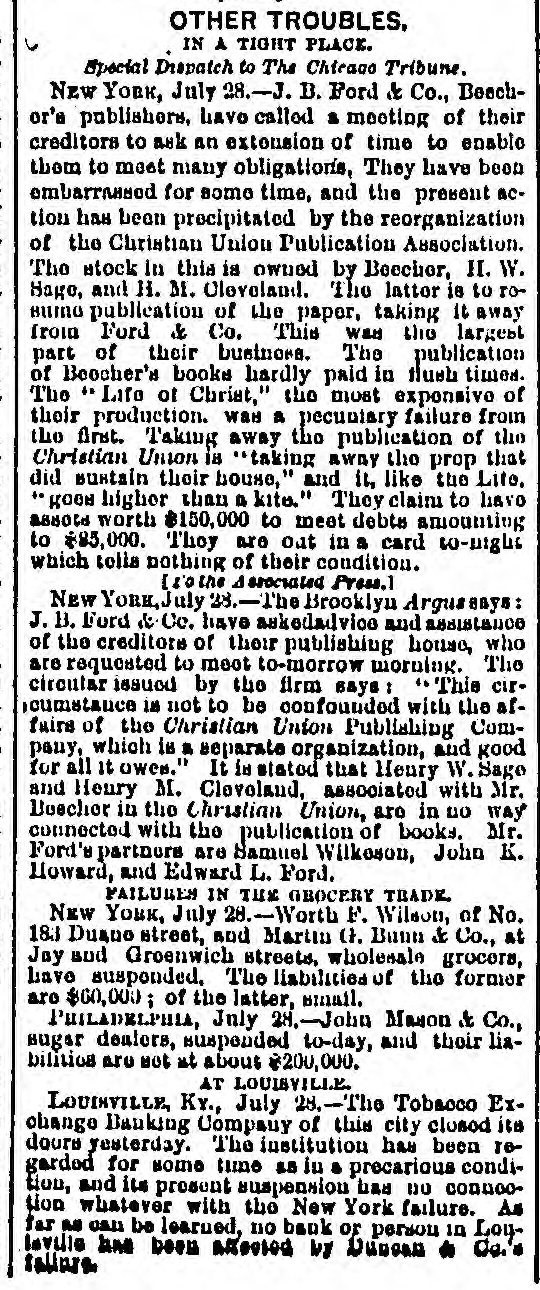
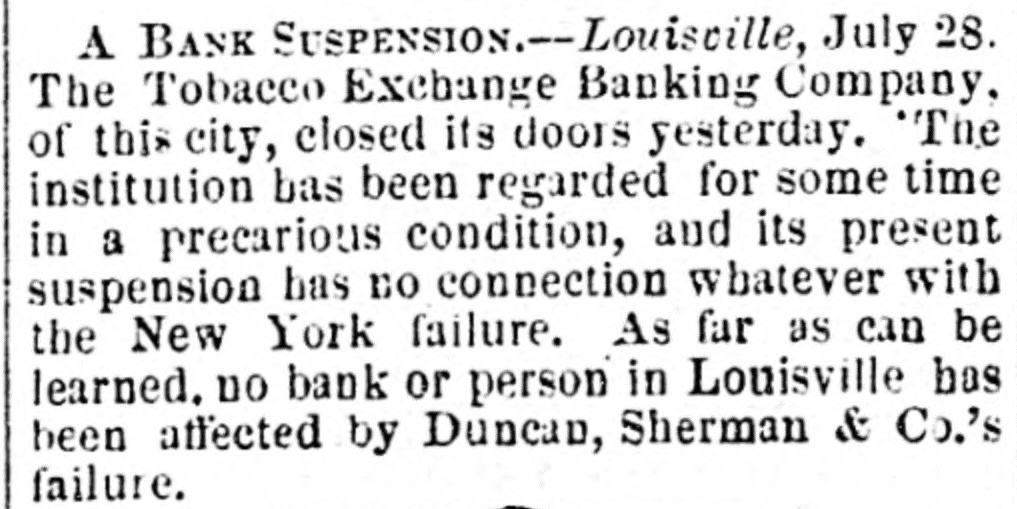
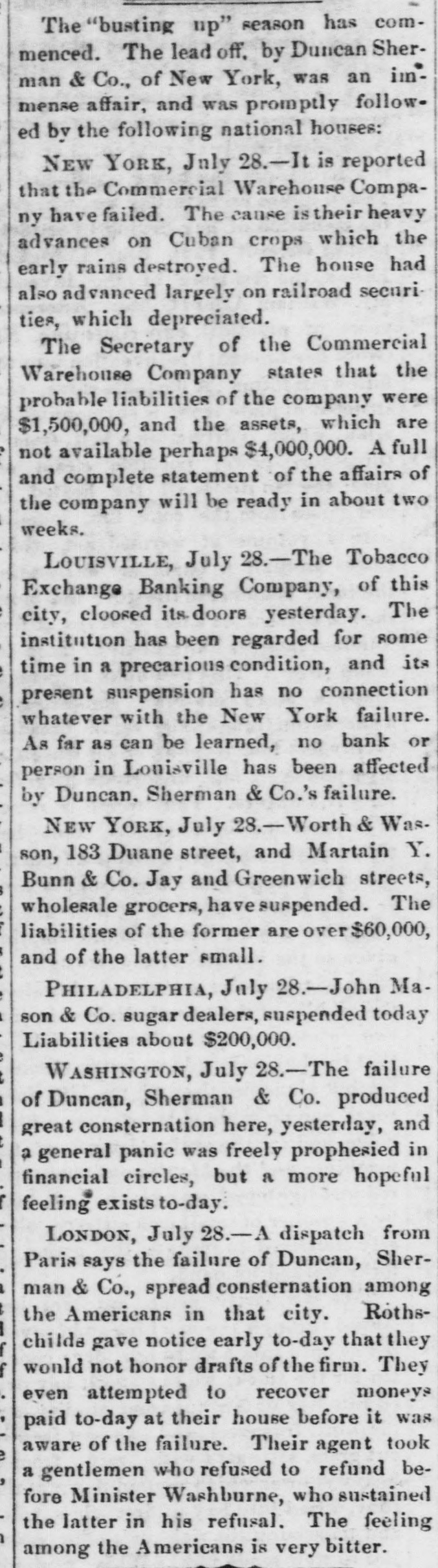
The Tobacco Exchange Banking company, in Louisville, closed its doors yesterday. The institution has been regarded for some time as in a precarious condition, and its present suspension has no connection whatever with the New York failure.
Source
newspapers

Newspaper Articles (10)

Article from Evening Star, July 29, 1875

Click image to open full size in new tab

Article Text

The Late Business Fallares. DUNCAN, SHERMAN & CO. The New York papers of yesterday devoted considerable space to the failure of Duncan, Sherman & Co., bankers, on Tuesday last. Various rumors were put in circulation very soon after the news was ma le public regarding the cause of the failure, some a ssigning heavy speculations in coiton and grain as the cause, while others attributed it largely to speculations in unprofitable railroad securities. The firm has long been acting as the New York fiscal agents of the Mobile and Ohio Railroad. More than a year ago, it was stated, the firm was heavily involved on account of its transactions with this road, which. however. it was supposed were settied: more recently the coupons of the road to the amount of about $700,000 fell due and the road was unable to meet the payment. Duncan, Sherman & Co. bought up the coupons, and it is not known that any part of this $700,000 has since been paid. The report that heavy speculations in cotton brought about the suspension was generally discredited at the Cotton Exchange. Consternation was spread among the Americans in Paris by the failure of Duncan, Sherman & Co., of New York. The Rothschilds shut down on the credits of the firm and tried unsuccessfully to get back money paid to holders of bills and letters before thedenoument. A PUBLISHING HOUSE EMEARRASSED. J. B. Ford & Co., of New York, have asked advice and assistance of the creditors of their publishing house, who were requested to meet this morning. The circular issued by the firm says: "This circumstance is not to be confounded with the affairs of the Christian Union Publishing Company, which is a separate organization, and good for all it owes." It is stated that Henry W. Sage and Henry M. Cleveland, associated with Mr. Beecher in the Christian Union, are in no way connected with the publication of books. Mr. Ford's partners are Samuel Wilkeson, John K. Howard and Edward L. Ford. FAILURE IN LOUISVILLE. The Tobacco Excha nge Banking company, in Louisville, closed its doors yesterday. The institution has been regarded for some time as in a precarious condition. and its present suspension has no connection whatever with the New York failure. As far as can now be learned no bank or person in Louisville has been affected by the Duncan, Sherman & Co. failure.
Article from Wilmington Daily Commercial, July 29, 1875

Click image to open full size in new tab

Article Text

FIRST EDITION. The Financial Crash. ADDITIONAL PARTICULARS OF THE DUNCAN, SHERMAN & 00.'8 FAILURE--A MILLION LOST IN COTTON SPECULATION. Judge Shipman, to whom the assignment by Duncan Sherman & Co. was made, was at the banking house yesterday, but conld give no further information regarding the condition of the suspended firm, He had begun, he said, to look into its affairs, and it was impossible at present to give any reliable statement how the bank stood, either as regards assets or liabilities. All he could say was that the liabilities were large and that the assets were less than the liabilities. But more than this he could not say, and he did not think any one knew more at present. It was learned. however, from various well informed persons that the immediate cause of the suspension of the house was the loss by the recent fall in price in cotton and stagnation of the market in England of about $1,000,000. No details of the speculations in cotton which have resulted 80 disastrously could be obtained, but advices from Liverpool to John J. Kiernan's European News Bureau at No. 21 Wall street stated that the consignees there who had made advanCCB to the house here were well protected. While the names of the principal creditors cannot be procured, it seems to be understood among the leading banking-houses that the paper of the firm is held mainly by persons outside of New York. Mr. Fisk, of Fisk & Hatch, said yesterday that a statement had been made up from information obtained at the different banks from well known bankers, of the probable amount of the bills of the firm owned in that city, by which it was shown that $100,000 would more than cover it. There were very few deposits made by the poor and hence there would probably be less real auffering than might otherwise have happened. The indebtedness of Duncan, Sherman & Co. to Americans traveling in Europe, Egypt, and the Holy Land, on letters of credit or with the circular notes of the firm, is admitted to be very large. Accurate figures cannot be obtained, and the house is unwilling to give an approximate estimate. It is believed that those travelers who have presented their letters of credit to banks or banking houses in Europe, and have had them accepted, are safe, and their drafts will be honored by the European bankers. The holders of circular notes and persons with unaocepted letters of credit, it is said, will not be so fortunate. The transfer of the large amount of real estate seems to have been made some time ago. Mr. Jas. K. Fay, the attorney of record, says that the papers put on record had been held by him for more than two years, with instructions from Alexander Dancan to put them on record whenever he thought prudent to do so. The time in his opinion came a day or two ago. He says further: "I can see now that it has an ugly look, but there was nothing wrong about the transaction. The deed was given for full consideration, and it WAS a bona ride transaction two years old." CONTINUATION OF THE CRASH. The Tobacco Exchange Banking Company of Louisville, suspended on Tuesday. It had been considered in a shaky condition for some time, and its failure caused no surprise. A telegram from New York last night stated that J. B. Ford & Co. had called a meeting of the creditors of their publishing house for this morning. It is stated that the Christian Union Publishing Company is a distinct concern, and in no way compromised.


Article from The Wheeling Daily Register, July 29, 1875

Click image to open full size in new tab

Article Text

Failure of a Banking Company. LOUISVILLE, July 28,-The Tobacco Exchange Banking Company of this city closed its doors yesterday. The institutioh has been regarded for sometime as in a precarious condition, and it- present suspension has no connection whatever with the New York failure. As far as can be learned no person in Louisville has been affected by Dunean, Sherman & Co's failure.


Article from The New Orleans Bulletin, July 29, 1875

Click image to open full size in new tab

Article Text

MORE FAILURES. NEW YORK, July 28.- The Commercial Warehouse Company failed. Cause heavy advances on Cuban crops, which early rains destroyed. The house also advanced largely on railroad securities, which depreciated. Liabilities $1,500,000. The assets which are not available will foot пр $4,000,000. Philadelphia, July 28.-John Mason & Co., sugar dealers, failed. Liabilitiea $200,000. LOUISVILLE, July 28.-The Tobacco Exchange Banking Company, of this city, closed its doors yesterday. The institution has been regarded for some time in a precarious condition, and its present suspension has no connection whatever with the New York failure. As far as can be learned no bank or person in Louisville bas been affected by Duncan, Sherman & Co.'s failure.


Article from The New York Herald, July 29, 1875

Click image to open full size in new tab

Article Text

FAILURE IN LOUISVILLE. LOUISVILLE, Ky., July 28, 1875. The Tobacco Exchange Banking Company, of this city, closed its doors yesterday. The institution has been regarded for some time as in a precarious condition, and its present suspension has no connection whatever with the New York failure. As lar as can be learned no bank or person in Louisville nas been affected by Duncan, Sherman & Code failure.


Article from Chicago Daily Tribune, July 29, 1875

Click image to open full size in new tab

Article Text

OTHER TROUBLES. IN A TIGHT PLACE. Special Dispatch to The Chicago Tribune. NEW YORK, July 28.-J. B. Ford & Co., Beechor's publishers, have called a meeting of their creditors to ask an extension of time to enable them to meet many obligations, They have been embarrased for some time, and the present action has been precipitated by the reorganization of the Christian Union Publication Association. The stock In this is owned by Beccher, II. W. Hage, and H. M. Cleveland. The latter is to rosumo publication of the paper, taking it away from Ford & Co. This was the largest part of their business. The publication of Beocher's books hardly paid in flush times. The " Life of Christ," the most expensive of their production. Was a pecuniary failure from the first. Taking away the publication of the Christian Union is "taking away the prop that did sustain their house," and it, like the Lite. .. HOOS higher than a kite." They claim to have assots worth $150,000 to meet debts amounting to $85,000. They are out in a card to-night which tells nothing of their condition. [so the Associated Press.1 NEW YORK, 28.-The Brooklyn Argussays J. B. Ford & Cc. have askedadvice and assistance of the creditors of their publishing house, who are requested to meet to-morrow morning. The circular issued by the firm says: This circumstance in not to be confounded with the affairs of the Christian Union Publishing Company, which is a separate organization, and good for all it owen." It in stated that Henry W. Sage and Henry M. Cleveland, associated with Mr. Beacher in the Christian Union, are in no way connected with the publication of books. Mr. Ford's partners are Samuel Wilkoson, John K. Howard, and Edward L. Ford. FAILURES IN THE GROCERY TRADE. NEW YORK, July 28.-Worth F. Wilson, of No. 183 Duane street, and Martin G. Bunn & Co., at Jay and Groenwich streets, wholesale grocors, have susponded, The liabilities of the former are $60,000 ; of the latter, smail. PHILADELPHIA, July 28,-John Mason & Co., sugar dealers, suspended to-day, and their liabilition are not at about $200,000. AT LOUISVILLE. LOUISVILLE, KY., July 28.-The Tobacco Exchange Banking Company of this city closed its doors yesterday. The institution has been regarded for some time as in & precarious condition, and its present suspension has DO connooMon whatever with the New York failure. As far M can be learned, no bank or person in Loyleville failure. lane been accessed by Duccan & Code


Article from The Daily Dispatch, July 30, 1875

Click image to open full size in new tab

Article Text

A BANK SUSPENSION.--Louiscille, July 28. The Tobacco Exchange Banking Company, of this city, closed its doors yesterday. "The institution bas been regarded for some time in a precarious condition, and its present suspension has no connection whatever with the New York failure. As far as can be learned. no bank or person in Louisville has been affected by Duncan, Sherman & Co.'s failure.


Article from The Somerset Press, July 30, 1875

Click image to open full size in new tab

Article Text

The "busting up" season has commenced. The lead off, by Duncan Sherman & Co., of New York, was an immense affair, and was promptly followed by the following national houses: NEW York, July 28.-It is reported that the Commercial Warehouse Company have failed. The cause istheir heavy advances on Cuban crops which the early rains destroyed. The house had also advanced largely on railroad securities, which depreciated. The Secretary of the Commercial Warehouse Company states that the probable liabilities of the company were $1,500,000, and the assets, which are not available perhaps $4,000,000. A full and complete statement of the affairs of the company will be ready in about two weeks. LOUISVILLE, July 28.-The Tobacco Exchange Banking Company, of this city, cloosed its doors yesterday. The institution has been regarded for some time in a precarious condition, and its present suspension has no connection whatever with the New York failure. As far as can be learned, no bank or person in Lonisville has been affected by Duncan. Sherman & Co.'s failure. NEW YORK, July 28.-Worth & Wasson, 183 Duane street, and Martain Y. Bunn & Co. Jay and Greenwich streets, wholesale grocers, have suspended. The liabilities of the former are over $60,000, and of the latter small. PHILADELPHIA, July 28.-John Mason & Co. sugar dealers, suspended today Liabilities about $200,000. WASHINGTON, July 28.-The failure of Duncan, Sherman & Co. produced great consternation here, yesterday, and a general panic was freely prophesied in financial circles, but a more hopeful feeling exists to-day. LONDON, July 28.-A dispatch from Paris says the failure of Duncan, Sherman & Co., spread consternation among the Americans in that city. Rothschilds gave notice early to-day that they would not honor drafts of the firm. They even attempted to recover moneys paid to-day at their house before it was aware of the failure. Their agent took a gentlemen who refused to refund before Minister Washburne, who sustained the latter in his refusal. The feeling among the Americans is very bitter.


Article from Delaware Tribune, August 5, 1875

Click image to open full size in new tab

Article Text

The Financial Crash. ADDITIONAL PARTICULARS OF THE DUNCAN, BHERMAN & CO.'D FAILURE-A MILLION LOST IN COTTON SPECULATION. Judge Shipman, to whom the assignment by Duncan Sherman & Co. was made, was at the banking house yesterday, but could give no further information regarding the condition of the suspended firm. He had begun, he said, to look into its alfairs, and it was impossible at present to give any reliable statement how the bank stood, either as regards assets or liabilities. All he could say was that the liabilities were large and that the assets were less than the liabilities. But more than this he could not May, and he did not think any one knew more at present. It was learned. however, from various well informed persons that the immediate cause of the suapension of the house was the loss by the recent fall in price in cotton and stagnation of the market in England of about $1,000,000. No details of the speculations in cotton which have resulted 80 disastrously could be obtained, but advices from Liverpool to John J. Kiernan's European News Burean at No. 21 Wall street stated that the consignees there who had made advanCOB to the house here were well protected. While the names of the principal creditors cannot be procured, it seems to be understood among the leading banking-houses that the paper of the firm is held mainly by persons outside of New York. Mr. Fisk, of Fisk & Hatch, said yesterday that a statement had been made up from information obtained at the different banks from well known bankers, of the probable amount of the bills of the firm owned in that city, by which it was shown that $100,000 would more than cover it. There were very few deposits made by the poor and hence there would probably be less real suffering than might otherwise have happened. The indebtedness of Duncan, Sherman & Co. to Americans traveling in Europe, Egypt, and the Holy Land, on letters of credit or with the circular notes of the firm, is admitted to be very large. Accurate figures cannot be obtained, and the house is unwilling to give an approximate estimate. It is believed that those travelers who have presented their letters of credit to banks or banking houses in Europe, and have had them accepted, are safe, and their drafts d will be honored by the European bankers. The holders of circular notes and persons with unsoe cepted letters of credit, it is said, will not be so a fortunate. The transfer of the large amount of real estate seems to have been made some time ago. Mr. Jas. K. Fay, the attorney of record, says In that the papers put on record had been held by ol him for more than two years, with instructions at from Alexander Duncan to put them on record D whenever he thought prudent to do so. The time in his opinion came a day or two ago. He e, says further: "I can see now that it has an ugly look, but there was nothing wrong about the 1. transaction. The deed was given for full cona sideration, and it was a bona fide transaction la two years old." CONTINUATION or THE CRASH. h, The Tobacco Exchange Banking Company of be Louisville, suspended on Tuesday. It had been D. considered in a shaky condition for some time, and its failure caused no surprise. ly A telegram from New York last night stated or that J. B. Ford & Co. had called a meeting of ed the creditors of their publishing house for this nt morning. It is stated that the Christian Union wn Publishing Company is a distinct concern, and alf in no way compromised. w-


Article from Mineral Point Tribune, August 5, 1875

Click image to open full size in new tab

Article Text

PERSONAL. Judge Fisher, Attorney of the District of Columbia, sent his resignation to President Grant, at Long Branch, on the 23d. Hugh Donahue has recently completed, in Boston, the task of walking 1,100 miles in 1,100 consecutive hours. He was in good condition at the close. Avery, Chief Clerk of the Treasury Department at Washington, indicted by the Grand Jury at St. Louis for complicity in the whisky frauds, was requested to resign on the 26th, and did so at once. On the 24th Maj. Fulton, of the American rifle team, received from the Princess Louise the cup which he won at Wimbledon on the 21st. James Gifillan, long an employe in the Treasury Department at Washington, has been appointed to the chief clerkship in place of Avery, resigned. The old and prominent New York banking house of Duncan, Sherman & Co. suspended on the 27th. Much excitement was produced in commercial and financial circles by this failure, which was entirely unexpected. The suspension was caused by heavy speculations in cotton. The liabilities are placed at between $5,000,000 and $6,000,000. Mrs. Celia Burleigh, the well-known womansuffrage agitator, died at Syracuse, N. Y., on the 27th, aged forty-eight years. Ex-Chief Clerk Avery, of the Treasury Department, was arrested in Washington on the 28th by a Deputy-Marshal and taken before the District Court, being admitted to bail in the sum of $5,000. The New York Evening Post of the 28th says the losses of Duncan, Sherman & Co. on cotton exceeded $1,000,000. John Mason &-Co., sugar-dealers of Philadelphia, suspended on the 28th. Liabilities about $200,000. The Commercial Warehouse Company of New York and one or two other smaller institutions were reported on the 28th as having failed. The Tobacco Exchange Banking Company, of Louisville, Ky., closed its doors on the 28th. J. B. Ford & Co., publishers, of New York, have failed. Their failure, it is said, does not affect the Christian Union, of which they were the publishers.