Farmers Bank (Lawton, IA)

Episode Information

Episode UID
72168171477
Episode Type
Suspension β†’ Closure
Bank Type
private
Bank ID
7216817 routing
Routing Number
72-1681
Start Date
January 12, 1923
Location
Lawton, Iowa (42.479, -96.184)

Metadata

Model
gpt-5-mini (chosen from majority vote of a three-model LLM ensemble)
Short Digest
35e1943b2beb75f6

Response Measures

None

Description

Articles identify a receiver and refer to the bank as defunct, indicating permanent closure.

Events (3)

1. January 12, 1923 Receivership
Newspaper Excerpt
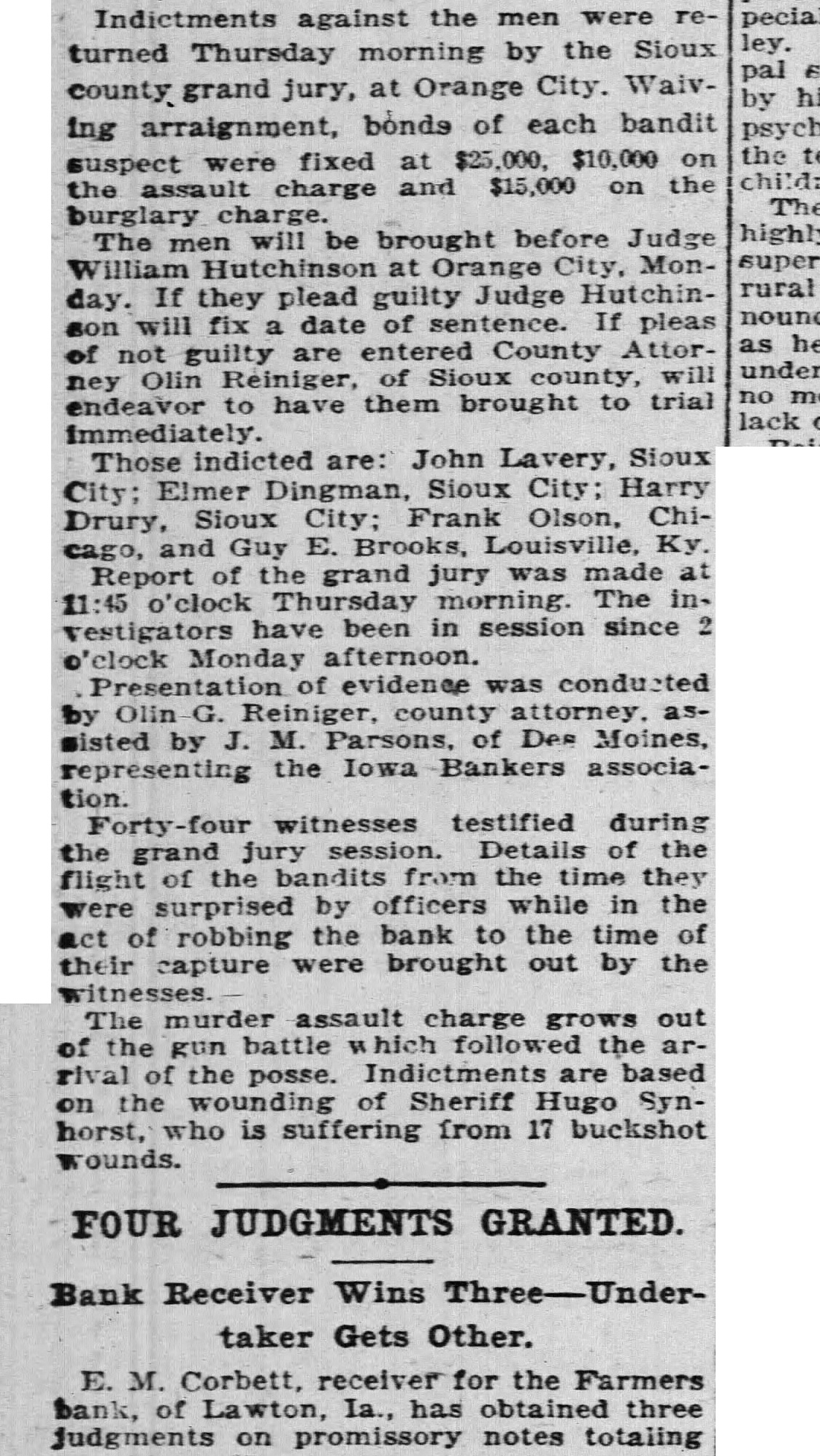
E. M. Corbett, receiver for the Farmers bank, of Lawton, Ia., has obtained three judgments on promissory notes totaling ...
Source
newspapers
2. January 12, 1923 Suspension
Cause
Government Action
Cause Details
Bank placed in receivership leading to suspension of normal operations
Newspaper Excerpt
E. M. Corbett, receiver for the Farmers bank, of Lawton, Ia., has obtained three judgments on promissory notes
Source
newspapers
3. February 18, 1923 Other
Newspaper Excerpt
Trial of a suit in which E. M. Corbett, as receiver for the Farmers bank, of Lawton, Ia., is suing R. L. Pilcher ... B. K. Younglove, president of the defunct bank, ... has been started before a jury
Source
newspapers

Newspaper Articles (2)

Article from The Sioux City Journal, January 12, 1923

Click image to open full size in new tab

Article Text

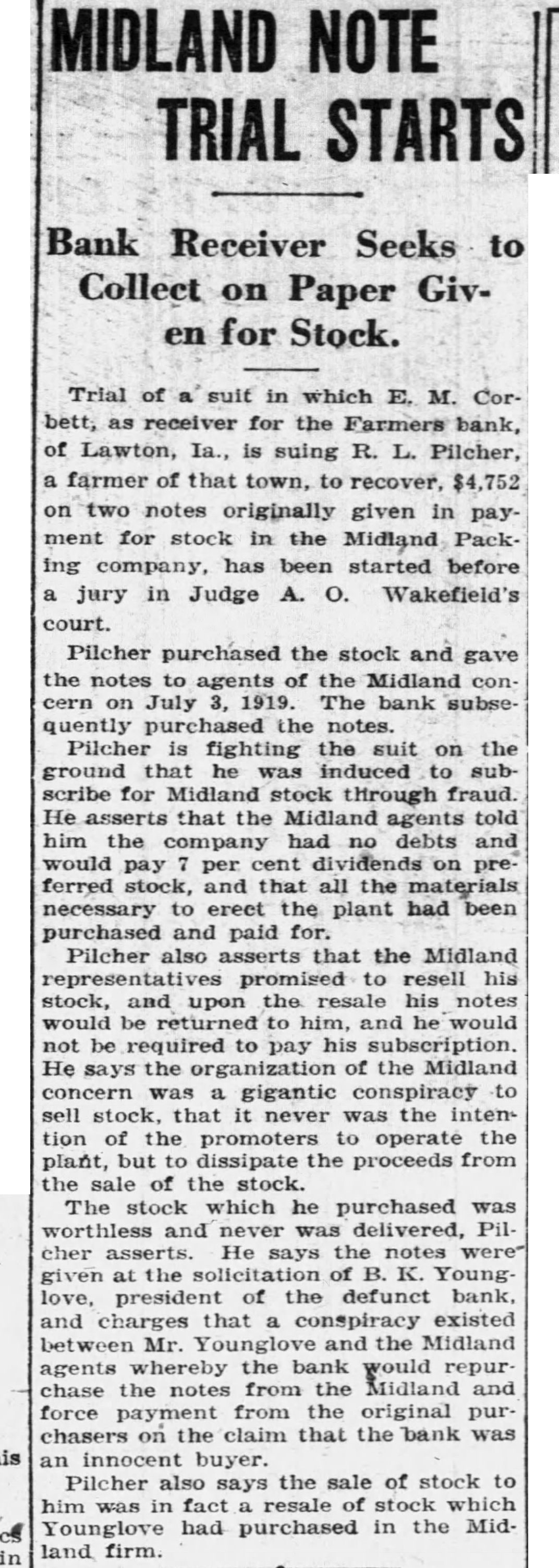
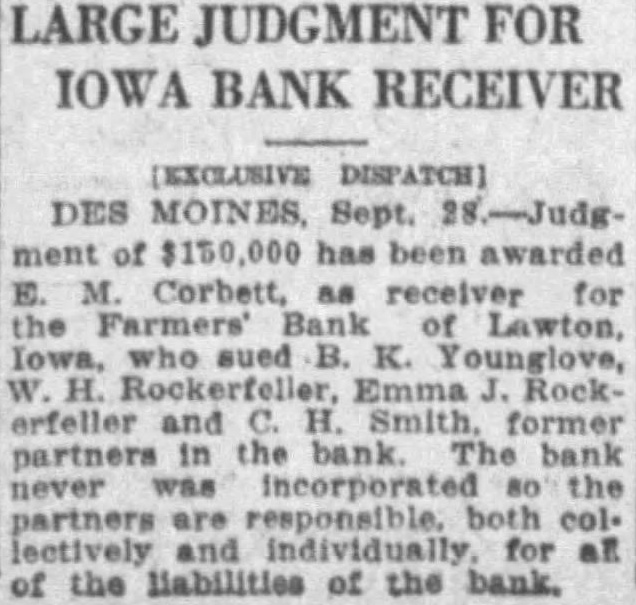
Indictments against the men were returned Thursday morning by the Sioux county grand jury, at Orange City. Waiving arraignment, bonds of each bandit suspect were fixed at $25,000, $10,000 on the assault charge and $15,000 on the burglary charge. The men will be brought before Judge William Hutchinson at Orange City, Monday. If they plead guilty Judge Hutchinson will fix a date of sentence. If pleas of not guilty are entered County Attorney Olin Reiniger, of Sioux county, will endeavor to have them brought to trial immediately. Those indicted are: John Lavery, Sioux City; Elmer Dingman, Sioux City; Harry Drury, Sioux City; Frank Olson, Chicago, and Guy E. Brooks, Louisville, Ky. Report of the grand jury was made at 11:45 o'clock Thursday morning. The investigators have been in session since 2 o'clock Monday afternoon. Presentation of evidence was conducted by Olin G. Reiniger, county attorney, assisted by J. M. Parsons, of Des Moines, representing the Iowa Bankers association. Forty-four witnesses testified during the grand jury session. Details of the flight of the bandits from the time they were surprised by officers while in the act of robbing the bank to the time of their capture were brought out by the witnesses. The murder assault charge grows out of the gun battle which followed the arrival of the posse. Indictments are based on the wounding of Sheriff Hugo Synhorst, who is suffering from 17 buckshot wounds. FOUR JUDGMENTS GRANTED. Bank Receiver Wins Threeβ€”Undertaker Gets Other. E. M. Corbett, receiver for the Farmers bank, of Lawton, Ia., has obtained three judgments on promissory notes totaling
Article from The Sioux City Journal, February 18, 1923

Click image to open full size in new tab

Article Text

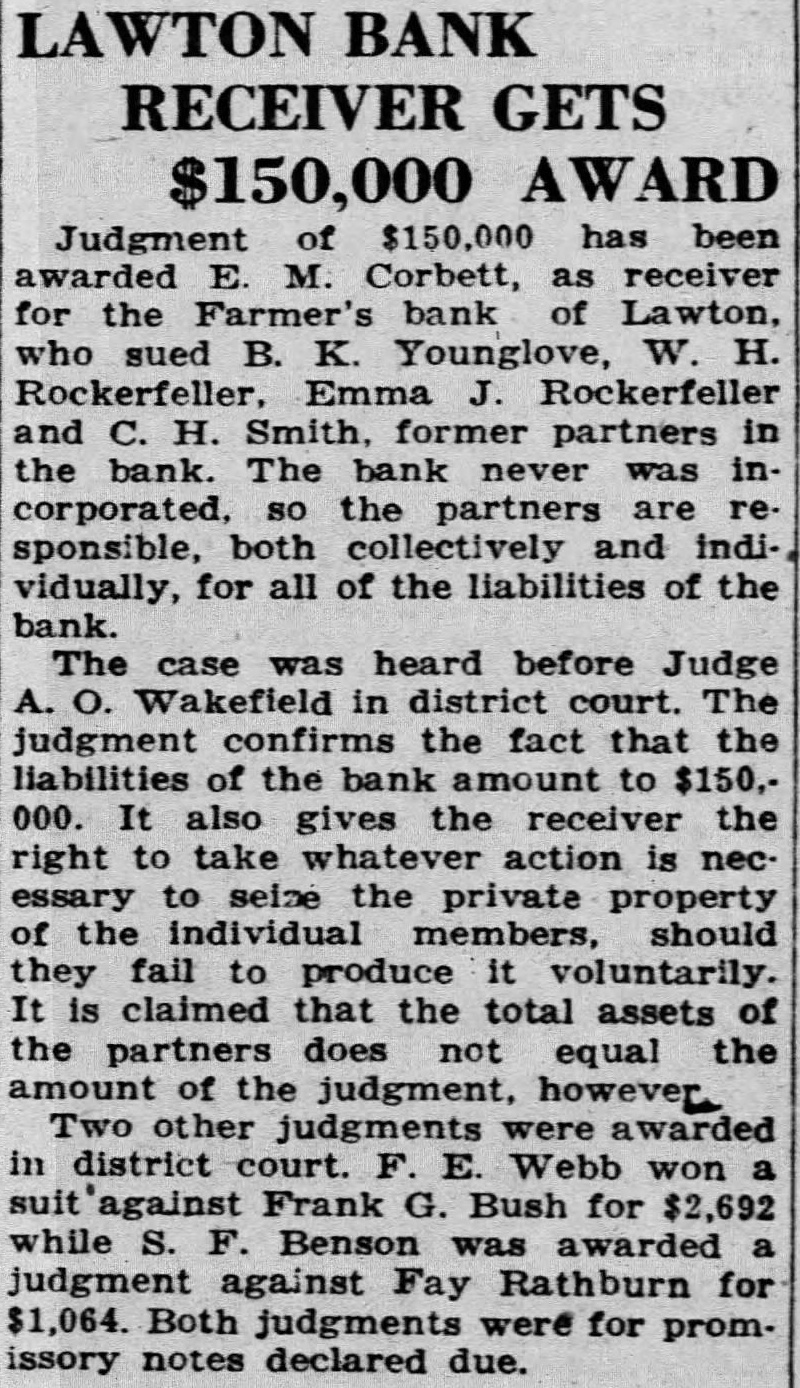
MIDLAND NOTE TRIAL STARTS Bank Receiver Seeks to Collect on Paper Given for Stock. Trial of a suit in which E. M. Corbett, as receiver for the Farmers bank, of Lawton, Ia., is suing R. L. Pilcher, a farmer of that town, to recover, $4,752 on two notes originally given in payment for stock in the Midland Packing company, has been started before a jury in Judge A. O. Wakefield's court. Pilcher purchased the stock and gave the notes to agents of the Midland concern on July 3, 1919. The bank subsequently purchased the notes. Pilcher is fighting the suit on the ground that he was induced to subscribe for Midland stock through fraud. He asserts that the Midland agents told him the company had no debts and would pay 7 per cent dividends on preferred stock, and that all the materials necessary to erect the plant had been purchased and paid for. Pilcher also asserts that the Midland representatives promised to resell his stock, and upon the resale his notes would be returned to him, and he would not be required to pay his subscription. He says the organization of the Midland concern was a gigantic conspiracy to sell stock, that it never was the intention of the promoters to operate the plant, but to dissipate the proceeds from the sale of the stock. The stock which he purchased was worthless and never was delivered, Pilcher asserts. He says the notes were given at the solicitation of B. K. Younglove, president of the defunct bank, and charges that a conspiracy existed between Mr. Younglove and the Midland agents whereby the bank would repurchase the notes from the Midland and force payment from the original purchasers on the claim that the bank was an innocent buyer. Pilcher also says the sale of stock to him was in fact a resale of stock which Younglove had purchased in the Midland firm.