City Bank (Jefferson, IA)

Episode Information

Episode UID
72034471447
Episode Type
Suspension β†’ Closure
Bank Type
private
Bank ID
7203447 routing
Routing Number
72-0344
Start Date
July 22, 1920
Location
Jefferson, Iowa (42.015, -94.377)

Metadata

Model
gpt-5-mini (chosen from majority vote of a three-model LLM ensemble)
Short Digest
5f69a688dbc32510

Response Measures

None

Description

Owner made an assignment for benefit of creditors; first bank failure in the county.

Events (1)

1. July 22, 1920 Suspension
Cause
Local Shock
Cause Details
Inability to convert overdue farm and other loan paper to cash amid freight car shortage and slow collections; deposits tied up leading to suspension.
Newspaper Excerpt
The City Bank of Jefferson suspended business yesterday... inability to turn its assets into money with which to pay the checks of its depositors.
Source
newspapers

Newspaper Articles (7)

Article from The Daily Gate City and Constitution-Democrat, July 21, 1920

Click image to open full size in new tab

Article Text

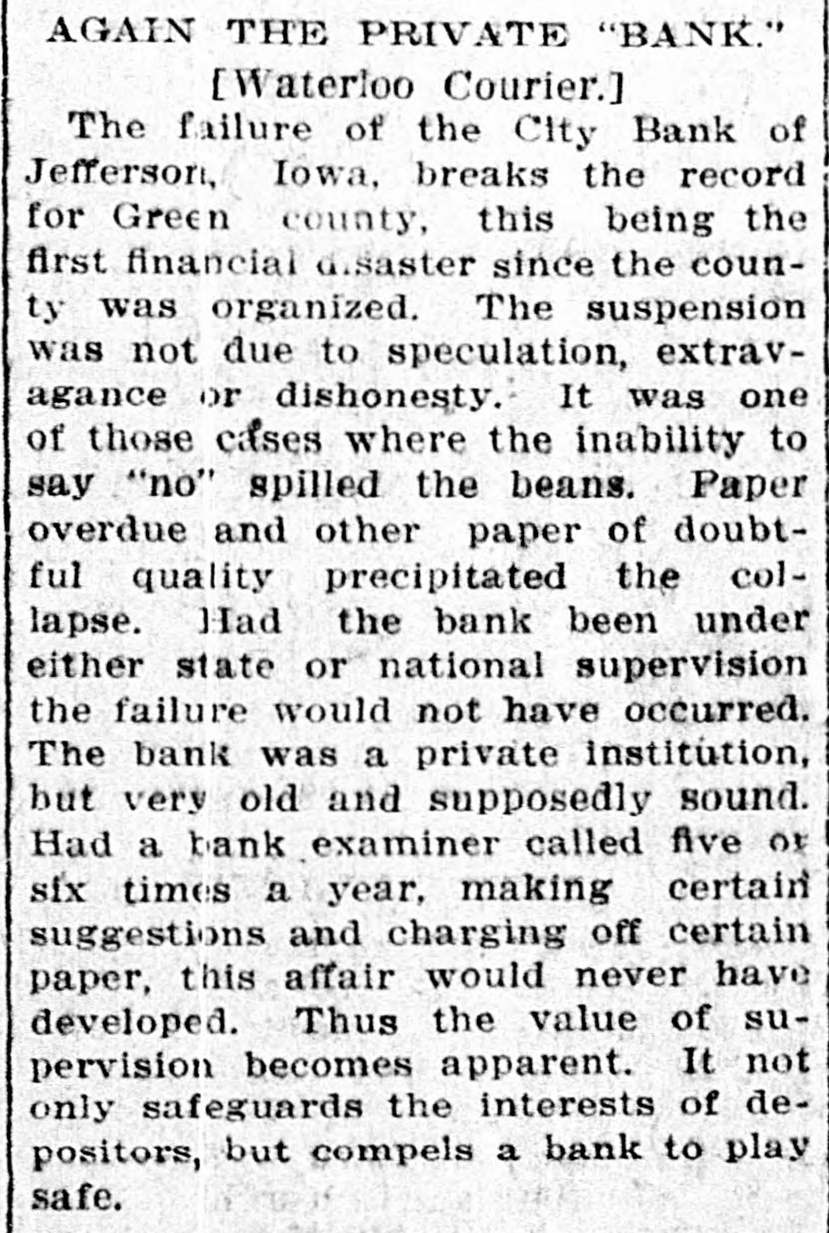
Ask Secret Confererce. CHICAGO, July 21. Leaders of organized railroad labor today requested a secret conference with the full membership of the U. S. railroad labor board relative to the award announced yesterday by the board. The award granted a $600,000,000 increase to railway labor. Labor chiefs refused to make known what they would present. They had been in executive session all morning when the request was made. Judge Barton, chairman of the board, immediately presented the re quest to other members and labor leaders resumed their session pending the board's decision. PRIVATE BANK IS CLOSED lowa Institution, Capitalized for $50, 000 Locks Doors Today, While Airplane Prevents Run on Other. [United Press Leased Wire Service.] DES MOINES, Iowa, July :1.-The City bank of Jefferson, Iowa, sixty miles northwest of here, closed its doors today, according to advices to Des Moines bankers. The bank, a private institution, was capitalized at $50,000. Fearing a run on his bank, Jay M. Wiggins, president of the Farmers and Merchants bank at Jefferson, made a hurried trip to Des Moines. via airplane and secured several thousand dollars, in currency. The : return trip was also made via plane.


Article from The Seattle Star, July 21, 1920

Click image to open full size in new tab

Article Text

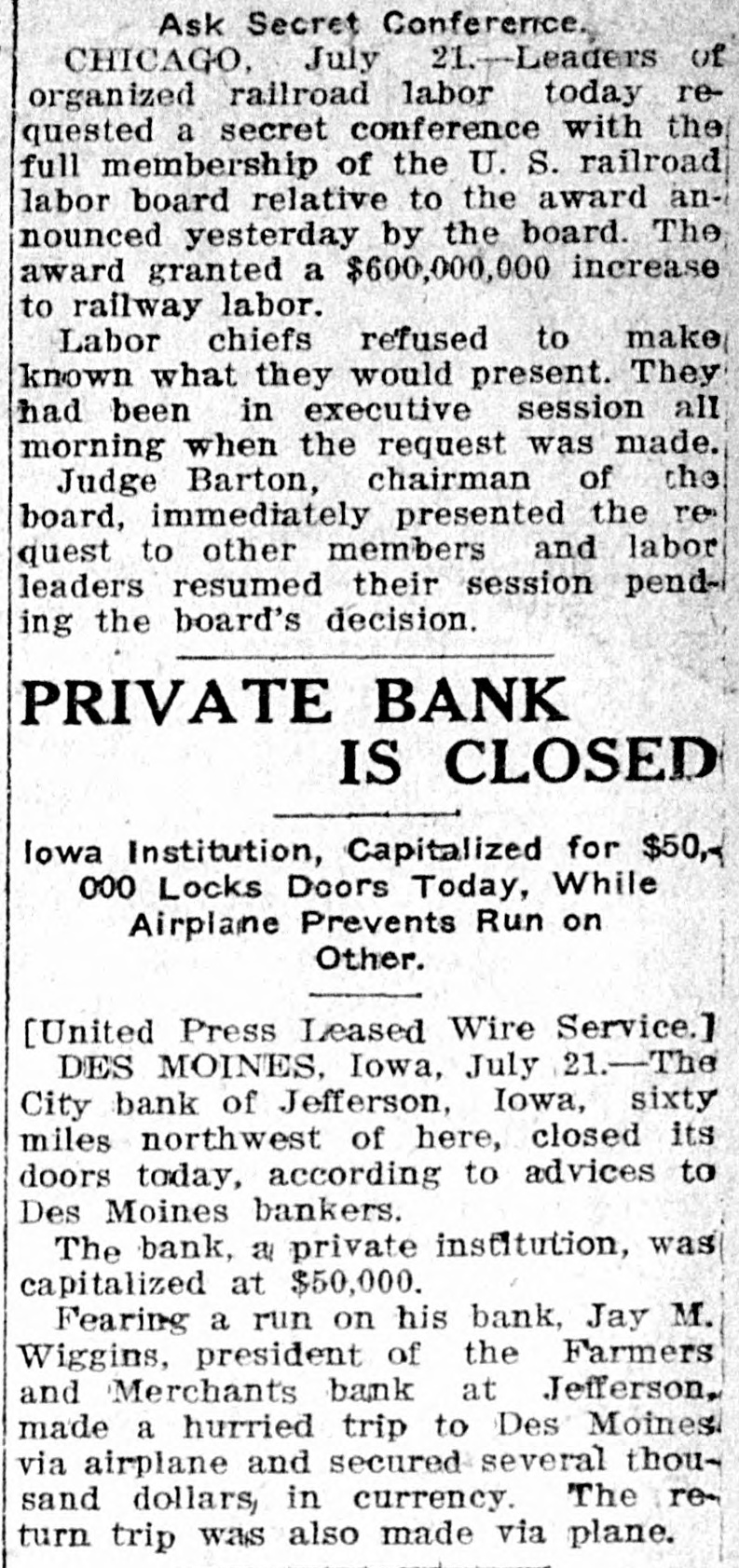
Jefferson, Iowa, Bank Closes Down DES MOINES, Iowa, July 21.The City Bank of Jefferson, Iowa, 60 miles northwest of here, closed its doors today, according to advices to Des Moines bankers. The bank, a private Institution, was capitalized at $50,000. Fearing a run on his bank, Jay M. Wiggins, president of the Farmers' and Merchants' bank at Jefferson, made a hurried trip to Des Moines via airplane and obtained several thousand dollars in currency. The return trip was also made via plane. Turnhout, Belgium, has a school for lacemaking, which is attended by 1,600 children.


Article from The Denison Review, July 28, 1920

Click image to open full size in new tab

Article Text

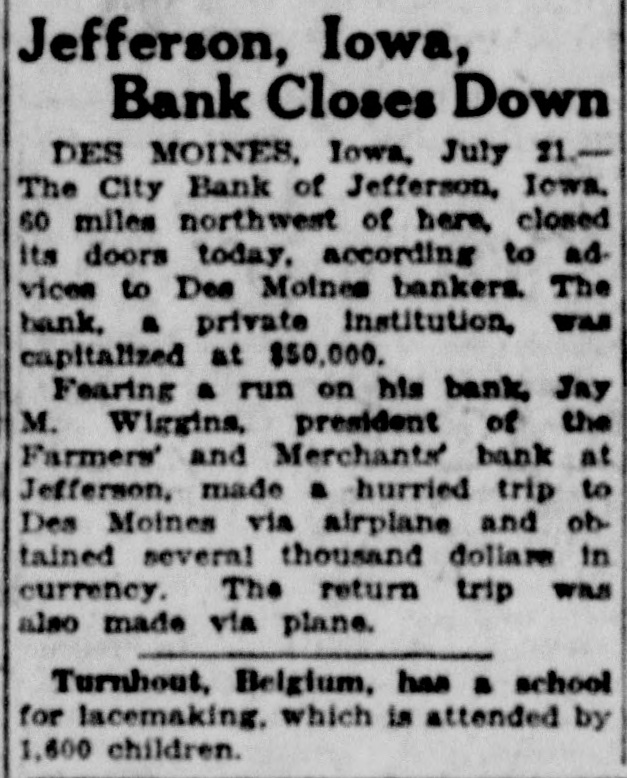
BANK AT JEFFERSON CLOSES JEFFERSON, July 22-The City Bank of Jefferson suspended business yesterday. The cause of the failure of this old and respected financial institution is inability to turn its assets into money with which to pay the checks of its depositors. The bank has notes aggregating more than $500,000. but too large a proportion of these notes are overdue, and their makers can not come forward with the money. : The deposit ors' money is in these notes, and with the present shortage of freight cars and inability to ship grain and livestock, the depositors have been gradually using their money until the point came where the bank could pay no more checks. M. G. McDuffie, president and owner of the bank, made an assignment for the benefit of the creditors of the bank, of all his real and personal property, which includes his bank buildings, his farms and other property. Attorney S. J. Sayers will be named as assignee, and the closing out of the institution's affairs will be under his direction. Many of the notes of the bank that can not be collected right now to provide cash for depositors, will be collectible in time, and the prospects are that the actual loss to depositors, if any, will not be very great. The worst feature of the matter is that it ties up their money for the present, when money is scarce and hard to get. This is the first bank failure in the history of Jefferson. The cause was lack of promptness in making collections, and in letting notes run too long, until in many cases they became worth less, together with doubtful judgment in the extending of credit.


Article from Audubon County Journal, July 29, 1920

Click image to open full size in new tab

Article Text

enn with a band of 30 gypsies at the edge of town and handed over $75 when it was demanded by the sheriff. Coal production in Iowa is averag. ing 50 per cent more now than it did at this time a year ago. Fuel is being mined in this state at a rate of between 9,000,000 and 9,500,000 tons annually, whereas the 1919 production amounted to only 6,000,000 tons. The City Bank, a private banking institution at Jefferson, Iowa, has closed its doors. Slow collections on farm loans and the car shortage are given as the reason for the fall. Jay M. Wiggins, president of the Farmers and Merchants National bank at Jefferson. went to Des Moines by airplane to secure funds to forestall an anticipated run on his bank, due to the failure of the sister financial institution. E. J. Dixon, prominent resident of West Grove, was fined $5000 by Judge Martin J. Wade in Federal Court when found guilty of violation of the federal espionage act. Dixon's attorney immediately appealed the case and the appeal bond was fixed at $7500. Dixon is alleged to have made severe remarks against the policy of the present administration during the world war. Dixon is a bachelor and is said to be worth about $100,000. The Department of Agriculture has fust published data summarizing the most of production of wheat for 1919 on 481 Iowa farms. Two farms of the 481 produced wheat at a cost as 20 uo while bushell Jed IS se MOI eyL Der 9$ лэло SEM 11 Farms average was $2.15 per bushel. Yields averaging 14.9 bushels on the winter whent farms studied and S.4 bushels on the spring wheat farms, and the average cost per acre was $27.80 for the winter and $22.40 for the spring. Under a decision rendered by the Iowa supreme court ballots used in a franchise election must state in full the proposition to which the voter is asked to give his consent. The decision was given in connection with the election held recently in Newton on which the citizens voted on two propositions; one being the sale of the old city owned light plant to A. H. Rich and the other on the granting of a franchise to Rich and his company to operate an electric light plant. The hot formaldehyde method of treating seed potatoes is proving very popular with Mitchell county farmers. During a recent week five demonstrations were held in the county and fully 900 bushels of potatoes of seed treated by this method. The method consists of merely soaking the potatoes for two minutes in a solution of formaldehyde, made up in the ratio of one pint of formalin to 15 gallons of water, heated to a temperature of 118 degrees to 122 degrees F. The first statewide contest to determine the highest yiefding strains of corn is being conducted by the Iowa Corn and Small Grain Growers association and is well under way Definite plans for this competition were not formulated until early in March, yet 128 of the leading farmers of the state entered their highest yielding strains of corn in this new departure in corn comparison. Such a representative number of entries insures a successful contest. The record of John Sims, & Jackson county farmer, who had resided on the same farm sixty-six years, was thought to be unequalled in the entire- county. Now comes Frank Burleson, an old and well known resident of the community west of Maquoketa, who has lived On his farm eighty-three years. His father bought the place and moved there when Mr. Burleson was six months old, In 1860, Mr. Burleson married and took his bride to the home farm and for sixty years they have lived there together. Mr. Burleson's father. Shade Burleson, was one of the earliest settlers of the county. Selling for $10,000 an animal for which he paid $86 a little over eight months ago is the record made by Howard L Cook of Coffin's Grove township near Manchester. He sold


Article from Walker Lake Bulletin, July 31, 1920

Click image to open full size in new tab

Article Text

INTERMOUNTAIN. Mrs. Imanuel J. Kandt was killed and her husband and Mr. and Mrs. Andrew Stitber were injured in a cyclone that swept through a portion of McHenry county, ten miles south of Anamoose, N. D., late Friday. Mose Gibson, negro, sentenced to hang for murder of Roy Trapp, Fullerton, Cal., rancher, has confessed to ten murders and SO mapy burglaries the could not enumerate them. Only families with children can rent Mwellings owned by H. L. Neslin, a Walla Walla landlord, it has been anmounced. Mr. Neslin has promised to give his tenants a month's rept free for every child born to them while they are residing in his houses. Excerpts for the Marconi Wireless company, who are at St. John, N. F., conducting experiments in long distance wireless telephonic communitations, have announced that they have heard messages from the Chelmsford station near London more than 2,000 miles distant. All records for travel in Yellowstone national park were broken on July 22, when 1383 persons and 241 private automobiles were admitted. More than 26,000 persons have visited the park this season, about 20 per cent more than during the same period last year. DOMESTIC. Walter S. Wilson, widely known throughout the southwest as a. cowboy and exhibition roper, was shof and killed Saturday on a country road near Winfield, Kansas. Ashby H: Keeney, son of Seth A. Keeney, Santa Barbara, Cal., bank president and former owner of the Brooklyn Daily Eagle, was killed Saturday in an auto accident. J. M. Zion was nominated for governor by the Farmer-Labor party at Indianapolis, Ind., Saturday, over Francis J. Dillon of Indianapolis. Mr. Dillon was the party's choice for United States senator. Mr. Zion is a farmer. All forms of work were stopped Saturday at Vera Cruz as a result of the general strike. At a meeting of merchants it was proposed to close all business places if the strike continued. Bodies of 881 American soldiers who died overseas, arrived at New York, July 21, on the steamsnip Princess Matolka from Danzig and Antwerp. Twenty-five "war brides" of French and German nativity were among the first cabin passengers and Polish repatriated troops composed the majority of the 2,094 steerage passengers. Prohibition has been beneficial to the nation's industrial and economic life, in the opinion of Elbert H. Gary, head of the United States Steel corporation, who issued a statement at New York on the eve of departure for Europe, giving his views on the business outlook generally. Dr. Stockton Axson, President Wilson's brother-in-law, and during the war national secretary of the American Red Cross, collapsed last week, and left Los Angeles to seek trΓ©atment for nervous breakdown. Two miners were wounded when the Portsmouth Solvay Coal company's mine at Freeborn, W. Va., was attacked by Spersons hidden in the hills on the West Virginia and Kentucky sides of Tug river. Chairman White of the Democratic national committee has announced that Saturday, August 7, had been chosen as the date for notification of Goyernor Cox_of his nomination as presidential candidate. The City Bank of Jefferson, Ia., has closed its door. Fearing a run on his bank, Jam M. Wiggins, president of the Farmers and Merchants' bank at Jefferson, made a hurried trip to Des Moines via airplane and secured several thousand dollars in currency. Whether the spectre of a nationwide railway strike has been laid by the $600,000,000 wage increase granted on July 20 to more than 1,800,000 railroad employees remains undecided. The $600,000,000 award represents a 21 per cent increase in the pay of the railwaymen. For the first time in history the roads' payrolls this year will pass the three billion dollar mark. Parley P. Christensen, FarmerLabor party candidate for president, telegraphed from Denver to Senator Harding, Republican nominee, and Governor Cox, Democratic candidate, suggesting that all join in a demand upon President Wilson to immediately release Eugene V. Debs from prison. Jack Johnson, negro, former heavyweight champion pugilist, crossed the international boundary line from Mexico near San Diego on Tuesday, and was arrested by the deputy United States marshal. Johnson is under sentence in Chicago for violation of the Mann act. On July 20, Sir Thomas Lipton's yacht, the Shamrock IV, ran up a tally of two races to none against the American defender Resolute winning in
Article from Evening Times-Republican, July 31, 1920

Click image to open full size in new tab

Article Text

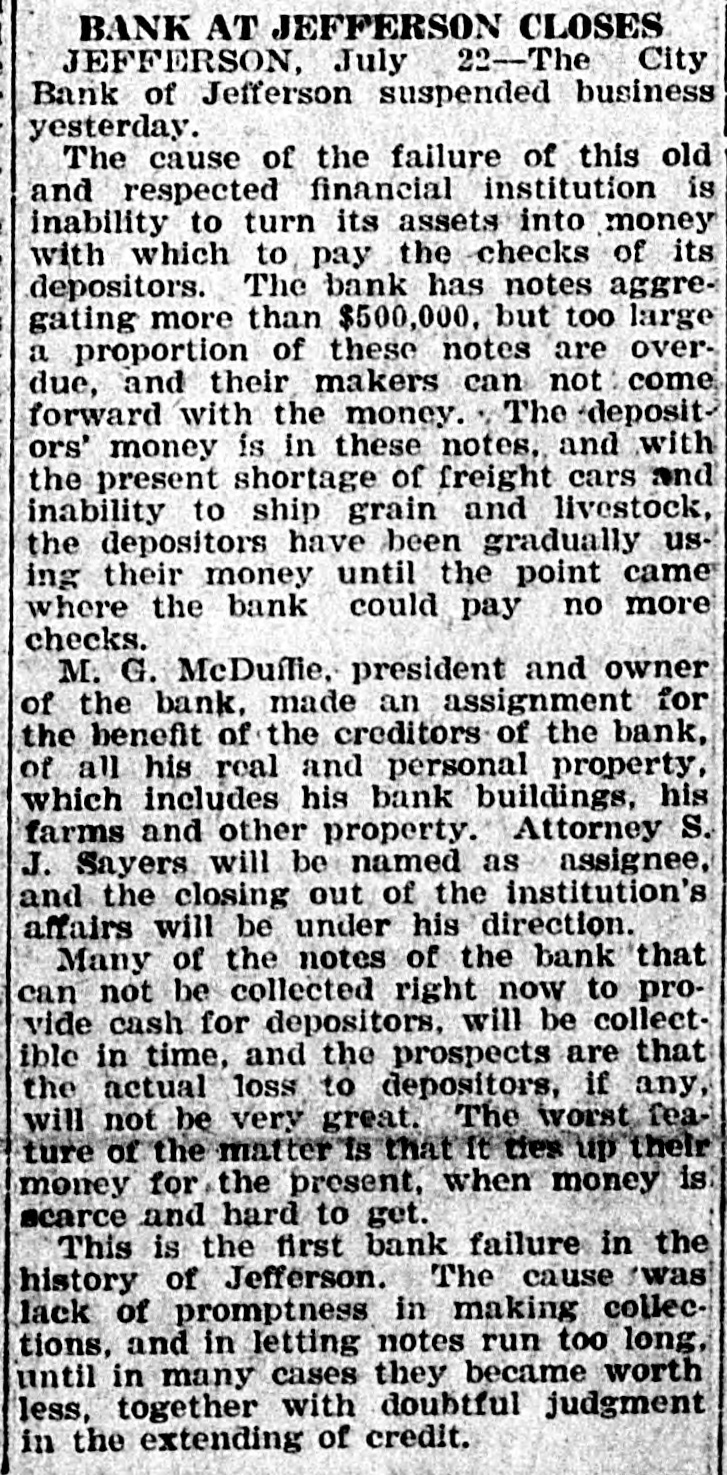
AGAIN THE PRIVATE "BANK." [Waterloo Courier.] The failure of the City Bank of Jefferson, Iowa, breaks the record for Green county, this being the first financial disaster since the county was organized. The suspension was not due to speculation, extravagance or dishonesty. It was one of those cases where the inability to say "no" spilled the beans. Paper overdue and other paper of doubtful quality precipitated the collapse. Had the bank been under either state or national supervision the failure would not have occurred. The bank was a private institution, but very old and supposedly sound. Had a bank examiner called five or six times a year, making certain suggestions and charging off certain paper, this affair would never have developed. Thus the value of supervision becomes apparent. It not only safeguards the interests of depositors, but compels a bank to play safe.


Article from The Des Moines Register, July 31, 1927

Click image to open full size in new tab

Article Text

Bank Situation Improves CLOSED IOWA BANKS NOT IN TABLE to 1923. bank failures were rare and when a state supervised bank occasionally suspended business receiver for it was appointed by district court. as receivers are still appointed for private and national banks. No systematic records were kept by any state official, such as are now kept, for banks which failed prior to 1923. hence the information about the state supervised banks listed here is not readily available as for the banks closed after 1922. For the same reason information concerning closed and private banks was not available for the table. The national list of banks closed but not in the table, from 1918 to June 30, 1922, as follows: far been held at a net cost of receiver confident that this loss more than offset by receipts from sales properties advantageous times and the report states that had not the advances been made the assets would have been lost 1918. STATE BANKS. Name of bank. Capital. Date closed. Town. Conway Savings 20,000 May, 191: Conway PRIVATE Cedar Cedar Bank 10,000 Dec., 1918 YEAR ENDING JUNE 30, 1920. STATE BANKS. Carroll Carroll T. 50,000 Apr. 1919 Decatur Decatur State Savings 25,000 May 1919 Hartley Iowa Savings 30,000 June 27, YEAR ENDING JUNE 30, 1921. STATE BANKS. Citizens Savings 50,000 May 13, 1921 Anita Braddyville Farmers Savings 25,000 Nov. 5, 1920 Clarinda Clarinda T. 75,000 Dec. 1920 bElliott Elliott Savings 25,000 June 1921 Farmers Savings 15,000 Mar. 1921 Harper Marathon Marathon Savings 40,000 April 1921 Onawa Citizens State 30,000 April 1921 Rome Rome Savings 12,500 Mar. 23. 1921 Sioux City Union T. 100,000 Feb. 1921 Ulmer Farmers Savings 10,000 Mar. 1921 PRIVATE BANKS. July 1920 Jefferson City Bank Emmet County bank Dec. 1920 Armstrong Percival Percival bank Dec. 28, 1920 Davis City Valley bank April 11, 1921 Lawton Farmers bank April 14, 1921 NATIONAL BANKS. Emmetsburg National March 1921 Emmetsburg Milford National 25,000 April 13, 1921 First National 50,000 April 14, 1921 Marcus as Citizens*State. bReopened as Farmers State. cReorganized as Security National. YEAR ENDING JUNE 30, 1922. STATE BANKS. Bevington Bevington Savings 10,000 Citizens Savings 15,000 1921 Curlew Harris Savings 30,000 Oct. 1921 Harris Farmers Savings 15,000 Sept. 1921 aLamont Massena Savings 20,000 April 1922 bMassena Liberty North Liberty Savings 10,000 Aug. 1921 North Melcher State 25,000 May 20. 1922 Melcher State Bank of Oto 25,000 Dec. 1921 50,000 Nov. 1921 Sioux City American Savings Swaledale Savings 15,000 Sept. 14, 1921 Swaledale aReopened as Farmers State. bReopened as Massena State. PRIVATE BANKS. Grafton Farmers Exchange Bank Sept. 19, 1921 NATIONAL BANKS aCherokee Security National 50,000 Feb. 1922 bJefferson Farmers and Merchants 40,000 June 30, 1922 bReopened.