Madison State Bank (Virginia City, MT)

Episode Information

Episode UID
7185084991465
Episode Type
Suspension → Closure
Bank Type
state
Bank ID
718508499 hash
Start Date
January 1, 1922*
Location
Virginia City, Montana (45.294, -111.946)

Metadata

Model
gpt-5-mini (chosen from majority vote of a three-model LLM ensemble)
Short Digest
66a1c5c641181b5d

Response Measures

None

Events (1)

1. January 1, 1922* Suspension
Cause
Bank Specific Adverse Info
Cause Details
Bank failed and was placed in receivership; assets administered by a receiver following failure.
Newspaper Excerpt
receiver of the defunct Madison State bank
Source
newspapers

Newspaper Articles (8)

Article from The Butte Daily Post, September 26, 1923

Click image to open full size in new tab

Article Text

Miller Smith, executors, against the city of Helena. The court reversed the district court of Madison county in the case of the state of Montana on the relation of the attorney general against the Madison State bank of Virginia City. In the Madison county court, from which the case was appealed, the Fidelity and Deposit company of Maryland petitioned for an order directing the receiver of the defunct Madison State bank to allow as a preferred claim out of the assets of the closed bank a claim for $2,462.75, the amount paid by the indemnity company to the state as reimbursement for state funds deposited in the bank. On March 11, 1922 the petitioner executed an indemnity bond to secure deposits of state funds in the Virginia City bank in the sum of $2,450. When the bank failed the indemnity company paid over the sum of the bond to the state and presented its claim to the receiver of the bank. The receiver declined to honor it as a preferred claim and the court in Madison county upheld his ruling that the claim was a general and not a preferred one. The indemnity company appealed.
Article from Great Falls Tribune, September 27, 1923

Click image to open full size in new tab

Article Text

Surety Firm Wins Out in Bank Claim Appeal Helena, Sept. 26.—(By The Associated Press.)—The Montana supreme court Wednesday reversed the district court of Madison county in the case of the state of Montana, on the relation of the attorney general, against the Madison State bank of Virginia City. In the Madison county court, from which the case was appealed, the Fidelity and Deposit company of Maryland petitioned for an order directing the receiver of the defunct Madison State bank to allow as a preferred claim out of the assets of the closed bank, a claim for $2,462.75, the amount paid by the indemnity company to the state as reimbursement for state funds deposited in the bank. On March 11, 1922, the petitioner executed an indemnity bond to secure deposits of state funds in the Virginia City bank in the sum of $2,450. When the bank failed the indemnity company paid over the sum of the bond to the state and presented its claim to the receiver of the bank. The receiver declined to honor it as a preferred claim and the court in Madison county upheld his ruling that the claim was a general and not a preferred one. The indemnity company appealed.

Article from The Daily Missoulian, September 27, 1923

Click image to open full size in new tab

Article Text

Madison Court Reversed in Virginia City State Bank Case. By the Associated Press. Helena, Sept. 26.—Claims of indemnity companies for money expended to guarantee deposits of counties in defunct banks are preferred claims, the state supreme court held today in reversing the Madison county court in the case of the state against the Madison State bank of Virginia City. In the Madison county court, from which the case was appealed, the Fidelity and Deposit company of Maryland petitioned for an order directing the receiver of the defunct Madison State bank to allow as a preferred claim out of the assets of the closed bank a claim for $2,462.75, the amount paid by the indemnity company to the state as reimbursement for state funds deposited in the bank. On March 11, 1922 the petitioner executed an indemnity bond to secure deposits of state funds in the Virginia City bank in the sum of $2,450. When the bank failed the indemnity company paid over the sum of the bond to the state and presented its claim to the receiver of the bank. The receiver declined to honor it as a preferred claim and the court in Madison county upheld his ruling that the claim was a general and not a preferred one. The indemnity company appealed. Silver Bow Court Sustained. Judgment of the Silver Bow county district court was affirmed today by the supreme court in the case of Lloyd Weir against Walter R. Ryan. The suit was instituted in the district court of Silver Bow county to collect $720 alleged to be due Weir as salary as a farm hand in the employ of Ryan by virtue of the plaintiff's having been hired by the year but being dismissed at the end of the first six months. The jury gave Weir judgment for $639.50 from which Ryan appealed. The defendant averred that no contract existed and that he hired Weir on a month-to-month basis. Weir came to Montana from Pleasant Plains, Ill., to take the job. Paving District Upheld. Legality of the creation of the Main street-Neill avenue paving district in Helena was upheld today by the supreme court in affirming the lower court in the case of Jesse C. Ricker and J. Miller against the city of Helena. In the Lewis and Clark district court the plaintiffs were denied an injunction restraining the defendants from proceeding with the creation of Main street-Neill avenue improvement district officially known as Special Improvement district No. 139. The project involved the paving of certain streets around the parks near the Great Northern depot. An injunction was asked on the contention that the city council authorized the creation of the district after wrongfully finding that protests of property owners were insufficient. The petitioners maintained that the council illegally included in the district ground dedicated as parks totalling 34,125 square feet and not subject to assessment for the payment of costs of an improvement district. They averred that when the area of the land thus exempt from taxation should have been excluded there would remain subject to assessment 138,660.85 square feet and that property owned by protesting property owners totalled 62,618.25 an area in excess of 40 per cent. The petitioners also contended that Main street being already paved, the owners of property in the district would not be equally and alike benefitted by the paving on Neill avenue and that creation of the district was in effect taking property from the plaintiffs for public use without just compensation.

Article from The Daily Missoulian, September 27, 1923

Click image to open full size in new tab

Article Text

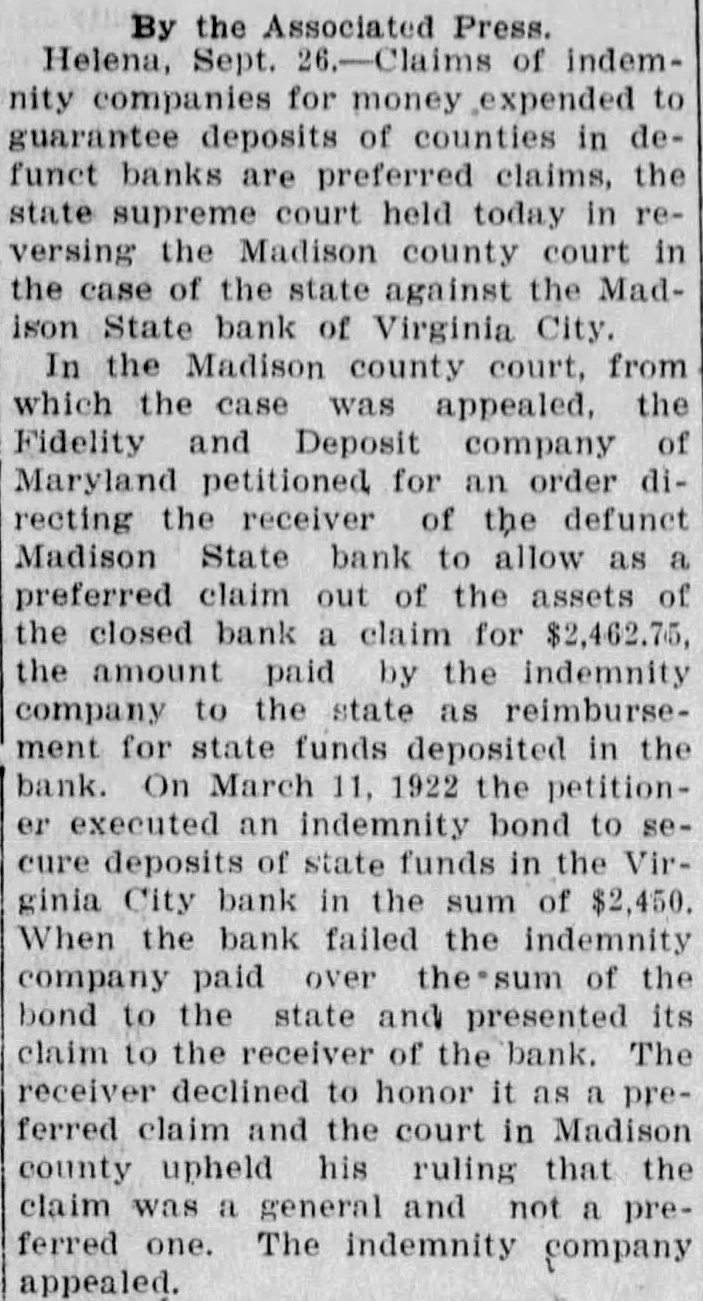
By the Associated Press. Helena, Sept. 26.—Claims of indemnity companies for money expended to guarantee deposits of counties in defunct banks are preferred claims, the state supreme court held today in reversing the Madison county court in the case of the state against the Madison State bank of Virginia City. In the Madison county court, from which the case was appealed, the Fidelity and Deposit company of Maryland petitioned for an order directing the receiver of the defunct Madison State bank to allow as a preferred claim out of the assets of the closed bank a claim for $2,462.75, the amount paid by the indemnity company to the state as reimbursement for state funds deposited in the bank. On March 11, 1922 the petitioner executed an indemnity bond to secure deposits of state funds in the Virginia City bank in the sum of $2,450. When the bank failed the indemnity company paid over the sum of the bond to the state and presented its claim to the receiver of the bank. The receiver declined to honor it as a preferred claim and the court in Madison county upheld his ruling that the claim was a general and not a preferred one. The indemnity company appealed.

Article from The Billings Gazette, September 27, 1923

Click image to open full size in new tab

Article Text

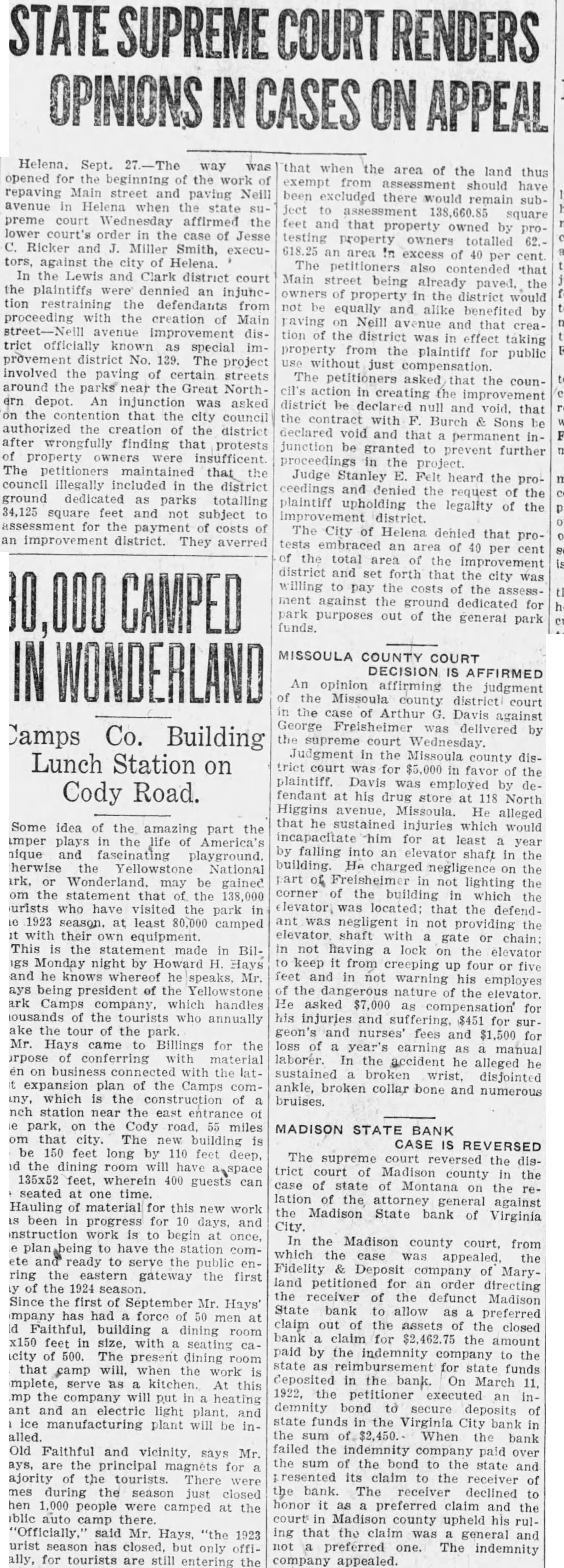
STATE SUPREME COURT RENDERS OPINIONS IN CASES ON APPEAL Helena, Sept. 26.—The way was opened for the beginning of the work of repaving Main street and paving Neill avenue in Helena when the state supreme court Wednesday affirmed the lower court's order in the case of Jesse C. Ricker and J. Miller Smith, executors, against the city of Helena. In the Lewis and Clark district court the plaintiffs were denied an injunction restraining the defendants from proceeding with the creation of Main street—Neill avenue improvement district officially known as special improvement district No. 139. The project involved the paving of certain streets around the parks near the Great Northern depot. An injunction was asked on the contention that the city council authorized the creation of the district after wrongfully finding that protests of property owners were insufficient. The petitioners maintained that the council illegally included in the district ground dedicated as parks totalling 34,125 square feet and not subject to assessment for the payment of costs of an improvement district. They averred that when the area of the land thus exempt from assessment should have been excluded there would remain subject to assessment 138,660.85 square feet and that property owned by protesting property owners totalled 62,618.25 an area in excess of 40 per cent. The petitioners also contended that Main street being already paved, the owners of property in the district would not be equally and alike benefited by paving on Neill avenue and that creation of the district was in effect taking property from the plaintiff for public use without just compensation. The petitioners asked that the council's action in creating the improvement district be declared null and void, that the contract with F. Burch & Sons be declared void and that a permanent injunction be granted to prevent further proceedings in the project. Judge Stanley E. Felt heard the proceedings and denied the request of the plaintiff upholding the legality of the improvement district. The City of Helena denied that protests embraced an area of 40 per cent of the total area of the improvement district and set forth that the city was willing to pay the costs of the assessment against the ground dedicated for park purposes out of the general park funds. MISSOULA COUNTY COURT DECISION IS AFFIRMED An opinion affirming the judgment of the Missoula county district court in the case of Arthur G. Davis against George Freisheimer was delivered by the supreme court Wednesday. Judgment in the Missoula county district court was for $5,000 in favor of the plaintiff. Davis was employed by defendant at his drug store at 118 North Higgins avenue, Missoula. He alleged that he sustained injuries which would incapacitate him for at least a year by falling into an elevator shaft in the building. He charged negligence on the part of Freisheimer in not lighting the corner of the building in which the elevator was located; that the defendant was negligent in not providing the elevator shaft with a gate or chain; in not having a lock on the elevator to keep it from creeping up four or five feet and in not warning his employes of the dangerous nature of the elevator. He asked $7,000 as compensation for his injuries and suffering, $451 for surgeon's and nurses' fees and $1,500 for loss of a year's earning as a manual laborer. In the accident he alleged he sustained a broken wrist, disjointed ankle, broken collar bone and numerous bruises. MADISON STATE BANK CASE IS REVERSED The supreme court reversed the district court of Madison county in the case of state of Montana on the relation of the attorney general against the Madison State bank of Virginia City. In the Madison county court, from which the case was appealed, the Fidelity & Deposit company of Maryland petitioned for an order directing the receiver of the defunct Madison State bank to allow as a preferred claim out of the assets of the closed bank a claim for $2,462.75 the amount paid by the indemnity company to the state as reimbursement for state funds deposited in the bank. On March 11, 1922, the petitioner executed an indemnity bond to secure deposits of state funds in the Virginia City bank in the sum of $2,450. When the bank failed the indemnity company paid over the sum of the bond to the state and presented its claim to the receiver of the bank. The receiver declined to honor it as a preferred claim and the court in Madison county upheld his ruling that the claim was a general and not a preferred one. The indemnity company appealed.

Article from The Roundup Record, September 28, 1923

Click image to open full size in new tab

Article Text

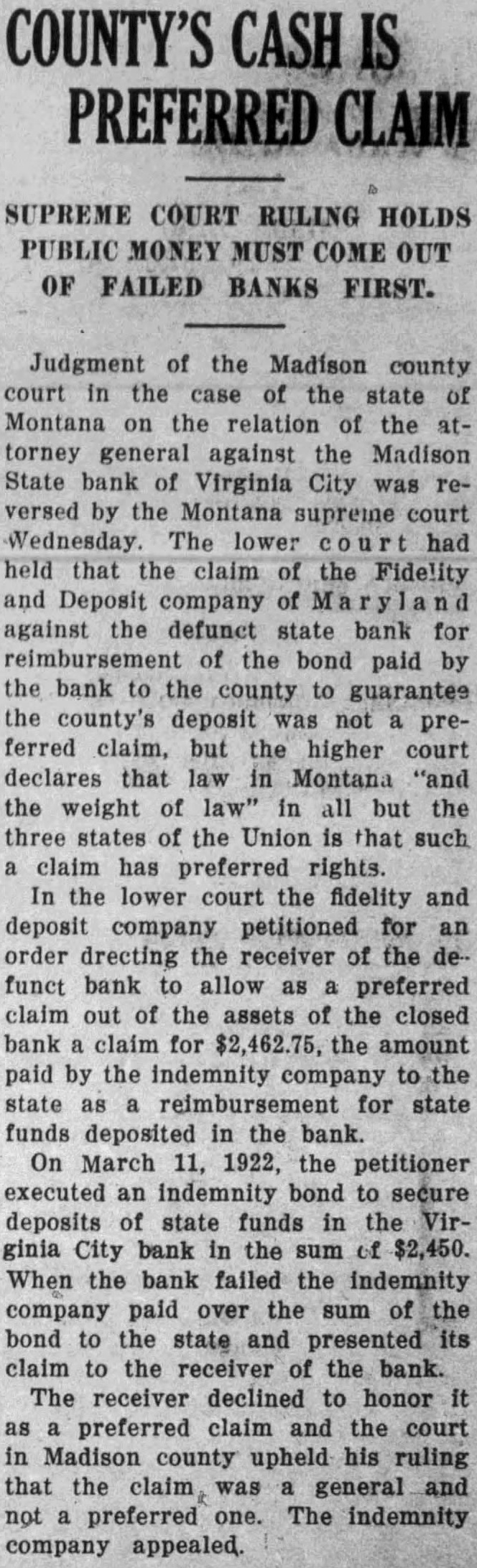
COUNTY'S CASH IS PREFERRED CLAIM SUPREME COURT RULING HOLDS PUBLIC MONEY MUST COME OUT OF FAILED BANKS FIRST. Judgment of the Madison county court in the case of the state of Montana on the relation of the attorney general against the Madison State bank of Virginia City was reversed by the Montana supreme court Wednesday. The lower court had held that the claim of the Fidelity and Deposit company of Maryland against the defunct state bank for reimbursement of the bond paid by the bank to the county to guarantee the county's deposit was not a preferred claim, but the higher court declares that law in Montana "and the weight of law" in all but the three states of the Union is that such a claim has preferred rights. In the lower court the fidelity and deposit company petitioned for an order directing the receiver of the defunct bank to allow as a preferred claim out of the assets of the closed bank a claim for $2,462.75, the amount paid by the indemnity company to the state as a reimbursement for state funds deposited in the bank. On March 11, 1922, the petitioner executed an indemnity bond to secure deposits of state funds in the Virginia City bank in the sum of $2,450. When the bank failed the indemnity company paid over the sum of the bond to the state and presented its claim to the receiver of the bank. The receiver declined to honor it as a preferred claim and the court in Madison county upheld his ruling that the claim was a general and not a preferred one. The indemnity company appealed.


Article from Midland Empire News, October 2, 1923

Click image to open full size in new tab

Article Text

STATE SUPREME COURT RENDERS OPINIONS IN CASES ON APPEAL Helena, Sept. 27.—The way was opened for the beginning of the work of repaving Main street and paving Neill avenue in Helena when the state supreme court Wednesday affirmed the lower court's order in the case of Jesse C. Ricker and J. Miller Smith, executors, against the city of Helena. In the Lewis and Clark district court the plaintiffs were denied an injunction restraining the defendants from proceeding with the creation of Main street-Neill avenue improvement district officially known as special improvement district No. 139. The project involved the paving of certain streets around the parks near the Great Northern depot. An injunction was asked on the contention that the city council authorized the creation of the district after wrongfully finding that protests of property owners were insufficient. The petitioners maintained that the council illegally included in the district ground dedicated as parks totalling 34,125 square feet and not subject to assessment for the payment of costs of an improvement district. They averred that when the area of the land thus exempt from assessment should have been excluded there would remain subject to assessment 138,660.85 square feet and that property owned by protesting property owners totalled 62,618.25 an area in excess of 40 per cent. The petitioners also contended that Main street being already paved, the owners of property in the district would not be equally and alike benefited by paving on Neill avenue and that creation of the district was in effect taking property from the plaintiff for public use without just compensation. The petitioners asked that the council's action in creating the improvement district be declared null and void, that the contract with F. Burch & Sons be declared void and that a permanent injunction be granted to prevent further proceedings in the project. Judge Stanley E. Felt heard the proceedings and denied the request of the plaintiff upholding the legality of the improvement district. The City of Helena denied that protests embraced an area of 40 per cent of the total area of the improvement district and set forth that the city was willing to pay the costs of the assessment against the ground dedicated for park purposes out of the general park funds. MISSOULA COUNTY COURT DECISION IS AFFIRMED An opinion affirming the judgment of the Missoula county district court in the case of Arthur G. Davis against George Freisheimer was delivered by the supreme court Wednesday. Judgment in the Missoula county district court was for $5,000 in favor of the plaintiff. Davis was employed by defendant at his drug store at 118 North Higgins avenue, Missoula. He alleged that he sustained injuries which would incapacitate him for at least a year by falling into an elevator shaft in the building. He charged negligence on the part of Freisheimer in not lighting the corner of the building in which the elevator was located; that the defendant was negligent in not providing the elevator shaft with a gate or chain; in not having a lock on the elevator to keep it from creeping up four or five feet and in not warning his employes of the dangerous nature of the elevator. He asked $7,000 as compensation for his injuries and suffering, $451 for surgeon's and nurses' fees and $1,500 for loss of a year's earning as a manual laborer. In the accident he alleged he sustained a broken wrist, disjointed ankle, broken collar bone and numerous bruises. MADISON STATE BANK CASE IS REVERSED The supreme court reversed the district court of Madison county in the case of state of Montana on the relation of the attorney general against the Madison State bank of Virginia City. In the Madison county court, from which the case was appealed, the Fidelity & Deposit company of Maryland petitioned for an order directing the receiver of the defunct Madison State bank to allow as a preferred claim out of the assets of the closed bank a claim for $2,462.75 the amount paid by the indemnity company to the state as reimbursement for state funds deposited in the bank. On March 11, 1922, the petitioner executed an indemnity bond to secure deposits of state funds in the Virginia City bank in the sum of $2,450. When the bank failed the indemnity company paid over the sum of the bond to the state and presented its claim to the receiver of the bank. The receiver declined to honor it as a preferred claim and the court in Madison county upheld his ruling that the claim was a general and not a preferred one. The indemnity company appealed.


Article from Laurel Outlook, October 3, 1923

Click image to open full size in new tab

Article Text

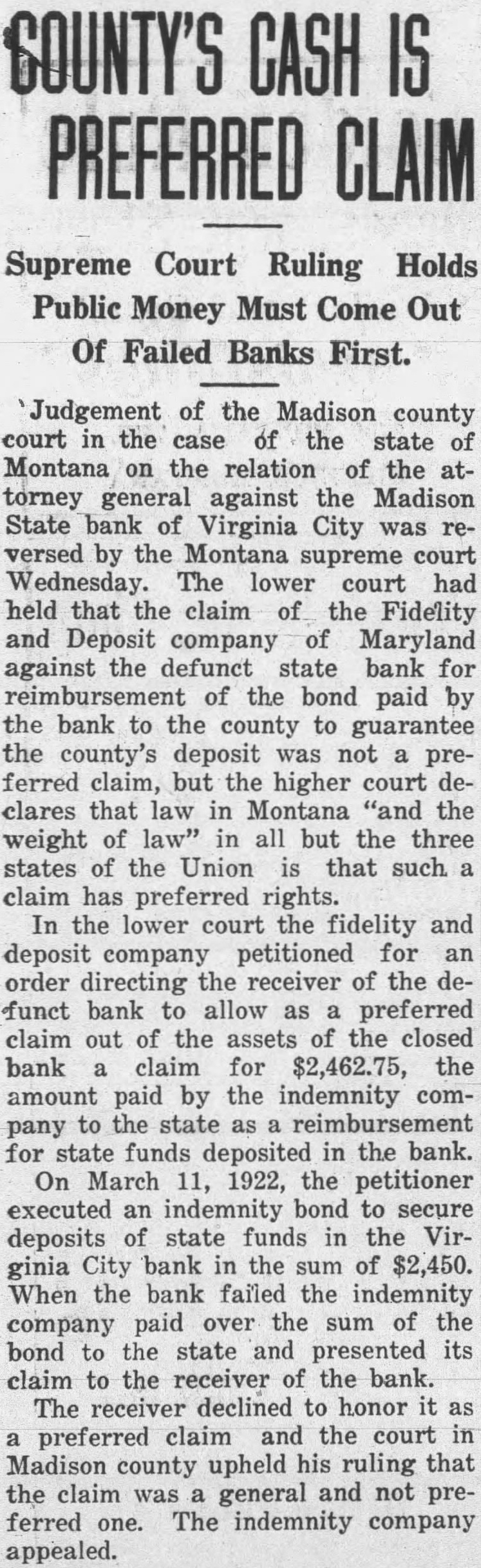
COUNTY'S CASH IS PREFERRED CLAIM Supreme Court Ruling Holds Public Money Must Come Out Of Failed Banks First. Judgement of the Madison county court in the case of the state of Montana on the relation of the attorney general against the Madison State bank of Virginia City was reversed by the Montana supreme court Wednesday. The lower court had held that the claim of the Fidelity and Deposit company of Maryland against the defunct state bank for reimbursement of the bond paid by the bank to the county to guarantee the county's deposit was not a preferred claim, but the higher court declares that law in Montana "and the weight of law" in all but the three states of the Union is that such a claim has preferred rights. In the lower court the fidelity and deposit company petitioned for an order directing the receiver of the defunct bank to allow as a preferred claim out of the assets of the closed bank a claim for $2,462.75, the amount paid by the indemnity company to the state as a reimbursement for state funds deposited in the bank. On March 11, 1922, the petitioner executed an indemnity bond to secure deposits of state funds in the Virginia City bank in the sum of $2,450. When the bank failed the indemnity company paid over the sum of the bond to the state and presented its claim to the receiver of the bank. The receiver declined to honor it as a preferred claim and the court in Madison county upheld his ruling that the claim was a general and not preferred one. The indemnity company appealed.