7181. First National Bank (Newton, MA)

Bank Information

Episode Type
Suspension β†’ Closure
Bank Type
national
Bank ID
488
Charter Number
488
Start Date
March 2, 1867
Location
Newton, Massachusetts (42.337, -71.209)

Metadata

Model
gpt-5-mini
Short Digest
b5a9bb00638eaad6

Response Measures

None

Description

Contemporary articles (Mar–Aug 1867) report the First National Bank of Newton (Mass.) was short due to its cashier (absconded / defalcation ~$110,000), closed/suspended in early March 1867 for examination, placed in charge of the Comptroller's agents, and later reported as failed / in the hands of a receiver (by June 1867). No clear contemporaneous description of a depositor run is present; the failure was driven by cashier embezzlement and losses from Mellen, Ward & Co. exposures. Receiver D. W. Jones is named in August reports. Dates chosen from newspaper datelines (Mar 2–4 and Jun 11, 1867).

Events (5)

1. July 27, 1864 Chartered
Source
historical_nic
2. March 2, 1867 Suspension
Cause
Bank Specific Adverse Info
Cause Details
Cashier E. Porter Dyer Jr. absconded/was discovered short about $110,000 due to alleged embezzlement and heavy losses in stock speculation; bank closed for examination of accounts and suspended operations pending investigation.
Newspaper Excerpt
E. Porter Dyer, Jr., the cashier of the First National Bank of Newton, Mass., is short $110,000 ... The president of the bank gave notice that the cashier came to Boston yesterday ... and has not since been heard of.
Source
newspapers
3. March 4, 1867 Other
Newspaper Excerpt
The First National Banks of Newton, Mass., and Hudson, N. Y., have been placed in charge of agents of the Controller of the Currency for investigation.
Source
newspapers
4. March 11, 1867 Voluntary Liquidation
Source
historical_nic
5. June 11, 1867 Receivership
Newspaper Excerpt
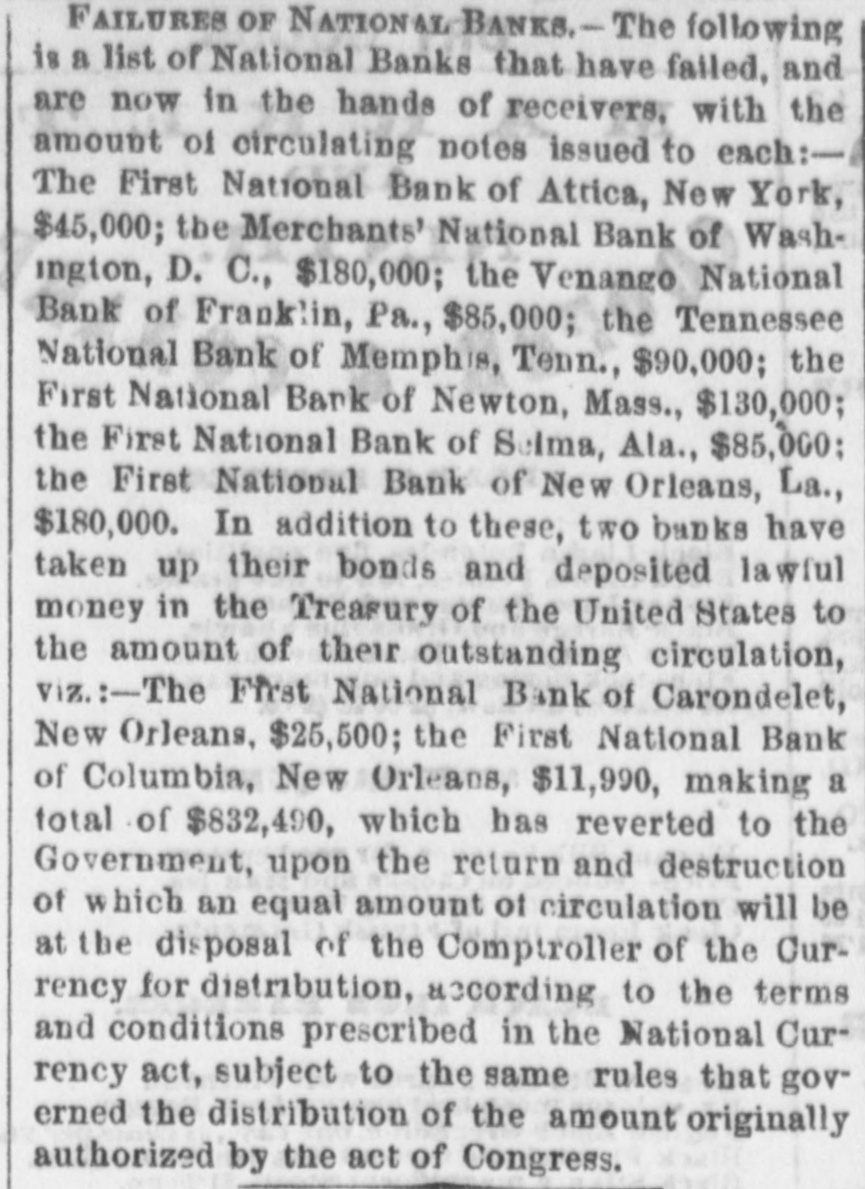
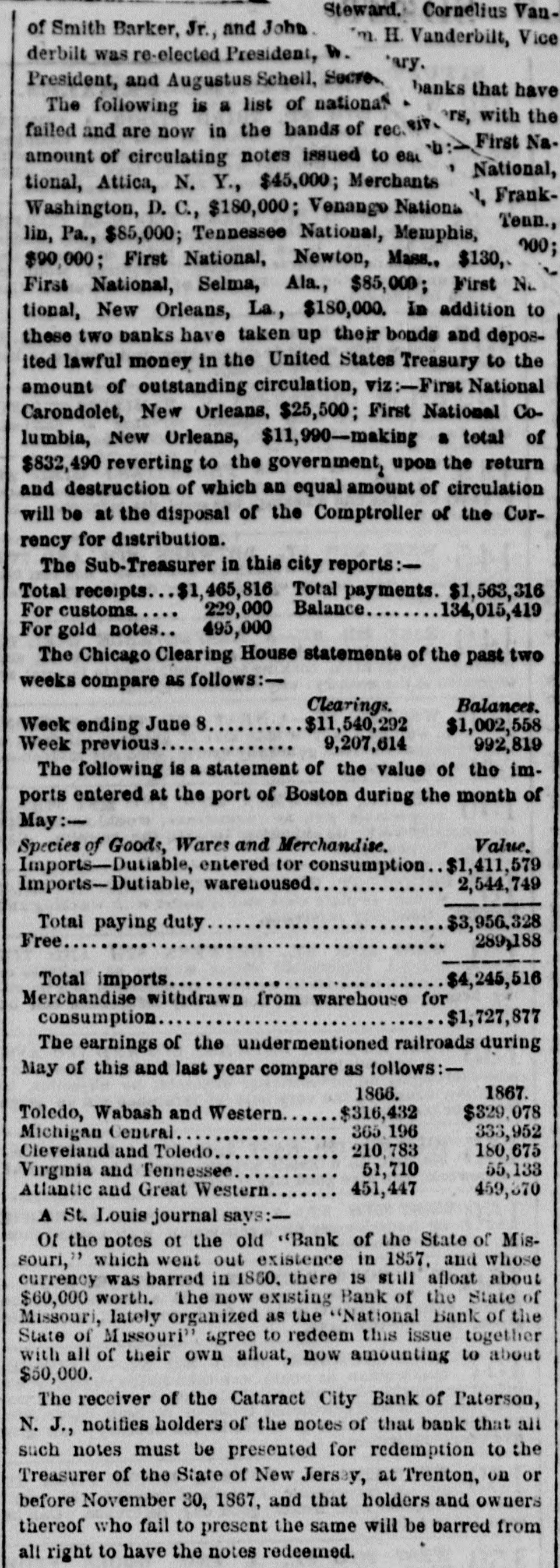
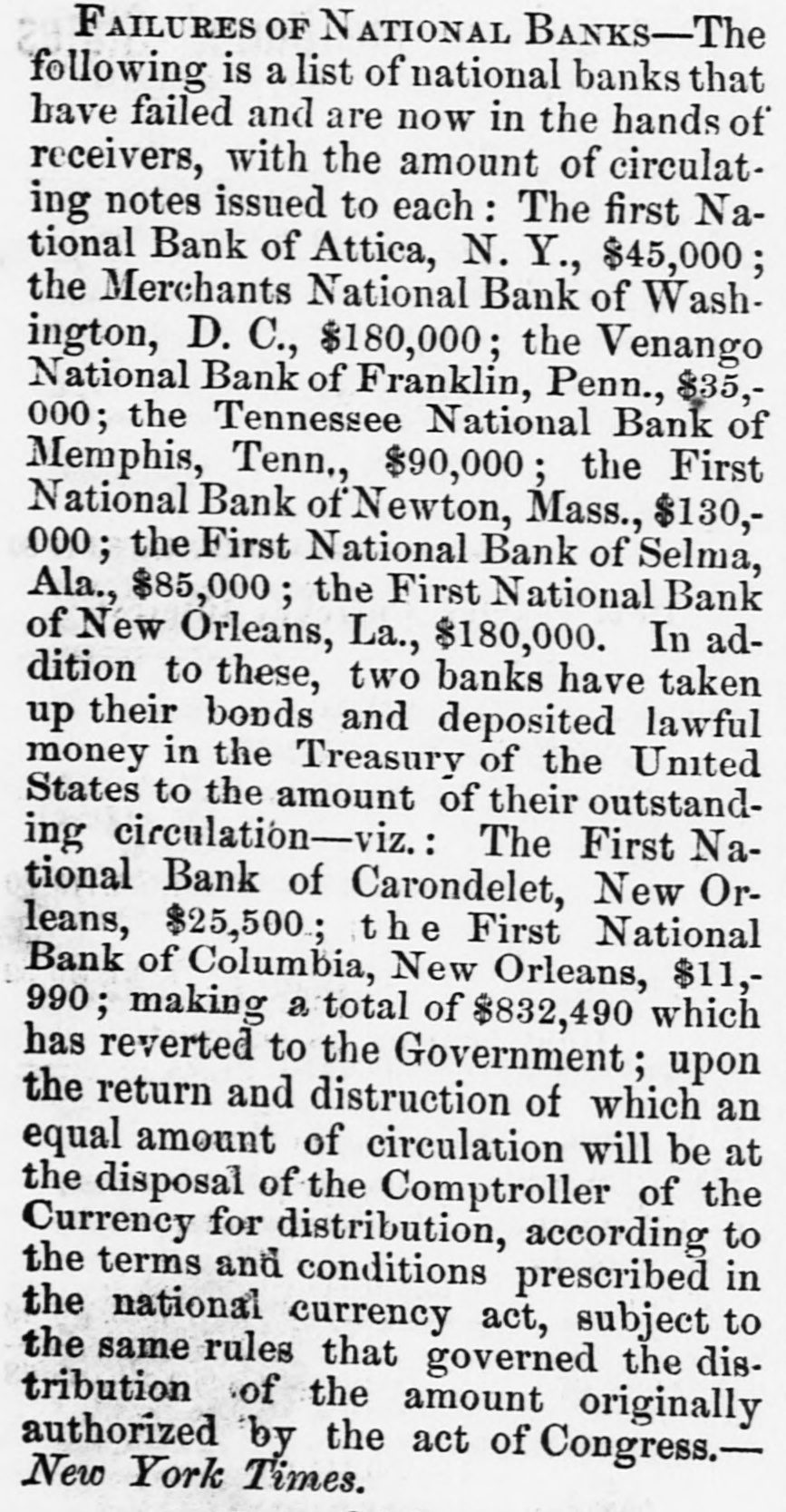
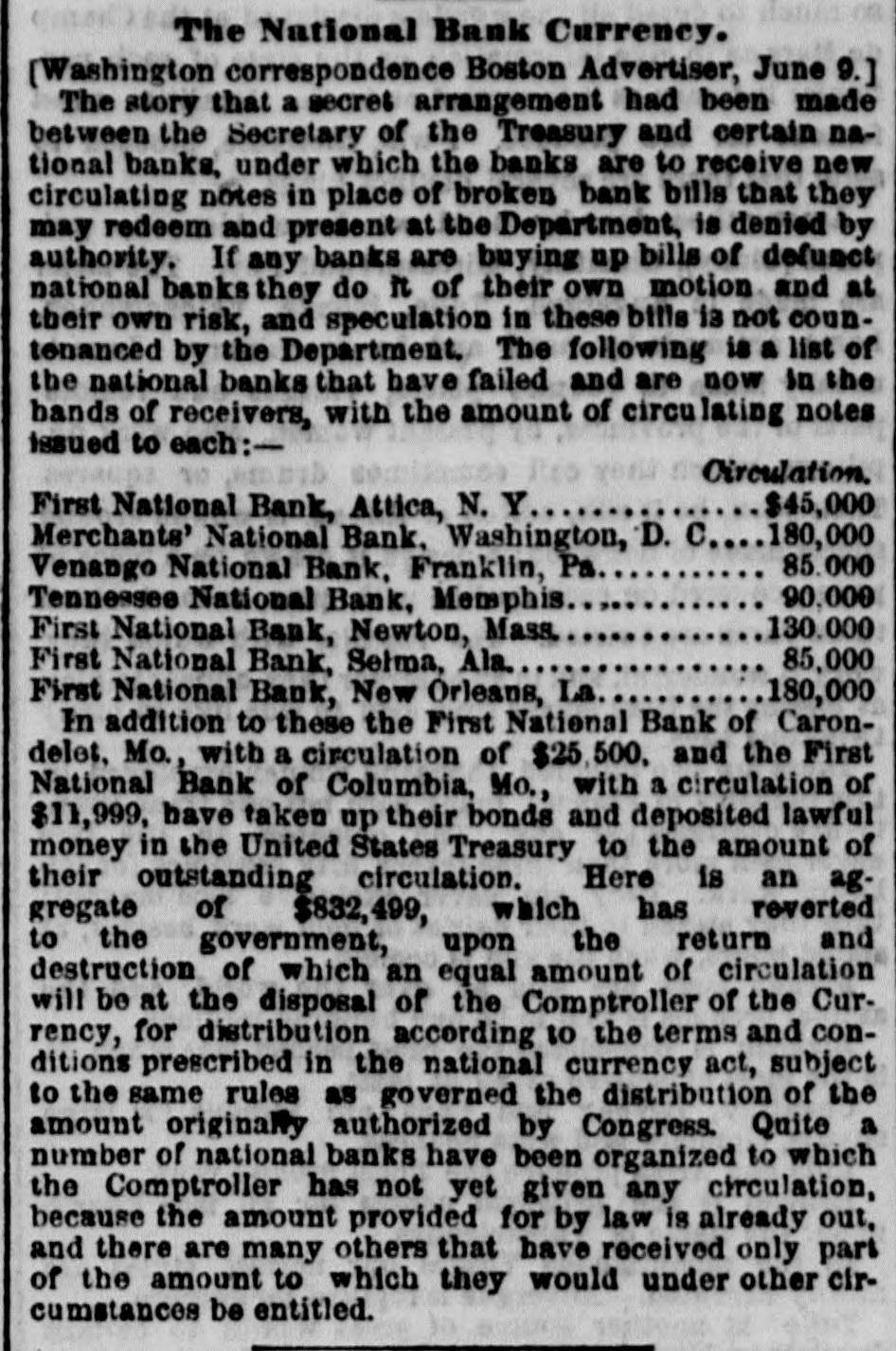
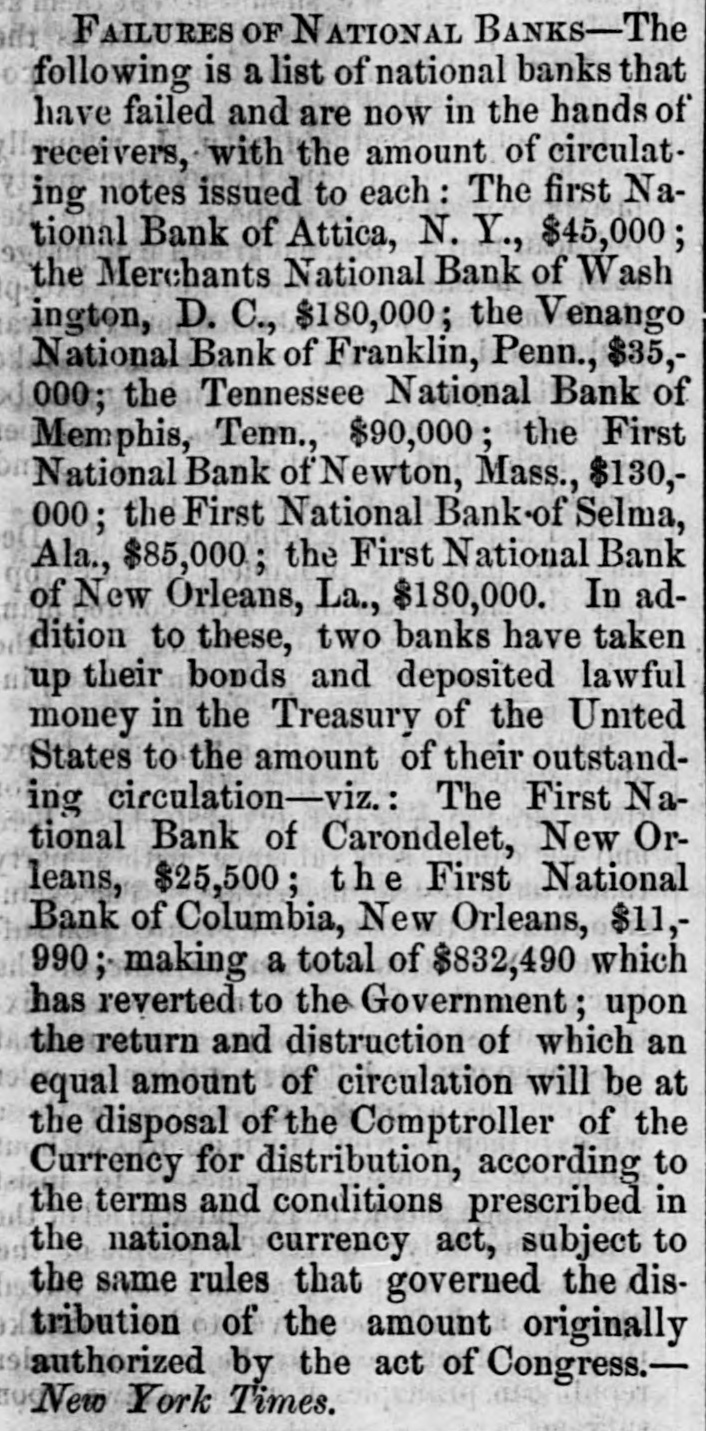
The First National Bank of Newton, Mass., $130,000 ... are failures and are now in the hands of receivers, with the amount of circulating notes issued to each: ... First National Bank, Newton, Mass., $130,000.
Source
newspapers

Newspaper Articles (24)

Article from The New York Herald, March 3, 1867

Click image to open full size in new tab

Article Text

BANK TROUBLES, DEFALCATIONS AND ERAUDS. First National Bank of Hudson. N. Y. HUDSON, N. Y., March 2, 1867. The First National Bank of this city was closed to day for examination of accounts, it being alleged that Peter S. Wynkoop, the cashier, is a defaulter to a large amount. The directors of the bank are investigating the matter, and will report the amount of deficiency as soon as ascertained. The cashier makes a clean breast of it, and acknowledges that he has lost heavily by speculations in fancy stocks. The following notice was posted on the doors of the bank to-day:The board of directors of the First National Bank of Hudson are pained to inform the public that owing to known defalcations of the cashier of that institution they are compelled to close its doors until a full examination of its condition can be made. Notwithstand. ing the frank confession of the late cashier it is impossible at this moment, from the absence of proper data, and the state of the cashier's mind, to determine what is the actual amount of the defalcations; but from present appearances they are thought to be such as to imparir only a minor part of the capital. The board have every confidence in assuring depositors that they are amply secured. Bill holders, of course, have nothing to fear. Valuables deposited for safe keeping are believed to be untouched. Every means in the power of the board will be used to relieve depositors from their unfortunate situations. At the earliest mement a statement of the affairs of the bank will be made. J. W. FAIRFIELD, President. An investigation into the affairs of the bank shows as embezzlement of about $50,000. A further examina. tion will doubtless increase the amount. Hasbrouck, the defaulting cashier, was taken into custody this evening at the instance of the president of the bank and lodged in jail. The above bank has a paid in capital of $200,000, and power to increase to half a million. Its notes are no. deemed at the Ninth National Bank of New York city. First National Bank of Newton, Mass. BOSTON, March 2, 1867. There is great trouble in financial circles here. E. Porter Dyer, Jr., the cashier of the First National Bank of Newton, Mass., is short $110,000 The President of the bank gave notice that the cashier came to Boston yesterday at eleven o'clock and has not since been heard of. The paid in capital of the bank is only $150,000, but it has authority to increase its stock to $300,000. It redeems in New York at the National Park Bank. Swindling the Dollar Savings Bank of Pitte. burg, Pa. Relative to the embezzlement of some $15,000 CODEmitted by A. V. H. Elder, general bookkeeper of the Dollar Savings Bank at Pittsburg, the Post of that city has the following:The occasion of the discovery of the fraud was as follows:-A gentleman, whose name we forbear making public, received a small patrimony, amounting to some $700, which he deposited in the Dollar Savings Bank for safe keeping. The sum was correctly entered upon the depositor's bankbook, but upon the credit book in the bank it was set down $200, the bookkeeper pocketing the other $500. In a short time the depositor wished to check for $200, whereupon the teller asked him if he would not have his account balanced. He replied in the negative, stating that he still had some $500 on deposit, when be was requested to leave his book for settlement. This was done. The discrepancy was discovered and suspicion aroused. The directors were informed, other pass books were sent for and accounts settled, in which similar errors were found to exists. A thorough investigation took place, and deficits to the above amount were found. State Bank of Massachusetts-Over Half a Million Dollars Involved. BOSTON, March 2, 1867. There was considerable excitement in State street this morning occasioned by the development of the irregularities in transactions of the cashier of the State Bank in regard to certification of checks as "good" bearing the name of Mellen, Ward & Co., brokers, who suspended payment yesterday. These checks were presented at the Clearing House at the morning settlement by the various banks holding the same and were thrown out by the State Bank, on which certifications were made. The directors of the institution declare that they never entered into, or agreed to any arrangement made with the city banks for the certification of checks, and such action of their cashier was wholly unauthorized by them. The sum involved in these transactions is upwards of half a million dollars. Other parties besides those mentioned are also implicated in these diffculties.
Article from The Portland Daily Press, March 4, 1867

Click image to open full size in new tab

Article Text

FINANCIAL TROUBLE IN BOSTON.-There was great excitement in Boston on Saturday, occasioned by certain financial transactions, in which the Cashier of the State Bank seems to have been mixed up. It was announced on Friday afternoon that the broker and banking firm of Mellen, Ward & Co. had suspended and as they had operated largely in copper stocks the effect on the market was felt Saturday, especially in Copper Falls, which sold on Friday at 74 and Saturday declined to 29. On Saturday it was ascertained that this failure had brought to light irregularities which implicated a large number of persons and involved several of the banks in heavy losses. It was stated on the street that Mr. Julius F. Hartwell, Cashier of the Sub-Treasury, obtained on certain gold certificates a large amount of money, which he deposited in the Merchants' Bank. He subsequently withdrew this amount, which is stated to reach over five hundred thousand dollars, by depositing a check certified by Charles H. Smith, Cashier of the State Bank. Saturday the check held by the Merchants' Bank was presented to the State Bank, when it was refused paymeut on the ground that no entry of the transaction appeared on the books. The Merchants' Bank still hold the check and the question of responsibility will be settled hereafter. Mr. Smith resigned his position and his resignation was accepted. It is stated that the cash account of the SubTreasury is correct, and it is rumored that the gold checks which were made the basis of the transaction in the first place were either uncancelled checks which had been paid or were fraudulently used. Mr. Julius F. Hartwell, it is reported, has been relieved at the Sub-Treasury. Mr. Carter, of the firm of Mellen, Ward & Co., is a director of the Newton Bank, which is said to be a sufferer, but to what amount is not known. The effect on State street of this startling expose was very marked. Many rumors were current regarding the losses of other banks, but they are of very inconsiderable amounts. It has not been ascertained what became of the gold checks, but as the cash at the SubTreasury is right, it is to be presumed they are held by innocent parties who have advanced money, accepting them as security. It is stated when the check of Mellen, Ward & Co. was first offered at the Merchants' Bank it was not certified, but Mr. Smith, Cashier of the State Bank, subsequently went into the Merchants' Bank and there certified it, taking the securities. These were carried to the SubTreasury, and as it was late, Mr. Smith was informed that a certificate of deposit would be sent to the State Bank in the morning. On making a demand for it, Mr. Smith was informed that there was nothing in the Sub-Treasury to the credit of the Bank. The Second National Bank (Granite) has one of the checks to the amount of $175,000. It is reported that Mr. Carter has been arrested, and it is also stated that the loss of the First National Bank of Newton is so heavy that it will be obliged to wind up. The bill holders under the National Banking system are secured.


Article from The Portland Daily Press, March 4, 1867

Click image to open full size in new tab

Article Text

The Financial Trouble in Boston. BOSTON, March 2. The whole loss by the suspension of Mellen, Ward & Co., is srid to be nearly $1,000,000. The First National Bank of Newtonville, of which Edward Carter, a member of the suspanded firm, was a director, has closed its doors, having suffered to the extent of $200,000, near14 twice its capital. Julius F. Hartwell, the Cashier of the Sub-Treasury, who has been concerned in these transactions, has resigned. The Government, however, does not lose a dollar. Mr. Smith, the Cashier of the State Bank, has also resigned.


Article from Daily Davenport Democrat, March 4, 1867

Click image to open full size in new tab

Article Text

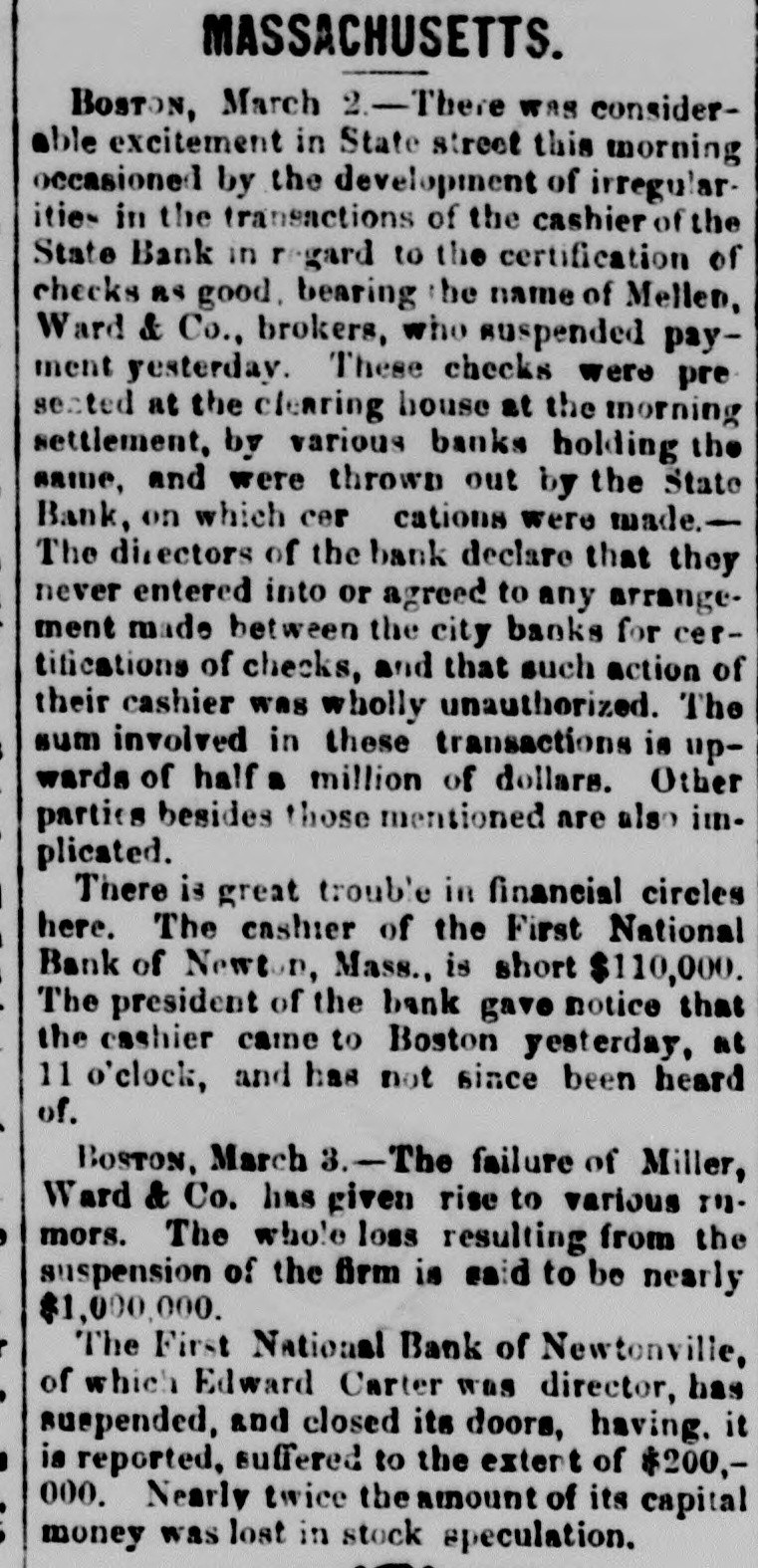
MASSACHUSETTS. BOSTON, March 2.-There was considerable excitement in State street this morning occasioned by the development of irregularities in the transactions of the cashier of the State Bank in regard to the certification of checks RS good. bearing the name of Meller, Ward & Co., brokers, who suspended payment yesterday. These checks were pre seated at the clearing house at the morning settlement, by various banks holding the same, and were thrown out by the State Bank, on which cer cations were made.The directors of the bank declare that they never entered into or agreed to any arrangement made between the city banks for certitications of checks, and that such action of their cashier was wholly unauthorized. The sum involved in these transactions is upwards of half a million of dollars. Other parties besides those mentioned are also implicated. There is great trouble in financial circles here. The cashier of the First National Bank of Newton, Mass., is short $110,000. The president of the bank gave notice that the cashier came to Boston yesterday, at 11 o'clock, and has not since been heard of. BOSTON, March 3.-The failure of Miller, Ward & Co. has given rise to various III. mors. The whole loss resulting from the suspension of the firm is said to be nearly $1,000,000. The First National Bank of Newtonville, of which Edward Carter was director, has suspended, and closed its doors, having. it is reported, suffered to the extent of $200,000. Nearly twice the amount of its capital money was lost in stock speculation.


Article from The Daily Gate City, March 5, 1867

Click image to open full size in new tab

Article Text

FROM BOSTON. The Recent Bank Failures. BOSTON, March 4. The failure of Miller, Ward & Co. hasgiven rise to various rumors. The whole loss re, sulting from the suspension of the firm is said to be nearly one million dollars. The First National Bank of Newtonville, of which Edward Canter, a member of the suspended firm, was Director, has closed its doors, having, it is reported, affered to the extent of two hundred thousand dollars, nearly twice the amount of its capital. The money was lost in stock speculations on the principal.


Article from New-York Tribune, March 5, 1867

Click image to open full size in new tab

Article Text

THE BANK DEFALCATIONS. WASHINGTON, March 4.-The First National Banks of Newton, Mass., and Hudson, N. Y., have been placed in charge of agents of the Controller of the Currency for investigation. It is expected that the First National Bank of Hudson, N. Y., will pay all its losses and go on. The Mechanics' National Bank of Bank of Baltimore will not suspend business. The Directors and stockholders are wealthy, and will pay up the amount of defalcation. The defalcation of this bank commenced more than 20 years ago, but had been skillfully covered up and concealed, but was finally brought to light by an official examination, made by an agent of the Controller of the Currency. Mr. Huilburd acts promptly, and will carry out the law to the extent of his powers under the law. FINANCIAL DISTRUST IN BOSTON.) BY TRIEGRAPH TO THE TRIBUNE. BOSTON, March 4.-The Journal of this evening says: There is a general feeling of distrust on the street so far as regards the transactions of brokers and bankers, the recent failure having brought to light such Fross irregularities that even well-established and high-toned houses suffer from the suspicion which is naturally created. The First National Bank of Newton appears to have been completely cleaned out, and many eases of individual suffering are related. It appears probable that one or two other banks, besides those emmierated, have been subjected to loss, and $20,000 was taken out of one individual whose friendship made him an easy dupe. We are happy to hear that there is every prospect that the whole affair will be made the subject of legal investiga tion. THE HUDSON DEFALCATION-CORRECTION HUDSON, N. Y., March 4.-The New-York pape erroneously publish the name of P. 8. Wyukoop am of the defaulting cashier in this city. Justice to A Wynkoop requires that this mistake should be correcte Joseph Hasbrouck is the defaulter, of the First Nation Bank. Mr; Wynkoop has had no connection with thi bank for a long time past.


Article from Daily Davenport Democrat, March 5, 1867

Click image to open full size in new tab

Article Text

WASHINGTON. W ASHINGTON, March 4.-The First Na. tional Bank of Newton, Mass., and the First National Bank of Hudson, New York, have been placed in charge of the Comptiolier of the Currency for investigation, It is espected that the last named Bank will pay all losses and go on. The Merchants' National Bank of Baltimore will not suspend business. The Directors and stockholders are wealth and will pay up the amount of defalcationIt is not probable tHat any formal sage*will be sent to Congress by the Presio dent. en short a time having elepsed since


Article from Evening Star, March 6, 1867

Click image to open full size in new tab

Article Text

GOVERNMENT SECURITIES. WASHINGTON, March 6, 1867. Jay Cooke & Co fornish the following quotations of Government securities: Buying. Selling. U. S. 6'8 Coupon, 1881 109 110 % U. S. Five Twenties, 1862 109 109 X U. S. Five Twenties. 1864 107 % 107% U. S. Five Twenties. 1865 108 107 % 107 U. S. Five Twentiee, Jan&J'y, '65. 106 x U. S. Ten Forties 97 98 106 TT N. Seven Thirtier, August 105 1/2 U.S. Seven Thirties, June 105 % 105% U. S. Seven Thirties, July 105 x 105% NEW YORK FIRST BOARD SALES. 10.40's Coupons 109% 97% 5.20's. 1862 109 105% 7.30's, August 5.20's, 1864 107% 7.30's, June 105 Y 5.20's, 1865 1071/2 105 7.30's. July Gold 5.20's. Jn &Jy, '65. 106% 135 THE NATIONAL BANK FAILURES - The Comptroller of the Currency has received re. ports from special agents in charge of the First National Bank of Newton, Massach asetts. and the First National Bank of Hudson, New York. which banks were lately com pelled to suspend business. and into the affairs of which the Compireller has ordered 10 vestigations to be made. The information is to the effect the affairs of the banks, and especially of the one at Hudson, are in a much more faverable condition than was a first thought, and it is supposed that the First National Bank of Hudson will, in a short time, pay off its losses and resume business operations. The Mechanics' National Bank of Baltimore, will not suspend business. although the losses are very heavy. The directors and stockhold. ers are wealthy men. and will pay up the amount of the defalcation. The defalcation in this bank commenced more than twenty years ago, but bad been skilfully concealed until brought to light by the official examination of an agent of the Comptroller ot the Currency, who has acted promptly in this matter, and will carry out the provisions of the law to the extent of his ability.


Article from Clarksville Weekly Chronicle, March 8, 1867

Click image to open full size in new tab

Article Text

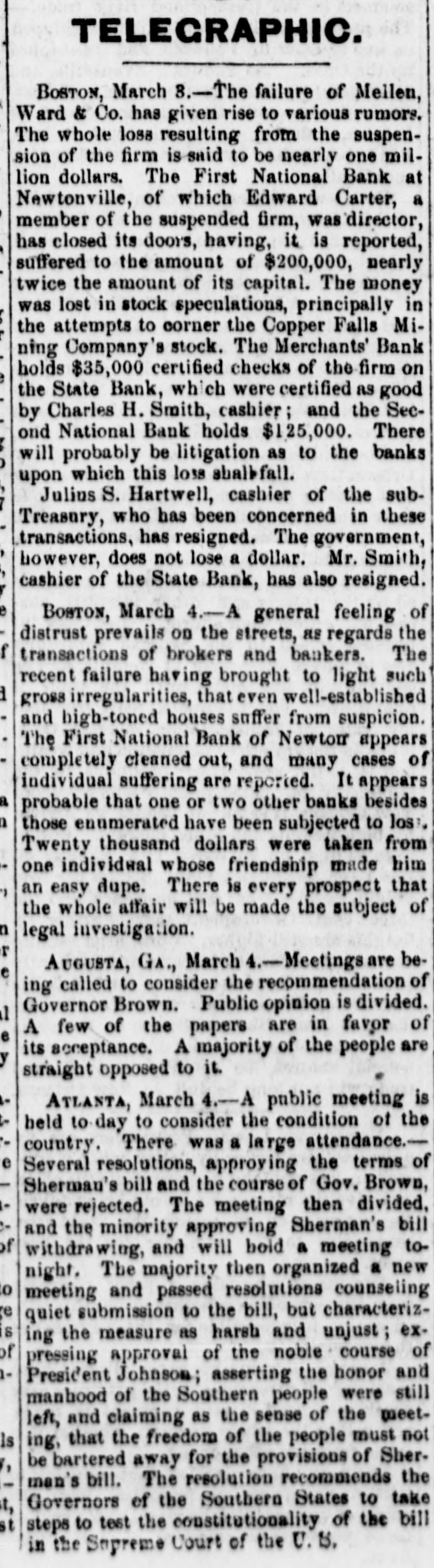
TELEGRAPHIC. BOSTON, March 8.-The failure of Mellen, Ward & Co. has given rise to various rumors. The whole loss resulting from the suspension of the firm is said to be nearly one million dollars. The First National Bank at Newtonville, of which Edward Carter, a member of the suspended firm, was director, has closed its doors, having, it is reported, suffered to the amount of $200,000, nearly twice the amount of its capital. The money was lost in stock speculations, principally in the attempts to corner the Copper Falls Mining Company's stock. The Merchants' Bank holds $35,000 certified checks of the firm on the State Bank, which were certified as good by Charles H. Smith, cashier; and the Second National Bank holds $125,000. There will probably be litigation as to the banks upon which this loss shall fall. Julius S. Hartwell, cashier of the subTreasury, who has been concerned in these transactions, has resigned. The government, however, does not lose a dollar. Mr. Smith, cashier of the State Bank, has also resigned. BOSTON, March 4.-A general feeling of distrust prevails on the streets, as regards the transactions of brokers and bankers. The recent failure having brought to light such gross irregularities, that even well-established and high-toned houses suffer from suspicion. The First National Bank of Newton appears completely cleaned out, and many cases of individual suffering are reported. It appears a probable that one or two other banks besides a those enumerated have been subjected to los Twenty thousand dollars were taken from one individual whose friendship made him an easy dupe. There is every prospect that the whole affair will be made the subject of legal investigation. AUGUSTA, GA., March Meetings are being called to consider the recommendation of Governor Brown. Public opinion is divided. A few of the papers are in favor of its acceptance. A majority of the people are straight opposed to it. ATLANTA, March 4.--A public meeting is held to day to consider the condition of the country. There was a large attendance.e Several resolutions, approving the terms of Sherman's bill and the course of Gov. Brown, were rejected. The meeting then divided, and the minority approving Sherman's bill of withdrawing, and will hold a meeting tonight. The majority then organized a new to meeting and passed resolutions counseling e submission to quiet the bill, but characteriz- exis ing the measure as harsh and unjust; of pressing approval of the noble course of President Johnson; asserting the honor and manhood of the Southern people were still left, and claiming as the sense of the meetIs ing, that the freedom of the people must not be bartered away for the provisions of Sher7, man's bill. The resolution recommends the Governors of the Southern States to take it, st steps to test the constitutionality of the bill in the Sepreme Court of the U.S.


Article from Memphis Daily Appeal, March 8, 1867

Click image to open full size in new tab

Article Text

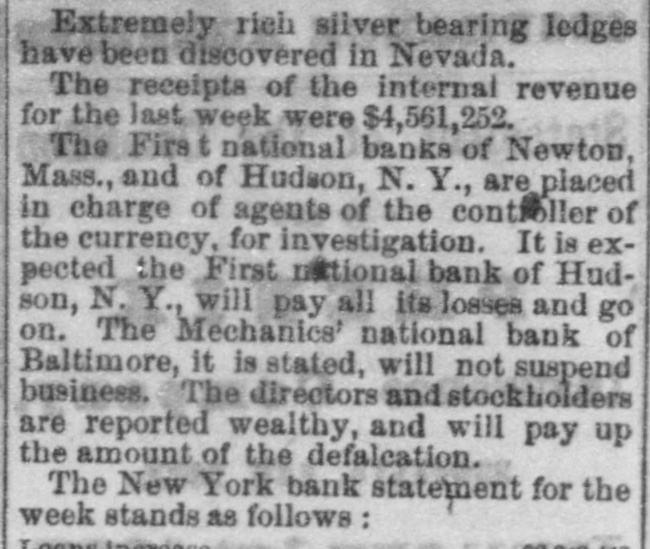
Extremely rieh silver bearing ledges have been discovered in Nevada. The receipts of the internal revenue for the last week were $4,561,252. The First national banks of Newton, Mass., and of Hudson, N. Y., are placed in charge of agents of the controller of the currency, for investigation. It is expected the First national bank of Hudson, N. Y., will pay all its losses and go on. The Mechanics' national bank of Baltimore, it is stated, will not suspend business. The directors and stockholders are reported wealthy, and will pay up the amount of the defalcation. The New York bank statement for the week stands as follows :


Article from Delaware State Journal and Statesman, March 8, 1867

Click image to open full size in new tab

Article Text

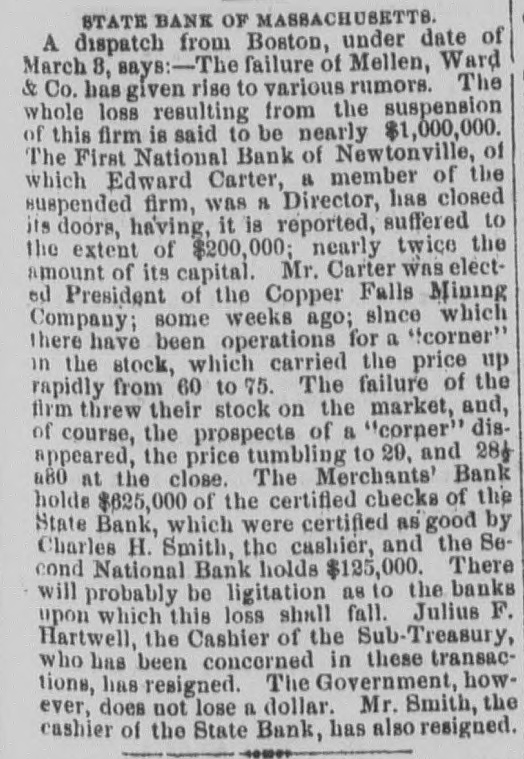
STATE BANK OF MASBACHUSETTS. A dispatch from Boston, under date of March 8, says:-The failure of Mellen, Ward & Co. has given rise to various rumors. The whole loss resulting from the suspension of this firm is said to be nearly $1,000,000. The First National Bank of Newtonville, of which Edward Carter, a member of the suspended firm, was a Director, has closed its doors, having, it is reported, suffered to the extent of $200,000; nearly twice the amount of its capital. Mr. Carter was elected President of the Copper Falls Mining Company; some weeks ago; since which there have been operations for a "corner" in the stock, which carried the price up rapidly from 60 to 75. The failure of the firm threw their stock on the market, and, of course, the prospects of a "corper" disappeared, the price tumbling to 29, and 28 a80 at the close. The Merchants' Bank holds $625,000 of the certified checks of the State Bank, which were certified as good by Charles H. Smith, the cashier, and the Second National Bank holds $125,000. There will probably be ligitation as to the banks upon which this loss shull fall. Julius F. Hartwell, the Cashier of the Sub-Treasury, who has been concerned in these transactions, has resigned. The Government, however, does not lose a dollar. Mr. Smith, the cashier of the State Bank, has also resigned.


Article from Marshall County Republican, March 8, 1867

Click image to open full size in new tab

Article Text

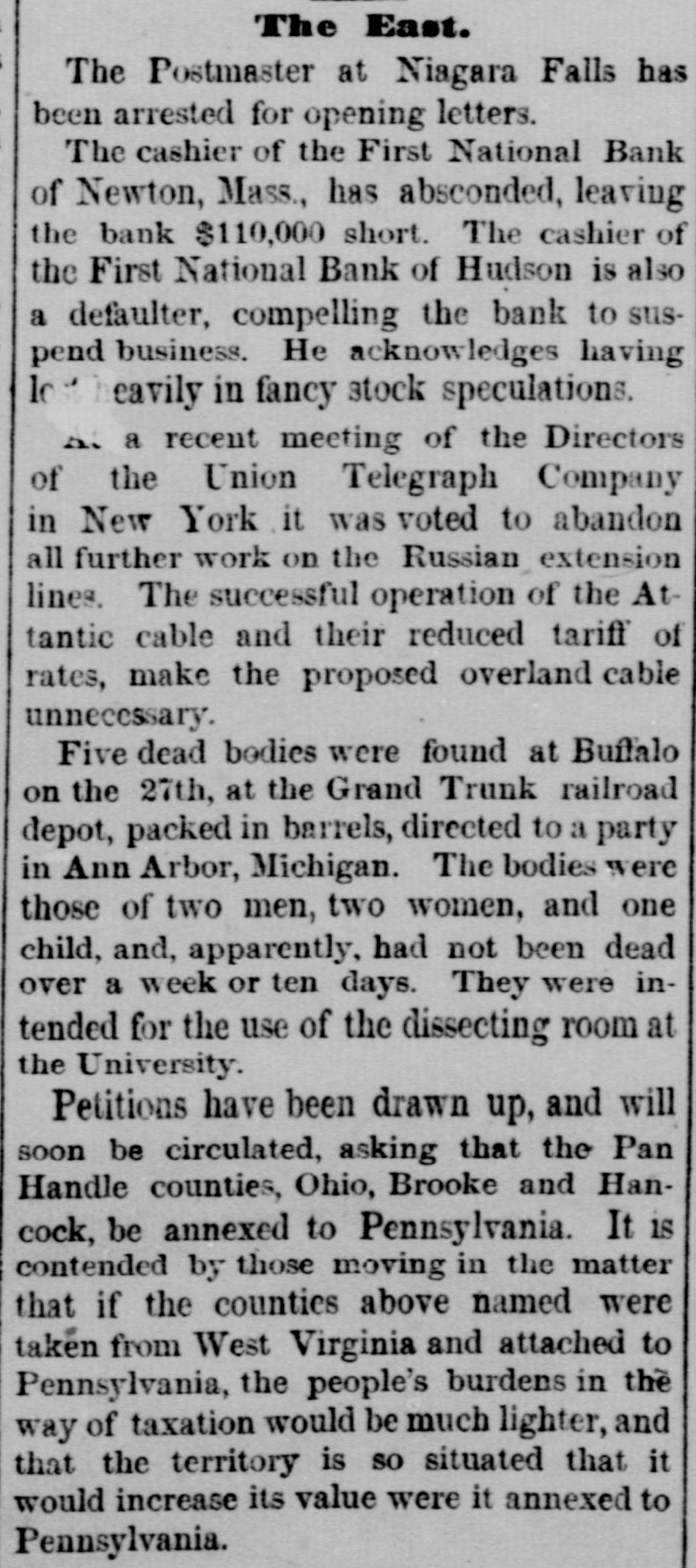
The East. The Postmaster at Niagara Falls has been arrested for opening letters. The cashier of the First National Bank of Newton, Mass., has absconded, leaving the bank $110,000 short. The cashier of the First National Bank of Hudson is also a defaulter, compelling the bank to suspend business. He acknowledges having lo heavily in fancy stock speculations. A. a recent meeting of the Directors of the Union Telegraph Company in New York it was voted to abandon all further work on the Russian extension lines. The successful operation of the Attantic cable and their reduced tariff of rates, make the proposed overland cable unnecessary. Five dead bodies were found at Buffalo on the 27th, at the Grand Trunk railroad depot, packed in barrels, directed to a party in Ann Arbor, Michigan. The bodies were those of two men, two women, and one child, and, apparently, had not been dead over a week or ten days. They were intended for the use of the dissecting room at the University. Petitions have been drawn up, and will soon be circulated, asking that the Pan Handle counties, Ohio, Brooke and Hancock, be annexed to Pennsylvania. It is contended by those moving in the matter that if the counties above named were taken from West Virginia and attached to Pennsylvania, the people's burdens in the way of taxation would be much lighter, and that the territory is so situated that it would increase its value were it annexed to Pennsylvania.


Article from Bloomsburg Democrat, March 13, 1867

Click image to open full size in new tab

Article Text

FROM WASHINGTON, Washington, March 4th,1867. THE NEW CONGRESS. Thirty-ninth Congress expired to-day the The the House, Conat o elect for the but roll The twelve of was members immediately clock M. In called, Fortieth names. and all gress four answered to their Colfax three or farce was then enacted for Speakorganization candidate of the Radicals 127 er, The was and, the of course was elected, remainder receiving were votes out 157 cast. S. S. Marshall, of Illinois, given Democratic to Hon. candidate. Before Brooks, the voting of the commenced, Mr. for Speaker York, obtained the floor, and, that in the a New foreible speech, showed parallel brief but session of Congress has no been present history of the country having days af in the within a month and nine it, and convened the passage of the law authorizing no Represeventeen ter in addition to that fact, there States are of the sentatives Union-only from twenty, a bare majority, submitted being In conclusion, he Democratic represented. signed by all the He a protest," against such an organization. journal, members to have it entered upon the could not asked Clerk decided that he Speaker. but entertain the it, pending the election of A CAUCUS. Radical members of the Representa- House will The caucus in the Hall of of nomihold a this evening for the purpose tives candidates for Door-keeper, is Sergeant a great nating and Postmaster There dozens of at-Arms for these positions, and members scramble are busy to-day besieging the canaspirants advocate their claims. Among Radito for Door-keeper, is a defeated Illinois, cal didates candidate for Congress from named Lippincott. DURATION OF THE SESSION. general impression is that few the present weeks The will not last more than a the imsession The intention seems to be to refer Commitquestion to the regular committee peachment the Judiciary, or a special to authorprefers the latter-and the recess -Butler committee to sit during session. of ize Congress said and to report at the next THE PRESIDENT AT THE CAPITOL. Star says: The President, accompa- Colonel The his private Secretaries, Mornied by Colonel Johnson. and Colonel this mornMoore, left the Executive Mansion to the row, about ten o 'clock and proceeded in signing ing where he was engaged and Capitol. the adjournment of Congress, half bills returned until to the White House about past twelve. CRIPPLED NATIONAL BANKS. THE First National Banks New of Newton, York, Massachusetts, The and Hudson, of the been placed in charge of for agents investigahave Comptroller of the Currency that the First National tion. of It is Hudson, expected New York, will pay Na- all Bank and go on. The Mechanics suspend business. its tional losses Bank of Baltimore will not Washington, March 5. NO MESSAGE. Dawes, from the committee President appoint and ed Mr. yesterday to wait on the of the two houses inform him that quorum were ready to receive any assembled be pleased to communication had and he might committee make, had to-day that the the Presiannounced their duty, and that make dent discharged said he had no communication to to Congress at present. THE NEW MEMBERS. a few prominent exceptions, with the the pres- last, With is about on a par so far made for the better, worse, last have ent House been it goes. if In that some were instances possible. but changes in more Con- The for the of the Republican side is out. Judge Hale, of of ablest gress, man seems to be New a gentleman York, deleHis successor ability. The Maryland the last. gation very ordinary is rather an improvement upon RADICAL CAUCUS. Radicals will hold another caueus take into to The night, at the Capitol. to should be morrow the business which sesconsideration by them during the present that the transacted Congress It is believed recess sion questions of of impeachment and of a will be discussed. THE VACANT OFFICES. new nominations will be fill vacancies made by the rejections. The Many President of the Senate Postmaster-Gen to caused by that not less than $2,000,000 are eral states in the hands of clerks of postoffices now destitute of postmasters. ERTY. SUIT FOR RECOV ERY OF CONFISCATED PROPin the Henry B. Tyler, and formerly who, during a Major the war, Marine corps, the Confederate army, commenced has through a served in Brent and Merrick, the posMessrs. John D. Defrees, for suit against west half of Lot 6. in Square session of will the be recollected that the the property war, 445. wa.libelled It by the Court during the life inunder the confiscation act, to the deand, the plaintiff was sold the first terest of This is believed to be and it will suit fendant. of the kind instituted here, be an interesting case. Washington, March 6. CONGRESS. houses adjourned to-day, about half o without ap past of importance. anxious Both business 12 clock, having Members transacted to any restless, and pear to be growing the citv. either by a recess or get away adjournment from The question, the caucus however, this un will probably be settled relative by strength of the advocates evening, when and the opponents of the impeachment scheme will be tested. THE TARIFF BILL friends of the tariff bill are the anxious ComThe it, but in the absence of such action to revive Ways and Means, that mittee of good. It is quite likely until would the whole do no subject will be postponed the next regular session. VOTE FOR CHAPLAIN. The Globe THE of this morning says that Rev.


Article from Daily Davenport Democrat, March 18, 1867

Click image to open full size in new tab

Article Text

THE IN CYCLONE BOSTON. Mellem. Ward & Co. Faile and the Results The Failure. Boston (March 10) Corresp of the N Times. The past week has been the most remark finan able ever known in Boston so far as eial matters are cerned The city have handled the late failure and its delicately very comitent them of many reasons Chrismoral or the highest order stands to-day National Bank, Newton, Masa. has been completely as well as several stockholders, including two or three its aged individuals who had saved up from $15,000 to $20,000 by life of toil on land who are now poor in cash they wete 80 years age, much poorer in sical health and intellectual rigor, and hence not w well fitted to start snew. Two of the beariest of the Boston bank with combined capital of $5,000,000, have been thrown into very sum stances. and between the two they will loss of from $800,000 to $900,000. A portion this, consisting of checks on New York.h already been settled by one of them, but there is dispute in regard to $000,000 which was obtained from the Merchante' by the cashier of the State bank. whereas the truth of the matter was, the house had neither funds mor there. Another city bank in victimized. generally understood to the tune of $150,000. another about $125 000, another to the amount of $50,000 other parties on the street are largely out of pocket, one house losing $42,000, another $20,000. and quite number of smaller amounts The entire loss. brief is estimated nearly $1,500,000 Two bank cashiers, bank director, and sub treasury cashier stand before the world with reputation somewhat affected, and, although they have not as yet lost their liberty the univeropinion is that each should have been to ore this. there But appears of Neither the make one in banks which have suffered most seems clined to that direction, test they should make mistake or false move which wight affect their case in court, for it is un desstood the matter to be decided on its legal merita, one party having secured the services of Judge Abbott and.Mr Curtis: the other of Mr Bartlett, and other first-clase talent There is no doubt the case will be adroitly handled. But your readers may ask what this is all about To go back little, allow me to say Some three four years ago, . nica new iron store on Con street was occupied for the first time by three young men, under the style of Ward & Monu. with capital of $80,000. it is seld. They The started well, but end the ending first two years ther did large and pros perous business being agents for the sale of Government securities, on which their commissions were large, and as stock brokers they also received an escallent share of that sort of business, which then in the "full tide of ex periment But change came over the spirit of their dreams. The sale of Governments bad its run, and their profits from that source rapidly declined the speculay tion in stocks, which was rampant 1864, became thing of the past. Office expenses and east of living were both heavy, and something must be done. Mr retired from the firm and, after some unfortunate operations in gold, retired to the Green Mountains. the home of his tives. Mellea Ward kept on, and ad unitted Carter, First He Bank into the firm. is reported $30,000 talked Carter things' ef. has house idear. big big building kept span horses considered He bug. big the ested raising cently bad on hand 100 big hogs. conceived of matters corner big the and hang shy, why Copper but one dividend, #70 an Finally found. Coppers about and far enough short Another willing between them both some 2,000 oversold. Now was the opportunity thought Carter but money must be used, and freely, too. The entire funds of the Newton First National absorbed the fund of the United States sub-tru bad been used through the cashier, It one time as high as $1,200,000 un began reat upon hin., and he could that too way. much his for and was His be to was killing him the be made defictency on right be emination day s were sent here, does not They and of $600 That the bank State. that the the certificates bank the "seen" by Smith stated that the Co. on that bank willing to certify to it. the and were State bank Down they went cashier the as wishin them, to bridge over the first of the would return them next He idea of doing this, hower. already tired of the game. His wife had found out about and it is detective on his track. The certificates once in the treasury office of the custom house, the government cash was made right, the cashier "resigned." the cartiticates were not delivered to the Cooper Falls "ring" when they applied for nest The jig the checks of Melles. Ward were refused at the banks during the day -the exploat on took place, and very for unately, perhaps. for had the clique again got control of the rtificates as they intended, and of the sub treasury enobier. the reatter, as bad as it might have worse month or bence The have caused this young. and all bare now or have hard working and frugal but they were not willing to tread in their foot acquire short must out They thought they bad the their hands. to street State take to them. 10 that State street may be in having their heads shaved at The father of the cashier of the N owton bank (who is thought to have known all about the matter) said ciergyman at 8g merviile Certer lived in style as Newton and moved in the first circles. Smith, of the State bank. was keeping his fast horses and building large house at Jameion Plains, The the bank supposed prudent and economical young man artwell, the sub-treasury cashier. a was keeping up appearances, living in la ge house with rich merchants for neigh


Article from The Evening Telegraph, June 11, 1867

Click image to open full size in new tab

Article Text

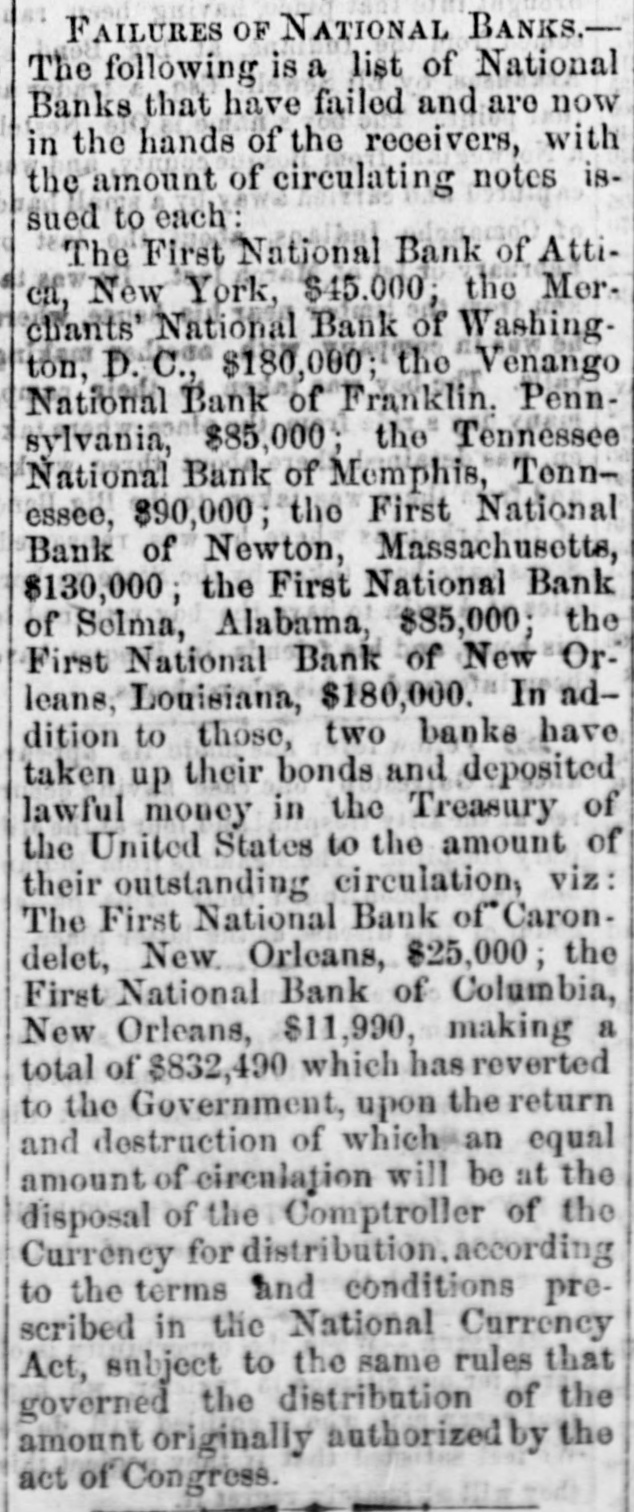
FAILURES OF NATIONAL BANKS. - The following is a list of National Banks that have failed, and are now in the hands of receivers, with the amount of circulating notes issued to each:The First National Bank of Attica, New York, $45,000; the Merchants' National Bank of Washington, D. C., $180,000; the Venango National Bank of Franklin, Pa., $85,000; the Tennessee National Bank of Memphis, Tenn., $90,000; the First National Bark of Newton, Mass., $130,000; the First National Bank of Selma, Ala., $85,000; the First National Bank of New Orleans, La., $180,000. In addition to these, two banks have taken up their bonds and deposited lawful money in the Treasury of the United States to the amount of their outstanding circulation, viz. : - The First National Bank of Carondelet, New Orleans, $25,500; the First National Bank of Columbia, New Orleans, $11,990, making a total of $832,490, which has reverted to the Government, upon the return and destruction of which an equal amount of circulation will be at the disposal of the Comptroller of the Currency for distribution, according to the terms and conditions prescribed in the National Currency act, subject to the same rules that governed the distribution of the amount originally authorized by the act of Congress.


Article from The New York Herald, June 11, 1867

Click image to open full size in new tab

Article Text

Steward. Cornelius Vanof Smith Barker, Jr., and John H. Vanderbilt, Vice derbilt was re-elected President, W. ary. President, and Augustus Scheil, Secre banks that have The following is a list of national rs, with the Bive failed and are now in the bands of rec. First Na. amount of circulating notes issued to eac National, tional, Attica, N. Y., $45,000; Merchants FrankWashington, D. C., $180,000; Venango Nationa Tenn., lin, Pa., $85,000; Tennessee National, Memphis, 200; $90,000; First National, Newton, Mass., $130, First National, Selma, Ala., $85,000; First N tional, New Orleans, La, $180,000. In addition to these two banks have taken up their bonds and deposited lawful money in the United States Treasury to the amount of outstanding circulation, viz:-First National Carondolet, New Orleans, $25,500; First National Columbia, New Orleans, $11,990-making a total of $832,490 reverting to the government, upon the return and destruction of which an equal amount of circulation will be at the disposal of the Comptroller of the Currency for distribution. The Sub-Treasurer in this city reports:Total receipts $1,465,816 Total payments. $1,563,316 For customs. 229,000 Balance 134,015,419 495,000 For gold notes The Chicago Clearing House statements of the past two weeks compare as follows:Balances. Clearings. $11,540,292 Week ending June 8 $1,002,558 9,207,614 Week previous 992,819 The following is a statement of the value of the imports entered at the port of Boston during the month of May:Value. Species of Goods, Wares and Merchandise. Imports-Dutiable, entered tor consumption $1,411,579 2,544,749 Imports-Dutiable, warehoused $3,956,328 Total paying duty Free 289,188 Total imports $4,245,516 Merchandise withdrawn from warehouse for $1,727,877 consumption The earnings of the undermentioned railroads during May of this and last year compare as follows:1867. 1866. $329,078 $316,432 Toledo, Wabash and Western 365,196 333,952 Michigan Central Cleveland and Toledo 210,783 180,675 51,710 55,133 Virginia and Tennessee Atlantic and Great Western 451,447 459,370 A St. Louis journal says:or the notes of the old "Bank of the State of Missouri, " which went out existence in 1857, and whose currency was barred in 1860, there 18 still afloat about $60,000 worth. The now existing Bank of the State of Missouri, lately organized as the "National Bank of the State of Missouri" agree to redeem this issue together with all of their own afloat, now amounting to about $50,000. The receiver of the Cataract City Bank of Paterson, N. J., notifies holders of the notes of that bank that all such notes must be presented for redemption to the Treasurer of the State of New Jersey, at Trenton, on or before November 30, 1867, and that holders and owners thereof who fail to present the same will be barred from all right to have the notes redeemed.


Article from Memphis Daily Appeal, June 15, 1867

Click image to open full size in new tab

Article Text

BANKS. TENNESSEE 90 Merchant's Bank Bank of Chattarooga10 Ocoee Memphis par Planters' Middle Tenn90 20 Southern Tenold is'se..35 40 SO W. Tenn Shelbyville 50 90 Traders' City B'k Nashville Union Commercial Bank par In Canada there are seventy-three yield gold mines, employing 708 miners. The is valof gold for the last three months ued As at an $690,955. illustration of the rapidity with of which the conversion and purchases the seven-thirty notes have been pushed forward it is officially reported that$151, have been taken in by the treas746,600 ury department during the four months ending June 1st. The reports in circulation that the sec- of of the treasury and comptroller of the retary currency are connected with any of efforts whereby the circulation suspended the banks is returned, and new circulation issued to the banks returning are officially denied. The comptroller it, of the currency regards all circulation or retire in the same light as new he circulation, and whenever has unlessed a margin unissued, he will distribute it according to the merits of the applications on file, without regard to who may return the circulation. If parties purthe circulation of retired banksaue they do it at a knows no and chase premium the comptroiler their of entitles own way risk, no of preventing it but that fact in the to any special privilèges new circulation. The national banks that is issue party list of of have receivers, following failed and a now in the hands of are the amount of circulating notes with to each: The First National bank issued Attica, N. Y., $45,000; the Merchants' of National bank of Washington, D. C., the Venango National bank of $180,000; Franklin, Penn., $85,000 the Tennessee $90,National bank of Memphis. Tenn., the First National bank of Newton, 000; Mass., $130,000; the First National bank NaSelma, Ala., $85,000; the First tional of bank of New Orleans, La., banks $180,addition to these, two up their bonds and in the treasury 000. have lawful taken In money deposited to of the the of the United States amount treasury of their outstanding circulation, The First National bank of Caron- First delet, viz: New Orieans, $25,500; the National bank of Columbia, New Orleans. $11,990, making a total of $832,490, which has reverted to the government, upon the return and destruction of which be at equal amount of circulation will an disposal of the comptroller of curthe for distribution, according to the the rency terms and conditions prescribed in national currency act, subject to the rules that governed the distribution by of same the amount originally authorized the act of congress. It has been reported that ex-President Jefferson Davis lost some money which of he was supposed to have in the hands Trenholm & Co. This error. He Frazer, had no funds on deposit with that upon the collapse of the ConMr. Judah Benjamin firm on account of from federacy, firm. the But, the procured Coufedt erate funds, a bill for twelve thousand t dollars in gold, which was duly paid. had received his salary in paper, and the sum for him as a partial cured Confederate Mr. Davis remuneration thus was se1 for the loss of depreciated paper strictly due. It is true, however, that a other members of the Confederate government were not so fortunate ( S The New Orleans Picayune of Tuesday Suit has been instituted in the p says: United States district court by Messrs. f George Soule and others, depositors in c the Bank of Commerce, of this city, o forcing the proprietor, Mr. Jacob Barker, bankruptcy. o Judge Dureil granted, upon the appliof an order to the States marshal, to cation United petitioners, directed seize the S property and effects of the defendant, the to be held subject to further orders of b ti b court. This is the first case either of voluntary or involuntary bankruptey in this in state under the operation of the new bankrupt law. a The showery character of the weather 4 made business more quiet than usual today. Very little was done in the way of S shipping, either by rail or river, Tomorrow, being the regular time for the ol departure of some of our local packets, will no doubt show a improvement. gi COTTON-The same remarks and to quotationsgiven yesterday would answer th very well for to-day. There is the very same firmness and the same difference W n the views of operators. Sales of about of 00 bales were reported to us, of mixed T ots. Receipts for the past 24 hours were 9 bales. No shipments.


Article from The Tri-Weekly Standard, June 15, 1867

Click image to open full size in new tab

Article Text

FAILURES OF NATIONAL BANKS-The following is a list of national banks that have failed and are now in the hands of receivers, with the amount of circulating notes issued to each : The first National Bank of Attica, N. Y., $45,000; the Merchants National Bank of Washington, D. C., $180,000; the Venango National Bank of Franklin, Penn., $35,000; the Tennessee National Bank of Memphis, Tenn., $90,000; the First National Bank of Newton, Mass., $130,000; the First National Bank of Selma, Ala., $85,000; the First National Bank of New Orleans, La., $180,000. In addition to these, two banks have taken up their bonds and deposited lawful money in the Treasury of the United States to the amount of their outstanding circulation-viz.: The First National Bank of Carondelet, New Orleans, $25,500; the First National Bank of Columbia, New Orleans, $11,990; making a total of $832,490 which has reverted to the Government; upon the return and distruction of which an equal amount of circulation will be at the disposal of the Comptroller of the Currency for distribution, according to the terms and conditions prescribed in the national currency act, subject to the same rules that governed the distribution of the amount originally authorized by the act of Congress.New York Times.


Article from The New York Herald, June 17, 1867

Click image to open full size in new tab

Article Text

The National Bank Currency. (Washington correspondence Boston Advertiser, June 9.] The story that a secret arrangement had been made between the Secretary of the Treasury and certain national banks, under which the banks are to receive new circulating notes in place of broken bank bills that they may redeem and present at the Department, is denied by authority. If any banks are buying up bills of defunct national banks they do it of their own motion and at their own risk, and speculation in these bills is not countenanced by the Department. The following is a list of the national banks that have failed and are now in the bands of receivers, with the amount of circu lating notes issued to each:Circulation. $45,000 First National Bank, Attica, N. Y Merchants' National Bank, Washington, D. C 180,000 85.000 Venango National Bank, Franklin, Pa 90.000 Tennessee National Bank, Memphis 130.000 First National Bank, Newton, Mass. 85,000 First National Bank, Selma, Ala. 180,000 First National Bank, New Orleans, La In addition to these the First National Bank of Carondelet, Mo., with a circulation of $25,500. and the First National Bank of Columbia, Mo., with a circulation of $11,999, have taken up their bonds and deposited lawful money in the United States Treasury to the amount of their outstanding circulation. Here is an aggregate of $832,499, which has reverted to the government, upon the return and destruction of which an equal amount of circulation will be at the disposal of the Comptroller of the Currency, for distribution according to the terms and conditions prescribed in the national currency act, subject to the same rules as governed the distribution of the amount originalty authorized by Congress. Quite a number of national banks have been organized to which the Comptroller has not yet given any circulation, because the amount provided for by law is already out, and there are many others that have received only part of the amount to which they would under other circumstances be entitled.


Article from The Weekly North-Carolina Standard, June 19, 1867

Click image to open full size in new tab

Article Text

FAILURES OF NATIONAL BANKS- The following is a list of national banks that have failed and are now in the hands of receivers, with the amount of circulating notes issued to each : The first National Bank of Attica, N. Y., $45,000; the Merchants National Bank of Wash ington, D. C., $180,000; the Venango National Bank of Franklin, Penn., $35,000; the Tennessee National Bank of Memphis, Tenn., $90,000; the First National Bank of Newton, Mass., $130,000; the First National Bank of Selma, Ala., $85,000; the First National Bank of New Orleans, La., $180,000. In addition to these, two banks have taken up their bonds and deposited lawful money in the Treasury of the United States to the amount of their outstanding circulation-viz.: The First National Bank of Carondelet, New Orleans, $25,500; the First National Bank of Columbia, New Orleans, $11,990; making a total of $832,490 which has reverted to the Government; upon the return and distruction of which an equal amount of circulation will be at the disposal of the Comptroller of the Currency for distribution, according to the terms and conditions prescribed in the national currency act, subject to the same rules that governed the distribution of the amount originally authorized by the act of Congress.New York Times.


Article from Dallas Herald, July 13, 1867

Click image to open full size in new tab

Article Text

FAILURES OF NATIONAL BANKS.The following is a list of National Banks that have failed and are now in the hands of the receivers, with the amount of circulating notes issued to each: The First National Bank of Atticit, New York, $45.000; the Mer. chants' National Bank of Washington, D. C., $180,000; the Venango National Bank of Franklin, Pennsylvania, $85,000; the Tennessee National Bank of Memphis, Tennessee, $90,000; the First National Bank of Newton, Massachusetts, $130,000; the First National Bank of Selma, Alabama, $85,000; the First National Bank of New Orleans, Louisiana, $180,000. In addition to those, two banks have taken up their bonds and deposited lawful money in the Treasury of the United States to the amount of their outstanding circulation, viz: The First National Bank of Carondelet, New Orleans, $25,000; the First National Bank of Columbia, New Orleans, $11,990, making a total of $832,490 which has reverted to the Government, upon the return and destruction of which an equal amount of circulation will be at the disposal of the Comptroller of the Currency for distribution. according to the terms and conditions prescribed in the National Currency Act, subject to the same rules that governed the distribution of the amount originally authorized by the act of Congress.


Article from The Jasper Weekly Courier, July 19, 1867

Click image to open full size in new tab

Article Text

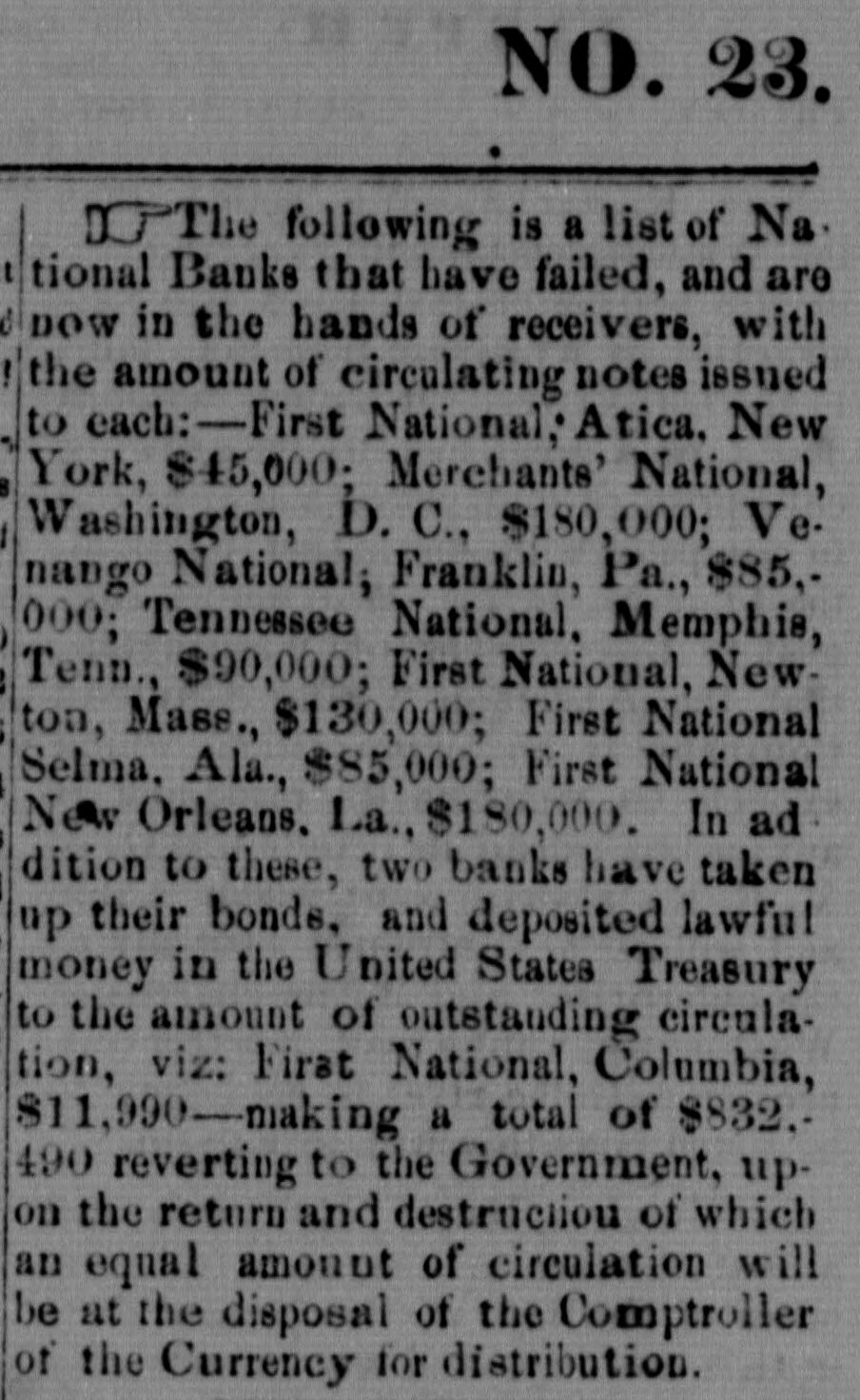
NO. 23. The following is a list of Na. tional Banks that have failed, and are DOW in the hands of receivers, with the amount of circulating notes issued to each:-First National, Atica. New York, $45,000; Merchants' National, Washington, D. C., $180,000; Venango National; Franklin, Pa., $85,000; Tennessee National, Memphis, Tenn., $90,000; First National, Newton, Mass., $130,000; First National Selma, Ala., $85,000; First National New Orleans, La., $180,000. In ad dition to these, two banks have taken up their bonds, and deposited lawful money in the United States Treasury to the amount of outstanding circulation, viz: Firat National, Columbia, $11,990-making a total of $832. 490 reverting to the Government, upon the return and destruction of which an equal amount of circulation will be at the disposal of the Comptroller of the Currency for distribution.


Article from The Evening Telegraph, August 15, 1867

Click image to open full size in new tab

Article Text

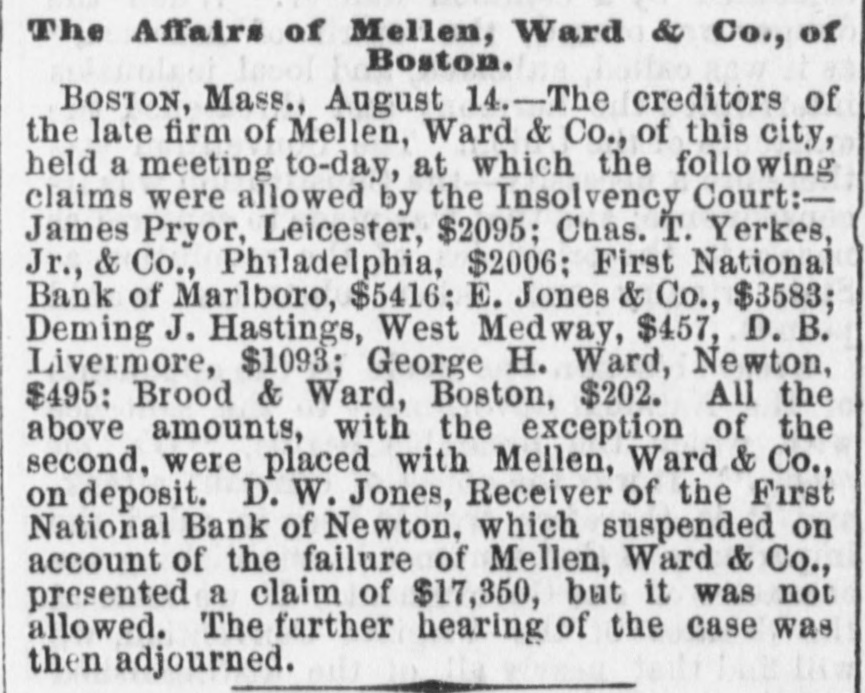
The Affairs of Mellen, Ward & Co., of Boston. BOSTON, Mass., August 14.-The creditors of the late firm of Mellen, Ward & Co., of this city, held a meeting to-day, at which the follo wing claims were allowed by the Insolvency Court:James Pryor, Leicester, $2095; Chas. T. Yerkes, Jr., & Co., Philadelphia, $2006; First National Bank of Marlboro, $5416; E. Jones & Co., $3583; Deming J. Hastings, West Medway, $457, D. B. Livermore, $1093; George H. Ward, Newton, $495: Brood & Ward, Boston, $202. All the above amounts, with the exception of the second, were placed with Mellen, Ward & Co., on deposit. D. W. Jones, Receiver of the First National Bank of Newton. which suspended on account of the failure of Mellen, Ward & Co., presented a claim of $17,350, but it was not allowed. The further hearing of the case was then adjourned.


Article from The New York Herald, August 15, 1867

Click image to open full size in new tab

Article Text

THE AFFAIRS OF MELLEN, WARD & CO., OF BOSTON. [From the Evening Telegram.] BOSTON, Mass., Aug. 14, 1867. The creditors of the late firm of Metten, Ward & Co., of this city, held a meeting to-day. at which the rollowing claims were allowed by the Insolvency Court:James Pryor, Leicester, $2,095; Charles T. Yerkes, Jr., & Co., Philadelphia, $2,006; First National Bank of Mariboro, $5,416; E. Jones & Co., $3,583; Deming J. Hastings, West Medway, $457; D. B. Livermore, $1,093; George H. Ward, Newton, $495; Brood & Ward, Boston. $202. All the above amounts, with the exception or the second, were placed with Mellen, Ward & Co., on deposit. D. W.Β° Jones, Receiver of the First National Bank, of Newton, which suspended on account of the failure of Melten, Ward & Co., presented a claim of $17,350. but it was not allowed. The further hearing of the case was then adjourned.