Bank of New England (Minneapolis, MN)

Episode Information

Episode UID
7143160691122
Episode Type
Run โ†’ Suspension โ†’ Reopening
Bank Type
state
Bank ID
714316069 hash
Start Date
June 26, 1893
Location
Minneapolis, Minnesota (44.980, -93.264)

Metadata

Model
gpt-5-mini (chosen from majority vote of a three-model LLM ensemble)
Short Digest
2e7e9dcee5b17fea

Response Measures

None

Description

A receiver was appointed after the suspension (assignment 7 July 1893) but the bank later resumed in late August 1893.

Events (5)

1. June 26, 1893 Run
Cause
Local Banks
Cause Details
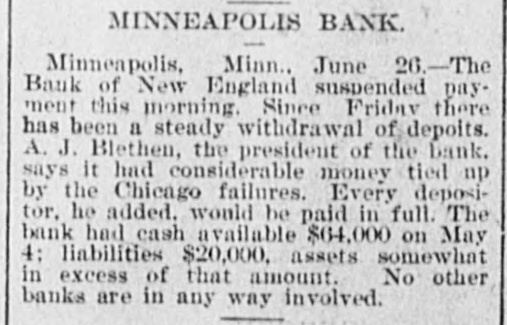
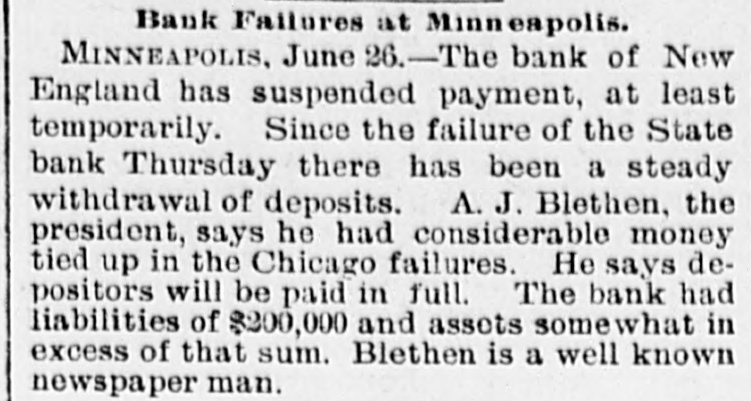
Steady withdrawals following the failure of the State Bank and tied-up funds from recent Chicago failures triggered heavy withdrawals.
Measures
President A. J. Blethen publicly assured depositors they would be paid in full; no special emergency measure reported.
Newspaper Excerpt
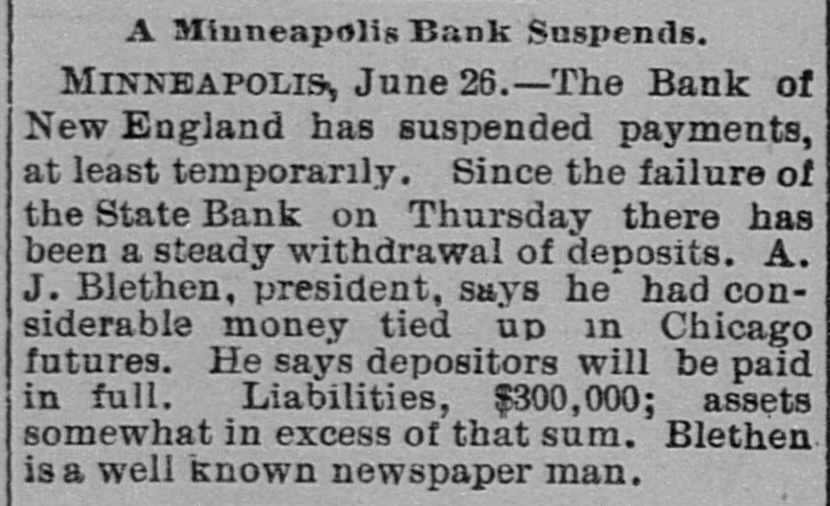
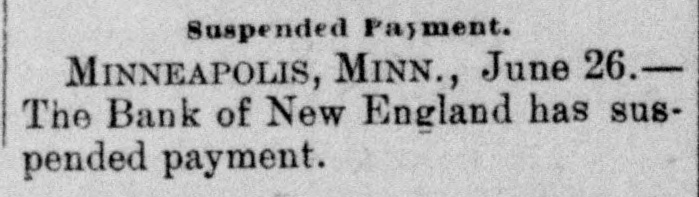
Since the failure of the State Bank Thursday there has been a steady withdrawal of deposits.
Source
newspapers
2. June 26, 1893 Suspension
Cause
Local Banks
Cause Details
Suspension followed heavy withdrawals after the State Bank failure and related strain from Chicago bank failures.
Newspaper Excerpt
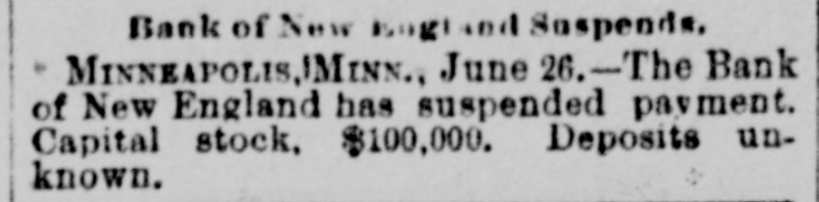
The Bank of New England has suspended payment.
Source
newspapers
3. July 7, 1893 Receivership
Newspaper Excerpt
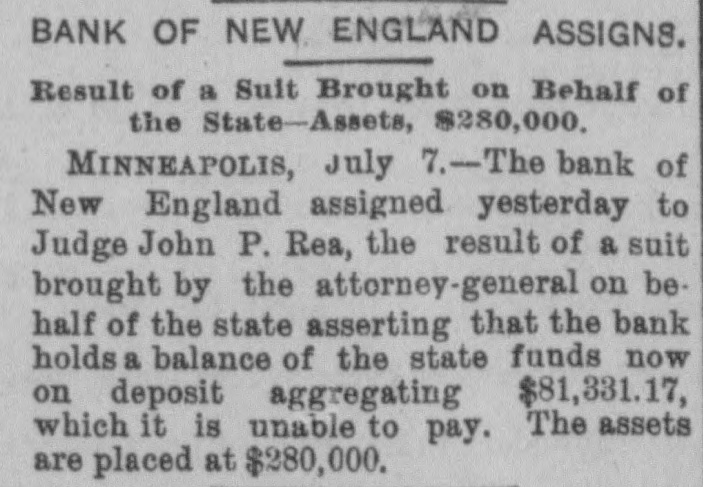
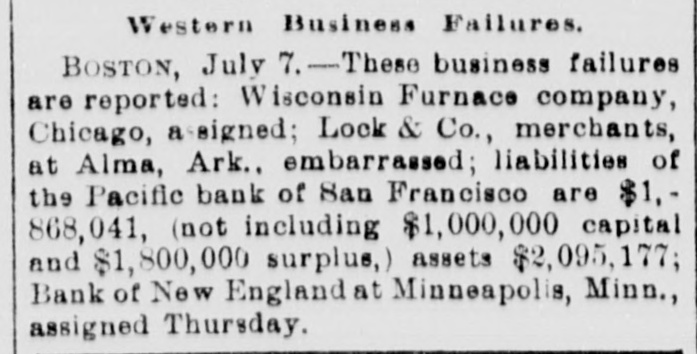
The Bank of New England assigned yesterday to Judge John P. Rea, the result of a suit brought by the Attorney-General ... asserting that the bank holds a balance of the State funds ... which it is unable to pay. The assets are placed at $280,000.
Source
newspapers
4. August 28, 1893 Reopening
Newspaper Excerpt
The Bank of New England, which suspended recently, will resume Saturday.
Source
newspapers
5. November 13, 1897 Other
Newspaper Excerpt
Receivership case of the Bank of New England ... affidavit charging State Treasurer with having received 21/2 per cent personal interest on state moneys deposited with the bank.
Source
newspapers

Newspaper Articles (23)

Article from Evening Star, June 26, 1893

Click image to open full size in new tab

Article Text

CLOSED THEIR DOORS. Banks and Business Men Unable to Meet Their Obligations. MINNEAPOLIS, MINN., June - The Bank of New England has suspended payment. The capital stock of the bank is $100,000; surplus, $12,000; undivided profits, $4,000; deposits unknown. The Chemical National of Chicago. recently failed, was the Chicago correspondent. TOPEKA. KAN., June 26.-The Bank of Ness City has closed its doors with but $85.39 in cash on hand. Deposits amount to $31,360, with other liabilities of $4.000. It has loans aggregating $74.000, mostly on real estate securities, from which but little can be realized. The capital of the bank is $40,000. NEW YORK, June 26.-Aaron W. Mann, Solon H. Mann and David Mann. composing the firm of Mann Bros., clothing dealers at Nos. 314 to 318 Broadway. today confessed judgment for $55,925.67. The attorneys for the firm place the liabilities at $250,000. The failure was caused, it is said, by creditors issuing attachments against Mann Bros. property on Saturday last. No statement of. the assets can be had until the inventory has been completed. The sheriff today took possession of the firm's stock on three executions which were issued on the judgments obtained. BUFFALO. N. Y., June -The Queen City Bank of this city has failed.


Article from The Wichita Daily Eagle, June 27, 1893

Click image to open full size in new tab

Article Text

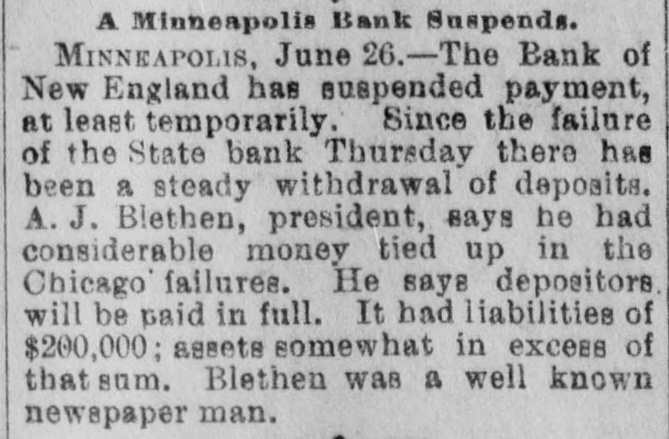
FAILURES. MINNEAPOLIS, Minn., June 26.-The Bank of New England suspended payment Since this morning, temporarily at least. the failure of the State bank on Thursday dethere has been a steady withdrawal of posits. A. J. Blethen, the president of the bank, says that it had considerable money tied up by the Chicago failures. Every depositor, be adds, will be paid in full, of the as the stockholders i suffer instead if the bank does had cash available to the last depositors The bank not of resume. amount the $64,000 on May 4, the time and of but its liabilities were $200,000 that report, somewhat in excess of The capital stock of the is surplus, the amount. $100,000; assets $12,000; undivided bank profits, $4,000; deposits unknown. NESS CITY, Kan., June 26,-The Bank of ComNess City has been closed by Bank missioner Breidenthal, after an unsuccess- its ful attempt to raise money among its eastern stockholders to tide it over bank, present embarrassment. This had $31,300 which had a capital of $40,000, in deposits. When the bank commissioner took charge of it the cash on hand amountd to just $83.55. Mr. Breidenthal says real that the bank was loaded down with estate and bad debts. BUFFALO, N. Y. June 26.-The Queen The City bank of this city has failed. suspension is due to a drain of money bank out the bank for several weeks. The offiof owes depositors over $1,400,000. The will cers are hopeful that the bank reThe liabilities of the bank. accord- The sume. ing to the June report, are $2,323,754. assets are not known. The bank paid out all the money it had, Mr. to dimes, nickels and pennies. even Englehart, one of the directors, said that but the bank had plenty of collateral, found it impossible to realize on it in New the present financial stringency. The York banks would not let them have any The depositors will be paid In money. The state superintendent of banking an examiner here. until when he full. dent, will send recently, resigned The presi- on H. account of ill health, was William Jackson. Since his resignation the bank has been in charge of a committee of its directors. ALBANY, N. Y., June 26.-SuperintendPreston of the state banking department, ent speaking of the Queen City bank failure, said that the report of the condi- re-tion of the bank on June 1st showed sources of $2,351,600 and liabilities of $2,Reference to the amount of cash 351,600. on hand shows that it does not equal the amount of the 10 per cent legal reserve required by law. The report of the examiner for Feburary showed a nominal sur- had plus of $35,600. Poor investments considerable to do with the collapse. CHESTER, Pa., June 26. - The Crum Creek Iron and Steel company has assigned. The liabilities are estimated at $120,000 and the assets at $119,000. The sum of $40,000.is due the company from a former agent. Dullness in trade and threatened suits caused the failure. NEW YORK, June 26.Mann Bros., clothing dealers, today confessed judgment for $55,000. The attorneys for the say that the liabilities are about $300,000, half of which istor borrowed money and the other half for merchandise, The value of the assets is not known. The failure is attributed to several causes, the stringency in the money market being the principal one, as they were unable to meet notes as they mature. NEW YORK, June 26.-The supreme court this morning appointed a receiver for the Mutual Brewing company of College Point. GALLIPOLIS, O., June 26.-The Carl coal works, at Carlton, have assigned. The liabilities are $50,000, and the assets ยฃ7,000. HAMILTON, O., June 26.-Louis Snyder's Sons tonight assigned their four great paper mills at Hamilton, and their real estate and paper warehouses, with contents, in Cincinnati. The assets are over $1,000,000. The liabilities are less than $300,000. The assignment is due to the fact that they were unable to borrow $7, 000 from the banks. It is an old and well established firm. PORT ANGIERS, Wash., June 26.-The First National bank has suspended temporarily. The assets are $142,000, and the liabilities $85,000. SAN FRANCISCO, June 26.-Sands & Gump. extensive dealers in rt goods, have assigned. The liabilities are $14,000 and in the assets $100,000. The stringency money caused the failure. WILMINGTON, O., June -The Sabina bank, a private banking institution in this is county, has suspended. The capital $12,000. No statement was made. BOSTON, June xi-Forty-three banks, represented at the clearing house meeting this morning, voted unanimously in favor of clearing house certificates for payment at the clearing house.


Article from The Times, June 27, 1893

Click image to open full size in new tab

Article Text

MORE BANK FAILURES. Two Small Banks Suspend-California Banks Resume. TOPEKA, KAN., June 26.-The Bank of Ness City has closed its doors with but eighty-five dollars and thirty-nine cents in cash on hand. Deposits amount to $31,360, with other liabilities of $4,000. It has loans aggregating $74,000, mostly on real estate securities, from which but little can be realized. The capital of the bank is $40,000. WASHINGTON O., June 26.-Sabina and Jeffersonville banks closed their doors this morning: caused by the failure of W. T. Haydock, of St. Louis, who. is a stockholder in both banks. The Sabina Bank had a capital of $25,000. SAN DIEGO, CAL. June 26.-The Bank of Commerce resumed business this morning, and the First National Bank will probably resume in a few days. Queen City Bank Suspends. BUFFALO, June 26.-The Queen City Bank, which was started here a little over a year ago, closed its doors shortly after noon to-d V. Mr. F. M. Inglehart, one of the direct 's, said that the suspension was due to a steady drain of money out of the bank, which has been going on for several weeks. The bank paid out all the money it had, even the dimes, nickels and pennies, and when the last cent was gone the officers went out and closed. Mr. Inglehart said that the bank had plenty of collateral, but found it impossible to raise money on it in the present financial stringency. The New York banks would not let them have any money. He said the depositors will be paid in full. The bank owes depositors $1,400,000. MINNEAPOLIS, MINN., June 26.-The Bank of New England has suspended payment. Capital stock, $100,000. Deposits unknown.


Article from The Daily Morning Astorian, June 27, 1893

Click image to open full size in new tab

Article Text

paid the Illinois corporation known as the World's Columbian Exposition. FAILURES OF A DAY. Banks and Business Houses Suspend and Others Resume Business. Port Angeles, Wash., June 26.-The First National Bank of this city suspended shortly after opening its doors this morning. The suspension was caused by the sudden withdrawal of deposits by several large depositors. The officers of the bank saw that the cash on hand would not hold out, so they decided to suspend temporarily until funds could be secured. The assets of the bank are $142,000; liabilities, $86, 000; due depositors, $82,000. The bank has been conducted on very conservative lines, and is in good condition. The suspension caused no excitement, and confidence in an early resumption is expressed by all parties. The suspension will only cause a temporary embarrassment to a few. Buffalo, June 26.--The Queen City Bank has failed. The bank suffered a steady drain for the past several weeks. After paying out all its available cash, even to dimes, nickels and pennies, the officers this morning walked out and closed the doors. It owes the depositors over $140,000. The management claim the depositors will be paid in full. San Francisco, June 26.-The firm of S. &. G. Gump, extensive dealers in art goods, made an assignment today. The liabilities are placed at $140,000. The assets of the firm are supposed to exceed this amount. The cause of the failure is attributed to the calling in of loans. Minneapolis, June 26.-The Bank of New England has suspended payment at least temporarily. A. J. Blethen, the president, says the depositors will be paid in full. New York, June 26.-A receiver has been appointed for the Mutual Brewing Company of College Point. San Diego, June 26.-The Bank of Commerce resumed business this morn-, ing.


Article from The Madison Daily Leader, June 27, 1893

Click image to open full size in new tab

Article Text

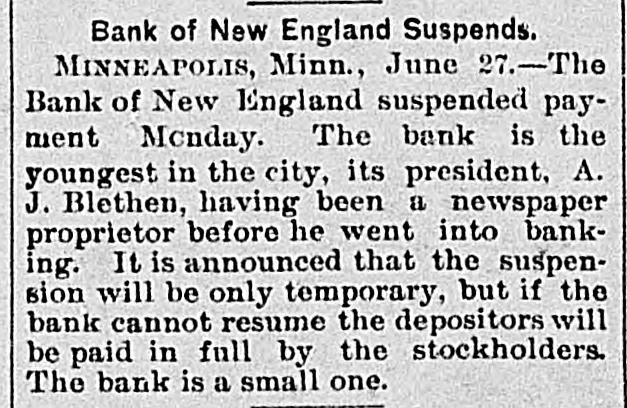
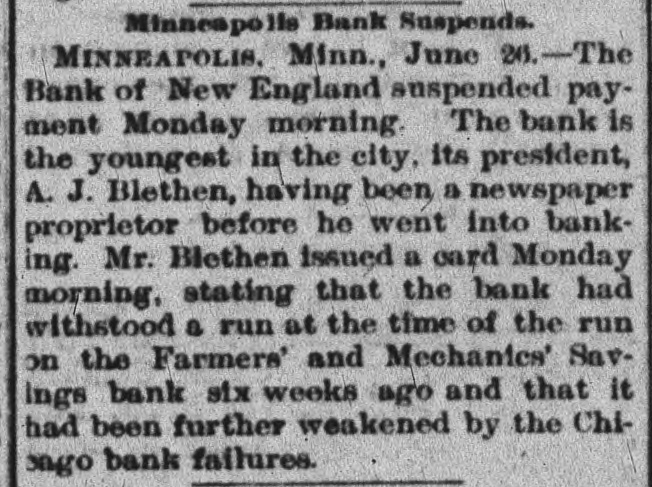
BUSINESS REVERSES. Blethen's Bank Fails. MINNEAPOLIS, June 27.-The Bank of New England has suspended payment. The bank is the youngest in the city, its president, A. J. Ble. hen, having been a newspaper proprietor before he went into banking. Mr. Blethen has issued a card stating the bank had withstood a run at the time of the run on the Farmers and Mechanics Savings bank six weeks ago, and that it had been further weakened by the Chicago bank failures. It is announced that the suspension will be only temporary. but if the bank cannot resume every d positor will be paid in full by the stockholders. The bank is a small one.


Article from New-York Tribune, June 27, 1893

Click image to open full size in new tab

Article Text

MORE WESTERN BANKS GO DOWN. Minneapolis, June 26.-The Bank of New-England suspended payment this morning, temporarily, at least. Since the failure of the State Bank Thursday there has been a steady withdrawal of deposits. A. J. Blethen, the president of the bank. says It had considerable money tied up by the Chicago failures. Every depositor, lie adds, will be paid in full. as the stock holders will suffer Instead of the depositors If the bank does not resame. The capital stock of the bank is $100,000; surplus, $12,000; undivided profits, $4,000; deposits unknown. The Chemical National, of Chicago, recently failed. was the Chicago correspondent. The bank had cash available of 864,000 on May 4, the time of the last report: but its liabili ties were $200,000, and assets somewhat In excess of that amount. No other banks are in any way involved, as they were warned by the State Bank failure. The bank was organized about two years ago. Topeka, Kan., June 26.-The Bank of Ness City has been closed by State Bank Commissioner Breidenthal, after an unsaccessful attempt to raise money among its Eastern stockholders to tide 11 over Its present embarrassment. This bank, which has a capital stock of $40,000, had $31,300 deposits. and when the Bank Controller took charge it land cash on hand of 883 95. Bank Commissioner Breidenthal says the bank was loaded down with real estate. Washington Court House, Ohlo. June 26.-Sabina and Jeffersonville banks closed their doors this morning. caused by the failure of W. T. Haydock, of SI. Louis, who is a stockholder in both banks. The Sabina Bank had a capital of $25,000.


Article from Watertown Republican, June 28, 1893

Click image to open full size in new tab

Article Text

MINNEAPOLIS BANK FAILS. New England Depository Forced to Close Its Doors. MINNEAPOLIS, Minn., June 26.-The Bank of New England suspended payments this morning, temporarily at least. Since the failure of the state bank Thursday there has been a steady withdrawal of deposits. A. J. Blethen, the president of the bank, says it had considerable money tied up by the Chicago failures. Every depositor, headds, will be paid in full, as the stockholders will suffer instead of the depositors if the bank does not resume. The bank had cash available of $64,000 on May 4, the time of the last report, but its liabilities were $200,000 and assets somewhat in excess of that amount. No other banks are in anyway involved as they had been warned by the State Bank failure. The bank was organized about two years ago.


Article from Grant County Herald, June 29, 1893

Click image to open full size in new tab

Article Text

BANKS FAIL. Several Financial Institutions in Various Places Forced to Suspend. SAN FRANCISCO, June 24.-At a meeting of directors of the Pacific bank, of San Francisco ,it was decided to close the doors. In a statement issued by the vice president the liabilities, outside of capital stock and surplus, are placed at $1,630,000. Assets, properly handled, $2,000,000. All the banks of this city were well prepared for the expected runs on themยฎ NIAGARA FALLS, N.Y., June 24.-The Cataract bank of this city, the largest bank in Niagara county, closed its doors at noon. There is great excitement among business men in consequence, as over $700,000 of their money was on deposit. The suspension was totally unexpected and was not preceded by a run on the bank. MINNEAPOLIS, Minn., June 24.-The State Bank of Minneapolis suspended payment Friday owing to heavy withdrawals of deposits, withdrawals since March having aggregated $100,000. BUFFALO, N. ยฅ., June -The Queen City bank, which was started here a little over a year ago, closed its doors shortly after noon Monday. F. M. Englehart, one of the directors, said that the suspension was due to a steady drain of money out of the bank, which has been going on for several weeks. The bank paid out all the money it had. It owes its depositors over $1,400,000. The liabilities of the bank according to the June report are $2,328,754. The assets are unknown. TOPEKA, Kan., June i.-The bank of Ness City has closed its doors with but $85.39 in cash on hand. Deposits amount to $31,360. with other liabilities of $4,000. It has loans aggregating $74,000, mostly on real estate, from which but little can be realized. The capital of the bank is $40,000. MINNEAPOLS, Minn., June 27. -The Bank of New England closed its doors yesterday. SABINA, O., June 27.-The Sabina bank was forced to suspend yesterday.


Article from Abilene Weekly Reflector, June 29, 1893

Click image to open full size in new tab

Article Text

MISSOURI MINERS OUT. The Men at the Ardmore Mine Strike Over a Grievance. MACON, Mo., June 27.-Organizer Walters, of Kansas, spoke to the Kansas & Texas miners at Ardmore, Macon county. He advised them to join the miners' union, like the one organized in Kansas, for the purpose of standing together under all circumstances, in case anyone has or might have a grievance. At these meetings held by Walters, committees were selected to complete the organization and to attend to other business. A chairman for each committee was selected. This was not well taken by Superintendent Murlin, in charge of the coals company, and he discharged the committees who are the agitators in the movement from the coal company's employ. A mass meeting of all the miners was then called. The company refused to reinstate the discharged men and for this reason the miners went out on a strike, or rather refused to go back to work. The Kansas & Texas Coal Co. operate three or four mines at Ardmore and employ about 500 men. All surface day men have also been laid off except a few that are absolutely necessary to do some work needing immediate attention. Walters will go from Ardmore to the Bevier coal mines and begin to perfect an organization there. In case the company attempts to put in non-union men trouble is expected. Depositors WIII Be Paid in Full. MINNEAPOLIS, Minn., June 27.-The Bank of New England suspended payments this morning, temporarily at least. A. J. Blethen, president of the bank, formerly of Kanshs City, says it had considerable money tied up by the Chicago failures. Every depositor, he adds. will be paid in full. Cholera Deaths Many. LONDON, June 27.-A dispatch from Mecca says that there were 455 deaths from cholera there Saturday.


Article from Evening Journal, July 7, 1893

Click image to open full size in new tab

Article Text

BANK OF NEW ENGLAND ASSIGNS. Result of a Suit Brought on Behalf of the State-Assets, $280,000. MINNEAPOLIS, July 7.-The bank of New England assigned yesterday to Judge John P. Rea, the result of a suit brought by the attorney-general on be. half of the state asserting that the bank holds a balance of the state funds now on deposit aggregating $81,331.17, which it is unable to pay. The assets are placed at $280,000.


Article from The Sun, July 8, 1893

Click image to open full size in new tab

Article Text

Minor Business Troubles. OAKLAND. Me., July 7.-The postponed meeting of the directors and stockholders of the Madison Woollen Mill. the largest in Maine. was held yesterday. This mill is at present in financial straits in consequence of disagreement with the former selling agents, H.J. Libby & Co. of New York. It was decided to shut down the mill temporarily and to take account of stock. Thus several hundred operatives will be thrown out of employment. DES MOINES, Ia., July 7.-Attachments aggregating $20.000 and mechanics' liens to the amount of $89,000 were filed yesterday against Lowry Goode. the Highland Park Land Company. the Des Moines Electric and Water Power Company. and other concerns with which Goode is prominently connected. Goode claims that with time he will be able to pay. The amount involved is probably $200,000. RED CLIFF. Col.. July i.-The Eagle County Bank has suspended payment. The capital is $12,000 and its assets. which are estimated at $40,000. are considered worth 100 per cent. The liabilities are $34,000. The withdrawal of large sums on account of the drop in silver was the cause. PUEBLO. Col., July 7.--There was no further run on the First National Bank this morning. Bank Examiner Adams has taken charge of the suspended banks here and will push his examination of their affairs an rapidly as possible. There was no very heavy run yesterday on the First National Bank. Most of the depositors who called for their money have but small accounts deposited. MINNEAPOLIS, July 7.-The Bank of New England assigned yesterday to Judge John P. Rea. the result of a suit brought by the Attorney-General on behalf of the State. asserting that the bank holds a balance of the State funds now on deposit aggregating $81,331.17. which it is unable to pay. The assets are placed at $280,000.


Article from New-York Tribune, July 8, 1893

Click image to open full size in new tab

Article Text

TROUBLES OF WESTERN BANKS. Omaha, Neb., July 7.-The American Savings Bank. which closed on Wednesday night. was put in charge of a special examiner by the State Banking Board yesterday. The bank is believed to be solvent. The National Bank of Ashland, an offshoot of the American Loan and Trust Company, also failed. It had a capital of $100,000. Minneapolis, Minn., July 7.-The Bank of NewEngland assigned yesterday to Judge John P. Rea. as the result of a suit brought by the Attorney-General on behalf of the State, alleging that the bank holds a balance of State funds now on deposit. aggregating $81,331 17. which it is unable to pay. The assets are placed at $280,000. Pueblo, Col., July 7.-There was no further run on the First National Bank to-day. Bank Examiner Adams has taken charge of the suspended banks here. and will push the examination of their affairs as rapidly as possible. Pine Bluif, Ark., July 7 (Special).-The Arkansas State Bank. of Stuttgart, and the Arkansas Farmers and Traders' Bank, of Dewitt. near this city, have closed their doors. Neither institution had large assets and depositors will not suffer to any considerable degree. Both banks were under the same management, and the recent failure of the Stutigart and Kansas River Railway, of which T. H. Leslie, the father of C. K. Leslie, the cashier of the banks, was president, precipitated the collapse. Red Cliff, Col., July 7.-The Eagle County Bank has suspended payment. Its capital is $12,000 and its assets, which are estimated at $40,000, are considered worth 100 per cent. The liabilities are $34, 000. The withdrawal of large sums on account of the drop in silver was the cause. Washington, July 7.-Controller Eckels is informed that the First National Bank of Hot Springs, S. D., and the Livingston National Bank of Livingston, Mont.. have closed their doors to business. Bank Examiner Diamond has been ordered to take charge of the Hot Springs bank. and Bank Examiner Flynn will take charge of the Livingston bank.


Article from Fort Worth Gazette, August 29, 1893

Click image to open full size in new tab

Article Text

WILL RESUME. I MINNEAPOLIS, Minn., Aug. 28.-The Bank of New England. which suspended recently, will resume Saturday.


Article from The Globe-Republican, September 1, 1893

Click image to open full size in new tab

Article Text

Another Bank Resuming. MINNEAPOLIS, Minn., Aug. 29.-The Bank of New England which suspended a month ago will resume business Saturday next. President Blethen says the bank has better backing than ever.


Article from The Star, September 6, 1893

Click image to open full size in new tab

Article Text

# BANK RESUMPTIONS. Many Reported From Different Parts of the Country. A telegram from Washington says: The following national banks, which recently suspended payment, have been permitted to reopen their doors for business: The State national bank of Denver, Col.; the Louisville city national bank, of Louisville, Ky.; the Merchants' bank of Louisville; Ky.; the First national bank of Ashland, Wis., and the First national bank of Platteville, Wis.; the German national bank of Denver, Col.; the First national bank of Canon City, Col. At Minneapolis, the Bank of New England, which suspended about a month ago, has resumed business. At San Francisco the People's home savings bank, which closed its doors June 23, opened for business. A statement issued by the national banks of Kansas City shows that since the height of the financial flurry, which was reached on June 19, the deposits have increased $2,000,000. The First national bank of Dubuque, Ia.; the First National bank of Grand Rapids, Col. The American national bank of Omaha, Neb.; the American national bank of Nashville, Tenn. The First national bank of Mankato, the National Citizens' bank of Mankota the Mankato national bank, all of Mankato, Minn.


Article from Grand Rapids Herald, November 13, 1893

Click image to open full size in new tab

Article Text

HEAVY LITIGATION PROMISED. Suits to Be Started to Compel Minnesota Treasurers to Disgorge. MINNEAPOLIS, Nov. 12. - Minnesota may have a back interest litigation soon that will be second to the famous cases which were brought against the ex state treasurers of Wisconsin whereby they were compelled to pay back to the state some hundreds of thousands of dollars which they had appropriated. The matter came out in the receivership case of the Bank of New England which came up before Judge Russell yesterday morning. Assistant Attorney General Edgerton made the sensational state. ment that an affidavit had been filed charging State Treasurer Joseph Bobleter with having received 21/2 per cent personal interest on state moneys de posited with the bank besides the 3 per cent allowed by law. It has since developed that the affi. davit was made by J. W. Arelander, a prominent attorhey. who says that certain banks in order to get the deposits had entered into an agreement to pay the state treasurer 3 per cent for the regular interest on deposits and 21/6 per ceat directly to him. This last was not to be used by the state, nor was it the intention of either party to the deal that the money should ever reach the coffers of the state treasury, but it was distinctly understood that it would go into the pocket of the state treasurer. In other words it was nothing more nor less than an emolument for the placing of deposits of state money with them rather than with some other banks In the case of the state banks Mr. Arclan der charges that the state treasurer has received some $12,000 and from $40,000 to $50,000 from other banks in the same way.


Article from St. Paul Daily Globe, November 19, 1893

Click image to open full size in new tab

Article Text

CAPITOL CULLINGS. The state historical library yesterday received a copy of Crisp's new "Visitation of England and Wales." Articles of incorporation of the East Grand Forks Fair and Driving association, with a capital stock of $10,000. were filed yesterday with the secretary of state. State Treasurer Bobleter has been elected cashier of the Columbia National Bank of Minneapolis, but he will not take an active part in the management. Articles or incorporation of the "Delong Abdominal Bandage Manufacturing company." of St. Paul. with a capital stock of $5,000, were filed yesterday with the secretary of state. Attorney General Childs and Assistant Attorney General Edgerton were in Minneapolis yesterday to attend the hearing of the application of the state for a receiver for the Bank of New England. Ole Gunderson, sheriff of Norman county, yesterday collected $80.27 from the state for taking two prisoners to Stillwater. Sheriff J., C. Thorn, of Nobies county, also collected $57 for bringing two from his county.


Article from The Saint Paul Globe, September 10, 1896

Click image to open full size in new tab

Article Text

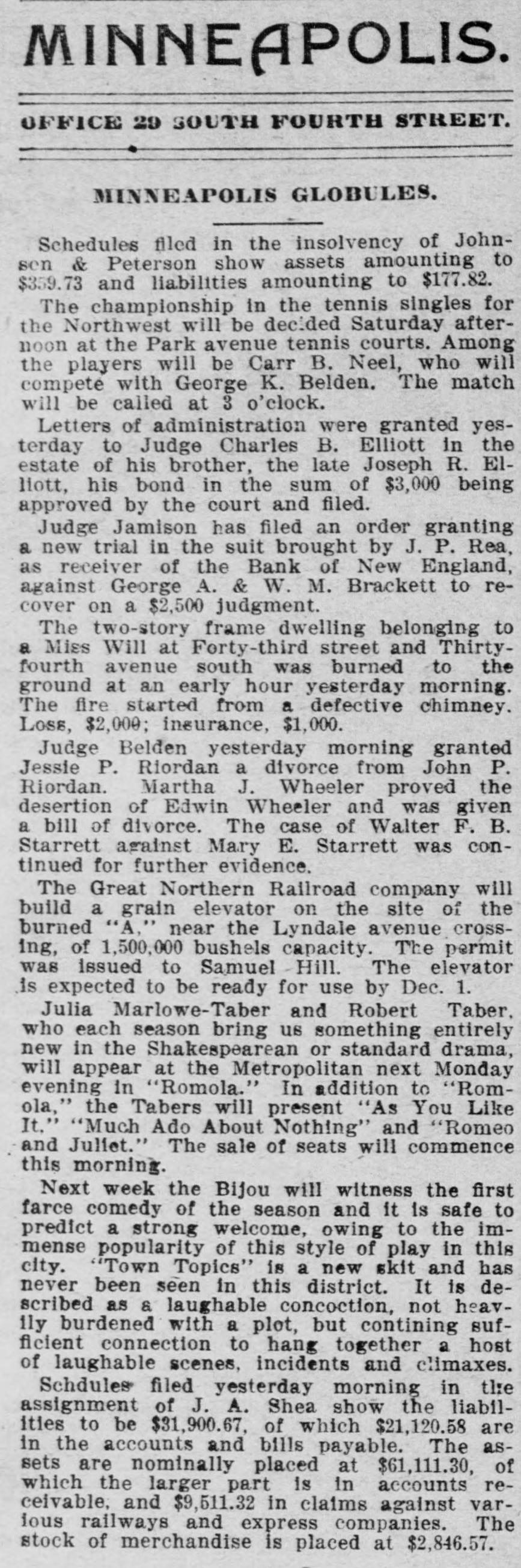
MINNEAPOLIS. OFFICE 29 SOUTH FOURTH STREET. MINNEAPOLIS GLOBULES. Schedules filed in the insolvency of Johnsen & Peterson show assets amounting to $359.73 and liabilities amounting to $177.82. The championship in the tennis singles for the Northwest will be decided Saturday afternoon at the Park avenue tennis courts. Among the players will be Carr B. Neel, who will compete with George K. Belden. The match will be called at 3 o'clock. Letters of administration were granted yesterday to Judge Charles B. Elliott in the estate of his brother, the late Joseph R. Elliott, his bond in the sum of $3,000 being approved by the court and filed. Judge Jamison has filed an order granting a new trial in the suit brought by J. P. Rea, as receiver of the Bank of New England, against George A. & W. M. Brackett to recover on a $2,500 judgment. The two-story frame dwelling belonging to a Miss Will at Forty-third street and Thirty-fourth avenue south was burned to the ground at an early hour yesterday morning. The fire started from a defective chimney. Loss, $2,000; insurance, $1,000. Judge Belden yesterday morning granted Jessie P. Riordan a divorce from John P. Riordan. Martha J. Wheeler proved the desertion of Edwin Wheeler and was given a bill of divorce. The case of Walter F. B. Starrett against Mary E. Starrett was continued for further evidence. The Great Northern Railroad company will build a grain elevator on the site of the burned "A," near the Lyndale avenue crossing, of 1,500,000 bushels capacity. The permit was issued to Samuel Hill. The elevator is expected to be ready for use by Dec. 1. Julia Marlowe-Taber and Robert Taber, who each season bring us something entirely new in the Shakespearean or standard drama, will appear at the Metropolitan next Monday evening in "Romola." In addition to "Romola," the Tabers will present "As You Like It," "Much Ado About Nothing" and "Romeo and Juliet." The sale of seats will commence this morning. Next week the Bijou will witness the first farce comedy of the season and it is safe to predict a strong welcome, owing to the immense popularity of this style of play in this city. "Town Topics" is a new skit and has never been seen in this district. It is described as a laughable concoction, not heavily burdened with a plot, but contining sufficient connection to hang together a host of laughable scenes, incidents and climaxes. Schdules filed yesterday morning in the assignment of J. A. Shea show the liabilities to be $31,900.67, of which $21,120.58 are in the accounts and bills payable. The assets are nominally placed at $61,111.30, of which the larger part is in accounts receivable, and $9,511.32 in claims against various railways and express companies. The stock of merchandise is placed at $2,846.57.
Article from The Saint Paul Globe, February 9, 1897

Click image to open full size in new tab

Article Text

# SENATE WAS DULL. Barely a Quorum in the Morning, None Later. There were so few senators, more than a quorum present at the session yesterday morning, that the senators who were fortunate enough to have bills on the calendar were afraid to try to get them through, lest a few objections might kill them. General orders were hurried through and a recess taken until 2 o'clock for the consideration of the calendar, but the attendance was smaller still then, and no bills were passed. Mr. Thrope had a pocketful of bridge bills and there were some others introduced. The most important measure was one by Senator Wyman, to relieve the receivers of the Bank of New England in Minneapolis, from paying interest on state funds deposited in the bank at the time it failed. The bank had on deposit $61,208.35 of state funds. The bill states that the principal has been paid the state, and that the funds remaining are insufficient to pay the general creditors in full, so it is inequitable, they believe, for the state to insist upon the interest. Senator Stevens called up his bill providing that a deposit of $100,000 made with the state shall be sufficient to authorize title insurance companies to do business in this state. At present they are required to deposit $200,000-$100,000 with the state auditor and another $100,000 with the insurance commissioner. The bill also provides that the company shall be taxed on the real estate held by the trust department, the same as other corporations are taxed, and that in addition it shall pay the regulation gross earnings tax on the insurance earnings. The bill was recommended to pass. The committee recommended the passage of Heneman's bill to permit villages situated in two or more townships to separate themselves from the township government. The bill is intended to afford relief to the village of Hutchinson, which is so situated. The substitute bill by the committee on education to raise the standard of qualifications for teachers was also recommended to pass. The provisions of the bill are: That a first-grade certificate be good for two years, and the second grade for one year, both good anywhere in the county. A third-grade certificate is made good for six months in a given district only. The grade of the certificate is to be determined by ex-amination in orthography, reading in Eng-lish, penmanship, arithmatic, grammar, mod-ern geography, history of the United States, and the practical, elementary facts of hygiene. Certificates may be renewed by indorsement of the county superintendent; provided that in addition to the above named branches, candidates for first-grade certificates shall be examined in elementary algebra, elementary plane geometry, physical geography, physiology, natural history, civil government and the theory and practice of teaching, and no person may receive a first-grade certificate who has not taught at least one term of three months or more. Candidates for certificates shall qualify in one of the following classes: First Class-Must be a graduate of a college preparatory school, normal school or college. Second Class-Must have secured final standings from state high schools of the first-class, or normal schools in arithmetic, English grammar, geography, history of the United States, civil government and physiology. Third Class-Must hold state high school board certificates in Class 2. All candidates must be over eighteen years of age. The qualifications regarding the schooling of the applicants for the three classes and the minimum age limit of eighteen years are the additions to the qualifications in the old law. The judiciary committee killed the Peterson public defender bill.


Article from The Saint Paul Globe, February 12, 1897

Click image to open full size in new tab

Article Text

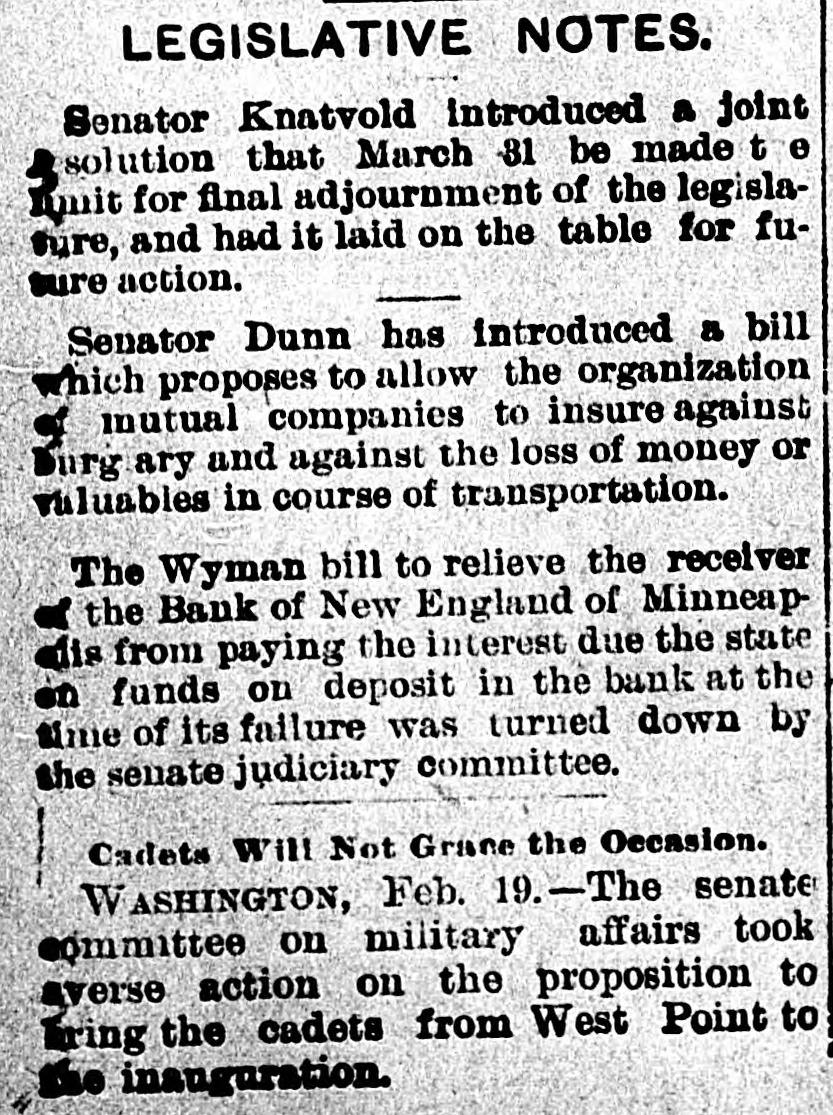
# LEGISLATIVE FEATURES. The senate committee on banking indefinitely postponed the Wyman bill to relieve the Bank of New England, in Minneapolis, from paying the interest on the state deposit it held at the time of its suspension. The committee recommended the passage of Wyman's bill to allow the state superintendent of banks two additional assistant examiners, that banks may be examined twice a year instead of once. It also reported favorably on the general banking law prescribing the manner in which banks shall do business and providing that the state superintendent of banks shall immediately take charge of any bank found to have been violating the law. The senate committee on railroads yesterday morning recommended the indefinite postponement of the Ringdal bill, a reincarnation of the Anderson bill for the taxation of railroad lands. The committee does not believe that the Anderson bill was invalidated by the unseating of Frank Day. Senator Hanna would pay county commissioners $3 per day for services and 10 cents per mile for traveling, and limit the number of days for which they may draw pay to fifteen, and the number of miles traveled 100 in any one year. Senator Stevens this morning introduced a bill to exempt from execution the library, philosophical and chemical or other apparatus used in instruction and the furniture of any educational institution in the state. Senator Thompson's bill to amend the insurance law of 1895, authorizes insurance against loss by burglary, which is not allowed under the present law. Senator Sperry introduced a bill to regulate the tax on mines. It provides for a tax of 5 cents per ton on iron ore, 1 cent per ton on coal and 50 cents per ton on copper mined in this state. This tax to be in lieu of all taxes on the capital stock and the real estate actually used in mining. The proceeds of the tax are to be divided between the state and the counties in which the mines are located in the same proportion that other taxes are divided. Senator Culkin would amend section 5612 of the General Statutes of 1894, in relation to the issuing of subpoenas, to read as follows: "Every clerk of a court of record and every justice of peace and every attorney admitted to practice in the district courts, may issue subpoenas for witnesses in all civil and criminal cases pending before the court, provided that an attorney shall only issue the subpoena in matters in which he is retained."


Article from The Ely Miner, February 17, 1897

Click image to open full size in new tab

Article Text

# THE LEGISLATURE. Both Bodies Are in Good Working Order. Gossipy Letters Giving in Detail the More Important Work of the Senate and House of Repre- sentatives. St. Paul, Feb. 9.-Yesterday was a dull day in both branches of the legis- lature. A good many members went home over Sunday and the attendance was light. In the senate a bill was in- troduced limiting fire insurance com- panies to one line of business; also a bill relieving the receiver of the Bank of New England, of Minneapolis, from paying interest on the funds belonging to the state, the bank had when it failed. The bank had over $61,000 when its doors closed and the amount has been paid in full. As there is not money enough to pay other creditors in full the bill proposes to relieve the re- ceiver from paying interest which ac- crued between the time of the failure and time of the final payment to the state. In the honse the business was even of less importance than it was in the senate. Only seven bills were intro- duced and five of those were for roads and bridges. The only episode of in- terest was a squabble over a bill or- ganizing the unorganized counties in the northern part of the state. Such a bill was introduced and referred to the committee on towns and counties. That committee reported back a substitute. Mr. Feig wanted the bill again referred to the committee on towns and coun- ties, of which he is chairman, claiming that there were several parties who wanted to be heard. The argument against the reference was that the owners of pine timber are always in- venting schemes for delay in order to prevent the organization of counties, because such organization increased their taxes. This argument carried the day and the bill was sent to the com- mittee of the whole, instead of to the committee on towns and counties. St. Paul, Feb. 10.-Though there have been 607 bills introduced in the legis- lature up to date, the visitor at the sessions yesterday would have scarcely imagined that there was anything to do. The fact is, nearly all the bills are in the hands of committees, and some of the committees are absolutely buried with proposed legislation. In the sen- ate yesterday five bills were passed and eleven introduced. Among those passed was the bill putting the grain inspection department under civil serv- ice, and also the traveling library bill. One of the measures introduced was the constitutional amendment author- izing the legislature to call on the su- preme court for an opinion as to the constitutionality of bills pending, in order to avoid passing unconstitutional measures. There was the usual drive at corporations by a bill inflicting a penalty on railroads for failing or re- fusing to furnish cars for shippers. Another, similarly aimed, proposes to tax express, telephone and telegraph companies. A compulsory education bill was presented, which requires every child between 8 and 16 years old to be sent by parent or guardian to school for twenty weeks each year in cities of over 30,000 people, and in smaller places twelve weeks annually. The house was treated to the novel spectacle of the speaker apologizing for misconduct. It seems that on Mon- day, in his zeal in favor of a bill, the speaker advocated it from the chair, when he should have called some one else to the chair and spoken from the floor. He announced that he had made a mistake and wished to apologize. There is a constant fear being ex- pressed that the unseating of Senator Frank A. Day invalidates the Ander- son bill taxing railroad lands. A bill renewing the Anderson bill has been introduced in both houses, but the one in the house was killed yesterday by a vote of 82 to 14. There was quite a long debate before the bill was post- poned and the opinion was freely ex- pressed that the Anderson bill would no longer hold. Mr. Anderson himself, who is again a member of the house, does not share that opinion, and he urged the members yesterday not to cast a cloud on his bill by re-enacting it. In this request he was accommo- dated. No bills were passed in the house and but few introduced, the greater portion of the time being spent in debating the bill proposing to abol- ish capital punishment. St. Paul, Feb. 11.-At last the reap- portionment committee has been com- pleted. Lieut. Gov. Gibbs appointed on yesterday the 14 members to which the senate is entitled and the house having appointed its committee three weeks ago, nothing now remains but for the committee to get together and formulate a bill to be defeated by dis- agreement between the two houses. This is on the theory that history will repeat itself. Reapportionment is six years past due, and at each of the pre- ceding sessions of the legislature an ineffectual effort has been made to pass a reapportionment bill. Mean- time the newer portions of the state are deprived of proper representation while the older portions have more than their share. Of course it was expected that the state would pay the expenses of ex- Senator Day and his successful com-


Article from The Saint Paul Globe, February 21, 1897

Click image to open full size in new tab

Article Text

# WHY PREFER THE STATE? In the senate a bill is pending remitting the claim of the state for some $6,000 interest on its deposits in the Bank of New England, one of the Minneapolis banks that went into a receivership. If this sum is remitted it is stated that the other depositors will receive about 10 per cent on their claims; if insisted on they will get little if anything. Another measure is proposed that will subrogate the bondsmen of this or some bank to the state's prior lien on the assets of the bank, permitting them to have a preference over the depositors. In the course of the debate on the abatement of interest Senator Morgan expressed the hope that the session would see a bill enacted into law waiving the preference of the state as a creditor and leaving it to take its chances with the other depositors. And why not? The state is sovereign, and "the sovereign can do no wrong." But does it do right when it, with its boundless riches, refuses to share pro rata in the assets of a bank in which it is a depositor with its citizens, but insists upon its pound of flesh, thus diminishing the shares of its fellow depositors? It has not only the assets, but also the resources of the bondsmen whose assurance it requires in addition to the legal responsibility of the bank, a resource the citizen depositors have not. Would it not be nearer justice did the state exhaust the bond security before depriving the citizens of their share? Is this right, or does might still make right? Will the real interests of the commonwealth be better served by the state getting the uttermost farthing of its dues, though it bring ruin to numbers of its citizens? Where some must suffer, is it the better policy that the individual or the state should? If preferences are to be shown, does not public policy incline to the citizen rather than to the state? But it is not a question whether there should be preferences, but whether the state should not stand equal with the citizen who is also a depositor, each bearing his proportionate share of the loss. Were it a question whether the citizen should not be first paid there are equities that might be urged strongly in support of it, but they are even stronger in advocacy of the equal standing of the state and the individual depositors. The very fact that the state is a depositor gives credit to the bank, and induces individual deposits. The citizen is aware that the state possesses means of informing itself as to the solvency of the depository that he has not. It has its bank examiner and his staff whom it can send in behind the counters to examine the books, the securities and assets. No individual depositor has this right. He only has the reports required by law, and all know how unsound a condition they can be made to cover with the appearance of solvency. Is it not equitable then, that the state, having these means of knowing the condition of the bank it deposits with, and neglecting to use them, should, at least, stand on common ground with the citizens whom it has misled? Again, if the money of the citizen on deposit is to be used to refund the money deposited by the state, does the law not make each one of them an unconsenting guarantor of the bank as to the state's fund? Is it just thus to exact an unwilling security from the citizen? Is it good public policy to thus add to the ele- ments of distrust of our banks? Will it not be accepted as one of the conditions of trade that state deposits weaken a bank, and, when doubt arises of the stability of banks, will not depositors accelerate the crisis by rushing to withdraw their funds from banks patronized by the state? Will men take chances then of losing all because the state has the power, not the right, to take all? This is the present question because of past policy and results. The larger question is, whether it is not wiser that the state have no surplus for deposits; that this money be left as long as possible with the men who need and will use it in their own affairs, and whether it is not better that the payment of taxes be made in installments, say quarterly, or even


Article from The Ely Miner, March 17, 1897

Click image to open full size in new tab

Article Text

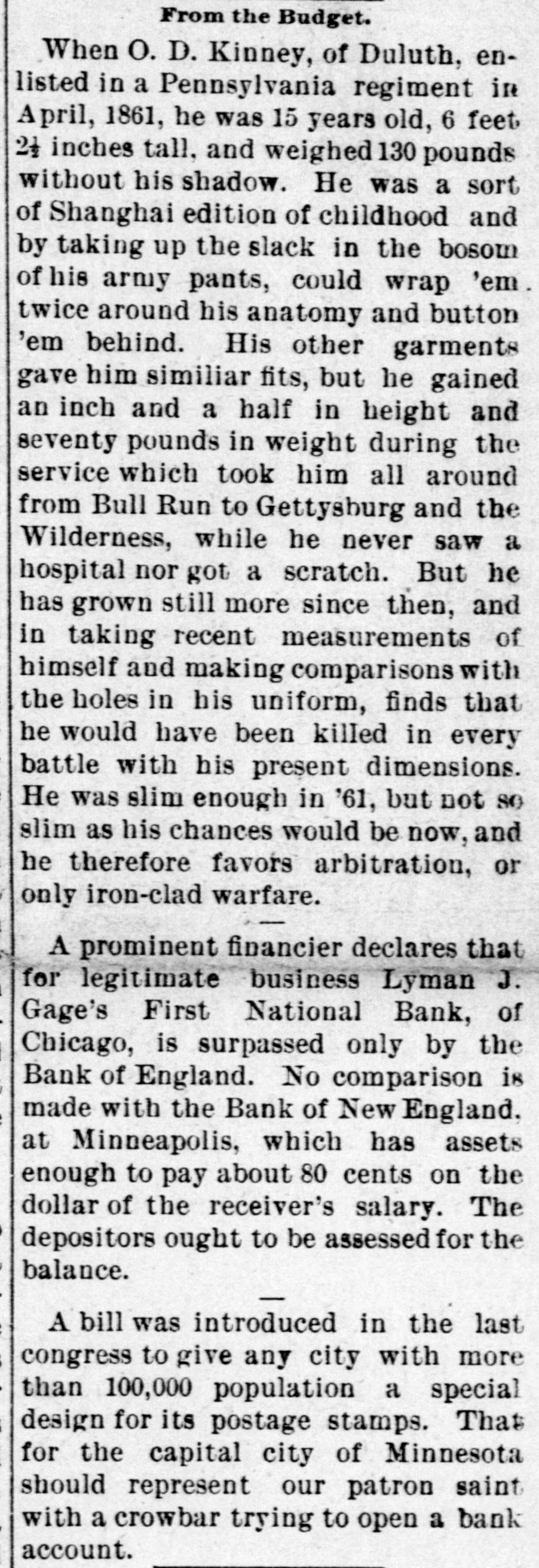
From the Budget. When O. D. Kinney, of Duluth, enlisted in a Pennsylvania regiment in April, 1861, he was 15 years old, 6 feet 2ยฝ inches tall, and weighed 130 pounds without his shadow. He was a sort of Shanghai edition of childhood and by taking up the slack in the bosom of his army pants, could wrap 'em twice around his anatomy and button 'em behind. His other garments gave him similiar fits, but he gained an inch and a half in height and seventy pounds in weight during the service which took him all around from Bull Run to Gettysburg and the Wilderness, while he never saw a hospital nor got a scratch. But he has grown still more since then, and in taking recent measurements of himself and making comparisons with the holes in his uniform, finds that he would have been killed in every battle with his present dimensions. He was slim enough in '61, but not so slim as his chances would be now, and he therefore favors arbitration, or only iron-clad warfare. A prominent financier declares that for legitimate business Lyman J. Gage's First National Bank, of Chicago, is surpassed only by the Bank of England. No comparison is made with the Bank of New England, at Minneapolis, which has assets enough to pay about 80 cents on the dollar of the receiver's salary. The depositors ought to be assessed for the balance. A bill was introduced in the last congress to give any city with more than 100,000 population a special design for its postage stamps. That for the capital city of Minnesota should represent our patron saint with a crowbar trying to open a bank account.