7127. Lancaster Savings Bank (Lancaster, MA)

Bank Information

Episode Type
Suspension โ†’ Closure
Bank Type
savings bank
Start Date
December 22, 1875
Location
Lancaster, Massachusetts (42.456, -71.673)

Metadata

Model
gpt-5-mini
Short Digest
712743c3039a94ec

Response Measures

None

Description

Articles report that the Lancaster Savings Bank (Lancaster, MA) was found insolvent by the State Bank Commissioner Getchell, an injunction was issued (Dec 22, 1875) and the bank was placed in the hands of a receiver. Subsequent articles (1876) describe receivers selling bank-owned mortgaged property. No bank run is described; the bank remained in receivership/being wound up rather than reopening.

Events (3)

1. December 22, 1875 Receivership
Newspaper Excerpt
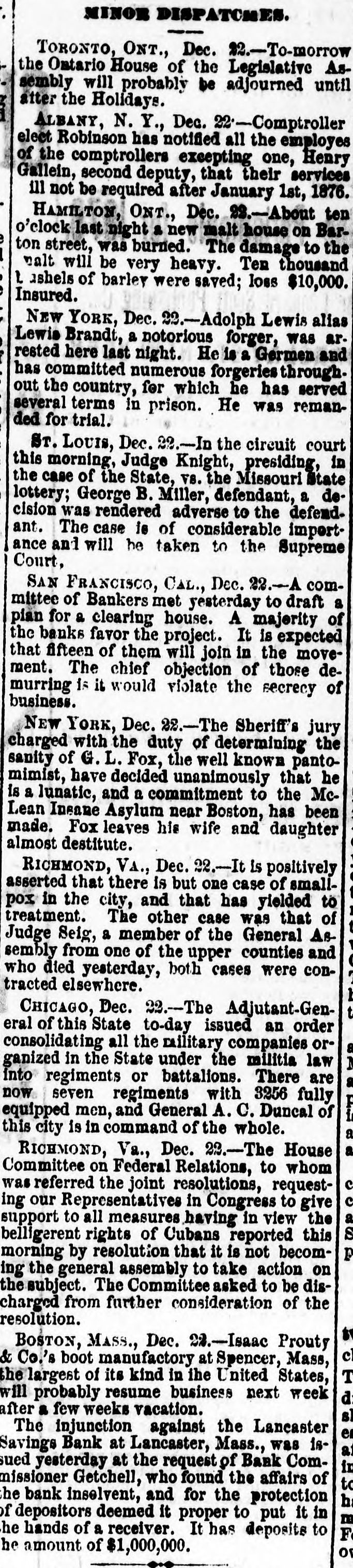
put it in the hands of a receiver. It has deposits to the amount of $1,000,000.
Source
newspapers
2. December 22, 1875 Suspension
Cause
Government Action
Cause Details
Bank Commissioner Getchell found the bank insolvent and requested an injunction to place it in the hands of a receiver for protection of depositors.
Newspaper Excerpt
The injunction against the Lancaster Savings Bank at Lancaster, Mass., was issued yesterday at the request of Bank Commissioner Getchell, who found the affairs of the bank insolvent, and for the protection of depositors deemed it proper to put it in the hands of a receiver.
Source
newspapers
3. October 11, 1876 Other
Newspaper Excerpt
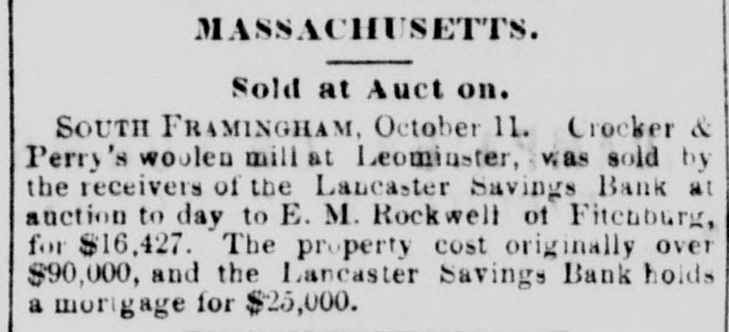
Sold by the receivers of the Lancaster Savings Bank at auction ... The Lancaster Savings Bank holds a mortgage for $25,000.
Source
newspapers

Newspaper Articles (8)

Article from The Morning Herald, December 23, 1875

Click image to open full size in new tab

Article Text

: MINOR DISPATCHES. TORONTO, ONT., Dec. 92.-To-morrow the Ontario House of the Legislative Assembly will probably be adjourned until after the Holidays. ALBANY, N. Y., Dec. 22-Comptroller elect Robinson has notified all the employes of the comptrollers excepting one, Henry Gallein, second deputy, that their services ill not be required after January 1st, 1876. HAMILTON, ONT., Dec. 22.-About ten o'clock night a new malt house on Barton street, was burned. The damage to the malt will be very heavy. Ten thousand 1 ushels of barley were saved; loss $10,000. Insured. NEW YORK, Dec. 22.-Adolph Lewis alias Lewis Brandt, a notorious forger, was ar. rested here last night. He is a Germen and has committed numerous forgeries through. out the country, for which he has served several terms in prison. He was remanded for trial. Sr. Louis, Dec. 22.-In the circuit court this morning, Judge Knight, presiding, in the case of the State, VS. the Missouri State lottery; George B. Miller, defendant, a decision was rendered adverse to the defend. ant. The case is of considerable importance and will be taken to the Supreme Court, SAN FRANCISCO, CAL., Dec. 22.-A committee of Bankers met yesterday to draft a plan for a clearing house. A majerity of the banks favor the project. It is expected that fifteen of them will join in the movement. The chief objection of those demurring is it would violate the secrecy of business. NEW YORK, Dec. 22.-The Sheriff's jury charged with the duty of determining the sanity of G. L. Fox, the well known pantomimist, have decided unanimously that he is a lunatic, and a commitment to the McLean Ineane Asylum near Boston, has been made. Fox leaves his wife and daughter almost destitute. RICHMOND, VA., Dec. 22.-It is positively asserted that there is but one case of smallpox in the city, and that has yielded to treatment. The other case was that of Judge Seig, a member of the General Assembly from one of the upper counties and who died yesterday, both cases were contracted elsewhere. CHICAGO, Dec. 22.--The Adjutant-General of this State to-day issued an order consolidating all the military companies organized in the State under the militia law into regiments or battalions. There are now seven regiments with 3256 fully equipped men, and General A. C. Duncal of this city is in command of the whole. RICHMOND, Va., Dec. 22.-The House Committee on Federal Relations, to whom was referred the joint resolutions, requesting our Representatives in Congress to give support to all measures having in view the belligerent rights of Cubans reported this morning by resolution that it is not becoming the general assembly to take action on the subject. The Committee asked to be discharged from further consideration of the resolution. BOSTON, MASS., Dec. 22.-Isaac Prouty cl & Co.'s boot manufactory at Spencer, Mass, T the largest of its kind in the United States, d will probably resume business next week after a few weeks vacation. sl The injunction against the Lancaster e a Savings Bank at Lancaster, Mass., was issued yesterday at the request of Bank Comin missioner Getchell, who found the affairs of to the bank inselvent, and for the protection h of depositors deemed it proper to put it in he hands of a receiver. It has deposits to F he amount of $1,000,000. o
Article from The New Orleans Bulletin, February 9, 1876

Click image to open full size in new tab

Article Text

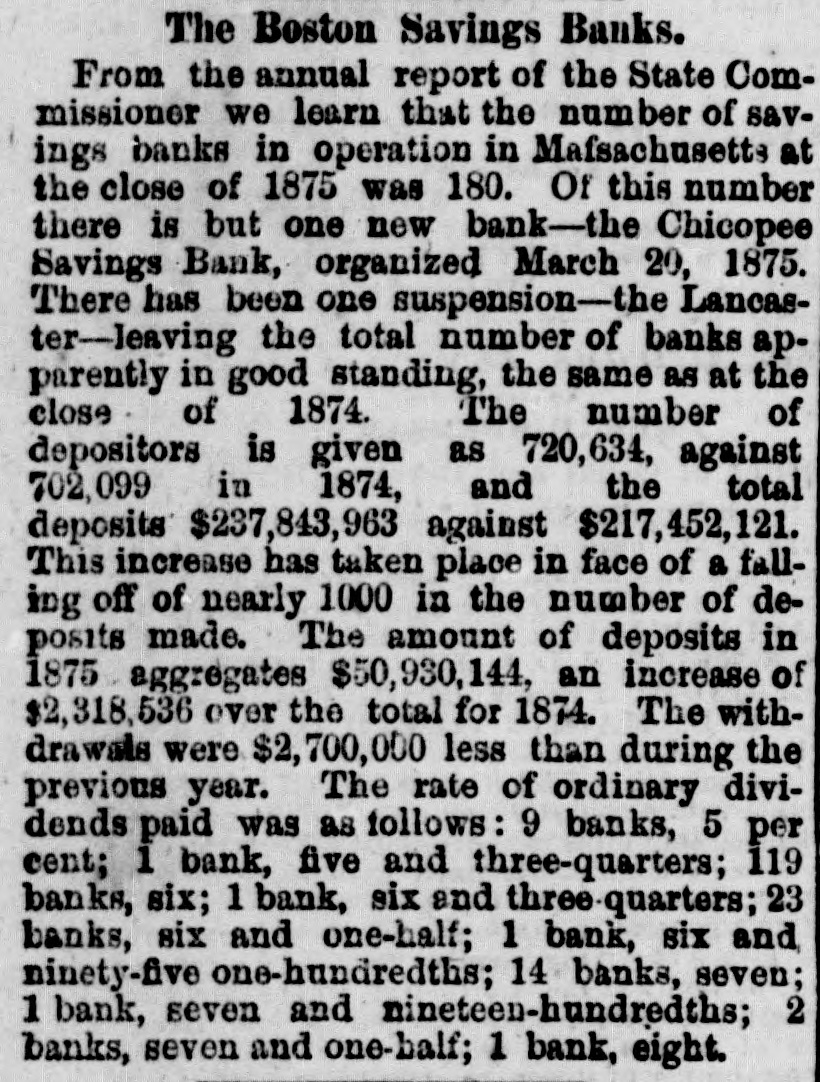
The Boston Savings Banks. From the annual report of the State Commissioner we learn that the number of savings banks in operation in Mafsachusetts at the close of 1875 was 180. Of this number there is but one new bank-the Chicopee Savings Bank, organized March 20, 1875. There has been one suspension-the Lancaster-leaving the total number of banks apparently in good standing, the same as at the close of 1874. The number of depositors is given as 720,634, against 702,099 in 1874, and the total deposits $237,843,963 against $217,452,121. This increase has taken place in face of a falling off of nearly 1000 in the number of deposits made. The amount of deposits in 1875 aggregates $50,930,144, an increase of $2,318,536 over the total for 1874. The withdrawals were $2,700,000 less than during the previous year. The rate of ordinary dividends paid was as follows: 9 banks, 5 per cent; 1 bank, five and three-quarters; 119 banks, six; 1 bank, six and three-quarters; 23 banks, six and one-half; 1 bank, six and ninety-five one-hundredths; 14 banks, seven; 1 bank, seven and mineteen-hundredths; 2 banks, seven and one-half; 1 bank, eight.


Article from Daily Kennebec Journal, October 12, 1876

Click image to open full size in new tab

Article Text

MASSACHUSETTS. Sold at Auct on. SOUTH FRAMINGHAM, October 11. Crocker & Perry's woolen mill at Leominster, was sold by the receivers of the Lancaster Savings Bank at auction to day to E. M. Rockwell of Fitenburg, for $16,427. The property cost originally over $90,000, and the Lancaster Savings Bank holds a mortgage for $25,000.


Article from New-York Tribune, January 2, 1886

Click image to open full size in new tab

Article Text

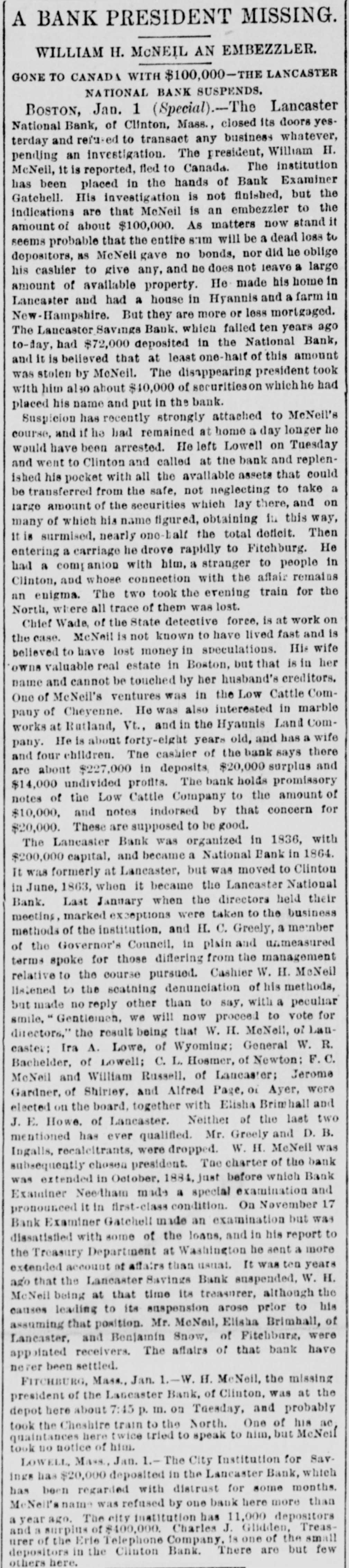
A BANK PRESIDENT MISSING. WILLIAM H. McNEIL AN EMBEZZLER. GONE TO CANADA WITH $100,000-THE LANCASTER NATIONAL BANK SUSPENDS. BOSTON, Jan. 1 (Special).-The Lancaster National Bank, of Clinton, Mass., closed its doors yesterday and refused to transact any business whatever, pending an investigation. The president, William H. McNeil, it is reported, fled to Canada. The institution has been placed in the hands of Bank Examiner Gatehell. His investigation is not finished, but the indications are that McNeil is an embezzler to the amount of about $100,000. As matters now stand it seems probable that the entire sam will be a dead loss to depositors, as McNeil gave no bonds, nor did he oblige his cashier to give any, and be does not leave a large amount of available property. He made his home in Lancaster and had a house in Hyannis and a farm in New-Hampshire. But they are more or less mortgaged. The Lancaster Savings Bank. which failed ten years ago to-day, had $72,000 deposited in the National Bank, and it is believed that at least one-half of this amount was stolen by McNeil. The disappearing president took with him also about $10,000 of securitieson which he had placed his name and put in the bank. Suspicion has recently strongly attached to McNeil's course, and if he had remained at home a day longer he would have been arrested. He left Lowell on Tuesday and went to Clinton and called at the bank and replenished his pocket with all the available assets that could be transferred from the safe, not neglecting to take a large amount of the securities which lay there, and on many of which his name figured, obtaining in this way, It is surmised, nearly one-balf the total deficit. Then entering a carriage he drove rapidly to Fitchburg. He had a companion with him, a stranger to people in Clinton, and whose connection with the affair remains an enigma. The two took the evening train for the North, where all trace of them was lost. Chief Wade, of the State detective force, is at work on the case. McNeil is not known to have lived fast and is believed to have lost money in speculations. His wife owns valuable real estate in Boston, but that is in her name and cannot be touched by her husband's creditors. One of McNeil's ventures was in the Low Cattle Company of Cheyenne. He was also interested in marble works at Rutland, Vt., and in the Hyaunis Land Company. He is about forty-eight years old, and has a wife and four children. The cashier of the bank says there are about $227,000 in deposits $20,000 surplus and $14,000 undivided profits. The bank holds promissory notes of the Low Cattle Company to the amount of $10,000, and notes indorsed by that concern for $20,000. These are supposed to be good. The Lancaster Bank was organized in 1836, with $200,000 capital, and became a National Bank in 1864. It was formerly at Lancaster, but was moved to Clinton in June, 1863, when it became the Lancaster National Bank. Last January when the directors held their meeting, marked exceptions were taken to the business methods of the institution. and H. C. Greely, a member of the Governor's Council, in plain and unmeasured terms spoke for those differing from the management relative to the course pursued. Cashier W. H. McNeil Halened to the seatning denunciation of his methods, but made no reply other than to say, with a peculiar smile. Gentlemen, we will now proceed to vote for directors," the result being that W. H. McNell, of Laneaster: Ira A. Lowe, of Wyoming; General W. R. Bachelder, of Lowell; C. L. Hosmer, of Newton: F.C. McNeil and William Russell. of Lancaster; Jerome Gardner, of Shirley. and Alfred Page, oi Ayer, were elected on the board. together with Elisha Brimhall and J.E. Howe. of Lancaster. Neither of the last two mentioned has ever qualified. Mr. Greely and D. B. Ingalls, recalcitrants, were dropped. W. H. McNeil was subsequently chosen president. Tue charter of the bank was extended in October. 1884, just before which Bank Examiner Needham made a special examination and pronounced It in first-class condition. On November 17 Bank Examiner Gatehell made an examination but was dissatisfied with some of the loans, and in his report to the Treasury Department at Washington he sent a more extended account of affairs than usual. It was ten years ago that the Laneaster Savings Bank suspended, W. H. McNeil being at that time its treasurer, although the causes leading to its suspension arose prior to his assuming that position. Mr. McNeil, Elisha Brimhall, of Lancaster, and Benjamin Snow, of Fitehbarg, were appolated receivers. The affairs of that bank have never been settled. FITCHBURG, Mass. Jan. 1.-W. H. McNeil, the missing president of the Laneaster Bank, of Clinton, was at the depot here about 7:45 p. in. on Tuesday, and probably took the Cheshire train to the North. One of his ac. quaintances here twice tried to speak to him, but McNeil took no notice of him. LOWELL Mass. Jan. 1.- The City Institution for Savings has $20,000 deposited in the Lancaster Bank, which has been regarded with distrust for some months. McNell'aname was refused by one bank here more than a year ago. The city Institution has 11,000 depositors and a surplus of $400,000. Charles J. Glidden, Treasurer of the Erle Telephone Company. is one of the small depositors in the Clinton Bank. There are but few others here.


Article from The Salt Lake Herald, January 3, 1886

Click image to open full size in new tab

Article Text

Another Crooked Banker. CLINTON, Mass., January 1.-Lancaster National Bank closed its doors last night, after an examination of the books by the directors. President W. H. McNeil is missing, and has not been heard from since Tuesday, when he was in Lowell, whence he started ostensibly for Boston. He is charged with having used the bank's money for speculative purposes in which he was interested, and which do not furnish sufficient security. The directors, Messrs. Batehelder, Hosmer, Gardner, Russell and Page, together with Bank Examiner Mitchell, who came to Olinton to-day, have been hard at work on the books all day. The directors seem depressed and are exceedingly reticent, Cashier Farren Forester expresses himself very plainly and his condemnation of President McNeil's financiering is unmistakable. He says the latter, since his elevation to the presidency of the bank last January, has invested the bank's funds, according to his own inclinations. His operations have at times been far from straight. At the present the bank has a surplus of $3,500. The bank holds paper of the Low Cattle Company, of Wyoming, to the amount of $30,000. So far as can be learned the deposits amount to over $200,000, and according to statements from a quarter which is supposed to be authentic, President McNiel has appropriated this amount. The belief prevails that the examination of the books of the bank will develop new and startling features. McNeil has not been heard from since Tuesday last. It is said that a resident of Clinton saw him in Nebraska, N. H., last Wednesday. Nothing further regarding the real condition of the banks' finances will le known for a day or two, and possibly not then. One of the directors of the Lancaster National Bank, at Canton. is authority for the statement that McNeil, the missing president, was at the bank on Monday night, when he took from the vaults $600 in bank notes and $1,000 in gold, and a large amount of stock in the Ruthland (Vt.) Marble Company. supposed to be about $30,000 worth. There was in the vault considerable money belonging to the defunct Lancaster Savings Bank, of which McNiel was one the receivers, a good portion of which is said to be missing.


Article from New-York Tribune, January 6, 1886

Click image to open full size in new tab

Article Text

PRESIDENT M'NEIL STILL IN HIDING. BOSTON, Jan. 5 (Special).-No news has been received of the absconding bank president, W. H. McNeil, of Clinton. Depositors in the Lancaster Savings Bank have decided to bring suit against the receivers of the bank for their proportion of the funds of that bank deposited with the Lancaster National Bank. They have employed as counsel General B. F. Butler, and a petition has been filed with the Probate Court of Worcester County, praying that W. H. McNeil be removed as administrator of the estate of Rufus Childs, of Lancaster.


Article from Burlington Weekly Free Press, January 8, 1886

Click image to open full size in new tab

Article Text

PRESIDENT M'NEIL FLED. Decamped with $7000 in Gold, and Some Rutland Marble Stock. CLINTON, Mass., Jan. 3.-There is now but little doubt that W. H. McNeil, president of the Lancaster National Bank, is a defaulter. An honored man, universally regarded as above reproach. has gone off, and so has a goodly amount of other people's money. The investment committee of one of the Lowell banks called upon him the first of the week relative to some of its money, but he talked in such a suave manner and made affairs appear in so safe a light that all suspicion was swept aside. Early Tuesday morning he took a train for Boston. What he did there is not known. His arrival here was not long after the bank closed and he went to that institution soon after Cashier Forrester had gone to his home. That official had, during the day, been looking into the bank's affairs, and left with the intention of returning later to prosecute his labors, and in view of this intent he did not put on the time-lock. The theory is that President McNeil profited by the nonusage of that safeguard and secured the money. Just how much he is alleged to to have secured is not given out, but it is authoritatively affirmed that he took $6000 in bills, $1000 in gold, and about $35,000 worth of stock in a marble quarry at Rutland, Vermont. Then he went out unseen, reached the station, and from there was driven to Lancaster by a hackman. Mr. McNeil was accompanied by a person unknown to the driver of the hack, but possibly known to the directors, who claim to be able to guess quite well upon the identity of the stranger. The companion of the fleeing bank president went to the latter's house and got his bag, which was handed to him for that gentleman, who did not leave the team. He then took a hurried drive to Fitchburg, from which point he went no one knows just where. While waiting at the station in that city he was accosted by an intimate acquaintaince, but he ignored his friend. Since that moment he has not been heard from. Mr. McNeil was one of the three receivers of the Lancaster Savings bank. The affairs of that institution were about ready to be settled up, and it is thought that the near approach to the time when a final dividend was to be paid the depositors compelled McNeil to go by a fast express, as he had tangled up the receiver's deposits with his schemes in such a manner that they could not secure their funds and close up the business of the bank, SO long partially defunct.


Article from New-York Tribune, February 18, 1886

Click image to open full size in new tab

Article Text

MASSACHUSETTS SAVINGS BANKS. THEIR PROSPEROUS CONDITION-NEW LAWS SUGGESTED BY THE COMMISSIONERS. BOSTON. Feb. 17 (Special).--The Savings Bank Commissioners have pablished their annual report. It shows that there are 171 savings banks, or three more than there were last year, in Massachusetts. Five new banks were authorized by the last Legislature, of which the Somerville, North Middlesex, of Ayer, and Peoples'. of Holyoke, have begun business, while the Reading and the Belmont have not begun business. The Emigrant Savings Bank has been wound up, paying 991g per cent. The Groveland Savings Bank is closing up and the depositors will receive a dividend above thefr principal. The bank is being closed because it is not needed. The Scituate Savings Bank has paid a final dividend, making a total of 85 per cent. The receivers of the Barnstable and Needham banks have deposited the books and papers with the Commissioners, as required. The closing of the Lancaster Bank is delayed by the absconding of President McNeil of the Lancaster National Bank, who WAS a receiver of the savings bank. The closing up of the Reading Bank is delayed by the slow progress in terminating suits to recover securities. The Framingham bank, the treasurer of which committed Auicide a few months age when his wrong-doing had been discovered, will probably not show a deficiency, when it is finally settled, the property of the treasurer, his bondsmen and his son having been surrendered to the bank. The Commissioners recommend that the deposits by a savings bank in any one National bank or loan and trust company be limited to 5 per cent of its deposita and 25 per cent of the capital stock of the National bank or trust company. The Commissioners also recommend an amendment to the lav so that personal loans cannot run over a year, also that the bonds of all treasurers should run for a uniform time, not to exceed five years. It 18 suggested that all savings banks verity their accounts by a trial balance of individ ual accounts and total deposits. The latter could then by examining a portion of the books of the depositors jud accuratoly the reliability of the accounts. The receipts of the savings banks for sixty-nine years have been $1,275,000,000, of which about $1,882,000, or threetweatieths of one per cent has been lost by failures. The co-operative banks number thirty, against twentysix in 1884, and they are growing rapidly and are prosperous.