Click image to open full size in new tab
Article Text
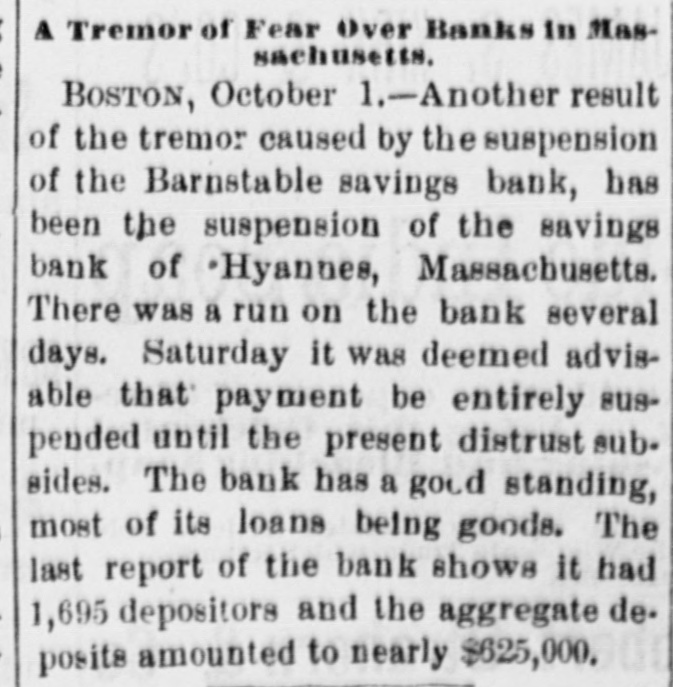
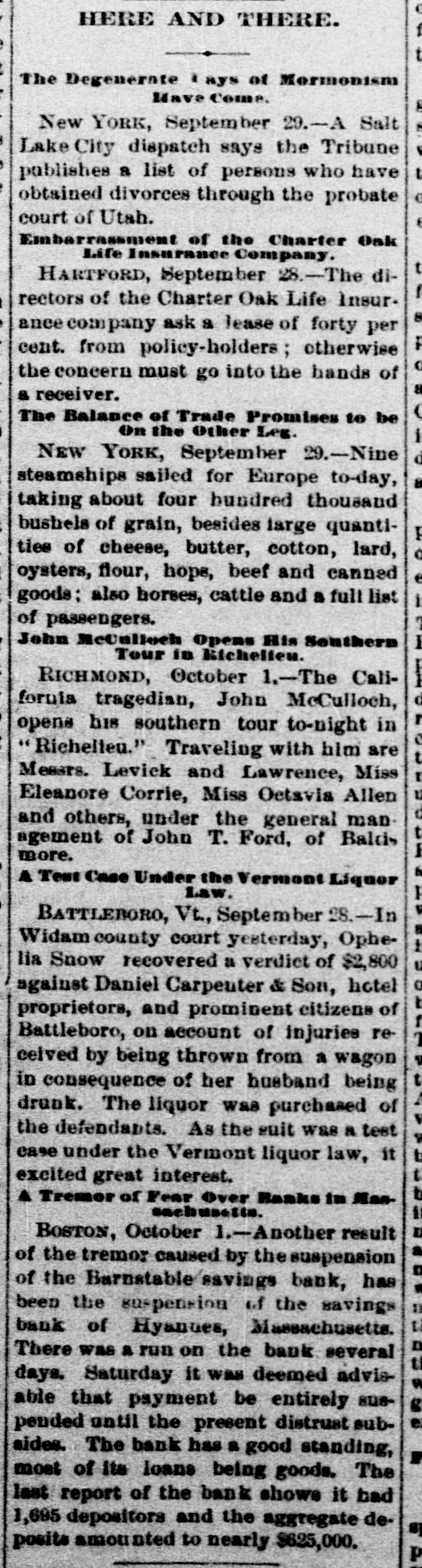
€ HERE AND THERE. f t The Degenerate . ays of Mermonism Have Come. g 8 New YORK, September 29.-A Salt y Lake City dispatch says the Tribune t publishes a list of persons who have 0 obtained divorces through the probate court of Utah. & Embarrassment of the Charter Oak Life Insurance Company. t HARTFORD, September 28.-The di1 rectors of the Charter Oak Life Insur8 ancecompany ask a lease of forty per I cent. from policy-holders ; otherwise o the concern must go into the hands of a a receiver. ( The Balance of Trade Promises to be On the Other Leg. I NEW YORK, September 29.-Nine o steamships sailed for Europe to-day, a taking about four bundred thousand bushels of grain, besides large quantiI ties of cheese, butter, cotton, lard, o oysters, flour, hops, beef and canned e goods; also horses, cattle and a full list I of passengers. 1 John McCulloch Opens His Southern I Tour in Richelieu. RICHMOND, October 1.-The Calio foruia tragedian, John McCulloch, , opens his southern tour to-night in 'Richelleu." Traveling with him are t I Messrs. Levick and Lawrence, Miss ti Eleanore Corrie, Miss Octavia Allen 0 and others, under the general mant agement of John T. Ford, of Balds more. b A Test Case Under the Vermont Liquor Law. I 9 BATTLEBORO, Vt., September 28.-In a Widam county court yesterday, Ophet u lia Snow recovered a verdict of $2,800 0 against Daniel Carpenter & Son, hotel proprietors, and prominent citizens of f Battleboro, on account of injuries re1 V celved by being thrown from a wagon t in consequence of her husband being drunk. The liquor was purchased of V the defendants. As the suit was a test y t case under the Vermont liquor law, it t excited great interest. to & Tremor of Fear Over Banks in Mansachusetts. II BOSTON, October 1.-Another result of the tremor caused by the suspension a of the Barnstable/savings bank, has II been the suspension of the savings L bank of Hyanues, Massachusetts. n There was a run on the bank several ti days. Saturday it was deemed advisable that payment be entirely sueg pended until the present distrust subsides. The bank has a good standing, IF most of Its loans being goods. The last report of the bank shows it bad 1,695 depositors and the aggregate de8] posits amounted to nearly $625,000. P