7104. Greenfield Savings Bank (Greenfield, MA)

Bank Information

Episode Type
Suspension → Reopening
Bank Type
savings bank
Start Date
February 1, 1909
Location
Greenfield, Massachusetts (42.588, -72.600)

Metadata

Model
gpt-5-mini
Short Digest
d6096e3794f24214

Response Measures

None

Description

The Greenfield Savings Bank was closed by order of the Massachusetts Supreme Judicial Court and placed under the supervision of the state Savings Bank Commissioner (Pierre Jay) on Feb 1, 1909 due to bad real-estate loans/unproductive assets. No article describes a depositor run to force suspension; the closure was by court/commissioner action with a plan to 'nurse' the bank back and reopen. Later articles (1911) discuss litigation and anticipate resumption by mid-1912. No receiver was appointed; business continued under supervision, consistent with suspension followed by reopening.

Events (4)

1. February 1, 1909 Suspension
Cause
Government Action
Cause Details
Temporary injunction by the Massachusetts Supreme Judicial Court at request of the Savings Bank Commissioner after finding unproductive assets and bad real-estate transactions.
Newspaper Excerpt
Pierre Jay, Massachusetts state bank inspector today closed the Greenfield Savings Bank ... Justice Sheldon of that court issued a temporary injunction restraining the bank from doing business
Source
newspapers
2. February 9, 1909 Suspension
Cause
Government Action
Cause Details
Permanent injunction issued by the court restraining the bank from receiving or paying out funds; business to be continued under commissioner supervision.
Newspaper Excerpt
Supreme court Judge Sheldon today made permanent the injunction restraining the officers of the suspended Greenfield Savings bank from paying or receiving funds of depositors.
Source
newspapers
3. March 25, 1911 Other
Newspaper Excerpt
Filed by Massachusetts Bank Commissioner Against Finance Com. Members of Greenfield Savings Bank ... caused an attachment to be made of $350,000 against Robert Abercrombie ... charges of negligence in making loans resulting in large losses to the bank after its suspension in February, 1909; present board expects bank will resume business by July, 1912, paying dollar for dollar.
Source
newspapers
4. July 1, 1912* Reopening
Newspaper Excerpt
The Greenfield, Mass., Savings bank probably will be able to resume business in the usual way next July, paying all the depositors in full ... Commissioner Arthur B. Chapin is authority for the statement
Source
newspapers

Newspaper Articles (10)

Article from The Bridgeport Evening Farmer, February 1, 1909

Click image to open full size in new tab

Article Text

CLOSE BANK TO PROTECT ITS DEPOSITORS / Greenfield, Mass., Savings Institution Suspends Business on Order of Court. (Special from United Press.) Greenfield, Mass., Feb. 1.-Pierre Jay, Massachusetts state bank inspector today closed the Greenfield Savings Bank which has deposits of about $2,000,000. No reason is yet definitely known but it is said bad real estate transactions have involved the bank. Crowds gathered in the street in front of the bank to read the notice of suspension. As in all savings banks, most of the depositors are poor, many of them women. Following the posting of the notice President Robert Abercromble, gave out the following statement to the public: "I urgently advise all depositors of the Greenfield Savings Bank not to dispose of their deposit books at a discount because after a short suspension of dividends which I concede will not be over two or three years the bank will open again and resume business. Those who then desire to dispose of their books may do so at 'heir full present value. (Signed) Robert Abercrombie, President." The closing down of the bank was the direct result of action taken today in the Supreme court in Boston. Justice Sheldon of that court issued a temporary injunction restraining the bank from doing business on the grounds that it would be hazardous for the depositors for the bank to keep on receiving deposits. Bank Commissioner Jay asked for the injunction. He told the court that he had found that the assets of the bank could not be readily realized upon. The Greenfield Savings Bank opened for business and was incorporated March 19, 1869. Robert Abercrombie is president and William F. Aiken, brother of Chief Justice of the Massachusetts Superior Court is treasurer.
Article from Daily Kennebec Journal, February 2, 1909

Click image to open full size in new tab

Article Text

Commissioner Takes the Charge of Savings Bank At Greenfield, Mass., and Will Nurse Its Resources Until the Institution Is Again on Firm Financial Footing. Boston, Feb. 1.-By an order of the supreme judicial court today closing the Greenfield Savings Bank of Greenf.els, Mass., and suspending the payment of further dividends, it is hoped to eliminate the unproductive assets of the bank and eventually throw open the doors of the institution to its 7000 depositors who have entrusted nearly $3,000,000 to its keeping. The bank is one of the largest savings institutions in the Connecticut valley and its closing today at the request of the savings bank commissioner, Pierre Jay, came unexpectedly to the thousands of depositors, many of whom are mill hands and working people. Instead of asking for a receiver, Commissioner Jay requested that a course similar to that adopted in adjusting the finances of the Marblehead Savings Bank, five years ago, be pursued. This permits the trustees to carry on the business of the bank under. the supervision of the bank commissioner. to lend money to needy depositors and gradually to nurse the bank back to a healthy condition, which in the case of the Marblehead institution occupied about three years. The court today issued a temporary injunction and on Feb. 9 will take up the question of making it permanent when the plan of the commissioner will be presented to the court for approval. The deposits on Jan. 31 amounted to $2,838,075, of which $1,198,277 has been loaned on real estate. The bank also has in its possession real estate valued at $222,950 and real estate by foreclosure valued at $125,892. The bank also has among its assets $110,000 in street railway bonds. In a statement issued from Greenfield, President Abercrombie earnestly advised all depositers not to dispose of their books at a sacrifice, as he anticipates that the bank will resume business in two or three years, when all books will have their full face value.


Article from Norwich Bulletin, February 2, 1909

Click image to open full size in new tab

Article Text

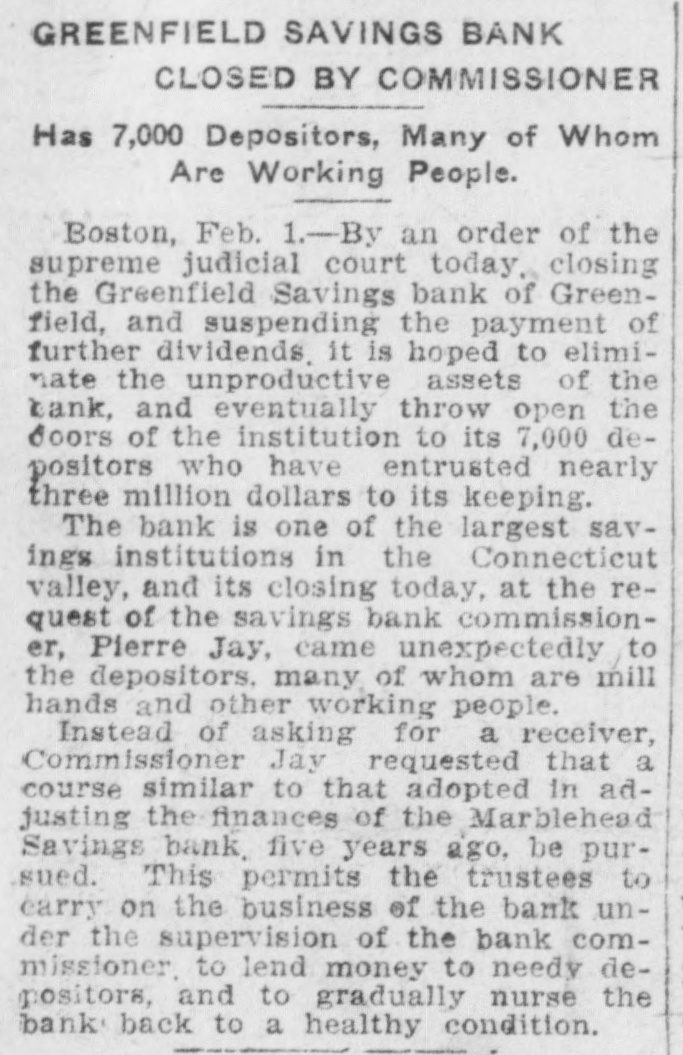
GREENFIELD SAVINGS BANK CLOSED BY COMMISSIONER Has 7,000 Depositors, Many of Whom Are Working People. Boston, Feb. 1.-By an order of the supreme judicial court today, closing the Greenfield Savings bank of Greenfield, and suspending the payment of further dividends, it is hoped to eliminate the unproductive assets of the bank, and eventually throw open the doors of the institution to its 7,000 depositors who have entrusted nearly three million dollars to its keeping. The bank is one of the largest savings institutions in the Connecticut valley, and its closing today, at the request of the savings bank commissioner, Pierre Jay, came unexpectedly to the depositors, many of whom are mill hands and other working people. Instead of asking for a receiver, Commissioner Jay requested that a course similar to that adopted in adjusting the finances of the Marblehead Savings bank five years ago, be pursued. This permits the trustees to carry on the business of the bank under the supervision of the bank commissioner. to lend money to needy depositors, and to gradually nurse the bank back to a healthy condition.


Article from New-York Tribune, February 2, 1909

Click image to open full size in new tab

Article Text

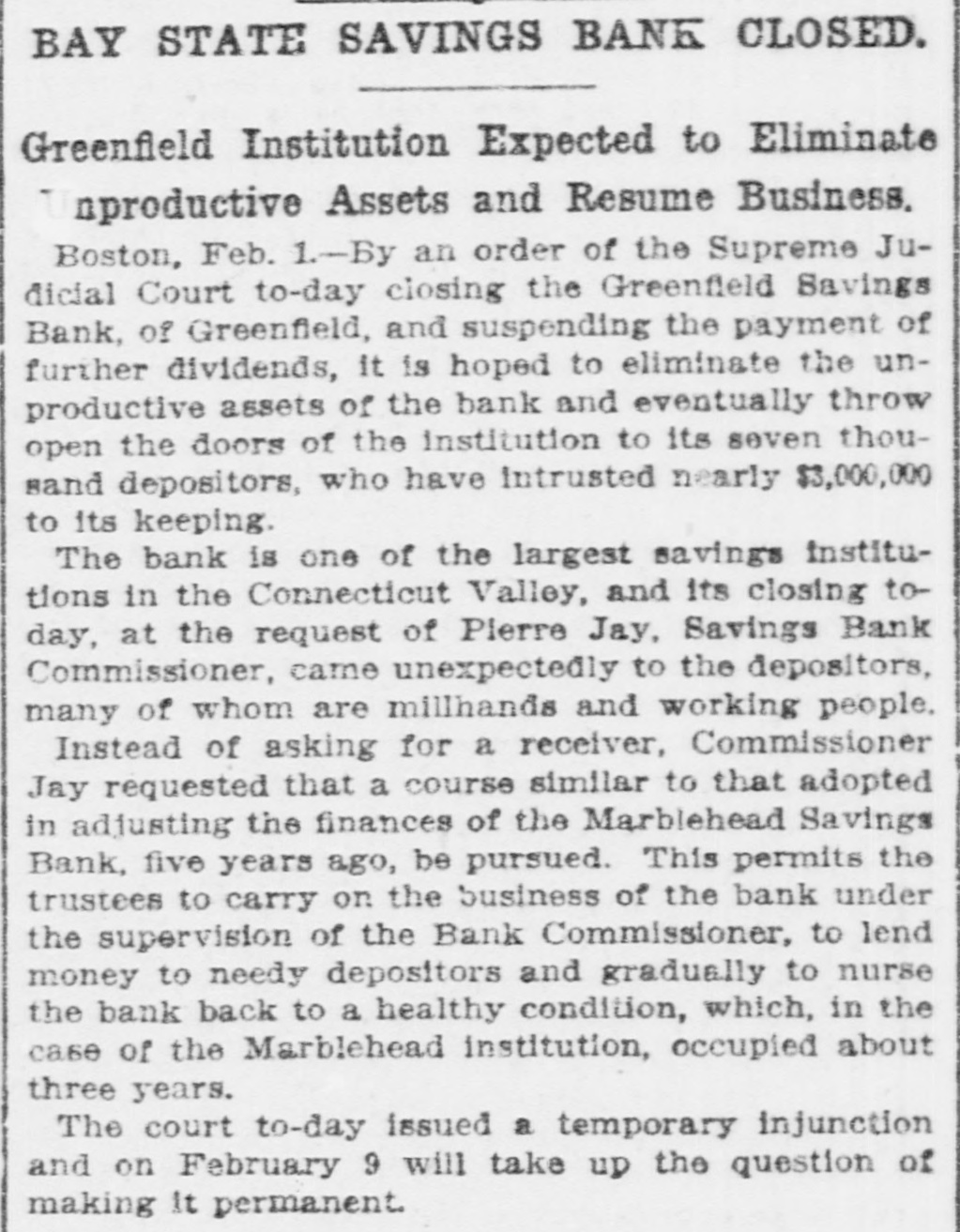
BAY STATE SAVINGS BANK CLOSED. Greenfield Institution Expected to Eliminate inproductive Assets and Resume Business. Boston, Feb. 1.-By an order of the Supreme Judicial Court to-day closing the Greenfield Savings Bank, of Greenfield, and suspending the payment of further dividends, it is hoped to eliminate the unproductive assets of the bank and eventually throw open the doors of the institution to its seven thousand depositors, who have intrusted nearly $3,000,000 to its keeping. The bank is one of the largest savings institutions in the Connecticut Valley, and its closing today, at the request of Pierre Jay, Savings Bank Commissioner, came unexpectedly to the depositors, many of whom are millhands and working people. Instead of asking for a receiver, Commissioner Jay requested that a course similar to that adopted in adjusting the finances of the Marblehead Savings Bank, five years ago, be pursued. This permits the trustees to carry on the business of the bank under the supervision of the Bank Commissioner, to lend money to needy depositors and gradually to nurse the bank back to a healthy condition, which, in the case of the Marblehead institution, occupied about three years. The court to-day issued a temporary injunction and on February 9 will take up the question of making It permanent.


Article from The Montgomery Advertiser, February 2, 1909

Click image to open full size in new tab

Article Text

SAVINGS BANK CLOSED. Court Decides on Method to Eliminate Unproductive Assets. Boston, Mass., Feb, 1,-By an order of the Supreme Judicial Court today, closing the Greenfield Savings Bank of Greenfield, and suspending the payment of further dividends, It is hoped to eliminate the unproductive assets of the bank, and eventually throw open the doors of the institution to its 7,000 depositors, who have entrusted nearly three million dollars to its keeping. The bank is one of the largest savings institutions in the Connecticut Valley, and its closing today at the request of Savings Bank Commissioner Pierre Jay came unexpectedly to the depositors, many of whom are mill hands. The court issued a temporary injunction. and on February 9 will take up the question of making it permanent.


Article from The Barre Daily Times, February 9, 1909

Click image to open full size in new tab

Article Text

PERMANENTLY ENJOINED. Officers of Greenfield Bank Can't Receive or Pay Out Funds. Boston, Feb. 9.-Supreme court Judge Sheldon today made permanent the injunction restraining the officers of the suspended Greenfield Savings bank from paying or receiving funds of depositors. The business will - be continued, and it is hoped in a few months the bank will re-open, settling with the 6,779 depositors in full.


Article from The Bennington Evening Banner, February 10, 1909

Click image to open full size in new tab

Article Text

FRANK E. HOWE, Editor and Publisher Difference in Banks. Vermonters who borrow money from savings banks on real estate security are often heard to grumble because the bank will only loan them an amount equal to sixty per cent of the value of their property. But, in the words of the clever advertisement writer, there is a reason, and this reason has been emprasized by the recent failure of a Greenfield savings bank, which had deposits of almost three millions and was supposed to be one of the strongest banks in Massachusetts. Since the bank was closed the cause of its troubles have been made public at least in part and the principal cause assigned is the loaning of money on real estate to an amount that proved later to be greater than the value of the property. When payment was defaulted and property was taken under foreclosure it could not be sold for the amount of the loan. It is stated that the bank had in the vicinity of a million and a half loaned on North Adams real estate. Owing to the. business stagnation at North Adams during the past year all property there depreciated in value to a point that made it impossible for the bank to realize on its loans It is probable that the depositors in the bank will not lose their principal but they are likely to lose interest for several years while the bank is in liquidation. In the meantime Vermonters have reason to congratulate themselves that in this state savings banks can loan to an owner of real estate only sixty per cent of the value of his property. This gives a good margin for possible depreciation or accident and protects the depositors absolutely from danger of loss. The Bennington savings bank has not lost a dollar on real estate loans in many years and even during the business depression of the past year it continued to prosper so that at the beginning of the present year it commenced paying four per cent interest on deposits.


Article from The Abbeville Press and Banner, February 17, 1909

Click image to open full size in new tab

Article Text

COURT CLOSES A SAVINGS BANK. Order Permits Business to Continue Pending Reorganization. Boston, Mass.-By an order of the Supreme Judicial Court closing the Greenfield Savings Bank, of Greenfield, and suspending the payment of further dividends, it is hoped to eliminate the unproductive assets of the bank and eventually throw open its doors to its 7000 depositors, who have intrusted, nearly $3,000,000 to its keeping. The bank is one of the largest savings institutions in the Connecticut Valley, and its'closing, at the request of the Savings Bank Commissioner, Pierre Jay, came unexpectedly to the depositors, many of whom are mill hands and working people.


Article from Daily Kennebec Journal, March 25, 1911

Click image to open full size in new tab

Article Text

Filed by Massachusetts Bank Commissioner Against Finance Com. Members of Greenfield Savings Bank. Also Causes $350,000 Attachment --Alleges Neglect of Law. Greenfield, Mass, March 24.-Claiming that the respondents, all of whom were members of the finance committee of the Greenfield Savings Bank at the time of its suspension in February. 1909 were guilty of neglect to perform their duties properly, Arthur B. Chapin. savings bank commissioner of Massachusetts, filed a bill of complaint in the supreme court todav and caused an attachment to be made of $350.000 against Robert Abercrombie, Levi .1. Gum, Charles R. Lowell, William A. Borbes and S. B Slate. The bill is 11 voluminous document of about 50 typewritten pages and was filed by C. E. Choate Jr., a Boston attorney, in behalf of Bank Commissioner Chapin, who in turn represents the Greenfield Savings Bank The bill alleges that the respondents failed to observe the statutes and requirements of the banking laws relative to making loans. The bill also asks that the respondents be forced to repay to the bank the money which it is allleged the bank lost as a result of their official negligence. When the bank was enjoined from doing business in February, 1909 it had property valued at about $4,000,000. Since that time the sum of $288,000 nas been charged off as the lossess on poor loans made by the respondents of their predecessors. It is alleged that these losses will aggregate half a million dollars. The bill of complaint declares that Messrs. Abercrombie and Gunn received from George N. Rich of North Adams inducements and gifts offered by Rich for the purpose of getting an improper loan. The bill also states that this fact did not become known to the complainant until recently and that the Greenfield Savings Bank is not informed of the character and amount of such loans. According to the specifications in the bill of complaint the banks losses were sustained on loans made to North Adams pàrties. One specification alleges that a loan of $153,000 was made to the Berkshire Hotel of North Adams and that this property brought only $35,000 at a sale, causing a loss to the bank of $118,000. Some thirty or forty other unprofitable loans are cited in the bill. In conclusion the bill charges that the respondents not only exceeded the legal loan rate of 60 per cent. of the property value, but in some cases loaned more than the total value of the property. The present officials of the bank were not consulted by Mr. Chapin in the present litigation it is understood. The present board of officers expect that by July, 1912. the bank will resume business and pay dollar for dollar.


Article from Vermont Phœnix, September 22, 1911

Click image to open full size in new tab

Article Text

The Greenfield, Mass., Savings bank probably will be able to resume business in the usual way next July, paying all the depositors in full, although without interest on their deposits from the time the bank suspended payment, Feb. 1, 1909. Savings Bank Commissioner Arthur B. Chapin is authority for the statement that if put into liquidation now the bank could pay 95 cents on each dollar of the deposits. New Orleans is used to floods, but one occurred there early in the week which startled even the oldest inhabitants. A warehouse on the levee burst Tuesday noon, and as it covers more than a block and was once used as a reservoir, and of late had been full of molasses, there was trouble. A 20-foot section of a side-wall burst out with a roar, and more than 1,000,000 gallons of molasses started down Magazine street. The molasses was soon 10 inches deep in the street, and the weight broke two city water mains, which added their contributions. The fire department was called out to aid the street cleaners and it will be days before the sticky mess is entirely removed.