Article Text
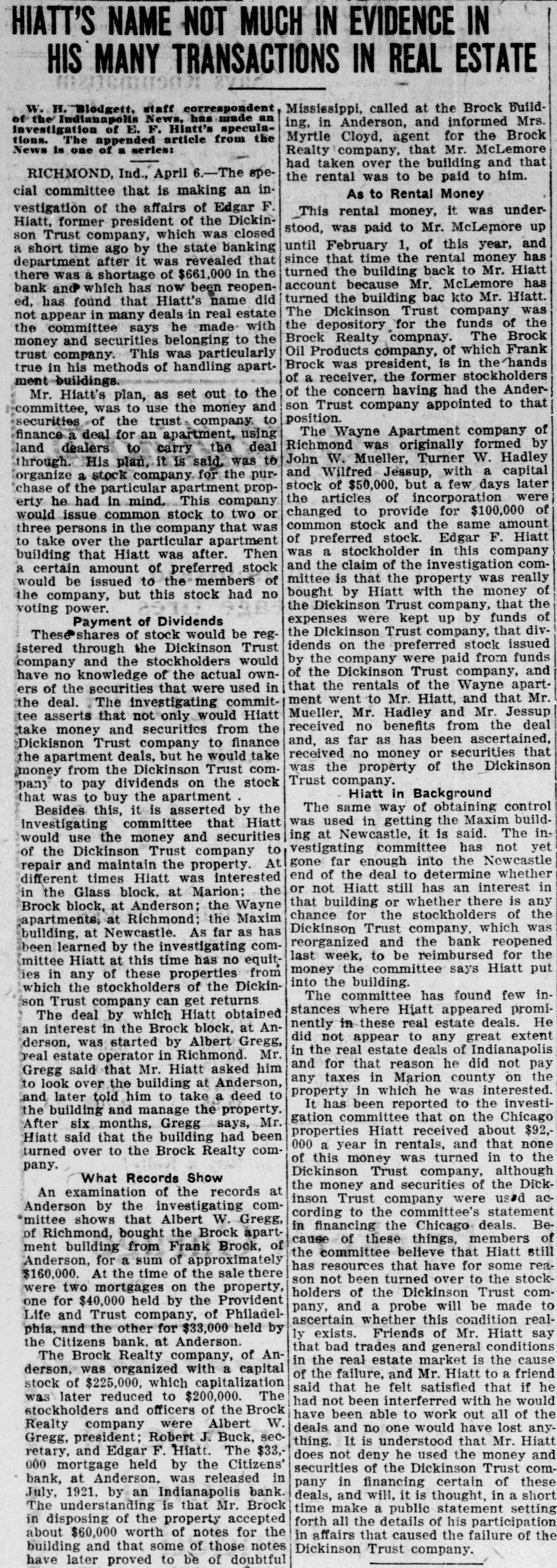
HIATT'S NAME NOT MUCH IN EVIDENCE IN
HIS MANY TRANSACTIONS IN REAL ESTATE
W. H. Blodgett, staff correspondent, Mississippi, called at the Brock build- of the Indianapolis News, has made an ing, in Anderson, and informed Mrs. Investigation and E. F. Hiatt's specula- Myrtle Cloyd, agent for the Brock tions. The appended article from the Realty company, that Mr. McLemore News is one of a series: had taken over the building and that the rental was to be paid to him.
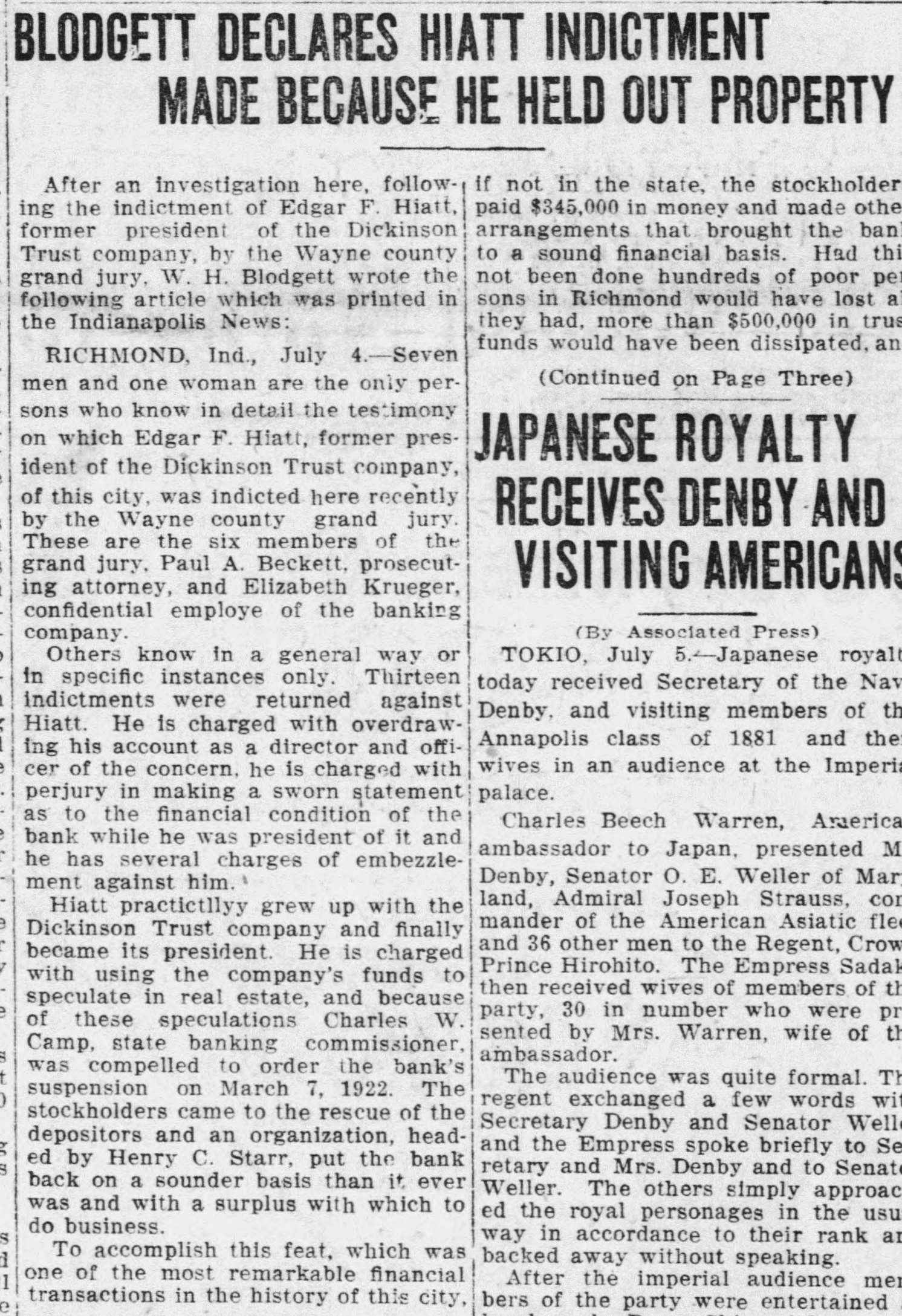
RICHMOND, Ind., April 6.-The spe- cial committee that is making an in- vestigation of the affairs of Edgar F. Hiatt, former president of the Dickin- son Trust company, which was closed a short time ago by the state banking department after it was revealed that there was a shortage of $661,000 in the bank and which has now been reopen- ed, has found that Hiatt's name did not appear in many deals in real estate the committee says he made with the money and securities belonging to the trust company. This was particularly true in his methods of handling apart- ment buildings.
Mr. Hiatt's plan, as set out to the committee, was to use the money and securities of the trust company to finance a deal for an apartment, using land dealers to carry the deal through. His plan, it is said, was to organize a stock company for the pur- chase of the particular apartment prop- erty he had in mind. This company would issue common stock to two or three persons in the company that was to take over the particular apartment building that Hiatt was after. Then a certain amount of preferred stock would be issued to the members of the company, but this stock had no voting power.
Payment of Dividends
These shares of stock would be reg- istered through the Dickinson Trust company and the stockholders would have no knowledge of the actual own- ers of the securities that were used in the deal. The investigating commit- tee asserts that not only would Hiatt take money and securities from the Dickisnon Trust company to finance the apartment deals, but he would take money from the Dickinson Trust com- pany to pay dividends on the stock that was to buy the apartment.
Besides this, it is asserted by the investigating committee that Hiatt would use the money and securities of the Dickinson Trust company to repair and maintain the property. At different times Hiatt was interested in the Glass block, at Marion; the Brock block, at Anderson; the Wayne apartments, at Richmond; the Maxim building, at Newcastle. As far as has been learned by the investigating com- mittee Hiatt at this time has no equit- ies in any of these properties from which the stockholders of the Dickin- son Trust company can get returns.
The deal by which Hiatt obtained an interest in the Brock block, at An- derson, was started by Albert Gregg, real estate operator in Richmond. Mr. Gregg said that Mr. Hiatt asked him to look over the building at Anderson, and later told him to take a deed to the building and manage the property. After six months, Gregg says, Mr. Hiatt said that the building had been turned over to the Brock Realty com- pany.
What Records Show
An examination of the records at Anderson by the investigating com- *mittee shows that Albert W. Gregg, of Richmond, bought the Brock apart- ment building from Frank Brock, of Anderson, for a sum of approximately $160,000. At the time of the sale there were two mortgages on the property, one for $40,000 held by the Provident Life and Trust company, of Philadel- phia, and the other for $33,000 held by the Citizens bank, at Anderson.
The Brock Realty company, of An- derson, was organized with a capital stock of $225,000, which capitalization was later reduced to $200,000. The stockholders and officers of the Brock Realty company were Albert W. Gregg, president; Robert J. Buck, sec- retary, and Edgar F. Hiatt. The $33,- 000 mortgage held by the Citizens' bank, at Anderson, was released in July, 1921, by an Indianapolis bank. The understanding is that Mr. Brock in disposing of the property accepted about $60,000 worth of notes for the building and that some of those notes have later proved to be of doubtful
As to Rental Money
This rental money, it was under- stood, was paid to Mr. McLemore up until February 1, of this year, and since that time the rental money has turned the building back to Mr. Hiatt account because Mr. McLemore has turned the building bac kto Mr. Hiatt. The Dickinson Trust company was the depository for the funds of the Brock Realty compnay. The Brock Oil Products company, of which Frank Brock was president, is in the hands of a receiver, the former stockholders of the concern having had the Ander- son Trust company appointed to that position.
The Wayne Apartment company of Richmond was originally formed by John W. Mueller, Turner W. Hadley and Wilfred Jessup, with a capital stock of $50,000, but a few days later the articles of incorporation were changed to provide for $100,000 of common stock and the same amount of preferred stock. Edgar F. Hiatt was a stockholder in this company and the claim of the investigation com- mittee is that the property was really bought by Hiatt with the money of the Dickinson Trust company, that the expenses were kept up by funds of the Dickinson Trust company, that div- idends on the preferred stock issued by the company were paid from funds of the Dickinson Trust company, and that the rentals of the Wayne apart- ment went to Mr. Hiatt, and that Mr. Mueller, Mr. Hadley and Mr. Jessup received no benefits from the deal and, as far as has been ascertained, received no money or securities that was the property of the Dickinson Trust company.
Hiatt in Background
The same way of obtaining control was used in getting the Maxim build- ing at Newcastle, it is said. The in- vestigating committee has not yet gone far enough into the Newcastle end of the deal to determine whether or not Hiatt still has an interest in that building or whether there is any chance for the stockholders of the Dickinson Trust company, which was reorganized and the bank reopened last week, to be reimbursed for the money the committee says Hiatt put into the building.
The committee has found few in- stances where Hiatt appeared promi- nently in these real estate deals. He did not appear to any great extent in the real estate deals of Indianapolis and for that reason he did not pay any taxes in Marion county on the property in which he was interested.
It has been reported to the investi- gation committee that on the Chicago properties Hiatt received about $92,- 000 a year in rentals, and that none of this money was turned in to the Dickinson Trust company, although the money and securities of the Dick- inson Trust company were used ac- cording to the committee's statement in financing the Chicago deals. Be- cause of these things, members of the committee believe that Hiatt still has resources that have for some rea- son not been turned over to the stock- holders of the Dickinson Trust com- pany, and a probe will be made to ascertain whether this condition real- ly exists. Friends of Mr. Hiatt say that bad trades and general conditions in the real estate market is the cause of the failure, and Mr. Hiatt to a friend said that he felt satisfied that if he had not been interferred with he would have been able to work out all of the deals and no one would have lost any- thing. It is understood that Mr. Hiatt does not deny he used the money and securities of the Dickinson Trust com- pany in financing certain of these deals, and will, it is thought, in a short time make a public statement setting forth all the details of his participation in affairs that caused the failure of the Dickinson Trust company.