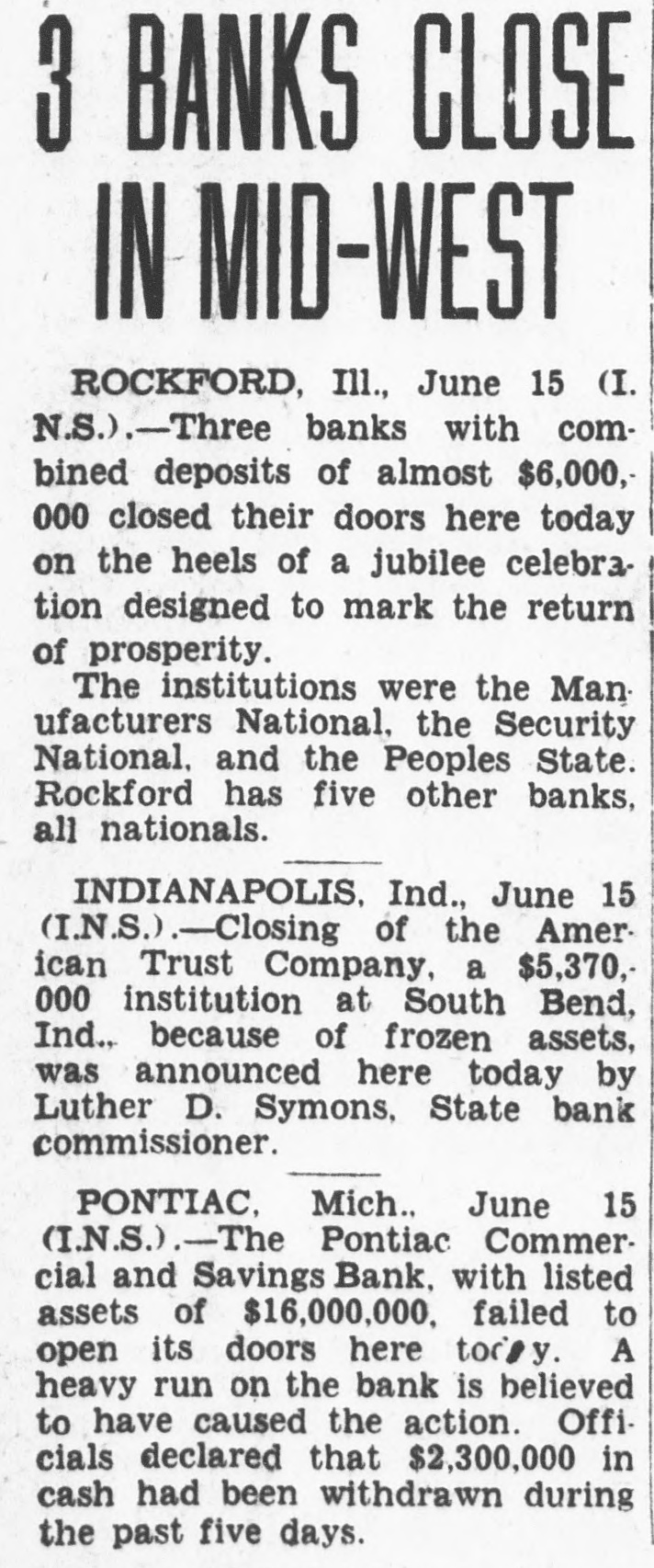
Article Text
SOUTH BEND PLAN IS BOOSTED AT MEETING
(Continued from Page One)
sidered virtually worthless," Mr. Robinson declared. "Furthermore, it has reduced the number of depositors on our books from 10,000 to 4,500 at the present time.
"Our assets, as a result of its operation, have become more valuable and our liabilities have been reduced $925,000.
"It is an extra-legal measure, inasmuch as it will not be sanctioned or condemned by the state banking department; but our experience with it proves it to be a wise, sound, and business-like method of meeting a desperate emergency.
"We have succeeded in saving numerous business enterprises which otherwise would have gone to the wall. Furthermore, we have drawn more actual cash into circulation than before the plan was introduced."
Mr. Robinson then went into the details of operation. He said his bank had adopted an arbitrary valuation of 50 per cent of the face value of each account affected by the plan. In other words, if an account was worth $100 while the bank was in operation, it was discounted 50 per cent in the new plan and the bank, therefore, traded it in at $50.
Stores and professional people, on the other hand, accepted the account at from 50 to 100 per cent of its face value, depending on the type of purchase made or service rendered. Then they used the account at 50 per cent of its face value to offset an obligation which they owed the bank.
Thus, according to Mr. Robinson, everybody benefited. The bank's worthless assets became more valuable with liquidation, depositors found a means to use their impounded monies, and business, in general, enjoyed the stimulating effect of a more rapid turnover.
Albert McGann, liquidating agent for the American Trust company of South Bend, was the next to explain the plan. He said his bank handled more commercial accounts than did the Union Trust company and that, therefore, a better measure of its value could be obtained from his experience with the plan.
He declared that liquidation first was started on the worst loans in the bank. Gradually, these loans became more valuable with liquidation until, today, most of the lower grade loans have been advanced to higher classifications and, thus, the bank's assets have been made more valuable with a corresponding beneficial result accruing to depositors and creditors alike.
The two bankers asserted that they are showing surplus earnings every month over the cost of liquidation, that liabilities have been reduced one-third, and that actual distress among indigent depositors has been relieved substantially. Business, too, has benefited proportionately, they declared.
Virtually the same opinion was