International Trust Company (New York, NY)

Episode Information

Episode Type
Run → Suspension → Reopening
Start Date
October 25, 1907
Location
New York, New York (40.714, -74.006)
Bank Type
trust

Metadata

Notes

Institution suspended during the Panic of 1907; later placed in receivership amid fraud findings and reorganized by mid-1908.

Events (5)

1. October 25, 1907 Run
Cause
Macro News
Cause Details
Panic of October 1907: heavy withdrawals and runs on trust companies causing inability to secure cash.
Measures
Announced suspension until restoration of public confidence; deposits meetings and examination by counsel.
Newspaper Excerpt
Runs on Banks Continue, But They Are Prepared. ... The International Trust Company, 206 Broadway, Manhattan, announced its suspension until the restoration of public confidence.
Source
newspapers
2. October 25, 1907 Suspension
Cause
Macro News
Cause Details
Closed due to inability to secure ready cash amid widespread runs during the 1907 financial panic.
Newspaper Excerpt
The International Trust Company, of 206 Broadway, did not open for business today, and its suspension involved the Borough Bank of Brooklyn...
Source
newspapers
3. November 16, 1907 Receivership
Newspaper Excerpt
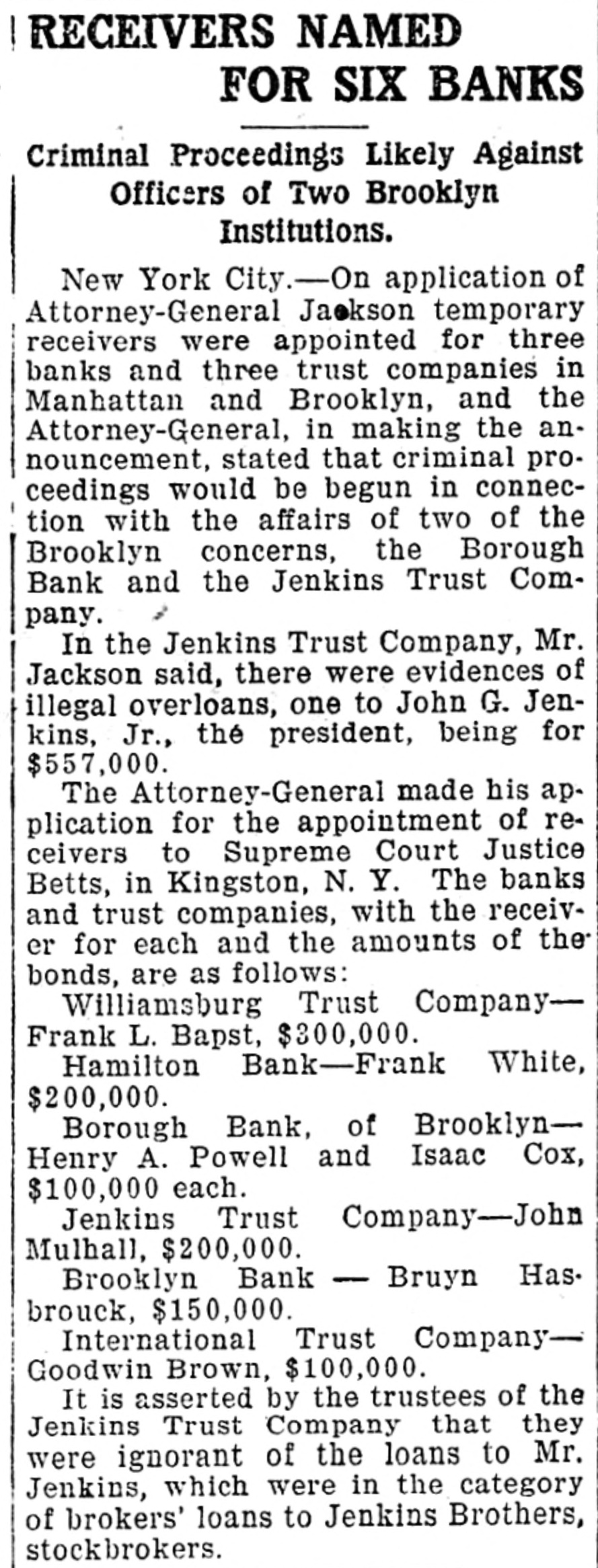
Temporary receivers were appointed today for six New York city banks and trust companies which recently suspended... International Trust company included.
Source
newspapers
4. November 30, 1907 Other
Newspaper Excerpt
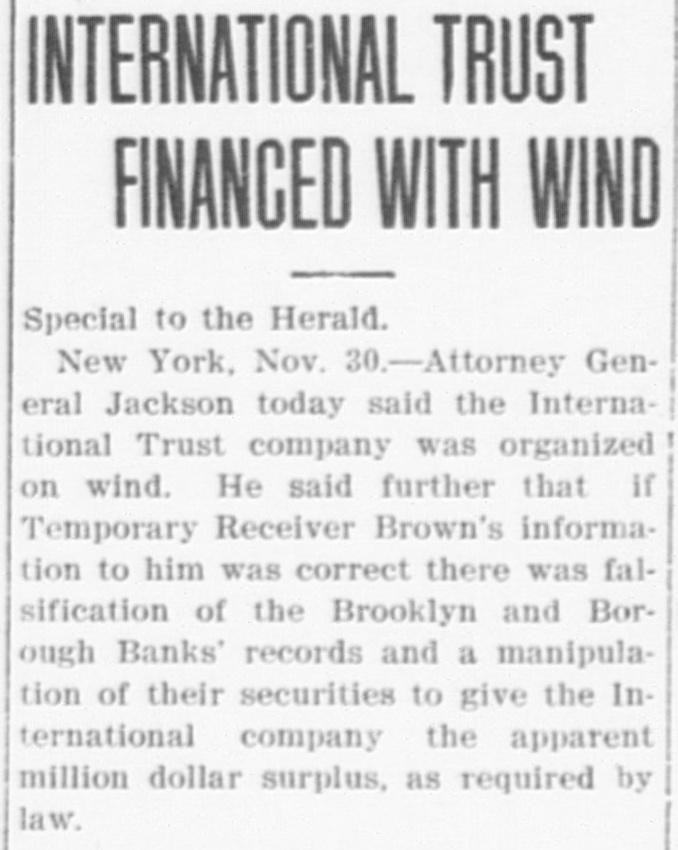
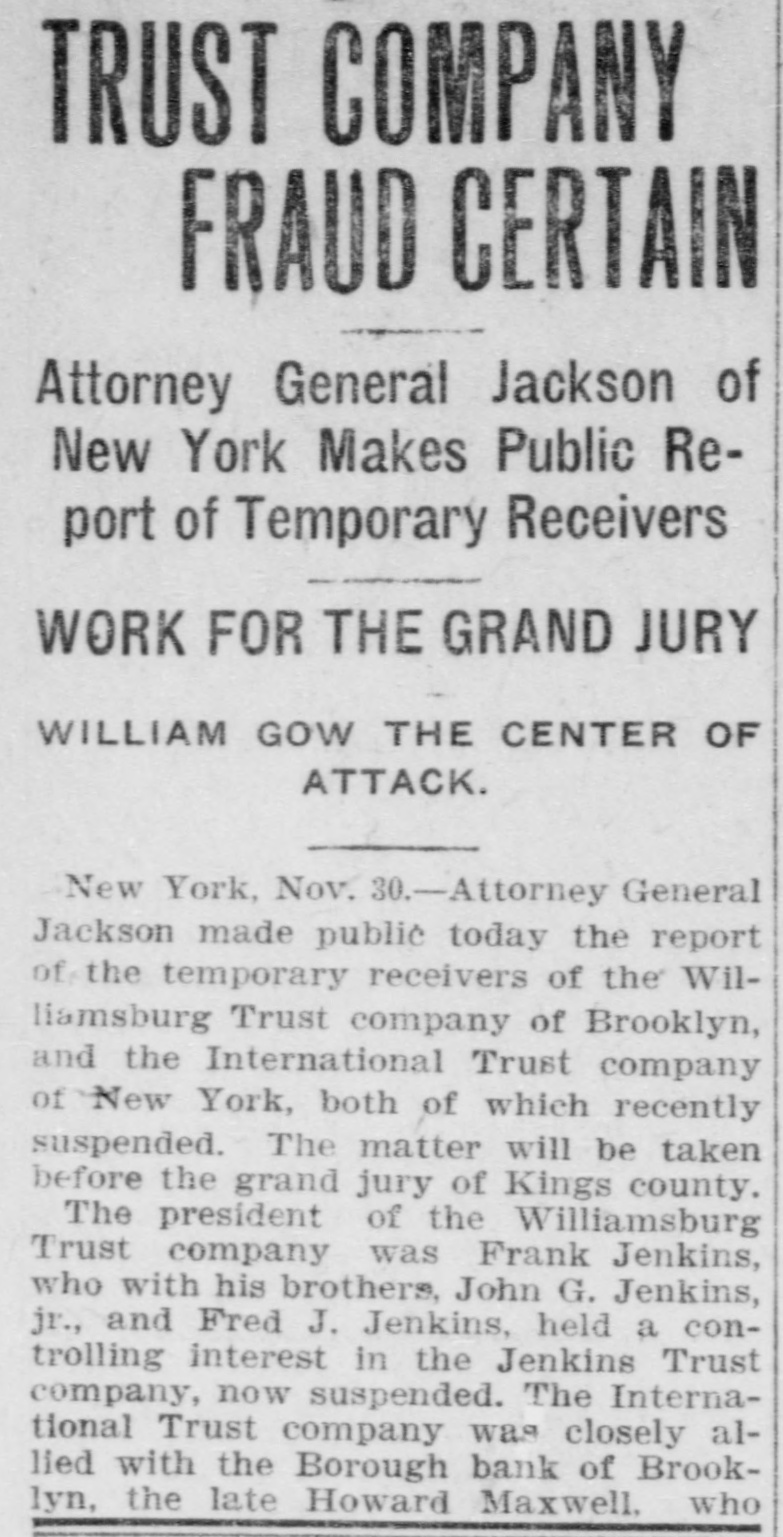
Attorney General Jackson said the International Trust company was organized on wind... falsification of the Brooklyn and Borough Banks' records and manipulation of their securities was alleged in receivers' reports.
Source
newspapers
5. July 2, 1908 Reopening
Newspaper Excerpt
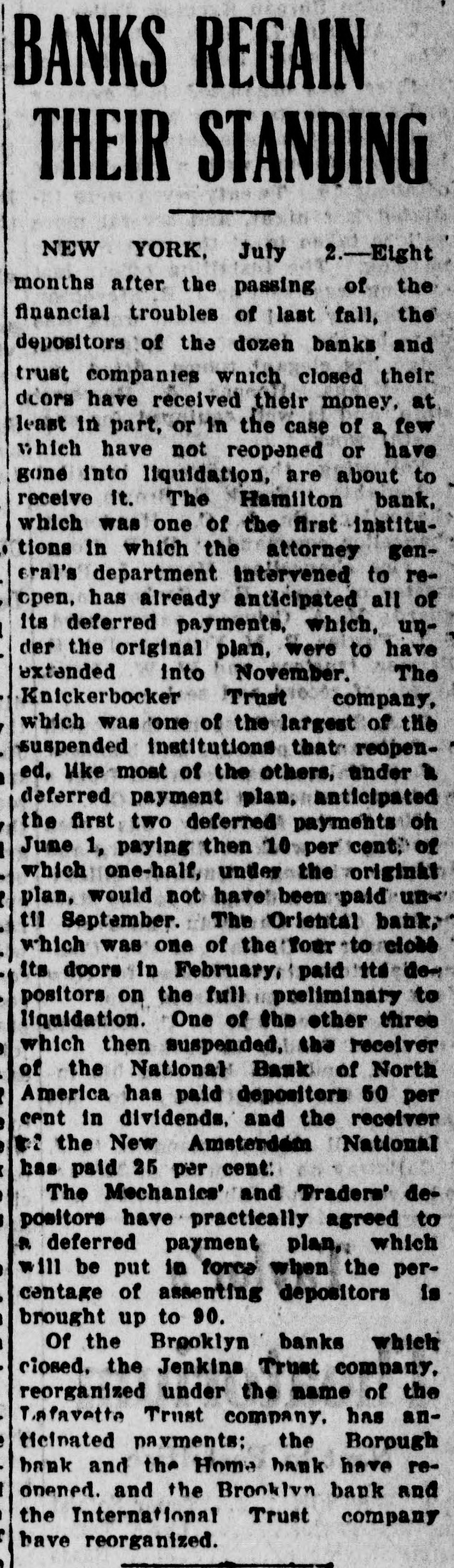
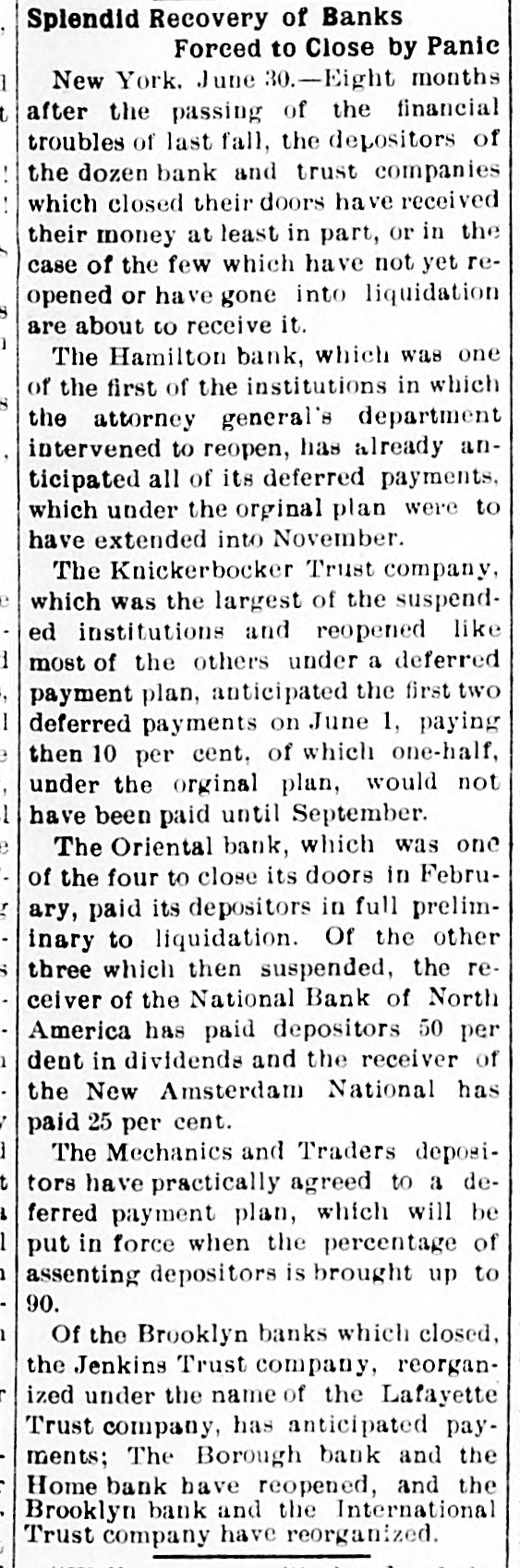
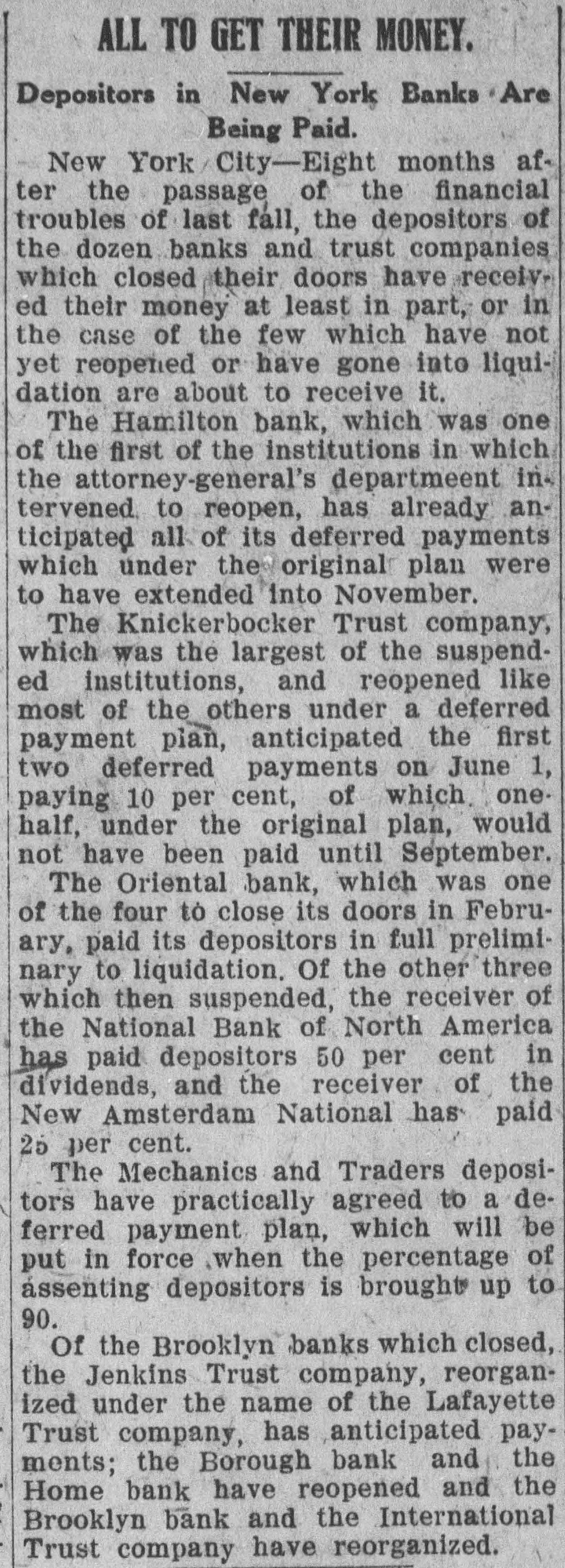
The Brooklyn bank and the International Trust company have reorganized.
Source
newspapers

Newspaper Articles (24)

Article from The Washington Times, October 25, 1907

Click image to open full size in new tab

Article Text

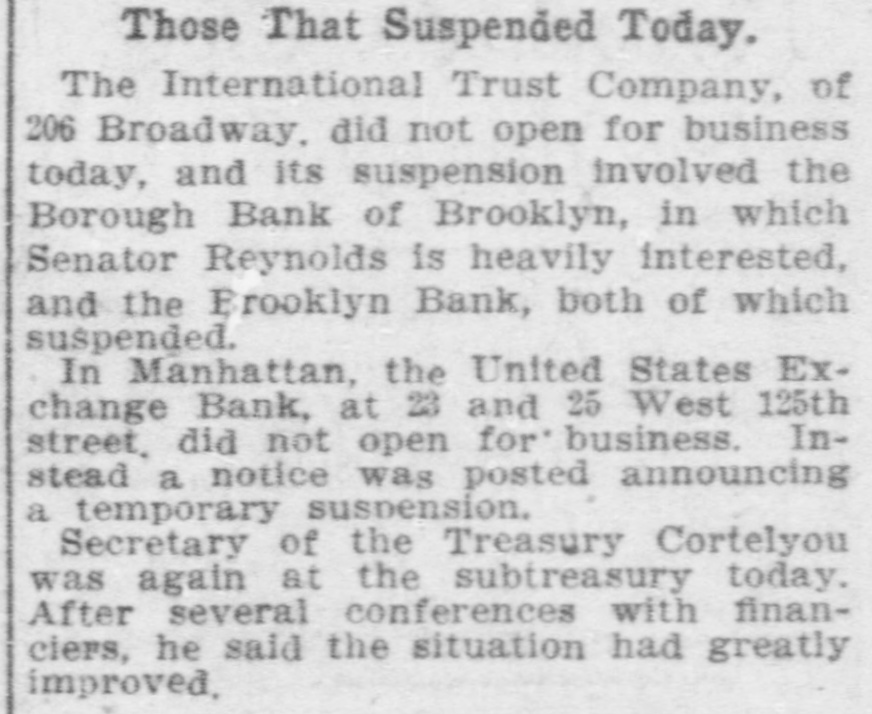
Those That Suspended Today

The International Trust Company, of 206 Broadway. did not open for business today, and its suspension involved the Borough Bank of Brooklyn, in which Senator Reynolds is heavily interested, and the Brooklyn Bank, both of which suspended. In Manhattan, the United States Exchange Bank, at 23 and 25 West 125th street, did not open for business. Instead a notice was posted announcing a temporary suspension. Secretary of the Treasury Cortelyou was again at the subtreasury today. After several conferences with financiers, he said the situation had greatly improved.


Article from The Washington Times, October 25, 1907

Click image to open full size in new tab

Article Text

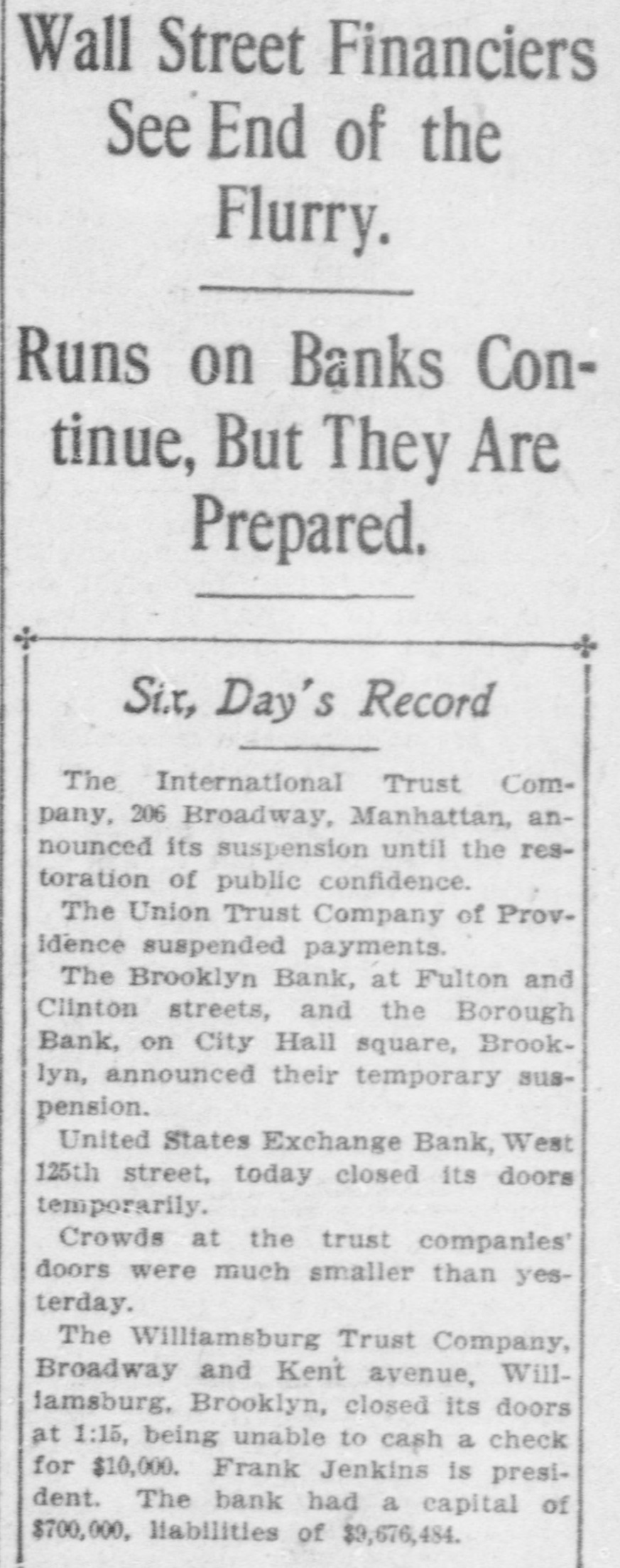
Wall Street Financiers See End of the Flurry. Runs on Banks Continue, But They Are Prepared. Six, Day's Record The International Trust Company, 206 Broadway, Manhattan, announced its suspension until the restoration of public confidence. The Union Trust Company of Providence suspended payments. The Brooklyn Bank, at Fulton and Clinton streets, and the Borough Bank, on City Hall square, Brooklyn, announced their temporary suspension. United States Exchange Bank, West 125th street, today closed its doors temporarily. Crowds at the trust companies' doors were much smaller than yesterday. The Williamsburg Trust Company, Broadway and Kent avenue, Willlamsburg, Brooklyn, closed its doors at 1:15, being unable to cash a check for $10,000. Frank Jenkins is president. The bank had a capital of $700,000, liabilities of $9,676,484.


Article from The Evening World, October 25, 1907

Click image to open full size in new tab

Article Text

FIRST NATIONAL OF BROOKLYN AND SIX OTHER BANKS CLOSE

SITUATION AT A GLANCE.

Secretary Cortelyou said after the close of banking hours:

"The situation is good. This is the third day, and I see no setback of serious import. I shall probably remain in the city all day tomorrow, and if there is no critical development—which I see no sign of at this time and do not expect by any means—I shall return to Washington."

The First National Bank of Brooklyn, a Clearing-House institution; the Williamsburg Trust Company and the Jenkins Trust Company of Brooklyn, with numerous branches, suspended temporarily. The solvency of the institution has not been questioned.

President William A. Nash, of the Corn Exchange Bank, said:

"The outlook is decidedly better, and I think the crucial point has been passed. The failure of the smaller banks is not disturbing. They did not have much cash on hand and it was better for them to suspend than to stand a run. They are perfectly solvent and will be able to resume business when the present hysteria subsides."

The International Trust Company, of No. 206 Broadway; the Brooklyn Bank and the Borough Bank of Brooklyn failed to open their doors for business.

The Union Dime Savings Bank, Thirty-second street and Broadway, with deposits of over $27,000,000, has given notice that it will require thirty days' notice in writing of intent to withdraw. Other savings banks have adopted this course.

J. Pierpont Morgan and half a dozen bankers raised a pool of $10,000,000 late this afternoon which was loaned on call on the Stock Exchange to protect the market.

International banking houses have arranged to import between $10,000,000 and $15,000,000 in gold from Europe.

The Lincoln Trust Company, the Trust Company of America, the Colonial Trust Company and the Harlem Savings Bank safely weathered runs. The trust companies received substantial aid and the Harlem Savings Bank took advantage of the sixty-day clause.

Secretary of the Treasury Cortelyou placed about $8,000,000 in New York banks during the day, a total of $30,000,000 since last Friday.

Superintendent of Banks Clark Williams said that conditions have improved and will continue to improve if bank depositors are reasonable.

The stock market passed through a precarious, feverish day, closing in a skyrocket finish that sent the general range of prices away above yesterday's final quotations.

State Bank Examiner Leonard stated that the Lincoln Trust Company is in a solvent condition.

An officer of the Hanover National Bank suggested that Gov. Hughes proclaim special holidays enabling the banks to close next week to allow the arrival of gold from abroad. Gov. Hughes, over the long-distance telephone, said he had no power to order such holidays.

A shipment of $2,500,000 in small bills was received from the United States Treasury in Washington.

Ernst Thalman, Otto T. Bannard and Gen. Henry C. Ide were appointed temporary receivers of the Knickerbocker Trust Company.

Before the close of the stock market Halstead & Hodges and Van Emburgh & Atterbury, brokers, loaned on the floor of the Stock Exchange $10,000,000 of the syndicate money at 50 per cent.

The amount pledged by the Clearing House banks to the aid of the Stock Exchange will be between $12,000,000 and $15,000,000.

Williamsburg and Jenkins Concerns, Belonging to the Jenkins String of Banking Institutions, Temporarily Close Their Doors.

THERE WAS VERY LITTLE EXCITEMENT AT EITHER BANK

Borough and Brooklyn Banks and International Trust Company Had Been Forced to Suspend Earlier in the Day.

In rapid succession the Williamsburg Trust Company and its branch on Fulton street, Brooklyn, the Jenkins Trust Company and all its branches and the First National Bank of Brooklyn closed their doors this afternoon for lack of ready cash.

In each instance it was announced that the suspension was temporary and that all the institutions would reopen as soon as currency for carrying on business could be secured.

All the institutions that are affected belong in what is known as the Jenkins string of banking companies which enjoy the best of reputation. It is stated that they are absolutely solvent.
Article from Daily Press, October 26, 1907

Click image to open full size in new tab

Article Text

THREE SMALL BANKS
CLOSE THEIR DOORS

New York Capitalists Say They Have No Bearing on Situation and Conditions Are Better.

YESTERDAY A NERVE-RACKING DAY

Savings Banks Compel Depositors to Give Thirty or Sixty Days Notice of Withdrawal of Accounts-Plenty of Money on the Stock Exchange- Clearing House Certificates.

(By Associated Press.) NEW YORK, Oct. 25.-Another nerve racking day has passed but the financial institutions of New York have shown extraordinary power of resistance to the pressure put upon them.

While it is true that several minor institutions have been forced to close their doors, yet two things should be said about them-first, that the amount involved was not so great as to exert any marked influence on the general situation as those banks were located in residential quarters and did not come into touch with the larger financial institutions of the metropolis, and second-that there are several rea- sons to believe that these banks and trust companies are entirely solvent and their difficulties will prove to be only temporary and due entirely to in- ability to secure ready cash on gilt- edged securities in their vaults.

In the light of the general excite- ment, the savings banks thought it wise to put into effect the rule re quiring thirty to sixty days notice for the withdrawal of deposits and this will prevent the withdrawal of money which would otherwise be put in safety deposit boxes. The savings banks, if they continued to make pay- ments, would be obliged to withdraw funds from the National banks, there- by causing an additional strain on the general banking situation. There was not the slightest hint that any of the savings institutions was in anything but in the soundest condition as it was pointed out that the savings banks of this state are so restricted by law in investing their money that there can be no question that all of the securities in their possession are of good value and readily salable in normal times.

The institutions which closed their doors today with the sums due de- positors, were: the United States Ex- change Bank, Harlem, $6,600,000. In- ternational Trust Company, Brooklyn, $7,500,000. The First National Bank of Brooklyn, $3,500,000.

The First National Bank of Brook- lyn the Williamsburg Trust Company and the International Trust Company, were allied institutions. None of these companies had important con- nections with the larger banks, which are representative of the city's finan- cial affairs.

On the other hand, a number of fa- vorable features marked the day. The Trust Company of American and the Lincoln Trust Company, the two or- ganizations which have suffered most from runs, have been slowly paying out their deposits and closed today with all demands having been met. In the case of the Trust Company of America, the run has well nigh spent its force as the bulk of the depositors have been paid off. At the close of business there were a good many in line at the Lincoln Trust Company, but also there was a marked reduction in the number of anxious depositors. Plenty of Money for Stock Exchange.

The most favorable incident of the day was that the Stock Exchange was provided with funds ample to meet its immediate necessities by a money pool headed by J. Pierpont Morgan, which sent about $15,000,000 to the Exchange during the afternoon. As all the loans made today hold over until Monday, the Stock Exchange situation will not be affected in the problems that bankers may be called upon to solve tomorrow.

A very encouraging feature of the afternoon's developments was a sign- ed statement by Clark Williams, the newly appointed state superintendent of banking, affirming the solvency of the local institutions.

A further encouraging development of the afternoon, the good effect of which can scarcely be over estimated, was the decision arrived at, unofficial- ly, to issue clearing house certificates, probably tomorrow. There will be a full meeting of the clearing houses a- ssociation tomorrow morning at 11 o'clock for the purpose of taking of- ficial action for the issuance of these certificates.

The immediate effect of this will be to enable the banks to settle the bal- ances between themselves with these certificates, and thereby release large sums of currency for the regular needs of business.

Clearing House Certificates. The decision to issue clearing house


Article from The Washington Herald, October 26, 1907

Click image to open full size in new tab

Article Text

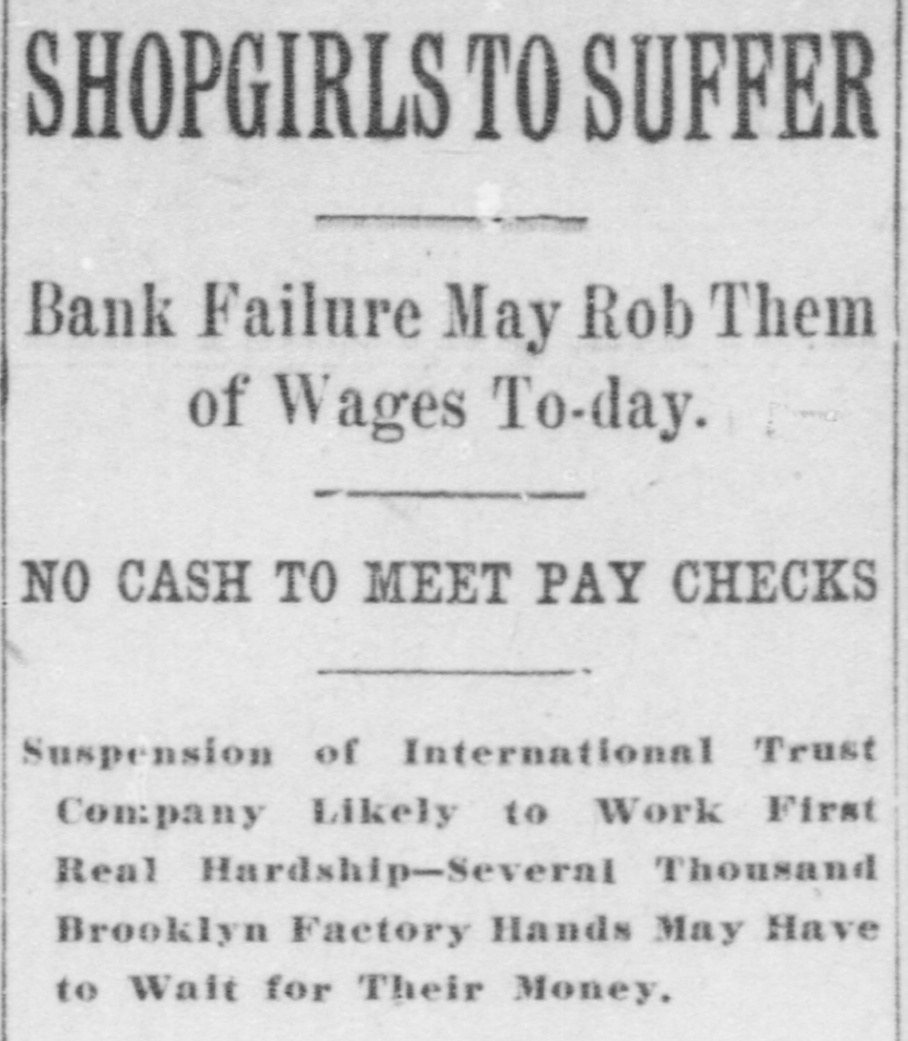
SHOPGIRLS T TO SUFFER Bank Failure May Rob Them of Wages To-day. NO CASH TO MEET PAY CHECKS Suspension of International Trust Company Likely to Work First Real Hardship-Several Thousand Brooklyn Factory Hands May Have to Wait for Their Money.


Article from The Bemidji Daily Pioneer, October 26, 1907

Click image to open full size in new tab

Article Text

Small Trust Company Fails

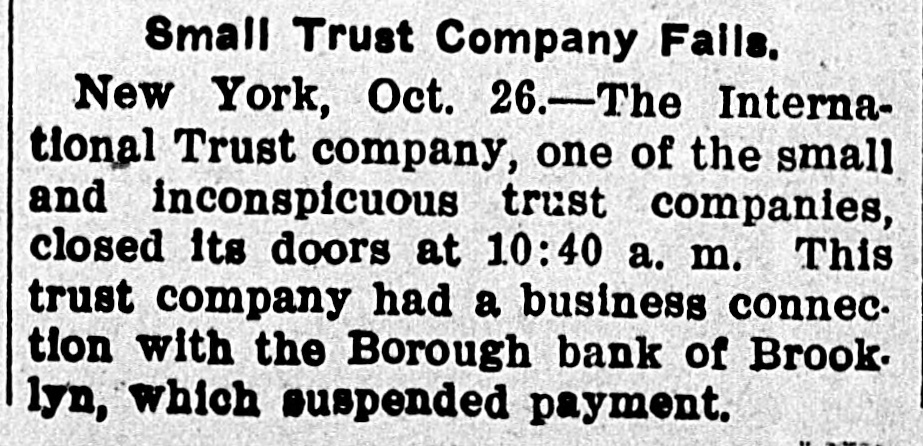
New York, Oct. 26.-The International Trust company, one of the small and inconspicuous trust companies, closed its doors at 10:40 a. m. This trust company had a business connection with the Borough bank of Brook. lyn, which suspended payment.


Article from The Ocala Evening Star, October 26, 1907

Click image to open full size in new tab

Article Text

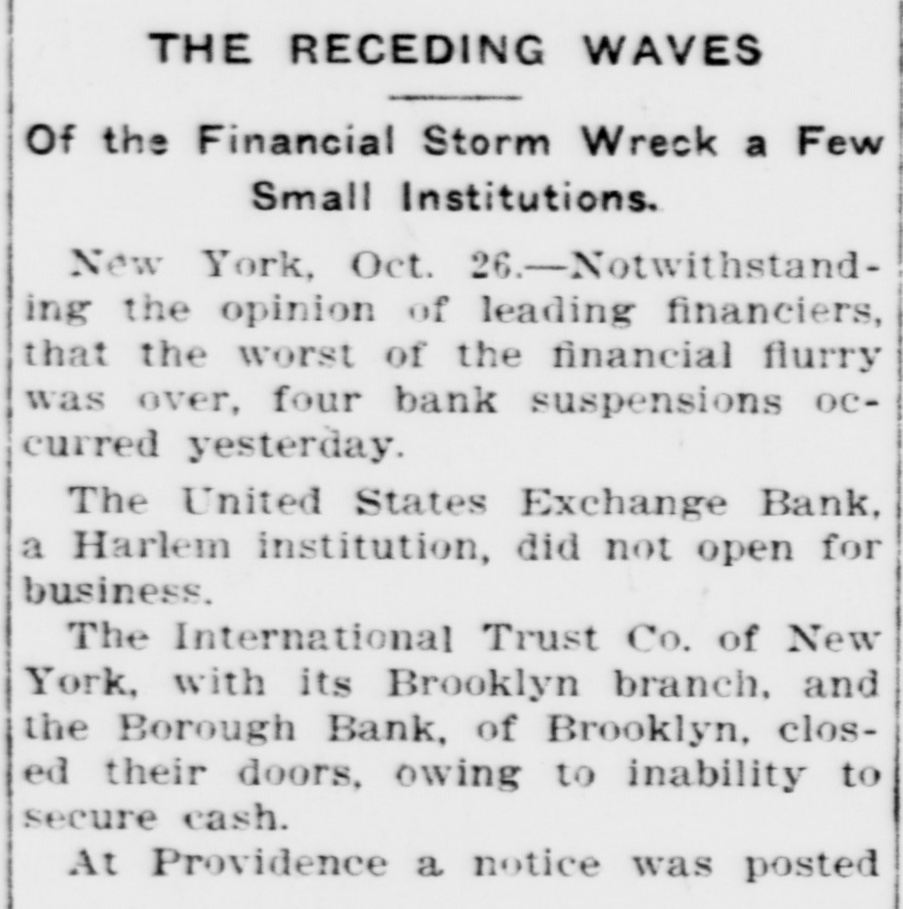
THE RECEDING WAVES Of the Financial Storm Wreck a Few Small Institutions. New York, Oct. 26.-Notwithstanding the opinion of leading financiers, that the worst of the financial flurry was over, four bank suspensions OCcurred yesterday. The United States Exchange Bank, a Harlem institution, did not open for business. The International Trust Co. of New York, with its Brooklyn branch, and the Borough Bank, of Brooklyn, closed their doors, owing to inability to secure cash. At Providence a notice was posted


Article from The News-Democrat, November 16, 1907

Click image to open full size in new tab

Article Text

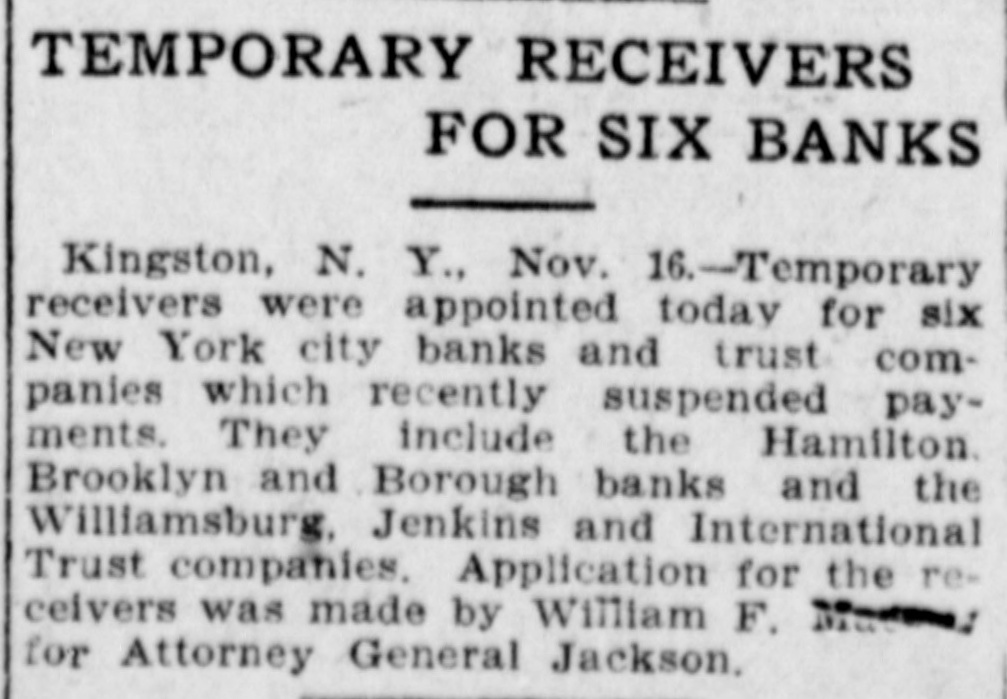
TEMPORARY RECEIVERS FOR SIX BANKS Kingston, N. Y., Nov. 16.-Temporary receivers were appointed today for six New York city banks and trust companies which recently suspended payments. They include the Hamilton. Brooklyn and Borough banks and the Williamsburg, Jenkins and International Trust companies. Application for the receivers was made by William F. Mat for Attorney General Jackson.


Article from The Barre Daily Times, November 18, 1907

Click image to open full size in new tab

Article Text

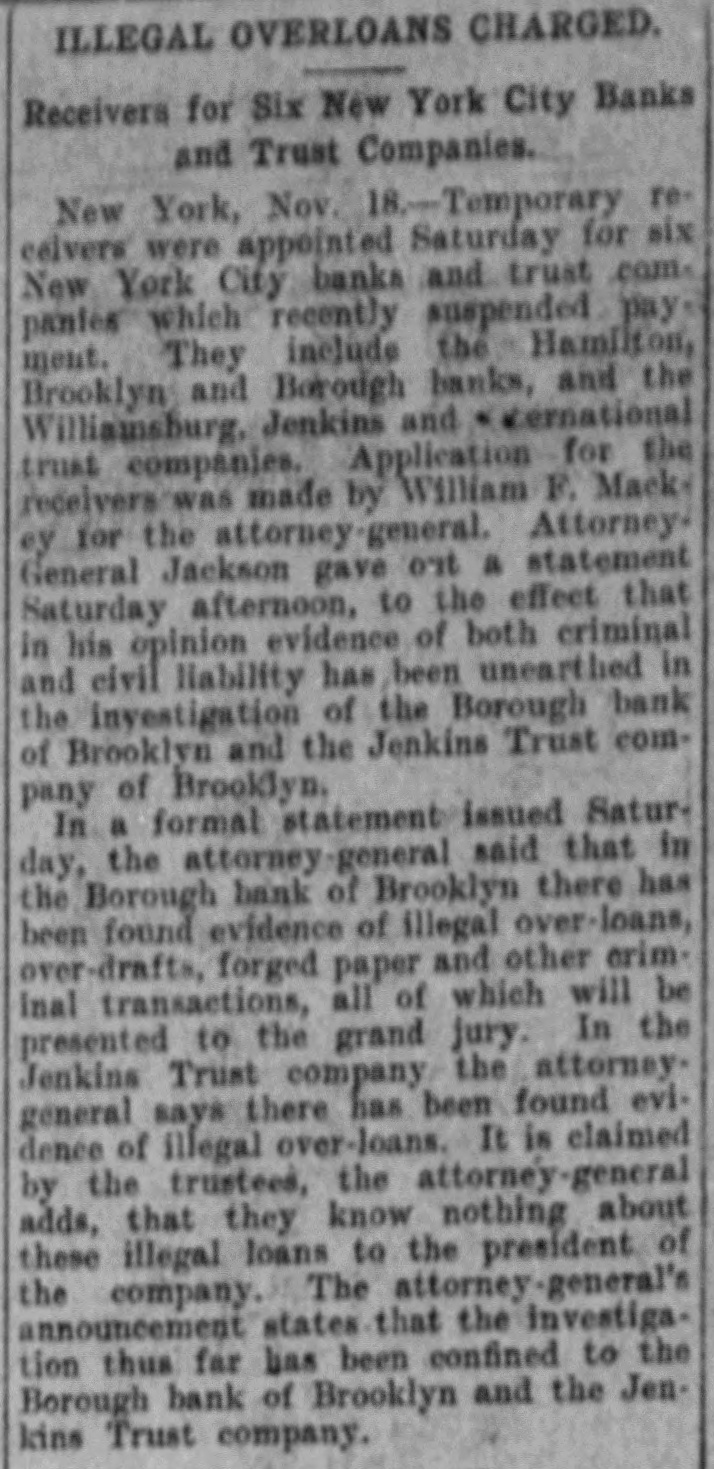
ILLEGAL OVERLOANS CHARGED

Receivers for Six New York City Banks and Trust Companies. New York, Nov. 18.-Temporary recelvers were appointed Saturday for six New York City banks and trust companies which recently suspended pay. ment. They include the Hamilton, Brooklyn and Borough banks, and the Williamsburg, Jenkins and cernational trust companies. Application for the receivers was made by William F. Mackey for the attorney-general. AttorneyGeneral Jackson gave ont a statement Saturday afternoon, to the effect that in his opinion evidence of both criminal and civil liability has been unearthed in the investigation of the Borough bank of Brooklyn and the Jenkins Trust company of Brooklyn. In a formal statement issued Saturday, the attorney-general said that in the Borough bank of Brooklyn there has been found evidence of illegal over-loans, over-drafts, forged paper and other crimInal transactions, all of which will be presented to the grand jury. In the Jenkins Trust company the attorney. general says there has been found evidence of illegal over-loans. It is claimed by the trustees, the attorney-general adds, that they know nothing about these illegal loans to the president of the company. The attorney-general's announcement states that the investigation thus far has been confined to the Borough bank of Brooklyn and the Jenkins Trust company.


Article from The Bennington Evening Banner, November 18, 1907

Click image to open full size in new tab

Article Text

Receivers For Six New York Banks. KINGSTON, N. Y., Nov. 18.-Temporary receivers were appointed for six New York city banks and trust companies which recently suspended payment. They include the Hamilton, Brooklyn and Borough banks and the Williamsburg, Jenkins and International Trust companies. Application for the receivers was made by William F. Mackey for Attorney General Jackson.


Article from New-York Tribune, November 22, 1907

Click image to open full size in new tab

Article Text

THREE BANK ARRESTS

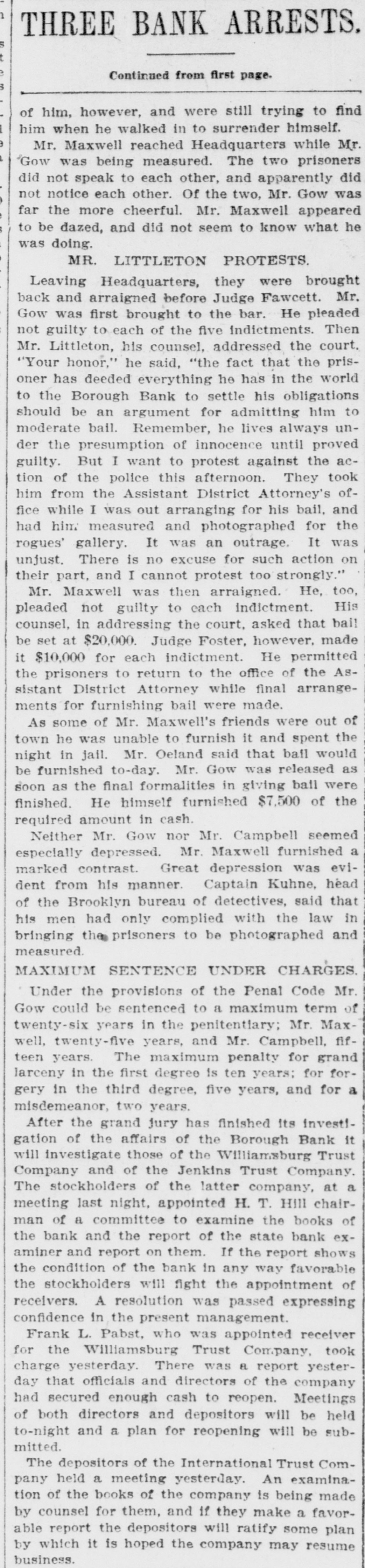
Continued from first page. $ of him, however, and were still trying to find him when he walked in to surrender himself. I 9 Mr. Maxwell reached Headquarters while Mr. s Gow was being measured. The two prisoners did not speak to each other, and apparently did not notice each other. Of the two, Mr. Gow was far the more cheerful. Mr. Maxwell appeared to be dazed, and did not seem to know what he was doing. MR. LITTLETON PROTESTS. Leaving Headquarters, they were brought back and arraigned before Judge Fawcett. Mr. Gow was first brought to the bar. He pleaded not guilty to each of the five indictments. Then Mr. Littleton, his counsel, addressed the court. "Your honor," he said, "the fact that the prisoner has deeded everything he has in the world to the Borough Bank to settle his obligations should be an argument for admitting him to moderate bail. Remember, he lives always under the presumption of innocence until proved guilty. But I want to protest against the action of the police this afternoon. They took him from the Assistant District Attorney's office while I was out arranging for his bail, and had him measured and photographed for the rogues' gallery. It was an outrage. It was unjust. There is no excuse for such action on their part, and I cannot protest too strongly." Mr. Maxwell was then arraigned. He, too, pleaded not guilty to each indictment. His counsel, in addressing the court, asked that bail be set at $20,000. Judge Foster, however, made it $10,000 for each indictment. He permitted the prisoners to return to the office of the Assistant District Attorney while final arrangements for furnishing bail were made. As some of Mr. Maxwell's friends were out of town he was unable to furnish it and spent the night in jail. Mr. Oeland said that bail would be furnished to-day. Mr. Gow was released as soon as the final formalities in giving ball were finished. He himself furnished $7,500 of the required amount in cash. Neither Mr. Gow nor Mr. Campbell seemed especially depressed. Mr. Maxwell furnished a marked contrast. Great depression was evident from his manner. Captain Kuhne, head of the Brooklyn bureau of detectives, said that his men had only complied with the law in bringing the prisoners to be photographed and measured MAXIMUM SENTENCE UNDER CHARGES Under the provisions of the Penal Code Mr. Gow could be sentenced to a maximum term of twenty-six years in the penitentlary; Mr. Maxwell, twenty-five years, and Mr. Campbell, fifteen years. The maximum penalty for grand larceny in the first degree is ten years; for forgery in the third degree, five years, and for a misdemeanor, two years. After the grand jury has finished its investigation of the affairs of the Borough Bank it will investigate those of the Williamsburg Trust Company and of the Jenkins Trust Company. The stockholders of the latter company, at a meeting last night, appointed H. T. HIII chairman of a committee to examine the books of the bank and the report of the state bank examiner and report on them. If the report shows the condition of the bank in any way favorable the stockholders will fight the appointment of receivers. A resolution was passed expressing confidence in the present management. Frank L. Pabst, who was appointed receiver for the Williamsburg Trust Company, took charge yesterday. There was a report yesterday that officials and directors of the company had secured enough cash to reopen. Meetings of both directors and depositors will be held to-night and a plan for reopening will be submitted. The depositors of the International Trust Company held a meeting yesterday. An examination of the books of the company is being made by counsel for them, and if they make a favorable report the depositors will ratify some plan by which it is hoped the company may resume business.


Article from Palestine Daily Herald, November 30, 1907

Click image to open full size in new tab

Article Text

INTERNATIONAL TRUST FINANCED WITH WIND Special to the Herald. New York, Nov. 30.-Attorney General Jackson today said the International Trust company was organized on wind. He said further that if Temporary Receiver Brown's information to him was correct there was falsification of the Brooklyn and Borough Banks' records and a manipulation of their securities to give the International company the apparent million dollar surplus, as required by law.


Article from The Salt Lake Herald, December 1, 1907

Click image to open full size in new tab

Article Text

TRUST COMPANY FRAUD CERTAIN Attorney General Jackson of New York Makes Public Report of Temporary Receivers WORK FOR THE GRAND JURY WILLIAM GOW THE CENTER OF ATTACK. New York, Nov. 30.-Attorney General Jackson made public today the report of the temporary receivers of the Williamsburg Trust company of Brooklyn, and the International Trust company of New York, both of which recently suspended. The matter will be taken before the grand jury of Kings county. The president of the Williamsburg Trust company was Frank Jenkins, who with his brothers, John G. Jenkins, jr., and Fred J. Jenkins, held a controlling interest in the Jenkins Trust company, now suspended. The International Trust company was closely allied with the Borough bank of Brooklyn, the late Howard Maxwell, who


Article from New-York Tribune, December 1, 1907

Click image to open full size in new tab

Article Text

BIG SUMS DRAWN OUT

BANK RECEIVERS REPORT. Trust Company Accounts Almost at Minimum Before Suspension. Reports of the temporary receivers of the Williamsburg Trust Company and the International Trust Company were made public by Attorney General Jackson yesterday. They show that large withdrawals were made from both institutions just prior to their suspension on October 25. The array of accounts that were drawn down almost to a minimum in the International Trust Company is startling. It would appear that William Gow made some $150,000 by the transfer of the lease of No. 206 Broadway, where the company did business. Deputy Attorney General Robert J. will before District all the facts he has in to-morrow Steele Special place Attorney connection and Jerome ask with the International Trust Company, that some action be taken on them. At the same time the Kings County Grand Jury for December, take which is to be sworn in to-morrow, will up the Williamsburg Trust Company Attorney General Jackson said last night that the loan committee of the Williamsburg Trust Company might be responsible for loans amounting to $220,000, which went to five clerks in the employ of the F. & J. G. Jenkins, jr., brokerage in which this corporation, all which is held by the concern. the stock farm The of ly, way members of dollars of Jenkins borrowed thousands from the Jenkins Trust Company has already been told. It is understood that it also had large loans from the First National Bank, of Brooklyn, which is in the hands of a federal receiver. More evidence has been found to show how some of the accounts in the Borough Bank were drawn down just before its suspension. Arguments were heard yesterday by Justice Bette in Albany on an application to make the receivers of suspended Brooklyn institutions permanent. The application was strenuously opposed by counsel for the banks. All the arguments were adjourned, the Borough Bank to December 10, the International Trust Company. the Brocklyn Bank, the Williamsburg Trust Company and the Jenkins Trust Company to December 12. ORGANIZED OUT OF WIND In giving out the report of Goodwin Brown, receiver for the International Trust Company. Attorney General Jackson said it would seem as if the concern had been organized largely out of whid. "If the report of the receiver is correct," he said, "there was a falsification of the books of the Borough Bank and the Brooklyn Bank and a manipulation of their securities, in order, apparently to give the International Trust Company a surplus and capital of $1.000,000. It was organized only a few weeks before it went up, and when it closed its doors had only about ninety depositors, with deposits of between $110,000 and $120,000. The report states that R. W. Jones, jr., the former president of the Oriental Bank, had a demand loan of $32,250, which was entirely unsecured. "This indebtedness has not been adjusted," says Mr. Brown. "Mr. Jones is ill, but his attorney has promised to confer with me in reference to the matter." An interesting transaction, where William Gow, the organizer of the trust company, apparently made $150,000 is related at some length. It seems that Gow paid to the trustees of the Henderson estate for the lease of No. 206 Broadway, where the trust company did businear, $107,000 in cash and gave a mortgage for $200,000. He apparently sold the lease to the trust company for $457,545 on October 21. or four days before the suspension, receiving $257.545 55 above the mortgage. He on the same day deposited stocks and bonds with the company and drew out $325,852. CONCERNING GOW'S DEAL Concerning this transaction the report has this to say: In another part of my report 1 have called attention to Gow windrawing from the company the $325,852 50 on October 21, 1907 This covered credit he received from the transfer of the leasehold of the building No. 206 Broadway, at a total cost to the company of $457,545 55. which, however, included a mortgage for $200.000 w hich Gow gave to the Henderson trustees at the time he purchased the lease from them. a He by taking out the amount he did, realized profit of $150,000 in disposing of the lease to the company On the other hand however, is to be noted the fact that on October 21 Gow also turned over of to the company stocks and bonds of the value $150,000, so that as a result of the entire transaction if the company had a balance left of about $82,293. we are to concede the full value paid by the compass for the leasehold. and that, as pointed out in another part of my report, is extremely doubtful. In my opinion, Gow originally had no intention of transferring the lease to the company Having paid $107,000 in cash on account of the purchase price paid by him to the Henderson trustees, the the rentals exceeded the charges of operating building by substantial amount It was good investment for him. but on October 21 he evidently needed money either for his own use or to put in the Borough Bank. By turning the lease over to the company on that date at the price of $257,545.65 over and above the existing mortgage for $200,000, and also turning over to the company stocks and bonds of the stated value of $157,600. he was enabled thereby to take on the Fame day from the company's cash at the Oriental Bank the sum of $225,852.50 In support of my opinion that Gow had no inten In tion originally of transferring the lease to the ternational Trust Company, call attention to the fact that the lease itself is not dated, although it The was duly acknowledged on October 21. 1907. original lease made by the Church Corporation contained a clause that in the event of an assignment of the lease being made without their consent, the Church Corporation could then re-enter. This conContinued on second page. CONGRESS OPENS DECEMBER 2ND.


Article from The Abbeville Press and Banner, December 11, 1907

Click image to open full size in new tab

Article Text

RECEIVERS NAMED FOR SIX BANKS Criminal Proceedings Likely Against Officers of Two Brooklyn Institutions. New York City.-On application of Attorney-General Jackson temporary receivers were appointed for three banks and three trust companies in Manhattan and Brooklyn, and the Attorney-General, in making the announcement, stated that criminal proceedings would be begun in connection with the affairs of two of the Brooklyn concerns, the Borough Bank and the Jenkins Trust Company. In the Jenkins Trust Company, Mr. Jackson said, there were evidences of illegal overloans, one to John G. Jenkins, Jr., the president, being for $557,000. The Attorney-General made his application for the appointment of receivers to Supreme Court Justice Betts, in Kingston, N. Y. The banks and trust companies, with the receiver for each and the amounts of the bonds, are as follows: Williamsburg Trust CompanyFrank L. Bapst, $300,000. Hamilton Bank-Frank White, $200,000. Borough Bank, of BrooklynHenry A. Powell and Isaac Cox, $100,000 each. Jenkins Trust Company-John Mulhall, $200,000. Brooklyn Bank - Bruyn Hasbrouck, $150,000. International Trust CompanyGoodwin Brown, $100,000. It is asserted by the trustees of the Jenkins Trust Company that they were ignorant of the loans to Mr. Jenkins, which were in the category of brokers' loans to Jenkins Brothers, stockbrokers.


Article from The Brunswick News, December 12, 1907

Click image to open full size in new tab

Article Text

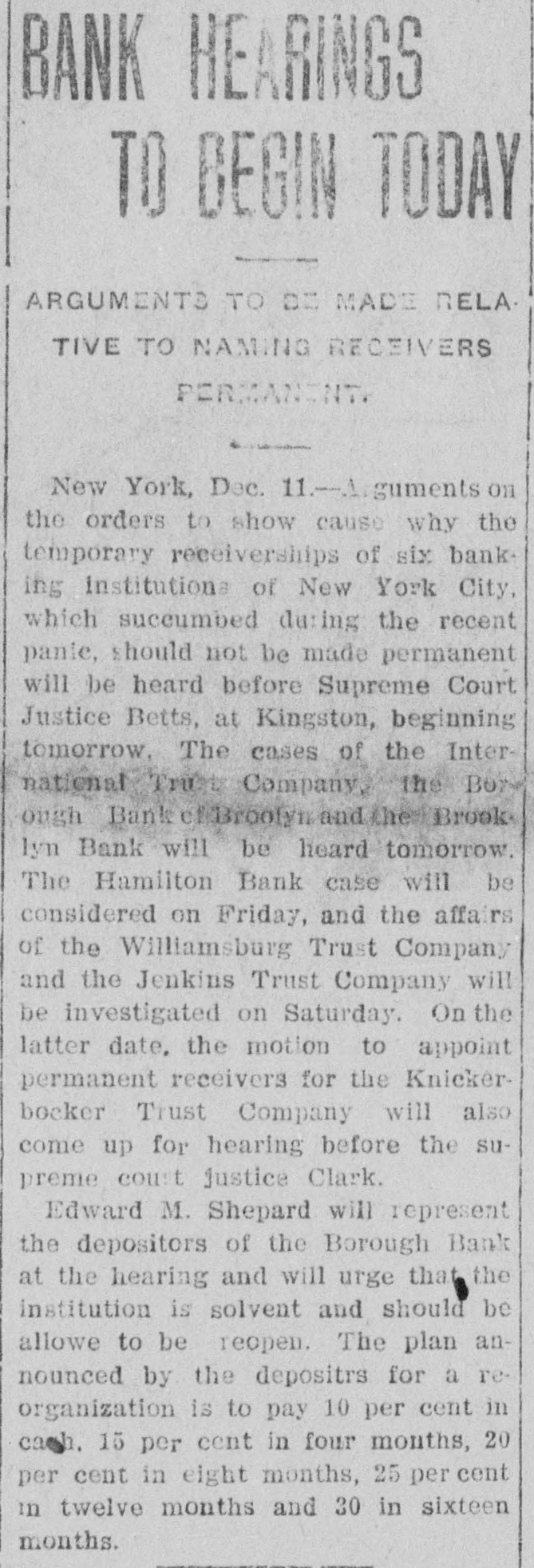
BANK HEARINGS TO BEGIN TODAY ARGUMENTS TO DE MADE RELA TIVE TO NAMING RECEIVERS PERMANENT / New York, Dec. Arguments on the orders to show cause why the temporary receiverships of six bank ing Institutions of New York City, which succumbed during the recent panie, should not be made permanent will be heard before Supreme Court Justice Betts, at Kingston, beginning tomorrow, The cases of the International Trub Company, the Box ough Bank C Broolyn and the Brook lyn Bank will be heard tomorrow. The Hamilton Bank case will be considered on Friday, and the affairs of the Williamsburg Trust Company and the Jenkins Trust Company will be investigated on Saturday. On the latter date. the motion to appoint permanent receivers for the Knickerbocker Trust Company will also come up for hearing before the supreme court Justice Clark. Edward M. Shepard will represent the depositors of the Borough Bank at the hearing and will urge that the institution is solvent and should be allowe to be reopen. The plan announced by the depositrs for a reorganization is to pay 10 per cent in cash. 15 per cent in four months, 20 per cent in eight months, 25 per cent in twelve months and 30 in sixteen months.


Article from New-York Tribune, December 17, 1907

Click image to open full size in new tab

Article Text

TO FIGHT PERMANENT RECEIVERSHIP

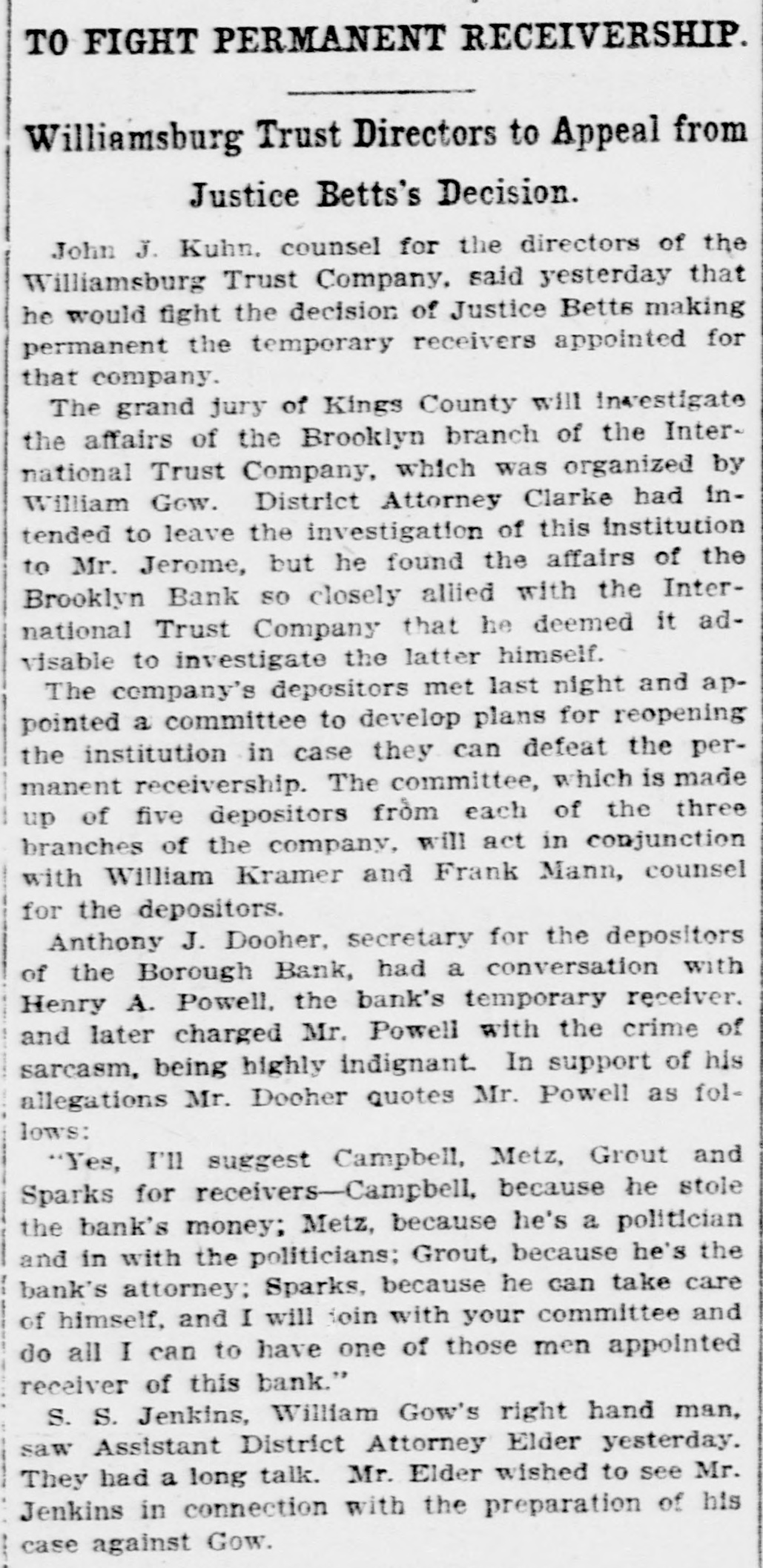
Williamsburg Trust Directors to Appeal from Justice Betts's Decision. John J. Kuhn, counsel for the directors of the Williamsburg Trust Company. said yesterday that he would fight the decision of Justice Betts making permanent the temporary receivers appointed for that company. The grand jury of Kings County will investigate the affairs of the Brooklyn branch of the International Trust Company, which was organized by William Gow. District Attorney Clarke had intended to leave the investigation of this institution to Mr. Jereme, but he found the affairs of the Brooklyn Bank so closely allied with the International Trust Company that he deemed it advisable to investigate the latter himself. The company's depositors met last night and appointed a committee to develop plans for reopening the institution in case they can defeat the permanent receivership. The committee, which is made up of five depositors from each of the three branches of the company, will act in conjunction with William Kramer and Frank Mann, counsel for the depositors. Anthony J. Dooher, secretary for the depositors of the Borough Bank, had a conversation with Henry A. Powell, the bank's temporary receiver. and later charged Mr. Powell with the crime of sarcasm, being highly indignant. In support of his allegations Mr. Dooher quotes Mr. Powell as follows: "Yes, I'll suggest Campbell, Metz, Grout and Sparks for receivers-Campbell, because he stole the bank's money; Metz, because he's a politician and in with the politicians; Grout, because he's the bank's attorney: Sparks, because he can take care of himself, and I will join with your committee and do all I can to have one of those men appointed receiver of this bank." S. S. Jenkins, William Gow's right hand man, saw Assistant District Attorney Elder yesterday. They had a long talk. Mr. Elder wished to see Mr. Jenkins in connection with the preparation of his case against Gow.


Article from New-York Tribune, January 2, 1908

Click image to open full size in new tab

Article Text

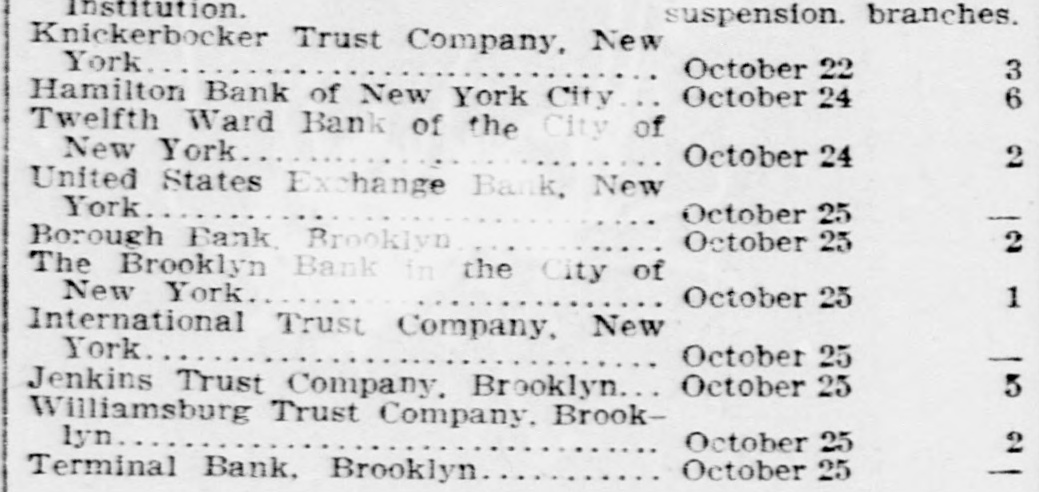
Institution

suspension. branches. Knickerbocker Trust Company, New York 3 October 22 October 24 6 Hamilton Bank of New York City Twelfth Ward Bank of the City of New York 2 October 24 United States Exchange Bank, New York October 25 Borough Bank Brooklyn 2 October 25 The Brooklyn Bank in the City of New York 1 October 25 International Trust Company, New York October 25 5 October 25 Jenkins Trust Company. Brooklyn Williamsburg Trust Company. Brooklyn 2 October 25 October 25 Terminal Bank, Brooklyn


Article from New-York Tribune, March 4, 1908

Click image to open full size in new tab

Article Text

REFERS TO FORMER INDICTMENTS Mr

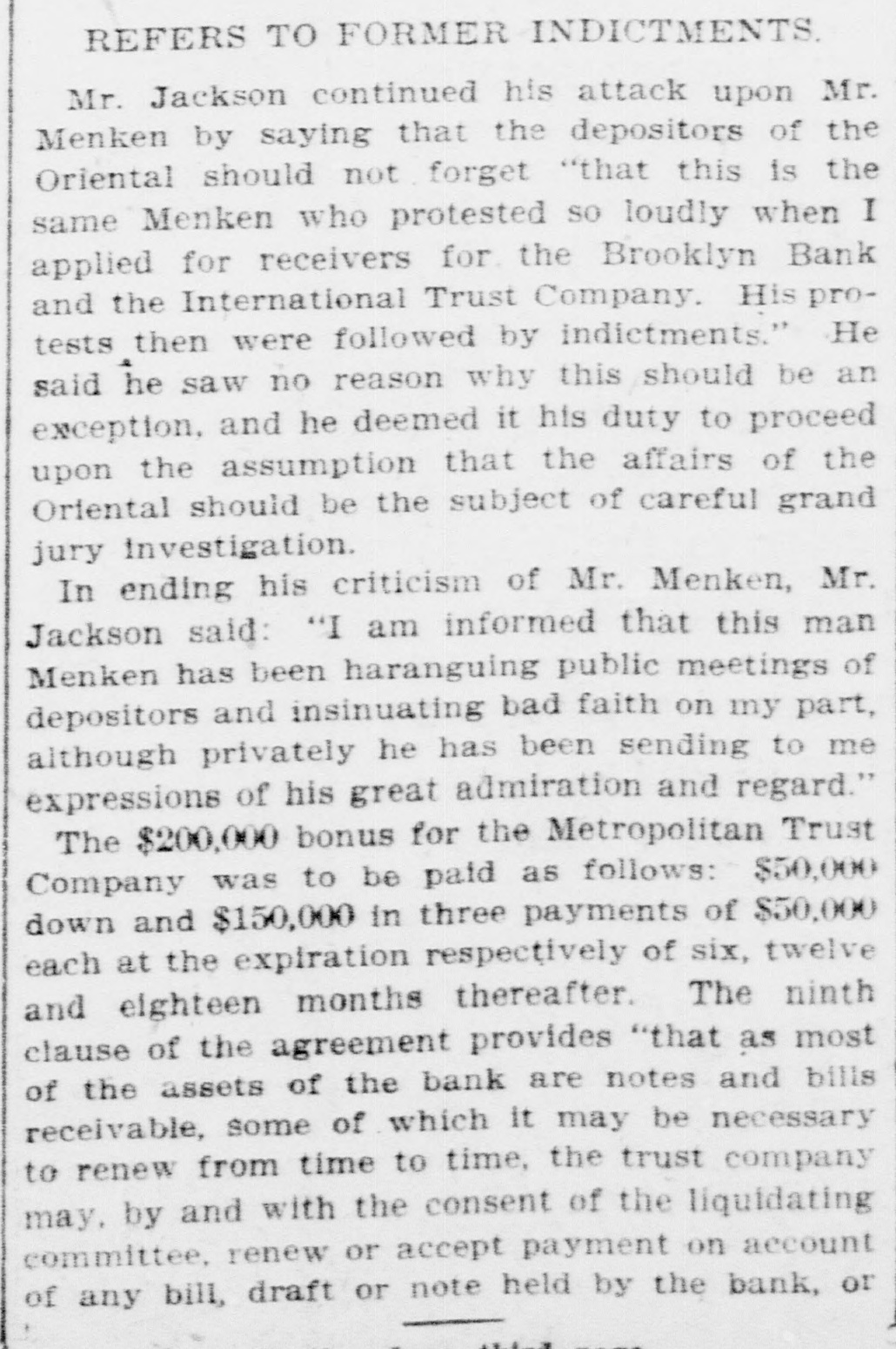
Jackson continued his attack upon Mr. Menken by saying that the depositors of the Oriental should not forget "that this is the same Menken who protested so loudly when I applied for receivers for the Brooklyn Bank and the International Trust Company. His protests then were followed by indictments." He said he saw no reason why this should be an exception. and he deemed it his duty to proceed upon the assumption that the affairs of the Oriental should be the subject of careful grand jury investigation. In ending his criticism of Mr. Menken, Mr. Jackson said: "I am informed that this man Menken has been haranguing public meetings of depositors and insinuating bad faith on my part, although privately he has been sending to me expressions of his great admiration and regard." The $200,000 bonus for the Metropolitan Trust Company was to be paid as follows: $50,000 down and $150,000 in three payments of $50,000 each at the expiration respectively of six, twelve and eighteen months thereafter. The ninth clause of the agreement provides "that as most of the assets of the bank are notes and bills receivable, some of which it may be necessary to renew from time to time, the trust company may, by and with the consent of the liquidating committee, renew or accept payment on account of any bill, draft or note held by the bank, or


Article from New-York Tribune, May 23, 1908

Click image to open full size in new tab

Article Text

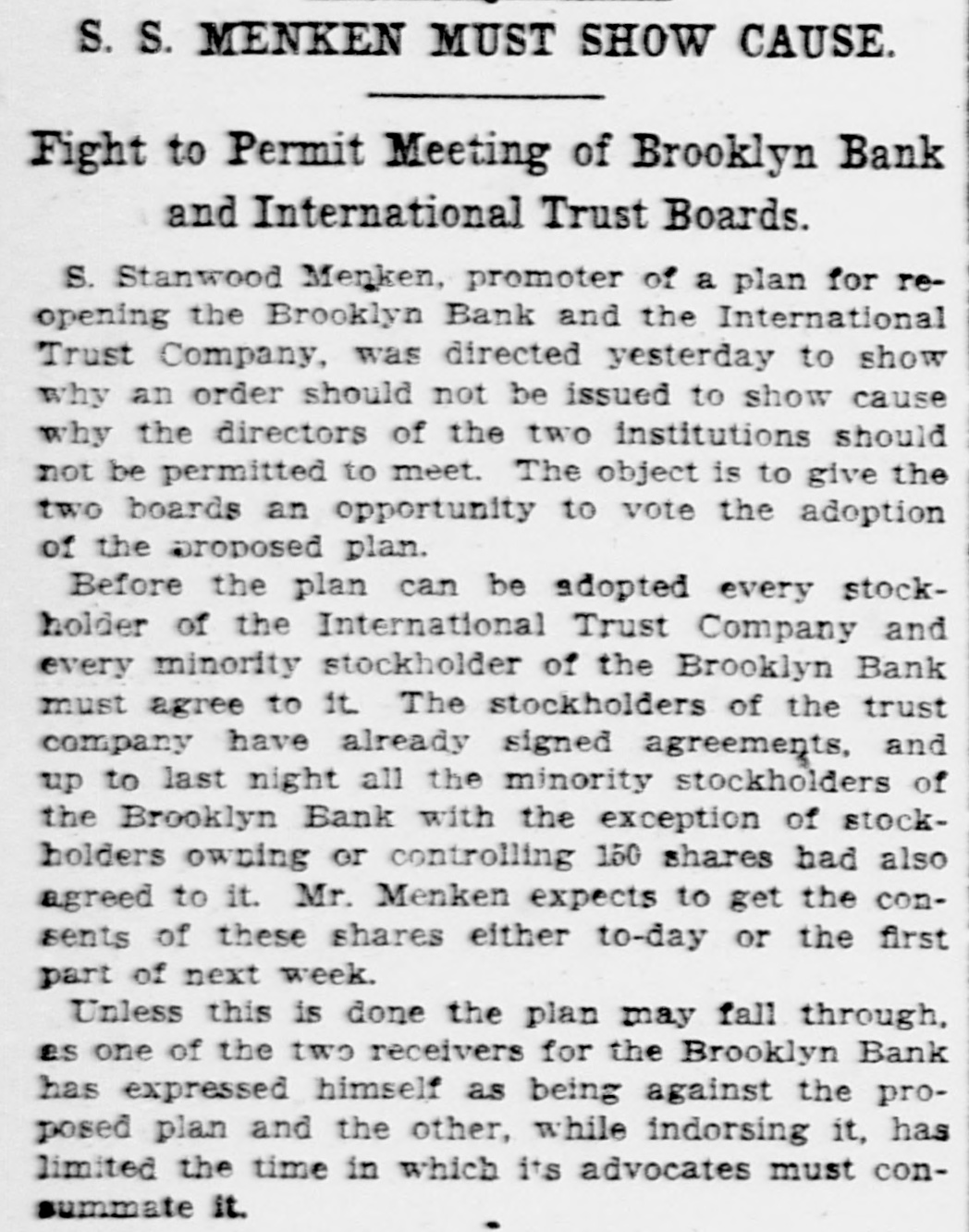
S. S. MENKEN MUST SHOW CAUSE. Fight to Permit Meeting of Brooklyn Bank and International Trust Boards. S. Stanwood Menken, promoter of a plan for reopening the Brooklyn Bank and the International Trust Company, was directed yesterday to show why an order should not be issued to show cause why the directors of the two institutions should not be permitted to meet. The object is to give the two boards an opportunity to vote the adoption of the proposed plan. Before the plan can be adopted every stockholder of the International Trust Company and every minority stockholder of the Brooklyn Bank must agree to it. The stockholders of the trust company have already signed agreements, and up to last night all the minority stockholders of the Brooklyn Bank with the exception of stockholders owning or controlling 150 shares had also agreed to it. Mr. Menken expects to get the consents of these shares either to-day or the first part of next week. Unless this is done the plan may fall through, es one of the two receivers for the Brooklyn Bank has expressed himself as being against the proposed plan and the other, while indorsing it, has limited the time in which its advocates must consummate it.


Article from Lewiston Evening Teller, July 2, 1908

Click image to open full size in new tab

Article Text

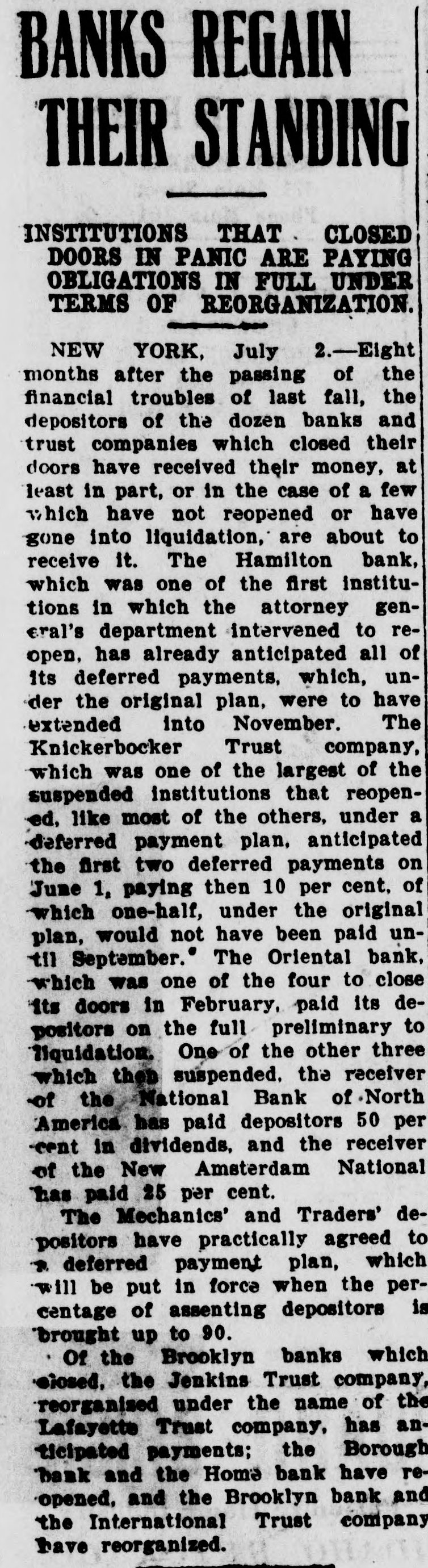
BANKS REGAIN THEIR STANDING INSTITUTIONS THAT CLOSED DOORS IN PANIC ARE PAYING OBLIGATIONS IN FULL UNDER TERMS OF REORGANIZATION. NEW YORK, July 2.-Eight months after the passing of the financial troubles of last fall, the depositors of the dozen banks and trust companies which closed their doors have received their money, at least in part, or in the case of a few which have not reopened or have gone into liquidation, are about to receive it. The Hamilton bank, which was one of the first institutions in which the attorney general's department intervened to reopen, has already anticipated all of its deferred payments, which, under the original plan, were to have extended into November. The Knickerbocker Trust company, which was one of the largest of the suspended institutions that reopened, like most of the others, under a deferred payment plan, anticipated the first two deferred payments on June 1, paying then 10 per cent, of which one-half, under the original plan, would not have been paid until September. The Oriental bank, which was one of the four to close its doors in February, paid its depositors on the full preliminary to liquidation. One of the other three which then suspended. the receiver of the National Bank of -North America has paid depositors 50 per -cent in dividends, and the receiver of the New Amsterdam National has paid 25 per cent. The Mechanics' and Traders' depositors have practically agreed to s deferred payment plan, which will be put in force when the percentage of assenting depositors is brought up to 90. Of the Brooklyn banks which elosed, the Jenkins Trust company, reorganized under the name of the Lafayette Trust company, has anticipated payments; the Borough 'hank and the Homa bank have reopened, and the Brooklyn bank and the International Trust company have reorganized.


Article from Lewiston Evening Teller, July 2, 1908

Click image to open full size in new tab

Article Text

BANKS REGAIN THEIR STANDING NEW YORK, July 2.-Eight months after the passing of the financial troubles of last fall, the depositors of the dozen banks and trust companies which closed their doors have received their money, at least in part, or in the case of a few which have not reopened or have gone into liquidation, are about to receive it. The Hamilton bank, which was one of the first institutions in which the attorney general's department Intervened to reopen, has already anticipated all of its deferred payments, which, under the original plan, were to have extended into November. The Knickerbocker Trust company, which was one of the largest of the suspended institutions that reopened, like most of the others, under in deferred payment plan, anticipated the first two deferred payments oh June 1, paying then 10 per cent, of which one-half, under the original plan, would not have been paid until September. The Oriental bank, which was one of the four to close its doors in February, paid its de-: positors on the full preliminary to liquidation. One of the other three which then suspended, the receiver of the National Bank of North America has paid depositors 50 per cent in dividends, and the receiver to: the New Amsterdam National has paid 25 per cent: The Mechanics' and Traders' depositors have practically agreed to R. deferred payment plan, which will be put in force when the percentage of assenting depositors is brought up to 90. Of the Brooklyn banks which closed. the Jenkins Trust company, reorganized under the name of the T.afavette Trust company. has anticinated payments: the Borough bank and the Home bank have reonened. and the Brooklyn bank and the International Trust company have reorganized.


Article from The Julesburg Grit-Advocate, July 3, 1908

Click image to open full size in new tab

Article Text

Splendid Recovery of Banks Forced to Close by Panic 1 New York. June 30.-Eight months t after the passing of the financial troubles of last fall, the depositors of the dozen bank and trust companies which closed their doors have received their money at least in part, or in the case of the few which have not yet reopened or have gone into liquidation are about to receive it. The Hamilton bank, which was one of the first of the institutions in which the attorney general's department intervened to reopen, has already anticipated all of its deferred payments, which under the orginal plan were to have extended into November. The Knickerbocker Trust company, e which was the largest of the suspended institutions and reopened like 1 most of the others under a deferred payment plan, anticipated the first two deferred payments on June 1, paying then 10 per cent, of which one-half, under the orginal plan, would not have been paid until September. The Oriental bank, which was one of the four to close its doors in February, paid its depositors in full preliminary to liquidation. Of the other three which then suspended, the receiver of the National Bank of North America has paid depositors 50 per 1 dent in dividends and the receiver of the New Amsterdam National has paid 25 per cent. The Mechanics and Traders depositors have practically agreed to a de1 ferred payment plan, which will be put in force when the percentage of assenting depositors is brought up to 90. Of the Brooklyn banks which closed, the Jenkins Trust company, reorganized under the name of the Lafayette Trust company, has anticipated payments; The Borough bank and the Home bank have reopened, and the Brooklyn bank and the International Trust company have reorganized.


Article from The Lee County Journal, July 10, 1908

Click image to open full size in new tab

Article Text

ALL TO GET THEIR MONEY

Depositors in New York Banks Are Being Paid. New York City-Eight months after the passage of the financial troubles of last fall, the depositors of the dozen banks and trust companies which closed their doors have received their money at least in part, or in the case of the few which have not yet reopened or have gone into liquidation are about to receive it. The Hamilton bank, which was one of the first of the institutions in which the attorney-general's departmeent in tervened. to reopen, has already anticipated all of its deferred payments which under the original plan were to have extended into November. The Knickerbocker Trust company, which was the largest of the suspended institutions, and reopened like most of the others under a deferred payment plan, anticipated the first two deferred payments on June 1, paying 10 per cent, of which onehalf, under the original plan, would not have been paid until September. The Oriental bank, which was one of the four to close its doors in February, paid its depositors in full preliminary to liquidation. Of the other three which then suspended, the receiver of the National Bank of North America has paid depositors 50 per cent in dividends, and the receiver of the New Amsterdam National has paid 25 per cent. The Mechanics and Traders depositors have practically agreed to a deferred payment plan, which will be put in force when the percentage of assenting depositors is brought up to 90. Of the Brooklyn banks which closed, the Jenkins Trust company, reorganized under the name of the Lafayette Trust company, has anticipated payments; the Borough bank and the Home bank have reopened and the Brooklyn bank and the International Trust company have reorganized.