7055. National City Bank (Cambridge, MA)

Bank Information

Episode Type
Suspension β†’ Closure
Bank Type
national
Bank ID
770
Charter Number
770
Start Date
February 23, 1910
Location
Cambridge, Massachusetts (42.376, -71.118)

Metadata

Model
gpt-5-mini
Short Digest
bdb5d6ef51106a2f

Response Measures

None

Receivership Details

Depositor recovery rate
100.0%
Date receivership started
1910-02-23
Date receivership terminated
1920-12-16
OCC cause of failure
Fraud
Share of assets assessed as good
82.3%
Share of assets assessed as doubtful
17.6%
Share of assets assessed as worthless
0.1%

Description

Articles report discovery of a large internal embezzlement by bookkeeper George W. Coleman in Feb 1910, the comptroller ordered the bank closed and a receiver (John L. Bates) was appointed; the institution was rendered insolvent and placed in receivership (permanent closure/liquidation). No run on the bank is described.

Events (4)

1. January 31, 1865 Chartered
Source
historical_nic
2. February 23, 1910 Receivership
Source
historical_nic
3. February 23, 1910 Receivership
Newspaper Excerpt
Former Governor John L. Bates, the receiver, will liquidate the remaining assets. Ellis S. Pepper, a national bank examiner, was appointed temporary receiver in some accounts; later Bates was named receiver by the comptroller of the currency. (Articles various dates Feb 23-26, 1910.)
Source
newspapers
4. February 23, 1910 Suspension
Cause
Bank Specific Adverse Info
Cause Details
Discovery of a large shortage/defalcation (initially reported $144,000, later estimates up to ~$300,000) attributable to bookkeeper George W. Coleman.
Newspaper Excerpt
The National City bank of Cambridge closed its doors today by order of the comptroller of currency
Source
newspapers

Newspaper Articles (18)

Article from The Wenatchee Daily World, February 23, 1910

Click image to open full size in new tab

Article Text

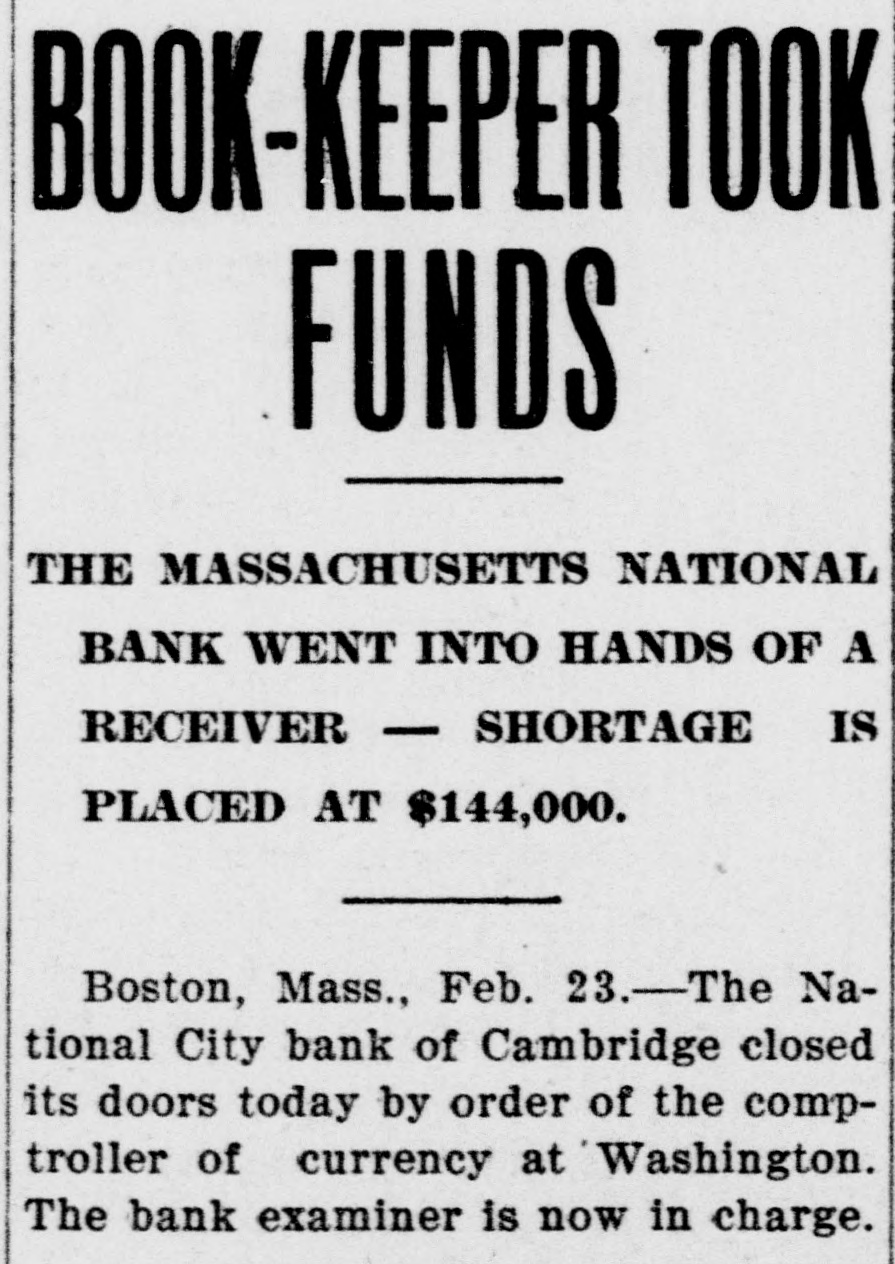
BOOK-KEEPER TOOK FUNDS THE MASSACHUSETTS NATIONAL BANK WENT INTO HANDS OF A RECEIVER - SHORTAGE IS PLACED AT $144,000. Boston, Mass., Feb. 23.-The National City bank of Cambridge closed its doors today by order of the comptroller of currency at Washington. The bank examiner is now in charge.


Article from Albuquerque Morning Journal, February 24, 1910

Click image to open full size in new tab

Article Text

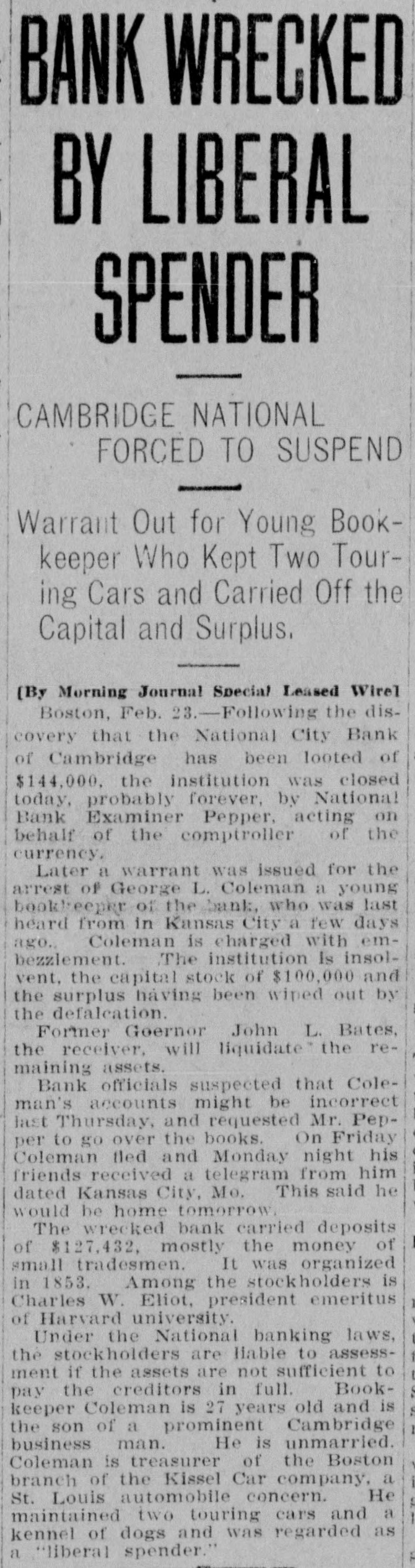
BANK WRECKED BY LIBERAL SPENDER CAMBRIDGE NATIONAL FORCED TO SUSPEND Warrant Out for Young Bookkeeper Who Kept Two Touring Cars and Carried Off the Capital and Surplus. (By Morning Journal Special Leased Wirel Boston, Feb. 23.-Following the discovery that the National City Bank of Cambridge has been looted of $144,000. the institution was closed today, probably forever, by National Bank Examiner Pepper, acting on behalf of the comptroller of the currency. Later a warrant was issued for the arrest of George L. Coleman a young bookkeeper of the bank who was last heard from in Kansas City a few days ago., Coleman is charged with embezzlement. The institution Is insolvent, the capital stock of $100,000 and the surplus having been wiped out by the defalcation. Former Goernor John L. Bates, the receiver, will liquidate* the remaining assets. Bank officials suspected that Coleman's accounts might be incorrect last Thursday, and requested Mr. Pepper to go over the books. On Friday Coleman fled and Monday night his friends received a telegram from him dated Kansas City, Mo. This said he would be home tomorrow. The wrecked bank carried deposits of $127,432. mostly the money of small tradesmen. It was organized in 1853. Among the stockholders is Charles W. Eliot, president emeritus of Harvard university. Under the National banking laws, the stockholders are Hable to assessment if the assets are not sufficient to pay the creditors in full. Bookkeeper Coleman is 27 years old and is the son of a prominent Cambridge business man. He is unmarried. Coleman is treasurer of the Boston branch of the Kissel Car company, a St. Louis automobile concern. He maintained two touring cars and a kennel of dogs and was regarded as a "liberal spender."


Article from Bismarck Daily Tribune, February 24, 1910

Click image to open full size in new tab

Article Text

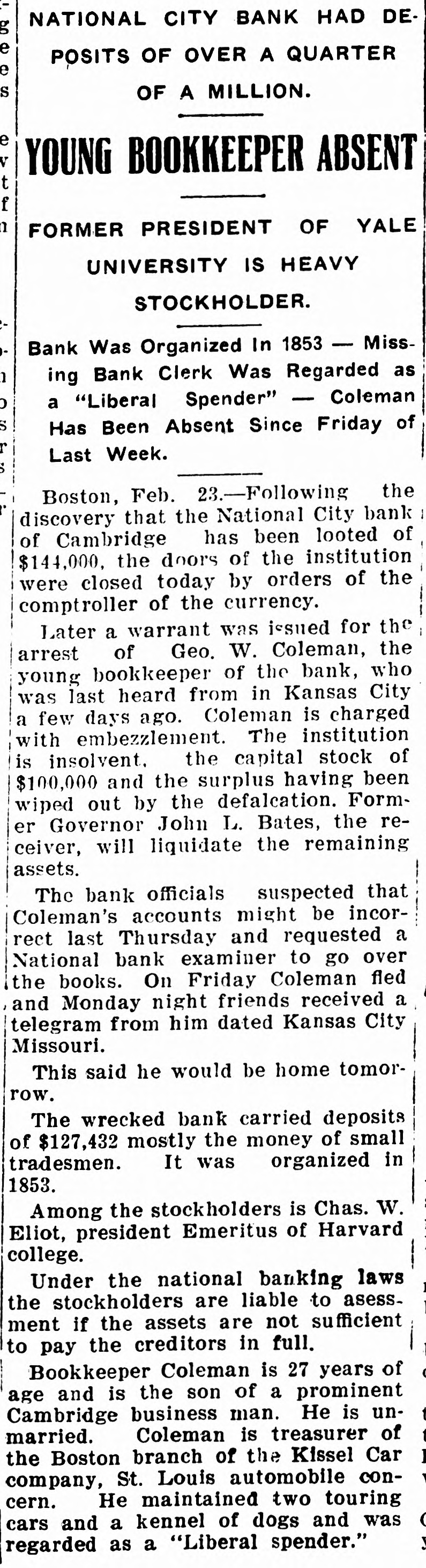
NATIONAL CITY BANK HAD DEPOSITS OF OVER A QUARTER OF A MILLION. YOUNG BOOKKEEPER ABSENT FORMER PRESIDENT OF YALE UNIVERSITY IS HEAVY STOCKHOLDER. Bank Was Organized In 1853 - Missing Bank Clerk Was Regarded as a "Liberal Spender" - Coleman Has Been Absent Since Friday of Last Week. Boston, Feb. 23.-Following the discovery that the National City bank of Cambridge has been looted of $144,000. the doors of the institution were closed today by orders of the comptroller of the currency. Later a warrant was issued for the arrest of Geo. W. Coleman, the young bookkeeper of the bank, who was last heard from in Kansas City a few days ago. Coleman is charged with embezzlement. The institution is insolvent. the capital stock of $100,000 and the surplus having been wiped out by the defalcation. Former Governor John L. Bates, the receiver, will liquidate the remaining assets. The bank officials suspected that Coleman's accounts might be incorrect last Thursday and requested a National bank examiner to go over the books. On Friday Coleman fled and Monday night friends received a telegram from him dated Kansas City Missouri. This said he would be home tomorrow. The wrecked bank carried deposits of $127,432 mostly the money of small tradesmen. It was organized in 1853. Among the stockholders is Chas. W. Eliot, president Emeritus of Harvard college. Under the national banking laws the stockholders are liable to asessment if the assets are not sufficient to pay the creditors in full. Bookkeeper Coleman is 27 years of age and is the son of a prominent Cambridge business man. He is unmarried. Coleman is treasurer of the Boston branch of the Kissel Car company, St. Louis automobile concern. He maintained two touring cars and a kennel of dogs and was regarded as a "Liberal spender."


Article from The Barre Daily Times, February 24, 1910

Click image to open full size in new tab

Article Text

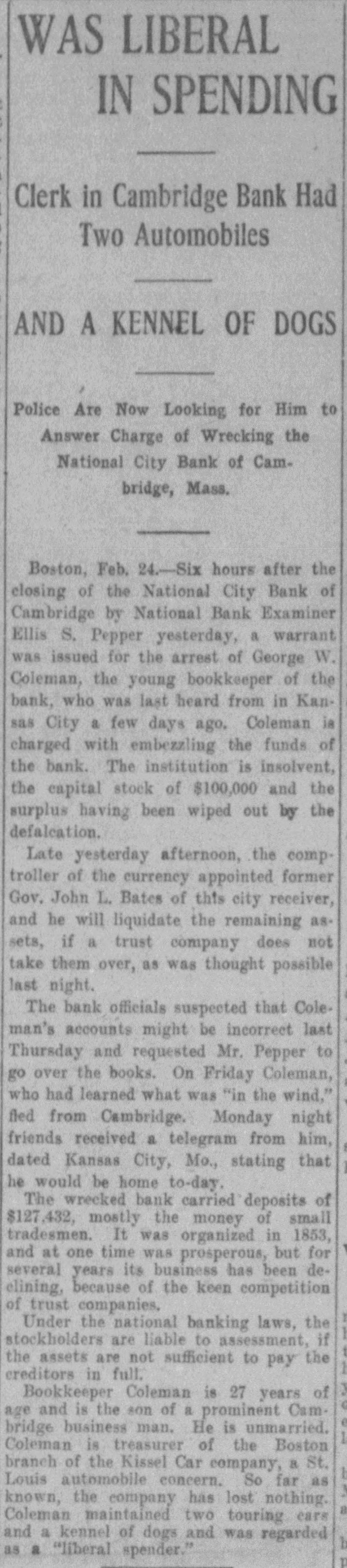
WAS LIBERAL IN SPENDING Clerk in Cambridge Bank Had Two Automobiles AND A KENNEL OF DOGS Police Are Now Looking for Him to Answer Charge of Wrecking the National City Bank of Cambridge, Mass. Boston, Feb. 24.-Six hours after the closing of the National City Bank of Cambridge by National Bank Examiner Ellis S. Pepper yesterday, a warrant was issued for the arrest of George W. Coleman, the young bookkeeper of the bank, who was last heard from in Kansas City a few days ago. Coleman is charged with embezzling the funds of the bank. The institution is insolvent, the capital stock of $100,000 and the surplus having been wiped out by the defalcation. Late yesterday afternoon, the comp. troller of the currency appointed former Gov. John L. Bates of this city receiver, and he will liquidate the remaining assets, if a trust company does not take them over, as was thought possible last night. The bank officials suspected that Coleman's accounts might be incorrect last Thursday and requested Mr. Pepper to go over the books. On Friday Coleman, who had learned what was "in the wind," fled from Cambridge. Monday night friends received a telegram from him, dated Kansas City, Mo., stating that he would be home to-day. The wrecked bank carried deposits of $127,432. mostly the money of small tradesmen. It was organized in 1853, and at one time was prosperous, but for several years its business has been declining, because of the keen competition of trust companies, Under the national banking laws, the stockholders are liable to assessment, if the assets are not sufficient to pay the creditors in full. Bookkeeper Coleman is 27 years of age and is the son of a prominent Cambridge business man. He is unmarried. Coleman is treasurer of the Boston branch of the Kissel Car company, a St. Louis automobile concern. So far as known, the company has lost nothing. Coleman maintained two touring cars and a kennel of dogs and was regarded as a "liberal spender."


Article from Omaha Daily Bee, February 24, 1910

Click image to open full size in new tab

Article Text

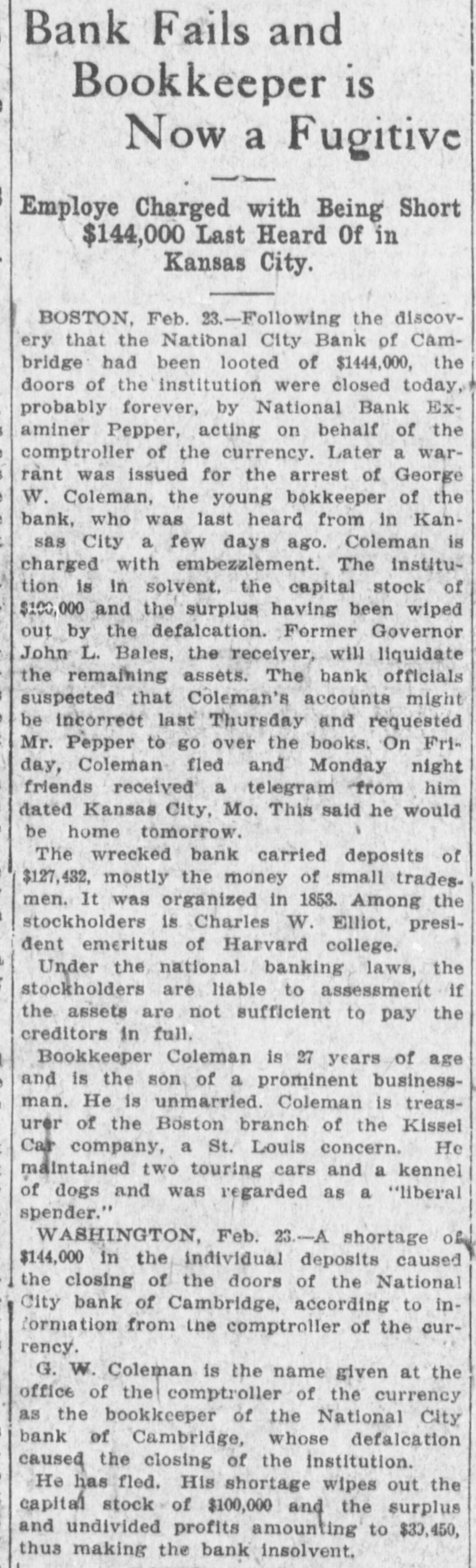
Bank Fails and Bookkeeper IS Now a Fugitive Employe Charged with Being Short $144,000 Last Heard Of in Kansas City. BOSTON, Feb. 23.-Following the discovery that the National City Bank of Cambridge had been looted of $1444,000, the doors of the institution were closed today, probably forever, by National Bank Examiner Pepper, acting on behalf of the comptroller of the currency. Later a warrant was issued for the arrest of George W. Coleman, the young bokkeeper of the bank, who was last heard from in Kansas City a few days ago. Coleman is charged with embezzlement. The institution is In solvent. the capital stock of $100,000 and the surplus having been wiped out by the defalcation. Former Governor John L. Bales, the receiver, will liquidate the remaining assets. The bank officials suspected that Coleman's accounts might be incorrect last Thursday and requested Mr. Pepper to go over the books. On Friday, Coleman fled and Monday night friends received a telegram from him dated Kansas City, Mo. This said he would be home tomorrow. The wrecked bank carried deposits of $127,432, mostly the money of small trades. men. It was organized in 1853. Among the stockholders is Charles W. Elliot, president emeritus of Harvard college. Under the national banking laws, the stockholders are liable to assessment if the assets are not sufficient to pay the creditors in full. Bookkeeper Coleman is 27 years of age and is the son of a prominent businessman. He is unmarried. Coleman is treasurer of the Boston branch of the Kissel Car company, a St. Louis concern. He maintained two touring cars and a kennel of dogs and was regarded as a "liberal spender." WASHINGTON, Feb. 23.-A shortage of $144,000 in the individual deposits caused the closing of the doors of the National City bank of Cambridge, according to information from the comptroller of the currency. G. W. Coleman is the name given at the office of the comptroller of the currency as the bookkeeper of the National City bank of Cambridge, whose defalcation caused the closing of the institution. He has fled. His shortage wipes out the capital stock of $100,000 and the surplus and undivided profits amounting to $33,450, thus making the bank insolvent.


Article from The Barre Daily Times, February 26, 1910

Click image to open full size in new tab

Article Text

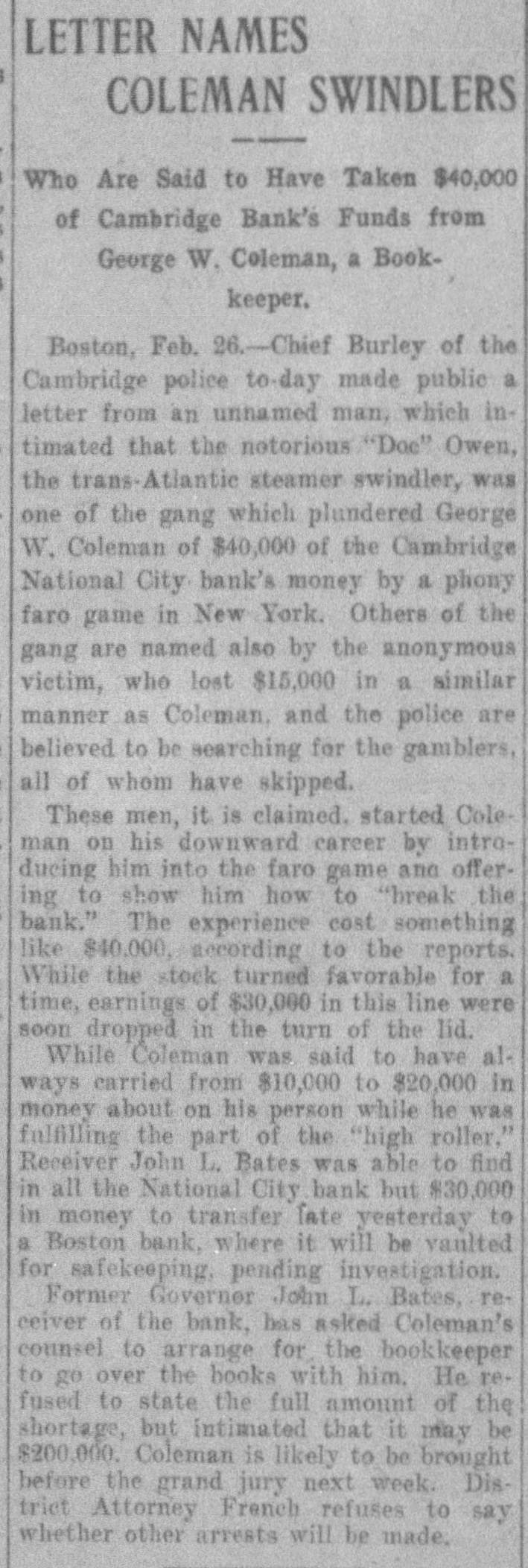
LETTER NAMES COLEMAN SWINDLERS Who Are Said to Have Taken $40,000 of Cambridge Bank's Funds from George W. Coleman, a Bookkeeper. Boston, Feb. 26.-Chief Burley of the Cambridge police to-day made public a letter from an unnamed man, which intimated that the notorious "Doe" Owen, the trans-Atlantic steamer swindler, was one of the gang which plundered George W. Coleman of $40,000 of the Cambridge National City bank's money by a phony faro game in New York. Others of the gang are named also by the anonymous victim, who lost $15,000 in a similar manner as Coleman. and the police are believed to be searching for the gamblers, all of whom have skipped. These men, it is claimed. started Coleman on his downward career by introducing him into the faro game and offering to show him how to "break the bank." The experience cost something like $40,000, according to the reports. While the stock turned favorable for a time, earnings of $30,000 in this line were soon dropped in the turn of the lid. While Coleman was said to have always carried from $10,000 to $20,000 in money about on his person while he was fulfilling the part of the "high roller." Receiver John L. Bates was able to find in all the National City bank but $30,000 in money to transfer late yesterday to a Boston bank, where it will be vanited for safekeeping pending investigation. Former Governor John L. Bates, receiver of the bank, has asked Coleman's counsel to arrange for the bookkeeper to go over the books with him. He refused to state the full amount of the shortage, but intimated that it may be $200,000. Coleman is likely to be brought before the grand jury next week. District Attorney French refuses to say whether other arrests will be made.


Article from Evening Star, February 26, 1910

Click image to open full size in new tab

Article Text

tonight at 8: Congressman Bennet of New York will speak on Sunday at 8 p.m.; gospel services daily, 12 m. and 7:30 p.m.; Sundays, 3 p.m. WEEK ENDING FEBRUARY 26,'10 President Taft withdrew his nominations for the new customs court because Congress would not pay $10,000 salaries; the President announced that the five measures which he considered should be passed at the present session of Congress in order to redeem party pledges were postal savings banks, interstate commerce law amendments, conservation, anti-injunction and statehood for Arizona and New Mexico. The United States Supreme Court handed down more than fifty decisions, several of them being in important railroad cases. Secretary Meyer will call for the building of two twenty-eightthousand-ton battleships, the largest in the world. Mr. Aldrich declared $300,000,000 could be saved by a more businesslike administration of the government. Chairman Elkins reported to the Senate, without conference, the Taft-Wickersham bill to amend the interstate commerce laws. An appropriation of $125,000 for the immigration commission was voted in the urgent deficiency bill by the House; the Indian appropriation bill and the Sherley bankruptcy bill, which defines the limits of the present law and reduces the compensation of receivers, were passed; the House took up the Post Office appropriation bill. Le Roy Percy was elected United States senator in Mississippi. Philadelphia's trolley strike caused rioting in many parts of the city, and hundreds of arrests were made. The National City Bank of Cambridge, Mass., was forced to close its doors because of the alleged embezzlement of $144,000 by George W. Coleman, the bookkeeper of the institution. J. P. Morgan gave a $30,000 collection of Indian relics to the American Museum of Natural History. Fifteen persons, two so seriously that they may die, were burned in an incendiary blaze in a New York tenement. Foreign Affairs. Premier Asquith completed his cabinet; parliament was formally opened by King Edward; the Irish refused to support Mr. Asquith's program, and another general election is feared within a few months; the first division disclosed a majority of thirty-one for the government, against tariff reform: the Irish members abstained from voting. The Moroccan envoy in Paris announced to the French minister of foreign affairs that the sultan had ratified the agreement between the two governments. France sends a cruiser to the Island of Guadeloupe, where a strike of cane sugar workers is In progress, to restore order. Senator Millies-Lacroix wounded Senator Lintilhac in a duel in Paris, and the men were then reconciled. France and England urged China to respect the wishes of Russia and Japan regarding the Chin-Chow and Aigun railway,Former Vice President Fairbanks occupied the pulpit in a Berlin church. Boutros Pacha Ghali, Egyptian premier and minister of foreign affairs, died from the effects of a bullet wound inflicted by a nationalist student. Twenty-three people were killed by an avalanche which ingulfed an Icelandic village. Gen. Toledo, the Nicaraguan minister of war, announced that the government forces had defeated the insurgents, under Gen. Chamorro, at Tisma. A widespread revolutionary plot was discovered in Portugal. In the District. Agreeing with general sentiment that the federal buildings in the National Capital should stretch along the south side of Pennsylvania Γ₯venue, the Senate committee on public buildings and grounds ordered a favorable report on Senator Heyburn's bill appropriating $10,000,000 for the purchase of the property between Pennsylvania avenue and the Mall. An appropriation of $1,000,000 for the improvement of the Anacostia flats was proposed by Senator Gallinger. The Commis sioners of the District reported favorably the bill to regulate the practice of osteopathy. Assistant Secretary Norton of the Treasury Department issued a statement saying that about 200 employes of the department will lose their positions about July 1. Charles C. Rogers, collector of tax S, issued 2,000 copies of a book containing the lists of real estate in the District on which taxes are overdue. The Society of Sponsors of the United States Navy held its third annual meeting. The Better Washington Association, composed of public spirited womon furt
Article from Smyrna Times, March 2, 1910

Click image to open full size in new tab

Article Text

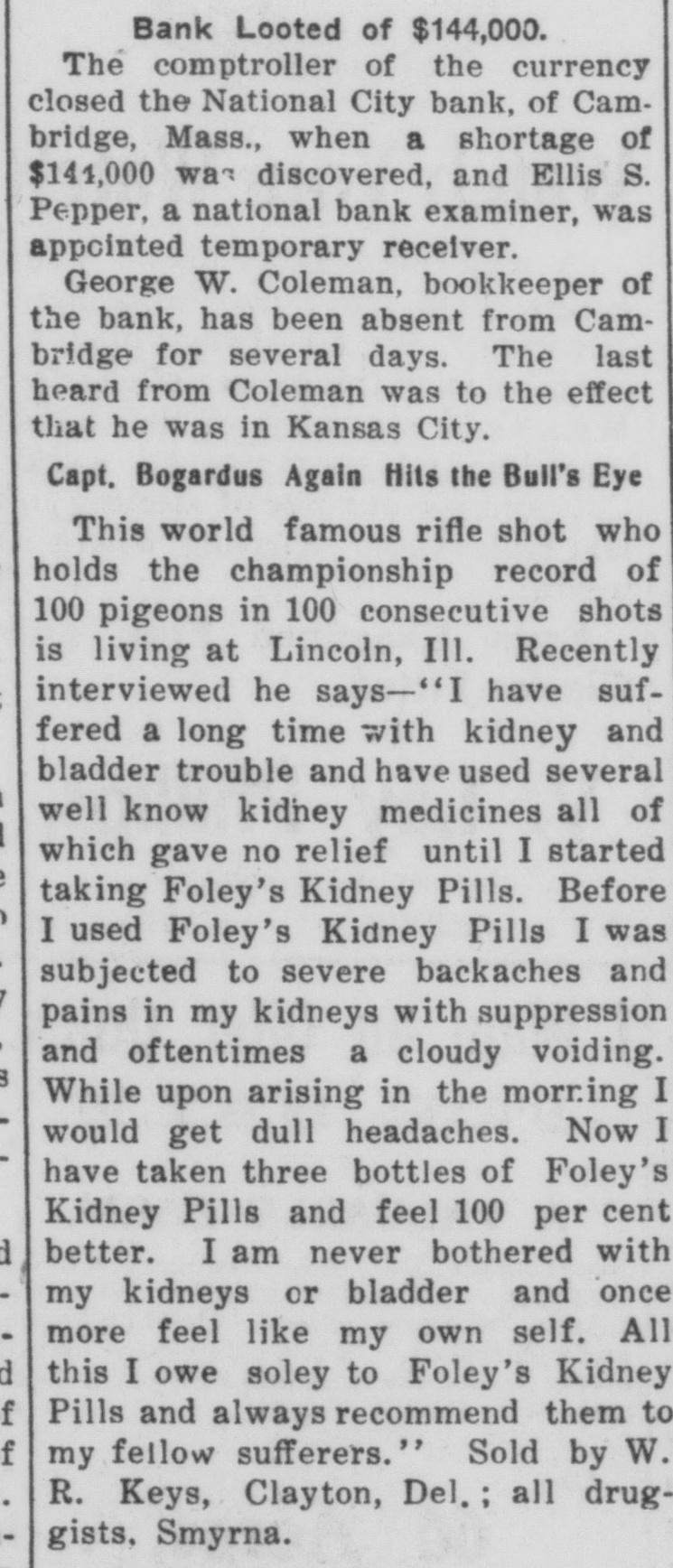
Bank Looted of $144,000. The comptroller of the currency closed the National City bank, of Cambridge, Mass., when a shortage of $141,000 was discovered, and Ellis S. Pepper, a national bank examiner, was appointed temporary receiver. George W. Coleman, bookkeeper of the bank, has been absent from Cambridge for several days. The last heard from Coleman was to the effect that he was in Kansas City. Capt. Bogardus Again Hits the Buil's Eye This world famous rifle shot who holds the championship record of 100 pigeons in 100 consecutive shots is living at Lincoln, Ill. Recently interviewed he says-"I have suffered a long time with kidney and bladder trouble and have used several well know kidney medicines all of which gave no relief until I started taking Foley's Kidney Pills. Before I used Foley's Kidney Pills I was subjected to severe backaches and pains in my kidneys with suppression and oftentimes a cloudy voiding. While upon arising in the morr.ing I would get dull headaches. Now I have taken three bottles of Foley's Kidney Pills and feel 100 per cent better. I am never bothered with d my kidneys or bladder and once more feel like my own self. All this I owe soley to Foley's Kidney Pills and always recommend them to my fellow sufferers." Sold by W. R. Keys, Clayton, Del. ; all druggists, Smyrna.


Article from The Farmville Herald, March 4, 1910

Click image to open full size in new tab

Article Text

Bank Looted of $144,000. The comptroller of the currency closed the National City bank, of Cambridge, Mass., when a shortage of $141,000 was discovered, and Ellis S. Pepper, a national bank examiner, was appointed temporary receiver. George W. Coleman, bookkeeper of the bank, has been absent from Cambridge for several days. The last heard from Coleman was to the effect that he was in Kansas City.


Article from The Barre Daily Times, March 5, 1910

Click image to open full size in new tab

Article Text

As to Gang of Faro Artists Who Trimmed Him DEFALCATION IS GROWING Developments Coming Rapidly in the Cambridge Bank Scandal-Important Witnesses Rounded Up. Boston, March 5.-George W. Coleman, the Cambridge bank looter, has been examined to-day by District Attorney Pelletier, as to the activities of the gang of fare swindlers, who are alleged to have trimmed New Englanders out of hundreds of thousands of dollars in the last few years. Other officers of the wrecked bank will also be examined. Bank Receiver Former Governor Bates refuses to give out the amount of Coleman's defalcation until after submitting his report to Comp troller Murray of the treasury, but it is believed it will exceed $200,000. Late yesterday afternoon Frank B. Von Blarcom, manager of the curb brokerage firm of J. Thomas Reinhart, 54 Devonshire street, and Frank L. Crocker, a clerk for the same firm, were served with summonses to appear be fore the United States attorney in the federal building for examination in connection with the case. They were elogeted with Assistant United States Attorney William H. Garland from 4:30 to o'clock. Cnarles F. DeWoody, special assistant to the United States attorney-general, took part in the examination of the two men, and Special Examiners Risley Brown and John D. Fernsler were present. At the conclusion of the exam ination the men were dismissed The summons for Von Blarcom was served by Deputy Marshal Frank A. Young, and the summons for Crocker was handed to him by Deputy Mar shal Charles A. Bancroft. The deputy marshals remained in attendance un til the two brokers were dismissed after the examination, and it was generally understood that the matter of an arrest hinged on the statements made by the two men. No bail has been furnished for the release of Wilson Lockhart, who had assisted Coleman in keeping the books at the Cambridge National City bank the amount of buil having been set at $30,000 yesterday An Important Witness, Next in importance to the :rraignment of Lockhart was the unsuspected introduction into the case, as a witness, of Harvey S. Galbraith of 14 Jay street, Cambridge, formerly employed as a mes senger at the defunct institution for savings. Galbraith is at present employed as time elerk at the plant of the Carver Cotton Gin works in East Bridgewater. He received a summons at his lodgings in that town at o'clock Thursday night to appear early yesterday at the federal building and was on hand at 9 o'clock. He didn't know about the arrest of Lock hart in the case until he read the morning papers on the way to Boston. Galbraith is said to he one of the gov ernment's most important witnesses in the case they are weaving about certain persons, and he has been sworn to secrecy since the lengthy conference he had with Assistant United States District Attor ney Garland and Examiner Charles E De Woody of the department of justice. following Lockhart's arraignment. Last November Galbraith severed his connection with the National City Bank of Cambridge, where for three years he had been employed as messenger. While at the bank. he was intimately acquainted with Coleman and Lockhart, who was employed as messenger at the bank for about $5 or $6 a week before Galbraith got the position in 1906. Galbraith was closeted with the au thorities for hours yesterday, and every word of his examination was taken down by a stenographer Two of the secret service men who have been detailed on the case by the federal government visited the bank yesterday morning. and after a short conference with Receiver Bates called on two Cambridge young women. A story was current that the arrest of one of these women might occur during the day but the Cambridge police and the deputy marshals were withdrawn temporarily from the case at 6 o'clock last night, without having made an arrest


Article from The Tacoma Times, March 5, 1910

Click image to open full size in new tab

Article Text

BOOKKEEPER ROBBED BANK OF $144,000 GRADUALLY BOSTON, March 5.-Because a the effect that he was in Kansas shortage, said to be $144,000, was City. Steps have been taken by discovered in the accounts of the the federal authorities to apprehend him. National City Bank of Cambridge that institution was closed today The missing bookkeepr is the 1 by order of the comptroller of the son of a prominent business man, currency, and John L. Bates, forand his friends have always had mer governor of Massachusetts, the impression that a paternal alwas appointed receiver. lowance enabled him to live in a George W. Coleman, bookkeeper style in excess of that permitted r of the bank, has been absent from by a bank employe's salary. He is Cambridge for several days. The less than 30 years old. A warlast heard from Coleman was to rant is out foi his arrest.


Article from Evening Star, March 11, 1910

Click image to open full size in new tab

Article Text

# BANK MUCH TO BLAME # FOR BIG DEFALCATION Ordinary Diligence Would Have Discovered Cambridge Fraud, Declares Examiner Hann. "Palpable and glaring," is the characterization by National Bank Examiner Hann of the fraud committed on the National City Bank of Cambridge, Mass., whose bookkeeper, George W. Colman, defaulted for about $150,000. The defalcation, he says, could have been discovered by ordinary diligence if the plain instructions of the controller of the currency had been followed. Mr. Hann examined the bank, at the direction of the controller of the currency, with a view to determining whether previous examinations should have disclosed its condition preceding the announcement of the shortage in the individual deposits. The information thus gathered was turned over to the Department of Justice, and resulted in the arrest of one W. W. Lockhart, who, it is alleged, aided and abetted Coleman. Ellis S. Pepper, the bank examiner who made an examination of the institution in December, is under suspension. His was the last examination made previously to the closing of the bank. Who Lockhart is is not known here.


Article from The Penn's Grove Record, April 22, 1910

Click image to open full size in new tab

Article Text

Bank Looted For $309,000. A report by the receiver of the National City Bank of Cambridge, Mass. showed that the total shortage will reach $309,000. It was looted from the inside by trusted officials.


Article from The Barre Daily Times, April 28, 1910

Click image to open full size in new tab

Article Text

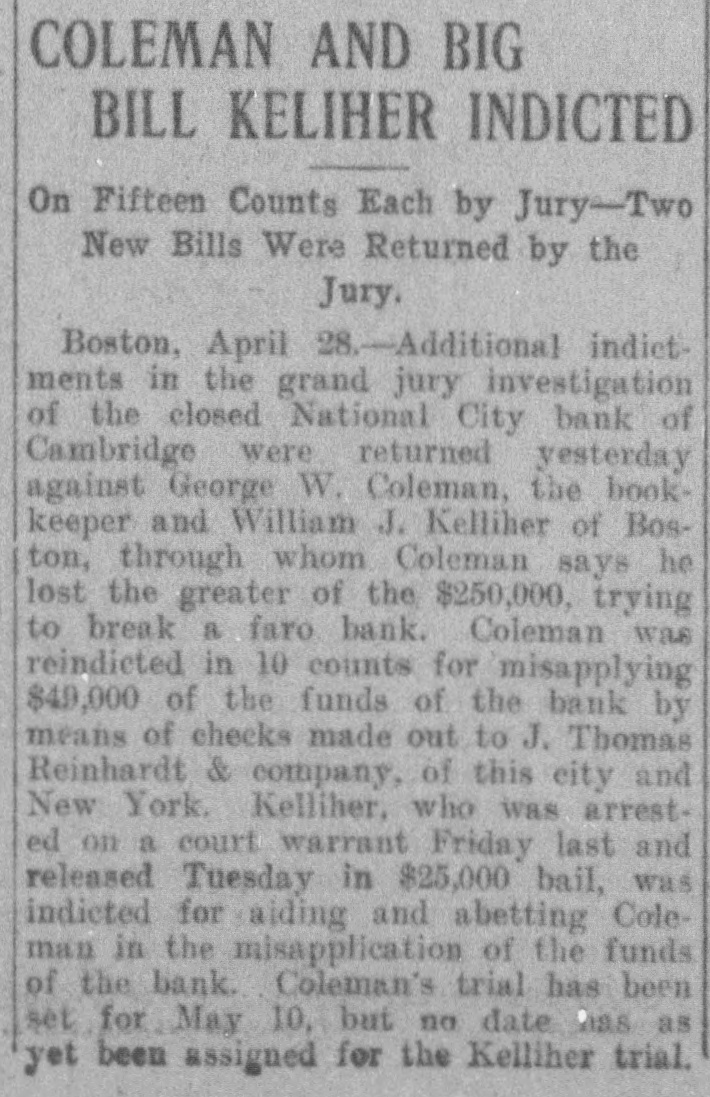
# COLEMAN AND BIG # BILL KELIHER INDICTED On Fifteen Counts Each by Jury-Two New Bills Were Returned by the Jury. Boston, April 28.-Additional indict- ments in the grand jury investigation of the closed National City bank of Cambridge were returned yesterday against George W. Coleman, the book- keeper and William J. Kelliher of Bos- ton, through whom Coleman says he lost the greater of the $250,000, trying to break a faro bank. Coleman was reindicted in 10 counts for misapplying $49,000 of the funds of the bank by means of checks made out to J. Thomas Reinhardt & company, of this city and New York. Kelliher, who was arrest- ed on a court warrant Friday last and released Tuesday in $25,000 bail, was indicted for aiding and abetting Cole- man in the misapplication of the funds of the bank. Coleman's trial has been set for May 10, but no date was as yet been assigned for the Kelliher trial.


Article from Daily Kennebec Journal, May 28, 1910

Click image to open full size in new tab

Article Text

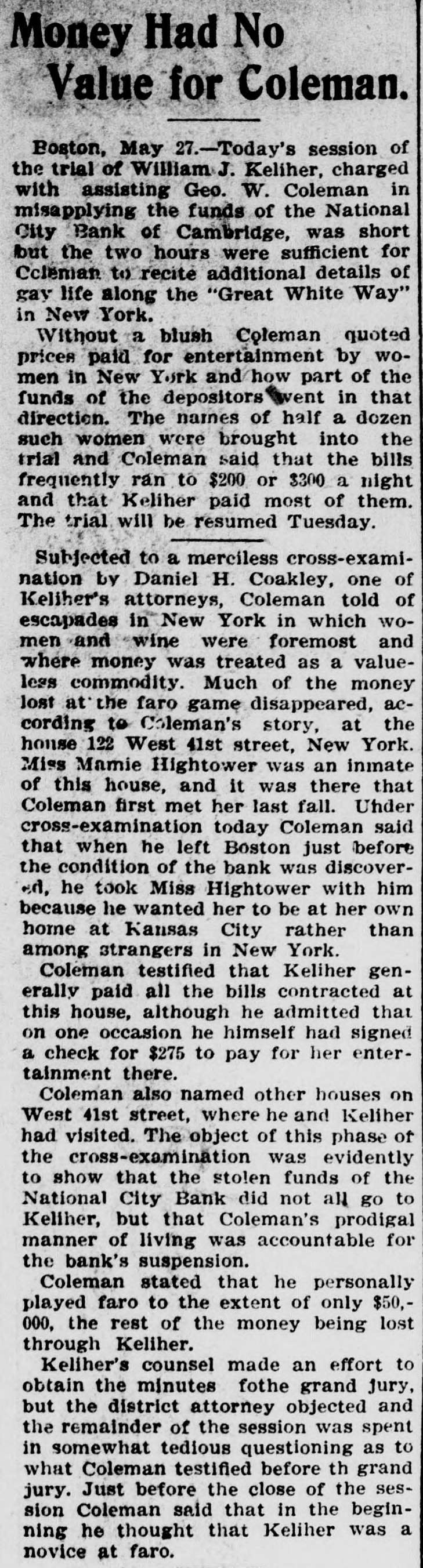
# Money Had No Value for Coleman. Boston, May 27.-Today's session of the trial of William J. Keliher, charged with assisting Geo. W. Coleman in misapplying the funds of the National City Bank of Cambridge, was short but the two hours were sufficient for Coleman to recite additional details of gay life along the "Great White Way" in New York. Without a blush Coleman quoted prices paid for entertainment by women in New York and how part of the funds of the depositors went in that direction. The names of half a dozen such women were brought into the trial and Coleman said that the bills frequently ran to $200 or $300 a night and that Keliher paid most of them. The trial will be resumed Tuesday. Subjected to a merciless cross-examination by Daniel H. Coakley, one of Keliher's attorneys, Coleman told of escapades in New York in which women and wine were foremost and where money was treated as a valueless commodity. Much of the money lost at the faro game disappeared, according to Coleman's story, at the house 122 West 41st street, New York. Miss Mamie Hightower was an inmate of this house, and it was there that Coleman first met her last fall. Under cross-examination today Coleman said that when he left Boston just before the condition of the bank was discovered, he took Miss Hightower with him because he wanted her to be at her own home at Kansas City rather than among strangers in New York. Coleman testified that Keliher generally paid all the bills contracted at this house, although he admitted that on one occasion he himself had signed a check for $275 to pay for her entertainment there. Coleman also named other houses on West 41st street, where he and Keliher had visited. The object of this phase of the cross-examination was evidently to show that the stolen funds of the National City Bank did not all go to Keliher, but that Coleman's prodigal manner of living was accountable for the bank's suspension. Coleman stated that he personally played faro to the extent of only $50,000, the rest of the money being lost through Keliher. Keliher's counsel made an effort to obtain the minutes fothe grand jury, but the district attorney objected and the remainder of the session was spent in somewhat tedious questioning as to what Coleman testified before th grand jury. Just before the close of the session Coleman said that in the beginning he thought that Keliher was a novice at faro.


Article from New-York Tribune, October 10, 1911

Click image to open full size in new tab

Article Text

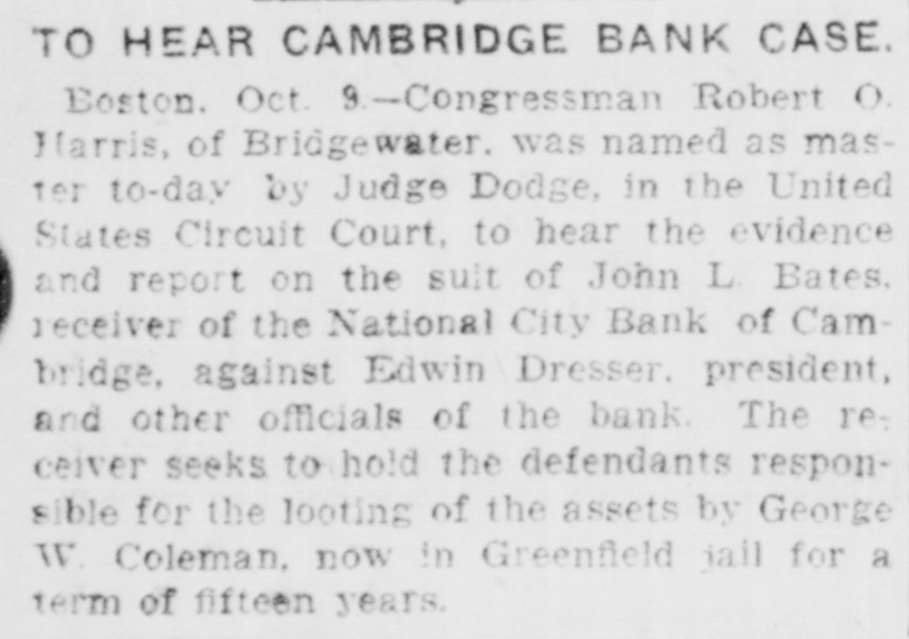
TO HEAR CAMBRIDGE BANK CASE. Boston. Oct. 9.-Congressman Robert O. Harris, of Bridgewater. was named as master to-day by Judge Dodge, in the United States Circuit Court, to hear the evidence and report on the suit of John L Bates receiver of the National City Bank of Cambridge, against Edwin Dresser. president, and other officials of the bank The re: ceiver seeks to hold the defendants responsible for the looting of the assets by George a W Coleman, now in Greenfield jail for term of fifteen years


Article from Daily Kennebec Journal, October 10, 1911

Click image to open full size in new tab

Article Text

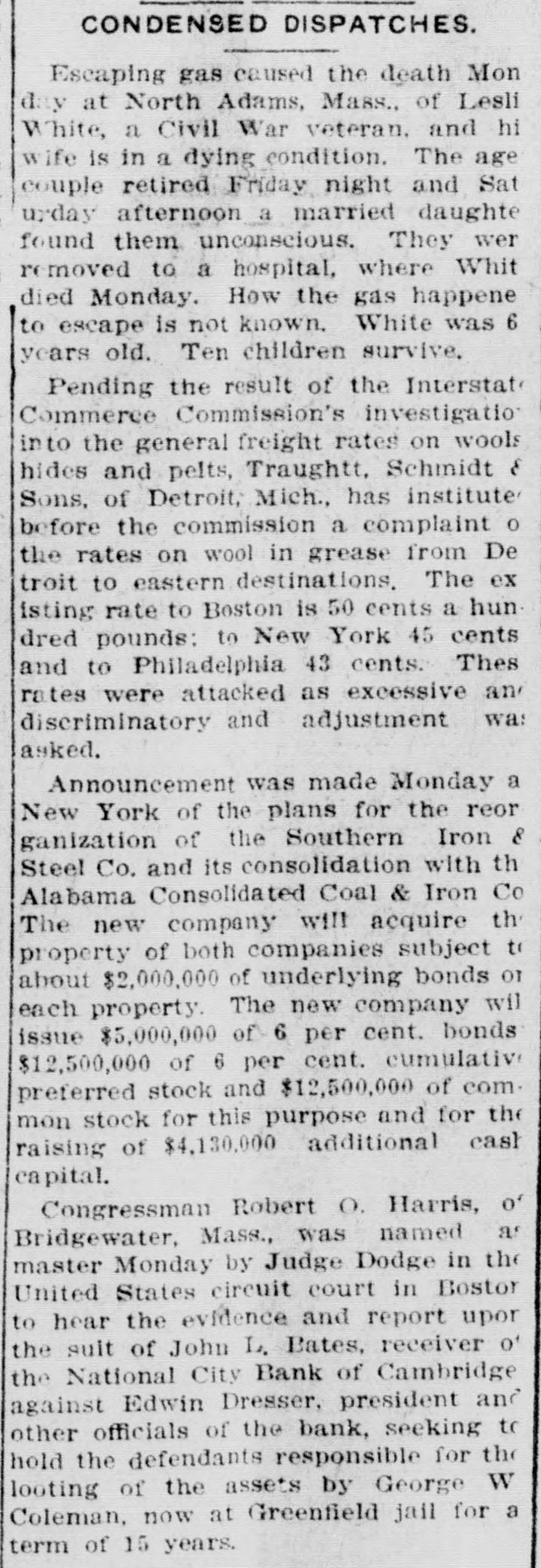
CONDENSED DISPATCHES. Escaping gas caused the death Monday at North Adams, Mass., of Lesli White, a Civil War veteran, and hi wife is in a dying condition. The age couple retired Friday night and Saturday afternoon a married daughter found them unconscious. They wer removed to a hospital, where White died Monday. How the gas happene to escape is not known. White was 6 years old. Ten children survive. Pending the result of the Interstate Commerce Commission's investigation into the general freight rates on wools hides and pelts, Traughtt, Schmidt & Sons, of Detroit, Mich., has institute before the commission a complaint o the rates on wool in grease from Detroit to eastern destinations. The existing rate to Boston is 50 cents a hundred pounds: to New York 45 cents and to Philadelphia 43 cents. Thes rates were attacked as excessive and discriminatory and adjustment was asked. Announcement was made Monday a New York of the plans for the reorganization of the Southern Iron & Steel Co. and its consolidation with the Alabama Consolidated Coal & Iron Co The new company will acquire the property of both companies subject to about $2,000,000 of underlying bonds or each property. The new company will issue $5,000,000 of 6 per cent. bonds $12,500,000 of 6 per cent. cumulative preferred stock and $12,500,000 of common stock for this purpose and for the raising of $4,130,000 additional cash capital. Congressman Robert O. Harris, of Bridgewater, Mass., was named a master Monday by Judge Dodge in the United States circuit court in Boston to hear the evidence and report upon the suit of John L. Bates, receiver of the National City Bank of Cambridge against Edwin Dresser, president and other officials of the bank, seeking to hold the defendants responsible for the looting of the assets by George W Coleman, now at Greenfield jail for a term of 15 years.


Article from The Barre Daily Times, January 2, 1912

Click image to open full size in new tab

Article Text

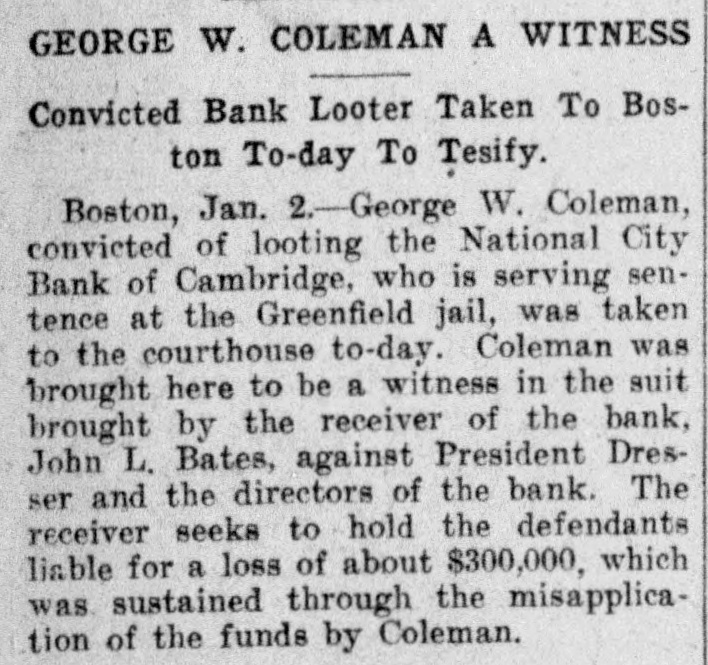
GEORGE W. COLEMAN A WITNESS Convicted Bank Looter Taken To Boston To-day To Tesify. Boston, Jan. 2.-George W. Coleman, convicted of looting the National City Bank of Cambridge, who is serving sentence at the Greenfield jail, was taken to the courthouse to-day. Coleman was brought here to be a witness in the suit brought by the receiver of the bank, John L. Bates, against President Dresser and the directors of the bank. The receiver seeks to hold the defendants liable for a loss of about $300,000, which was sustained through the misapplication of the funds by Coleman.