First National Bank (Cleveland, OH)

Episode Information

Episode UID
701014
Episode Type
Suspension → Reopening
Bank Type
national
Bank ID
70 national
Charter Number
7
Start Date
June 12, 1884
Location
Cleveland, Ohio (41.499, -81.695)

Metadata

Model
gpt-5-mini (chosen from majority vote of a three-model LLM ensemble)
Short Digest
568558b35d448732

Response Measures

None

Description

One article records a false rumor of suspension (denied); others describe jurisdiction-wide use of the 60-day/notice rules in 1893 and 1907.

Events (6)

1. June 22, 1863 Chartered
Source
historical_nic
2. May 13, 1882 Chartered
Source
historical_nic
3. June 12, 1884 Other
Newspaper Excerpt
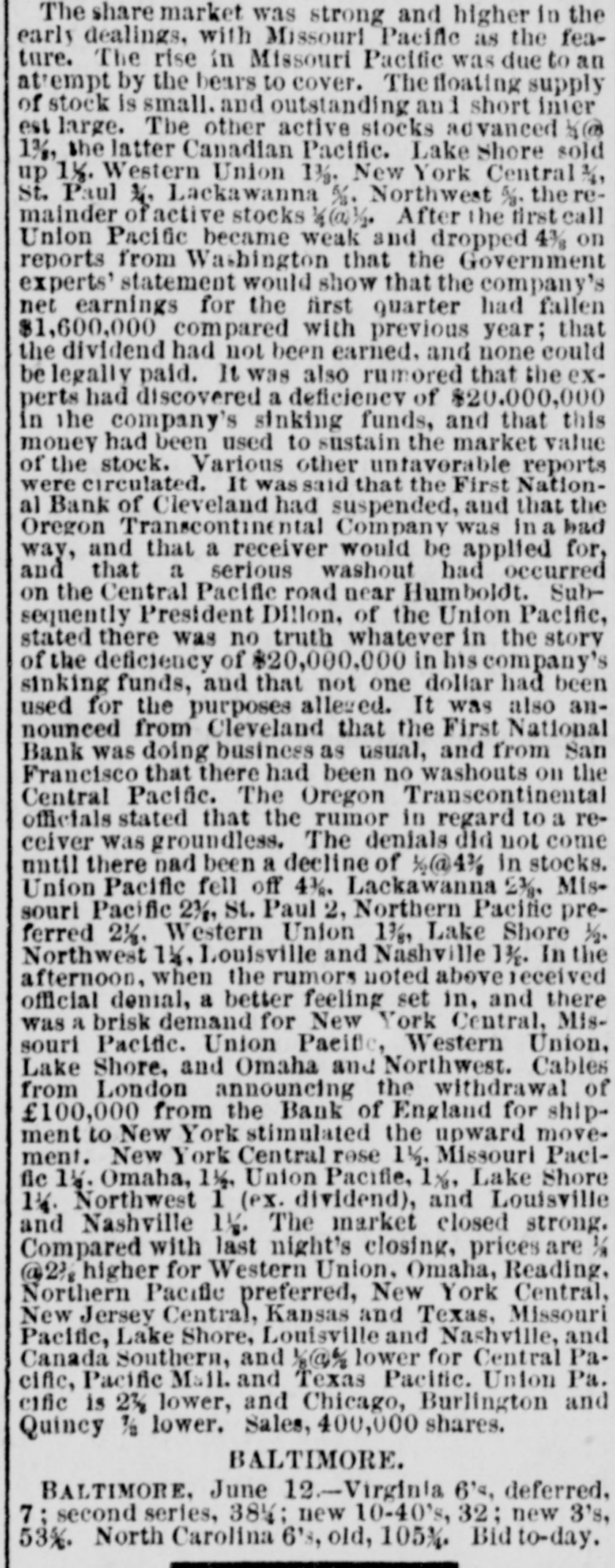
It was said that the First National Bank of Cleveland had suspended...; it was also announced from Cleveland that the First National Bank was doing business as usual.
Source
newspapers
4. August 2, 1893 Suspension
Cause
Macro News
Cause Details
City-wide precautionary requirement of notice for withdrawals amid broader banking stress in 1893.
Newspaper Excerpt
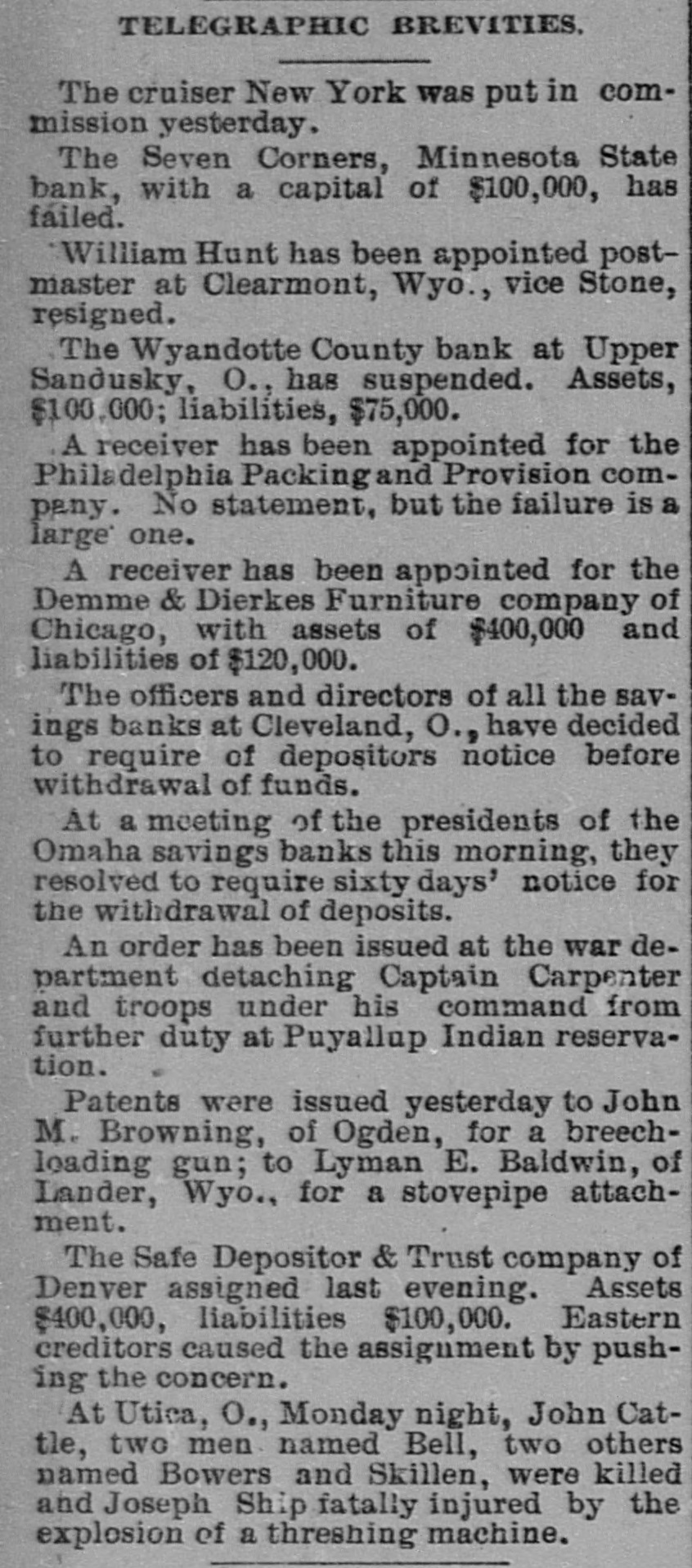
The officers and directors of all the savings banks at Cleveland, 0., have decided to require of depositors notice before withdrawal of funds.
Source
newspapers
5. November 6, 1907 Suspension
Cause
Macro News
Cause Details
Adoption of the 60-day rule (temporary restriction on withdrawals) in Cleveland as part of the nationwide 1907 financial crisis.
Newspaper Excerpt
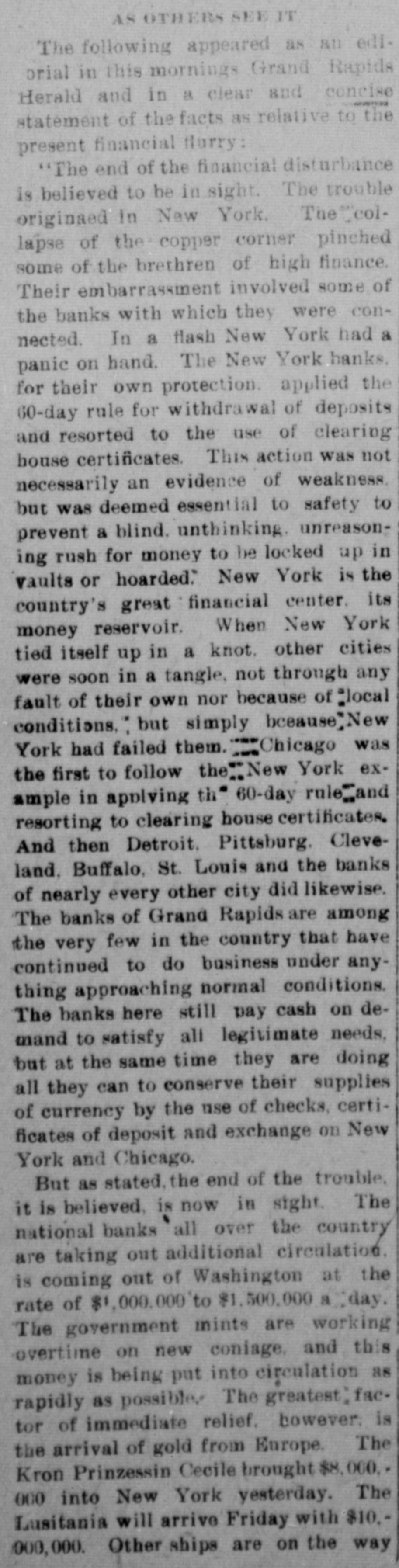
And then Detroit. Pittsburg. Cleveland. Buffalo, St. Louis and the banks of nearly every other city did likewise. The banks ... applied the 60-day rule and resorted to the use of clearing house certificates.
Source
newspapers
6. December 30, 1920 Voluntary Liquidation
Source
historical_nic

Newspaper Articles (3)

Article from The Daily Dispatch, June 13, 1884

Click image to open full size in new tab

Article Text

The share market was strong and higher in the early dealings. with Missouri Pacific as the feature. The rise in Missouri Pacific was due to an attempt by the bears to cover. The floating supply of stock is small. and outstanding an 1 short inter est large. The other active stocks advanced K@ 1%, the latter Canadian Pacific. Lake Shore sold up 1½. Western Union 1%, New York Central 1/4, St. Paul % Lackawanna %. Northwest 5/3, the remainder of active stocks After the first call Union Pacific became weak and dropped 4% on reports from Washington that the Government experts' statement would show that the company's net earnings for the first quarter had fallen $1,600,000 compared with previous year; that the dividend had not been earned. and none could be legally paid. It was also rumored that the experts had discovered a deficiency of $20.000,000 in the company's sinking funds, and that this money had been used to sustain the market value of the stock. Various other untavorable reports were circulated. It was said that the First National Bank of Cleveland had suspended, and that the Oregon Transcontinental Company was in a bad way, and that a receiver would be applied for, and that a serious washout had occurred on the Central Pacific road near Humboldt. Subsequently President Dillon, of the Union Pacific, stated there was no truth whatever in the story of the deficiency of $20,000,000 in his company's sinking funds, and that not one dollar had been used for the purposes alleged. It was also announced from Cleveland that the First National Bank was doing business as usual, and from San Francisco that there had been no washouts on the Central Pacific. The Oregon Transcontinental officials stated that the rumor in regard to a receiver was groundless. The denials did not come until there nad been a decline of %@4% in stocks. Union Pacific fell off 4½, Lackawanna 23/8, Missouri Pacific 2½, St. Paul 2, Northern Pacific preferred 2½, Western Union 1%, Lake Shore 1/2. Northwest 14, Louisville and Nashville 1%. In the afternoon, when the rumors noted above received official denial, a better feeling set in, and there was a brisk demand for New York Central, Missouri Pacific. Union Paeific, Western Union, Lake Shore, and Omaha and Northwest. Cables from London announcing the withdrawal of £100,000 from the Bank of England for shipment to New York stimulated the upward movement. New York Central rose 1½, Missouri Paclfle 14. Omaha, 1½, Union Pacifie, 1%, Lake Shore 14. Northwest 1 (ex. dividend), and Louisville and Nashville 1½. The market closed strong. Compared with last night's closing, prices are 1/2 @2% higher for Western Union, Omaha, Reading, Northern Pacific preferred, New York Central, New Jersey Central, Kansas and Texas, Missouri Pacific, Lake Shore, Louisville and Nashville, and Canada Southern, and %@% lower for Central Pa. cific, Pacific Mail. and Texas Pacific. Union Pa. cific is 2½ lower, and Chicago, Burlington and Quincy % lower. Sales, 400,000 shares. BALTIMORE. BALTIMORE, June 12.-Virginia 6's, deferred. 7; second series, 38%; new 10-40's, 32; new 3's, 53% North Carolina 6's, old, 105%. Bid to-day.
Article from The Salt Lake Herald, August 2, 1893

Click image to open full size in new tab

Article Text

TELEGRAPHIC BREVITIES. The cruiser New York was put in commission yesterday. The Seven Corners, Minnesota State bank, with a capital of $100,000, has failed. William Hunt has been appointed postmaster at Clearmont, Wyo., vice Stone, resigned. The Wyandotte County bank at Upper Sandusky, 0., has suspended. Assets, $100,000; liabilities, $75,000. A receiver has been appointed for the Philadelphia Packing and Provision company. No statement, but the failure is a large one. A receiver has been appointed for the Demme & Dierkes Furniture company of Chicago, with assets of $400,000 and liabilities of $120,000. The officers and directors of all the savings banks at Cleveland, 0., have decided to require of depositors notice before withdrawal of funds. At a meeting of the presidents of the Omaha savings banks this morning, they resolved to require sixty days' notice for the withdrawal of deposits. An order has been issued at the war department detaching Captain Carpenter and troops under his command from further duty at Puyallup Indian reservation. Patents were issued yesterday to John M. Browning, of Ogden, for a breechloading gun; to Lyman E. Baldwin, of Lander, Wyo., for a stovepipe attachment. The Safe Depositor & Trust company of Denver assigned last evening. Assets $400,000, liabilities $100,000. Eastern creditors caused the assignment by pushing the concern. At Utica, o., Monday night, John Cattle, two men named Bell, two others named Bowers and Skillen, were killed and Joseph Ship fatally injured by the explosion of a threshing machine.


Article from Alma Record, November 6, 1907

Click image to open full size in new tab

Article Text

AS OTHERS SEE IT The following appeared as an ediorial in this mornings Grand Rapids Herald and in a clear and concise statement of the facts as relative to the present financial Hurry: "The end of the financial disturbance is believed to be in sight. The trouble originaed in New York. The "collapse of the copper corner pinched some of the brethren of high finance. Their embarrassment involved some of the banks with which they were connected. In a flash New York had a panic on hand. The New York banks. for their own protection. applied the 60-day rule for withdrawal of deposits and resorted to the use of clearing house certificates. This action was not necessarily an evidence of weakness. but was deemed essential to safety to prevent a blind. unthinking. unreasoning rush for money to be locked up in vaults or hoarded." New York is the country's great financial center. its money reservoir. When New York tied itself up in a knot. other cities were soon in a tangle, not through any fault of their own nor because of "local conditions.", but simply bceause New York had failed them. Chicago was the first to follow the New York example in applving th* 60-day rule_and resorting to clearing house certificates. And then Detroit. Pittsburg. Cleveland. Buffalo, St. Louis and the banks of nearly every other city did likewise. The banks of Grand Rapids are among the very few in the country that have continued to do business under anything approaching normal conditions. The banks here still pay cash on demand to satisfy all legitimate needs, but at the same time they are doing all they can to conserve their supplies of currency by the use of checks, certificates of deposit and exchange on New York and Chicago. But as stated, the end of the trouble. it is believed, is now in sight. The national banks all over the country are taking out additional circulation. is coming out of Washington at the rate of $1,000.000 to $1,500,000 a day. The government mints are working overtime on new coniage. and this money is being put into circulation as rapidly as possible. The greatest, factor of immediate relief. however. is the arrival of gold from Europe. The Kron Prinzessin Cecile brought $8,000,000 into New York yesterday. The Lusitania will arrive Friday with $10.000,000. Other ships are on the way