Union National Bank (Chicago, IL)

Episode Information

Episode UID
69800885
Episode Type
Run β†’ Suspension β†’ Reopening
Bank Type
national
Bank ID
6980 national
Charter Number
698
Start Date
September 25, 1873
Location
Chicago, Illinois (41.850, -87.650)

Metadata

Model
gpt-5-mini (chosen from majority vote of a three-model LLM ensemble)
Short Digest
263f8983807ad25d

Response Measures

Accommodated withdrawals, Public signal of financial health, Partial suspension, Full suspension, Books examined

Clearinghouse involved: Yes (loan, examination, or other measures)

Description

Bank entered voluntary liquidation during the Sept. 1873 panic but later resumed operations in mid-October 1873.

Events (7)

1. January 11, 1865 Chartered
Source
historical_nic
2. September 25, 1873 Suspension
Cause
Macro News
Cause Details
Collective suspension by Chicago banks amid the national financial panic and difficulty converting balances into currency.
Newspaper Excerpt
All the Chicago banks have suspended.
Source
newspapers
3. September 30, 1873 Other
Newspaper Excerpt
The directors of the Union National Bank, after paying out about $400,000 yesterday, decided at a meeting last night to go into liquidation. The officers state that the assets are abundantly sufficient to pay all liabilities in full.
Source
newspapers
4. September 30, 1873 Run
Cause
Macro News
Cause Details
Wide financial panic of Sept. 1873 (national/market-wide loss of confidence) produced heavy withdrawals from the bank.
Measures
Directors paid out large sums (~$400,000) and later opted for voluntary liquidation to orderly meet claims.
Newspaper Excerpt
there WAS a heavy drain on the Union National, which decided the Directors ... to give up the fight and go into liquidation.
Source
newspapers
5. October 13, 1873 Other
Newspaper Excerpt
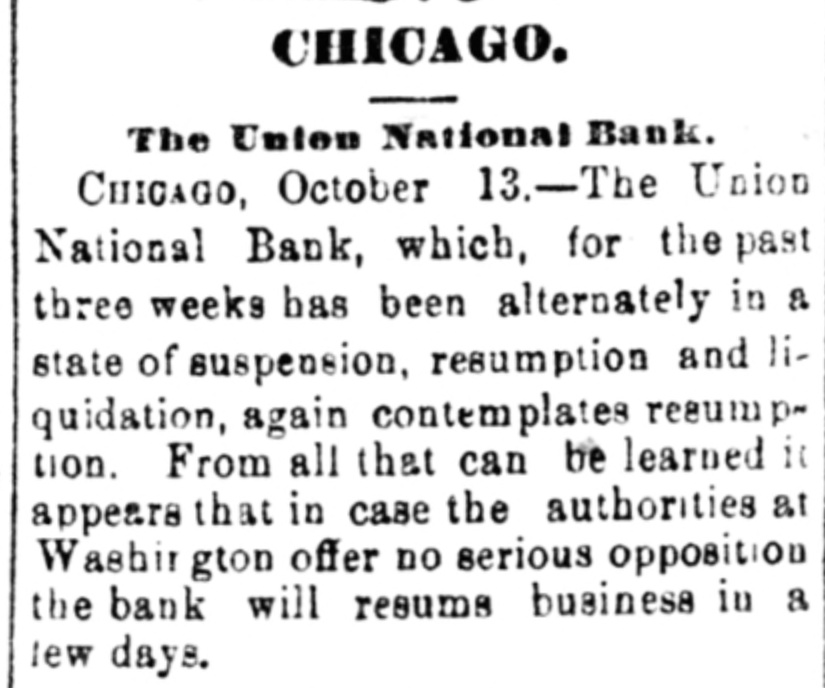
The Union National Bank ... again contemplates resumption. ... the bank will resume business in a few days.
Source
newspapers
6. October 16, 1873 Reopening
Newspaper Excerpt
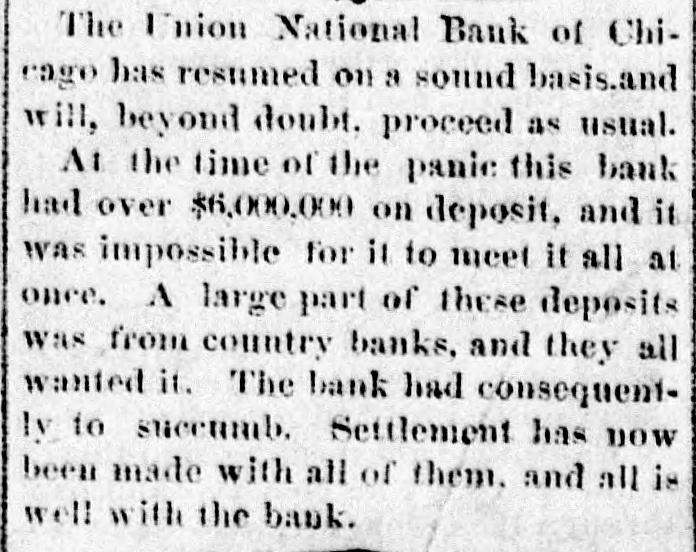
The Union National Bank of Chicago has resumed on a sound basis and will, beyond doubt, proceed as usual.
Source
newspapers
7. December 29, 1884 Voluntary Liquidation
Source
historical_nic

Newspaper Articles (25)

Article from The Daily State Journal, October 18, 1871

Click image to open full size in new tab

Article Text

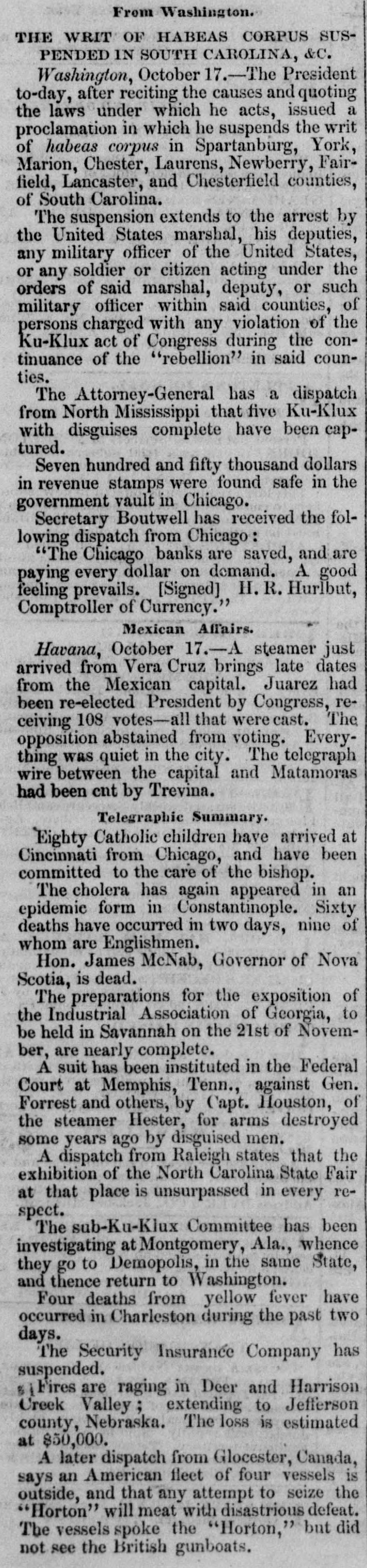
# THE WRIT OF HABEAS CORPUS SUSPENDED IN SOUTH CAROLINA, &C. Washington, October 17.--The President to-day, after reciting the causes and quoting the laws under which he acts, issued a proclamation in which he suspends the writ of habeas corpus in Spartanburg, York, Marion, Chester, Laurens, Newberry, Fairfield, Lancaster, and Chesterfield counties, of South Carolina. The suspension extends to the arrest by the United States marshal, his deputies, any military officer of the United States, or any soldier or citizen acting under the orders of said marshal, deputy, or such military officer within said counties, of persons charged with any violation of the Ku-Klux act of Congress during the continuance of the "rebellion" in said counties. The Attorney-General has a dispatch from North Mississippi that five Ku-Klux with disguises complete have been captured. Seven hundred and fifty thousand dollars in revenue stamps were found safe in the government vault in Chicago. Secretary Boutwell has received the following dispatch from Chicago: "The Chicago banks are saved, and are paying every dollar on demand. A good feeling prevails. [Signed] H. R. Hurlbut, Comptroller of Currency." Mexican Affairs. Havana, October 17.-A steamer just arrived from Vera Cruz brings late dates from the Mexican capital. Juarez had been re-elected President by Congress, receiving 108 votes-all that were cast. The opposition abstained from voting. Everything was quiet in the city. The telegraph wire between the capital and Matamoras had been cut by Trevina. Telegraphic Summary. Eighty Catholic children have arrived at Cincinnati from Chicago, and have been committed to the care of the bishop. The cholera has again appeared in an epidemie form in Constantinople. Sixty deaths have occurred in two days, nine of whom are Englishmen. Hon. James McNab, Governor of Nova Scotia, is dead. The preparations for the exposition of the Industrial Association of Georgia, to be held in Savannah on the 21st of November, are nearly complete. A suit has been instituted in the Federal Court at Memphis, Tenn., against Gen. Forrest and others, by Capt. Houston, of the steamer Hester, for arms destroyed some years ago by disguised men. A dispatch from Raleigh states that the exhibition of the North Carolina State Fair at that place is unsurpassed in every respect. The sub-Ku-Klux Committee has been investigating at Montgomery, Ala., whence they go to Demopolis, in the same State, and thence return to Washington. Four deaths from yellow fever have occurred in Charleston during the past two days. The Security Insurance Company has suspended. Fires are raging in Deer and Harrison Creek Valley; extending to Jefferson county, Nebraska. The loss is estimated at $50,000. A later dispatch from Glocester, Canada, says an American fleet of four vessels is outside, and that any attempt to seize the "Horton" will meat with disastrious defeat. The vessels spoke the "Horton," but did not see the British gunboats.

Article from The Tipton Advertiser, October 19, 1871

Click image to open full size in new tab

Article Text

# THE CHICAGO FIRE considered a sufficiently large figure to cover all the losses. The number of acres actually burned over is about 2,500-comprising the most compact and thickly inhabited part of the city, and the great bulk of its business and substance. About 20,000 buildings were burned, one-fourth of which were of stone or brick. The actual loss of life was undoubtedly over 300. Concerning the situation and prospects, on Friday, the Journal said: "Chicago is not hopelessly down. Her capitalists and merchants are 'up and doing'-preparing for reorganization and reconstruction upon the old foundations -and it is very apparent to all intelligent observers, that all will soon be well, and that Chicago will, before long, be in rapid process of rebuilding, and that before many years she will in all respects be herself again. The fact, now positively stated, that the heaviest insurance companies at the East will promptly adjust and pay in full their losses by our Great Conflagration, is the most cheering news we have yet received since the Calamity. This will go far towards helping many of our people out of their troubles and setting them on their feet again." On Monday, it speaks yet more cheerfully, speaking of the announcement that the banks would resume business on the 17th, which is strengthened by a certificate from the United States Comptroller of Currency that the National banks of Chicago are solvent institutions, as follows: "The decision of the banks to abandon their fifteen per cent. installment policy, and resume business as usual to-morrow, has restored confidence in Chicago. The universal opinion now is that the grain business will soon be running as usual. At present the derangement in insurance is a hindrance to shipments. There is no speculative business attempted. It is believed that the permanent increase in the price of grain will be slight. We hear of scores of cases where merchants or capitalists are already fully determined to rebuild in the most substantial style on the old sites, and it is already very evident that the South Side will before many months be 'reconstructed' even more substantially than is was built originally." The peace of the city has been restored and is maintained. The papers deprecate the statements which are finding place in newspapers signifying a different state of things, and say that General Sheridan and the city authorities report no cases of outrage or serious disturbance.


Article from Daily Kennebec Journal, December 4, 1872

Click image to open full size in new tab

Article Text

# THE CURRENCY. The Report of the Comptroller of the Currency is an elaborate document. The topic of most interest referred to is that of a proposed increase of the national bank notes. The Comptroller recommends the repeal of the act of Congress which calls for the redistribution of twenty-five millions of national bank currency, by withdrawing that amount from the Middle and Eastern States and giving it to the South and West, and in lieu thereof to issue five millions a year additional circulation for the next five years, to meet the wants of those States which have not had their full proportion. It is a commonly received but somewhat erroneous opinion that the amount of currency in the hands of each individual member of the community has been on the average largely increased by the National Bank system; but this report only gives it now as, for the whole United States, $9,18 per capita, against $7,59 before National Banks existed; but the circulation of United States Treasury notes should be added before any conclusion is reached from these figures. The State of Rhode Island has the largest per capita circulation: $61,56; Missippi the least: one centβ€”except Florida and California, which have none. New York has but $14,08. The National banks have paid in the last eight years some $40,000,000 taxes to the United States; their State and national taxes for four specified years together amount to $71,000,000. The bank dividends are not so large on the average as is generally supposed; they do not exceed in the aggregate those of the old State banks; for the whole Union they but slightly exceed five per cent on invested capital. The great question of the proper reserve to be held by the National Banks is discussed in this report, and the conclusion reached that it is only the smaller and weaker banks that want to go below the present limit. Their necessities arise from putting out their funds at interest on deposit with Eastern banksβ€”a condition which has more than once given rise to the most serious financial convulsions, as in 1857β€”and a remedy proposed by the Controller is the issue of a new security by a Government which will afford these banks the needful investment at interest. Not the least interesting feature of this report is the announcement that the Chicago banks, so far from being crippled as was anticipated after the fire by losses on discounted paper and the withdrawal of their balances, in point of fact steadily increased in business and profit, after resuming without embarrassment as soon as their safes were cool. There is a similar prospect in Boston, where the aggregate losses since the fire on bills receivable are estimated at less than three millions of dollars, which the bank surpluses will cover without touching capital or reserve. The question of usury is discussed. It appears that the penalty for its practice by National Banks is not clearly defined, and the


Article from Memphis Daily Appeal, September 22, 1873

Click image to open full size in new tab

Article Text

NEWS OF THE DAY. The Wisconsin State fair begins at Milwaukee to-day. The Texas editorial excursionists left Cincinnati last night for Louisville. The financial panic is reported to have seriously affected the narrow-gauge interests in Utah. The Chicago banks have taken advantage of the sixty-day privilege on their depositors. McClure's military academy, at Oakland, California, was entirely destroyed by fire Saturday night. Immediately after the cortes adjourns the Spanish government at Madrid will declare Spain in a state of seige. Thomas Tarwater, a brakeman, was run over and killed by a freight-train at Columbia, Tennessee, on the nineteenth instant. Pat Garnley, an insane man, set fire to a building in Jeffersonville, Indiana, yesterday, remained in it and was burned to death. Business generally will be suspended in Cincinnati to-day. it being proclaimed by the mayor. a holiday in the interest of the exposition. A strange and fatal disease at Kelter, in Utah, is very prevalent, producing great consternation. The patients die in a few hours. It resembles fever. Satisfactory arrangements have bee n perfected with the Ute and other tribes of Indians, hitherto in discontent, so that they will be settled upon their reservations. A Milwaukee dispatch says the financial panic of New York produces no disturbance there as yet, but the banks are preparing for any emergency that may occur the coming week. At Carbondale, Illinois, yesterday two negroes, Bill Smith and Frank Collins, remembered the Sabbath by playing cards, "fell out," resulting in the latter shooting the former through the heart. He's dead.


Article from The Rock Island Daily Argus, September 25, 1873

Click image to open full size in new tab

Article Text

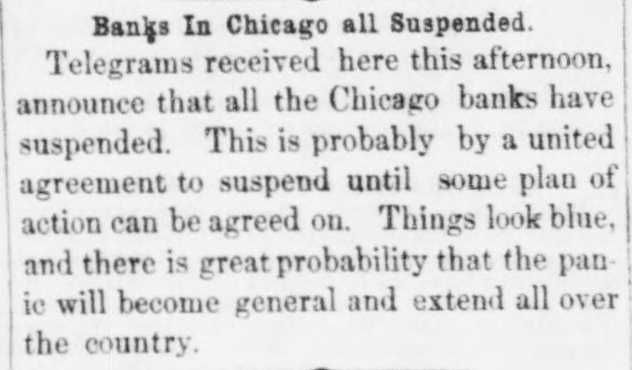
# Banks In Chicago all Suspended. Telegrams received here this afternoon, announce that all the Chicago banks have suspended. This is probably by a united agreement to suspend until some plan of action can be agreed on. Things look blue, and there is great probability that the panic will become general and extend all over the country.


Article from The True Northerner, September 26, 1873

Click image to open full size in new tab

Article Text

# True Northerner. PAW PAW, MICHIGAN, Sept. 26, 1873. # Local Department. Hon. Wilder D. Foster, Representative in Congress from the Fifth District of Michigan, died in Grand Rapids Sept. 20. H. P. McFarlin will hold an Auction Sale at the residence of Fdward Stowman, two miles north-west of Glendale P. O., Oct. 11. We advise every young man or lady who wish to qualify for business to attend the Kalamazoo Business College. The Ann Arbor Courier says the seating capactity of the new University Hall is 3,000, and by the use of temporary seats 4,000 can be accommodated. Charles Smolk has removed his Sewing Machine Depot to the new building on the corner of Main and Niles streets, adjoining the residence of T. A. Granger. The Fair of the Paw Paw Valley Agricultural Society commenced last Wednesday and closed to-day. We will give a more extended notice of it in our next issue. REV. R. C. WELCH, who has been assigned by the Michigan Conference to the charge of the M. E. Church in this place for the ensuing year. preached his first sermon on Sunday morning last. All the Banks of Chicago entered into an arrangement by which they closed their doors yesterday morning, and take thirty days in which to pay depositors. A genral derangement of business must be the result. The South Haven Sentinel says: "The condition of religion is good." That is just as we had supposed, and we are right glad to see that fact verified in so public a manner, for the past season has been unusually sickly. The Government Printing office in the City of Washington, in the Territory of Columbia, is one of the largest printing offices in the world. Six colored compositors are employed at the case in that concern. The Lapeer Clarion wants the fat men to stand back in future and give the lean men of the State a chance to hold a convention and get a good, square meal out of East Saginaw or some other philanthropic city. At a public gathering lately one of the gentlemen present was called upon for a speech, and this is how he responded: "Gentlemen and women, I ain't no speecher. More'n 20 years ago I came here a poor idiot boy, and now what are I?" On Saturday last, Miss Emma Pugsley left for Ann Arbor to enter the State University. She is a graduate of the school here, and is an excellent scholar. There are now two young ladies attending the University from this village, the other being Mies Emma Andrews. who has been there for the past two years. The Circuit Court has been in session during the past week. On Monday the Matteson case came up on a motion for change of venue, which motion, after a hearing and the reading of affidavits in support of the motion and counter affidavits opposed to it, was denied. The time for the trial will probably be set down for the next term of the Court. The most important other matter before the Court was a case between A. M. Merrifield and Philo Reed. LAWRENCE, Sept. 16, 1873. TRUE NORTHERNER: DEAR. SIR, I have been away all summer, and have but just returned. The first newspaper I saw after getting home was yourself going "Up in a Balloon." If a little money will save you, the enclosed Two Dollars will help. Keep the thing flying till they all respond, and keep the paper coming. Can't keep house without it. Yours Truly, The State Fair, held at Grand Rapids last week, was a success as regards the magnitude of the exhibition in all its departmentst-he Lumber of people who attended and financially. We learn that the receipts exceeded thirty thousand dollars. Our own Van Buren County maintained the ascendency she had heretofore attained. She bore off the highest prize for her County Collection of Fruit; the township of South Haven took the first prize for her Township collection of Fruit; and the Williams' process for evaporating fruit was pronounced superior to the Alden process. Mr. Williams. the inventor, is a resident and fruit grower of South Haven, in this countv. Our worthy and honored friend. Judge Monroe. met with a very serious mishap on Saturday night last, by which he is now lying in a critical condition. He had arrived here on the nine o'clock train on his way home from Grand Rapids, where he had been attending the State Fair. He started for his home, aboat eight miles from town, on foot and leading a ball by a cord attached to a ring in his nose. When about one-half mile from town the bull became somewhat refractory and refused to go. the Judge meanwhile pulling him along by the cord, when the animal suddenly attacked nim, throwing him to the ground and trampling him under his feet, bruising and lacerating him very seriously about the chest, side and bowels. fter becoming released the Judge crawled to the house of Mr. Clancy and aroused the inmates. who took him in and cared for him until he was taken home, Sunday morning. Ir not unfrequently happens that a party political convention is moved to deliberately falsify history in their platforms, declarations and resolves, as was the case of the Ohio in ther recant numatform adopted by


Article from The New York Herald, September 28, 1873

Click image to open full size in new tab

Article Text

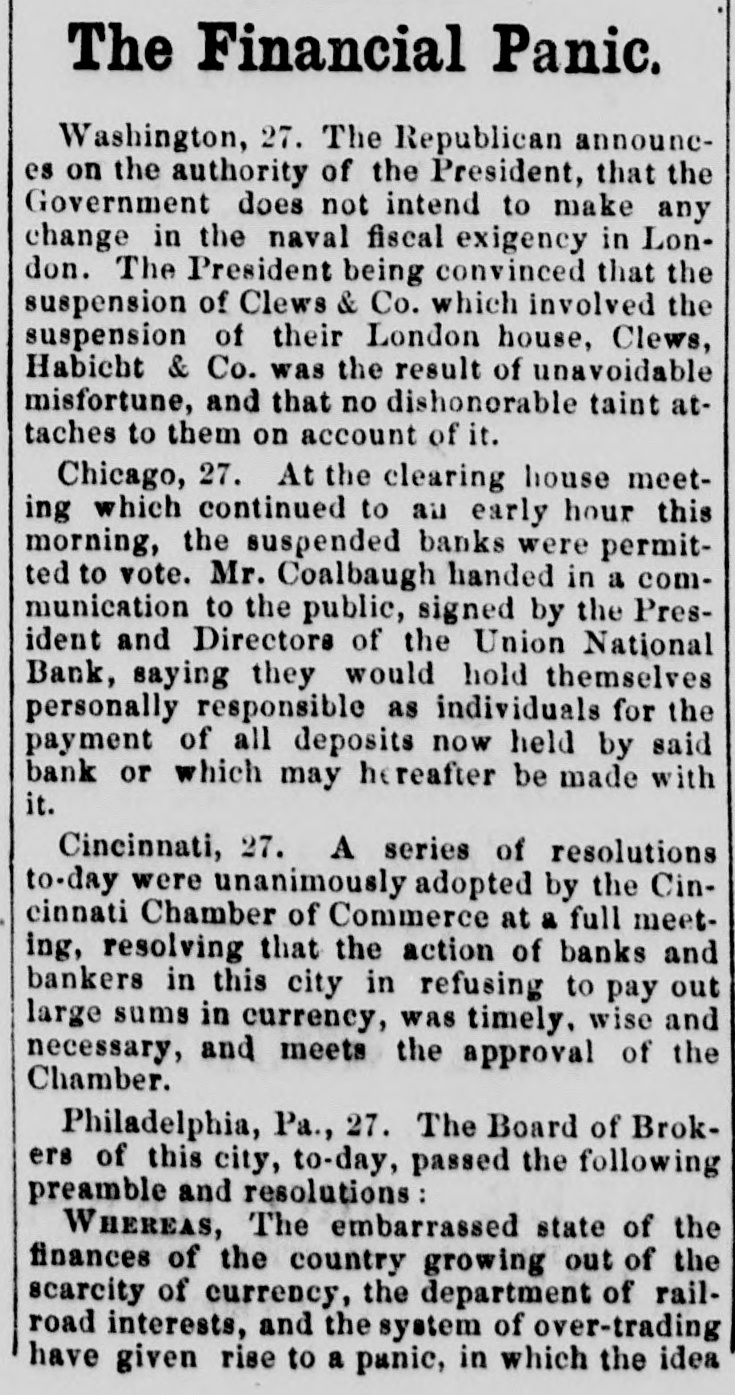
The Chicago Clearing House Association. in Session. CHICAGO, Ill., Sept. 27, 1873. At the Clearing House meeting, which continued to an early hour this morning, the suspended banks were permitted to vote. Mr. Coolbaugh handed in a communication to the public, signed by the President and Directors of the Union National Bank, saying they would hold themselves personally responsible, as individuals, for the payment or all deposits now held by said bank or which may hereafter be made with it. Mr. Coolbaugh also addressed the meeting as follows:He had been advised that the banks in Cincinnati and St. Louis were doing business on other than a currency basis. He believed, in view of the change made by these cities, that it would be as impossible for Chicago to go business on a currency basis as it would be for it to do business for the surrounding country on a gold basis. For the information of those present he would say that the entire assets of the bank amounted to $4,300,000, not over $50,000 of which was doubtful. In sixty days $4,000,000 would mature, and at the present time there was in the bank $1,000,000. He made this statement because it was due to the associated banks, and besides the Union National Bank would then know that it was far from being insolvent. A meeting of the associated banks will be held to-night, at which the New York plan will undoubtedly be adopted.


Article from Alexandria Gazette, September 30, 1873

Click image to open full size in new tab

Article Text

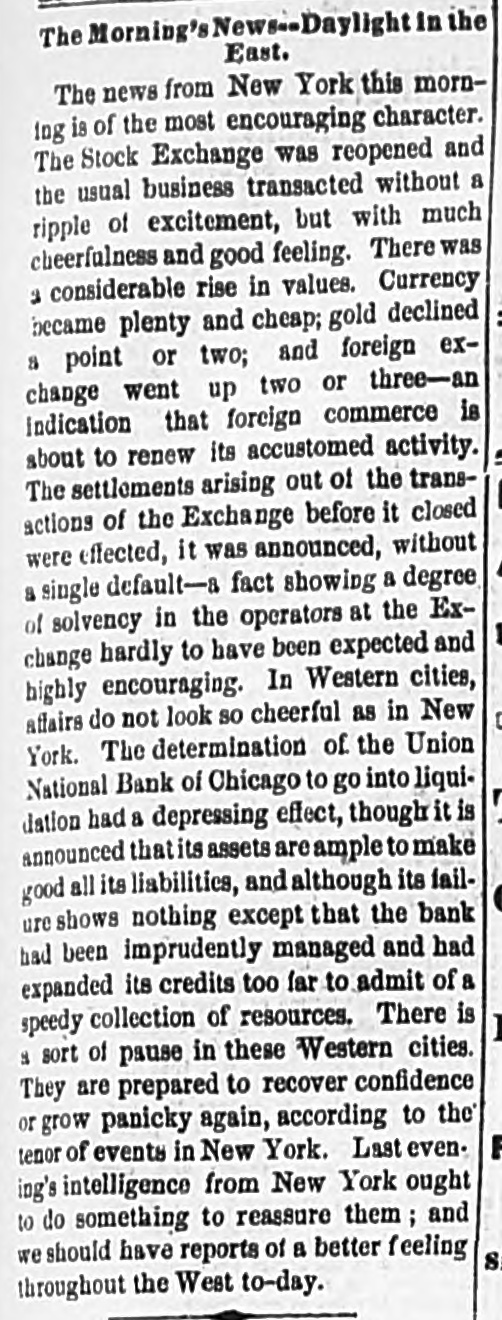
TELEGRAPH. [SPECIAL DISPATCHES TO THE GAZETTE.] Finance al Affairs. NEW YORK, Sept. 30-12:30.-There is considerable pressure to sell and realize on stocks and prices have declined from one to three per cent, from the opening quotations. The following are the prices at this hour, the market being feverish and unsettled : New York Central, 90; Pacific Mail, 33. Brokers gener; ally display disinclination to operate for custo mers on margins before affairs become more settled. LONDON, Sept. 30-3:30 p. m. -The of bullion withdrawn from the Bank of Eng. land on balance to-day is Β£50,000. LEAVENSWORTH, Ks., Sept. 20.-There is much indiguation among the stockholders and depositors of the First National Bank in this city in consequence of the Vice-President or7 dering the bank to suspand and at the sametime drawing from the bank nearly $100,000 in currency to sustain the credit of Scott & Co., brokers, of which firm the vice-President. Lyman Scott. is a partner. The German's Savings Bank and Insley, Shire & Co., bankers, re-opened yesterday and are abundantly well able to meet all demands. The other banks here are paying checks in limited sums. LONDON, Sept. 30--5 p. m.-The demand for discount at the Bank of England, as well as in open market to day has been heavy at the rate of 5 per cent. NEW YORK, Sept. 30. The sub-Treasurer paid out $6,500 on discount of the November interest. Smith & Seaver, who were reported suspended on the 19th inst., announce that they will pay all demands in full and continue business as heretofore. LONDON, Sept. 30.-A special dispatch from Berlin to the London Hour hints at financial troubles in Germany. Fancy stocks and bank shares are not saleable, and some have fallen as much as 20 per cent. There is some talk of government interference. CHICAGO, Sept. 30.-The directors of the Uuion National Bank, after paying out about $400,000 yesterday, decided at a meeting last night to go into liquidation. The officers state that the assets are abundantly sufficient to pay all liabilities in full. NEW YORK. Sept. 30.-The announcement was made iu the Stock Exchange that Smith & Seaver would pay in full in cash all claims against them. This was received with cheers and hailed as a good omen. The impression now prevails that all the leading houses will pull through. There was a decided improvement in foreign exchanges, which was looked upon as a favorable symptom of returning confidence Leading bankers advanced their rates to 1.064 for sixty days sterling and 1071 for sight, but actual business was at a reduction from these rates. Gold has been weak and lower. The price declined from 1124 to 111 and then recovered to 1124. At the opening loans in gold were made flat to 1 32 for use, but afterwards 1 32 was paid for carrying gold. Southern State securities are dull and without a feature. CHICAGO, Sept. 30.-The City Council have passed an ordinance authorizing the issue of $300.000 in Treasury scrip with which to pay the current expenses of the city during the lock up of currency. There is much difference of opinion along business men as to the expe dieney of this issue. MEMPHIS, Sept. 30. - At a large meetiug of the Chamber of Commerce this morning to cousider the financial situation, a resolution was received from the banks of the city to the effect that they would not suspend but would open in addition to the u ual business an exchange account to be paid in kind for the purpose of moving cotton, which was unanimously adopted by the Chamber. PROVIDENCE, R. I., Sept. 30.-An adjourned meeting of the Providence banks, this noon, received and adopted the report of the committee recommending a liberal policy on the part of the banks toward each other and their customers, that each bank should request its depositors to draw checks payable through the clearing house and should certify checks payable through the clearing house; that deposits made in the banks in currency be paid out to such depositors in currency, and that deposits made in certified checks be paid in kind. LONDON, Sept. 30.-The steamship Donau, which sailed from Southampton for New York to-day. took 136.000 pounds in bullion. LONDON, Sept. 30. ..-The 50,000 pounds drawn from the Bank of England on balance to-day is to be shipped to New York.


Article from Chicago Daily Tribune, September 30, 1873

Click image to open full size in new tab

Article Text

the seventh bell-pull a figure in white, with 'Is whiekers, appeared at the window: Mr. Wheeler in?" gently asked the reportor. "Heis," mildly insinugted the something in white-it was impossible to tell what it was. The reportor announced his mission in tones at once firm and respectful. He didn't want to hurt Mr. Wheeler's feelings, but, at the same time, a ride at midnight down as far as Twenty-third street must not be without results in panio time, oven if somo extra steam has to be put in. After a few minutes and elapsed, a click was heard at a window, and the snowy form was again apparent, o'ertopped by the genial face of the Vico-President. After apologizing for the inopportuneness of the visit, which he hoped the nocessity of the occasion would excuse, the reporter opened the saliont point of the interview with a question: Reporter-Mr. Whooler, what is the standing of the Union National this ovening ? Mr. Wheeler-You are n TRIBUNE reporter? Then of course you know. the news. We have resolved to go into voluntary liquidation. Reporter-Will not the public be surprised by this action ? Is not your bank solvent ? Mr. Whooler-As to the surprise I cannot answor. Our bank is solvent. Reporter-Then, Mr. Wheeler, what has inducod this action on the part of the Union National ? Mr. Whoolor-We have found our currency funds inadoquate to the supply of the demand upon us. Reporter-Upon your temporary suspension what amount of funds did you have on hand,I mean cash in currency and immediately availablo cash collaterals ? Mr. Whoolor-That Icannot definitely answer. It WAH stated correctly in THE TRIBUNE at the time, but I do not recollect the exact amount. Reporter-Was it not stated at $1,400,000? Mr. Whoolor-I believe that was the approximate amount, but it was not all in cash. Seon (tics deemed immediately available were included: Reporter-How has it been with you to-day? Mr. Wheeler-Wo oponed the bank against our better judgment, and our action was due to a feeling of compulsory acquiescence in general judgmont. We did not feel that circumstances


Article from Chicago Daily Tribune, September 30, 1873

Click image to open full size in new tab

Article Text

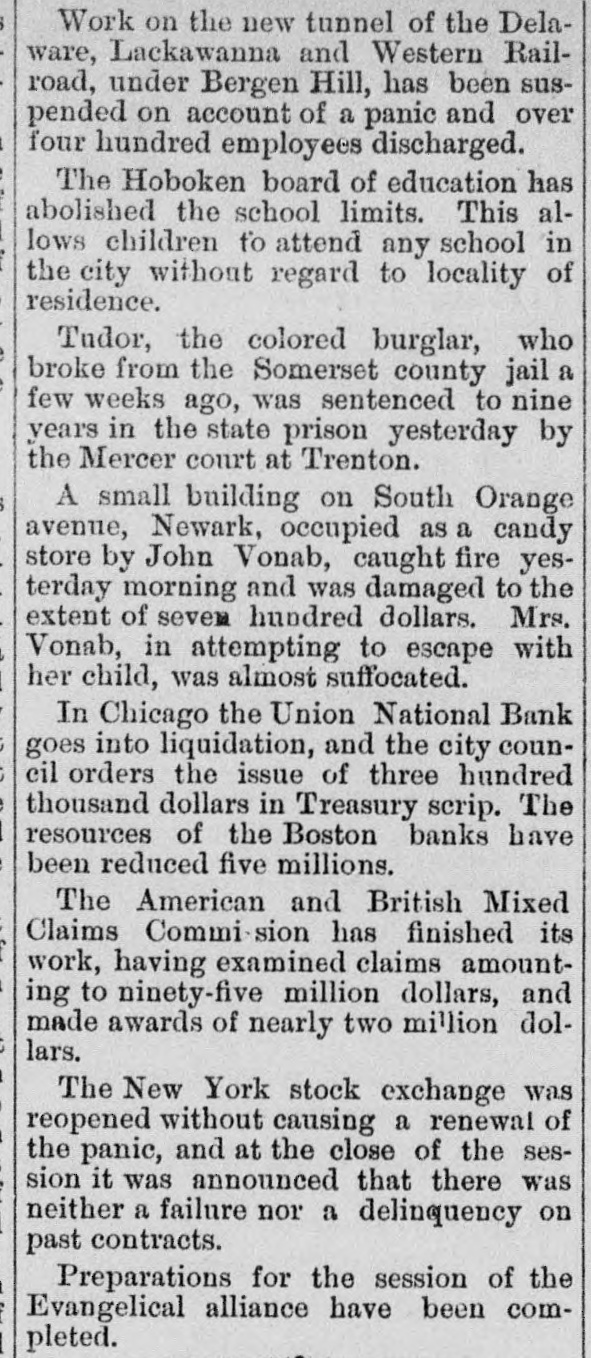
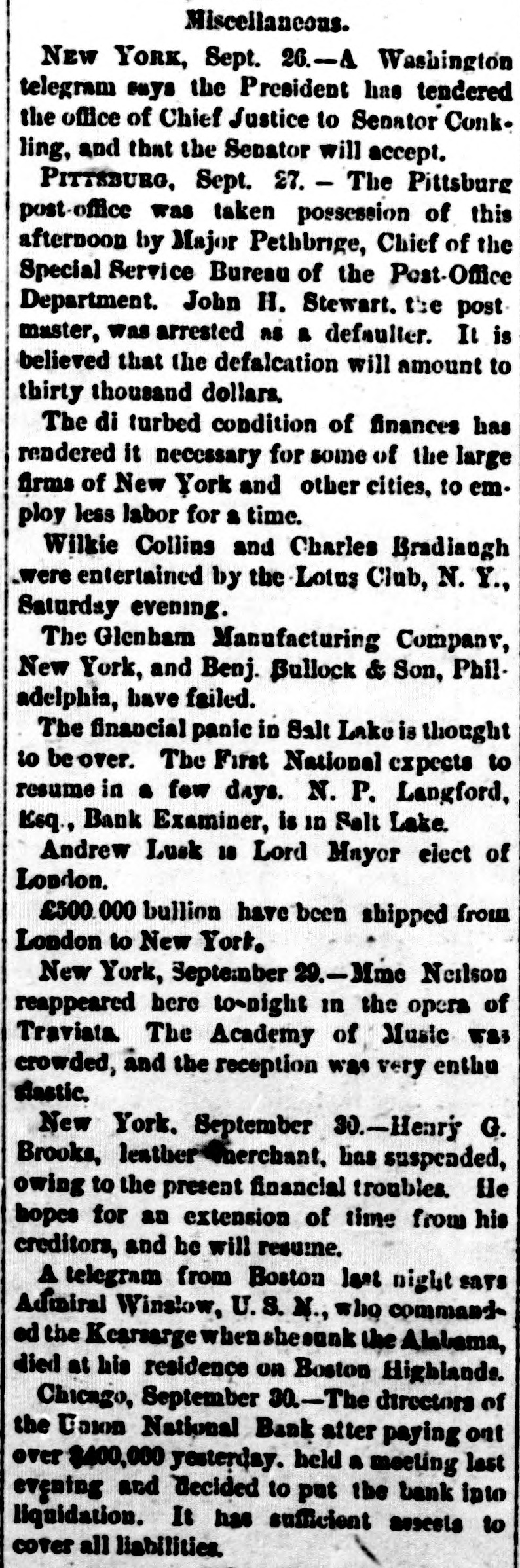
THE SITUATION. The day opened brightly in financial and business circles here yestorday. The largo influx of currency on Saturday and Sunday caused an activo market for grain, and the prico of wheat-advanced 4 to 5 cents per bushel. Corn advanced 2 conts, and oats 11/2 cent. Thore was no perceptible run on any of the banks, but there WAS a heavy drain on the Union National, which decided the Directors of that institution, at a lato hour last night, to give up the fight and go into liquidation. Except this untoward circumstance, the day was altogether the most cheering that Chicago has seen since the incondiary and false announcement was made last week that all her banks had resolved to close their places. The receipts of currency by express last night footed up as follows: $1,100,000 American Express 500,000 Adams Express 400,000 United States Express Total 82,000,000 About one-half of this was consigned to the banks, and the other half to private parties. The express companies expect an equally largo sum to-day. The effect of those large receipts of currency was not only vieiblo in the streets and the harbor and on the Board of Trade, but in the country also, from which returns are already being received in the form of remittancos to our wholesale merchants. The country banks all report themselves right side up. Wo wish to im press again upon the public the fact that the West holds the property which will command the circulating medium of the world, whether it be greenbacks, gold, wampum, or coon-skins; that this circulating medium is coming in a steady stream, and that until Europo and Canada and the Eastern States are supplied with food it must continuo to flow. All that is necessary to do is to steady ourselves with this fact, and go about our business. Prices will have to como down. Mon will have to Boll their services for less wages nominally, but there is every reason to believe that we shall CBcape tho fatal effects of a financial revulsion. If the present panic had started earlier in the year, before the crops began to move, the caso would have been different. Whatever may be the purport of the emergency that has come,-whether it be a more flurry or a genuino crisis,-it has como at the very time when we could stand up against it best. Our dispatches from Philadelphia announce the failure of Bonjamin Bullock's Sons, wool dealers, as a consequence of the failure of the Glenham Manafacturing Company, of Dutchoss County, N.Y.; also the failure of two factories (business not stated) in Kensington. Disston & Co., saw manufacturers, of Philadelphia, have reduced their works to two-thirds timo. From Boston it is reported that the Walthamand Howard Watch Companies have been compelled to discharge a large number of their workmen, from inability to get currency to pay their wages. A large dry-goods house in Now York has offered to discount 2 per cont per month from the maturing paper of their customers, for immediate payment. Our Washington dispatches state that Senator Morton thinks an extra session of Congress should be called forthwith. THE PRESIDENT'S REMEDY.


Article from Chicago Daily Tribune, September 30, 1873

Click image to open full size in new tab

Article Text

LAWRENCE, KS. Special Dispatch to The Chicago Tribune. LAWRENCE, Ks., Sept. 20.-Financial matters are looking brighter. The news of resumption by the Chicago banks is hailed with delight. Our banks have paid without suspension through the panic.


Article from Chicago Daily Tribune, September 30, 1873

Click image to open full size in new tab

Article Text

SAN FRANCISCO. Special Dispatch to The Chicago Tribune. SAN FRANCISCO, Sept. 20.-To-day was devoted almost exclusively to collections and legitimate channels, and the result inspirod confidence. Tho resumption of business by the Chicago banks was the subject of much congratulation, showing the panic had no serious effects on Western finance and stability. This, with the promptness with which to-day's matured obliga- tions were mot, has reopened the current of exchange, which resumed with some briskness. Coin drafts on New York sold at ΒΎ to 1 por cent; telegraphic transfers at 2 por cent. The panic has fully demonstrated the unadvisability of stock speculations. Capitalists are more unwilling than ever to invest in outside real estate, preferring legitimate enter- prises and staple products. The panic is charged


Article from The Wheeling Daily Register, October 1, 1873

Click image to open full size in new tab

Article Text

THE FINANCIAL OUTLOOK Symptoms of Returning Confidence. WASHINGTON, September 30.-There is an improved feeling in financial circles. The banks and banking houses outside the combination are doing an increased business, while those in the combination are certifying and declining to cash the smallest checks. Faut, Washington & Co. had paid threefourths of their depositors last week, when, owing to their inability to realize on ample securities, they were obliged to suspend payment. An arrangement has nearly been perfected with the re. maining depositors by which they expect soon to resume business. It is stated at the Treasury Depart= ment that the Department statement to-morrow will exhibit a fair reduction in the public debt, notwithstanding the revenues of the North have been very light. The Treasury disbursements for the usual expenses of the Government for the month ending to-day, have been below the average expenses for the last three or four months. MEMPHIS, September 30.-At a large meeting of the Chamber of Commerce this morning, to consider the financial situation, a resolution from the banks of the city was received to the effect that they would not suspend, but would open, in addition to their usual business. an exchange account to be paid in kind for the purpose of moving cottoo, which was unanimously adopted by the Chamber. The most responsible merchants of the city have subscribed and paid in three hundred and twenty thousand dollars to the First National Bank, which will enable it to pay all liabilities and resume all business at once. CHICAGO, September 30 -The Directors of the Union National Bank after paying out about four hundred thousand dollars yesterday. decided at a meeting last night to go into ] quidation. The officers state that the assets of the bank are abundantly sufficient to pay all liabilities in full. ST. LOUIS, September 30.-The City Council have passed an ordinance authorizing the issue of three hundred thousand dollars treasury scrip with which to pay the current expenses of the city during the lock up of the currepcy. There is much difference of opinion among business men as to the expediency of this issue, some holding it will work barm by pushing that much currency out of circulation, that it will greatly depreciate and will be ignored by the banks, while others think it will relieve the present great pressure for currency. HARRISBURG, September 30.-The manufacturers here have adopted rese lutions approving the action of the banks, in preventing a drain of currency a8 conducive to their best interests as well as the interests of the public at large.


Article from Chicago Daily Tribune, October 1, 1873

Click image to open full size in new tab

Article Text

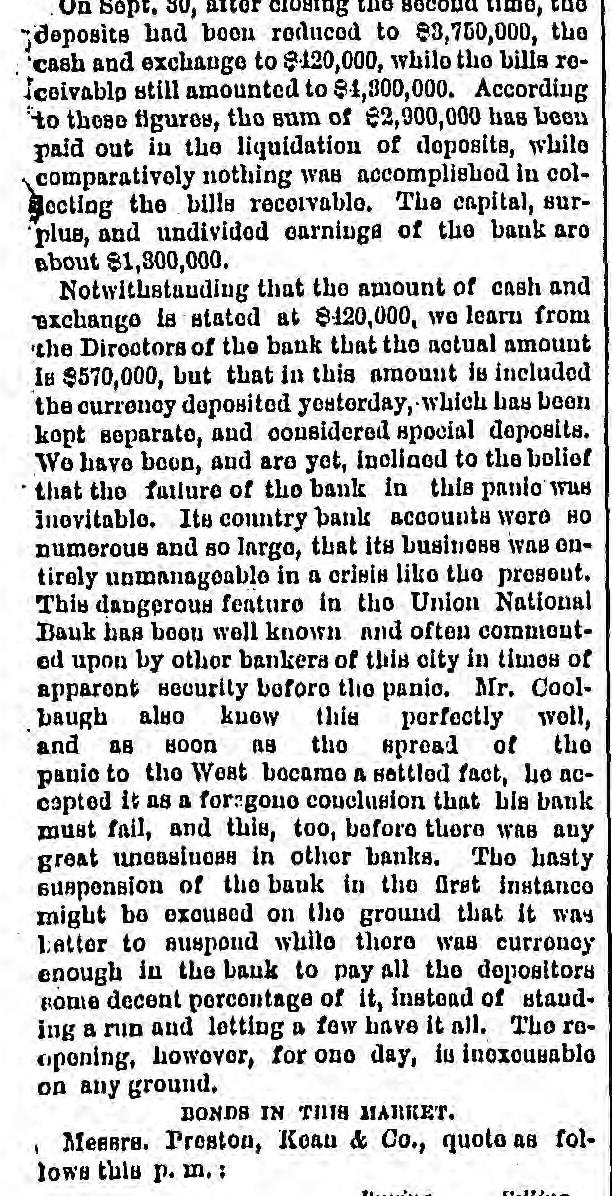
On Sept. 30, alter closing the second time, the deposits had been reduced to 83,750,000, the cash and exchange to $120,000, while the bills reIceivable still amounted to $4,300,000. According to those figures, the sum of 62,900,000 has been paid out in the liquidation of doposits, while comparatively nothing was accomplished in colSecting the bills receivable. The capital, surplus, and undivided earnings of the bank are about $1,300,000. Notwithstanding that the amount of cash and exchange is stated at 8420,000, we learn from the Directors of the bank that the actual amount Is $570,000, but that in this amount is included the currency deposited yesterday, which has been kopt separate, and considered special deposits. We have been, and are yet, inclined to the belief that the failure of the bank in this panio was inovitable. Its country bank accounts were HO numerous and 80 large, that its business WAB ontirely unmanageable in a crisis like the present. This dangerous feature in the Union National Bauk has been well known and often commented upon by other bankers of this city in times of apparent security before the panic. Mr. Coolbaugh also know this perfectly well, and as soon as the spread of the panic to the West became a settled fact, lie accapted it as a foragono conclusion that bis bank must fail, and this, too, before there WAB any great uneasiness in other banks. The hasty suspension of the bank in the first instance might be exoused on the ground that it way Letter to suspond while there was currency enough in the bank to pay all the depositors some decent percentage of it, instead of stauding a run and letting a few have it all. The roopening, howover, for one day, in inexougable on any ground. BONDS IN THE MARKET. Messre. Preston, Kean & Co., quote as follows this p.m.:


Article from The Daily Dispatch, October 2, 1873

Click image to open full size in new tab

Article Text

THE FINANCIAL SITUATION. WASHINGTON. WASHINGTON, October 1.-The financial situation closed yesterday without any new features. The liquidation of the Union National Bank of Chicago had rather a depressing effect, but caused no excitement. Much anxiety exists. All are looking to New York for a solution of the difficulty. NEW YORK. NEW YORK, October 1.-The Grant Locomotive Works, of Paterson, N. J., has discharged one hundred and seventy-tive employΓ©s. Four hundred operatives on the Delaware tunnel have been discharged in consequence of the scarcity of currency. The Cummings Car Company, of Jersey City, has suspended. The trouble is owing to the large amounts due by railroad companies which cannot be collected. NEW YORK, October 1.-There was a very quiet feeling in financial circles to day, with an entire absence of any exciting event. The firm of Northrop & Chip suspended this morning, but the failure had no influence on the Stock Exchange, as the firm had no stocks; the suspension being caused by the withdrawal of deposits. There was another sharp advance in foreign exchange to-day, and bankers advanced their rates to 1074 for sixty days' sterling, and 109 for sight. The suspension of Henry Clews & Co. was officially announced in the Stock Exchange. Bank officers report the demand for currency to be sent to the country banks has fallen off. Several banks out of town have telegraphed to stop further shipments, and some others have returned the greenbacks to New York. The total amount paid out on account of the November interest is $29,945.74. A visit to the different savings banks today shows that all fears on the part of depositors have vanished, and large numbers who drew out money last week have returned it. There are about $13,000,000 in greenbacks in the vaults, which, when all signs of any run is passed, will be distributed through other channels. Patton & Co., one of the oldest dry goods houses of this city, temporarily suspended to-day. CHICAGO. CHICAGO, October 1.-The financial situation here this morning presents a much brighter aspect than yesterday. The receipts of currency continue large, some three millions of dollars being reported yesterday, while the demands upon deposits are falling oil. In fact, some of the banks have already begun to furnish their customers with the usual accommodations. The prospect is that it will not be long before business will resume its wonted channels. It is stated that the Third National Bank will resuine business in a few days-probably by the beginning of another week. There is a much firmer feeling in the grain market, with an advancing tendency in prices. LOUISVILLE. LOUISVILLE, October 1.--It is reported that


Article from Ottumwa Weekly Courier, October 2, 1873

Click image to open full size in new tab

Article Text

On Monday evening last the following action was had by Chicago bankers : The Chicago Clearing House association of banks and bankers resolve that until further action, and in view of the disturbed condition of affairs in New York and other cities, and the difficulty of converting balances into currency, its members be recommended and authorized to suspend currency payments on any large demands made upon them, either from country banks or over their counters. Dispatches of last night show that this action of the Chicago bankers is commended in Keokuk and Des Moines, Iowa,"also by those of Quincy and Peoria, III. The excitement throughout the whole country is great, and yet everybody expresses the utmost confidence in the banks, except such as have been dealing in railroad stock. The opinion prevails that banks generally must suspend until the people settle quietly down. Our produce which had commenced moving, is about totally checked. Eastern banks refuse to send currency west, and as a consequence no produce can be bought. This certainly cannot last long, for the starving must have bread and the currency depot must be unlocked in the East.


Article from The Kenosha Telegraph, October 2, 1873

Click image to open full size in new tab

Article Text

MONETARY. Since our last issue there has passed a week of great anxiety and fear throughout the country, the best of financiers and the wisest not being able to forsee what S day might bring forth. In New York there were but few or no more important failures and the panic has gradually subsid ed and business is assuming its usual activity The Gold and Produce Exchanges were ecarcely more than closed till they were opened again. The Stock Exchange remained closed till Tuesday morning at 10 o'clock when it was opened and immediately filled by the crowds rushin in at the three entrances on Wall Broad and New streets. Stocks at first rose and then remained etationary or fell. Dividend paying stocks generally held an ad vance. The day passed and closed as fa. vorably as was expected-perhaps more favorably. The Secretary of the Treasury paid out $14,000,000 for the purchase of government indebtedness and then declined paying out any more. His declining to purchase any more bonds had a depressing effect but the orders for the prepayment of the interest accruing in November and the President's letter on the situation and the USJ of currency to restore confidence and legitimate trade and commerce had a reassuring effect. During tne week the financial stringen cy reached Chicago and six National Bankssuspended,namely-Union Natioual, Cook County National, National Bank of Commerce, Second National, Third National, Manufacturers National. The Bank Officers held several meetings but could come to no agreement as to the course to be pursued. Two plans were before the meetings, one to issue Clearing House certificates as 1 New York to be used in the settlement of balances, the other to go on as usual A motion to issue Clearing House certifi cates was voted down and the last meeting adjourned. Two of the suspended banks, Manufacturers National and Sec ond National, went into liquidation last week. On Monday three of the suspended banks, Unlon National, Cook County National, National Bank of Commerce after a suspension of two business days. reopened at the usual time and continued open till the hour for closing without any unusual rnn on the banks. On Tuesday one of the three, Union National Bank of Chicago, did not open, and gavo notice that it had gone into liquidation. The reason given by the Union National for going into liquidation was that it had out on their would soon out currency paid Monday $400,000 all be drawn and and the bank would become crippled,but by going into liquidation it could in thirty or forty days pay all demands, save the capital and have a surplus left. The Union going into liquidation had an un favorable effect but all the banks including the other three which reopened on Monday went safely through the day and paid their clearances as on Monday. Altogether the prospect Tuesday night was that the crisis had passed and that business was assuming a healthy tone. y Yesterday was an encouraging day. All the bank in Chicago doing business passed e safely through the day, many or all receiving n more in deposits than was withdrawn. The produce trade is reviving and prices advanc. ing. The general aspect is more cheerful o and confidence is becoming more general. e There have been no bank suspensions in Milwaukee and it is thought there will not d be. Business has been partly suspended by the adjournment of the Chamber of Commerce but otherwise is passing on about as usual. n In New York the panic seems to have n subsided, business being transacted and n confidence increasing. Boston has thus n far had no panic, no bank failures, and h not much suspension of business. I. Gold to a large amount is being imkported from England and currency to very large amount has been transmitted g and is being transmitted by express from y the East to the West. Of the currency st transmitted Chicago has received and is receiving it by millions. The produce er and pork business cannot be fully carried g, on without the use and assistance of the gy e banks. And this cannot be had without naccommodation on the part of the banks de and confidence by the banks in each other and in the banks by the people. The


Article from New-York Tribune, October 2, 1873

Click image to open full size in new tab

Article Text

CHICAGO FINANCES. IMPROVED CONDITION OF AFFAIRS - TRADE REVIVING. [BY TELEGRAPH TO THE TRIBUNE.] CHICAGO, Oct. 1.-Settlement day has passed with the happiest results, and people at last dare to believe the worst is over. The banks all made their clearings, and nearly all report largely-increased deposits over those during the crisis, The Union National is busy with the preliminaries of voluntary liquidation. Deputy Controller Maeruder, who has thoroughly examined its affairs, reports a capital and surplus of $1,300,000, unless the panic results in greater disaster to the commercial and mercantile interests. Mr. Coolbaugh has been all day a target for country bankers. whose dispatches and verbal protests have been almost overwhelming. Reports from the Iowa towns indicate the transfer of large accounts to the Cook County National, under the presidency of B. F. Allen, for years a successful financier in Des Moines. On 'Change to-day cash wheat rose nine cents per bushel, and transactions were large, chiefly on Canadian account. The Board of Trade rescinded the rule against ocean trading, and heavy sales for future delivery were made. This will set in motion the vast volume of grain still in the hands of farmers. The receipts of wheat for one day in August reached 1,145 ear-loads, while for to-day but 13,000 bushels came in. Charters for the shipment of a half million bushels were made this afternoon. The lights in the wholesale quarter this evening are deceptive, for with the mercantile community trade is reduced to a feeble condition and collections are next to impossible. The North-West is, however, still bare of supplies, and the ranks of jobbers are not broken by failures. It is believed that with the restoration of wholesale trade the reign of plenty will begin. The banks are pursuing a generous course with each other. and the 18 largest commercial institutions will doubtless weather the storm in safety. They are making loans sparingly on marketable collaterals, such being negotiated to-day in the open market at 10 per cent. Shippers are selling New-York exchange at four per cent discount. payable in certified checks in New-York. For the five weeks previous to the panic Chicago sent out into the North-West fifteen millions of currency, much of which must flow back on the return of confidence.


Article from Chicago Daily Tribune, October 2, 1873

Click image to open full size in new tab

Article Text

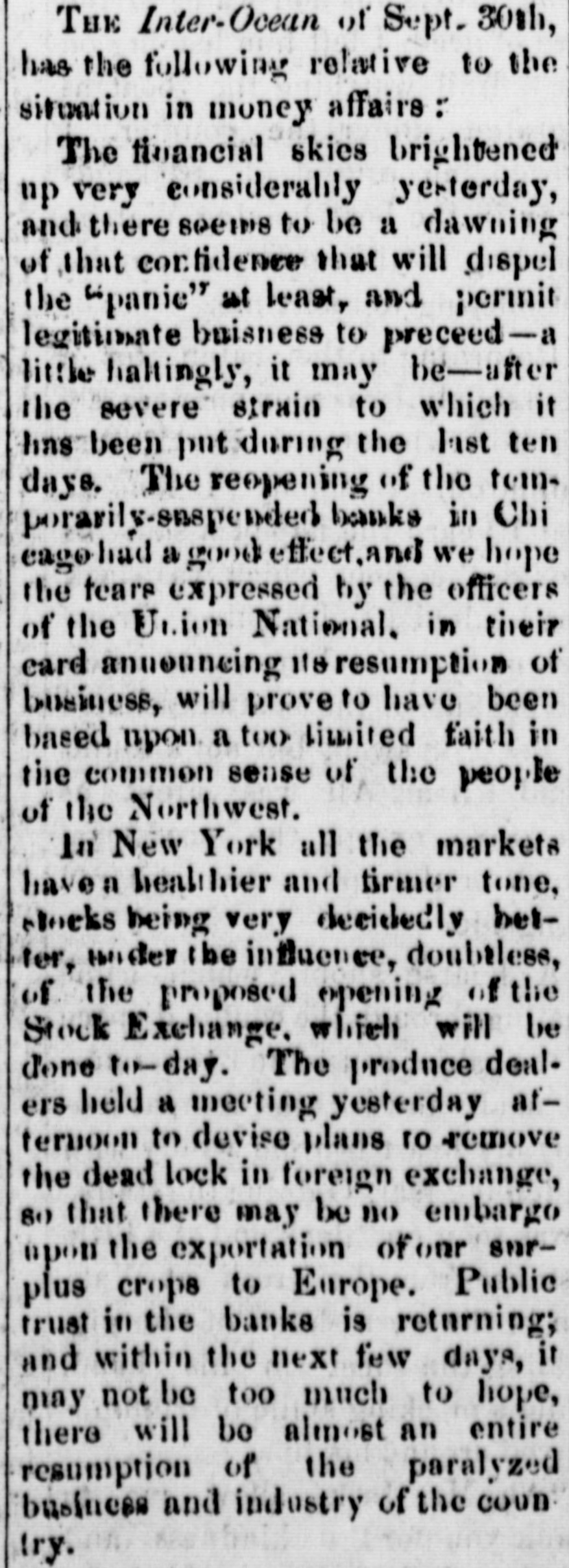
THE SITUATION. Yesterday was the first day sinco the panic began that signa of a roal ronction and improvement began to manifest themselves in local financial circles. Thore have been days when affairs wore a cheorful exterior, and peoplo falt botter without exactly knowing why. Yesterday everybody seemed to lenoto that thero was a change for the bettor. In the first place, the price of wheat advanced G conts por bushol, and before the closo of the day gained 31/3 cents more, closing at 81.031/6 cash, against 94 conta the previous day. Corn also advanced 4 cents, with shipments of 140,000 bushols on Tuesday, and a demand for freight-room for 750,000 bushols yestordny. Prices of grain aro now higher than at any time sinco the panio began. Foreign exchange has advanced in Now York to a point which insures the rapid and regular movement of the crope. General trade was more active than on any previous day, and the streets presented a livelier appearance than before, while the harbor was fairly alive with shipping. The savings banks report more doposits than notices of withdrawal. The receipts of currency by the express companios were about 83,000,000. The banks have commoncod croditing their customers for checks on other city bauke of good standing, instead of waiting pass them through the Clearing-House. The D fast freight linos are doiug a grain business fully equal to their capacity. The railroads are also p carrying great loads of the cattle, and the tom0 porary blockado at the Stock-Yarda has been ro0 moved. They are now in a condition to receive 3 and caro for all tho cattlo that may bo sont forward. There is also a healthier feeling in Now York consequent upon the advance in sterling oxchange. Certified checks, however, are quoted B at 2 to 3 per cent below par, which is not unnatural in view of the fact that $22,000,000 of o loan-certificates have been issued. The slight of decline in stocks is accounted for in two ways ; it (1) An indisposition to speculato, and (2) or sales of collaterals to meet matured B paper. The suspension of the banking house o of Northrup & Chick is attributed to the demand that has been made on them by their Westorn correspondents. The majority of thoso are in 1 Kansas, Missouri, and oven as far south as Texas ; there are but two or three in the four States of Illinois, Iowa, Wisconsin, and Minno,sola. One of the most encouraging signs in n, New York is that the domand for currency from ethe country banks has materially decreased. in Ordera for money are countermanded a and oven greenbacks that have been drawn out nare being returned. Now York is beginning to on traco the immediate cause of the currency lockh, up to our of Jay Gould's stock cornors. The in suspension of Paton & Co., a dry-goods firm, is 80 only temporary, occasioned by the contraction 10 in curroncy; it is iutimated that thoro will be a 11liberal policy of extensions on any commercial paper that may nood it, owing to the transient or stringency of the money market. Elsowhere throughont the country thore are on the samo ovidences of a restoration of public in confidence that are to be found in Now York and ok in Chicago. In Memphis, the banks are resuming and the cotton trade is improving. The solid St. on Louis bankora have already begun to regret the n00 adoption of the policy of issuing loan-certificates. The notico of voluntary liquidation by the Union alNational Bank, of this oily, has caused no susit, pensione among its country correspondents, he as It was feared might be the case, The farmto era' notos in the country banks falling duo the olfirst of the month are boing mot promptly. The ryoutlook is brighter from every possible point of da view. m-


Article from Chicago Daily Tribune, October 2, 1873

Click image to open full size in new tab

Article Text

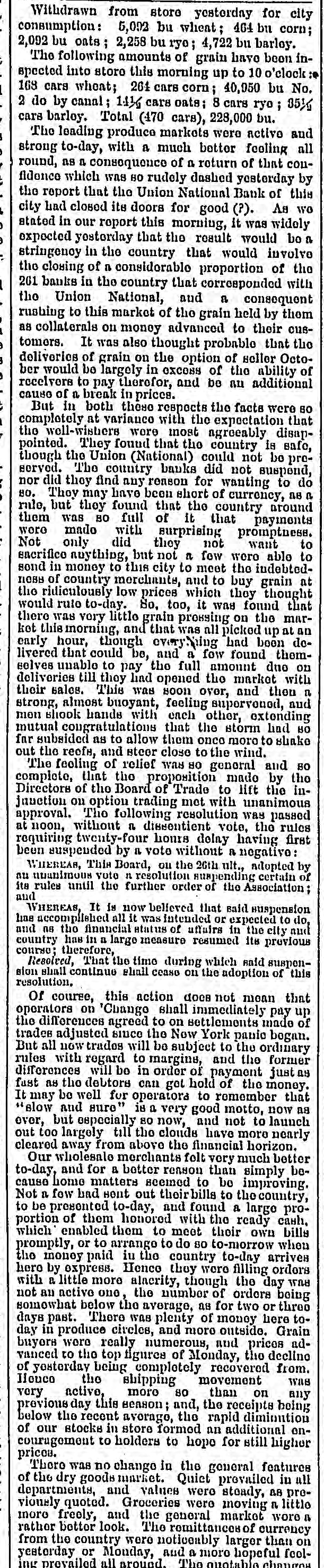
Withdrawn from store yesterday for city consumption: 5,092 bu whent: 464 bu corn; 2,092 bu oats 2,258 bu ryo 4,722 bu barloy. The following amounts of grain have been inspected into store this morning up to 10 'clock: 168 cars wheat; 261 cars corn; 40,050 bu No. 2 do by canal; 1:11/1 cars oats: 8 cars ryo ; 351/4 cars barloy. Total (470 cars), 228,000 bu. leading produce markets were active and strong to-day, with a much bottor feeling all round, as a consequence of a roturn of that confidence which was HO rudely dashed yesterday by the report that the Union National Bank of this city had closed its doors for good (?). As we stated in our report this morning, it was widely expected yestorday that the result would bo a stringency in the country that would involve the closing of a considorable proportion of the 201 banks in the country that corresponded with the Union National, and a consequent rushing to this market of the grain held by thom as collaterals on money advanced to their customors. It was also thought probable that the delivories of grain on the option of seller October would be largely in OXCOSS of the ability of receivers to pay therefor, and be an additional cause of a break in prices. But in both these respects the facts were 60 completely at variance with the expectation that the well-wishers were most agreeably disappointed. They found that the country is safe, though the Union (National) could not be preserved. The country banks did not suspond, nor did thoy find any reason for wanting to do a 80. Thoy may have been short of currency, as rule, but they found that the country around them was BO full of it that payments were mado with surprising promptness. Not only did they not want to encrifico anything, but not a fow were ablo to sond in money to this city to meet the indebtedNOBB of country merchants, and to buy grain at the ridiculously low prices which they thought would rule to-day. So, too, it was found that there was very little grain prossing on the markot this morning, and that was all picked up at an early hour, though every Shing had been dolivered that could be, and a fow found themselves unablo to pay the full amount due on deliveries till they lind opened the market with their sales. This was soon lover, and then a strong, almost buoyant, feeling supervoned, and mon shook hands with each other, extending mutual congratulations that the storm lind far subsided ns to allow them onco moro to slinko out the reefH, and steer close to the wind. The feeling of relief was 80 general and so complete, that the proposition mado by the Directors of the Board of Trade to lift the injunction ou option trading met with unanimous approval. The following resolution was passed at noon, without n dissentient vote, the rules requiring twenty-four hours dolny having first been suspended by n vote without a negative: WHEREAR, This Board, ou the 26th ult., adopted by au upanimous vote n resolution suspending certain of its rules until the further order of the Association; and WHEREAS, It is now believed that said suspension line accomplished all it was intended or expected to do, and na the financial status of affairs in the city and country has in a large measure resumed its previous course; therefore. Resolved, That the time during which said suspension shall continue shall ceaso on the adoption of this resolution. Of course, this action does not mean that operators on 'Chango shall immediately pay up the differences agreed to on settlements made of trades adjusted since the Now York panic began. But all now trados will be subject to the ordinary rules with regard to margina, and the former differences will be in order of payment justa fast as tho debtors can get hold of the money. It may be well for operatora to remember that " Blow and sure ΒΉ is a very good motto, now as over, but especially so now, and not to launch out too largely till the clouds have more nearly cleared away from above the financial horizon. Our wholesale merchants folt very much better to-day, and for a better reason than simply because home matters seemed to be improving. Not a few bad sent out theirbills to the country, to be presented to-day, and found a large proportion of them honored with the ready cash, which enabled them to meet their own bills promptly, or to arrange to do so to-morrow when the money paid iu the country to-day arrives hero by express. Henco they were filling orders with a little more alacrity, though the day was not an active one. the number of orders being somowhat below the average, as for two or threo days past. There was plenty of money here today in produce circles, and more outside. Grain buyers were really numerous, and prices advanced to the top figures of Monday, the declino of yesterday being completely recovered from. Ilouco the shipping movement was very active, more so than on any previous day this season; and, the receipts being below the recent avorage, the rapid diminution of our stocks in store formed an additional oncouragement to holders to hope for still higher prices. There was no change in the general features of the dry goods market. Quiet provailed in all departments, and values were steady, as previonely quoted. Groceries were moving n little more freely, and the general market wore a rathor bottor look. The romittances of currency from the country were noticeably larger than on yesterday or Monday, and a more hopeful feeling prevailed all around. The quotable chauges


Article from The Emporia News, October 3, 1873

Click image to open full size in new tab

Article Text

THE NEWS. ### Latest in Rgard to the Late Panie. The news in regard to the late panic is decidly cheerful. The danger seems to be passed, and business shows signs of rapidly settling into the regular channels. On Tuesday the New York stock exchange was re-opened, and congratulatory remarks were made by the President of the Exchange, which were received with applause. Smith & Seaver, reported suspended on the 19th announce that they will pay all demands in full and resume. A dispatch of Thursday says the day in Wall street passed in a more satisfactory manner than ever. The most sanguine feeling prevailed, the general markets closing quietly without a ripple of excitement. At the stock exchange a calmer feeling characterized the dealings throughout, while many sold stock for cash to complete settlements. It is but just to add that there was a spirit of forbearance between members, and also between money lenders and brokers. The general delivery hour finally came and with it animportant announcement from the committiee appointed to make settlements between members, that there was not one single defaulter. This announcement was received with cheers. AT ST. LOUIS. The financial situation here presents no new feature. All is apparently quiet with the banks. They stili pursue ue the policy first marked out, and nothing has occurred to produce jar or discord. The announcement that the Union National bank of Chicago had gone into liquidation, produced a profound sensation on change, and a depressed feeling followed, but no excitement occurred. There is, however, still much apprehension felt for the future in commercial circles, but if things work out well in New York, it is the general belief here that business will revive and no more disasters occur. AT CHICAGO. The annoucement this morning that the Union National bank was going into liquidation, took everybody by suprise except the bankers, who anticipated the event and took it very coolly, none of them expressing any apprehension that it would materially injure the financial situation, though it had the effect to temporarily depress prices of grain, and caused quite a feeling on change. There has been no further trouble with any of the other banks, all going through the clearing house without difficulty. ### WHAT JAY GOULD. THINKS. New York, Sept. 29- Jay Gould being asked his views concerning the financial situation, gave them as follows: I think the panic is over. I have every faith now in an advance in prices, and believe the market will be more bouyant than in a long time before. Wall street has been cleared out of a great part of worthless stocks and so-called securities by the process of the panic, and there are now comparativly few stocks quoted except those of real value. The disturbed state of the money market has made it necessary for some large firms in this city to discharge many of their hands, and to give others only three-fourths work in a week. One large manfuacturing firm has closed up alltogether. Much difficulty is experienced by employers in getting cash for their workmen and on Saturday last many were paid, either in whole or in part, in checks. In the neighboring cities a similar condition of affairs exists.


Article from Burlington Weekly Free Press, October 3, 1873

Click image to open full size in new tab

Article Text

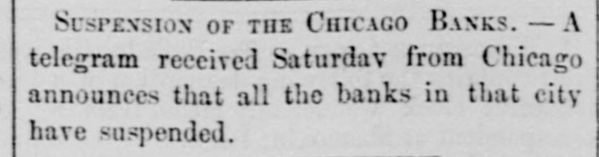
SUSPENSION OF THE CHICAGO BANKS. - A A telegram received Saturday from Chicago announces that all the banks in that city have suspended.


Article from The Wheeling Daily Register, October 14, 1873

Click image to open full size in new tab

Article Text

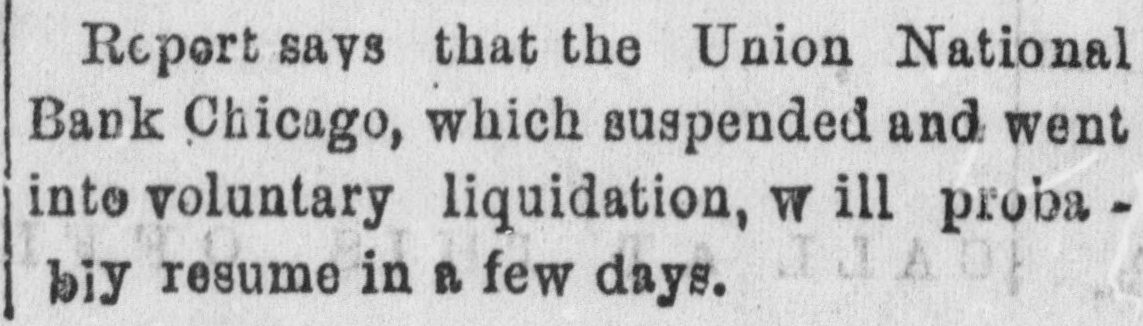
CHICAGO. The Union National Bank. CHICAGO, October 13.-The Union National Bank, which, for the past three weeks has been alternately in a state of suspension, resumption and liquidation, again contemplates resumption. From all that can be learned it appears that in case the authorities at Washin gton offer no serious opposition the bank will resums business in a lew days.


Article from Ottumwa Weekly Courier, October 16, 1873

Click image to open full size in new tab

Article Text

The I Union National Bank of Chicago has restimed on a sound basis.and will, beyond doubt. proceed as usual. At the time of the panic this bank had over $6,000,000 on deposit, and it was impossible for it to meet it all at once. A large part of these deposits was from country banks, and they all wanted it. The bank had consequentIv to succtumb. Settlement has now been made with all of them. and all is well with the bank.


Article from The Stark County Democrat, November 15, 1877

Click image to open full size in new tab

Article Text

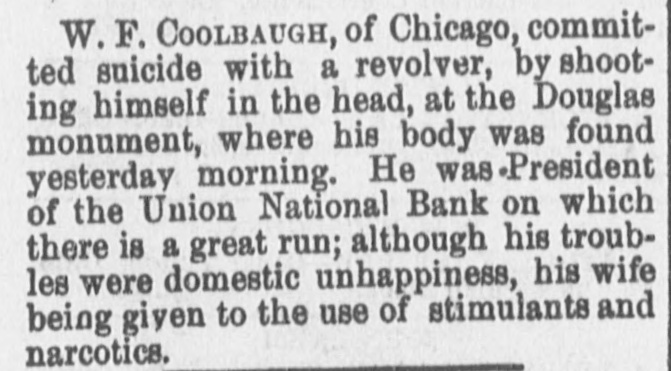
W. F. COOLBAUGH, of Chicago, committed suicide with a revolver, by shooting himself in the head, at the Douglas monument, where his body was found yesterday morning. He was President of the Union National Bank on which there is a great run; although his troubles were domestic unhappiness, his wife being given to the use of stimulants and narcotics.