6944. Globe National Bank (Boston, MA)

Bank Information

Episode Type
Run โ†’ Suspension โ†’ Closure
Bank Type
national
Bank ID
936
Charter Number
936
Start Date
December 16, 1899
Location
Boston, Massachusetts (42.358, -71.060)

Metadata

Model
gpt-5-mini
Short Digest
cf00fe9bf6357b9e

Response Measures

Accommodated withdrawals, Borrowed from banks or large institutions, Full suspension, Books examined

Receivership Details

Depositor recovery rate
100.0%
Date receivership started
1899-12-21
Date receivership terminated
1903-02-25
OCC cause of failure
Fraud
Share of assets assessed as good
38.1%
Share of assets assessed as doubtful
46.1%
Share of assets assessed as worthless
15.8%

Description

Newspaper accounts describe heavy withdrawals and clearing-house assistance in mid-December 1899, followed by appointment of a temporary receiver (Comptroller/Controller Dawes appointing Daniel G. Wing) and permanent closing. The immediate trigger was large losses from copper-stock speculation and bad loans (bank-specific adverse information); clearing-house certificates and offers by National Shawmut temporarily mitigated withdrawals but the bank was placed in receivership and did not reopen. Dates are taken from contemporaneous reports (Dec 16โ€“22, 1899).

Events (5)

1. March 25, 1865 Chartered
Source
historical_nic
2. December 16, 1899 Run
Cause
Bank Specific Adverse Info
Cause Details
Heavy withdrawals tied to the bank's large speculative exposures in copper stocks and overloans; loss of confidence after sharp declines in copper and related brokerage failures.
Measures
Boston Clearing House issued $3,500,000 in certificates to the Globe; National Shawmut Bank offered advances to Globe depositors (50% of net deposits) and clearing-house loans of several million provided temporary liquidity.
Newspaper Excerpt
Boston escaped a panic Thursday by the clearing house going to the relief of the Globe National bank. The clearing house issued $3,500,000 in certificates to tide the bank over its troubles.
Source
newspapers
3. December 21, 1899 Receivership
Source
historical_nic
4. December 21, 1899 Receivership
Newspaper Excerpt
Controller Dawes this evening appointed Special Examiner Daniel G. Wing temporary receiver of the Globe National Bank of Boston. To allow the bank to remain open longer will result in injustice to unsecured creditors... said Controller Dawes in explanation of his action. (Morning News, Dec. 22 report referencing Dec. 21 action.)
Source
newspapers
5. December 22, 1899 Suspension
Cause
Government Action
Cause Details
Comptroller/Controller Dawes (Comptroller of the Currency) appointed Special Examiner Daniel G. Wing temporary receiver after insolvency was found; bank closed to protect unsecured creditors.
Newspaper Excerpt
The Globe Bank did not open its doors this morning. A notice bearing the signature of D. G. Wing, temporary receiver, gave the reason. BANK CLOSED.
Source
newspapers

Newspaper Articles (23)

Article from Blackfoot News, December 16, 1899

Click image to open full size in new tab

Article Text

General News Paragraphs. Gen'l Otis reports his troops in close pursuit of Aguinaldo's scattered army. The Democrats, of Kentucky, will bring a contest before the legislature to oust the Republican governor and other state officers installed this week. All England is in sorrow over British losses and great alarm is felt for the aged queen who is seriously affected by the news of her reverses. Ex-Senator Allen the at lest Populist statesman in the country has been appointed by Gov. Poynter to succeed the late Senator Hayward from Nebraska. The Boers have had it largely their own way in South Africa this week. Old England feels keenly the defeat of her troops. The investigation of the Roberts case of Utah may be more far-reaching than was at first dreamed of. A number of federal officials in the state may lose their places and the agricultural college be made to suffer temporarily by withholding funds appropriated for it. Boston escaped a panic Thursday by e its clearing house going to the relief of a the Globe National bank. The clearing 8 house issued $3,500,000 in certificates to tide the hank over its troubles. And still there is money enough in the country, and prosperity sings songs of the blessed. n o Congress has been without any exciting incidents this week. The days e of the senate have been spent in routine and executive business and of the lower house in discussing the currency bill. Three night sessions were held to giye d more time for the discussion. A vote 08 will be taken today. The Roberts committee has been busy with its work without reaching any conclusions. Both A. houses will adjourn for the holidays on the 20th to meet again 3rd of January


Article from The Providence News, December 18, 1899

Click image to open full size in new tab

Article Text

well, Charles A. Deshon, Edwin Gould, H. I. Irving Keyser, Edward R. Ladew, Henry A. McGee, W. Willis Merrill, J. W. Middendorf, Edward A. Maher, S. D Scudder, John A. Shibley, John P. Truesdell, C. M. Warner, John Skelton Williams, B. F. Young, Thomas A. McIntyre. The officers of the company declined to see anybody or to give anything for publication beyond this supplementary statement that was posted on the doors: "The immediate cause of the suspension of the company is its inability to convert its securities into cash in time to meet the sudden and abnormal demand made upon it." ALLEN & CO. SUSPEND. New York, Dec. 18.-The suspension of the firm of Henry Allen & Co., bankers and brokers, was announced on the Stock exchange today. The firm is not yet prepared to make a statement, but the suspension is attributed to the failure of some of its customers to respond to calls for additional margins made necessary by recent declines. house has been known as a trader on an extensive scale. SITUATION AT BOSTON. Boston, Dec. 18.-Business in banking circles in this city was opened today with an apparent confidence that the troubles which were experienced last week, when two national banks in the city were embarrassed, one of which closed its doors, while the other accepted a loan of $3,500,000, were ended If a trace of nervousness still remained it soon gave way to the improved conditions resulting from conferences held and plans laid by bankers during Saturday afternoon and Sunday. The Boston clearing house association issued a statement this morning to the effect that up to the present time the Globe National and the Broadway National Banks were the only two that appealed to the association for assistance and that in all probability the affairs of the Broadway National Bank would be wound up in due course. The clearing house association voted today to vest authority in its regular committee to issue certificates at its discretion. In case a financial institution should need assistance the committee will be enabled to act without calling a meeting of the association. It seemed to be the general opinion that the crisis has been passed, and that if there are no further heavy business failures, the situation will soon be normal.


Article from New-York Tribune, December 19, 1899

Click image to open full size in new tab

Article Text

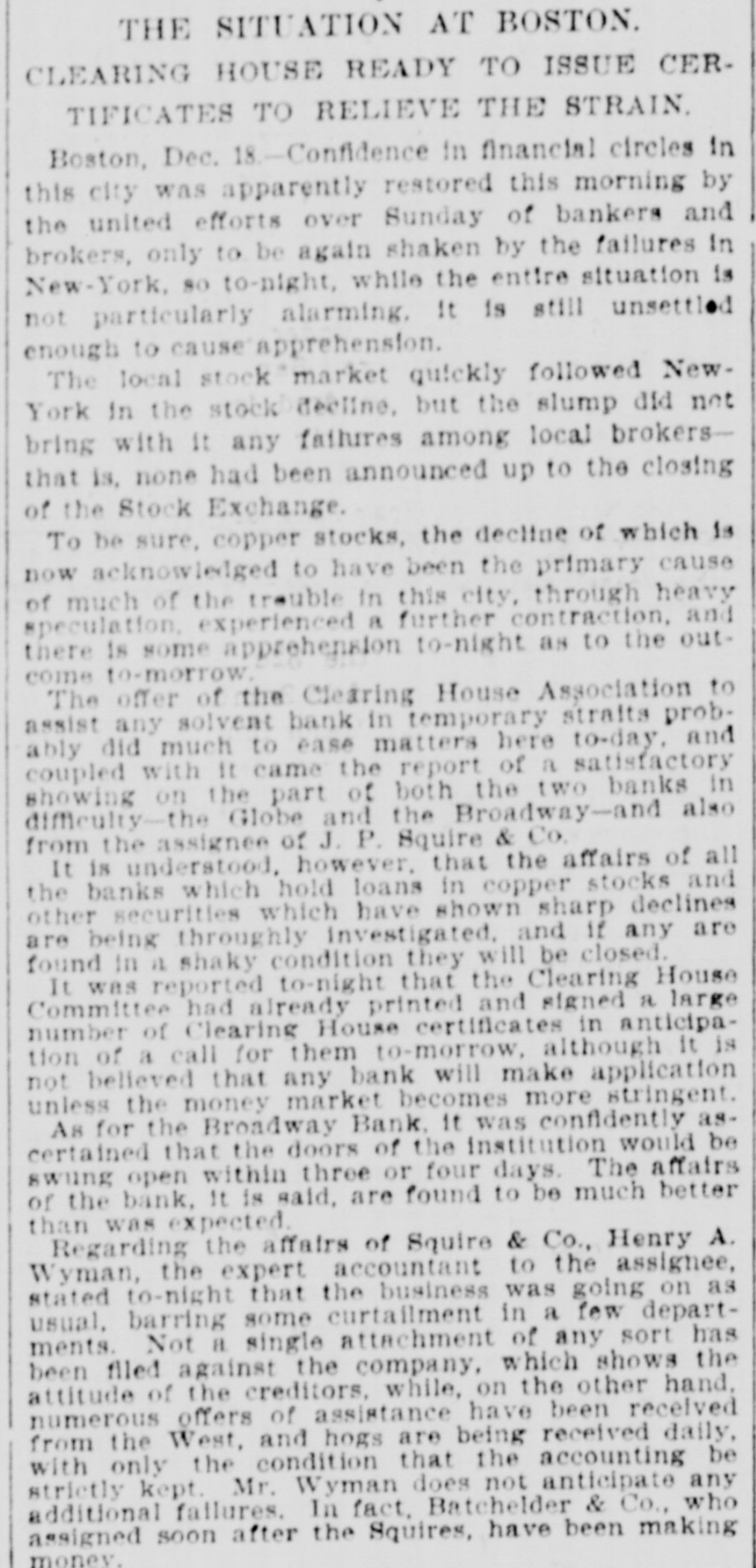
THE SITUATION AT BOSTON. CLEARING HOUSE READY TO ISSUE CERTIFICATES TO RELIEVE THE STRAIN. Boston, Dec. 18.-Confidence in financial circles in this city was apparently restored this morning by the united efforts over Sunday of bankers and brokers, only to be again shaken by the failures In New-York, so to-night, while the entire situation is not particularly alarming. It is still unsettled enough to cause apprehension. The local stock market quickly followed NewYork in the stock decline, but the slump did not bring with It any fathures among local brokersthat is, none had been announced up to the closing of the Stock Exchange. To be sure, copper stocks, the decline of which is now acknowledged to have been the primary cause of much of the treuble in this city, through heavy speculation. experienced a further contraction, and there is some apprehension to-night as to the outcome to-morrow. The offer of the Clearing House Association to assist any solvent bank in temporary straits probably did much to ease matters here to-day, and coupled with It came the report of a satisfactory showing on the part of both the two banks in difficulty-the Globe and the Broadway-and also from the assignee of J. P. Squire & Co. It is understood, however, that the affairs of all the banks which hold loans in copper stocks and other securities which have shown sharp declines are being throughly investigated, and if any are found in it shaky condition they will be closed. It was reported to-night that the Clearing House Committee had already printed and signed a large number of Clearing House certificates in anticipation of a call for them to-morrow, although it is not believed that any bank will make application unless the money market becomes more stringent. As for the Broadway Bank, it was confidently ascertained that the doors of the institution would be swung open within three or four days. The affairs of the bank, It is said, are found to be much better than was expected. Regarding the affairs of Squire & Co., Henry A. Wyman, the expert accountant to the assignee, stated to-night that the business was going on as usual, barring some curtailment in a few departments. Not 8. single attachment of any sort has been filed against the company, which shows the attitude of the creditors, while, on the other hand, numerous offers of assistance have been received from the West, and hogs are being received daily, with only the condition that the accounting be strictly kept. Mr. Wyman does not anticipate any additional failures. In fact, Batchelder & Co., who assigned soon after the Squires, have been making money.


Article from Santa Fe New Mexican, December 22, 1899

Click image to open full size in new tab

Article Text

BOSTON BANKS. They Helped One Another and Restored Confidence. Boston, December 22.-There was a nervous feeling apparent in financial quarters to-day before the opening of business on account of the troubled aspect of the situation resulting from the closing of the Globe National Bank. Considerable confidence was expressed, however, that the action of the clearing house last week in making certificates available in case of emergency would avert any further serious failures. At the Globe bank to-day all the clerks were busy when the regular hour for opening came, but the doors remained closed, and a notice bearing *the signature of D. G. Wing, temporary receiver, gave the reason. Boston, December 22.-The galleries of the stock exchange were crowded today when business began. The market was weak at the opening. Trading was very animated, and violent fluctuations in sugar were recorded. The coppers were a trifle weak, Montana dropping 5, but recovering half the loss almost immediately. The market showed good support. Receiver Wing and President R. H. Stevens, of the Globe bank, declined to say anything about the situation today. There was no unusual scene around the bank, although a number of out-of-town customers who came to draw money for Christmas were considerably upset by the information that the bank had closed. The National Shawmut offered to advance to-day to all depositors of the Globe bank against their deposits 50 per cent net of the amount of the same. The action of the National Shawmut Bank had an excellent effect in all circles, and within a short- time after it became known, except for the feverish tendency of some transactions on the stock exchange, the financial sections of the city were as quiet as usual. It was learned in connection with the Globe Bank case to-day that of $3,500,000 advanced by the Boston clearing house to the bank last Saturday, $200,000 has been repaid. The nominal market value of securities given the clearing house for the loan is $4,500,000. Boston, Mass., December 22.-The creditors of John P. Squire & Co., a corporation, at a meeting to-day voted to continue the business firm under the assignee, subject to the assistance and approval of a committee of three representing the creditors. After the meeting it developed that Mr. Chaplin's denial of the reported indebtedness of the firm to the Globe Bank caused a sensation, as he stated the firm was reported as owing more than $1,000,000, through falsifying the books of the bank. This was done, Chaplin explained, by charging notes and collateral loans against the firm without crediting collateral, so every loan was made to appear twice as large as it should. An explicit examination of the books caused the overdraft to disappear. At first it was not considered wise to give publicity to the condition of the bank's affairs, but the assignment is thought to make it prudent to do so now.


Article from The Morning News, December 22, 1899

Click image to open full size in new tab

Article Text

RECEIVER FOR GLOBE BANK. STOCKHOLDERS LIKELY TO BE THE ONLY LOSERS. Bank's Total Assets Are More Than $10,000,000-Receiver Appointed for Protection of the Unsecured Creditors-Flurry in the Copper Market Brought About Its Failure. Efforts Will Be Made to Avert " Panis, But Another Flurry May Come. Washington, Dec. 21.-Controlier Dawes this evening appointed Special Examiner Daniel G. Wing temporary receiver of the Globe National Bank of Boston. The bank's resources are as follows: Loans and discounts, $5,573,104; United States bonds to secure circulation, $1,000.000; United States bonds to secure United States deposits, $190,000; premiums on bonds, $139,350; stock and securities, $1,092. 202; cash on hand and due from banks, $2.533,297 Total, $10,529,953. Controller Dawes, in explanation of his action, said: "In view of the fact that to allow the bank to remain open longer will result in injustice to unsecured creditors, now that the condition of insolvency is found to exist, it becomes my duty under the law to appoint a receiver. A considerable cash dividend can be paid to creditors at once, "The condition of the bank was discovered by Special Examiner Wing in time to secure such action on the part of the directors as will probably prevent the failure from inflicting heavy losses upon the depositors, but the directors and stockholders will lose heavily. In Difficulty for Months. The bank has been in difficulty for some months, in fact ever since the resignation of Charles Cole, for many years its president. Mr. Cole's retirement caused a sensation at the time, for it was known that he was heavily interested in the copper combination known as the United States Mining Company One of the directors, H. H. Stevens, was elected to fill the position of president, and since then has done everything possible to keep the bank from going under. Every known method was adopted to keep up the tone of the market in copper shares, and it was expected that the bank would gradually be able to realize on a greater part of loans on those stocks without loss. The tight money market, coup led with the great decline in all stocks, however, carried down the coppers, and last Thursday the bank was forced to call upon the clearing house for assistance. After a consultation the clearing house came to the rescue, and issued $3,500,000 in certificates, to enable the Globe to meet its indebtedness to the other banks. The action of the clearing house was generally regarded as timely, although there was much surprise, when, two days later, the clearing house refused to rescue the Broadway Bank from the hands of a receiver. On Monday came the failure of the brokerage firm that financed the mining company, but as no other firm followed, and as the Globe Bank gave no intimation of succumbing through the bad fall in copper stocks, confidence in the situation seemed in a fair way of being restored. The slumps in the New York market on no reverse in this was an Tuesday city, and brought this material regarded almost additional guarantee that the crisis here had passed. May Be More Trouble. Whether the old wound will be opened again to-morrow remains to be seen, but it is known that every effort will be made on the part of the strong financial institutions to avert a panic. Upon their success depends the status of many brokerage houses which have been carrying over Christmas heavy blocks of copper stocks. A few of those houses have already attempted to protect themselves, and attachments have been filed against the promoters of the United States Mining Company, Charles H. Cole, late president of the Globe Bank, William H. Coolidge and Edward C. Clark, The action of the controller in waiting a reasonable time for the guaranty to be made good regarding the bad assets of the bank, is geneally acknowledged to have been very generous, and indicated a desire to assist as much as possible, and it is generally agreed that if the bank had been closed last week a severe panic would have resulted, which would have undoubtedly carried down its stocks and wrecked many strong institutions, During the past week the withdrawals from the bank have been exceedingly heavy, amounting, it is said, to over $2. 000,000 in deposits. It was stated that the closing of the institution could not af fect any great number of individual depositors. A flurry in copper stocks is anticipated at the opening of the Stock Exchange tomorrow. 1


Article from The Portland Daily Press, December 23, 1899

Click image to open full size in new tab

Article Text

$3,000,000Loaned Bank by Clearing House. Depositors Will Get Nearly All Due Them. Boston, December 22-Another day of onreat in Boston's financial circles went by without incidents of a startling nature and once more the public was shown how well supported the Institutions of this city can be mada by concerted effort. The receivership for the Globe national bank took nearly every banker and broker by surprise and before business In the money market began, forebodings were dire. But prophesying and fears were not realized for the situation tonight was conservatively considered, as good If not slightly better than at any time for a fortnight. Not a failure was announced when the stock exchange was closed and best of all, money seemed easy. The key of the whole situation 18 believed to be in the action of the clearing house association in issuing $8,500,000 worth of certificates for temporary relief. From this amount, it is understood the Globe bank received $3,000,000 in cash. Yesterday it is currently relorted the clearing house committee deolined to give the Globe tank further assistance, and to this fact is attributed the quiek appointment of a receiver. There is some interest in the value of the $4,500,000 worth of collateral turned over to the clearing house by the Globe bank, and whether the latter's failure has impaired that value. The loan of the $8,000,000 to the Globe bank relieved the financial tension on numerous brokers and bankers. Firms that had thousands on deposit, when the Globe bank first showed evidence of trouble, have since withdrawn their account and the modey paid out came from that clearing house loan. The bank paid out from its deposits during the past month $2,042,000. On May 6. the amount in the bank reached $10,175.000 and the average for months was between eight and nine millions up to the time of the recent troubles. Three-fourths of the banks stook, or $750,000, is held by Massachusetts savings banks, all of which are good for the 100 per cent liability imposed by law upon individual stockholders. When early would-be customers appeared at the Globe bank, they found Redelver Wing in charge and the clerks at their accustomed places. There was no excitement for a time, but AS business on the street grew to its height, the bank was the center of attraction and many harsh words were said against it and the officials. In the market itself, the mirror a of ups and downs of finances, hardly good sized ripple was created. As for coppers, which class of stocks are charged with turning Boston topsy turvey, they did not slump away as predioted. The Broadway National bank's affairs would have been lost sight of for the time being had not the creditors of the Squire


Article from Daily Kennebec Journal, December 23, 1899

Click image to open full size in new tab

Article Text

GLOBE BANK'S DOORS CLOSED. Depositors Can Realize on Deposits Through Offer of Shawmut Bank. Boston, Dec. 22.-The Globe Bank did not open its doors, this morning. The employes were all at their desks, but on the door was a notice: "BANK CLOSED." "In the hands of the comptroller of the currency. DANIEL G. WING,, (Signed) Temporary receiver." The following statement was made by the National Shawmut Bank, early today: "That there may be as little inconvenience as possible to the depositors of the Globe National Bank and others, the National Shawmut Bank offers to advance, today, to all depositors in the Globe Bank against their deposits 50 per cent. of the net amount of the same." The action of the Shawmut Bank had an excellent effect in all circles, which within a short time after it became known, except for a feverish tendency on the Stock Exchange, the financial section of the city were as quiet as usual. It was learned in connection with the Globe Bank case, today, that of the $3,500,000 advanced by the Boston Clearing House to the bank, last Saturday, $200,000 had been repaid. The nominal market value of the securities given the Clearing House for the loan is $4,500,000.


Article from The Anaconda Standard, December 23, 1899

Click image to open full size in new tab

Article Text

THE WORLD'S MARKETS Daily Record of Commercial and Financial Transactions. NEW YORK STOCK REPORT Digest of Exchange News-Mining Stocks. Metal Quotations-Wool Prices and Movements - Grain and Produce-Review of Trade. New York, Dec. 22.-The stock market had to undergo further liquidation to-day. Prices yielded without any active resistance, but there were no signs of panic and the liquidation was conducted in an orderly manner. The principal causes of weakness were evidently not local and seemed to be largely due to the condition of affairs in Boston. The closing of the Globe National bank was the cause of widespread uneasiness and brought large offerings on the New York market of the favorite Boston stocks. Sugar was the most conspicuous example, as is shown by its extreme decline of 7 points. This stock was under very heavy pressure all day on rumors of a coninuation of the trade war as well as on the forced selling for Boston account. Burlington, Federal Steel and Atchison preferred were also sold from Boston. London was a large seller of stocks in this market and the depression there exercised a large sentimental influence. The rise in the private discount rate and the fears of tr. able at the settlement now imminent are causes of apprehension. Some of the favorite international stocks were actually depressed from time to time, notably New York Central, St. Paul, Baltimore & Ohio, Missouri Pacific, Reading first preferred and Denver & Rio Grande preferred. The bears were energetic operators all day and supplemented their efforts by the circulation of some extravagant rumors regarding the financial condition of various houses and properties. The effect on some of the trust companies was to induce large calling in of loans as a measure of precaution against any extraordinary demands that might be made upon them. The rumor among the bears was SO flagrant in some cases as to cause the discussion by some of those who were the greatest sufferers of legal measures directed against the offenders. During the last hours the bears were very large buyers to cover short contracts and the effect on prices was seen in recoveries running all the way from 1 to 5 points in the principal railroads and industrials. As a result net losses were reduced within a range of 3 points except in a few meonspicuous stocks which had not moved previously during the week. A number of stocks, including those which have suffered most severely during the week. are elightly above last night's level. The rate for money flurried at one time to .8 per eent., but ruled for the most part at 6 per cent. or below. Estimates of to-morrow's bank statement are all at sea, owing to the extraordinary conditions that have prevailed. The amount of gold which will figure in the statement, including last Saturday's shipments, is about $3,000,000. This would indicate a net loss in cash on all accounts of about $1,000,000. U. S. new 4's advanced 1/2 per cent., the old 4's advanced 1/8 per cent. in the bid price.


Article from The Times, December 23, 1899

Click image to open full size in new tab

Article Text

STOCK MARKET STILL WEAK Due Chiefly to Condition of Affairs in Boston. MONEY RATE WAS FLURRIED It Rose at One Time to 8 per Cent., but Ruled for the Most Part at 6 or Below-Bonds Were Weak in Sympathy. NEW YORK, Dec. 22.-The stock market had to undergo further liquidation today Prices yielded without any very active resistance, but there were no signs of panic, and the liquidation was conducted in an orderly manner. The principal causes of weakness were evidently not local, and seemed to be largely due to the condition of affairs in Boston. The closing of the Globe National Bank there was the cause of widespread uneasiness and brought large offerings on the New York market of the favorite Boston stocks Sugar was the most conspicuous example, as is shown by its extreme decline of 7 points. This stock was under very heavy pressure all day on rumors of a continuance of the trade war, as well as on the forced selling for Boston account. Burlington, Federal Steel and At. chison preferred were also sold from Boston. London was a large seller of stocks in this market, and the depression there exercised a large sentimental influence The rise in the private discount rate and the fears of trouble at the settlement now imminent are causes of apprehension. Some of the favorite international stocks were acutely depressed from time to time, notably New York Central, St. Paul, Baltimore and Ohio, Missouri Pacific, Reading first preferred, and Denver and Rio Grande preferred. The bears were energetic operators all day. During the last hour the bears were very large buyers to cover short contracts, and the effect on prices was seen in recoveries running all the way from 1 to 5 points in the principal railroads and industrials. As a result net losses were reduced within a range of 3 oints, except in a few-inconspicuous stocks, which had not moved previously during the week. A number of stocks, including those which have suffered most severely during the week, rose slightly above last night's level. The rate for money flurried at one time to 8 per cent., but ruled for the most part at 6 per cent. or below. Estimates of tomorrow's bank statement are at sea, owing to the extraordinary conditions that have prevailed. The banks have gained on the regular interior movement, but the extraordinary demand from Boston has offset that so that the net loss on the interior movement is about $1,300,000. On Sub-Treasury operations they have gained about $3,000,000. The amount of gold expor which will figure in the statement, including last Saturday's shipments, is about $3,000,000. This would indicate a net loss in cash on all accounts of about $1,000,000. No one ventures to estimate what the loan changes may be. Bonds were weak in sympathy with stocks, the speculative issues showing some sharp declines. Total sales, par value, $2,590,000. United States new 4's advanced 1/2 the old 4's and 5's 1/4 in the bid price. The total sales of stocks to-day were 790,100 shares, including Atchison, 11,390; Atchison preferred 44,950; Baltimore and Ohio, 7,000; Chesapeake and Ohio. 9,515; Chicago Great Western, 6,530; Chicago, Burlington and Quincy, 440,390; Chicago, (Rock Island and Pacific, 12,895; Louisville and Nashville 11,351: Manhattan Elevated. 25,870: Metropolitan Street railway 12.775; Missouri Pacific, 8,410; New York Central 9,050: Norfolk and Western, 10,040: Northern Pacific, 17,620; Northern Pacific preferred, 5,050: Ontario and Western, 9,630; Pennsylvania, 9,230; Reading first preferred, 7.350; St. Paul 30,560; Southern Pacific, 45,582; Union Pacific 34.155: Union Pacific preferred, 18,995; Wheeling and Lake Erie, 5,950: American Steel and Wire, 22,705; American TobacCO, 43,440 Anaconda, 7,075; Brooklyn Rapid Transit. 70,885 Continental Tobacco, 8.301 do. preferred. 5,037; Federal Stee. 20,940; Leather. 10.550: do. preferred. 5,510: Western Union 5,457; North American, 5,500; Sugar, 93,570 MONEY AND EXCHANGE.-Money on call steady at 4@8 per cent.: last loan at 4 per cent.: ruling rate, 6 per cent. prime mercantile paper, 51/20 per cent Sterling exchange firmer. with actual business in bankers' bills at $4.87% for demand and at $4 80%@4.80% for sixty days posted rates, $4,814,@4.82 and $4.88@4.881/2 commercial bills. $4.80@4 80% Silver certificates. bar silver, 58 Mexican dollars, 471/4 Government bonds strong: State bonds weak; railroad bonds weak. BANK CLEARINGS.-The total bank clearings in the United States for the week were $2,222 484,264: an increase of 33 per cent. Exclusive of New York, $734,050,212. an increase of 17 per cent.
Article from Wheeling Sunday Register, December 24, 1899

Click image to open full size in new tab

Article Text

BOSTON, December 23.-As far as has been learned the statement made yesterday by H. W. Chaplain, assignee of the John P. Squire Co., that the accounts of the firm with the Globe National Bank had been misrepresented and the indebtedness of the bank shown to be more than a million dollars, while it realy was about $500,000, will not result in any action at present. It appears that the allegation against the bank was not prompted solely by recent developments, but that in one way or another it had been made privately since the trouble experienced by the bank early in November, which led to the resignation of Charles H. Cole. The open assertion was not made until yesterday. It was explained for business reasons, but in view of the receivership proceedings there was no further need of secrecy. Mr. Chaplin said to-day that as the assignee of the Squire corporation, in justice to the creditors, he felt compelled to explain the exact situation and he had accounted for the actual indebtedness of the firm. His duty ended there, he said, and as there now was no Globe Bank, there seemed to be little chance for further action. Just how the affairs of the Globe Bank were allowed to reach such a stage is probably known to few outside the former president, but it is practically agreed that it was a gigantic speculation in copper stocks in which Mr. Cole became so much involved that the bank's money and credit was used until it was well nigh exhausted. The inevitable result followed, except that the closing of the bank was delayed for over a month and during the last week was bolstered up by the clearing house which paid its indebtedness to the extent of many millions. The fact that the bank was in difficulty, but yet kept open through the aid of the clearing house, enabled its depositors to withdraw their accounts and a very large number did SO during the early part of the week, but the city of Boston, which through Mr. Cole's influence, when sinking fun commissioner, had placed nearly four hundred thousand dollars in the bank, failed to take the hint, with the result that that amount will be tied up for some time to come. Notwithstanding the heavy overloans, it is generally believed that the depositors will be paid in full, or nearly so, and that it will be the stockholders and directors who will suffer. Unfortunately a large number of savings banks are holders of the Globes stock, so that the loss will have to be made good by those institutions. While the Globe bank probably will never open its doors again, there seems to be every prospect that the Broadway bank will soon be on its feet again.


Article from The Salt Lake Herald, December 24, 1899

Click image to open full size in new tab

Article Text

INDEBTEDNESS OF THE BANK. How It Was Mixed Up With the John P. Squire Company. Boston, Dec. 23.-As far as has been learned the statement made yesterday by H. W. Chaplin, assignee for the John P. Squire company, that the accounts of the firm with the Globe National bank had been misrepresented, and the indebtedness of the bank shown to be more than $1,000,000, whereas it really was about $500,000, will not result in any action at present. It appears that the allegations against the bank was not prompted solely by recent developments, but that in one way or another it had been made privately since the trouble experienced by the bank early in November, which led to the resignation of Charles H. Cole. The open assertion was not made until yesterday, when it was explained for business reasons, but in view of the receivership proceedings there was no further need of secrecy. Mr. Chaplin said today that as the assignee of the Squire corporation, in justice to the creditors, he felt compelled to explain the exact situation, and he had accounted for the actual indebtedness of the firm. His duty ended there he said, and as there was no Globe bank, there seemed to be little chance for further action.


Article from The Seattle Star, December 26, 1899

Click image to open full size in new tab

Article Text

Lovell Arms Co. Fails. BOSTON, Dec. 36-John P. Lovell Arm Co. has assigned. Charles Cole, lately the president of the Globe Nations! Bank. has advanced this firm over one million dollars. thereby breaking himself and the bank.


Article from The Portland Daily Press, December 27, 1899

Click image to open full size in new tab

Article Text

Assignment Was Not a Matter of Surprise. No Statement As To Firm's Condition. Concern Was Organized in 1841 by John P. Lovell. Boston. December 26.-The John P. Lovell Arms company and John P. Lovell company, an allied concern, made an assignment this afternoon for the benefit of their oreditor: to Barnes and Ball attorneys. The assignment was not a matter of surprise, being simply a confirmation of rumors that had been in circulation in business circles for several days past. The firms were ebted for large amounts to the Globe National bank, which was last week placed in charge of a temporary receiver and this institution or more exactly, its former president, Mr. Cole, has been represented in the bustness by C. W. Noroross who is said to have virtually managed the concern for more than a year past in the interests of the bank. It has been stated that Mr. Cole. late president of the bank, exhanged the paper of the Lovell company for mining securities, but the fact that Mr. Nortross has remained in charge up to the present time would sesm to cast & doubt upon this story. It 1a stated that the merchandise bills contracted by the company have been paid as promptly as those of most business houses, so that the manufactur ra who have supplied them with goods are not very large creditors, the bulk of the indebtedness being to banks who have discounted the company's paper. Charles B. Barnes, Jr., one of the assignees, when seen at his home in Hingham tonight and asked as to the liabilities and assets of the company, said: "The assignees are unable to give any estimate yet as to the assets and liabilities and probably will not be able to do so for some days. There are two companies concerned-The John P. Lovell company and the John Lovell rins company. Both of these ompanies made an assignment with the same assignees in each once. The companies operate stores in a number of oitles from Bangor, Me., to Providence, R. 1., and they have large stocks on hand which will have to be thorougbly examined before the assignees can discover just what the financial situation is. A statement will probably Le issued in a few days but we cannot tell when. We do not know when a meeting of the creditors will be held. In fact. I have not yet seen a complete list of the creditors." The house of the John P. Lovell Arms company was formed in 1841 by John P Lovell and was at first engaged solely in the manufacture of guns. It soon branched ont into the sporting liue of business, and has grown to be one of the largest concerns of the kind in New England, there being scarcely an article used by a sportsman that was not carried In 1 DS stock. A few years ago the firm name was changed to the John P. Lovell Arms company, and as the sons grow up they were taken into partnership. At the death of the senior member in 1897, John P. Lovell was president; Col. B. S. Lovell, treasurer, and Henry L. Lovell, clerk. For a great many years the Brm has done all 118 finano al business with the Globe National bank A8, owing to the liking of John P. Lovell for that institution, he had, practically never had dealings with any other during his long business owreer. Col. Benjamin S. Lovell, the present treasurer of the company, has for many years been a familiar figure in Grand Army and political circles in Massachusetts, where he has Losts of strong and generous friends. He has been considered a careful business man and one who knew the value of money, but it has been said no one ever appealed to him on behalf of the Grand Army or a deserving veteran in vain. He has been a member of the legislature and or the executive council and was a member of Gov. Greenbalge's personal staff. Col. Lovell has not been in the best of health for % year or more, but kept about until month ano. when be was com-


Article from Barre Evening Telegram, December 27, 1899

Click image to open full size in new tab

Article Text

J. P. LOVELL CO. FAIL. The Result of the Failure of Globe Bank. Boston, Dec. 27.-The John P. Lovell Arms company assigned late yesterday to Charles B. Barnes. The firm was greatly indebted to the Globe National bank. The assignees are unable to give any estimate yet as to the assets and lia bilities and probably will not be able to do so for some days. There are two companies concerned, the John P. Lovell Co. and the John P. Lovell Arms Co. Both of these companies made an assignment with same assignees in each case. The companids operate stores in number places from Bangor, Me. to Providence, R. I.


Article from The Morning News, December 27, 1899

Click image to open full size in new tab

Article Text

LOVELL ARMS CO. ASSIGNS. Caused by the Collapse of the Globe National Bank. Boston, Dec. 26.-The John P. Lovell Arms Company assigned to-day to Charles B. Barnes. The John P. Lovell Arms Company is one of the largest sporting goods houses in the country, and the failure is the result of the collapse of the Globe National Bank of this city, to which the company was largely indebted. The company manufactured bicycles, firearms and sporting goods of nearly every description.


Article from Union Gazette, December 29, 1899

Click image to open full size in new tab

Article Text

LATER NEWS. An earthquake caused havoc in Southern California. Admiral Dewey has reached the age limit of 62 years, but he will continue in service. The Grangers' warehouse at Rose burg, Or., was destroyed by fire; loss, $4,000, fully insured. Four men were killed by a train wreck on the Northern Pacific near Bearmouth, Montana. A six-story building, 90 years old, enwas destroyed by fire in New York, tailing a loss of $80,000. At San Francisco the Carlisle Cali- Indefeated the university of fornia in a football game; score, dians his 2 home to 0. Julius Baldwin is dead at The Dalles. He was one of the old- the est at and most prominent pioneers of Northwest. Thirty men perished in a colliery caused by fire damp explosion horror at the Braznell mine, near Brownsville, Pa. Laurier's French-Canadian following sending protesting against Canada in any is more troops to help England South Africa. Mrs. Potter Palmer will be appointed the President McKinley director of the by American woman's department at Paris exposition. state department will investigate The action of the British government the in sezing several cargoes of American flour off Delagoa bay. The trainwreck near Pomona, and Cal., four one life was lost in which injured, was caused by the breakwere ing of a locomotive wheel At Rome the pope solemnly inauguthe holy year by performing the the rated ceremony of cathedral. opening impressive holy door of St. Peter's Fenians threaten to make as Britain, much trouble as possible for Great operations in will hamper her sending and troops from home ports. Twenty-one sailors from drowned the British Ariosto were in Hatteras, N Their steamship swamped. C., surf. Their companions the lifeboat lifewere was subsequently rescued by saving service. situation in the Philippines officials is The gratifying to Washington disvery insurgent army has pracitcally Luzon, where The from Northern 1. Otis appeared will be open January to the all will ports then give his attention J W. South. The charred remains and his of three chilThomas, a farmer, in the ashes of their dren, were found southwest of Chilli11 miles that Thomas Kan. It is supposed set children and life. murdered home, cothe, the took his then own fire and comto the house year ago Thomas' wife mitted About a suicide by taking poison. Buller's losses at Colenso were 1,119 men. Chicago poolrooms were closed by the police. London papers fret under restraint of censorship. Sol Smith Russell will retire from the Lieutenant stage for a year. Churchill has arrived at Delagoa bay. lot safely Swift & Co. are to be paid for a of beef that spoiled. A bank of receiver has been appointed Boston. for shot the Globe National was Norwood, o., a man wires. have and Near killed for cutting telegraph been dis covered Both salt in Lake and borax county lakes, Southern materially Oregon. Price of hops has already of the pool advanced in consequence by Oregon growers. protest formed President Kruger being has entered permitted to against purchase England's war supplies been in this officially country dePort Macaibo commerce, has and the Ven- an ezuela clared open revolution to is considered at or The continental end. Filipinos have placed firm a for large artil lery. der with They a are said to have plenty is money warden of a California prison A pris- to leave the penitentiary confronted oner The whose with term has a problem. expired refuses WashSenator States In by the turne, Ex-United of M nn escta, for is the suggested head of diana politicians Oriental commission. evan Dwight his proposed L. Moody, the home famous in East dead at cause of his death was gelist,is Northfield, a Mass. general The breaking down due to overwork. government troops under Venezuelan rebels The defeated the It is believed and completely Hernandez. were taken prisoners of ammunition large Hernandez that that General many quantity General a hope- fled. was seized. in Thibet have them. less Missionaires and dangerous years work task not before The a Budd- single After three been obtained. internal troubles, make physical hist convert priests, has are owing in absolute to war China's on control, the intro- and will duction of Christianity. Governor Stone, of that Pennsylvhansband every homestead. presses the opinion to his wife the Corshould deed has leased the his Senator Depew Washington for at coran senatorial mansion term at of six years full rental of $50,000. 70 feet shaft aggregate a granite an eminence at Erie, high, A is to Pa., be overlooking the monument, erected on lake, in


Article from The Weekly Intelligencer, December 30, 1899

Click image to open full size in new tab

Article Text

# CORNER ON MONEY. It is possible to corner the money market. That is what the money trust is for. All its plans were ripe, and it decided to do so. The Money Trust has at its disposal all the cash of the Standard Oil Company as well as its credit. It can flood the market with money or hide it in its safe. More than a week ago it began the latter process. Enormous wads of greenbacks and bushels of gold were hoard-ed by the National City Bank at a time, when they were in great demand and commanded splendid rates of interest. The bank was the miser that clutched and gloated over its treasure while neighbors starved. On Monday a week ago, when there was a panic in Wall street, the leading bankers met at the clearing-house. They talked over the situation. "Things are in a bad way," they said. "We must save the market. There is no knowing what will happen to it unless it is protected, Money must be loosened up." Just then in came President Stillman of the National City Bank-Stillman, the business manager of the Money Trust. He was rubbing his hands pleasantly and looking like one who has not a care in the world. "What is all this about, gentlemen?" he asked, "why have I been sent for?" They told him of the panic and of the danger. "My bank can do nothing more but gentlemen," he replied. "We have loaned $3,000,000 to-day purely out of philanthropy and to relieve the stringency." For every cent of that $3,000,000 that Mr. Stillman spoke so proudly of, the bank charged 100 per cent interest. The Money Trust made enormous profits from the case given to it by Secretary Gage from Uncle Sam's coffers. It realized $18,000 to $25,000 a day profit on the money in addition to the legal rate of 6 per cent interest. MONEY CORNER PROFITABLE. The Money Trust was finding that it is much more profitable to corner money than it is to corner even oil or copper. Those commodities never yield an interest of 186 per cent per day. Money does in panic time. With the aid of the Government there should be no reason for the failure of any scheme undertaken. The money trust plays with the market cards. There is a mechanism by which it can stop its roulette wheel at the red or at the black, just as it pleases. With the ability to loosen or tighten the money market, it can buy and make prices high or it can sell and make prices low. There is no limit to its profit. They are earned almost without risk. The members of the money trust know absolutely under which thimble the pea rolls. If by any chance the lamb speculator guesses the right thimble, the money trust by peculiar sleight of hand, can change the pea from one thimble to the other. This is better than owning industrial like oil, sugar or copper. It can all be done at oak desks, in nice, clean offices. It is absolutely sure. It comes as near as possible to owning the printing press on which the greenbacks are printed. SMASHED THE GLOBE BANK. Having accomplished a splendid coup in New York, the Money Trust went over to Boston and smashed Globe National Bank. It wanted the money copper stock contained in the bank vaults. It got them. President Rogers visited Boston, after a stormy interview with the


Article from New-York Tribune, December 31, 1899

Click image to open full size in new tab

Article Text

MORE FAILURES IN BOSTON. LIQUOR DEALERS AND A LUMBER FIRM MAKE ASSIGNMENTS. INFLUENCE OF RECENT BANK TROUBLES ON VARIED BUSINESS INTERESTS-DEPRES SION IN MONEY MARKET. Boston, Dec. 30.-A. M. Stetson & Co., lumber dealers, whose office is in Kilby-st., with yards at South Boston, and Alpheus M. Stetson, have made voluntary assignments to Horace G. Allen, lawyer, and Charles Mann for the benefit of their creditors. The firm has property in New-Brunswick, Maine, New-Hampshire and Vermont. It is believed that the liabilities will reach $150,000, but the creditors are understood to be friendly, and amicable arrangements are expected. Alpheus M. Stetson was for a long time senior member of the firm, but withdrew some years ago, leaving the business in charge of his son, John A., and his grandson, Hubert O. Stetson. His failure is due to indorsements on notes. When seen by a reporter this afternoon Mr. Allen said that the assignment came so suddenly that he had had no time to inquire into the details, and added that it would be impossible to furnish more specific facts before the first of the week. He declared that the indications were that the failure of the firm would not be a bad one by any means. The assignment, he said, was due to the failure of the firm to realize on assets in the shape of real estate on which it had furnished loans for lumber and other things. These assets would be productive, If it were not for the present depression in the money market. The collapse of the Globe Bank and other recent developments influenced to-day's action on the part of the Stetson company, it is said. Davis & Drake, importers and wholesalers of liquors, and W. L. Davis and M. L. Drake, as individuals, have assigned. Mr. Davis said today that the assignment came suddenly, and he was not now in a position to make a statement. He added: "We had connections with the Broadway National Bank and the Globe National Bank, which recently falled. and we were compelled to suspend in the interest of all concerned. We assigned to Michael H. Curley. who is connected with the Blue Grass Distillery, at Camp Nelson, Ky."


Article from Wausau Pilot, March 6, 1900

Click image to open full size in new tab

Article Text

# Telegraphic Brevities. The Comptroller of the Currency levied an assessment of 100 per cent. on the capital stock of the Globe National Bank of Boston. The ashes of Walter S. Blanchard, founder of the Corinthian Yacht Club, were scattered to the winds from the main mast of the ship Shenandoah, in San Francisco Bay. Mount San Piedra, near Santiago, Cuba, was recently covered with snow for the first time in thirty years. Excursions were run to the mountain to give the Cubans a view of the snow. An Egyptian, who has just arrived in New York to join a dime museum exhibition is 7 feet 11 inches tall. He is only 23 years old. Gerald Lapiner, central figure in most noted kidnaping case in recent years, was rescued from flames by father in his home in Chicago. There is a peculiar sect known as Zionists in Ontario, Canada. The cardinal doctrine of their creed is that hogs are possessed by devils, and should, therefore, be killed. The Zionist farmers, in some instances, have joined together, driven all their hogs into one place and there killed them, in no instance allowing any of the meat to be used as food. Col. B. S. Lovell, President of the John P. Lovell arms company, of Boston, died at Weymouth, Mass. A. W. Whelpley, 67, for 14 years librarian of the Cincinnati, O., public library, died suddenly from a stroke of apoplexy. A Tonawanda (Pa.) bank employed ingenious means to stop a recent run on the institution. While several hundred depositors were in line to withdraw their money three barrels of silver dollars were unloaded in front of the building and carried in by the basketful. The sight of $75,000 being dumped into the bank in this wholesale manner had a reassuring effect, and the run ceased.


Article from The Indianapolis Journal, March 7, 1900

Click image to open full size in new tab

Article Text

Lumber Company Assigns. LOWELL, Mass., March 6.-The Howe Lumber Company has assigned as a result of the failure of the Globe National Bank in Boston, to which the company owed a large amount of money. The exact assets and liabilities are not yet known. The business was founded thirty-five years ago.


Article from The Citizen, March 9, 1900

Click image to open full size in new tab

Article Text

CRIMINAL. Harland Whittaker, of Butler coun. ty, Kentucky, has been held without bail at Frankfort, on a charge of as. sassination of Governor Goebel. The case will be presented to the April Grand Jury. Charles E. Cole, President of the de funct Globe National Bank of Boston, has been indicted by the Grand Jury in the United States District Court for false entries on the books of the bank and misapplication of funds. The amount of the alleged misappropriation is $1,067,280. The How Lumber Company, of Lowell, has assigned as A result of the failure of the Globe National Bank. At the Carlisle plantation, near Chappell Hill, Texas, King Howard, in a fit of jealous rage, struck his wife with an iron bar, breaking her neck. The man then shot Luke Taylor to death. Vaults of the Farmers' Bank, at Farmington, Iowa, have been robbed of about $17,000. The safe in the office of the Hand Brewing Company, at Darlington, Rhode Island, was blown open March 6, and $3,000 in cash, more than $1. 600 worth of revenue stamps and checks aggregating $1,000 were stolen "Lon" Curry, one of the train rob bers who engaged in the Wilcox, Wy. oming, hold-up on the Union Pacific last June, when $30,000 was secured, was shot and killed by officers at Dod. son, Missouri, Feb. 28. while resisting arrest. George Williams, a negro, killed his mother while they were following the corpse of her husband to the grave, near Pleasant Hill, Georgia, the other day.


Article from Daily Kennebec Journal, January 24, 1901

Click image to open full size in new tab

Article Text

Receiver Wing of the Globe National Bank of Boston, has announced that in a day or two he will be ready to distribute checks for another 10 per cent. dividend. This dividend will make 60 per cent. and Mr. Wing says he thinks he will be able to pay still another 10 per cent., inside of three months. He has admitted that the comptroller's recent declaration that depositors would probably be paid in full and that the stockholders also would receive something was based on official information.


Article from Evening Star, February 25, 1901

Click image to open full size in new tab

Article Text

PAY FOR OVERTIME. Proposition to Remunerate War Department Employes. Mr. Daniel has given notice of an amendment to the deficiency appropriations bill authorizing the Secretary of War to pay the clerks and other employes of the War Department and its bureaus for the work performed by them in excesss of the regular working hours during the war with Spain up to and including January 31, 1899, at the same rate of pay received by them. The amendment makes available for this purpose any unexpended balance of the appropriation for national defense in the act of March 9, 1898. The amendment has been referred to the Court of Claims. Mr. J. A. Mathews. formerly Washington correspondent of the Chicago News, and later assistant receiver of the Globe National Bank of Boston, has returned to this city from Boston, where he was admitted Thursday to practice before the supreme court of Massachusetts.