6941. Globe Bank (Boston, MA)

Bank Information

Episode Type
Suspension → Closure
Bank Type
state
Start Date
November 1, 1901*
Location
Boston, Massachusetts (42.358, -71.060)

Metadata

Model
gpt-5-mini
Short Digest
cc41df03845d9d3d

Response Measures

None

Description

Articles (Nov 1901) report a receiver (Receiver Wing) in charge of the Globe Bank of Boston, directors paying $240,000 to settle claims, and the receiver arranging dividends. Coverage describes discovery of excessive loans to directors in violation of national banking laws and a receiver being appointed. There is no contemporaneous description of a depositor run; the bank was closed/placed in receivership and appears to be in liquidation/settlement. Later articles (1924) recount the historical closing and appointment of a receiver. Dates are taken from the newspaper items; OCR appears correct for names and amounts.

Events (3)

1. November 1, 1901* Suspension
Cause
Government Action
Cause Details
Bank was closed and a receiver (Receiver Wing) appointed after discoveries of excessive loans to directors in violation of national banking laws.
Newspaper Excerpt
the Globe Bank of Boston failed ... Receiver Wing
Source
newspapers
2. November 21, 1901 Other
Newspaper Excerpt
One of the discoveries the receiver made was that the bank had made excessive loans to directors in violation of national banking laws.
Source
newspapers
3. November 21, 1901 Receivership
Newspaper Excerpt
six directors of the bank paid to Receiver Wing $240,000 in cash in full settlement of the claims that the bank held against them. This payment will place Mr. Wing in a position to pay another dividend of 10 per cent.. or $250,000.
Source
newspapers

Newspaper Articles (8)

Article from The Daily Morning Journal and Courier, November 22, 1901

Click image to open full size in new tab

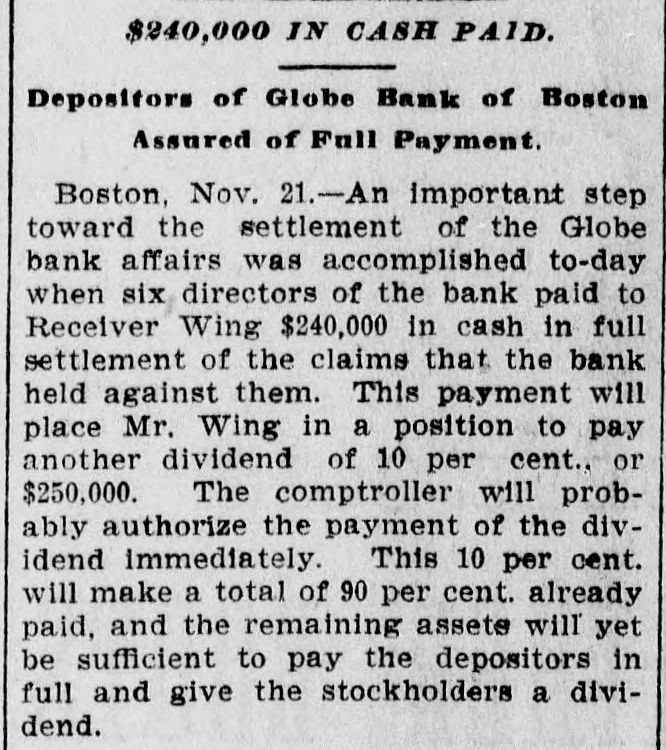
Article Text

$240,000 IN CASH PAID. Depositors of Globe Bank of Boston Assured of Full Payment. Boston, Nov. 21. - An important step toward the settlement of the Globe bank affairs was accomplished to-day when six directors of the bank paid to Receiver Wing $240,000 in cash in full settlement of the claims that the bank held against them. This payment will place Mr. Wing in a position to pay another dividend of 10 per cent.. or $250,000. The comptroller will probably authorize the payment of the dividend immediately. This 10 per cent. will make a total of 90 per cent. already paid, and the remaining assets will yet be sufficient to pay the depositors in full and give the stockholders a dividend.


Article from New-York Tribune, November 22, 1901

Click image to open full size in new tab

Article Text

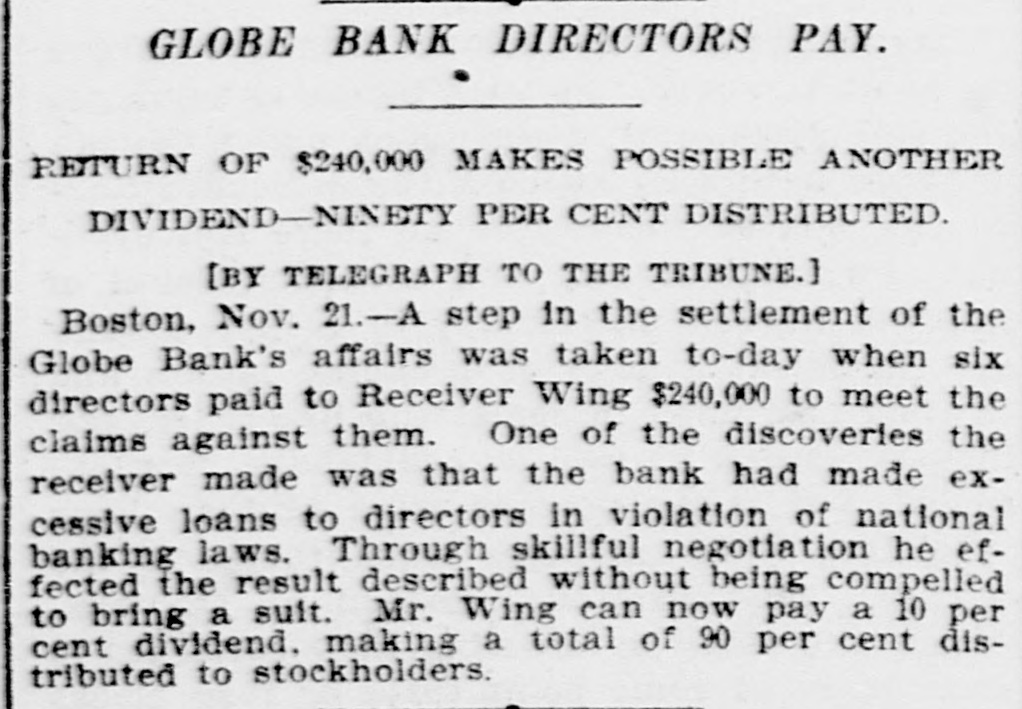
GLOBE BANK DIRECTORS PAY. RETURN OF $240,000 MAKES POSSIBLE ANOTHER DIVIDEND-NINETY PER CENT DISTRIBUTED. [BY TELEGRAPH TO THE TRIBUNE.] Boston, Nov. 21.-A step in the settlement of the Globe Bank's affairs was taken to-day when six directors paid to Receiver Wing $240,000 to meet the claims against them. One of the discoveries the receiver made was that the bank had made excessive loans to directors in violation of national banking laws. Through skillful negotiation he effected the result described without being compelled to bring a suit. Mr. Wing can now pay a 10 per cent dividend. making a total of 90 per cent distributed to stockholders.


Article from Deseret Evening News, November 22, 1901

Click image to open full size in new tab

Article Text

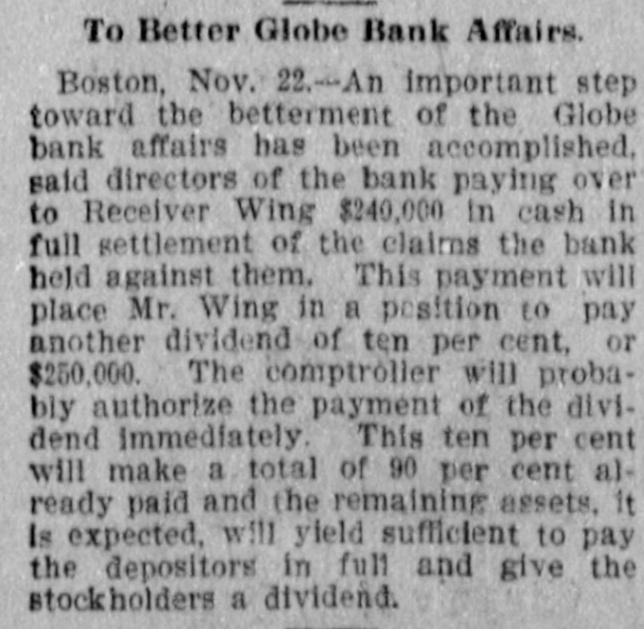
To Better Globe Bank Affairs. Boston, Nov. 22.--An important step toward the betterment of the Globe bank affairs has been accomplished, said directors of the bank paying over to Receiver Wing $240,000 in cash in full settlement of the claims the bank held against them. This payment will place Mr. Wing in a position to pay another dividend of ten per cent, or $250,000. The comptroller will probably authorize the payment of the dividend immediately. This ten per cent will make a total of 90 per cent already paid and the remaining assets, it Is expected, will yield sufficient to pay the depositors in full and give the stockholders a dividend.


Article from El Paso Herald, January 15, 1913

Click image to open full size in new tab

Article Text

# ROCKEFELLER WILLING TO TESTIFY Money Trust Committee May Call Oil Magnate For Brief Examination. IS NOW UNABLE TO TALK ABOVE WHISPER Washington, D. C., Jan. 15. Although suffering from shaking palsy and un- able to speak above a whisper, Wil- liam Rockefeller would be able to undergo a "brief examination" before the house money trust committee, if his testimony is of "paramount import- ance." So Dr. C. W. Richardson told the committee today. He said that to submit the oil magnate to prolonged questioning might cause a hemorrhage or a swelling of the larynx which would stop his breathing. While Dr. Richardson and Albert C. Burrage, who was concerned in the re- organization of the Amalgamated Cop- per company, testified, a list of finan- cial leaders waited to be called. They were president Hines of the National City Bank of New York, Geo. W. Per- kins, Thomas W. Lamont, H. P. David- son and Geo. Baker jr., the latter a son of the leading figure in the First National bank. The committee will take up the ques- tion of whether Mr. Rockefeller is to be examined at an executive meeting late today. Organization of Amalgamated. Albert C. Burrage, of Boston, testi- fied he was an organizer of the Amal- gamated Copper company in 1896. He named as his assistants Wm. Rocke- feller, Marcus Daly, H. H. Rogers and others. Mr. Burrage could not remem- ber how much was made by the or- ganizers in turning over the various properties to the Amalgamated. "Was the profit $39,000,000?" asked Mr. Untermyer. "I could not say," answered Burrage. He could not remember his own profits nor those of Thomas W. Lawson, Wm. Rockefeller and Mr. Rogers. "The panic came in in shoals, didn't it?" asked Mr. Untermyer. "Yes, you might say that," said Mr. Burrage. He could not say whether the "insiders" received large requests for subscriptions of the stock but he knew that before the stock was al- loted the price had gone to $115 or $120 per 100 shares. About $375,000,000 of of- fers, he said, were received for the $75,000,000 of stock. Cannot Remember Details. Mr. Burrage could not remember de- tails of operations by which Amalga- mated took over Butte and Boston. Boston and Butte, Mr. Burrage said, was accumulated on his advice. Later, he said, the Globe Bank of Boston failed, holding a large block of Bos- ton and Mostana stock. Just prior to the failure, he said, Mr. Lawson con- ducted a vigorous advertising cam- "paign, "bulling" Butte and Boston and "bearing" Boston and Montana. Mr. Burrage said he had taken no part in the negotiations by which the Amalga- mated organizers secured the Boston and Montana stock held by the Globe bank. He did not believe the Lawson advertising campaign had any relation to the Globe failure. Mr. Burrage said that Butte and Bos- ton stock was exchanged for Amal- gamated, at a rate of four shares of Amalgamated for one of Butte and Boston, which with Amalgamated at 130 made a price of 520. Butte-Mon- tana, he said, was excxhanged share for share with Amalgamated in the merger. Mr Burrage said that in 1904 he or- dered all his papers and accounts de- stroyed because Mr. Lawson and Mr. Rogers were engaged in an alterca- tion. Perkins Testifies. George W. Perkins was the first to take the stand when the committee resumed the hearing after lunch. Mr. Perkins told of having been a member of the firm of J. P. Morgan & company, and of his connection with the United States corporation. He


Article from Santa Fe New Mexican, January 15, 1913

Click image to open full size in new tab

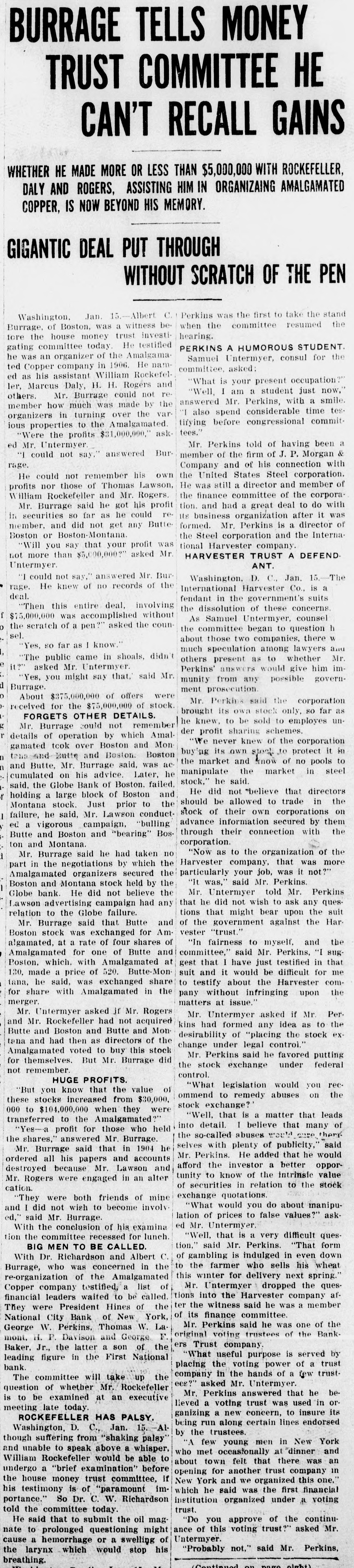
Article Text

# BURRAGE TELLS MONEY # TRUST COMMITTEE HE # CAN'T RECALL GAINS WHETHER HE MADE MORE OR LESS THAN $5,000,000 WITH ROCKEFELLER, DALY AND ROGERS, ASSISTING HIM IN ORGANIZAING AMALGAMATED COPPER, IS NOW BEYOND HIS MEMORY. # GIGANTIC DEAL PUT THROUGH # WITHOUT SCRATCH OF THE PEN Washington, Jan. 15. Albert C. Burrage, of Boston, was a witness before the house money trust investigating committee today. He testified he was an organizer of the Amalgamated Copper company in 1906. He named as his assistant William Rockefeller, Marcus Daly, H. H. Rogers and others. Mr. Burrage could not remember how much was made by the organizers in turning over the various properties to the Amalgamated. "Were the profits $31,000,000," asked Mr. Untermyer. "I could not say," answered Burrage. He could not remember his own profits nor those of Thomas Lawson, William Rockefeller and Mr. Rogers. Mr. Burrage said he got his profit in securities so far as he could remember, and did not get any Butte Boston or Boston-Montana. "Will you say that your profit was not more than $5,000,000?" asked Mr. Untermyer. "I could not say," answered Mr. Burrage. He knew of no records of the deal. "Then this entire deal, involving f $75,000,000 was accomplished without the scratch of a pen?" asked the counsel. "Yes, so far as I know." "The public came in shoals, didn't e it?" asked Mr. Untermyer. "Yes, you might say that, said Mr. Burrage. About $375,000,000 of offers were received for the $75,000,000 of stock. # FORGETS OTHER DETAILS. Mr. Burrage could not remember details of operation by which Amalgamated took over Boston and Montana and Butte and Boston. Boston and Butte, Mr. Burrage said, was accumulated on his advice. Later, he said, the Globe Bank of Boston, failed, of holding a large block of Boston and Montana stock. Just prior to the failure, he said, Mr. Lawson conducted a vigorous campaign, "bulling Butte and Boston and "bearing" Boston and Montana. Mr. Burrage said he had taken no part in the negotiations by which the Amalgamated organizers secured the Boston and Montana stock held by the Globe bank. He did not believe the Lawson advertising campaign had any relation to the Globe failure. Mr. Burrage said that Butte and Boston stock was exchanged for Amalgamated, at a rate of four shares of Amalgamated for one of Butte and Poston, which, with Amalgamated at 130, made a price of 520. Butte-Montana, he said, was exchanged share for share with Amalgamated in the merger. Mr. Untermyer asked if Mr. Rogers and Mr. Rockefeller had not acquired Butte and Boston and Butte and Montana and had then as directors of the Amalgamated voted to buy this stock for themselves. But Mr. Burrage did not remember. # HUGE PROFITS. "But you know that the value of these stocks increased from $30,000,000 to $104,000,000 when they were transferred to the Amalgamated?" "Yes-a profit for those who held the shares," answered Mr. Burrage. Mr. Burrage said that in 1904 he ordered all his papers and accounts destroyed because Mr. Lawson and Mr. Rogers were engaged in an altercation. "They were both friends of mine and I did not wish to become involved," said Mr. Burrage. With the conclusion of his examination the committee recessed for lunch. # BIG MEN TO BE CALLED. With Dr. Richardson and Albert C. Burrage, who was concerned in the re-organization of the Amalgamated Copper company testified, a list of financial leaders waited to be called. They were President Hines of the National City Bank of New York, George W. Perkins, Thomas W. Lamont, H. P. Davison and George. F. Baker, Jr., the latter a son of the leading figure in the First National bank. The committee will take up the question of whether Mr. Rockefeller is to be examined at an executive meeting late today. # ROCKEFELLER HAS PALSY. Washington, D. C., Jan. 15. Although suffering from "shaking palsy" and unable to speak above a whisper, William Rockefeller would be able to undergo a "brief examination" before the house money trust committee, if his testimony is of "paramount importance." So Dr. C. W. Richardson told the committee today. He said that to submit the oil magnate to prolonged questioning might cause a hemorrhage or a swelling of the larynx which would stop his breathing. Perkins was the first to take the stand when the committee resumed the hearing. # PERKINS A HUMOROUS STUDENT. Samuel Untermyer, consul for the committee, asked: "What is your present occupation?" "Well, I am a student just now," answered Mr. Perkins, with a smile. "I also spend considerable time testifying before congressional committees." Mr. Perkins told of having been a member of the firm of J. P. Morgan & Company and of his connection with the United States Steel corporation. He was still a director and member of the finance committee of the corporation, and had a great deal to do with its business organization after it was formed. Mr. Perkins is a director of the Steel corporation and the International Harvester company. # HARVESTER TRUST A DEFEND- # ANT. Washington, D. C., Jan. 15. The International Harvester Co., is a defendant in the government's suits. the dissolution of these concerns. As Samuel Untermyer, counsel the committee began to question h about those two companies, there w much speculation among lawyers and others present as to whether Mr. Perkins' answers would give him immunity from any possible government prosecution. Mr. Perkins said the corporation brought its own stock only, so far as he knew, to be sold to employes under profit sharing schemes. "We never knew of the corporation buy'ng its own stock to protect it in the market and know of no pools to manipulate the market in steel stock," he said. He did not believe that directors should be allowed to trade in the stock of their own corporations on advance information secured by them through their connection with the corporation. "Now as to the organization of the Harvester company, that was more particularly your job, was it not?" "It was," said Mr. Perkins. Mr. Untermyer told Mr. Perkins that he did not wish to ask any questions that might bear upon the suit of the government against the Harvester "trust." "In fairness to myself, and the committee," said Mr. Perkins, "I suggest that I have just testified in that suit and it would be difficult for me to testify about the Harvester company without infringing upon the matters at issue." Mr. Untermyer asked if Mr. Perkins had formed any idea as to the desirability of "placing the stock exchange under legal control." Mr. Perkins said he favored putting the stock exchange under federal control. "What legislation would you recommend to remedy abuses on the stock exchange?' "Well, that is a matter that leads into detail. I believe that many of the so-called abuses would care themselves with plenty of publicity," said Mr. Perkins. He added that he would afford the investor a better opportunity to know of the intrinsic value of securities in relation to the stock exchange quotations. "What would you do about manipulation of prices to false values?" asked Mr. Untermyer. "Well, that is a very difficult question," said Mr. Perkins. "That form of gambling is indulged in even down to the farmer who sells his wheat this winter for delivery next spring." Mr. Untermyer dropped the questions into the Harvester company after the witness said he was a member of its finance committee. Mr. Perkins said he was one of the original voting trustees of the Bankers Trust company. "What useful purpose is served by placing the voting power of a trust company in the hands of a few trustees?" asked Mr. Untermyer. Mr. Perkins answered that he believed a voting trust was used in organizing a new concern, to insure its being run along certain lines endorsed by the trustees. "A few young men in New York who met occasionally at dinner and about town felt that there was an opening for another trust company in New York and we organized this one." which he said was the first financial institution organized under a voting trust. "Do you approve of the continuance of this voting trust?" asked Mr. Untermyer. "Probably not," said Mr. Perkins, (Conti

Article from The Daily Worker, September 5, 1924

Click image to open full size in new tab

Article Text

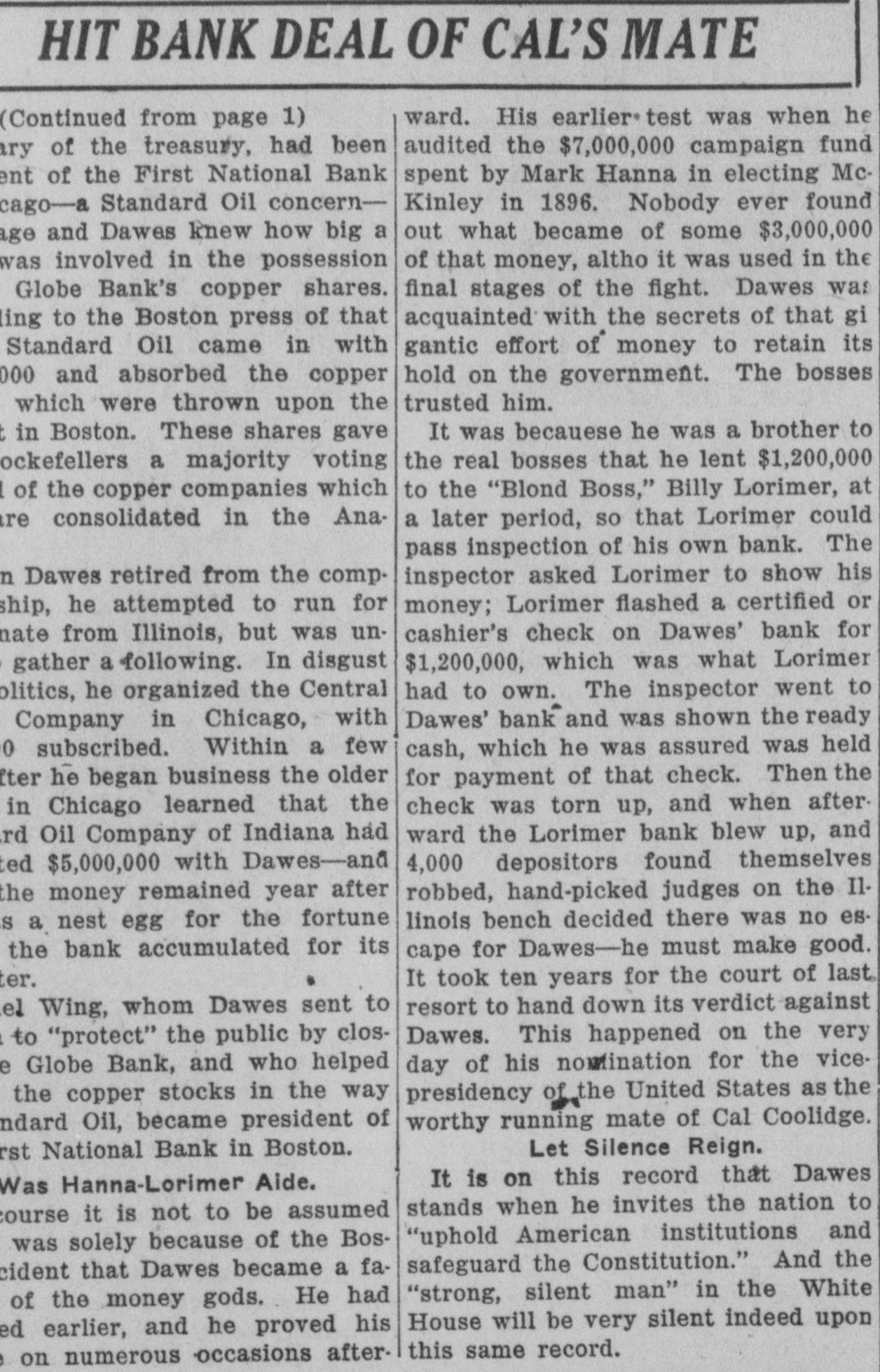
# HIT BANK DEAL OF CAL'S MATE (Continued from page 1) ary of the treasury, had been audited the $7,000,000 campaign fund ent of the First National Bank spent by Mark Hanna in electing Mc- cago-a Standard Oil concern- Kinley in 1896. Nobody ever found age and Dawes knew how big a out what became of some $3,000,000 was involved in the possession of that money, altho it was used in the Globe Bank's copper shares. final stages of the fight. Dawes was ling to the Boston press of that acquainted with the secrets of that gi- Standard Oil came in with gantic effort of money to retain its 1000 and absorbed the copper hold on the government. The bosses which were thrown upon the trusted him. in Boston. These shares gave It was becauese he was a brother to ockefellers a majority voting the real bosses that he lent $1,200,000 1 of the copper companies which to the "Blond Boss," Billy Lorimer, at are consolidated in the Ana- a later period, so that Lorimer could pass inspection of his own bank. The n Dawes retired from the comp- inspector asked Lorimer to show his ship, he attempted to run for money; Lorimer flashed a certified or mate from Illinois, but was un- cashier's check on Dawes' bank for - gather a following. In disgust $1,200,000, which was what Lorimer olitics, he organized the Central had to own. The inspector went to Company in Chicago, with Dawes' bank and was shown the ready 0 subscribed. Within a few cash, which he was assured was held fter he began business the older for payment of that check. Then the in Chicago learned that the check was torn up, and when after- rd Oil Company of Indiana had ward the Lorimer bank blew up, and Led $5,000,000 with Dawes-and 4,000 depositors found themselves the money remained year after robbed, hand-picked judges on the Il- s a nest egg for the fortune linois bench decided there was no es- the bank accumulated for its cape for Dawes-he must make good. Ler. It took ten years for the court of last resort to hand down its verdict against Lel Wing, whom Dawes sent to Dawes. This happened on the very to "protect" the public by clos- day of his nomination for the vice- e Globe Bank, and who helped presidency of the United States as the the copper stocks in the way worthy running mate of Cal Coolidge. ndard Oil, became president of rst National Bank in Boston. Was Hanna-Lorimer Aide. Let Silence Reign. It is on this record that Dawes course it is not to be assumed stands when he invites the nation to was solely because of the Bos- "uphold American institutions and cident that Dawes became a fa- safeguard the Constitution." And the of the money gods. He had "strong, silent man" in the White ed earlier, and he proved his House will be very silent indeed upon e on numerous occasions after this same record.


Article from The Daily Worker, September 5, 1924

Click image to open full size in new tab

Article Text

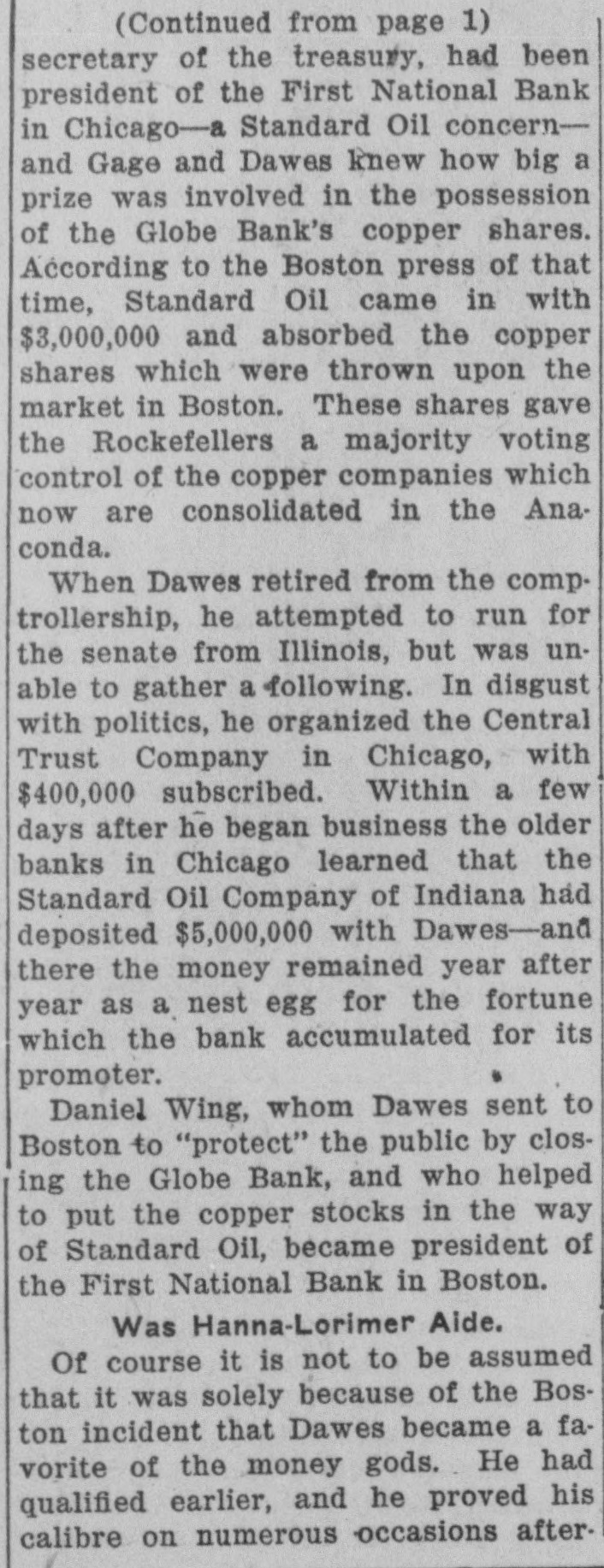
(Continued from page 1) secretary of the treasury, had been president of the First National Bank in Chicago—a Standard Oil concern—and Gage and Dawes knew how big a prize was involved in the possession of the Globe Bank's copper shares. According to the Boston press of that time, Standard Oil came in with $3,000,000 and absorbed the copper shares which were thrown upon the market in Boston. These shares gave the Rockefellers a majority voting control of the copper companies which now are consolidated in the Anaconda. When Dawes retired from the comptrollership, he attempted to run for the senate from Illinois, but was unable to gather a following. In disgust with politics, he organized the Central Trust Company in Chicago, with $400,000 subscribed. Within a few days after he began business the older banks in Chicago learned that the Standard Oil Company of Indiana had deposited $5,000,000 with Dawes—and there the money remained year after year as a nest egg for the fortune which the bank accumulated for its promoter. Daniel Wing, whom Dawes sent to Boston to "protect" the public by closing the Globe Bank, and who helped to put the copper stocks in the way of Standard Oil, became president of the First National Bank in Boston. ### Was Hanna-Lorimer Aide. Of course it is not to be assumed that it was solely because of the Boston incident that Dawes became a favorite of the money gods. He had qualified earlier, and he proved his calibre on numerous occasions after-


Article from Newark Leader, September 12, 1924

Click image to open full size in new tab

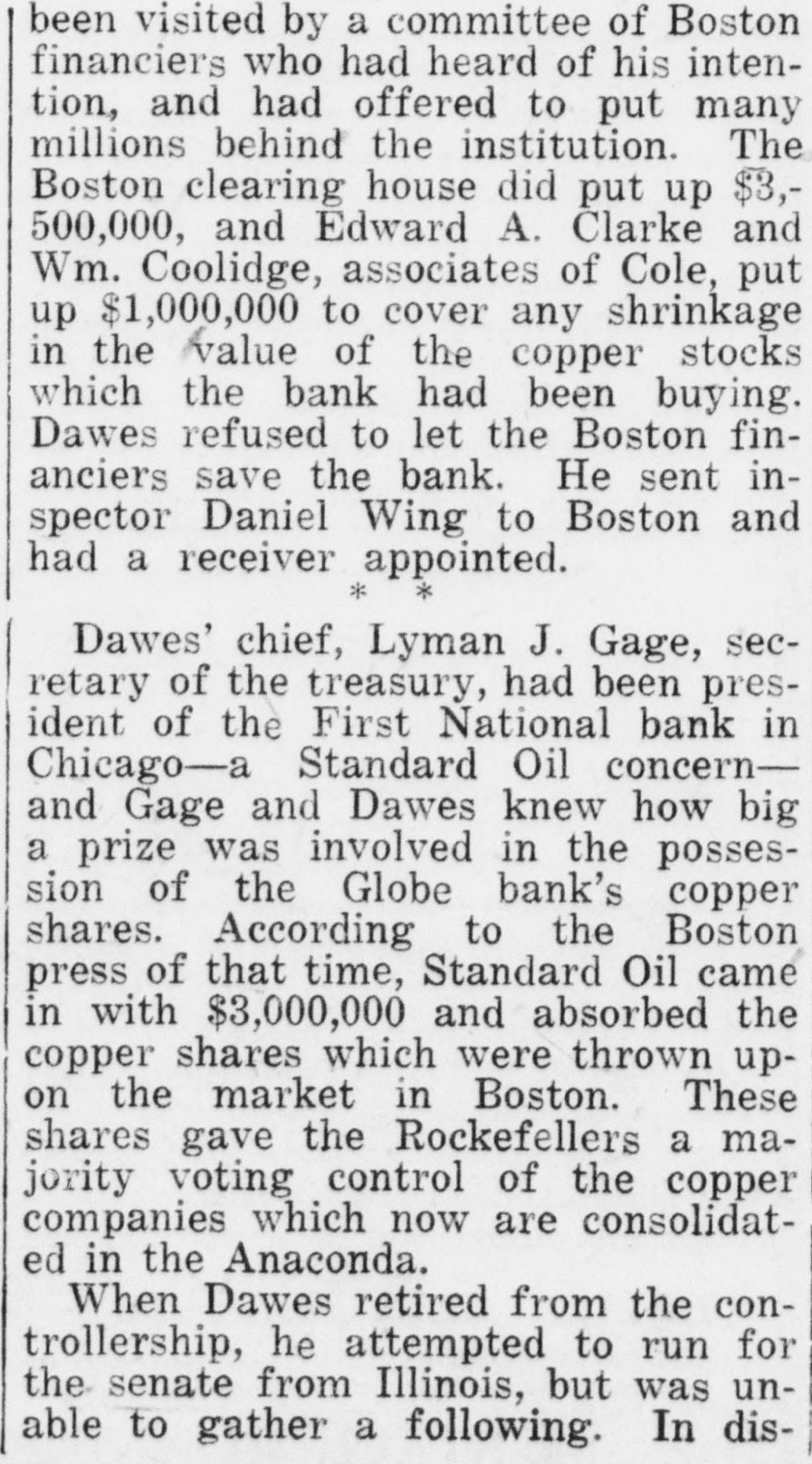
Article Text

been visited by a committee of Boston financiers who had heard of his intention, and had offered to put many millions behind the institution. The Boston clearing house did put up $3,500,000, and Edward A. Clarke and Wm. Coolidge, associates of Cole, put up $1,000,000 to cover any shrinkage in the value of the copper stocks which the bank had been buying. Dawes refused to let the Boston financiers save the bank. He sent inspector Daniel Wing to Boston and had a receiver appointed. Dawes' chief, Lyman J. Gage, secretary of the treasury, had been president of the First National bank in Chicago-a Standard Oil concernand Gage and Dawes knew how big a prize was involved in the possession of the Globe bank's copper shares. According to the Boston press of that time, Standard Oil came in with $3,000,000 and absorbed the copper shares which were thrown upon the market in Boston. These shares gave the Rockefellers a majority voting control of the copper companies which now are consolidated in the Anaconda. When Dawes retired from the controllership, he attempted to run for the senate from Illinois, but was unable to gather a following. In dis-