Article Text
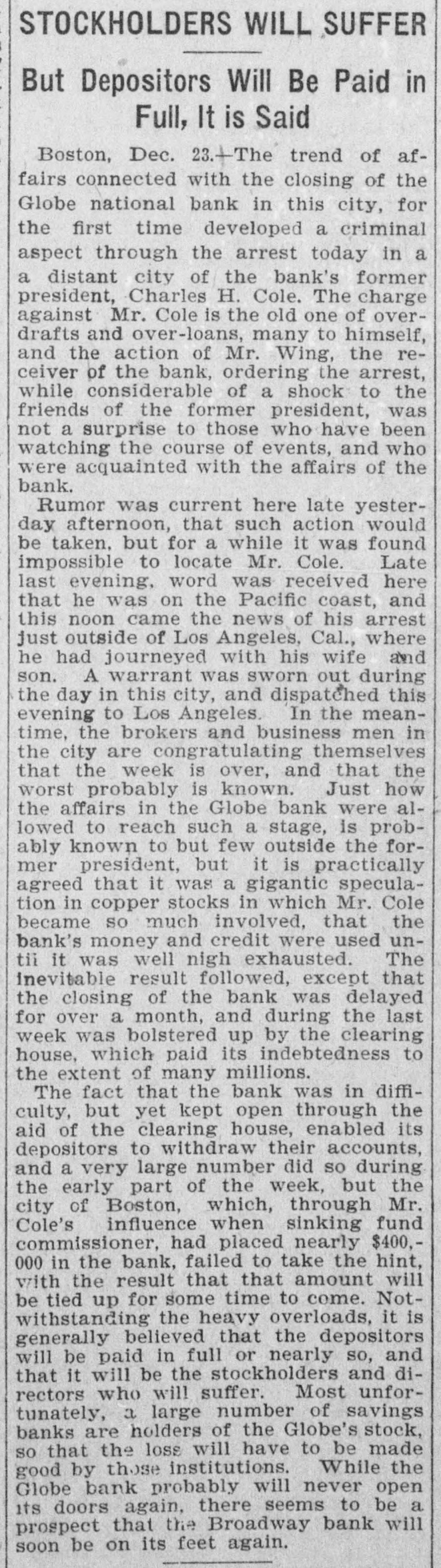
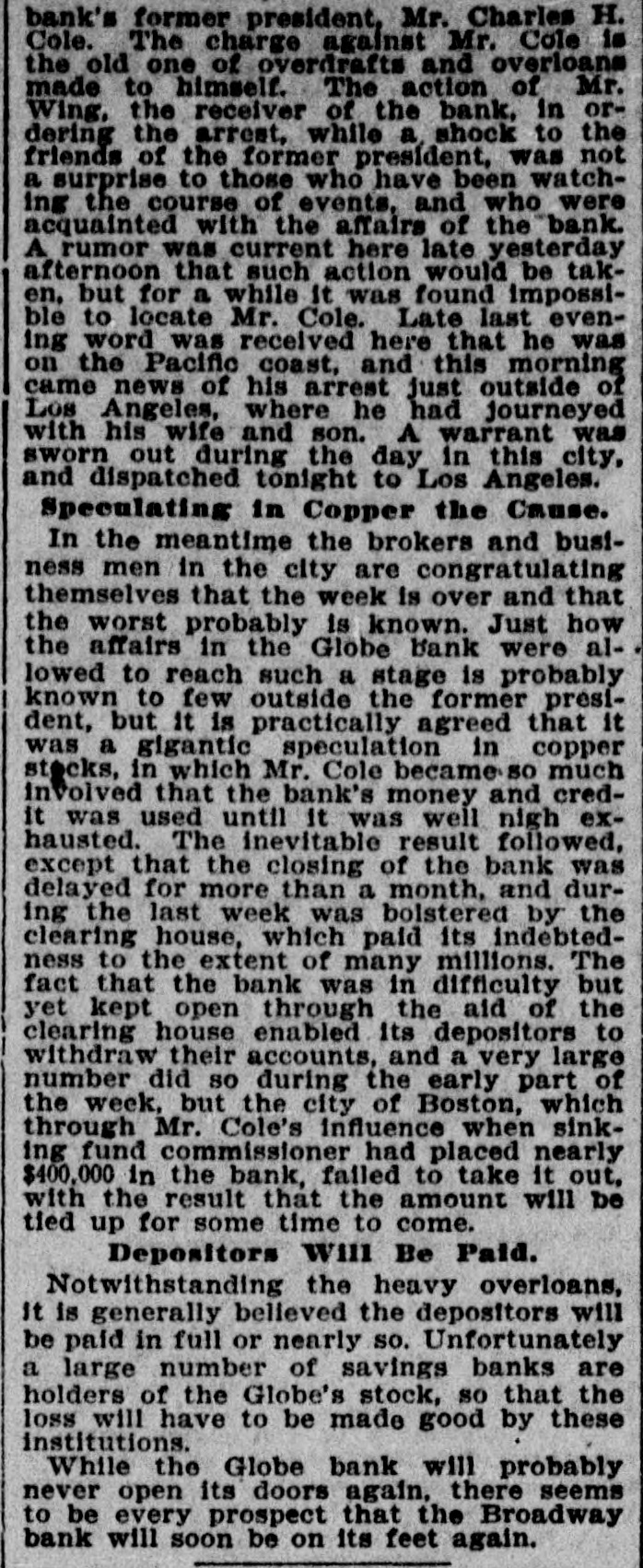
December 9. showed the following fig ures: Capital, $200,000; loans, $1,995,000; circulation, $45,000; individual deposits, $2,348,000; due banks, $131,000; due from resident agents,$274,000; expenses,clearing house, $273,000; due from banks, $168,000; five per cent. fund, $2250; legal tender, $158,000; specie, $113,000. Besides President Downer and Vicepresident Squire the directors of the bank include Henry L. Lawrence, John Graham and Frank W. Downer. IS NOT INVOLVED. Among the banks mentioned in the rumors which followed the news of the Broadway bank trouble, was the Fourth National bank, with which the Squire corporation was known to have transacted considerable business. This bank opened its doors as usual, however, and an official of the bank gave out the statement that while the John P. Squire corporation has indebtedness in the bank, it in no wise involved the bank's condition. A rumor also was current before noon that a sporting goods house here, one of the largest in New England, had made anassignment. Uponinvestigation it was found that the firm had made no assignment, and that the rumor was due to the fact that the concern was heavily indebted to the Globe National bank. It appears that the Globe National bank has endeavored to collect a considerable portion of the money due it with the result that arrangements were made whereby a large amount of the firm's stock had been marked down so that it could be disposed of quickly to realize enough money to pay part of its indebtedness to the bank. OPINIONS OF BANKERS. Members of the clearing house committee refused to discuss the Broadway Bank question today. It seemed to be the opinion among the bankers that no important failures would follow the closing of the bank. A prominent banker, who is closely in touch with the matters of the street said: "The management of financial affairs in Boston is in the hands of very able men, and we may feel sure that they will do all in their power to avert additional disasters. It is for the advantage of each bank that every other bank should stand on a solid footing and, if only for purely selfish reasons, they are all ready to stand by each other as far as possible." Another banker, when asked if he expected other failures as the result of the closing of the Broadway Bank said: "I have not sufficient information upon which to base an intelligent answer to that question. It is possible that there may be a weak institution or two which will be affected. but what of it? If a bank is not on a solid footing e sooner it is known the better. It would be for the advantage of State street and of business generally to have such institutions, if there are any, cleaned out as soon as possible. If a bank is in a bad way, rumors of it, at least, get afloat and exert a deletérious influence in every direction. In the long run it is cheapest and best for community that unstable concerns should go to the wall."