6823. Union National Bank (New Orleans, LA)

Bank Information

Episode Type
Run → Suspension → Reopening
Bank Type
national
Bank ID
1796
Charter Number
1796
Start Date
September 9, 1896
Location
New Orleans, Louisiana (29.955, -90.075)

Metadata

Model
gpt-5-mini
Short Digest
2aa90b62daec13be

Response Measures

Accommodated withdrawals, Borrowed from banks or large institutions, Public signal of financial health, Capital injected, Partial suspension, Full suspension, Books examined

Description

Contemporary reports (Sept 8–11, 1896) describe a quiet run and large withdrawals preceding a suspension announced Sept 8–9 due to discovered long-running defalcations by bookkeepers (≈$600k). Examiners were placed in charge. The bank complied with comptroller conditions and resumed business in early December 1896. I corrected small OCR name variants (Chalaron/Chalon/Chaleron -> Stephen Chalaron) based on repeated references.

Events (6)

1. February 23, 1871 Chartered
Source
historical_nic
2. September 9, 1896 Run
Cause
Bank Specific Adverse Info
Cause Details
Depositors had been withdrawing funds as the bank became known to be 'not thoroughly sound' after the failure of large local concerns and later discovery of extensive defalcations in the bank's books.
Measures
Bank limited clearing-house payments citywide; bank opened briefly then closed; clearing house limited withdrawals to $100 to prevent wider panic.
Newspaper Excerpt
There has been a quiet run on the bank for some time, so that the deposits still in its charge will not reach $100,000.
Source
newspapers
3. September 9, 1896 Suspension
Cause
Bank Specific Adverse Info
Cause Details
Bank suspended because examination revealed systematic defalcations by bookkeepers amounting to roughly $600,000; examiners took charge of the institution thereafter.
Newspaper Excerpt
At 11 o'clock to-day the failure of the Union National Bank was announced... The cause of the suspension is attributed to a long line of defalcations discovered when the system of book-keeping was changed...
Source
newspapers
4. September 14, 1896 Other
Newspaper Excerpt
United States Bank Examiner Escott completed his first trial balance of the Union National bank and found the amount stolen to be $602,687.07. ... Colcomb (sic) killed himself when the defalcation was discovered; Leefe, Wolfson, and Gaillot are under indictments before the Federal courts.
Source
newspapers
5. December 7, 1896 Reopening
Newspaper Excerpt
The Union National Bank... will resume business on Monday. ... The bank will start with a capital of $300,000. ... The bank will start business with $557,407.68 cash in its vaults.
Source
newspapers
6. April 14, 1902 Voluntary Liquidation
Source
historical_nic

Newspaper Articles (23)

Article from The News & Observer, September 10, 1896

Click image to open full size in new tab

Article Text

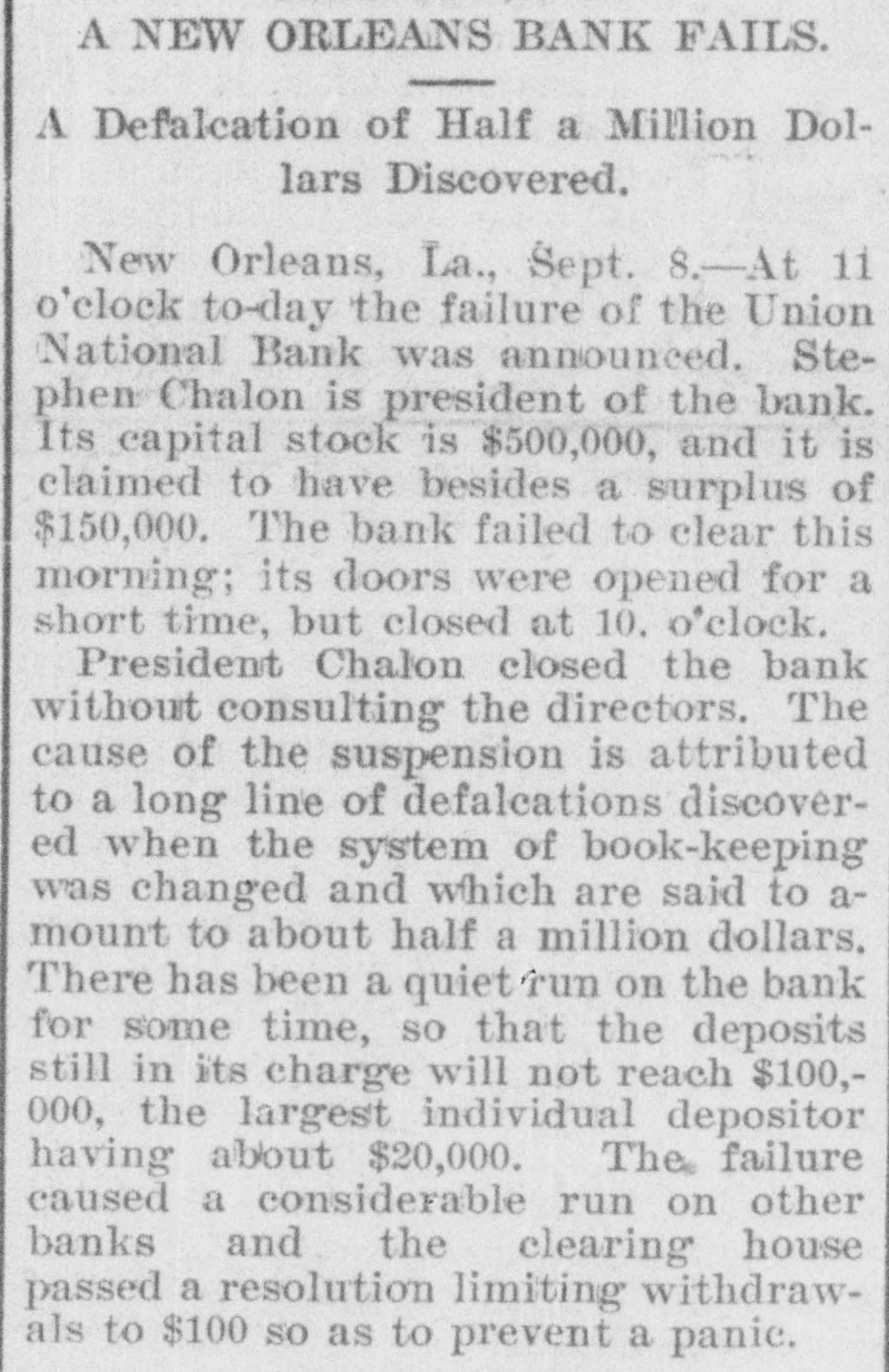
A NEW ORLEANS BANK FAILS. A Defalcation of Half a Million Dollars Discovered. New Orleans, La., Sept. 8.-At 11 o'clock to-day the failure of the Union National Bank was announced. Stephen Chalon is president of the bank. Its capital stock is $500,000, and it is claimed to have besides a surplus of $150,000. The bank failed to clear this morning; its doors were opened for a short time, but closed at 10. o'clock. President Chalon closed the bank without consulting the directors. The cause of the suspension is attributed to a long line of defalcations discovered when the system of book-keeping was changed and which are said to amount to about half a million dollars. There has been a quiet run on the bank for some time, so that the deposits still in its charge will not reach $100,000, the largest individual depositor having about $20,000. The failure caused a considerable run on other banks and the clearing house passed a resolution limiting withdrawals to $100 SO as to prevent a panic.


Article from The Morning News, September 10, 1896

Click image to open full size in new tab

Article Text

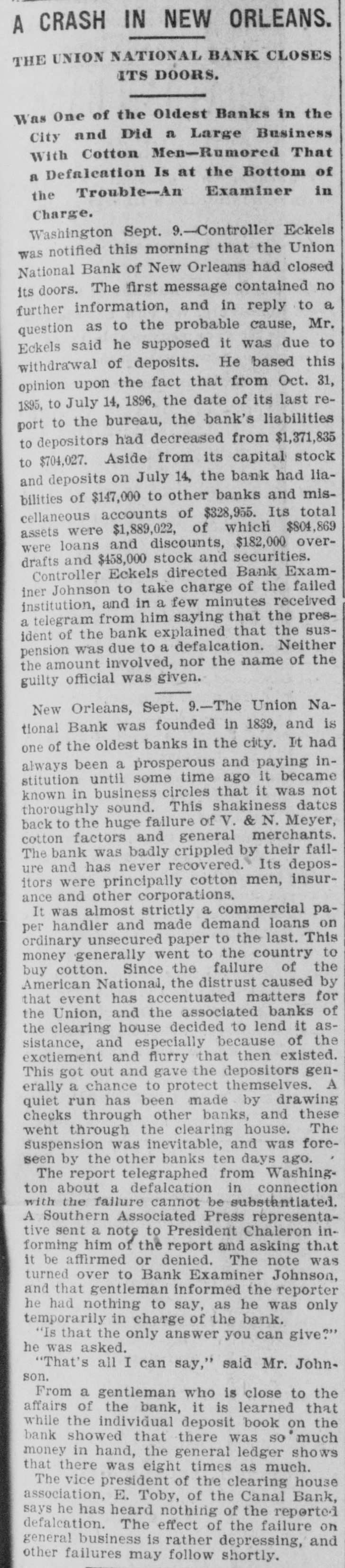
A CRASH IN NEW ORLEANS. THE UNION NATIONAL BANK CLOSES ITS DOORS. Was One of the Oldest Banks in the City and Did a Large Business With Cotton Men-Rumored That a Defalcation Is at the Bottom of the Trouble-An Examiner in Charge. Washington Sept. 9.-Controller Eckels was notified this morning that the Union National Bank of New Orleans had closed its doors. The first message contained no further information, and in reply to a question as to the probable cause, Mr. Eckels said he supposed it was due to withdrawal of deposits. He based this opinion upon the fact that from Oct. 31, 1895, to July 14, 1896, the date of its last report to the bureau, the bank's liabilities to depositors had decreased from $1,371,835 to $704,027. Aside from its capital stock and deposits on July 14, the bank had liabilities of $147,000 to other banks and miscellaneous accounts of $328,955. Its total assets were $1,889,022, of which $804,869 were loans and discounts, $182,000 overdrafts and $458,000 stock and securities. Controller Eckels directed Bank Examiner Johnson to take charge of the failed institution, and in a few minutes received a telegram from him saying that the president of the bank explained that the suspension was due to a defalcation. Neither the amount involved, nor the name of the guilty official was given. New Orleans, Sept. 9.-The Union National Bank was founded in 1839, and is one of the oldest banks in the city. It had always been a prosperous and paying institution until some time ago it became known in business circles that it was not thoroughly sound. This shakiness dates back to the huge failure of V. & N. Meyer, cotton factors and general merchants. The bank was badly crippled by their failure and has never recovered. Its depositors were principally cotton men, insurance and other corporations, It was almost strictly a commercial paper handler and made demand loans on ordinary unsecured paper to the last. This money generally went to the country to buy cotton. Since the failure of the American National, the distrust caused by that event has accentuated matters for the Union, and the associated banks of the clearing house decided to lend it assistance, and especially because of the exctiement and flurry that then existed. This got out and gave the depositors generally a chance to protect themselves. A quiet run has been made by drawing checks through other banks, and these weht through the clearing house. The suspension was inevitable, and was foreseen by the other banks ten days ago. The report telegraphed from Washington about a defalcation in connection with the failure cannot be substantiated. A Southern Associated Press representative sent a note to President Chaleron informing him of the report and asking that it be affirmed or denied. The note was turned over to Bank Examiner Johnson, and that gentleman informed the reporter he had nothing to say, as he was only temporarily in charge of the bank. "Is that the only answer you can give?" he was asked. "That's all I can say," said Mr. Johnson. From a gentleman who is close to the affairs of the bank, it is learned that while the individual deposit book on the bank showed that there was so much money in hand, the general ledger shows that there was eight times as much. The vice president of the clearing house association, E. Toby, of the Canal Bank, says he has heard nothing of the reported defalcation. The effect of the failure on general business is rather depressing, and other failures may follow shortly.


Article from Richmond Dispatch, September 10, 1896

Click image to open full size in new tab

Article Text

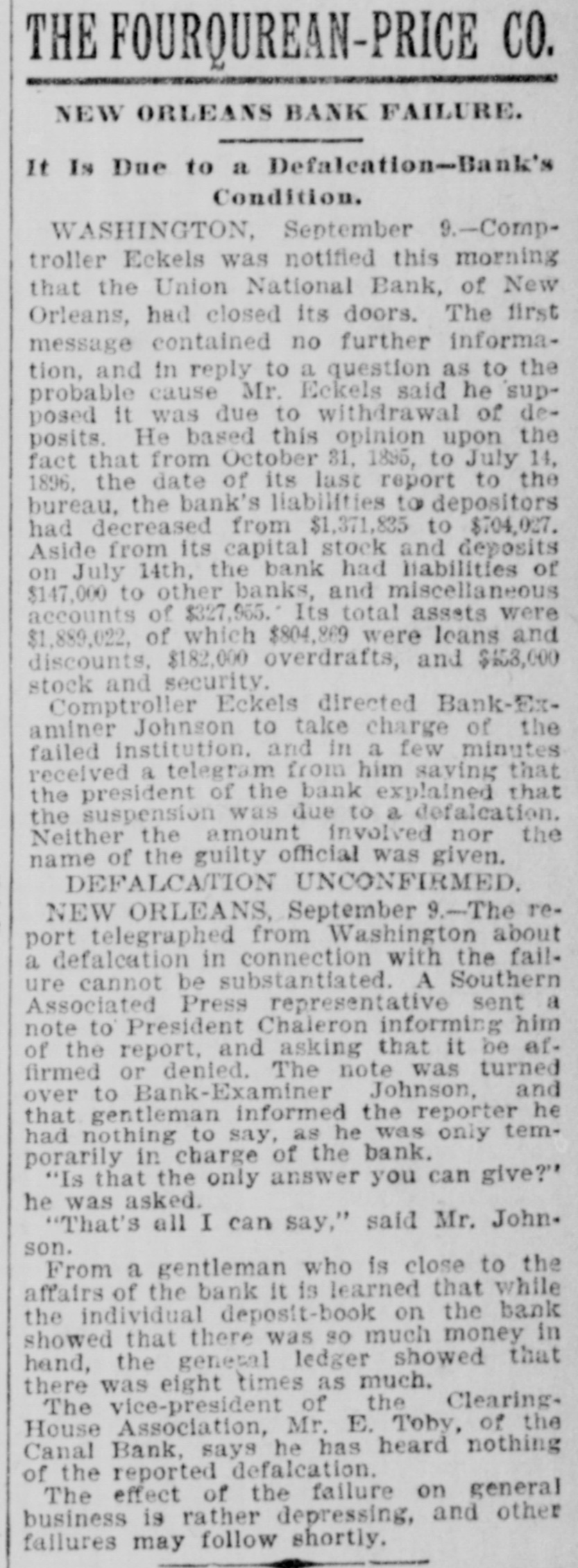
THE FOURQUREAN-PRICE CO. NEW ORLEANS BANK FAILURE. It Is Due to a Defaleation-Bank's Condition. WASHINGTON, September 9.-Comptroller Eckels was notified this morning that the Union National Bank, of New Orleans, had closed its doors. The first message contained no further information, and in reply to a question as to the probable cause Mr. Eckels said he supposed it was due to withdrawal of deposits. He based this opinion upon the fact that from October 31, 1895, to July 14, 1896, the date of its last report to the bureau, the bank's liabilities to depositors had decreased from $1,371,835 to $704,027. Aside from its capital stock and deposits on July 14th, the bank had liabilities of $147,000 to other banks, and miscellaneous accounts of $327,955.1 Its total assets were $1,889,022, of which $804,869 were leans and discounts, $182,000 overdrafts, and $453,000 stock and security. Comptroller Eckels directed Bank-Examiner Johnson to take charge of the failed institution. and in a few minutes received a telegram from him saying that the president of the bank explained that the suspension was due to a defalcation. Neither the amount involved nor the name of the guilty official was given. DEFALCATION UNCONFIRMED. NEW ORLEANS, September 9.-The report telegraphed from Washington about a defalcation in connection with the failure cannot be substantiated. A Southern Associated Press representative sent a note to President Chaleron informing him of the report, and asking that it be affirmed or denied. The note was turned over to Bank-Examiner Johnson, and that gentleman informed the reporter he had nothing to say, as he was only temporarily in charge of the bank. "Is that the only answer you can give?" he was asked. "That's all I can say," said Mr. Johnson. From a gentleman who is close to the affairs of the bank It is learned that while the individual deposit-book on the bank showed that there was so much money in hand, the general ledger showed that there was eight times as much. The vice-president of the ClearingHouse Association, Mr. E. Toby, of the Canal Bank, says he has heard nothing of the reported defalcation. The effect of the failure on general business is rather depressing, and other failures may follow shortly.


Article from The Evening Times, September 11, 1896

Click image to open full size in new tab

Article Text

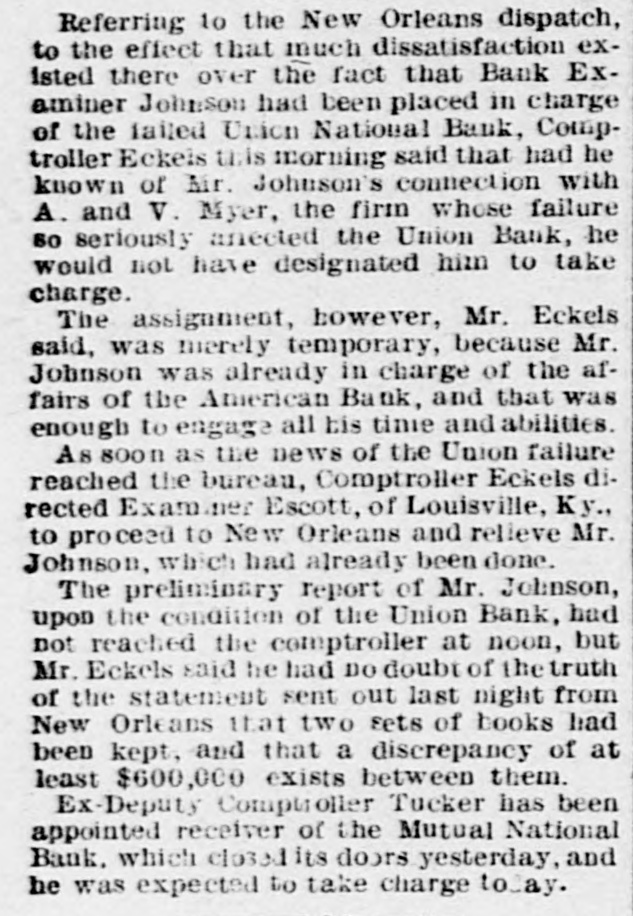
Referring to the New Orleans dispatch, to the effect that much dissatisfaction existed there over the fact that Bank Examiner Johnson had been placed in charge of the failed Union National Bank, Comptroller Eckels this morning said that had he known of Mr. Johnson's connection with A. and V. Myer, the firm whose failure so seriously affected the Union Bank, he would not have designated him to take charge. The assignment, however, Mr. Eckels said, was merely temporary, because Mr. Johnson was already in charge of the affairs of the American Bank, and that was enough to engage all his time and abilities. As soon as the news of the Union failure reached the bureau, Comptroller Eckels directed Examiner Escott, of Louisville, Ky., to proceed to New Orleans and relieve Mr. Johnson, which had already been done. The preliminary report of Mr. Johnson, upon the condition of the Union Bank, had not reached the comptroller at noon, but Mr. Eckels said he had no doubt of the truth of the statement sent out last night from New Orleans that two sets of books had been kept, and that a discrepancy of at least $600,000 exists between them. Ex-Deputy Comptroller Tucker has been appointed receiver of the Mutual National Bank, which closed its doors yesterday, and he was expected to take charge today.


Article from The Columbia Herald, September 11, 1896

Click image to open full size in new tab

Article Text

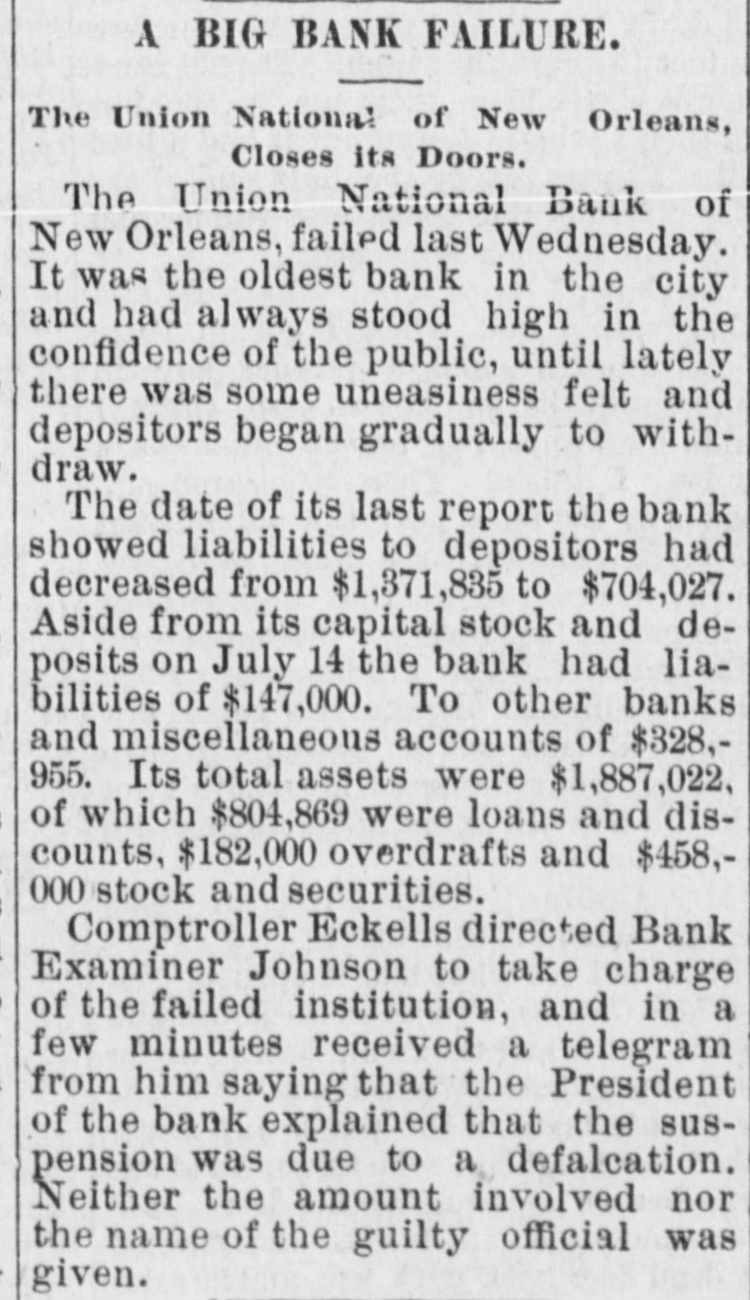
A BIG BANK FAILURE. The Union National of New Orleans, Closes its Doors. The Union National Bank of New Orleans, failed last Wednesday. It was the oldest bank in the city and had always stood high in the confidence of the public, until lately there was some uneasiness felt and depositors began gradually to withdraw. The date of its last report the bank showed liabilities to depositors had decreased from $1,371,835 to $704,027. Aside from its capital stock and deposits on July 14 the bank had liabilities of $147,000. To other banks and miscellaneous accounts of $328,955. Its total assets were $1,887,022, of which $804,869 were loans and discounts, $182,000 overdrafts and $458,000 stock and securities. Comptroller Eckells directed Bank Examiner Johnson to take charge of the failed institution, and in a few minutes received a telegram from him saying that the President of the bank explained that the suspension was due to a defalcation. Neither the amount involved nor the name of the guilty official was given.


Article from The Morning News, September 11, 1896

Click image to open full size in new tab

Article Text

A NEW ORLEANS BANK FAILS. The Mutual National In the Hands of An Examiner. New Orleans, Sept. 10.-The Mutual National Bank closed its doors this morning. The effect of this bank's suspension has been discounted, as it was well known to be in a bad way. Shortly after the American National Bank failed, a run was made on the Mutual, and the collapse of the bank at that time appeared inevitable. Luckily the run was started on Saturday, shortly before noon, and Saturday being a legal half holiday in New Orleans, providence was on the side of the sore pressed institution. By Monday morning it had a chance to recuperate. The clearing house held a meeting, and the other banks of the city fearing a panic came to the rescue and advanced money enough to meet all demands on them Monday. Large sums of money came here from various sources of the United States sub-treasury was paying out the sugar bounty as fast as possible. Before noon of that day the run ceased and all was serene, The president states that a steady drain has been maintained by depositors checking out their money. The unexpected failure of the Union National Bank Wednesday aroused the suspicions of depositors and another rush was made on the Mutual. The clearing house banks had on the first occasion advanced the Mutual $100,000, a little more than $17,000 of which had been repaid. Last night the Mutual tendered the clearing house another lot of collaterals and asked for further assistance to the extent of $25,000. This the clearing house refused and the suspension. of the Mutual followed this morning. The president says: "The bank owes depositors $92,993.72, which we have ample assets to pay dollar for dollar." President Baldwin of the clearing house says: "The officers of the bank foresaw what was coming, and as is customary in such cases, called on other banks to come once more to their assistance. A bank in distress is expected to hypothecate securities of such a kind as will justify other banks in lending the assistance. The securities offered by the Mutual was not considered the proper quality of paper to justify the clearing house in making the loan and the assistance was refused." The Mutual National was organized in 1871 with a capital stock of $500,000. This was reduced in January, 1894, to $200,000. In January, 1895, the Mutual absorbed the Traders' bank. Most of the stockholders of the Traders bank became interested in the Mutual. At a meeting of the celaring house held last night the financial situation was earnestly discussed, and the following resolution was adopted: "Resolved, for the present, That the clearing house banks should not pay on checks more than one hundred dollars to any one depositor in one dayall other payments shall be made by certificates of checks which shall be received on deposit by the clearing house banks." This step was necessary as a precaution. Employers of labor will be supplied with money to meet their pay rools. It was also agreed to adopt a system of clearing house certificates similar to that utilized in New York and elsewhere during the crisis of 1833. The savings banks also took steps to prevent a run by posting the 60-day rule. This is allowed by their charters. A depositor must give sixty days' notice of his intention to withdraw his deposit. There are no new developments in the case of the Union National. President Chalaron is bitterly criticised to-day for his precipitate action in closing the bank without consulting the directors. He is in seclusion and will see no one. There are all sorts of rumors, one to the effect that two sets of books was kept by the Union National-one for the directors and one for the bank officers, and that there is a discrepancy between these of an amount exceeding $600,000. Bank Examiner Johnson, temporarily in charge of the Union, was formerly confidential bookkeeper and agent for A. & V. Meyer, whose failure seriously affected the bank. This fact has caused much comment. To-day another bank examiner has been ordered here to take his place, a protest having been wired to Controller Eckels against Mr. Johnson's continuance in charge. Washington, Sept. 10.-Controller Eckels was to-day informed that the Mutual National Bank of New Orleans had failed. At its last report it had loans and discounts out amounting to $447,735; owed individual depositors $308,769; had undivided profits of $19,999, and owed other banks $13,396. The bank's capital was $200,000. Bank Examiner Tucker of Cincinnati has been ordered to take charge of the bank. A HIGH WIND AT PARIS.


Article from Richmond Dispatch, September 12, 1896

Click image to open full size in new tab

Article Text

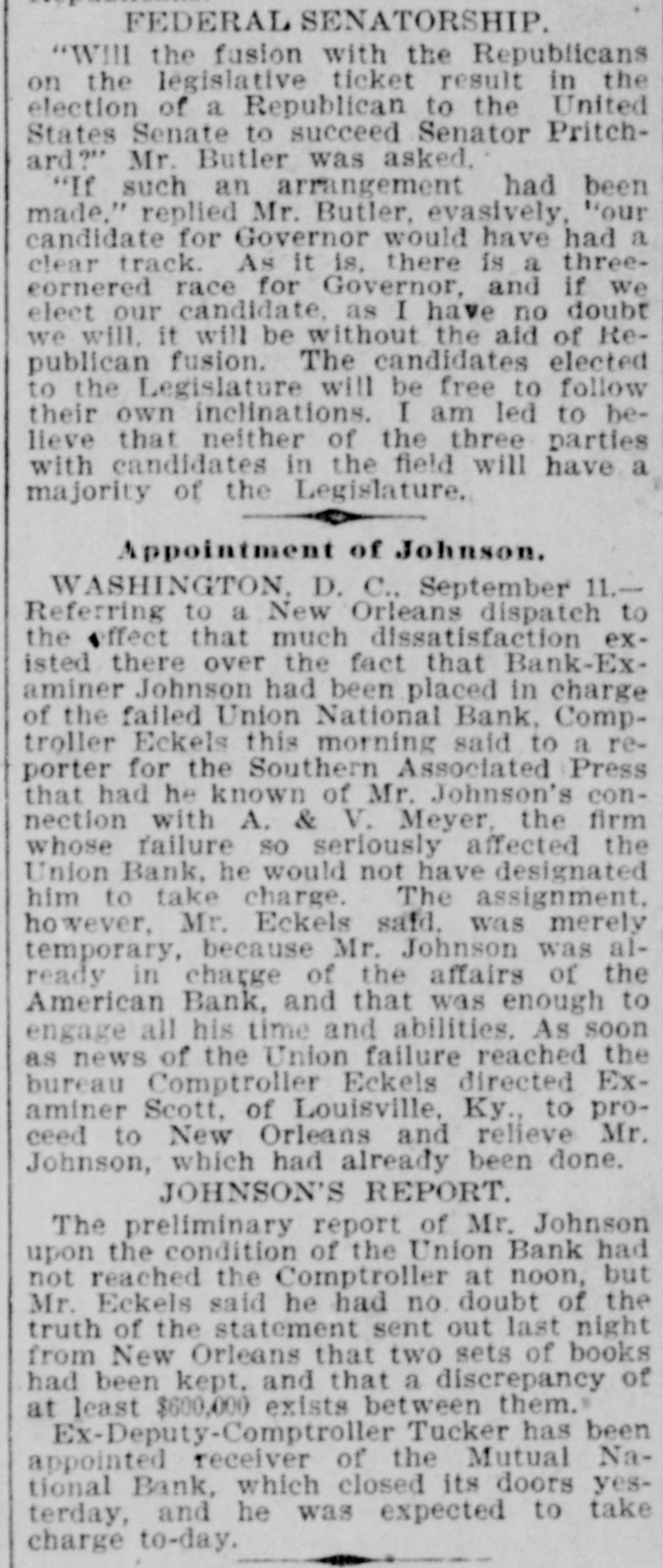
FEDERAL SENATORSHIP. "Will the fusion with the Republicans on the législative ticket result in the election of a Republican to the United States Senate to succeed Senator Pritchard?" Mr. Butler was asked. "If such an arrangement had been made," replied Mr. Butler, evasively, "our candidate for Governor would have had a clear track. As it is, there is a threeeornered race for Governor, and if We elect our candidate, as I have no doubt we will. it will be without the aid of Republican fusion. The candidates elected to the Legislature will be free to follow their own inclinations. I am led to believe that neither of the three parties with candidates in the field will have a majority of the Legislature, Appointment of Johnson. WASHINGTON D. C., September 11.Referring to a New Orleans dispatch to the effect that much dissatisfaction exlisted there over the fact that Bank-Examiner Johnson had been placed in charge of the failed Union National Bank, Comptroller Eckels this morning said to a reporter for the Southern Associated Press that had he known of Mr. Johnson's connection with A. & V. Meyer, the firm whose failure so seriously affected the Union Bank, he would not have designated him to take charge. The assignment, however, Mr. Eckels said. was merely temporary, because Mr. Johnson was already in charge of the affairs of the American Bank, and that was enough to engage all his time and abilities. As soon as news of the Union failure reached the bureau Comptroller Eckels directed Examiner Scott, of Louisville, Ky. to proceed to New Orleans and relieve Mr. Johnson, which had already been done. JOHNSON'S REPORT. The preliminary report of Mr. Johnson upon the condition of the Union Bank had not reached the Comptroller at noon, but Mr. Eckels said he had no doubt of the truth of the statement sent out last night from New Orleans that two sets of books had been kept. and that a discrepancy of at least $600,000 exists between them. Ex-Deputy-Comptroller Tucker has been appointed receiver of the Mutual National Bank, which closed its doors yesterday, and he was expected to take charge to-day.


Article from Las Vegas Daily Optic, September 12, 1896

Click image to open full size in new tab

Article Text

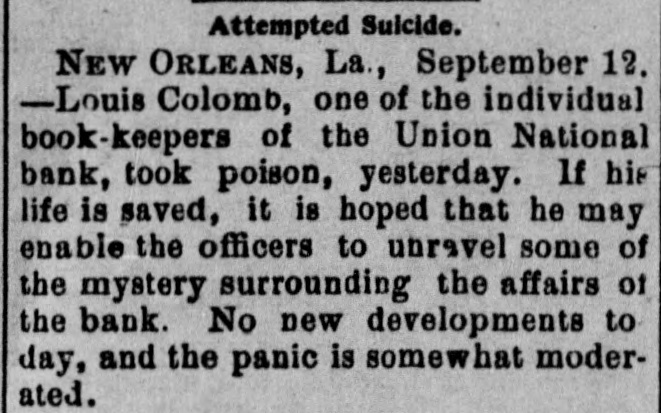
Attempted Suicide. NEW ORLEANS, La., September 12. -Louis Colomb, one of the individual book-keepers of the Union National bank, took poison, yesterday. If his life is saved, it is hoped that he may enable the officers to unrevel some of the mystery surrounding the affairs of the bank. No new developments to day, and the panic is somewhat moderated.


Article from The Morning News, September 12, 1896

Click image to open full size in new tab

Article Text

CHALARON MAY BE CRAZY. Two of the Union National's Bookkeepers Arrested. New Orleans, Sept. 11.-Bank Examiner E. Scott arrived here to-day, and took charge of the Union National, but his arrival has not dispelled the gloom of mystery which hangs over that institution. Mr. Chalaron, the president of the Union bank, visited the bank building early this morning, but remained only a short while. His persistent silence in the face of so many ugly rumors about the bank is severely criticised on all sides. Some of his warmest defenders have grown luke warm to his interest, and now say it is strange he does not talk. This afternoon the two individual bookkeepers of the Union National, Frank B. Leefe and A. Colomb, were arrested on affidavits by Cashier Labarthe. Colomb, it appears, is only "constructively" under arrest. The charge against Leefe is for violating section 5209, revised statutes United States, by falsifying his books and accounts, especially in a book of the bank known as the "book of daily summaries of individual accounts," his accounts showing a credit balance of $12,604.88, which should have been $196,163.60. The charge against Colomb is of a similar character., Leefe was arraigned before United States Commissioner Craig. He pleaded not guilty, and was placed under bonds of $10,000, which he immediately furnished. These arrests, taken in connection with President Chalaron's strange silence, are causing much comment to the effect that an attempt will be made to make the bookkeepers scapegoats. It is well known that the bank's bookkeepers do not handle a cent of the bank's funds. A reporter of the Southern Associated Press was informed to-night by an unimpeachable source that a prominent physician related to Bookkeeper Leefe forced an interview with President Chalaron late this afternoon in reference to Leefe's case, and the doctor says to-night that President Chal1 aron's mind is unbalanced and Mr. Chalaron does not know anything more about the books than he (the physician) does. Mr. Chalaron is an old man, highly nervous in temperament and was wrapped up in the existence of the bank. It is beginning to be believed that the change in the bookkeeping of the bank, which was recently inaugurated, has had a tendency to confuse Mr. Chalaron, and that 1 in going over the books he has become unbalanced, and jumped at the conclusion that there is a defalcation. Otherwise his precipitate action in closing the bank without consulting the directors and his silence is inexplicable. There is a strong ground for belief in the physician's story. d Judge Theard this evening appointed two receivers for the Bank of Commerce, d and its affairs will be immediately liquiS dated. It has ample assets and this course was deemed best in order to fully protect the bank's depositors and other f creditors. There was a persistent run to-day on the People's Bank, and that institution is in peril. Messrs. H. & B. Bees to-day n ordered $100,000 in currency by express S from New York to assist to relieve the f tension which now exists in this market.


Article from The Morning News, September 12, 1896

Click image to open full size in new tab

Article Text

SMASH OF THE UNION NATIONAL. The Controller Explains the Receivership Scandal. Washington, Sept. 11.-Referring to the New Orleans dispatch to the effect that much dissatisfaction existed there over the fact that Examiner Johnson had been placed in charge of the failed Union National Bank, Controller Eckels this morning said to a reporter for the Southern Associated Press that had he known of Mr. Johnson's connection with A. & V. Myer, the firm whose failure so seriously affected the Union bank, he would not have designated him to take charge. The assignment, however, Mr. Eckels said, was merely temporary, because Mr. Johnson was already in charge of the affairs of the American Bank, and that was enough to engage all his time and abilities. As soon as news of the Union failure reached the bureau Controller Eckels directed Examiner Escott of Louisville, Ky., to proceed to New Orleans and relieve Mr. Johnson, which had already been done. The preliminary report of Mr. Johnson, upon the condition of the Union bank had not reached the controller at noon, but Mr. Eckels said he had no doubt of the truth of the statement sent out last night from New Orleans that two sets of books had been kept, and that a discrepancy of at least $600,000 exists between them. Ex-Deputy Controller Tucker has been appointed receiver of the Mutual National Bank, which closed its doors yesterday, and he was expected to take charge today. Acting under the general instructions given them, the receivers of the several failed national banks at New Orleans took possession of all the property found in the vaults of the institutions. Among these were a number of boxes containing securities and other papers of depositors, and others left with the banks for safe keeping. Comptroller Eckels to-day wired instructions to the receivers to deliver the boxes to all owners who are not indebted to the banks, and to allow the owners to remove the papers not relating to their transactions with the bank, or which could not be used in settling them. Mr. Eckels explained that it was not only not the wish of the department to interfere with or embarrass the business men of the city in any way by the management of the receivers, but on the other hand, to facilitate and help them as much as possible. In order to aid as greatly as possible in restoring confidence to the people of New Orleans in their financial institutions, the treasury department had sent by telegraph and express to the subtreasury in that city within the past two days, $1,350,000, to be used in meeting sugar bounty claims and other demands upon the government. Up to the hour of closing the department this afternoon, Comptroller Eckels had received no report from the agents and employes of the bureau in charge of the failed banks.


Article from The Providence News, September 12, 1896

Click image to open full size in new tab

Article Text

ANOTHER BANK CLOSED. The Fourth Since the Financial Fanis Begun In New Orleans. New Orleans, Sept. 12-The failure in rapid succession of the American, the Union and the Mutual banks, all national institutions, and the very strong evidence in the case of the first two of crookedness, had the effect of causing a somewhat panicky feeling. The Associated banks, however, had anticipated this, and took precautions which somewhatichecked the panic. Thursday morning a very heavy run began on the Bank of Commerce, a state institution, which has a large number of depositors, doing the business of the Homestead associations, and all day long a swarm of depositors crowded the building. The bank paid all who came, and it was announced that the Whitney National and the other banks proffered the Bank of Commerce all the money it needed. The Bank of Commerce failed to open its doors yesterday. The Bank of Commerce was organized In 1887, with a capital stock of $100,000. William P. Nichols is its president. There was a great crowd about the bank building shortly after the doors were closed. It is stated that the bank was closed as a matter of precaution, there having been a run on the bank. Depositors, it is understood, will lose but little, as the bank has a surplus of $57,000.


Article from Evening Journal, September 14, 1896

Click image to open full size in new tab

Article Text

SYNDICATE OF ROBBERS Seven Persons In the New Orleans Steal of $602,000. CONFESSIONS HAVE BEEN MADE. Two Clerks of the Union National, Colcomb and Leone, Did the Work Inside. Money Spent In Luxurious Living and Speculation-Arrests to Be Made. NEW ORLEANS, Sept. 14.-There is only one more secret to come out in the wreckIng of the Union National bank and the bank panic which raged here last week, and it is announced that it will be disclosed within the next 24 hours. That is the names of the confederates, the men on the outside who drew out and appropriated the $602,000 of the bank's money. Colcomb and Leone, the bookkeepers, cooked the accounts so as to keep the bank always in debt to these confederates. The bank was robbed by a syndicate composed of seven persons, two on the inside of the bank and five on the outside. The whole transaction was businesslike and systematic, including an agreement as to the amount to be drawn out or stolen each day and the division of the funds. Colcomb, whose lack of nerve was shown by his suicide the moment suspicion pointed to him, was the organizer of the project and its director. It is reported that a confession has been made: that three members of the syndicate have been named, and that the only reason their names are not now made public is to prevent any escape, as some of them are out of town. The money went mainly in riotous living, the balance on speculation, with the hope of recovering the amount stolen. In the big cotton speculation last year when cotton went up so high the syndicate was ahead of the game. The sadden collapse of the market prevented it from making good the bank's money and rendered a new raid necessary. The bank has been plundered more heavily than ever since. The outside members of the syndicate are said to lie high livers. Not so Colcomb and Leone; they could not be so, for they were kept all the day at their desks working away to cover up the crookedness in their books. Money Spent In Luxurious Living. They had little time for a spree. Colcomb spent most of his share of the swag on his family. He lived most luxuriously, had ten servants and a housekeeper to relieve his wife of the trouble of domestic affairs, a rather large household for a clerk on a salary of $150 a month. He had evidently anticipated that the defalcation would come out sooner or later and had determined on suicide when 18 did, for he carried the poison on his person. to be used at a moment's notice. He had many friends, and they all speak of him as generous and brave. To commit suicide is the only thing a gentleman could do under the circumstances, they say. Colcomb was interviewed on Thursday night about the bank's condition. He was calm and collected then and apparently in the best of humor, although it was only a few hours before his death. and he had then evidently determined on suicide. He did not tell his family of his intention, and it was not until several hours later that he took the poison and was discovered in an insensible condition. Once or twice in the next 36 he rrs he opened his eyes and looked argePPine room, but he neither spoke nos seemed to know any one. Colcomb's death renders the work of investigating the defalcation very difflcult, and United States Bank Examiner Escott doubts whether it will ever be pos. sible to know all the details. The receivers of the Bank of Commerce and American National bank will take possession of them today. The other two closed banks, the Mutual National and Union National, still remain in the hands of the United States examiners. It is thought that the panic is over. United States Bank Examiner Escott completed his first trial balance of the Union National bank and found the amount stolen to be $602,687.07. This is subject to an increase when all the accounts are carefully examined.


Article from Evening Star, September 14, 1896

Click image to open full size in new tab

Article Text

BANK-LOOTING SYNDICATE Seven Persons in the New Orleans Steal of $602,000. From the New York Sun. NEW ORLEANS, September 13.-There is only one more secret to come out in the wrecking of the Union National Bank and the bank panic which raged here last week, and it is announced that it will be disclosed within the next twenty-four hours. That is the names of the confederates, the men on the outside who drew out and appropriated the $602,000 of the bank's money. Colcomb and Leone, the bookkeepers, cooked the accounts so as to keep the bank always in debt to these confederates. The bank was robbed by a syndicate composed of seven persons, two on the inside of the bank and five oh the outside. The whole transaction was businesslike and systematic, including an agreement as to the amount to be drawn out or stolen each day, and the division of the funds. Colcomb, whose tack of nerve was shown Ly his suicide the moment suspicion pointed to him, was the organizer of the project and its director. It is reported tonight that a confession has been made; that three members of the syndicate have been named, and that the only reason their names are not now made public is to prevent any escape, as some of them are out of town. The money went mainly in riotous living; the balance on speculation with the hope of recovering the amount stolen. In the big cotton speculation last year when cotton went up so high, the syndicate was ahead of the game. The sudden collapse of the market prevented It from making good the bank's money and rendered a new raid necessary. The bank has been plundered more heavily than ever since. The outside members of the syndicate are said to be high livers. Not so Colcomb and Leone; they could not be so, for they were kept all the day at their desks working away to cover up the crookedness in their books. They had little time for a spree. Colcomb spent most of his share of the swag on his family. He lived most luxuriously, had ten servants, and a housekeeper to relieve his wife of the trouble of domestic affairs, a rather large household for a clerk on a salary of $150 a month. He had evidently anticipated that the defalcation would come out sooner or later, and had determined on suicide when it did, for he carried the poison on his person to be used at a moment's notice. He had many friends, and they all speak of him as generous and brave. To commit suicide is the only thing a gentleman could do under the circumstances, they say. Colcomb was interviewed on Thursday night about the bank's condition. He was calm and collected then and apparently in the best of humor, although it was only a few hours before his death, and he had then evidently determined on suicide. He did not tell his family of his intention, and it was not until several hours later that he took the poison and was discovered in an insensible condition. Once or twice in the next thirty-six hours he opened his eyes and looked around the room, but he neither spoke nor seemed to know any one. Colcomb's death renders the work of investigating the defalcation very difficult, and United States Bank Examiner Escott doubts whether it will ever be possible to know all the details. The receivers of the Bank of Commerce and American National Bank will take possession of them tomorrow. The other two closed banks, the Mutual National and Union National, still remain in the hands of the United States examiners. It is thought that the panic is over and that there will be no trouble tomorrow. United States Bank Examiner Escott completed his first trial balance of the Union National Bank tonight and found the amount stolen to be $602,687.07. This is subject to an increase when all the accounts are carefully examined.


Article from Highland Recorder, September 18, 1896

Click image to open full size in new tab

Article Text

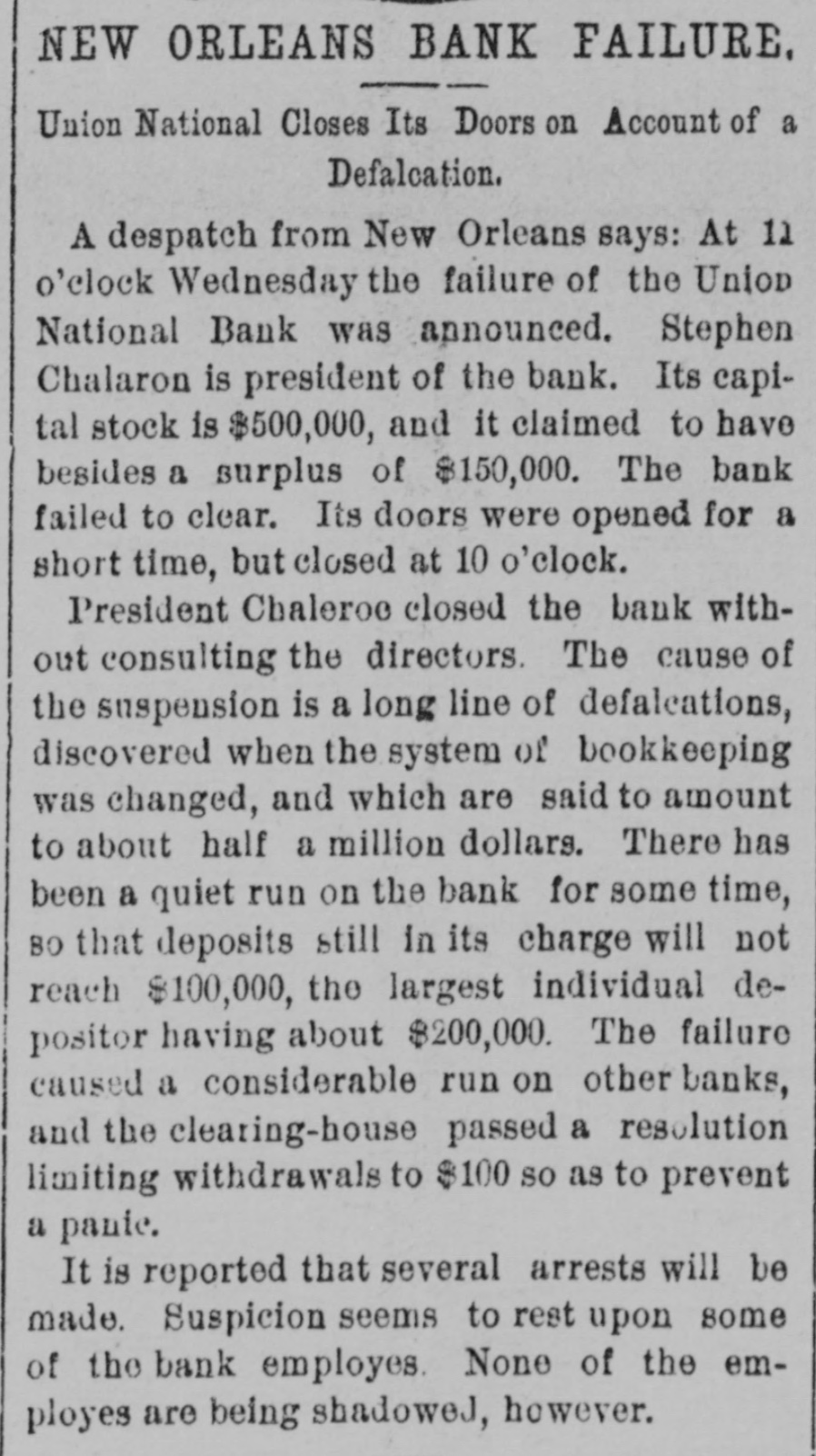
NEW ORLEANS BANK FAILURE. Union National Closes Its Doors on Account of a Defalcation. A despatch from New Orleans says: At 11 o'clock Wednesday the failure of the Union National Bank was announced. Stephen Chalaron is president of the bank. Its capital stock is $500,000, and it claimed to have besides a surplus of $150,000. The bank failed to clear. Its doors were opened for a short time, but closed at 10 o'clock. President Chaleroe closed the bank without consulting the directors. The cause of the suspension is a long line of defalcations, discovered when the system of bookkeeping was changed, and which are said to amount to about half a million dollars. There has been a quiet run on the bank for some time, SO that deposits still in its charge will not reach $100,000, the largest individual depositor having about $200,000. The failure caused a considerable run on other banks, and the clearing-house passed a resolution limiting withdrawals to $100 so as to prevent a panic. It is reported that several arrests will be made. Suspicion seems to rest upon some of the bank employes. None of the employes are being shadowed, however.


Article from Birmingham State Herald, September 20, 1896

Click image to open full size in new tab

Article Text

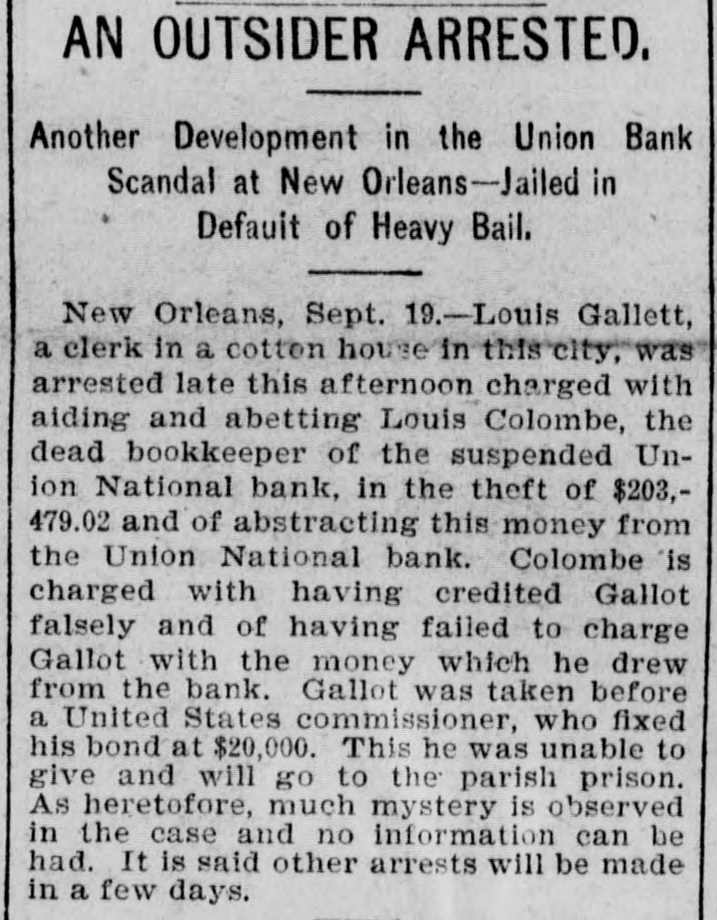
AN OUTSIDER ARRESTED. Another Development in the Union Bank Scandal at New Orleans-Jailed in Defauit of Heavy Bail. New Orleans, Sept. 19.-Louis Gallett, a clerk in a cotton house in this city, was arrested late this afternoon charged with aiding and abetting Louis Colombe, the dead bookkeeper of the suspended Union National bank, in the theft of $203,479.02 and of abstracting this money from the Union National bank. Colombe is charged with having credited Gallot falsely and of having failed to charge Gallot with the money which he drew from the bank. Gallot was taken before a United States commissioner, who fixed his bond at $20,000. This he was unable to give and will go to the parish prison. As heretofore, much mystery is observed in the case and no information can be had. It is said other arrests will be made in a few days.


Article from Iowa County Democrat, September 24, 1896

Click image to open full size in new tab

Article Text

LEGRAMS IN BRIEF. DOMESTIC DOTS. gold democrats of New Yor state convention and indorse and Buckner. R. Legg, treasurer of Pik Arkansas, has disappeared a shortage of $20,000. failure of the Union Nationa Kansas City Lead and Oil work by Marsh Bros., was destroye The loss is $100,000, fully in gold democrats of Connecticu lecided to put a full state ticket I including presidential elect Francis J. Child the oldes of the Harvard University ac in Boston, aged seventy-on -Lieutenant-Governor Sheehan York, has written a lette that he cannot support th platform. Kennett, ex-chief of police and killed Detective Lawson Angeles was sentenced to fif in prison. V. Bryan, cashier of the De ustom-house, was arrested fo zlement of $3,600 governmen V. Powderly and Ex-Senato Miller addressed a McKinle neeting in Cooper Union, New explosion of powder at the mil Ohio Powder company a stown, O., resulted in the death men. democratic electoral ticket 11 was indorsed by the republi opulist and silver party state tions. Iemphis, Herron, Taylor & Co. grocers, assigned. Assets liabilities, $98,000. Cause ollections. ouston, rex., Sam Allen, lumber has filed a deed of assignment $300,000, assets in land and $700,000. cations amounting to $500,000 lared to be responsible for the of the Union national bank at rleans. Superior, Wis., property of Stinson of Chicago nas been at in proceedings to recover on a $135,000. York Tammany is beginning npaign and has arranged for a neeting September 29, at which J. Bryan will speak. of Cleveland, O., celebrated ennial and also the anniversary modore Perry's naval victory British on Lake Erie in 1813 lete returns of the South Caronatorial primary have not been but there is no doubt of nomination over Evans by 5,000 Hill was elected a delegate New York state democratic conand instructed to support the platform. He declined the emocratic convention of the district nominated John L. of Dayton for congress, vice Sorg, renominated and dePeterson, 11 years old, tried pet dog from being crushed eight train at Chicago Heights killed. The dog was not Russell club, a national demoreanization of 300 men, went


Article from The Globe-Republican, October 1, 1896

Click image to open full size in new tab

Article Text

LATE NEWS NOTES. Seven cows were killed by lightning near Leavenworth. Miss Willard has issued an appeal to the W. C. T. U. for the Armenians. Jules A. Barron, brother-in-law of ex-Governor Lubbock of Texas, was killed by a trolley car at Galveston. Germany and Russia are endeavoring to uniform extradition laws in all Europe. with relation to Anarchists. The American representatives have finished their examination of English archives upon the Venezuelan boundary question. The Venezuela Commission will report to the President early in De. cember. Examiner Escott says that the liabilities of the Union National Bank of New Orleans are $1,635,700. C. L. Grimes was acquitted of the charge of murdering his son-in-law, Luther Whitmore, at Moberly, Mo. Two swell robbers held up five men in a Chicago office, got $1,600, shot a milkman and escaped in his wagon. President Nicholls and Cashier De Beane have been arrested at New Orleans for receiving deposits in the Bank of Commerce after it became insolvent. It is report d that England, Russia and France will act together as regards Turkey. A cloudburst struck the town of San Marcos, Texas, and washed away a large portion of the town. Treasurer George S. Morrison of Rensselaer county. N. Y., is a defaulter for $250,000. An anti-Masonic congress is in session at Trent, Southern Tyrol, with delegates from all European countries and Canada. Banks of Greeley and Argonia have failed. Mrs. Julia Lamb of Worth county has been convicted in the federal court at St. Joseph of pension frauds and fined $1,000 and costs of suit. Edward H. Mohnken. who resided near Sedalia, died from blood poisoning, the result of an accident wherein his ankle was fractured John W. Wicks of Topeka, who was married in St. Joseph last week, now mourns the loss not only of his wife but of $300 with which she skipped out. Four murderers were executed in New Mexico in one day. Bessie Bellwood. the well known music hall singer, is dead. Her death was due to syncope. Eugene C. Gregory, a Yale student, committed suicide in his home in New York by inhaling illuminating gas. Al Ruhman, the husband of Zella Nicolaus, has been sent to the Chicago bridewell on a fine of $100 for vagrancy. Harry M. Conway of Chicago was shot and killed by his 18-year-old wife, who then sent a bullet into her own heart. Li Hung Chang has sent a message to the secretary of state thanking the United States government for the many courtesies shown him on his visit to this country. A convention of delegates from the severalstateswill be held at Asheville, N. C., October 21-23 to petition Congress to adopt a "national flower of America," the convention to select the flower. D. D. Breckinridge of Watertown, N. Y., en route to Amesville. Ohio, to be married to Miss Ethel Gould, had his leg broken in a railway wreck at Athens. Miss Gould, on hearing of the accident, went to Athens, and the wedding took place at the appointed time. Callias Bey. the Arabian who married the widow of P. T. Barnum, is dead. Carnegie armor plate making secrets were learned by Russia through a small contract placed at Homestead. A Russian was present for eight months by stipulation in the contract, and learned the whole business. Carnegies were very accommodating, expecting new orders from Russia. James J. Joy of Detroit. famous railroad builder and financier, is dead. Burpee, Ramsey & Co., shoe manufacturers, of Lynn, Mass., have failed. They did d business of $1,000,000 a year. Because he slapped a 5-year-old white child James Hawkins was lynched and Alexander and Arthur Green shot dead near Gretna, La. All were colored. James A. Keaton has been appointed associate justice of the Oklahoma Supreme court. The lumber and mills of the Cascade Iowa, Lumber company were destroyed by fire. The loss is $105,000. A disastrous gale visited Great Britain. Much damage was done in London. Frank H. Johnson, a Chicago grain broker. killed himself in Lincoln park because of losses. National Sporting club, London, will not allow Corbett the premises, but will welcome Fitzsimmons. Allied Silver forces of Topeka will run C. K. Holliday for the Legislature against E. D. McKeever, Republican. A great locomotive on the Eig Four railroad blew up at Pekin, IIL, killing the fireman and wrecking a factory near by. Cattle Thief Kittrell, under arrest in Mexico and wanted in Indian Terretory. can not be extradited, his case not being covered by


Article from Hutchinson Gazette, October 1, 1896

Click image to open full size in new tab

Article Text

LATE NEWS NOTES. Seven cows were killed by lightning near Leavenworth. Miss Willard has issued an appeal to the W. C. T. U. for the Armenians. Jules A. Barron, brother-in-law of ex-Governor Lubbock of Texas, was killed by a trolley car at Galveston. Germany and Russia are endeavoring to uniform extradition laws in all Europe. with relation to Anarchists. The American representatives have finished their examination of English archives upon the Venezuelan boundary question. The Venezuela Commission will report to the President early in De. cember. Examiner Escott says that the liabilities of the Union National Bank of New Orleans are $1,635,700. C. L. Grimes was acquitted of the charge of murdering his son-in-law, Luther Whitmore, at Moberly, Mo. Two swell robbers held up five men in a Chicago office, got $1,600, shot a milkman and escaped in his wagon. President Nicholls and Cashier De Beane have been arrested at New Or. leans for receiving deposits in the Bank of Commerce after it became insolvent. It is report d that England, Russia and France will act together as regards Turkey. A cloudburst struck the town of San Marcos, Texas, and washed away a large portion of the town. Treasurer George S. Morrison of Rensselaer county, N. Y., is a defaulter for $250,000. An anti-Masonic congress is in session at Trent, Southern Tyrol, with delegates from all European countries and Canada. Banks of Greeley and Argonia have failed. Mrs. Julia Lamb of Worth county has been convicted in the federal court at St. Joseph of pension frauds and fined $1,000 and costs of suit. Edward H. Mohnken, who resided near Sedalia, died from blood poisoning, the result of an accident wherein his ankle was fractured. John W. Wicks of Topeka, who was married in St. Joseph last week, now mourns the loss not only of his wife but of $300 with which she skipped out. Four murderers were executed in New Mexico in one day. Bessie Bellwood, the well known music hall singer, is dead. Her death was due to syncope. Eugene C. Gregory, a Yale student, committed suicide in his home in New York by inhaling illuminating gas. Al Ruhman, the husband of Zella Nicolaus, has been sent to the Chicago bridewell on a fine of $100 for vagrancy. Harry M. Conway of Chicago was shot and killed by his 18-year-old wife, who then sent a bullet into her own heart. Li Hung Chang has sent a message to the secretary of state thanking the United States government for the many courtesies shown him on his visit to this country. I A convention of delegates from the 0 several states will be held at Asheville, N. C., October 21-23 to petition Congress to adopt a "national flower of America," the convention to select the flower. D. D. Breckinridge of Watertown, N. Y., en route to Amesville, Ohio, to be married to Miss Ethel Gould, had his leg broken in a rail way wreck at Athens. Miss Gould, on hearing of the accident, went to Athens, and the B wedding took place at the appointed time. Callias Bey. the Arabian who married the widow of P. T. Barnum, is dead. & Carnegie armor plate making secrets were learned by Russia through a small contract placed at Homestead. A Russian was present for eight months by stipulation in the contract, and learned the whole business. Carnegies were very accommodating, expecting new orders from Russia. James J. Joy of Detroit, famous railroad builder and financier, is dead. Burpee, Ramsey & Co., shoe manufacturers, of Lynn, Mass., have failed. They did d business of $1,000,000 a year. Because he slapped a 5-year-old white child James Hawkins was lynched and Alexander and Arthur S Green shot dead near Gretna, La. All were colored. James A. Keaton has been appointed P associate justice of the Oklahoma Supreme court. The lumber and mills of the Cascade Iowa, Lumber company were det stroyed by fire. The loss is $105,000. A disastrous gale visited Great Britain. Much damage was done in London. Frank H. Johnson, a Chicago grain broker, killed himself in Lincoln park because of losses. National Sporting club, London, will not allow Corbett on the premises, but will welcome Fitzsimmons. Allied Silver forces of Topeka will run C. K. Holliday for the Legislature against E. D. McKeever, Republican. A great locomotive on the Eig Four railroad blew up at Pekin, ILL, killing the fireman and wrecking a factory near by. Cattle Thief Kittrell, under arrest in Mexico and wanted in Indian Terretory. can not be extradited, his case not being covered by treaty. A. D. Powers, a Cuban worker in Chicago is missing.
Article from The Sea Coast Echo, November 14, 1896

Click image to open full size in new tab

Article Text

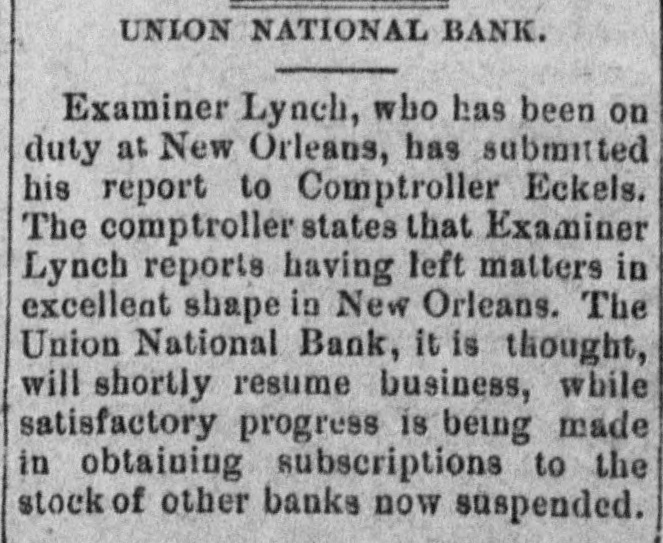
UNION NATIONAL BANK. Examiner Lynch, who has been on duty at New Orleans, has submitted his report to Comptroller Eckels. The comptroller states that Examiner Lynch reports having left matters in excellent shape in New Orleans. The Union National Bank, it is thought, will shortly resume business, while satisfactory progress is being made in obtaining subscriptions to the stock of other banks now suspended.


Article from The Morning Times, December 7, 1896

Click image to open full size in new tab

Article Text

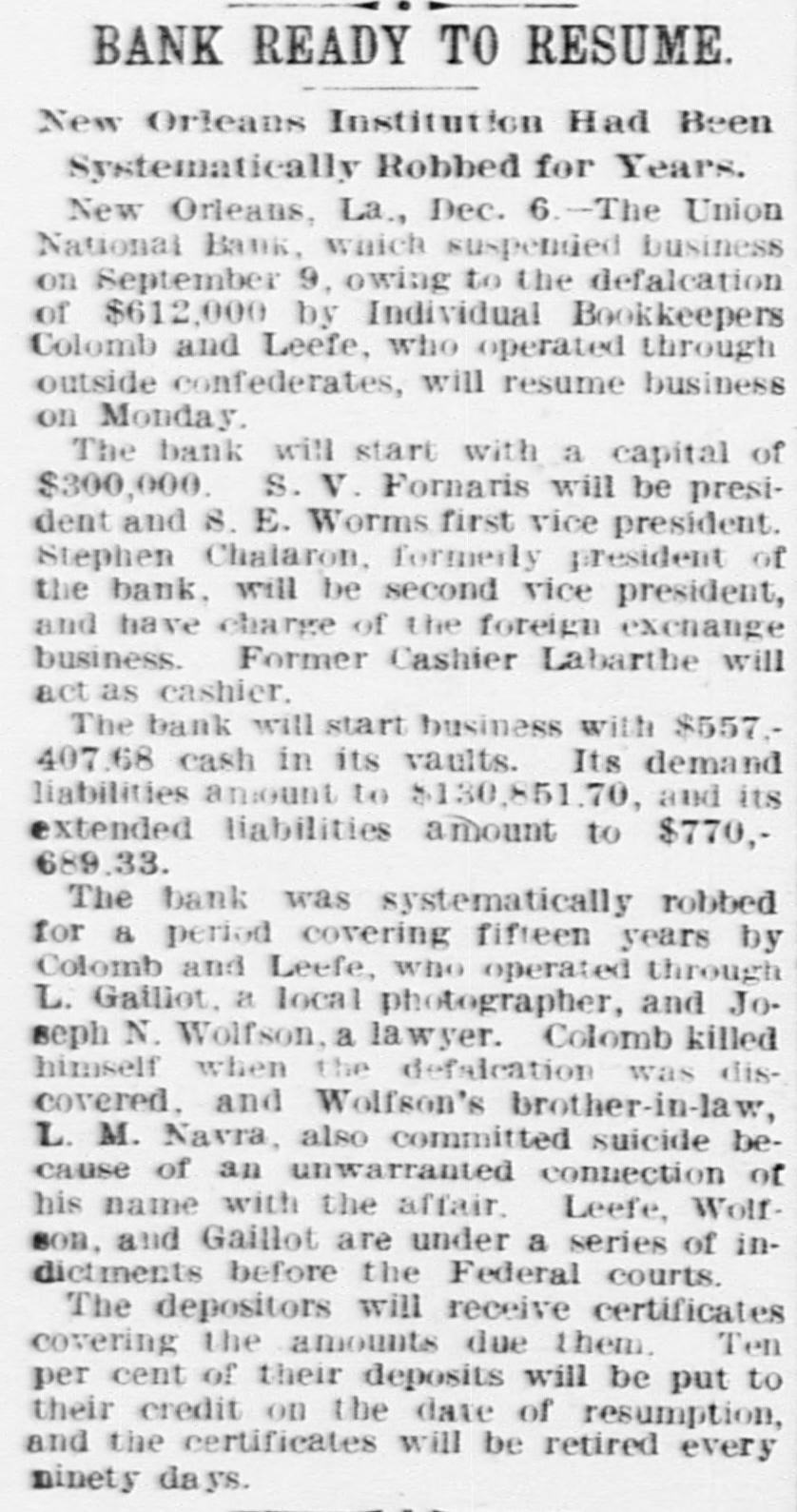
BANK READY TO RESUME. New Orleans Institution Had Been Systematically Robbed for Years. New Orleans, La., Dec. 6.-The Union National Bank, which suspended business on September 9, owing to the defalcation of $612,000 by Individual Bookkeepers Colomb and Leefe, who operated through outside confederates, will resume business on Monday. The bank will start with a capital of $300,000. S. V. Fornaris will be president and 8. E. Worms first vice president. Stephen Chalaron, formerly president of the bank. will be second vice president, and have charge of the foreign exchange business. Former Cashier Labarthe will act as cashier. The bank will start business with $557.407.68 cash in its vaults. Its demand liabilities amount to $130,851.70, and its extended liabilities amount to $770,689,33. The bank was systematically robbed for a period covering fifteen years by Colomb and Leefe, who operated through L. Gailiot. a local photographer, and Jo. seph N. Wolfson, a lawyer. Colomb killed himself when the defalcation was discovered, and Wolfson's brother-in-law, L. M. Navra, also committed suicide because of an unwarranted connection of his name with the affair. Leefe, Wolfson, and Gaillot are under a series of indictments before the Federal courts. The depositors will receive certificates covering the amounts due them. Ten per cent of their deposits will be put to their credit on the date of resumption, and the certificates will be retired every minety days.


Article from The Houston Daily Post, December 8, 1896

Click image to open full size in new tab

Article Text

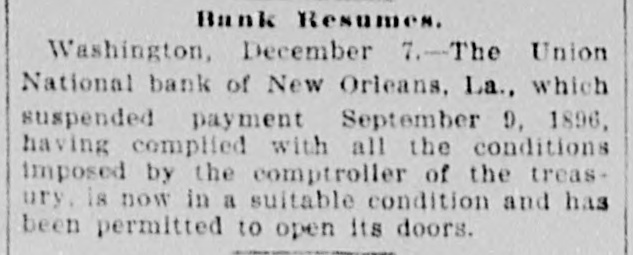
Bank Resumes. Washington, December 7.-The Union National bank of New Orleans, La., which suspended payment September D, 1896, having complied with all the conditions imposed by the comptroller of the treasury, is now in a suitable condition and has been permitted to open its doors.


Article from Reporter and Farmer, December 17, 1896

Click image to open full size in new tab

Article Text

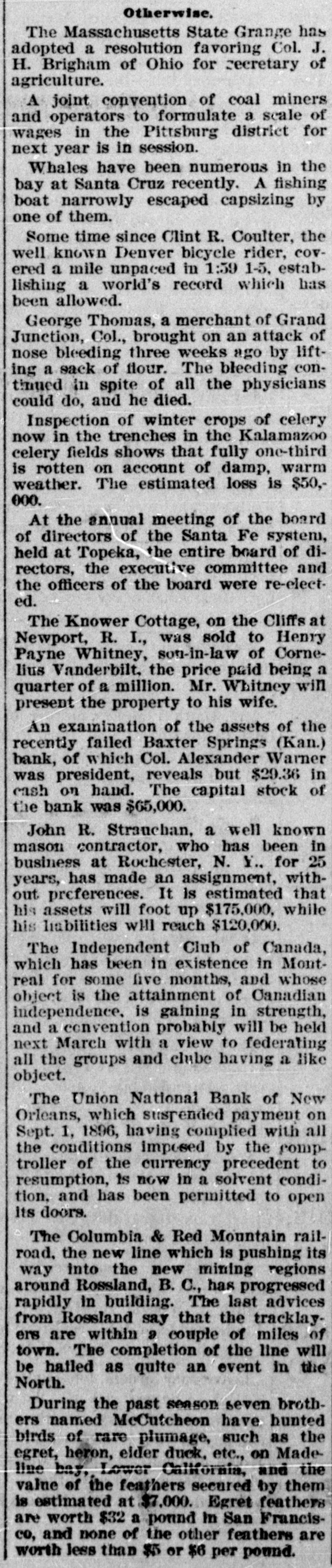
Otherwise. The Massachusetts State Grange has adopted a resolution favoring Col. J. H. Brigham of Ohio for cecretary of agriculture. A joint convention of coal miners and operators to formulate a scale of wages in the Pittsburg district for next year is in session. Whales have been numerous in the bay at Santa Cruz recently. A fishing boat narrowly escaped capsizing by one of them. Some time since Clint R. Coulter, the well known Denver bicycle rider, covered a mile unpaced in 1:59 1-5, establishing a world's record which has been allowed. George Thomas, a merchant of Grand Junction, Col., brought on an attack of nose bleeding three weeks ago by lifting a sack of flour. The bleeding continued in spite of all the physicians could do, and he died. Inspection of winter crops of celery now in the trenches in the Kalamazoo celery fields shows that fully one-third is rotten on account of damp, warm weather. The estimated loss is $50,000. At the annual meeting of the board of directors of the Santa Fe system, held at Topeka, the entire board of directors, the executive committee and the officers of the board were re-elected. The Knower Cottage, on the Cliffs at Newport, R. I., was sold to Henry Payne Whitney, son-in-law of Cornelius Vanderbilt, the price paid being a quarter of a million. Mr. Whitney will present the property to his wife. An examination of the assets of the recently failed Baxter Springs (Kan.) bank, of which Col. Alexander Warner was president, reveals but $29.36 in cash on hand. The capital stock of the bank was $65,000. John R. Strauchan, a well known mason contractor, who has been in business at Rochester, N. Y., for 25 years, has made an assignment, without proferences. It is estimated that his assets will foot up $175,000, while his liabilities will reach $120,000. The Independent Club of Canada, which has been in existence in Montreal for some five months, and whose object is the attainment of Canadian independence, is gaining in strength, and a convention probably will be held next March with a view to federating all the groups and clube having a like object. The Union National Bank of New Orleans, which suspended payment on Sept. 1, 1896, having complied with all the conditions imposed by the comptroller of the currency precedent to resumption, is now in a solvent condition, and has been permitted to open its doors. The Columbia & Red Mountain railroad. the new line which is pushing its way into the new mining regions around Rossland, B. C., has progressed rapidly in building. The last advices from Rossland say that the tracklayers are within a couple of miles of town. The completion of the line will be hatled as quite an event in the North. During the past season seven brothers named McCutcheon have hunted birds of rare plumage, such as the egret, heron, eider duck, etc., on Madeline bay, Lower California, and the value of the feathers secured by them is estimated at $7,000. Egret feathers are worth $32 a pound in San Francisco, and none of the other feathers are worth less than $5 or $6 per pound.


Article from The L'anse Sentinel, December 19, 1896

Click image to open full size in new tab

Article Text

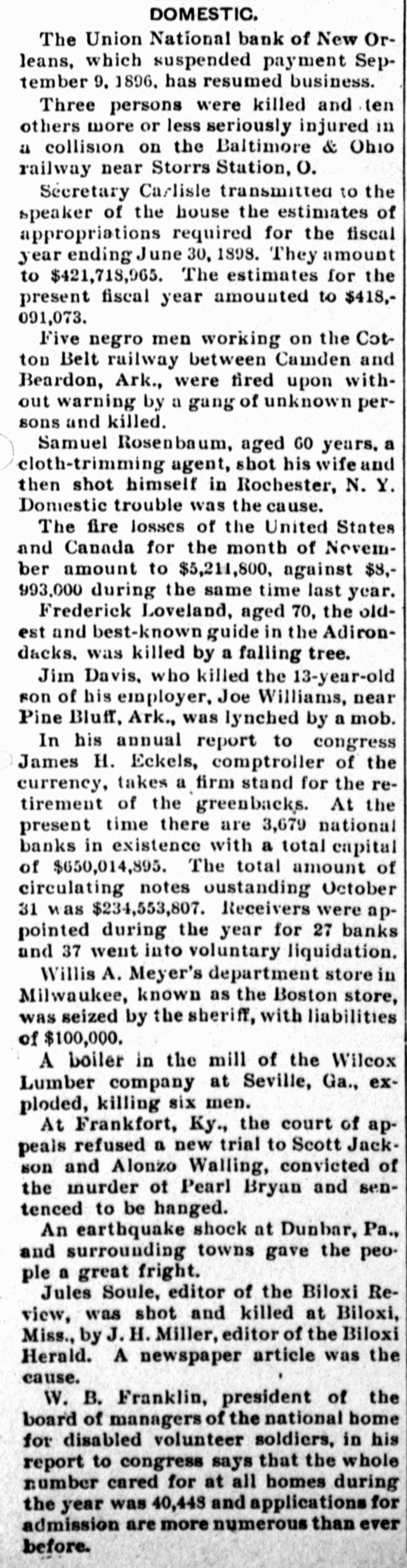
DOMESTIC. The Union National bank of New Orleans, which suspended payment September 9, 1896, has resumed business. Three persons were killed and ten others more or less seriously injured in a collision on the Baltimore & Ohio railway near Storrs Station, O. Secretary Carlisle transmitted to the speaker of the house the estimates of appropriations required for the fiscal year ending June 30, 1898. They amount to $421,718,965. The estimates for the present fiscal year amounted to $418,091,073. Five negro men working on the Cotton Belt railway between Camden and Beardon, Ark., were fired upon without warning by a gang of unknown persons and killed. Samuel Rosenbaum, aged 60 years, a cloth-trimming agent, shot his wife and then shot himself in Rochester, N. Y. Domestic trouble was the cause. The fire losses of the United States and Canada for the month of November amount to $5,211,800, against $8,993,000 during the same time last year. Frederick Loveland, aged 70, the oldest and best-known guide in the Adirondacks, was killed by a falling tree. Jim Davis, who killed the 13-year-old son of his employer, Joe Williams, near Pine Bluff, Ark., was lynched by a mob. In his annual report to congress James H. Eckels, comptroller of the currency, takes a firm stand for the retirement of the greenbacks. At the present time there are 3,679 national banks in existence with a total capital of $650,014,895. The total amount of circulating notes oustanding October 31 was $234,553,807. Receivers were appointed during the year for 27 banks and 37 went into voluntary liquidation. Willis A. Meyer's department store in Milwaukee, known as the Boston store, was seized by the sheriff, with liabilities of $100,000. A boiler in the mill of the Wilcox Lumber company at Seville, Ga., exploded, killing six men. At Frankfort, Ky., the court of appeals refused a new trial to Scott Jackson and Alonzo Walling, convicted of the murder of Pearl Bryan and sentenced to be hanged. An earthquake shock at Dunbar, Pa., and surrounding towns gave the people a great fright. Jules Soule, editor of the Biloxi Review, was shot and killed at Biloxi, Miss., by J. H. Miller, editor of the Biloxi Herald. A newspaper article was the cause. W. B. Franklin, president of the board of managers of the national home for disabled volunteer soldiers, in his report to congress says that the whole number cared for at all homes during the year was 40,445 and applications for admission are more numerous than ever before.