Click image to open full size in new tab
Article Text
Commercial Bank of Lockport, Lockport. 65.107
$1.255.759 $312,964
Total circulation
Circulation outstanding Dec. Ist, 1851. 312 964
Amount of circulation returned and
$942 805
destroyed..
Five individual bankers, who have heretofore given notice of their intention to close their business, having complied with the provisions of section & of chapter 319, Laws of 1841, by redeeming niasty per cent. of their circulation, have withdrawn the securities held in trust, and deposited an amount of money sufficient to redeem the balance of circulation outstanding.
The following statement shows the amount of circulation unredeemed on the 1st day of December, 1851 the amount of money held in trust by the Superintendent; the date of the first notice to billholders to present their notes for payment, and the time when such notice will expire:
Outstand-
ang circu- Cash in Date of Notice will
Banks. lation, deposit. notice. expire.
Courtiard Co. Bk. $10,000 $10,000 00 Dec. 1, '51. Dec. 1, '53
Franklin Co. BK. 2,811 2.680 37 Apt. 6. '50. Apl. 6, '58
Henry Keeps' Bk. 2,359 3,859 00 Sep. 17, '51. Sep. 17, '53
Village Bank. 866 872 00 May 22, '51. May22, '53
Warren Co. Bank 4.352 4.852 00 Nov. 4. '51. Nov. 4, '53
At the expiration of the above notices for two years, the securities held by the Superintendent in trust, may be given up to the banker or association upon receiving a bond, with security, conditioned for the prompt payment of any unredeemed circulating notes of such banker or association if presented within six yea's.
The circulation of the Walter Joy's Bank, which failed in the year 1850, has all been redeemed and canceled except $412. There is held in trust for this bank, the sum of $2,966 01. arising from the sale of stocks which were held in trust for it.
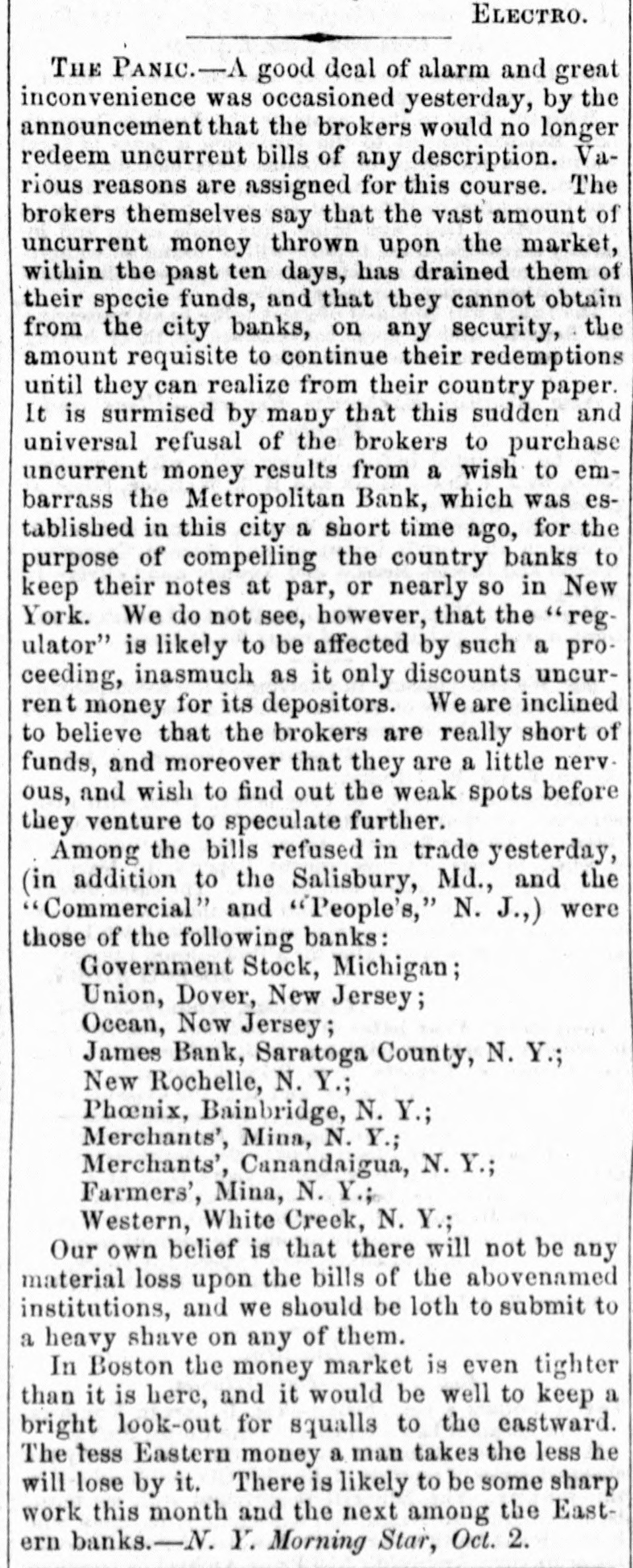
On the first day of October last. The James Bank, Bank of New-Rochelle, Farmers' Bank of Chautauque County, Western Bank of Washington County, and Phoenix Bank of Bainbridge, permitted their notes to be protested for non-redemption at their respective agencies.
The powers of attorney heretofore given to said banks, to collect interest on the securities deposited and held in trust for the redemption of their circulating notes, were promptly revoked. No other measures were taken to protect the billholders, as these banks were believed to be banks of circulation only and from the quarterly reports received from them, it is believed that the securities deposited in this department constitute their only assets.
Arrangements have been made by the Farmers' Bank of Chautauque County, Western Bank of Washington County, and Phonix Bank of Bainbridge, to redeem their notes as required by law.
The James Bank, and Bank of New-Rochelle, failed to pay their protested notes within the time allowed by law, after having been duly notified to do so. A portion of the securities held in trust for these banks have been disposed of at public sale, and the remainder will be converted into money in a short time, and a dividend will be made to bili holders in January next. The bonds and mortgages held in trust for these barks sold at a large discount.
The Comptroller, in his annual report to the Legislature of 1850, called its attention to the system of banking as practiced by many individual bankers.
I deem it my duty to again call the attention of the Legislature to this subject.
The law of 1848, chap 340, expressly provides that all banks shall be banks of discount and deposit, as well as of circulation, and that the usual business of all banking associations and individual bankers, shall be transacted at the place where such association or individual banker shall be located.
It is believed that this provision of the law is in many cases entirely evaded. The quarterly reports received, show that they are not banks of discount and deposit, having neither or if they have, it is a mere nominal sum incorporated into their reports to comply with the form and not the spirit of the law.
They are mere banks of circulation, and are established for that purpose alone. The business of circulating their notes, is done exclusively through agents and brokers in commercial cities distant from the location of the bank. In many instances, it is believed, the banker does not even sign the notes issued from this departmeut and put in ciroulation, but gives that power to an agent, with power also to appoint a substitute or subststutes for that purpose to deposit securities, receive interest on the same, exchange securities and mutilated notes, and to do ali acts connected with the bank which the banker himself could do. In this manner are evaded the provisions of the law of 1848, which makes it obligatory for banks and bankers to transact their usual business at the places where they are located.
These banks afford no facilities to the business portion of the community, and in a time of pressure or embarrassment in the money market, not unfrequently allow their notes to be discredited, thereby creating a panic and subjecting the bill holders to losses.
The system of selling and transferring individual barks, from one person to another, and the frequent changes of location, has become an evil which, in my judgment, requires a remedy.
It is believed that in some cases individual banks are transferred to irresponsible parties, and that the real owners, or the parties interested in the benefits and advantages of the same, avoid all personal responsibility by conducting their business in the names of other parties.
The establishing of individual banks, (in parts of the State remote from the great thoroughfares and the general current of business,) and selling them, has come to be regarded by some as a legitimate transaction. It is urged by those interested that inasmuch as they are required to deposit the same securities for the redempton of their circulating notes as those that do a regular business of discounting paper and receiving deposits, they give equal security to the bili-holder. It is however apparent, that there is a great difference in the security afforded to bill holders by the two classes. A bank of mere circulation, having no capital or assets except the securities deposted with the Superintendent, cannot be regarded in the same light with a bank having a real capital and doing a legitimate business. In the one case the public must depend entirely on the securities held by the Superintendent in trust for the redemption of the circulating notes (in case of failure) without reliance upon assets, capital, or individual responsibility in the other case the capital, assets, and individual responsibility of stockholders, add much to the security of bill-holders.
Our system of free banking, if fairly and honestly carried out, presents as perfect a combination of all the elements of security to the public and to bill-holders as can well be devised.
If the Legislature shall not deem this subject of sufficient importance to enact such further laws, with such penalties as will prevent the abuses and evasions referred to, and enforce a compliance with the obvious intention of the law as it now stands upen the statute book it is respectfully recommended, that a law be passed authorizing banks of circulation, which shall be secured by the stocks of the State of New-York and of the United States, and canal revenue certificates, to be, or to be made to be, equal to a stock producing six per centum per annum, and that no other securities shall be received by the Superintendent in trust for the redemption of circulating notes to be issued to such bank or bankers.
It is believed that this plan if adopted, will give to the public a more certain security and in case of the failure of a bank, or banker, to redeem their notes, the trust funds could be more readily converted into money, giving the bill holders the beneat of a more prompt redemption.
In pursuance of chapter 331, Laws of 1850, the affairs of 23 insolvent banks have been finally settled. On the 1st of May, 1850, notice was given by the Comptroller to holders of circulating notes of these banks, that they must be presented at the Bank Department for payment within six months, and that all notes not presented within the time thus specified would cease to be a claim on the residuary funds in his hands belonging to said banks. All notes of sald banks which were thus presented have been redeemed at the rates specified in the aforesaid notice. The amount held in trust for said banks, after paying the dividends to bill holders, was $21.132 45, which was divided, prorata, on the outstanding certificates.
Notice was given to certificate holders on the 12th of February 15to present their certificates for a final