Maverick National Bank (Boston, MA)

Episode Information

Episode Type
Run → Suspension → Closure
Start Date
November 2, 1891
Location
Boston, Massachusetts (42.358, -71.060)
Bank Type
national
Charter Number
677

Metadata

Response Measures

Accommodated withdrawals, Borrowed from banks or large institutions, Clearinghouse loan, Full suspension, Books examined

Clearinghouse involved: Yes (loan, examination, or other measures)

Receivership Details

Depositor recovery rate
90.2%
Date receivership started
1891-11-02
Date receivership terminated
1898-03-31
OCC cause of failure
Excessive lending
Share of assets assessed as good
43.0%
Share of assets assessed as doubtful
49.0%
Share of assets assessed as worthless
8.0%

Notes

Receiver appointed; later transactions resumed under receiver (receiver date per government records differs slightly from some press dates).

Events (6)

1. December 31, 1864 Chartered
Source
historical_nic
2. November 2, 1891 Run
Cause
Bank Specific Adverse Info
Cause Details
Suicide of cashier Evans and suspension of the firm I. A. Evans & Co. triggered withdrawals by depositors.
Measures
Clearing House committee decided to close the bank; associated banks offered support.
Newspaper Excerpt
these events ... caused a run of private depositors, and yesterday the Clearing House committee decided that it was necessary to close the bank.
Source
newspapers
3. November 2, 1891 Suspension
Cause
Bank Specific Adverse Info
Cause Details
Immediate suspension followed the run precipitated by the cashier's suicide and related firm failure.
Newspaper Excerpt
The Maverick National Bank, of Boston, has closed its doors.
Source
newspapers
4. November 2, 1891 Receivership
Newspaper Excerpt
Mr. Beal has taken his commission and is now receiver of the Maverick National Bank in Boston.
Source
newspapers
5. November 2, 1891 Receivership
Source
historical_nic
6. November 30, 1891 Reopening
Newspaper Excerpt
The Maverick National bank was opened this morning and the book keepers are delivering receiver's certificates to depositors who have proved their claims.
Source
newspapers

Newspaper Articles (25)

Article from The Providence News, November 2, 1891

Click image to open full size in new tab

Article Text

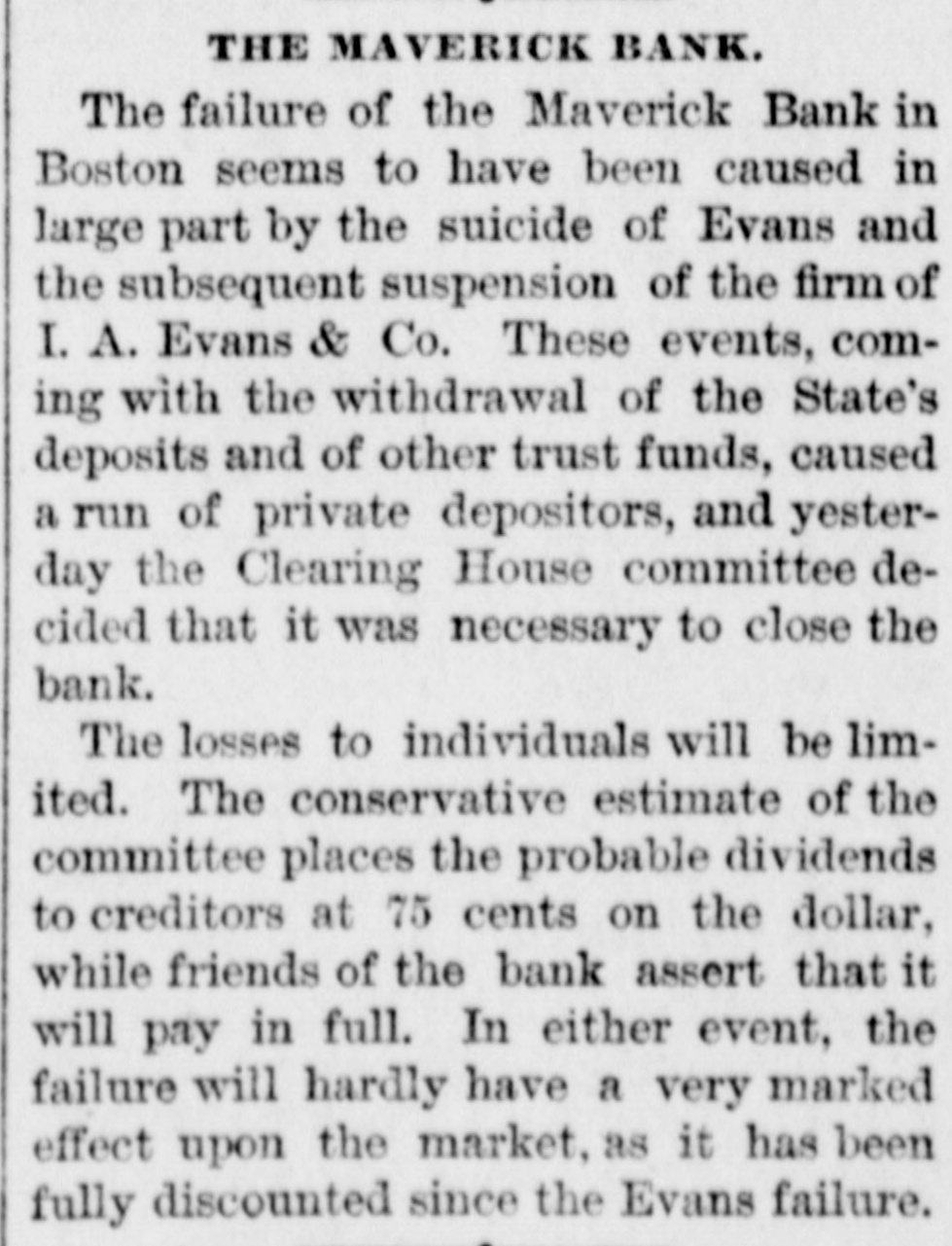
THE MAVERICK BANK

The failure of the Maverick Bank in Boston seems to have been caused in large part by the suicide of Evans and the subsequent suspension of the firm of I. A. Evans & Co. These events, coming with the withdrawal of the State's deposits and of other trust funds, caused a run of private depositors, and yesterday the Clearing House committee decided that it was necessary to close the bank. The losses to individuals will be limited. The conservative estimate of the committee places the probable dividends to creditors at 75 cents on the dollar, while friends of the bank assert that it will pay in full. In either event, the failure will hardly have a very marked effect upon the market, as it has been fully discounted since the Evans failure.


Article from The Portland Daily Press, November 3, 1891

Click image to open full size in new tab

Article Text

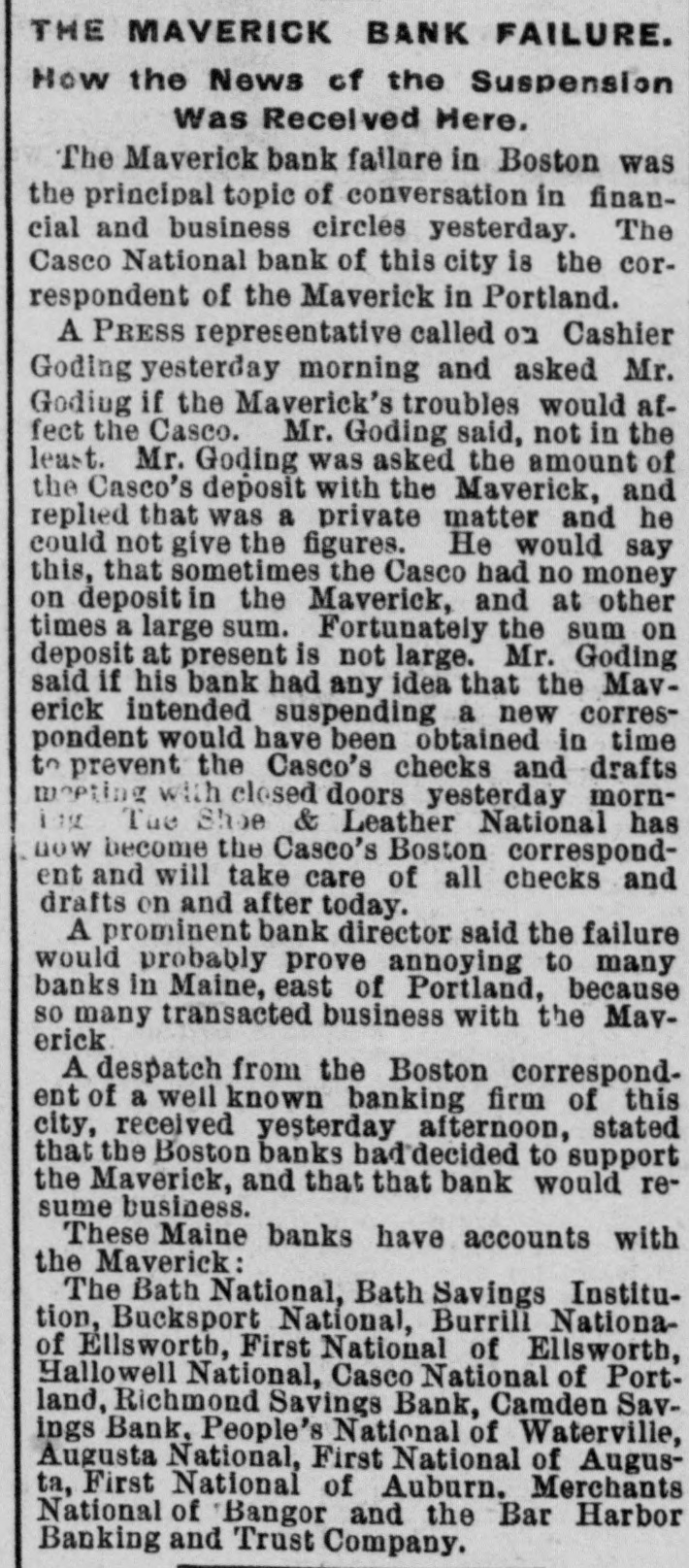
THE MAVERICK BANK FAILURE

How the News of the Suspension Was Received Here. The Maverick bank failare in Boston was the principal topic of conversation in financial and business circles yesterday. The Casco National bank of this city is the correspondent of the Maverick in Portland. A PRESS representative called on Cashier Goding yesterday morning and asked Mr. Goding if the Maverick's troubles would affect the Casco. Mr. Goding said, not in the least. Mr. Goding was asked the amount of the Casco's deposit with the Maverick, and replied that was a private matter and he could not give the figures. He would say this, that sometimes the Casco had no money on depositi in the Maverick, and at other times a large sum. Fortunately the sum on deposit at present is not large. Mr. Goding said if his bank had any idea that the Maverick intended suspending a new correspondent would have been obtained in time to prevent the Casco's checks and drafts meeting with closed doors yesterday mornin Tue Shoe & Leather National has now become the Casco's Boston correspondent and will take care of all checks and drafts on and after today. A prominent bank director said the failure would probably prove annoying to many banks in Maine, east of Portland, because so many transacted business with the Mayerick A despatch from the Boston correspondent of a well known banking firm of this city, received yesterday afternoon, stated that the Boston banks bad'decided to support the Maverick, and that that bank would resume business. These Maine banks have accounts with the Maverick: The Bath National, Bath Savings Institution, Bucksport National, Burrill Nationaof Ellsworth, First National of Ellsworth, Hallowell National, Casco National of Portland, Richmond Savings Bank, Camden Savings Bank. People's National of Waterville, Augusta National, First National of Augusta, First National of Auburn. Merchants National of Bangor and the Bar Harbor Banking and Trust Company.


Article from New-York Tribune, November 3, 1891

Click image to open full size in new tab

Article Text

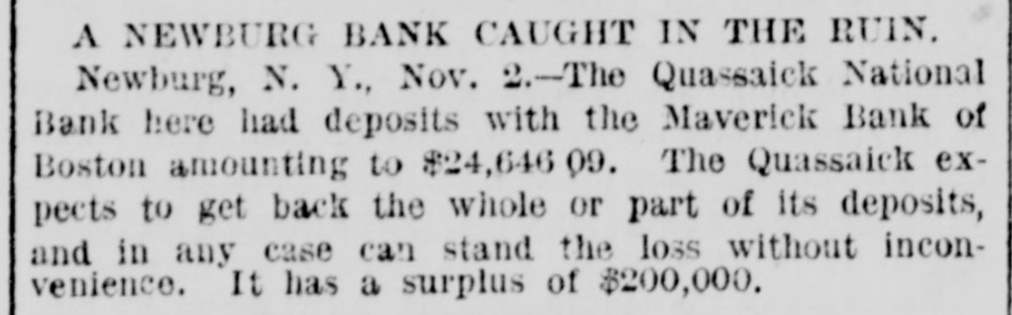
A NEWBURG BANK CAUGHT IN THE RUIN. Newburg, N. Y., Nov. 2.-The Quassaick National Bank here had deposits with the Maverick Bank of Boston amounting to $24,646 09. The Quassaick expects to get back the whole or part of its deposits, and in any case can stand the loss without inconvenience. It has a surplus of $200,000.


Article from Fort Worth Gazette, November 3, 1891

Click image to open full size in new tab

Article Text

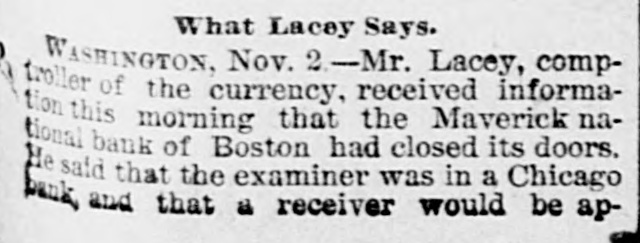
What Lacey Says

Nov. 2.-Mr. Lacey, compreceived informathis morning that the Maverick national bank of Boston had closed its doors. He said that the examiner was in a Chicago bank, and that a receiver would be ap-


Article from Evening Star, November 4, 1891

Click image to open full size in new tab

Article Text

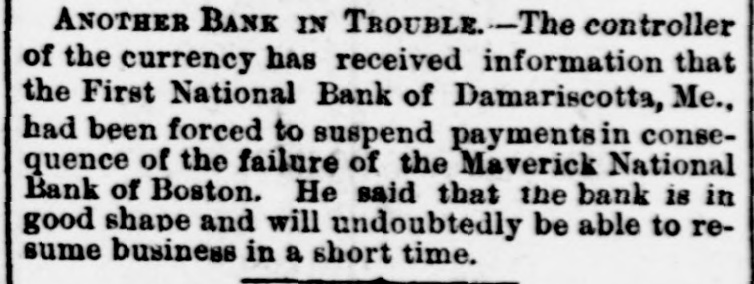
ANOTHER BANK IN TROUBLE

- The controller of the currency has received information that the First National Bank of Damariscotta, Me., had been forced to suspend payments in consequence of the failure of the Maverick National Bank of Boston. He said that the bank is in good shape and will undoubtedly be able to resume business in a short time.


Article from Grant County Herald, November 5, 1891

Click image to open full size in new tab

Article Text

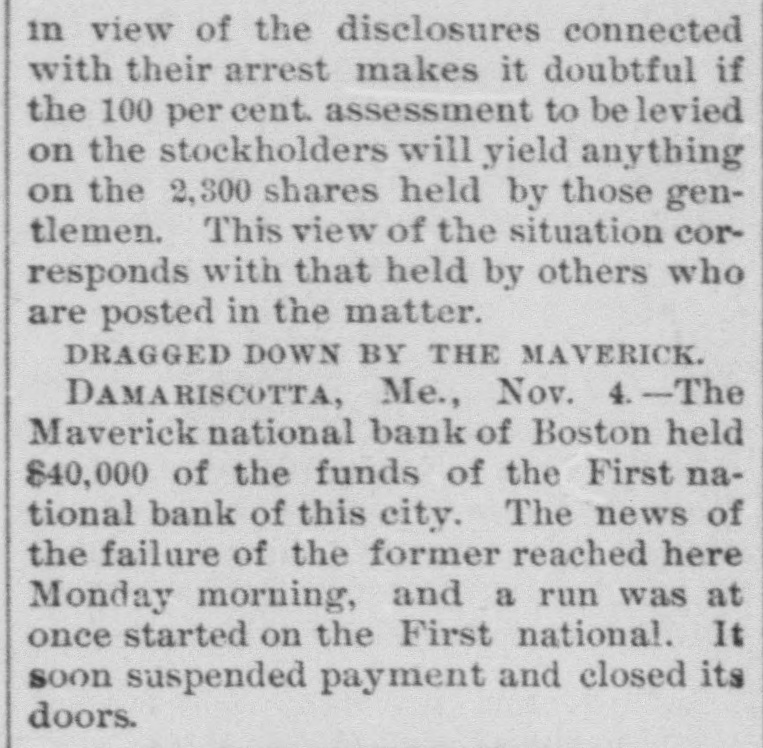
in view of the disclosures connected with their arrest makes it doubtful if the 100 per cent. assessment to be levied on the stockholders will yield anything on the 2,300 shares held by those gentlemen. This view of the situation corresponds with that held by others who are posted in the matter. DRAGGED DOWN BY THE MAVERICK. Damariscotta, Me., Nov. 4. -The Maverick national bank of Boston held $40,000 of the funds of the First national bank of this city. The news of the failure of the former reached here Monday morning, and a run was at once started on the First national. It soon suspended payment and closed its doors.


Article from The Dalles Daily Chronicle, November 5, 1891

Click image to open full size in new tab

Article Text

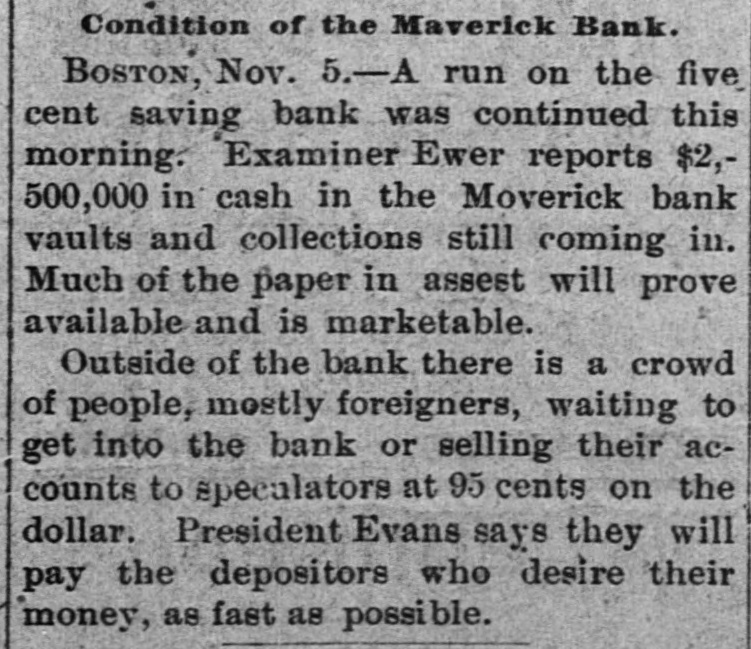
Condition of the Maverick Bank

BOSTON, Nov. 5.-A run on the five cent saving bank was continued this morning. Examiner Ewer reports $2,500,000 in cash in the Moverick bank vaults and collections still coming in. Much of the paper in assest will prove available and is marketable. Outside of the bank there is a crowd of people, mostly foreigners, waiting to get into the bank or selling their accounts to speculators at 95 cents on the dollar. President Evans says they will pay the depositors who desire their money, as fast as possible.


Article from Democratic Northwest, November 5, 1891

Click image to open full size in new tab

Article Text

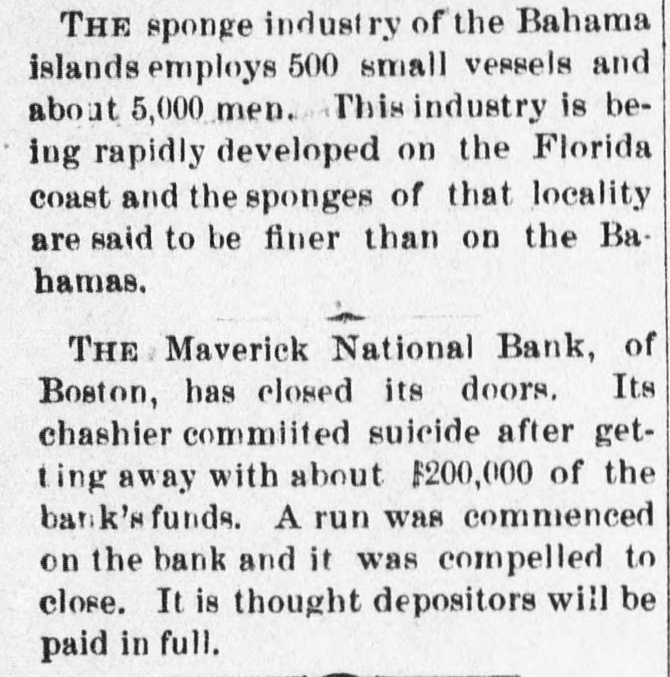
THE sponge industry of the Bahama islands employs 500 small vessels and about 5,000 men. This industry is being rapidly developed on the Florida coast and the sponges of that locality are said to be finer than on the Bahamas. THE Maverick National Bank, of Boston, has closed its doors. Its chashier commited suicide after gett ing away with about $200,000 of the bank's funds. A run was commenced on the bank and it was compelled to close. It is thought depositors will be paid in full.


Article from Alexandria Gazette, November 7, 1891

Click image to open full size in new tab

Article Text

Mr. Beal has taken bis commission and is now receiver of the Maverick National Bank in Boston.


Article from Fort Worth Gazette, November 7, 1891

Click image to open full size in new tab

Article Text

Maverick Bank Receivership

BOSTON, Mass., Nov. 6.-Mr. Beal has qualified as receiver of the Maverick bank, but has not yet taken out his commission.


Article from Daily Kennebec Journal, November 10, 1891

Click image to open full size in new tab

Article Text

MAVERICK BANK Making Ready to Resume Business Preparing a Statement. BOSTON, Nov. 9 -Comptroller Lacey, Bank Examiner Ewer and Receiver Beal met at Maverick bank early this morning and had a long conference. Thirty-eight of sixty clerk formerly employed at the Maverick are in their places today. and the work of getting ready to open the bank for the transaction of business with the receiver will be pushed rapidiy. Receiver Beal is preparing a statement to depositors which will be given to the press tomorrow.


Article from The Cheyenne Daily Leader, November 10, 1891

Click image to open full size in new tab

Article Text

Maverick Bank Trouble

BOSTON, Nov. 9.-Receiver Beale to. day issued a lengthy statement of the affairs of the Maverick National bank at the close of business Oct. 31, as shown by its books. As compared with Sept. 25, loans, bond accounts, cash with reserve agents, loans to banks and specie had been greatly reduced. Deposits at the date of suspension, including certificates of deposit and deposits of banks, aggregated $8,260,000, as against $8,910,000 five weeks before, a loss of $1,600,000, of which $734,000 was a falling off in individual deposits and $500,000 in bank deposits. Thus far everything is found to have been systematically conducted and all accounts balanced upon the books. The only difference thus far announced is inadequate collateral behind the loans to directors. There was no blanket endorsement on file, as has been stated. Today's statement is gratifying in that it shows less than $3,000,000 of individual deposits outside of the deposits of the banks and bankers at the time of failure.


Article from Pawtucket Tribune, November 10, 1891

Click image to open full size in new tab

Article Text

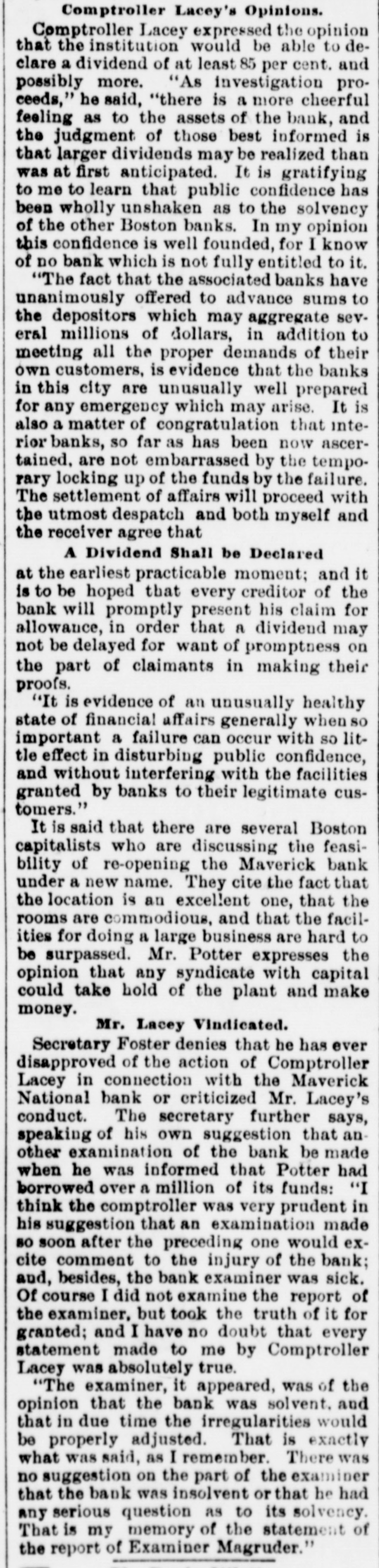
Comptroller Lacey's Opinions

Comptroller Lacey expressed the opinion that the institution would be able to declare a dividend of at least 85 per cent. and possibly more. "As investigation proceeds," he said, "there is a more cheerful feeling as to the assets of the bank, and the judgment of those best informed is that larger dividends may be realized than was at first anticipated. It is gratifying to me to learn that public confidence has been wholly unshaken as to the solvency of the other Boston banks. In my opinion this confidence is well founded, for I know of no bank which is not fully entitled to it. "The fact that the associated banks have unanimously offered to advance sums to the depositors which may aggregate several millions of dollars, in addition to meeting all the proper demands of their own customers, is evidence that the banks in this city are unusually well prepared for any emergency which may arise. It is also a matter of congratulation that interior banks, so far as has been now ascertained, are not embarrassed by the temporary locking up of the funds by the failure. The settlement of affairs will proceed with the utmost despatch and both myself and the receiver agree that A Dividend Shall be Declared at the earliest practicable moment; and it is to be hoped that every creditor of the bank will promptly present his claim for allowance, in order that a dividend may not be delayed for want of promptness on the part of claimants in making their proofs. "It is evidence of an unusually healthy state of financial affairs generally when so important a failure can occur with so little effect in disturbing public confidence, and without interfering with the facilities granted by banks to their legitimate customers." It is said that there are several Boston capitalists who are discussing the feasibility of re-opening the Maverick bank under a new name. They cite the fact that the location is an excellent one, that the rooms are commodious, and that the facilities for doing a large business are hard to be surpassed. Mr. Potter expresses the opinion that any syndicate with capital could take hold of the plant and make money. Mr. Lacey Vindicated. Secretary Foster denies that he has ever disapproved of the action of Comptroller Lacey in connection with the Maverick National bank or criticized Mr. Lacey's conduct. The secretary further says, speaking of his own suggestion that another examination of the bank be made when he was informed that Potter had borrowed over a million of its funds: "I think the comptroller was very prudent in his suggestion that an examination made so soon after the preceding one would excite comment to the injury of the bank; and, besides, the bank examiner was sick. Of course I did not examine the report of the examiner, but took the truth of it for granted; and I have no doubt that every statement made to me by Comptroller Lacey was absolutely true. "The examiner, it appeared, was of the opinion that the bank was solvent. and that in due time the irregularities would be properly adjusted. That is exactly what was said, as I remember. There was no suggestion on the part of the examiner that the bank was insolvent or that he had any serious question as to its solvency. That is my memory of the statement of the report of Examiner Magruder."


Article from New-York Tribune, November 10, 1891

Click image to open full size in new tab

Article Text

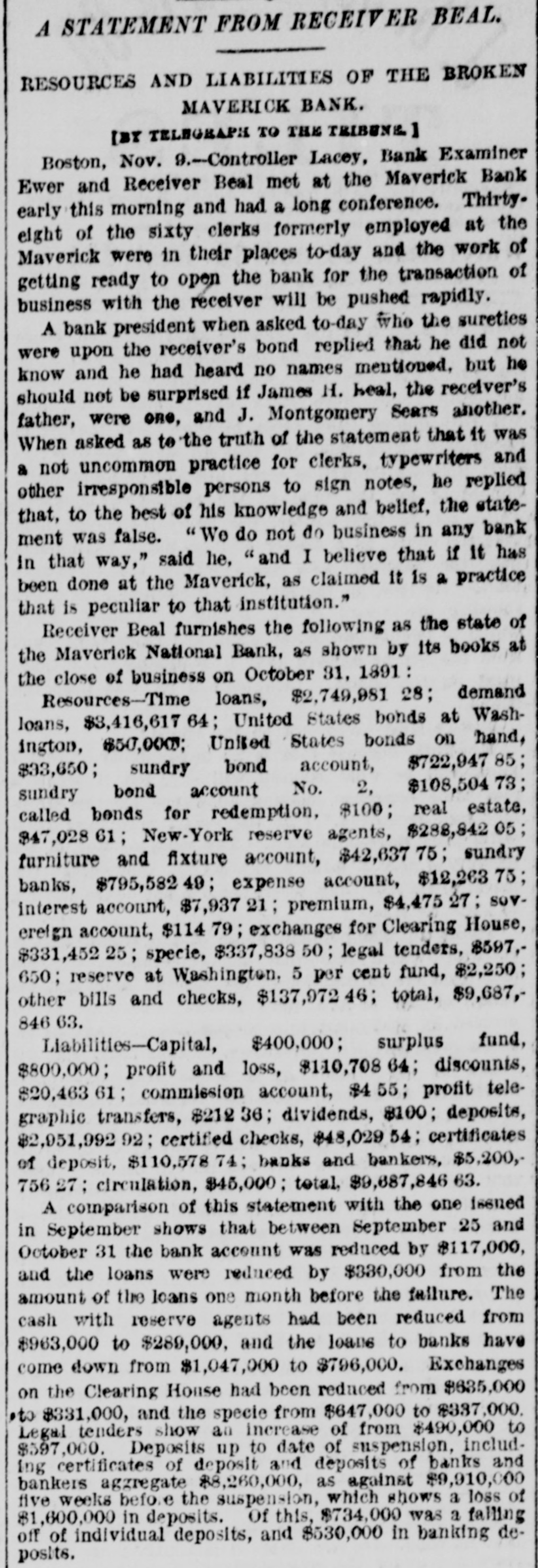
A STATEMENT FROM RECEIVER BEAL

RESOURCES AND LIABILITIES OF THE BROKEN MAVERICK BANK. [Br TELEGRAPH TO THE TRIBUNE] Boston, Nov. 9.-Controller Lacey, Bank Examiner Ewer and Receiver Beal met at the Maverick Bank early this morning and had a long conference. Thirtyeight of the sixty clerks formerly employed at the Maverick were in their places to-day and the work of getting ready to open the bank for the transaction of business with the receiver will be pushed rapidly. A bank president when asked to-day who the sureties were upon the receiver's bond replied that he did not know and he had heard no names mentioned. but he should not be surprised if James H. heal, the receiver's father, were one, and J. Montgomery Sears another. When asked as to the truth of the statement that it was a not uncommon practice for clerks. typewriters and other irresponsible persons to sign notes, he replied that, to the best of his knowledge and belief, the statement was false. "We do not do business in any bank in that way," said he, "and I believe that if it has been done at the Maverick, as claimed it is a practice that is peculiar to that institution." Receiver Beal furnishes the following as the state of the Maverick National Bank, as shown by its books at the close of business on October 31, 1891: Resources-Time loans, $2,749,981 28; demand loans, $3,416,617 United States bonds at Washington, $50,000); United States bonds on hand, $33,650; sundry bond account, $722,947 85; sundry bond account No. 2, $108,504 73; called bonds for redemption, $100; real estate, $47,028 61; New-York reserve agents, $288,842 05; furniture and fixture account, $42,637 75; sundry banks, $795,582 49; expense account, $12,263 75; interest account, $7,937 21; premium, $4,475 27; SOVereign account, $114 79; exchanges for Clearing House, $331,452 25; specie, $337,838 50; legal tenders, 8597,650; reserve at Washington, 5 per cent fund, $2,250; other bills and checks, $137,972 46; total, $9,687,846 63. Liabilities-Capital, $400,000; surplus fund, $800,000; profit and loss, $110,708 6 discounts, $20,463 61; commission account, 55; profit telegraphic transfers, $212 36; dividends, $100; deposits, $2,951,992 92; certified checks, $48,029 5 certificates of deposit, $110,578 74; banks and bankers, $5,200,756 27; circulation, $45,000; total, $9,687,846 A comparison of this statement with the one issued in September shows that between September 25 and October 31 the bank account was reduced by $117,000, and the loans were reduced by $330,000 from the amount of the loans one month before the failure. The cash with reserve agents had been reduced from $963,000 to $289,000, and the loans to banks have come down from $1,047,000 to $796,000. Exchanges on the Clearing House had been reduced from $635,000 ,to $331,000, and the specie from $647,000 to $337,000. Legal tenders show an increase of from $490,000 to $597,000. Deposits up to date of suspension, including certificates of deposit and deposits of banks and bankers aggregate $8,260,000, as against $9,910,000 five weeks before the suspension, which shows a loss of $1,600,000 in deposits. Of this, $734,000 was a falling off of individual deposits, and $530,000 in banking deposits.
Article from Evening Star, November 11, 1891

Click image to open full size in new tab

Article Text

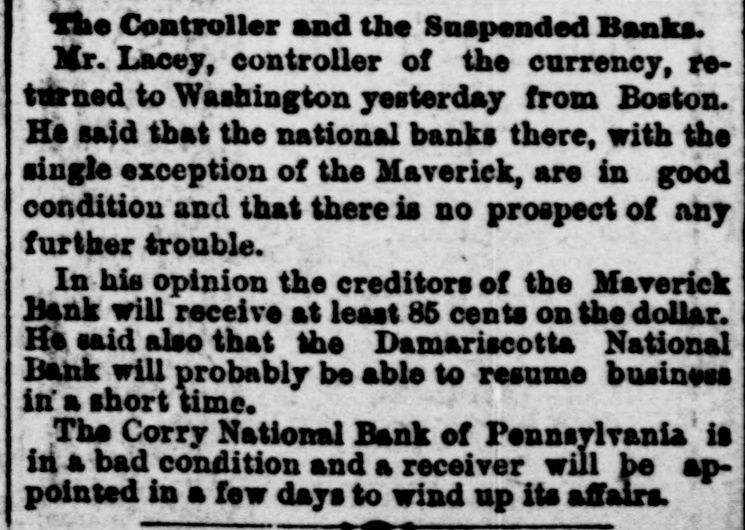
The Controller and the Suspended Banks. Mr. Lacey, controller of the currency, returned to Washington yesterday from Boston. He said that the national banks there, with the single exception of the Maverick, are in good condition and that there is no prospect of any further trouble. In his opinion the creditors of the Maverick Bank will receive at least 85 cents on the dollar. He said also that the Damariscotta National Bank will probably be able to resume business in a short time. The Corry National Bank of Pennsylvania is in a bad condition and a receiver will be appointed in a few days to wind up its affairs.


Article from The Sun, November 12, 1891

Click image to open full size in new tab

Article Text

MISCELLANEOUS,

THE Endicotts buy the Aberdeen hotel, St. Paul.

THE New York presbytery dismisses the charges of heresy against Dr. Briggs.

SNOW completely blocks threshing operations in North Dakota.

A NEWLY arrived German girl in New York marries her brother under very peculiar circumstances.

THE question of the state boundary line between Ohio and Indiana is in litigation.

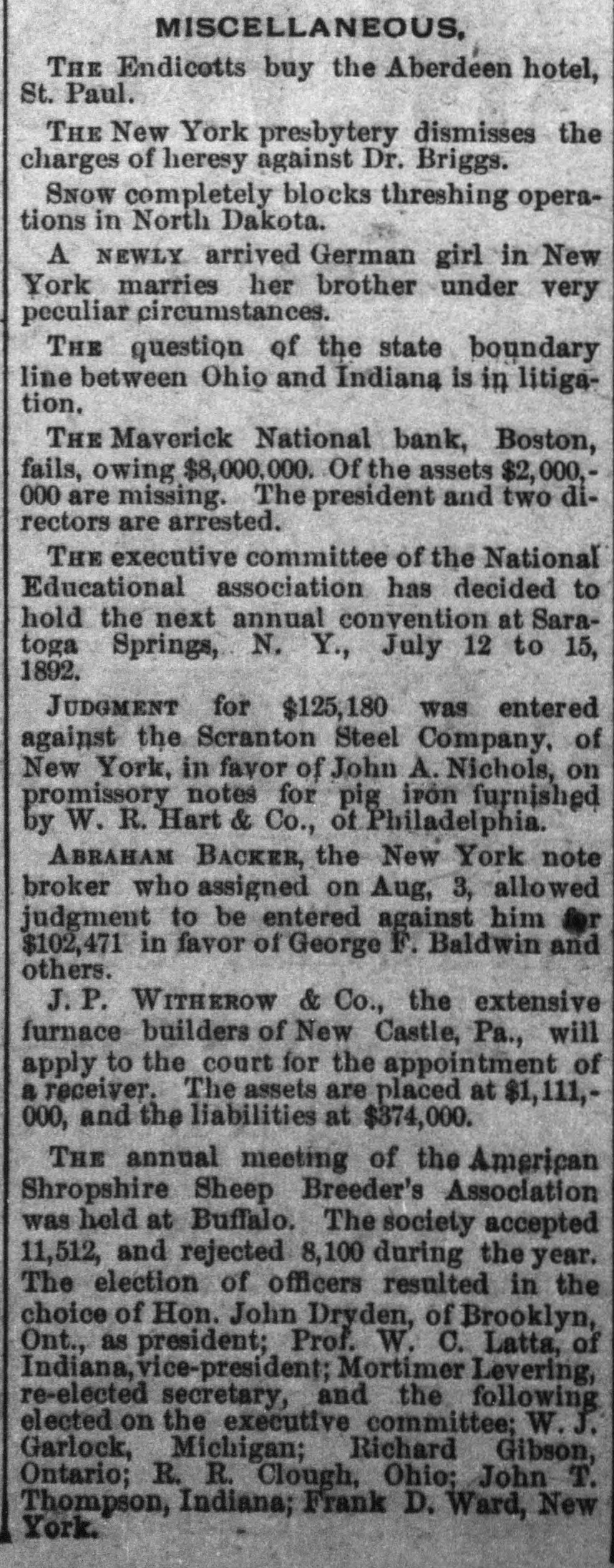
THE Maverick National bank, Boston, fails, owing $8,000,000. Of the assets $2,000,000 are missing. The president and two directors are arrested.

THE Executive committee of the National Educational association has decided to hold the next annual convention at Saratoga Springs, N. Y., July 12 to 15, 1892.

JUDGMENT for $125,180 was entered against the Scranton Steel Company, of New York, in favor of John A. Nichols, on promissory notes for pig iron furnished by W. R. Hart & Co., of Philadelphia.

ABRAHAM BACKER, the New York note broker who assigned on Aug, 3, allowed judgment to be entered against him for $102,471 in favor of George F. Baldwin and others.

J. P. WITHEROW & Co., the extensive furnace builders of New Castle, Pa., will apply to the court for the appointment of a receiver. The assets are placed at $1,111,000, and the liabilities at $374,000.

THE annual meeting of the American Shropshire Sheep Breeder's Association was held at Buffalo. The society accepted 11,512, and rejected 8,100 during the year. The election of officers resulted in the choice of Hon. John Dryden, of Brooklyn, Ont., as president; Prof. W. C. Latta, of Indiana, vice-president; Mortimer Levering, re-elected secretary, and the following elected on the executive committee; W. J. Garlock, Michigan; Richard Gibson, Ontario; R. R. Clough, Ohio: John T. Thompson, Indiana; Frank D. Ward, New York.


Article from Middlebury Register, November 13, 1891

Click image to open full size in new tab

Article Text

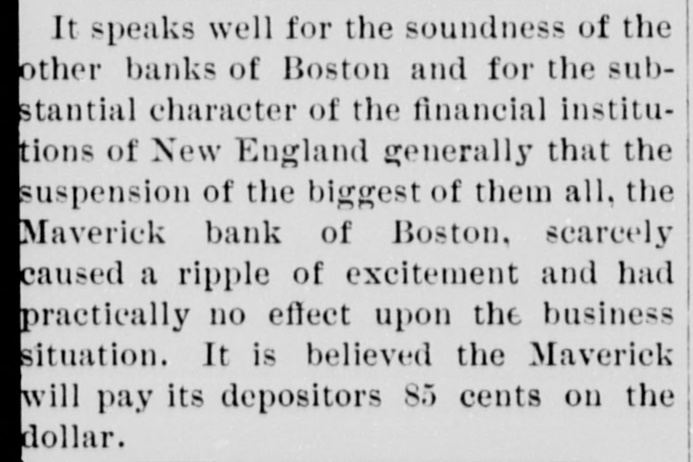
It speaks well for the soundness of the other banks of Boston and for the substantial character of the financial institutions of New England generally that the suspension of the biggest on of them all, the Maverick bank of Boston, scarcely caused a ripple of excitement and had practically no effect upon the business situation. It is believed the Maverick will pay its depositors 85 cents on the dollar.


Article from The Forrest City Times, November 13, 1891

Click image to open full size in new tab

Article Text

HAD OVER EIGHT MILLIONS

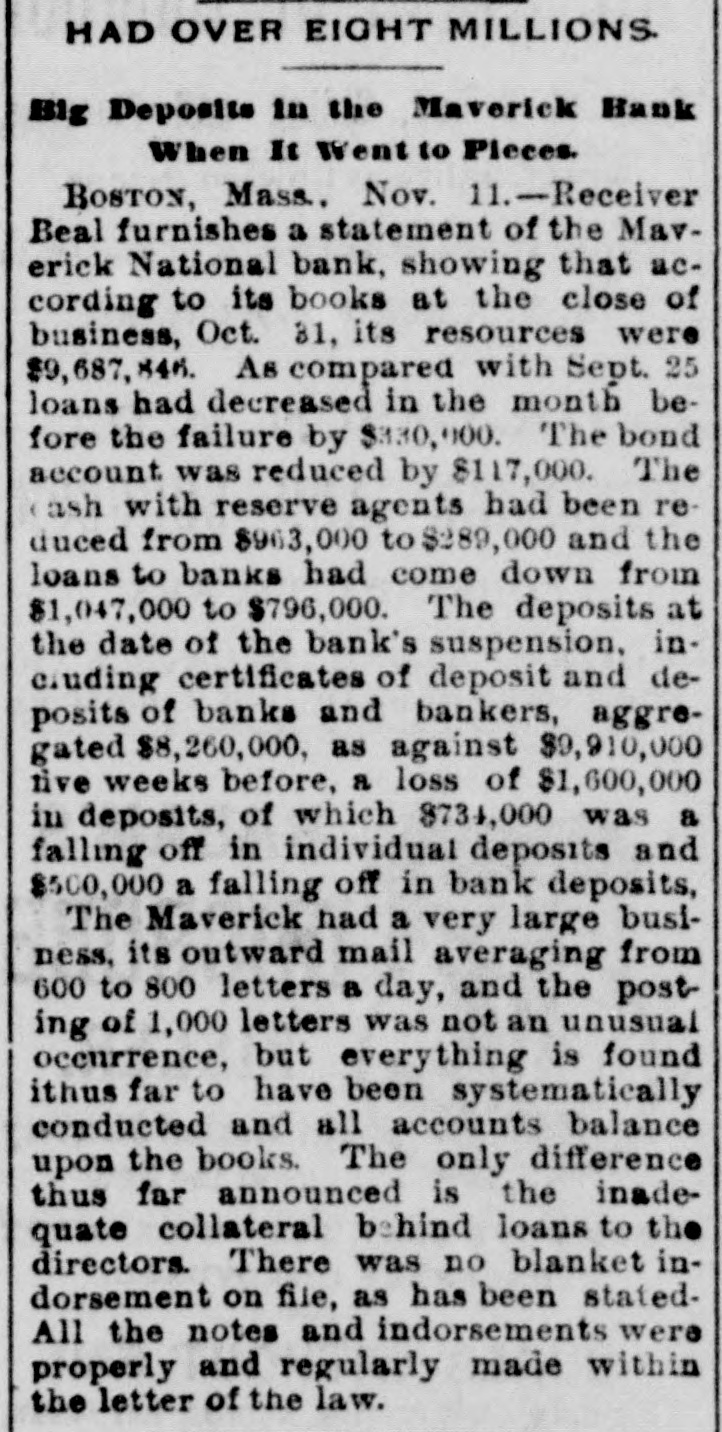
Big Deposits in the Maverick Hank When It Went to Pieces. BOSTON, Mass., Nov. 11.-Receiver Beal furnishes a statement of the Maverick National bank, showing that according to its books at the close of business, Oct. 31, its resources were $9,687,846. As compared with Sept. 25 loans had decreased in the month before the failure by $330,000. The bond account was reduced by $117,000. The ash with reserve agents had been reduced from $963,000 to $289,000 and the loans to banks had come down from $1,047,000 to $796,000. The deposits at the date of the bank's suspension, including certificates of deposit and deposits of banks and bankers, aggregated $8,260,000, as against $9,910,000 five weeks before, a loss of $1,600,000 in deposits, of which $734,000 was a falling off in individual deposits and $500,000 a falling off in bank deposits, The Maverick had a very large business, its outward mail averaging from 600 to 800 letters a day, and the posting of 1,000 letters was not an unusual occurrence, but everything is found ithus far to have been systematically conducted and all accounts balance upon the books. The only difference thus far announced is the inadequate collateral behind loans to the directors. There was no blanket indorsement on file, as has been statedAll the notes and indorsements were properly and regularly made within the letter of the law.


Article from The Morning Call, November 26, 1891

Click image to open full size in new tab

Article Text

Heavy Failure

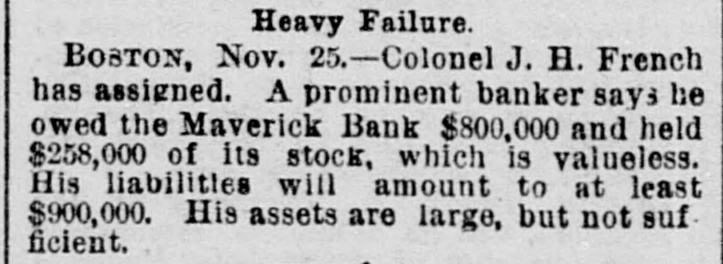
BOSTON, Nov. 25.-Colonel J. H. French has assigned. A prominent banker says he owed the Maverick Bank $800,000 and held $258,000 of its stock, which is valueless. His liabilities will amount to at least $900,000. His assets are large, but not suf ficient.


Article from The Progressive Farmer, December 8, 1891

Click image to open full size in new tab

Article Text

THE LATEST NEWS

parks from the Wires--Most Important Events Throughout the World for a Week. NEW YORK. Dec 1.-Phy sicians say yrus Field may not live through the ay. Three members of the Field re under arrest. TACOMAH. Wash., Nov. 30.-Distinct hocks of earthquake were felt in this ity yesterday afternoon. Port Townend and Olympia also report shocks. To damage done. BOSTON, Nov. 30.-The Maverick ational bank was opened this ng and the book keepers are deliverng receiver's certificates to depositors ho have proved their claims. GALENA, Ill., Nov. 30.-The mercury ast night fell to 15 degrees below zero. The Mississippi river, which was clear f ice Thursday, is now frozen from hore to shore. The weather is the oldest ever known here in November. RIO JANERIO, Dec. 1.-There is larming increase of yellow fever his port. The disease has assumed erious a form that the embarkation f government troops for Rio Grande o Sul and Santa Catalina has been emporarily suspended. Mrs. Duncan, of Washington, D. C., T S A., whose husband, an American, ttempted to murder her last May ear Bettwsy Boed, in Wales, and who as remained at Festinog since the age, has just been delivered of a oth mother and child are doing well JACKSON, Miss., Nov. 30.-Bill Nye, he famous humorist, who fell from he opera house gallery into a pile of umber at Yazoo City Saturday night, as considerably shaken up, but not eriously hurt. He passed through his city yesterday morning en or New Orleans, where he is billed to ecture. NEW ORLEANS, La., Nov. 30.-The hain building of a frame structure sed as a library, and several small uildings, belonging to Straight ersity for colored people, were troved by fire this morning. Theloss ; $30,000; insurance unknown. The uildings were owned by the American Issionary Association of New York. ODESSA, Russia. Nov. 30 An outcry as been raised that Zemstvo agents re paying fancy prices for rye that 0 adulterated with sand and other aterials that it is unfit to eat. and lso that they are buying wheat rices above the market rate. It eared that the outery will put a ) the contributions of people charit bly inclined. Damage reaching $150,000 was inlicted last night by a fire in the ently constructed building of the Chicago Arc-Light and Power any at Washington street bridge, Chicago. The blaze was started wo electric light wires sagging ach other. The Excelsior Cork Cut ing Company was a considerable y the conflagration. RONCEVERTE. W. Va., Nov. ead end freight collision occurred he west end of town this morning o'clock, which resulted in thedestruc ion of two engines and several nd the death of Freman W. M. Carter, f Hinton, and the engineer of rain was pretty badly scalded. Sev ral brakemen were injured. perator's carelessness caused vreck. LEXINGTON, Va., Nov. 30.-A shoot ng affray occurred here Saturday ight in a disreputable house. nan unknown was shot in the 'he parties have been arrested,


Article from The Portland Daily Press, December 10, 1891

Click image to open full size in new tab

Article Text

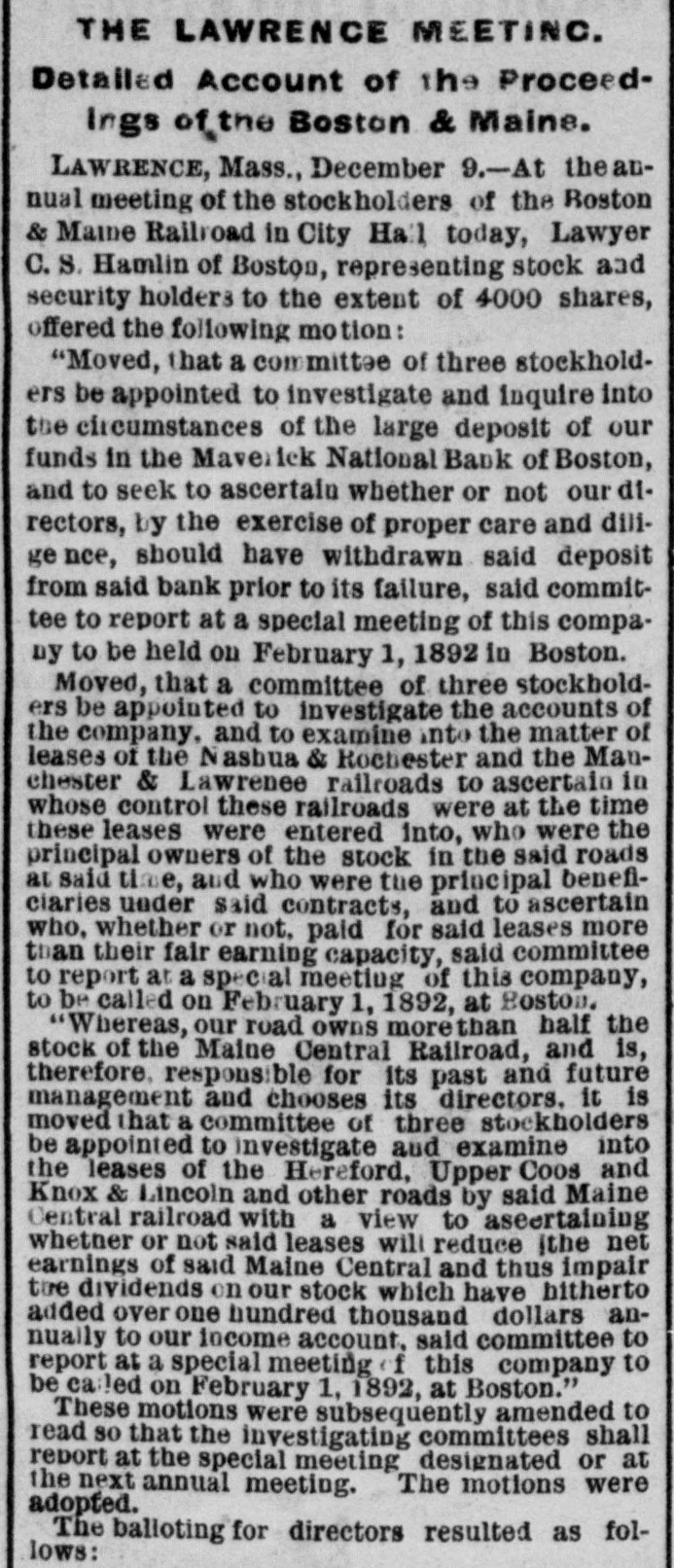
THE LAWRENCE MEETING.

Detailed Account of the Proceedings of the Boston & Maine.

LAWRENCE, Mass., December 9.-At the annual meeting of the stockholders of the Boston & Maine Railroad in City Hall today, Lawyer C. S. Hamlin of Boston, representing stock and security holders to the extent of 4000 shares, offered the following motion: "Moved, that a committee of three stockholders be appointed to investigate and inquire into the circumstances of the large deposit of our funds in the Maverick National Bank of Boston, and to seek to ascertain whether or not our directors, by the exercise of proper care and diligence, should have withdrawn said deposit from said bank prior to its failure, said committee to report at a special meeting of this company to be held on February 1, 1892 in Boston.

Moved, that a committee of three stockholders be appointed to investigate the accounts of the company, and to examine into the matter of leases of the Nashua & Rochester and the Manchester & Lawrenee railroads to ascertain in whose control these railroads were at the time these leases were entered into, who were the principal owners of the stock in the said roads at said time, and who were the principal beneficiaries under said contracts, and to ascertain who, whether or not, paid for said leases more than their fair earning capacity, said committee to report at a special meeting of this company, to be called on February 1, 1892, at Boston.

"Whereas, our road owns more than half the stock of the Maine Central Railroad, and is, therefore, responsible for its past and future management and chooses its directors, it is moved that a committee of three stockholders be appointed to investigate and examine into the leases of the Hereford, Upper Coos and Knox & Lincoln and other roads by said Maine Central railroad with a view to aseertaining whether or not said leases will reduce the net earnings of said Maine Central and thus impair the dividends on our stock which have hitherto added over one hundred thousand dollars annually to our income account, said committee to report at a special meeting of this company to be called on February 1, 1892, at Boston."

These motions were subsequently amended to read so that the investigating committees shall report at the special meeting designated or at the next annual meeting. The motions were adopted.

The balloting for directors resulted as follows:


Article from Wood County Reporter, January 21, 1892

Click image to open full size in new tab

Article Text

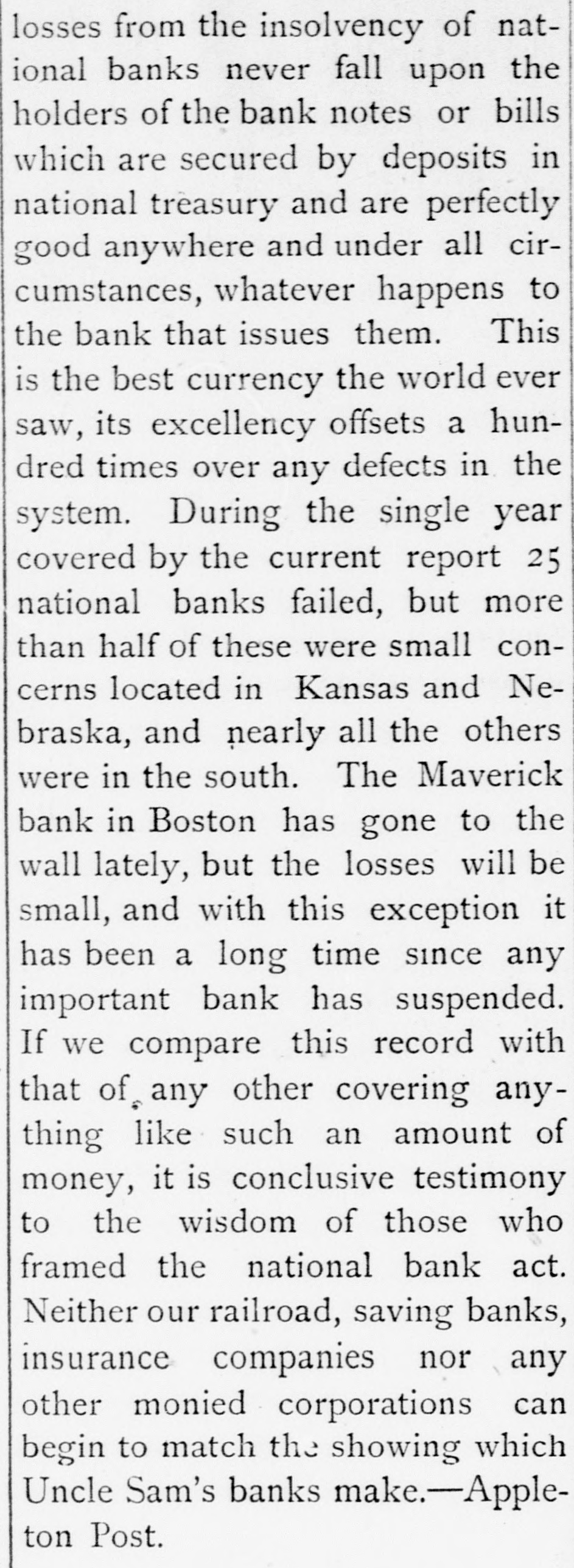
losses from the insolvency of nat- ional banks never fall upon the holders of the bank notes or bills which are secured by deposits in national treasury and are perfectly good anywhere and under all cir- cumstances, whatever happens to the bank that issues them. This is the best currency the world ever saw, its excellency offsets a hun- dred times over any defects in the system. During the single year covered by the current report 25 national banks failed, but more than half of these were small con- cerns located in Kansas and Ne- braska, and nearly all the others were in the south. The Maverick bank in Boston has gone to the wall lately, but the losses will be small, and with this exception it has been a long time since any important bank has suspended. If we compare this record with that of any other covering any- thing like such an amount of money, it is conclusive testimony to the wisdom of those who framed the national bank act. Neither our railroad, saving banks, insurance companies nor any other monied corporations can begin to match the showing which Uncle Sam's banks make.-Apple- ton Post.


Article from Pawtucket Tribune, July 27, 1892

Click image to open full size in new tab

Article Text

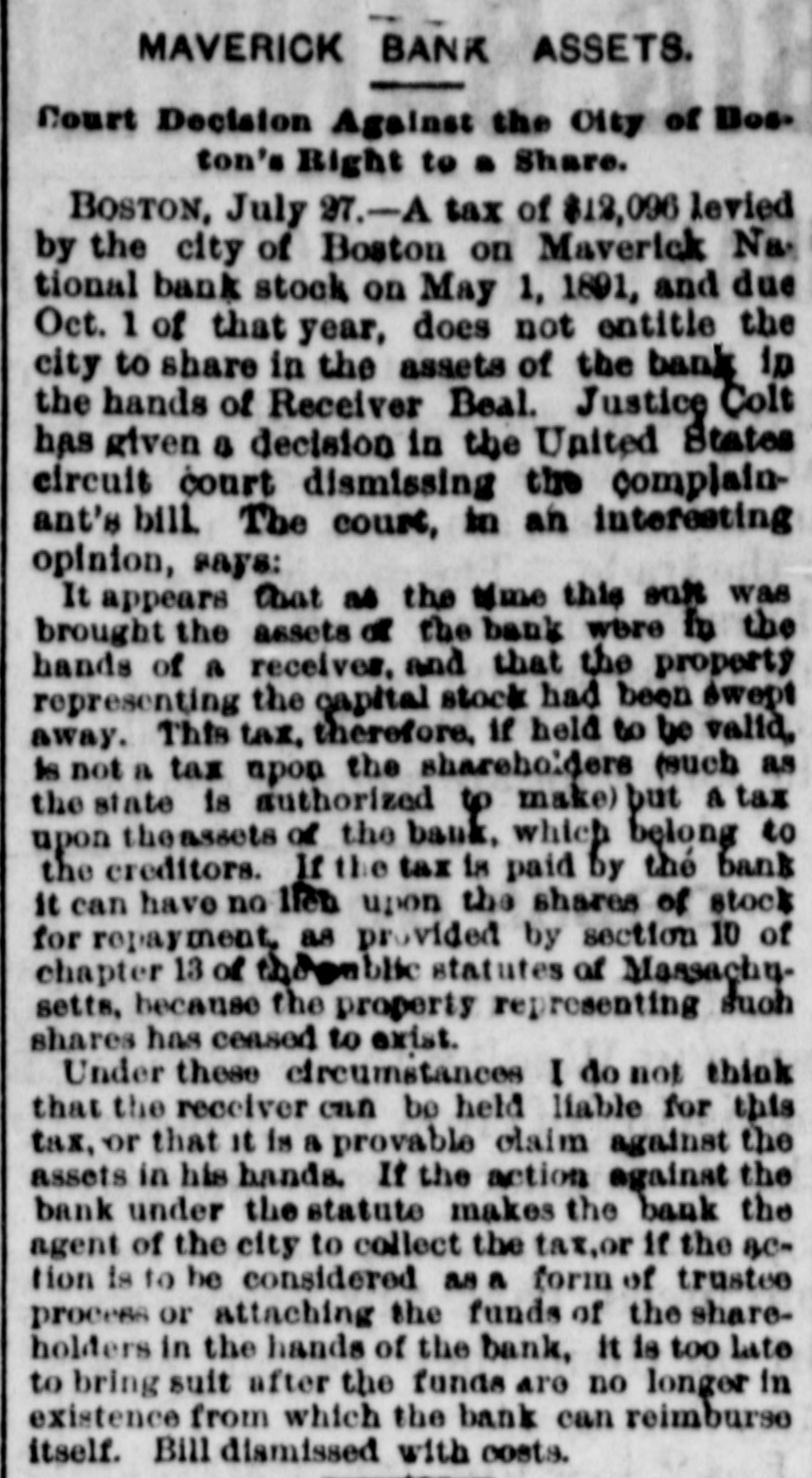
MAVERICK BANK ASSETS.

Court Decision Against the City of Boston's Right to a Share.

BOSTON, July 27.-A tax of $12,096 levied by the city of Boston on Maverick National bank stock on May 1, 1891, and due Oct. 1 of that year, does not entitle the city to share in the assets of the bank in the hands of Receiver Beal. Justice Colt has given a decision in the United States circuit court dismissing the complainant's bill. The court, in an interesting opinion, says:

It appears that as the time this suit was brought the assets of the bank were in the hands of a receiver, and that the property representing the capital stock had been swept away. This tax, therefore, if held to be valid, is not a tax upon the shareholders (such as the state is authorized to make) but a tax upon the assets of the bank, which belong to the creditors. If the tax is paid by the bank it can have no lien upon the shares of stock for repayment, as provided by section 10 of chapter 13 of the public statutes of Massachusetts, because the property representing such shares has ceased to exist.

Under these circumstances I do not think that the receiver can be held liable for this tax, or that it is a provable claim against the assets in his hands. If the action against the bank under the statute makes the bank the agent of the city to collect the tax, or if the action is to be considered as a form of trustee process or attaching the funds of the shareholders in the hands of the bank, it is too late to bring suit after the funds are no longer in existence from which the bank can reimburse itself. Bill dismissed with costs.


Article from Evening Journal, July 27, 1892

Click image to open full size in new tab

Article Text

Receiver Beal Wins

BOSTON, July 27.-Judge Colt dismissed the bill brought by the city of Boston against Receiver Beal, of the Maverick bank, to recover $12,000 taxes.


Article from The Evening Herald, September 15, 1892

Click image to open full size in new tab

Article Text

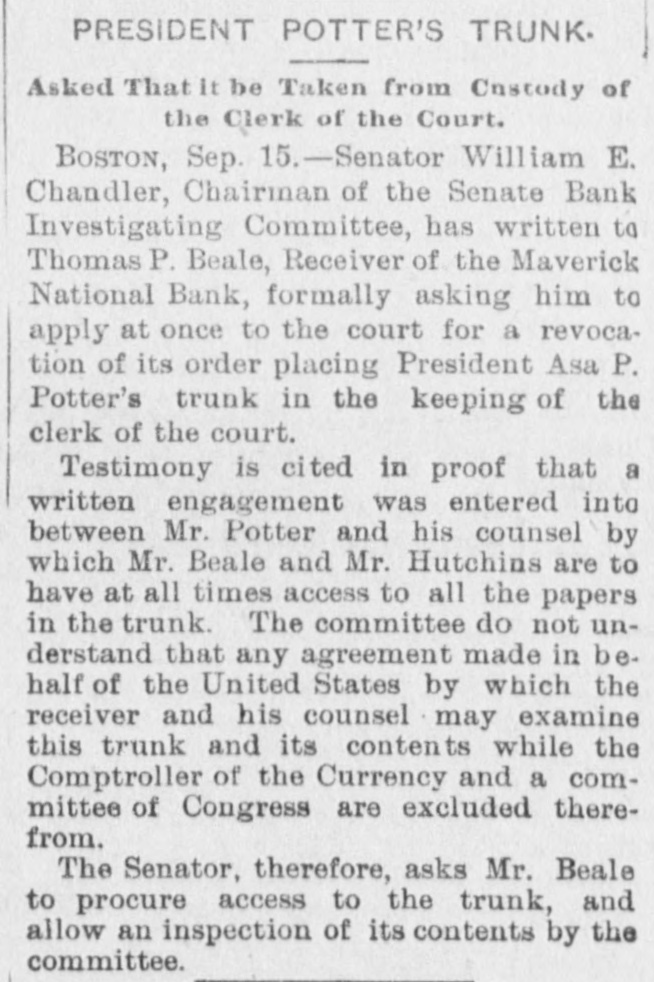
PRESIDENT POTTER'S TRUNK.

Asked That it be Taken from Custody of the Clerk of the Court.

BOSTON, Sep. 15. - Senator William E. Chandler, Chairman of the Senate Bank Investigating Committee, has written to Thomas P. Beale, Receiver of the Maverick National Bank, formally asking him to apply at once to the court for a revocation of its order placing President Asa P. Potter's trunk in the keeping of the clerk of the court.

Testimony is cited in proof that a written engagement was entered into between Mr. Potter and his counsel by which Mr. Beale and Mr. Hutchins are to have at all times access to all the papers in the trunk. The committee do not understand that any agreement made in behalf of the United States by which the receiver and his counsel may examine this trunk and its contents while the Comptroller of the Currency and a committee of Congress are excluded therefrom.

The Senator, therefore, asks Mr. Beale to procure access to the trunk, and allow an inspection of its contents by the committee.