6741. First National Bank (New Orleans, LA)

Bank Information

Episode Type
Run → Suspension → Closure
Bank Type
national
Bank ID
162
Charter Number
162
Start Date
May 14, 1867
Location
New Orleans, Louisiana (29.955, -90.075)

Metadata

Model
gpt-5-mini
Short Digest
c7f674bb20b1dbb5

Response Measures

Capital injected, Full suspension, Books examined

Other: Stockholders and capitalists examined assets and a meeting was adjourned pending action of capitalists (effort to recapitalize/resume). Receiver later appointed; payments suspended by examiner.

Receivership Details

Depositor recovery rate
79.0%
Date receivership started
1867-05-20
OCC cause of failure
Fraud
Share of assets assessed as good
46.6%
Share of assets assessed as doubtful
15.1%
Share of assets assessed as worthless
38.3%

Description

Contemporary articles (May–June 1867) report heavy withdrawals/run on New Orleans banks including the First National, the Comptroller of the Currency placing the bank in the hands of an examiner and suspending payments, and subsequently a receiver (Col. Case/Charles Case) being appointed and liquidating assets. The run appears driven by discovered defalcations and the closing/seizure by federal authorities (Comptroller/Controller John Jay Knox and sub-treasury actions). No evidence of reopening; the bank remained in receivership and was liquidated.

Events (6)

1. December 18, 1863 Chartered
Source
historical_nic
2. May 14, 1867 Run
Cause
Bank Specific Adverse Info
Cause Details
Heavy defalcations and the closing/seizure of the sub-treasury and revelations about the First National's condition triggered heavy withdrawals.
Measures
Heavy withdrawals; bank surrounded by crowds; other banks suspended (City National, Commercial, Bank of Commerce) as panic spread.
Newspaper Excerpt
There was a general run on the New Orleans banks, yesterday, growing out of the closing of the United States sub-treasury and First National Bank.
Source
newspapers
3. May 15, 1867 Suspension
Cause
Government Action
Cause Details
Placed in hands of an examiner and seized/closed by order of the Comptroller of the Currency (Controller John Jay Knox); payments suspended.
Newspaper Excerpt
The First National Bank has been placed In the hands of the examiner, and all payments suspended.
Source
newspapers
4. May 20, 1867 Receivership
Source
historical_nic
5. June 4, 1867 Receivership
Newspaper Excerpt
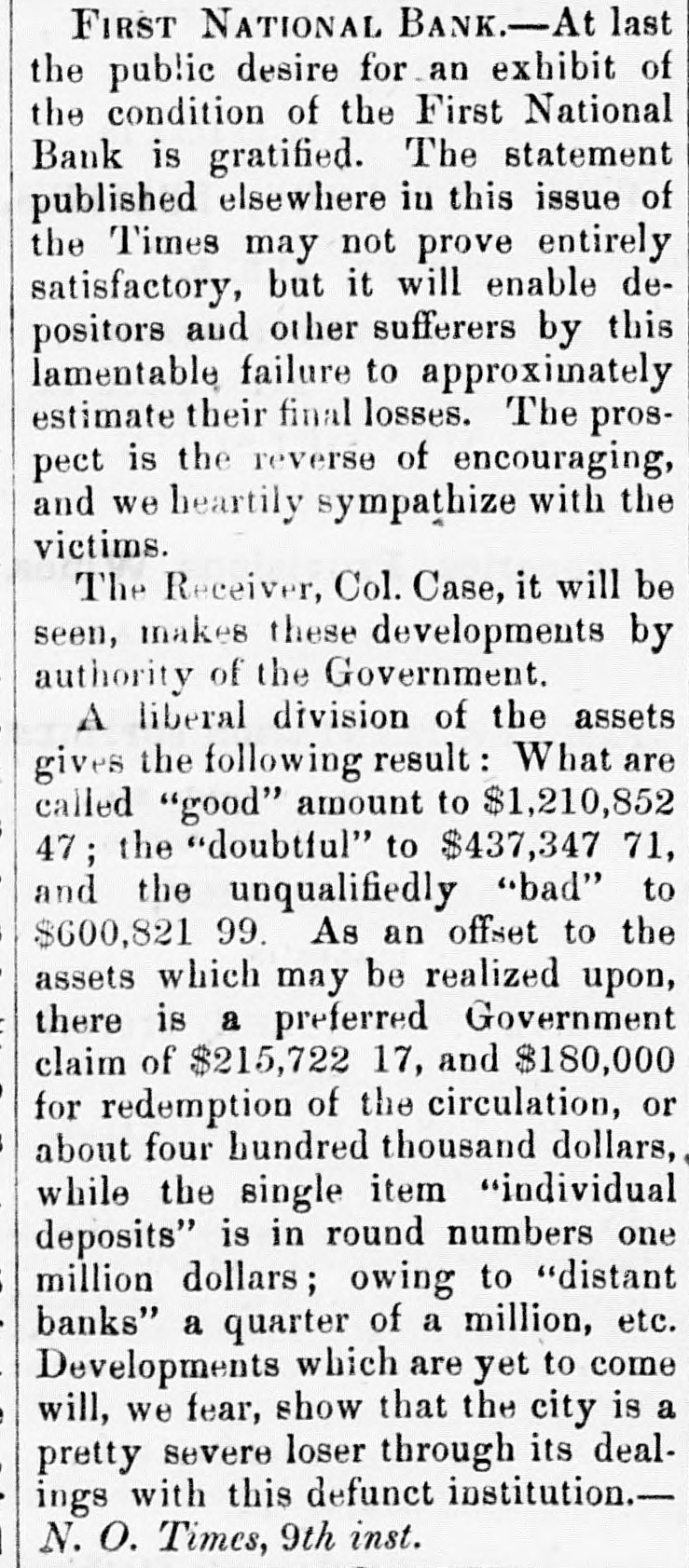
The Receiver of the First National Bank unhesitatingly pronounces the institution very rotten. ... The receiver, Col. Case, ... makes these developments by authority of the Government. (June 4–June 11 reports referencing Col. Case/Charles Case as receiver.)
Source
newspapers
6. June 11, 1867 Other
Newspaper Excerpt
Statement of assets: 'good' $1,210,852.47; 'doubtful' $437,347.71; 'bad' $600,821.99. Prospect is the reverse of encouraging ... development by authority of the Government (receiver's statement).
Source
newspapers

Newspaper Articles (24)

Article from The Daily Gate City, May 15, 1867

Click image to open full size in new tab

Article Text

FROM NEW ORLEANS. New ORLEANS, May 14. se ave BET 12 Two if portant decisions were rendered in the Sep Court of Louisiana yesterday. In the of Wainwright vs. Bridges, the, Court that no recovery can be had for for the purchase of slaves. In notes gime the case of Bowen vs. Racketlord, the Court holds, m previously, that no recovery could be had, as the notes were based on Confederate money, or in other words the money is illegal andfurther, the notes were signed before the passage of the stamp law and do Not a stamp to be usedas evidence. The First National Bank has been placed In the hands of the examiner, and all pay. ments suspended. Hon. Henry Wilson arrived to-day.


Article from The Daily Empire, May 15, 1867

Click image to open full size in new tab

Article Text

News by Telegraph and Mails. Gold again advanced in New York yesterday, closing at 1371/8. A Los Angelos telegram says a gentleman from Prescott, Arizona, reports the defeat of a company of United States troops by the Indians. Forty men were killed. The cash contributions for the indigent of the South raised in Pittsburg amounted to over $8,000. Mrs. Jefferson Davis has expressed laer intention to reside for some time in Norfolk, Virginia. Jefferson Davis left Richmond yesterday for New York, on his way to Canada, where his children areat present domiciled. The Democratic majority in Kentucky is over 42.000. The ultra-Radical Convention assembled yesterday, in Baltimore. It was a mixed affair of negroes and mean whites; the latter, now known as the plain people, were in the minority. An important decision was rendered in the Supreme Court of Louisiana yesterday, Wainwright vs. Bridges. The Court holds that no recovery can be had for notes given for the purchase of slaves. Thirteen thousand steerage passengers have arrived in New York from Europe since the 30th of April. There was a general run on the New Orleans banks, yesterday, growing out of the closing of the United States sub-treasury and First National Bank. The City National Bank has suspended. Moses A. Hawks, who killed his wife at St. Paul, to get the insurance on her life, has been indicted for murder in the first degree. The Rev. J. H. Young, minister of Trinity Church, New York, has been appointed Bishop of Florida. The Lexington races, yesterday, did not afford extraordinary sport. For the first two-mile heats, Colonel Alexander's horse, "Ansel," walked over the course. The second, handicap, mile and repeat, was won f by O. P. Beard's b. f., "Birty Bird," in 1:52 1/2 and 1:48. A monster bird of the pelican species was shot on the Yazoo a few days since. It measured nine feet seven inches from tip to tip-six feet three inches from point of beak to the feet, and its crop by actual measurement held a little over half a bushel of shelled corn. The firm of Barber & Hawley, perhaps the largest manufacturers of agricultural implements in Illinois, have failed. Attachments to the amount of $75,000 or more were levied on the assets of the firm at Decatur, on Friday. The night before, their branch shop at Pekin took fire and was burned to the ground. It is said the failure will be a very bad one.


Article from The Loyal Georgian, May 16, 1867

Click image to open full size in new tab

Article Text

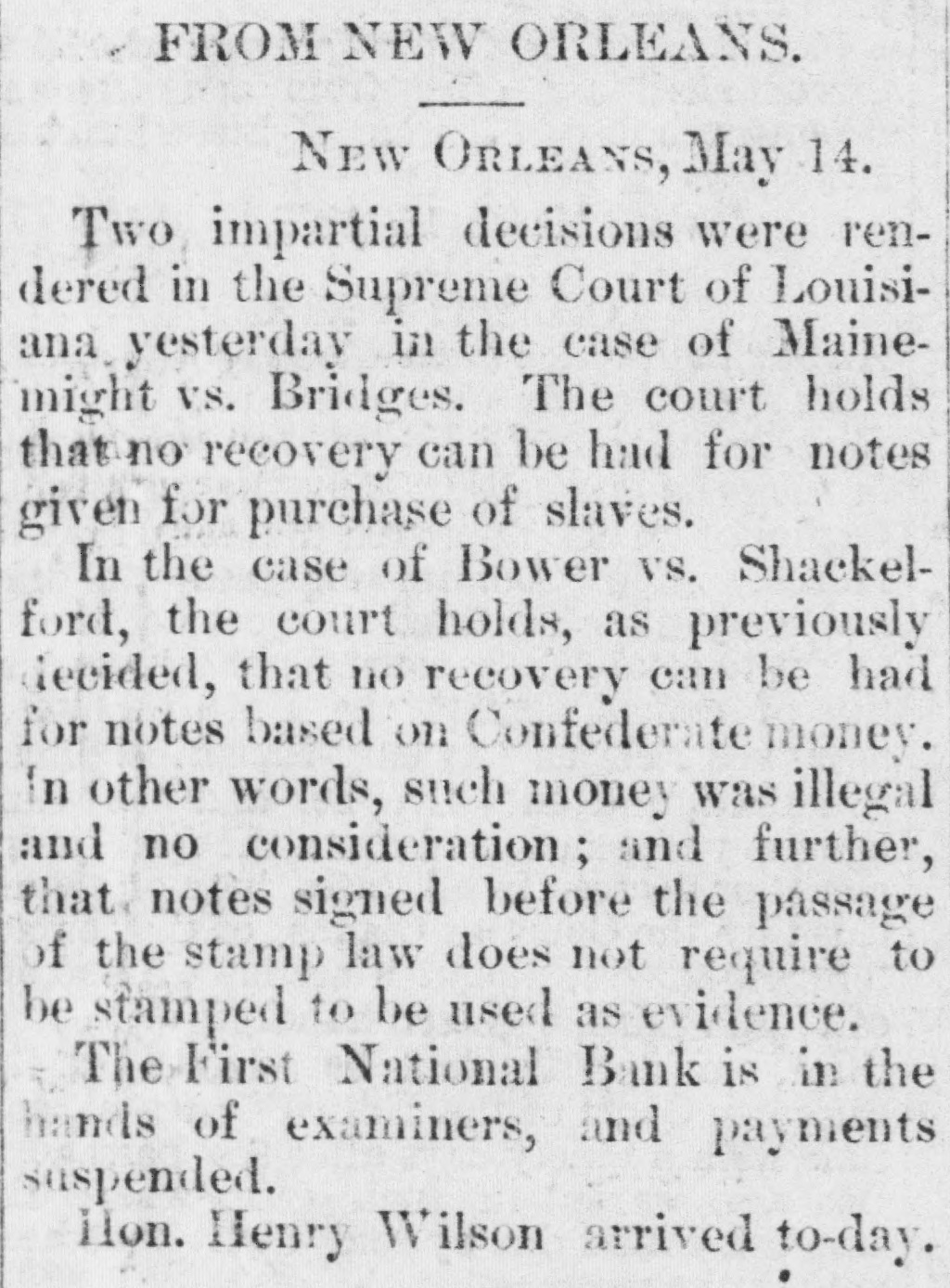
FROM NEW ORLEANS. NEW ORLEANS, May 14. Two impartial decisions were rendered in the Supreme Court of Louisiana yesterday in the case of Mainemight vs. Bridges. The court holds that no recovery can be had for notes given for purchase of slaves. In the case of Bower VS. Shackelford, the court holds, as previously decided, that no recovery can be had for notes based on Confederate money. In other words, such money was illegal and no consideration and further, that notes signed before the passage of the stamp law does not require to be stamped to be used as evidence. The First National Bank is in the hands of examiners, and payments suspended. ilon. Henry Wilson arrived to-day.


Article from Burlington Weekly Free Press, May 17, 1867

Click image to open full size in new tab

Article Text

New YORK, May 15. A special despatch from New Orleans yesterday, says there is great excitement there in financial circles caused by the closing of the U.S. sub-treasury, and 1st National Bank, by order of the Comptroller of Currency. Mr. Knox of the Treasury Department of Washington, has assumed the charge of the sub-treasury and has closed the bank. Heavy defalcations are already announced in both. L. Pillay, formerly subtressurer and President of the bank, made an assignment this morning of his effects to the extent of $1,250,000, to secure the government. The Banks held a large amount of paper of Gen. Herron, U.S. Marshal, but Mr Knox hopes to secure this out of Herron's distillery and plantation property. This excitement has caused a run on all the Banks and a very stringent money market. The Bank and Treasury have been surrounded by a crowd all day. The City national Bank suspended this evening. MOBILE, May 14. The Mayor and Common Council of Selma, Ala. were removed to-day by order of Gen. Swayne. The new officers appointed by tim were installed. DUBLIN, May 14--Eve. The death sentence of the Fenian prisoner Col. Burke, has been commuted to imprisonment for life at bard labor. BERLIN, May 14-Eve. The Crown Prince Frederick William, will leave for Paris during the present week, to attend the French Exposition. PARIS, May 14-Eve. Orders have been sent to the various military depots and headquarters throughout the Empire to disband the reserves which had recently been called into service. Luxemburg, May 14. The work of strengthening the fortifications of this city on which the garrison had for some time past been actively employed, has been discontinued by order of the Prussian commander at the post


Article from The Evening Telegraph, May 18, 1867

Click image to open full size in new tab

Article Text

The Financial Troubles at New Orleans. NEW ORLEANS, May 17.-Jacob Barker's Bank of Commerce could no longer sustain the run upon it, and suspended this morning. The assets of the First National are being examined by the stockholders and capitalists. There is every prospect of a resumption of business at an early day. The meeting of stockholders adjourned until Monday, awaiting the action of capitalists.


Article from The New York Herald, May 18, 1867

Click image to open full size in new tab

Article Text

NEW ORLEANS. SPECIAL TELEGRAMS TO THE HERALD. Threatening State of Affairs-Precauciomary Measures of the AuthoritiesPithy Speech of General Mower. &cc. NEW ORLEANS, May 17, 1867. General Sheridan telegraphed yesterday to General Hartsuff from Galveston, to issue an order forbidding all persons in this city from carrying firearms. Healso tele. graphed as follows:--"Let the firemen's festival go onHold troops in readiness to suppress a riot If necessary, keeping the Custom House as your base of operations, and if necessary call on the naval commander to place his ships opposite the foot of Canal street" The foregoing instructions are to be carried out, on the supposition that trouble in the city is andicipated. Gen. Mower addressed the rioters yesterday, when two hundred passed his headquarters on their way to the new Basin, brandishing clubs, and threatening to lynch the contractors there as follows:- If you feel yourselves wronged, you must apply to the proper authorities for redress, and you shall have it; but if you take this thing into your own hands, you may lose what rights you already possess. If you go on with this noting, by the eternal God I will throw grape and canister into you. Now, disperse, and go to your homes, or to your work." The mob immediately dispersed. There was a small affair of a like character 10-day, being an attempt on the part of the mob to prevent others from working. The police made several arrests. The military was reviewed to-day, and a gunboat has been ordered in front of the city. All is quiet. The Financial Troubles in New Orienna. NEW ORLEANS, May 17, 1867. Jacob Barker's Bank of Commerce could DO longer sustain the run upon it and suspended this morning. New ORLEANS, May 17-Evening. The assets of the First National Bank are being examined by the stockholders and capitalists There HS a very strong prospect of a resumption of businose as MD early day. The meeting of stockholdereadjourned until Monday. awaiting the action of capitalista.


Article from The Daily Dispatch, May 20, 1867

Click image to open full size in new tab

Article Text

New Orleans Bank Suspension-Order of General Sheridan, etc. NEW ORLEANS, May 17.-The Commercial Bank suspended this morning. Jacob Barker pledges real estates with an annual rental of $15,000, to cover the liabilities of the bank. An order was issued by General Sheridan this morning prohibiting the carrying of fire-arms by any persons except those authorized to do SO in the discharge of duty. Offenders are subject to trial and punishment by military commission. NEW ORLEANS, May 17-Evening.-The assets of the First National Bank are being examined by the stockholders and capitalists. There is a very strong prospect of a resumption of business at an early day. The meeting of stockholders adjourned until Monday, awaiting the action of the capitalists.


Article from The Louisiana Democrat, May 22, 1867

Click image to open full size in new tab

Article Text

A Financial Crisis. The suspension of the First National e Bank in New Orleans, and the heavy d run made on several of the other banking institutions, have caused much alarm in financial circles, and seem to give indications of an approaching financial convulsion. The tightness of y l the money market, the dearth in business of all kinds, and other premonitory symptons of a financial crash have been long felt, and have been expected to y bring forth their legitimate results.e And this state of things is not confined to the South. The complaints among Northern business men are as foud as e e among those of the South. The business of the country is 60 closely cons nected, that it is impossible to disturb $ that of one section, without the shock being felt in every other. The main cause of our present finan cial disorders is too plain to require any demonstaation of it. The finances of the country, in formertimes, were kept in a healthy condition by the immense value added to the national wealth by the agricultural products of the Southern States. That great source of wealth was virtually destroyed by the war. But if those who have had control of the government for the past two years had been actuated by proper motives, and had applied themselves to the task of reviving what had suffered so severely, the country would still be in a prosperous condition.But, by their revolutionary course, the South has been kept in a state of suspense and uncertainty, her labor system continually interfered with, her energies cramped, and foreign capital and foreign immigration, which would have contributed to her prosperty, kept from her borders. Political uncertainty has destroyed her industry, and the destruction of her industry has necessarily carried with it that poverty and distress which is inseparable from it. In the midst of these troubles there is one reflection which brings us some little consolation. We cannot suffer to a much greater extent than we have already suffered. Those who have the remedy in their own hands must feel the shock more keenly than we possibly can. The financial crisis which seems to threaten the country will open the eyes of the Northern people to the destructive doctrines of the party which now has control of the goverment. In place of the negro furore which has run the North mad, great financial questions will arise, which will swallow up all others, and on which political parties will divide. The re modelling of the present ruinous tariff, the overhauling of the rotten banking system of the country, and other matters, will cause such a division in the Republican ranks as forever to destroy the controlling influence of that party in the country. The great West and the South have identical interests and will soon refuse to submit to the class legislation which is building up the wealth of the East at their expense.Whenever the people of these two a great sections shall come to thoroughly understand their interest, they will form a perpetual union against the ex actions of the East, and will control the legislation of the country in all time to come. Radicalism will then have run its race, fanaticism lost its influence, and the peace and harmony of the country secured.


Article from The South-Western, May 22, 1867

Click image to open full size in new tab

Article Text

CARD. SHREVEPORT, LA., May 20, 1867. Messrs. Editors South-Western : Gentlemen-As many reports are and will, doubtless, be in circulation regarding financial affairs in New Orleans, having their origin in the suspension of the City Bank, the First National Bank and the Bank of Commerce, causing distrust in financial circles, I would state, as agent for the well-known and popular house of JOHN PHELPS & CO., that they are not in any way involved with these parties or others, and that I am amply prepared to make liberal CASH advances upon any amount of shipments of cotton or other produce to this house. I am also prepared to make liberal CASH advances on all cotton consigned to me for sale. D. B. MARTIN, Cotton Factor and Agent. my22 It


Article from The New York Herald, May 22, 1867

Click image to open full size in new tab

Article Text

THE COMMERCIAL CONDITION OF THE SOUTH. TO THE EDITOR OF THE HERALD. The failure of the First National Bank and the Bank of Commerce at New Orleans, following close upon the suspension of several large firms in the seaboard cities, are circumstances calculated to alarm the public as to the stability of commercial firms in the late rebel States, whose interests are more or less wrapped up with those of Northern and European houses. For many months much anxiety has been felt as to the financial and commercial interests of the South, and many have prophesied a general crash; but there is still hope that it may be averted. The collapse of the rebellion found commercial affairs in a chaotic state and many millions of Northern debts still standing against Southern merchants. The promptness with which most of these merchants came forward and met their obligations contracted before the rebellion gave new assurances to our importers of their honorable intentions, and consequently their old customers' orders were filled on long credit. Many new firms who had not been in the Southern market, anxious to compete with the old establishments, made large consignments on time to Southern cities. The Southern dealers, trusting their ability to meet their obligations, launched out into what they considered safe speculations. To do a strictly cash business ID the impoverished condition of the country was impossible; so the course generally pursued was to advance provisions and money to planters, taking a lien upon the crop as security for their indebtedness. Had the cotton and other staples yielded well in 1865-6-7, this system of mutual benefit would have worked admirably-the producer could have paid his hands, refended the money advanced by the Southern merchant, and had a respectable margin on which to work another year; the large amount due the importers would have been collected, and the South would have received a healthy start. The failure of the crops, however, has disarranged the entire commercial system of the Cotton States; the crop barely paid the expenses of labor employed to produce it, and, under an order from the Freedmen's Bureau, the freedmen had a first hen upon it; nearly the entire crop was swept away by them, and the planter and his creditor are the sufferers, Willing as the Southern merchant may be to pay his debts, be finds it impossible to meet his obligations to the importer, and hence a crash is imminent. As an evidence of the difficulties under which all commercial firms suffer, the fact may be instanced that one importing firm in this city have over $2,000,000 outstanding debts in the South that could be collected had the cotton crop of the past two years proved a bountiful one. A representative of the firm made a tour of the South, and succeeded in collecting but a few thousand dollars. Since the war closed over $5,000,000 have been invested in the planting interests of Mississippi, Louisiana and Alabama by the firm represented by General F. J. Herron, and it is to be presumed that but little has been realized on the amount invested. This is but a tithe of the Northern capital that has gone South to develop the country, and which as yet has not Kiven a return. It now becomes a serious matter of consideration as to what the results will be should the Northern importer force the payment of past obligations immediately. A commercial panic cannot be long staved off, and when it comes it is not the South alone that will feel the shock. It must extend North to those firms that are identified with the South. ern trade, many of which will, in all probability, be carried down with the crash. Tuere seems to be but one solution of the difficulty that presents itself. and that is for Northern importers to pause in enforcing their claims upon their debtors untir the return of another good crop, when it is safe to presume that all parties, by careful economy and caution, will be able to meet their obligations and a more healthy system be infused into the commercial oircles of the cotIMPORTER. ton producing States.


Article from Ellsworth American, May 24, 1867

Click image to open full size in new tab

Article Text

LOCAL NEWS, &C. Eight hour laws have been passed in three States. -Pre-ident Day of Yale College is in his ninety third year. --Hor Geo. Baucroft will accept the Prussian Mission. According to the latest Mexican news Maximillian is the "sick man just now. - Knickerbocker lobsters were plenty in our market on Monday. The Democrats carried Kentucky in the election for members of Congress. The weather continues cold and the prevailing winds have been from the Eastward. The Boston banks do not receive State bank bills after June 1st. Horace Greeley made a speech at the African Church. Richmond, Tuesday Evening. -The Evening Post of last Saturday says that prices of breadstuff< are rapidly declining. -Jeff. Davis is the guest of Charles O. Conner Esq. of New York. The Bangor Whig says the Foundry of Messrs. Estes & Whittier in that City has been purchased by Messrs. Wood. Bishop & Co. Ve call attention to the notice for the Annual Maine State Soldiers and Sailors Union to meet in Portland the 4th and 5th of June. We call attention to the Musical Festival or Convention to be held at Machias commence ing June 17th and continuing four days Marge number of Maine Free masons are expecting to go to Boston to attend the dedication of the Masonic Temple. ---The Hotels of Boston have closed their bars, and the State Constables are satisfied that it a clear ease, -Judge Kelley addressed a large crowd of Whites and Blacksat Montgomery, Ala. the 20th. Hewas listened to attentively. -Judge Kellev of Pennsy Ivania made a speech in Mobile Tuesday, which ended in: a riot. A number were killed. HALLINCT.-0 market was applied with fresh hallibut on Monday. the first of the season. It sold readily for 12cts. per lb., short weight. The first vessel loading at the wharves with lumber sawed this Spring, was the Sch. Delaware Capt. Wood. last week. The last lingering hope of a steamer to run union river in connection with the City of Richmond has been dissipated. The Clarion and Falcon are both mold. -There is a financial panic in New Orleans, caused by heavy defalcations in the First National Bank and the Sub Treasury. -It is said that President Johnson will visit Bost on in June, by water. It is healthy to get off the track, now and then. Congressman Bingham, who conducted the conspiracy trials, been employ by the government to conduct the trial of Suratt. -The New York Tribune thinks we ought to ask Count Gortschkoff how much he, or his Government will give the United States for its debt. It'It is rumored that the citizens of Trenton purpose to give Major General J. G. Blunt now on visit to his native town, a public reception on Monday. May 27th. We believe that Mr. Greeler is one of the most honest men we have and therefore we can not. as some do, take this occasion abuse him. He may be wrong, but he doesnot play the part of demagogue. Our advice squarely and openly to the Democratic party is. that on the 3d day ofJune one and all stay away from the Polls, and the Republican party decide the imprisonment let clause to suit themselves Machias Union. -Just as we supposed. If we had the right to advise the Democratic party we should by all mems say to "one and all go to the polls and vote like men, one way or the other. This will be manly, and honorable. Sont Whe is Secretary Seward like the ga Because he wasted his substance Prodi- in a fur country, -It is said that there is man in Cheshire gets Whose hair is so red that when he the morning the roosters think it is daylight up and begin to crow. be Envoy Baneron President of New Johnson York has appointed George nary and Minister Plenipotentiari Extraordideceased. ted States at Berlin, vice Joseph A. of the Wright. Uniat -The Castine Argussays the Abbot school house into be remodeled for the to is dation of the Normal school which N convene this fall at that place. d of Society Congregationalists The Argus correspondent says that the remodel their church this season. Castine, are : church. have fine vestry with a modern They littled will May : est to the tweigh West was day of unusual interRev. W. 11. Kelton Waterville Baptist church. the hand of fellowship baptised eleven. and 1 Others are expected to be baptised new soon. members rWest,the -In the first number of new necessary : loaned him editor the returns thanks to paper those who out State, . t, debt Vout had thanks been to abolished heaven that in capital. that imprisonment and also de- for r, to base -The ball New York Ecening Post clubs because object matches. and they thus people bet on the gambling. against The same objection became may means be of bet preaching as people have urged d outhe time a minister been take known in the been GOOD.-Rufus K. Larabee of Durham a. at convicted before the supreme Co has y and cattle Auburn of mutilating and butchering sitting mou in that town, and continuing horses his de. . work for some time. Hope he will get Hong sentence. the -"We execution are in favor of the Constitution planks of the law." was and The in the old "Bell and Everett one of the the State Constabluary are for the execution platform. I law against liquor selling. dent The Harris Brunswick has assumed Telegraph says Presj made duties as his President first Bowdoin the discharge College. of Saturday evening. appearance in the Chapel on He of formally introduced prayers. where be was t ris B. Sewall. made Acting President. students by Prof. casion. few remarks appropriate President to the Harf --Cultivator seeds One ficulty sometimes in of annual getting flowers find a difreadily. ing the seed remedy may be found by vegetate clean fine sand. when sown The in the flowe coveror silver sand. In dry best variety is the white til they even board may be laid over weather cloth FOR begin to push the seeds unwishes to L.M.-The dispose of Editor title of the Journal. Independent e came accidentally into his of Reverend which months ago, while traveling through posession the few


Article from Prescott Journal, May 25, 1867

Click image to open full size in new tab

Article Text

MISCELLANEOUS. Nearly 13,000 steerage passengers arrived at New York since the 30th of April. It is reported that France has purchased the rum Dunderburg. The Canadian government is said to have received information of another Fenian raid. The First National Bank in New Orleans has been placed in the hands of an examiner and all payments suspended During the quarter ending on the 31st of March last, 27,260 emigrants, arrived in the city of New York. Imports at the port of New York for the week ending the 11th, were $5,152,677, of which $1,351,621 were dry goods. The revolution in the interior of Co1 ombia has failed, the revolutionary troops haying returned to their allegiance. The government disbursements for the week ending the 11th were $2,233,236. Internal revenue receipts $2,073,429. The Board of Health, of New York city, has commenced the work of cleaning all buildings in an unhealthy condition. The work will be completed within thirty days.


Article from New-York Tribune, June 5, 1867

Click image to open full size in new tab

Article Text

LOUISIANA. UNIVERSAL SATISFACTION WITH GEN. AHERIDAN'S REMOVAL OF WELLS-BANKRUPTCY REGISTERS REJECTED. BY TELEGRAPH TO THE TRIBUNE. NEW-ORLEANS, June 4.-The removal of Gov. Wells by Gen. Sheridan, for directly or indirectly impeding the Commanding General in the faithful execution of the law, gives universal satisfaction in our community. Neither party had confidence or respect in him, and filled up petition after petition urging his removal. Influential Southern men telegraphed some time ago to the President, asking him to allow Gen. Sheridan to make a change. The appointment of Durant is highly indorsed by all of the press and people, irrespective of party. He is, unlike Wells, known to be anything but a political trickster and dishonest man, and dishonesty is more, than they must expect of him." Judge Durell has confirmed two of the nominations of Judge Chase for Register in Bankruptcy. Gov. Hamilton, and Mr. Kellogg. and the three others were rejected. Pending the nominations by Judge Chase, the others have filled their places, and will proceed at once to business. The Receiver of the First National Bank unheeitatingly pronounces the institution very rotten. It has leaked out that the following ingenious device was resorted to a short time since: to meet an examination which was ordered a few days before the bank closed, the accounts of the members of the clique who so freely used its funds being largely overdrawn, they were requested by the President to send in time bills drawn on somebody, somewhere, which were promptly credited, and their accounts balanced. These bills are still in the bank.


Article from Baton Rouge Tri-Weekly Gazette & Comet, June 11, 1867

Click image to open full size in new tab

Article Text

FIRST NATIONAL BANK.-At last the public desire for an exhibit of the condition of the First National Bank is gratified. The statement published elsewhere in this issue of the Times may not prove entirely satisfactory, but it will enable depositors and other sufferers by this lamentable failure to approximately estimate their final losses. The prospect is the reverse of encouraging, and we heartily sympathize with the victims. The Receiver, Col. Case, it will be seen, makes these developments by authority of the Government. A liberal division of the assets gives the following result: What are called "good" amount to $1,210,852 47 the "doubtful" to $437,347 71, to and the unqualifiedly "bad" $600,821 99. As an offset to the assets which may be realized upon, there is a preferred Government claim of $215,722 17, and $180,000 for redemption of the circulation, or about four hundred thousand dollars, while the single item "individual deposits" is in round numbers one million dollars; owing to "distant banks" a quarter of a million, etc. Developments which are yet to come will, we fear, show that the city is a pretty severe loser through its dealings with this defunct institution.N. O. Times, 9th inst.


Article from The Evening Telegraph, June 11, 1867

Click image to open full size in new tab

Article Text

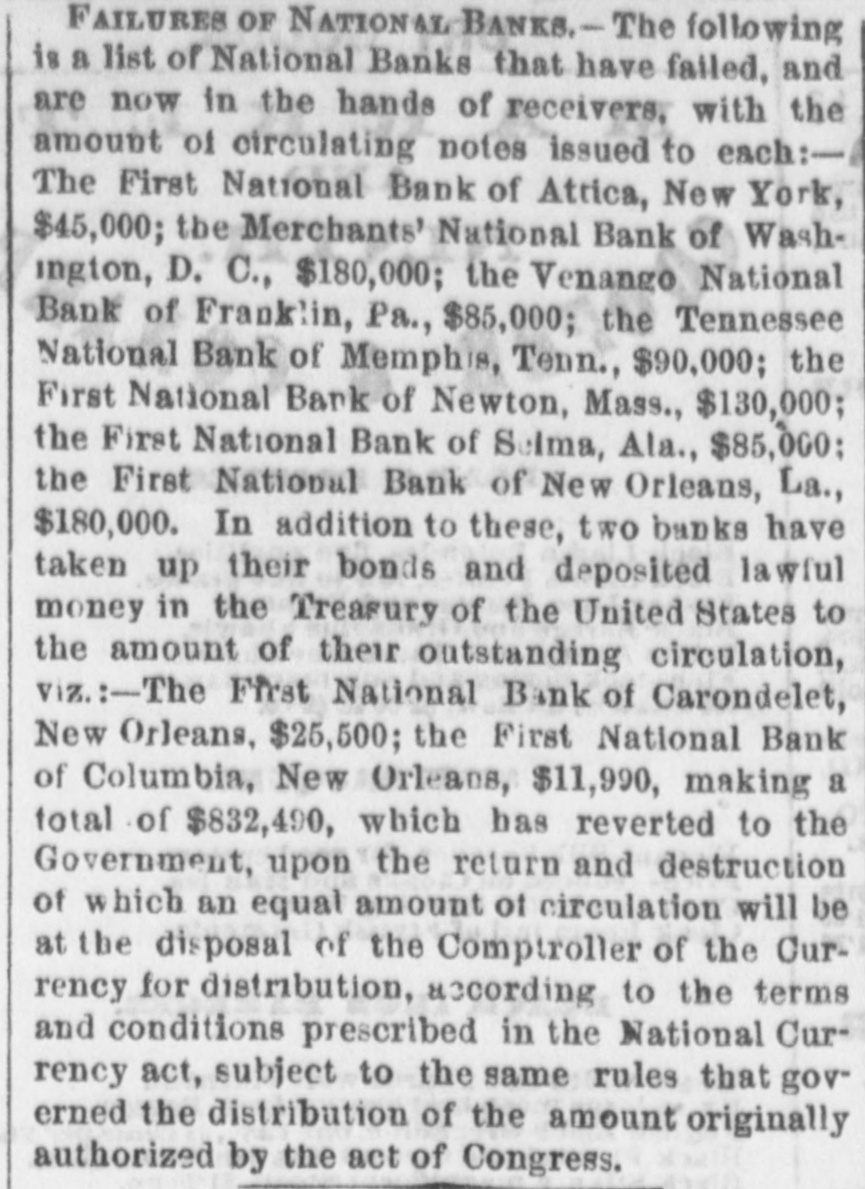
FAILURES OF NATIONAL BANKS. - The following is a list of National Banks that have failed, and are now in the hands of receivers, with the amount of circulating notes issued to each:The First National Bank of Attica, New York, $45,000; the Merchants' National Bank of Washington, D. C., $180,000; the Venango National Bank of Franklin, Pa., $85,000; the Tennessee National Bank of Memphis, Tenn., $90,000; the First National Bark of Newton, Mass., $130,000; the First National Bank of Selma, Ala., $85,000; the First National Bank of New Orleans, La., $180,000. In addition to these, two banks have taken up their bonds and deposited lawful money in the Treasury of the United States to the amount of their outstanding circulation, viz. : - The First National Bank of Carondelet, New Orleans, $25,500; the First National Bank of Columbia, New Orleans, $11,990, making a total of $832,490, which has reverted to the Government, upon the return and destruction of which an equal amount of circulation will be at the disposal of the Comptroller of the Currency for distribution, according to the terms and conditions prescribed in the National Currency act, subject to the same rules that governed the distribution of the amount originally authorized by the act of Congress.


Article from The New York Herald, June 11, 1867

Click image to open full size in new tab

Article Text

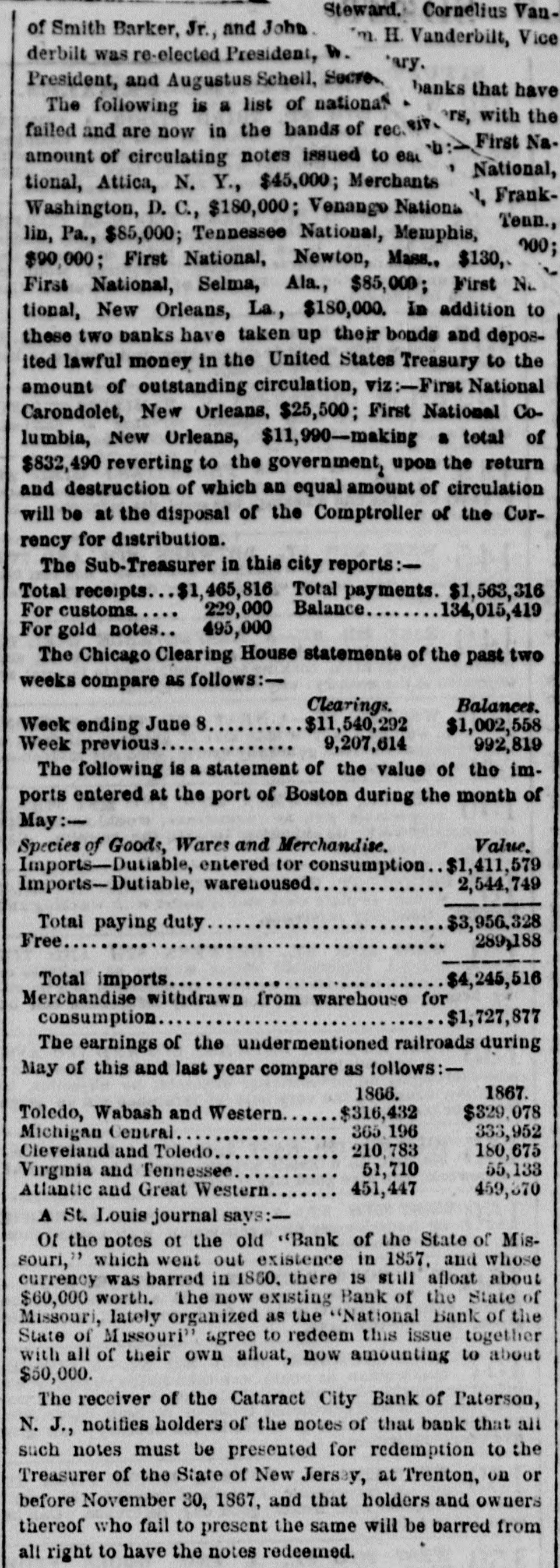
Steward. Cornelius Vanof Smith Barker, Jr., and John H. Vanderbilt, Vice derbilt was re-elected President, W. ary. President, and Augustus Scheil, Secre banks that have The following is a list of national rs, with the Bive failed and are now in the bands of rec. First Na. amount of circulating notes issued to eac National, tional, Attica, N. Y., $45,000; Merchants FrankWashington, D. C., $180,000; Venango Nationa Tenn., lin, Pa., $85,000; Tennessee National, Memphis, 200; $90,000; First National, Newton, Mass., $130, First National, Selma, Ala., $85,000; First N tional, New Orleans, La, $180,000. In addition to these two banks have taken up their bonds and deposited lawful money in the United States Treasury to the amount of outstanding circulation, viz:-First National Carondolet, New Orleans, $25,500; First National Columbia, New Orleans, $11,990-making a total of $832,490 reverting to the government, upon the return and destruction of which an equal amount of circulation will be at the disposal of the Comptroller of the Currency for distribution. The Sub-Treasurer in this city reports:Total receipts $1,465,816 Total payments. $1,563,316 For customs. 229,000 Balance 134,015,419 495,000 For gold notes The Chicago Clearing House statements of the past two weeks compare as follows:Balances. Clearings. $11,540,292 Week ending June 8 $1,002,558 9,207,614 Week previous 992,819 The following is a statement of the value of the imports entered at the port of Boston during the month of May:Value. Species of Goods, Wares and Merchandise. Imports-Dutiable, entered tor consumption $1,411,579 2,544,749 Imports-Dutiable, warehoused $3,956,328 Total paying duty Free 289,188 Total imports $4,245,516 Merchandise withdrawn from warehouse for $1,727,877 consumption The earnings of the undermentioned railroads during May of this and last year compare as follows:1867. 1866. $329,078 $316,432 Toledo, Wabash and Western 365,196 333,952 Michigan Central Cleveland and Toledo 210,783 180,675 51,710 55,133 Virginia and Tennessee Atlantic and Great Western 451,447 459,370 A St. Louis journal says:or the notes of the old "Bank of the State of Missouri, " which went out existence in 1857, and whose currency was barred in 1860, there 18 still afloat about $60,000 worth. The now existing Bank of the State of Missouri, lately organized as the "National Bank of the State of Missouri" agree to redeem this issue together with all of their own afloat, now amounting to about $50,000. The receiver of the Cataract City Bank of Paterson, N. J., notifies holders of the notes of that bank that all such notes must be presented for redemption to the Treasurer of the State of New Jersey, at Trenton, on or before November 30, 1867, and that holders and owners thereof who fail to present the same will be barred from all right to have the notes redeemed.


Article from The Daily Dispatch, June 12, 1867

Click image to open full size in new tab

Article Text

FAILURES OF NATIONAL BANKS.-The followis a list of national banks that have and are now in the hands of receivers, the amount of circulating notes issued each The First National Bank of Attica, Y., 845,000; the Merchants National Bank Washington, D. C. $180,000; the Venango National Bank of Franklin, Penn., $35,000; Tennessee National Bank of Memphis, Tenn $90,000; the First National Bank of Newton Mass., $130,000; the First National of Selma, Ala. $85,000; the First NaBank tional Bank of New Orleans, La., $180,000. In addition to these, two banks have taken up their bonds and deposited lawful money in the Treasury 01 the United States to the amount of their outstanding circulation-viz. : The First National Bank of Carondelet, New Orleans. $25,500 the First National Bank of Co. lumbia. New Orleans, $11,990; making a total $582,490 which has reverted to the Governupon the return and destruction of equal amount of circulation will be althe disposal of the Comptroller of the Currency for distribution, according to the terms and conditions prescribed in the national currency net. subject to the same rules that governed the distribution of the amount origimally authorized by the act of Congress.-New 1 to


Article from The Wheeling Daily Register, July 3, 1867

Click image to open full size in new tab

Article Text

THAT'S THE WAY THE MOXEY GOES.Town talk, in New Orleaus, is busy over a millinery bill of $11,000, run up since January by a leader of haute ton, one of rare beauty, whose hair is as bright and whose eyes as sunny as those of any lady in the land, but whose "great expeetations" have come to naught since the bottom fell out of the First National and Jacob Barker's banks. The "young man" in the case is a former Pittsburgher, later from Dubuque, an ex-Major General, the incumbent of what promised to be a fat public office at New Orleans. He can't pay, and the milliner has appealed to the Courts.


Article from The Jeffersonian, October 24, 1867

Click image to open full size in new tab

Article Text

National Banks Suspended. The following National Banks have passed into the hands of Receivers : Croton National Bank, New York. National Bank of Whitestown, Oneida co., New York. Atlas Bank of Providence, Rhode Island. Unadilla National Bank, Unadilla, New York. Kingston National Bank, Kingston, New York. Farmers' and Citizens' National Bank, Brooklyn, N. Y. First National Bank, Utica, N. Y. First National Bank Medina, N. Y. First National Bank, Columbia N. Y. Venango National Bank, Franklin, Pa Merchants' National Bank, Washing ton. D. C. Tennessee National Bank, Memphis, Tenn. First National Bank of New Orleans Louisana. First National Bank, Carondelet, Mo. First National Bank, Selma, Alabama Mrs. Jesse Craig of Island Falls, Maine made, in six weeks this summer, 50 pounds of cheese.


Article from New Orleans Republican, February 11, 1868

Click image to open full size in new tab

Article Text

# NEWS ITEMS. Hon. Joheil Raisback, of Bolivat county, has been nominated as the Republican candidate for representative from the second congressional district of Mississippi. General A. B. Norton is the Republican candidate for delegate to the Texas constitutional convention from Marion county. A. J. Evans, Esq., a talented young lawyer, is the candidate for McLennan county. The Houston Telegraph has had the good sense to reduce the daily to four pages instead of eight. Mammoth papers with little in them but dead advertisements are not sources of profit. A little paper well filled eis like a little farm well tilled. The First National bank of Houston had seven thousand dollars deposited in the First National bank of New Orleans at the time of its suspension. The chances of realizing half that sum are extremely dubious. On Saturday a single payment of one hundred and thirty thousand dollars was made to the city treasurer on account of sales of city property. The general appropriation bill reported in the house of representatives last week, appropriates for the war, navy, and other departments, including miscellaneous expenses, $90,000,000 in greenbacks, against an average of $70,000,000 in gold for the same objects under Buchanan's administration. This retrenchment proposition by the Republican congress does not please the Democrats who want a chance to raise the cry of "extravagance." A special Washington telegram to the Chicago Republican says that impeachment is again becoming popular in the house and senate, and that many Republican members of the house who have heretofore opposed impeachment are now inclined to vote for it. The schooner James Young arrived at New York from New Orleans on the sixth instant with a cargo of fourteen thousand bushels of corn, being the first cargo of grain ever shipped from here in bulk. There is a manifest disposition among the Republican senators to pass the reconstruction bill now before that branch of congress, providing that a majority of the votes cast shall be sufficient to adopt the constitution. The Alabama state election closes today. The Montgomery Sentinel says that on the first day of the election committees of the conservative party were at each voting place, adopting every expedient to mislead voters and prevent a full and fair vote. The Montgomery Sentinel, Republican, relates as an incident of the election that a colored man applied at the polls on Lawrence street to vote, who gave his name as Henry Clay. An inquisitive conservative asked what state he was from. He replied from Kentucky. When interrogated as to his relationship to the great Whig leader, he replied that he was a son of that statesman. On the steamboat Adam Jacobs above Cairo recently a woman named Hippendorf, emigrating with her husband from Germany to Chester, Illinois, gave birth to four children—two girls and two boys—while the steamer was ice bound. The children were named Addie Jacobs Hippendorf, Lovinia Hippendorf, W. Masson Hippendorf, and C. Nolte Hippendorf.


Article from New Orleans Republican, April 17, 1868

Click image to open full size in new tab

Article Text

First National Bank. Colonel Chase, the receiver of the First National bank of New Orleans has forwarded to us for publication the following copy of a letter from the Controller of the Treasury:


Article from The Morning Star and Catholic Messenger, May 17, 1868

Click image to open full size in new tab

Article Text

REVIEW OF THE WEEK. CITY COUNCIL.-The business transacted by both Boards of Council this week was unimportant. The Treasurer submitted a project for withdrawing city currency. He recommended the sale of the markets and wharves for three years; to collect the personal tax assessed for 1868, and levy a special tax of one per cent for 1869 and 1870 on real estate-thus the debt of $4,000,000 will be liquidated. Mr. Avegno submitted a lottery scheme looking to the same end, which was referred. A resolution was passed prohibiting the Treasurer from paying any more city money, and authorizing him to issue certificates of indebtedness instead. Mr. Sullivan urged the adoption of measures to secure a better supply of water. Mr. Kearney, lately appointed to the Assistant Board, took his seat, Mr. Dewees's resolution authorizing the City Surveyor to employ two hundred men to clean out the draining canals, was defeated by the casting vote of the President. JUDICIAL.-The only case of importance before our courts this week was that of the Receiver of the First National Bank against Robert Watson. The principle involved was of some importance. The defendent refused payment of a note held by the Bank, as it was held by Thomas P. May, and simply represented a transaction between May and James E. Duaham, given in the temporary absence of Dunham in place of another note of less amount, execu ted by Dunham in favor of May for three hundred and fifty shares of the capital stock of the bank, which stock May held as security, and which he continued to hold. Therefore May was the real debtor of the bank. The history of this transaction exhibits some sharp practice, not unusual among keen financiers, and the intricacy of which it would not pay to endeavor to elucidate in the present case. We will therefore merely give the decision of the Court: In this case, the Court having duly comsidered the pleadings and evidence, and being of opinion that the law and the evidence are in favor of defendant, it is adjudged and decreed that there be judgment for the defendant, Robert Watson, with costs. SEWERAGE.-Loud complaints have been rung in the ears of the authorities respecting the obstructed and defective sewerage of the city, hitherto unavailingly Now, it is almost too late in the season to un dertake a thorough reparation and cleansing, for experience has taught us that it is highly prejudicial to health to expose to summer sun the excavations of our soil. Still, something should be done to secure even a better sanitary condition of the streets and yards. IMPORTANT ARREST.-On Friday night two Spaniards were arrested at the Orleans hotel by the city police, who had in their possession $150,000 in gold nuggets, supposed to have been stolen from a bank in the city of Mexico, some months ago. A large reward, it is understood, has been offered by the parties on whom the theft was committed.


Article from New-York Tribune, December 2, 1872

Click image to open full size in new tab

Article Text

curity, or as collateral security, for any loan of money, or for a consideration shall agreeAto withhold the same from use, or shall offer or receive the custod or promise of custody of such notes as security, or as collateral security or consideration, for any lloan of money." 5th of April last the Controller was advised that bank On the in the City of New-York, with a capital of $1,000,000, a and whose average exchanges at the Clearinghouse did not exceed $300,000, was that morning creditor at the Clearing-house for $4,770,000. A8 it was evident that this large credit was not the result of legitimate business, the examiner was directed to make an exam ination of the bank, which was immediately done, 114 connection with a member of the Clearing-house committee. From the examination, which was thoroughly and carefully conducted, it appeared that deposits had been made in that bank, by one individual, upon the morning of April 5 to the amount of $4,100,000, the whole of which was drawn out upon the same day, upon the checks of the depositor, in legal-tender notes. The president of the bank denied that the bank had any interest in these trans actions, and there was no evidence of any loan, or of ad. vances in any shape. upon these deposits. These traus actions were the subject, subsequently, of an investiga tion by the Bank Committee of the House of Represent tarives, and, although it was clear that the spirit of the law had been violated, no evidence could be obtained to warrant the commencement of a suit for the recovery of the penalty prescribed in the act referred to. The in vestigation undoubtedly had the effect to prevent the repetition of similar transactions; no offenses of this been kind, on the part of any national bank, having since brought to the attention of the Controller. The New-York Clearing house Association subse quently passed a resolution declaring "that the Clearinghouse Committee be and is hereby directed, whenever it appears, in its judgment, that legal-tender notes have been withdrawn from use through the agency of any bank, members of the association, to make an immediate examination of the bank in question, and should there appear to be complicity on the part of the bank or its officials, to suspend said bank from the Clearing house until action of the association shall be taken there on." The withdrawal of currency for illegitimate purposes has, however, since been accomplished without the assistance of the banks. The rigid enforcement of the resolution of the Clearing-house will prevent complicity on the part of banks in such transactions; and it the New-York Stock Board and the leading banking houses will unite with the Clearing-house, and refuse to transact business with unserupulous men. who do not hesitate to embarrass legitimate business for the parpose of increasing or diminishing the values of stocks or bonds in which they are temporarily interested, they can do more to prevent such operations team any Congress enactment. INSOLVENT BANKS. Twenty-one national banks, organized in 11 different States, with an aggregate capital of $1,236,100, have failed since the organization of the system in 1863 The total circulation of these banks was $2,942,793. of which $2,441,430 has been redeemed in full, leaving a belance still outstanding of $501,363, which will also be redeemed, upon presentation to the Treasurer of the United States, from the avails of United States bonds held as security for that purpose. Of these banks, five have been finally closed (two during the past year), baying paid dividends to their ereditors. Six national banks have fatted during the past year. New-York: Of these, the Union Square National Bank, the Fourth National Bank, Philadelphia, and the Waverley National Bank, New-York, have paid their creditors in full-a settlement, it is believed, without a precedent prior to the establishment of the national system. The Eighth National Bank, New-York, has paid dividend of 50 per cent; the Ocean National Bank, New-York, a dividend of 70 per cent; and the receiver of the Ocean National Bank, and of the First National Bank of Fort Smith, Ark., estimate that the creditors of both these banks will últimately receive a dividend of 100 cents on the dollar. The Venango National Bank of Franklin, Penn.: the Merchants' National Bank of Washington. D. C. the First National Bank of Selma, Ala., and the First National Bank of New-Orleans, were United States depositories. e-final dividend in favor of the creditors of the First National Bank of Vicksburg has been unexpectedly delayed by the recent presentation of a claim of the United States for money alleged to have been illegally deposited by the Collector of Internal Revenue of that district, in the year 1868. Since that time no lesses have occurred to the Government by deposits made in the national banks, although many millions of dollars have been continually on deposit with banks which are designated as depositories. The three a first-named banks, at the time of their failure, had large amount of Government funds on deposit. SURPLUS AND SPECIE-EXTENDING THE LIMIT OF SURPLUS. The law requires that every national bank shall carry one-tenth part of its profits to surplus-fund account before the declaration of a dividend, until the same shall amount to 20 per cent of its capital stock. This wise provision has been generally observed. and the returns show that the banks now have a surplus of more than $100,000,000, and considerably more than onefifth of their capital in surplus account. The act also limits the liabilities of any association, person, com pany, or corporation, for money borrowed, to one-tenth of the capital stock paid in. The Controller recommends that this limit be extended to one-tenth of the capital and surplu. which will have a tendency to 10. crease the surplus fund beyond the limit required by the law. The following table will exhibit the aggregate amount of specie held by the national banks at the dates mentioned, the coin, coin certificates, and checks payable coin held by the national banks of the City of New York being stated separately. The country banks have not heretofore separated coin in their reports: -Held NationalsBanks in New- City.-
Article from The New Orleans Daily Democrat, November 8, 1879

Click image to open full size in new tab

Article Text

THE FIRST NATIONAL BANK. Presidents and Its Liquidators-A Lon Looked-fer Dividend. Tothe Editor of the Democrat: In May, 1867, just twelve years and a he ago, the First National Bank of this city WI seized by John Jay Knox, the Controller he Currency, when It was placed in the han of Charles Case, as receiver, for liquidatio Benjamin F. Flanders was the first presiden and A. G. Graham cashier during his admi stration. Mr. Flanders retired from ti presidency of the bank, owing It about $800 which was never paid. Recently the claim was sold at public auction for the paltry sui of $1000. Mr. Flanders is now United Stat sub-treasurer for Louisiana. A. G. Graham, the cashier, was then el vated to the presidency of the bank. J. P. May was United States sub-treasur for Louisiana. resigned that position an was appointed president of the bank. J. 1 May le the one who was a defaulter to ti government of over a million dollars. 1 subsequently left the bank, owing It fro $80,000 to $ 00,000. John S. Walton, the next succeeding pres dent, was also United States sub-treasur for Louisiana: he who was city Administrate of Finance in Warmoth's time, and at la cashier of the bankrupt Leuisiana Saving Bank. Mr. Walton, when he left the pres dency of the First National Bank, owed f overdrafts between $8000 and $10,000. Dr. Forbes was the last president of t1 bank, for It was during his administratic that the bank was seized. Dr. Forbes hr also, like his predecessors, illegally abstract moneys from the bank, and left owing $15,00 The agents of the government came here I May, 1867, and after investigating the affati of the bank declared that it was injudicious managed and irregular in Its transaction Upon the agents' report the bank was selze During the years 1867 to 1874, a period seven years, three dividends were declared i avor of the depositors, amounting in all 1 about per cent. Since that time no furth dividends have been made, although Contro or Knox admitted more than eighteen month that he had funds sufficient to permit ai other dividend, but the unfortunate creditor of the bank have waited anxiously in the val hope that Mr. Controller Knox would pay 1 she depositors the money. 80 cruelly detaine him to their prejudice. It was vainly supposed that when the su against the Carrollton R allroad Company fo ver three hundred thousand dollars was de ided adversely to the bank, that there wa 10 reason to delay the final adjustment. I May last Judge Billings, he of the Unite States court, gave an order for the sale of a he remaining assets of the bank. On th 1fth day of July last the entire assets, in ao ordance with the order of the court, wer old at public outery; and yet up to this hou 10 dividend has been declared. The liquida has been meandering through a term o early thirteen years, at a gain to th iquidators of many thousands yearly and at a cost to the defrauded deposi ors of over $150,000, and independen this extravagant expenditure ther till remains in the hands of John J. Kno bout $100,000 to the credit of the liquidation addition to that sum be It known tha hecks for $60,000 to $70,000 were issued to cer ain persons for dividends, which checks, fo easons not easily explained, remain to thi lay unclaimed; consequently, in addition t he $100,000 before mentioned. there must b this time fully $170,000 in the hands o Mr. Knox that ought to be paid to the cred tors, and as the entire assets of the ban have been realized since May last, now ove six months, Mr. Controller Knox car have n valid excuse to withhold from the lawful cred tors the moneys which he appears 80 relue ant to part with. Before closing these re narks. I shall mention A single instance (on