Washington National Bank (Pittsburg, PA)

Episode Information

Episode UID
672501273
Episode Type
Run Only
Bank Type
national
Bank ID
67250 national
Charter Number
6725
Start Date
January 16, 1906
Location
Pittsburg, Pennsylvania (40.441, -79.996)

Metadata

Model
gpt-5-mini (chosen from majority vote of a three-model LLM ensemble)
Short Digest
a9f82c3f4a3c8926

Response Measures

Accommodated withdrawals, Borrowed from banks or large institutions, Public signal of financial health

Events (3)

1. April 16, 1903 Chartered
Source
historical_nic
2. January 16, 1906 Run
Cause
Bank Specific Adverse Info
Cause Details
Mysterious disappearance of the cashier (rumors of defalcation/absconding) prompted depositors to withdraw funds.
Measures
Every depositor making application for his money was paid; bank displayed large amounts of specie to reassure depositors.
Newspaper Excerpt
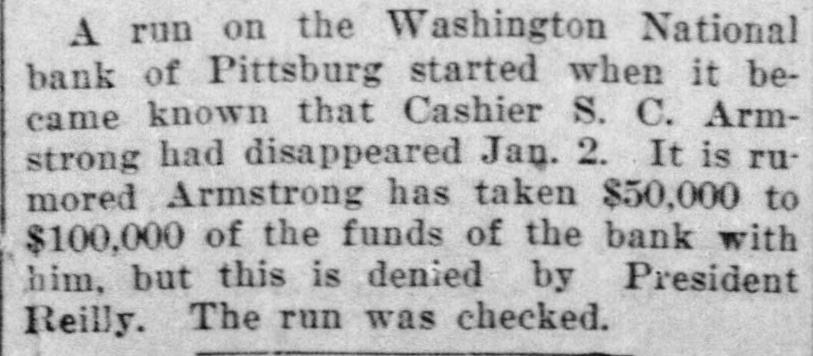
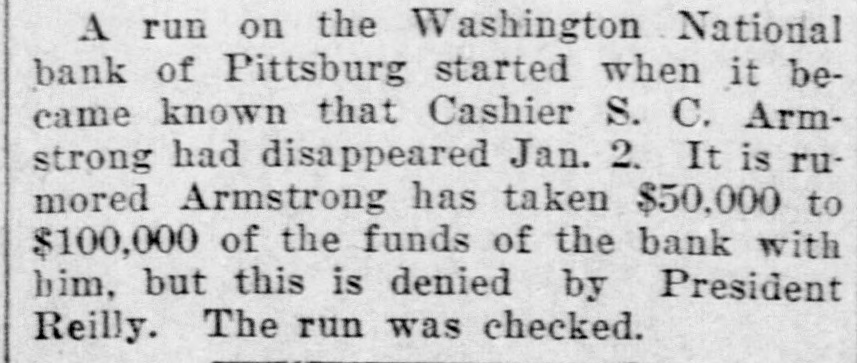
As the result of the mysterious disappearance of S. C. Armstrong, cashier of the Washington National Bank of Pittsburg ... the depositors, mostly foreigners, started a run on the bank last evening.
Source
newspapers
3. May 23, 1910 Voluntary Liquidation
Source
historical_nic

Newspaper Articles (11)

Article from Deseret Evening News, January 16, 1906

Click image to open full size in new tab

Article Text

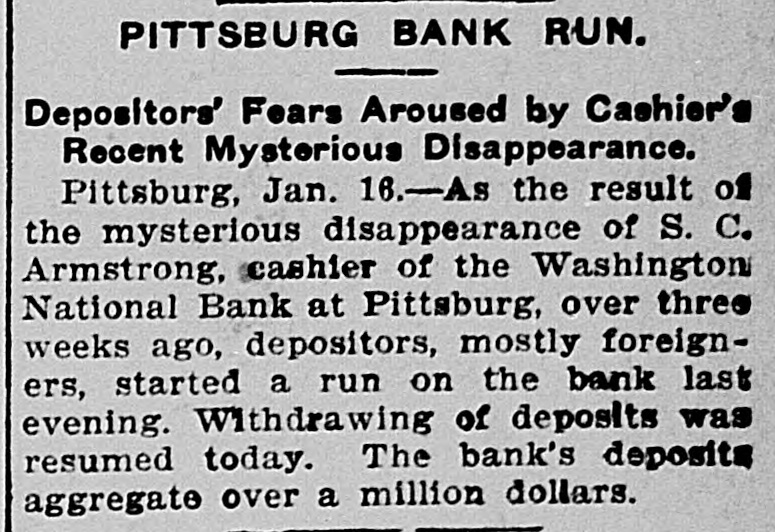
CASHIER DISAPPEARS. RUN ON BANK STARTS. Pittsburg, Jan. 16.-As the result of the mysterious disappearance of S. C. Armstrong, cashier of the Washington National Bank of Pittsburg, over three weeks ago, the depositors, mostly foreigners, started a run on the bank last evening. The withdrawing of deposits was resumed today. The bank's deposits aggregate over $1,000,000. The officials said today that the cashier has been missing for more than three weeks, but stated emphatically that there was no discrepancy in his accounts. Every depositor making application for his money was paid and the bank officials say there is plenty of funds to meet any demand which may be made. Mr. Armstrong has always borne a good reputation.


Article from The Topeka State Journal, January 17, 1906

Click image to open full size in new tab

Article Text

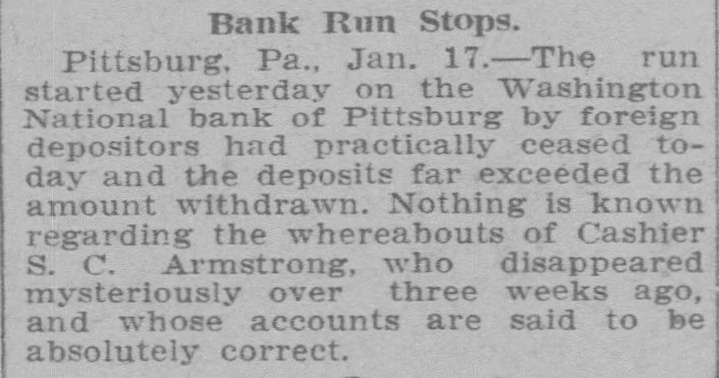
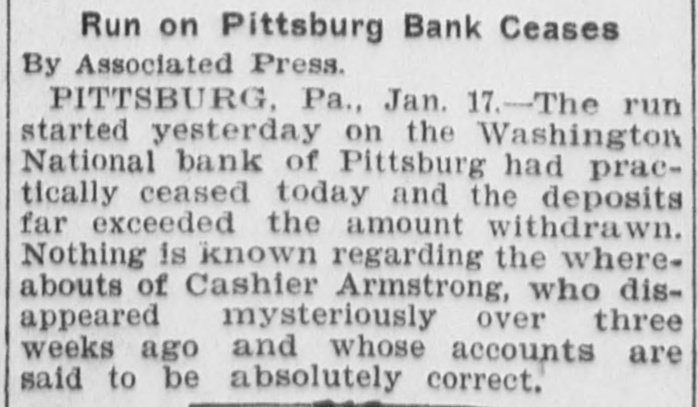
Bank Run Stops. run Pittsburg, Pa., Jan. 17.-The started yesterday on the Washington National bank of Pittsburg by foreign depositors had practically ceased today and the deposits far exceeded the amount withdrawn. Nothing is known regarding the whereabouts of Cashier S. C. Armstrong, who disappeared mysteriously over three weeks ago, and whose accounts are said to be absolutely correct.


Article from Rock Island Argus, January 17, 1906

Click image to open full size in new tab

Article Text

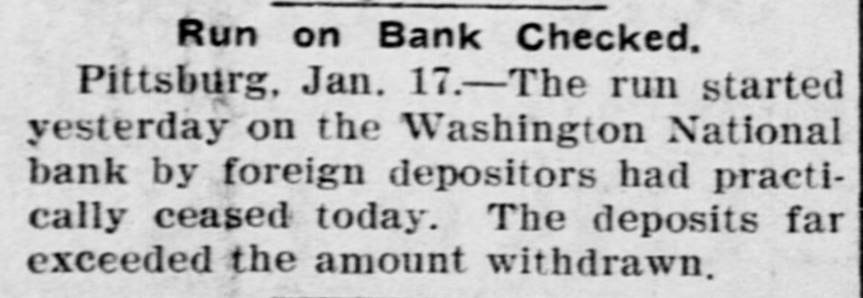
Run on Bank Checked. Pittsburg, Jan. 17.-The run started yesterday on the Washington National bank by foreign depositors had practically ceased today. The deposits far exceeded the amount withdrawn.


Article from Los Angeles Herald, January 17, 1906

Click image to open full size in new tab

Article Text

RUN ON A PITTSBURG BANK Disappearance of Cashier Frightens Depositors, Most of Whom Are Foreigners By Associated Press. PITTSBURG, Pa., Jan. 16.-As the result of the mysterious disappearance of C. S. Armstrong, cashier of the Washington National bank of Pittsburg over eight weeks ago, the depositors of that institution, mostly foreigners, started a run on the bank last evening. The withdrawing of deposits was continued today. The bank's deposits aggregate over $1,000,000. The officials said today that the cashier had been missing for more than three weeks, but stated that his accounts were in good shape. Every depositor making application for his money was paid. At the bank this afternoon it was stated that the run was small and would have no serious effect.


Article from The Salt Lake Tribune, January 17, 1906

Click image to open full size in new tab

Article Text

Records Mutilated. Aside from the shortage shown. the Morris report makes sensational disclosures concerning the erasure of the "State property" stamp from the backs of coupons and the mutilation of records in the offices of the State Treasurer and State Auditor. Thomas T. Kelly, the present State Treasurer, will tonight Issue a statement in reply to the charges made against him in the report. CASHIER GONE, RUN STARTS Pittsburg Bank Officials Say Affair Is of No Consequence. PITTSBURG, Jan. 16. - As the result of the mysterious disappearance of S. C. Armstrong, cashier of the Washington National bank of Pittsburg, over three weeks ago, the depositors, mostly foreigners, started a run on the bank last evening. The withdrawing of deposits was resumed today: The banks deposits aggregate over $1,000,000. The officials said today that the cashier has been missing for more than three weeks, but stated emphatically that there was no discrepancy in his accounts Every depositor making application for his money was paid, and the bank officials say there is plenty of funds to meet any demand which may be made. Mr. Armstrong has always borne a good reputation Say It Has No Effect. At the bank this afternoon it was stated the run was small, and would have no serious effect. The large depositors, it was said, are paying no attention to the matter.


Article from Ottumwa Tri-Weekly Courier, January 18, 1906

Click image to open full size in new tab

Article Text

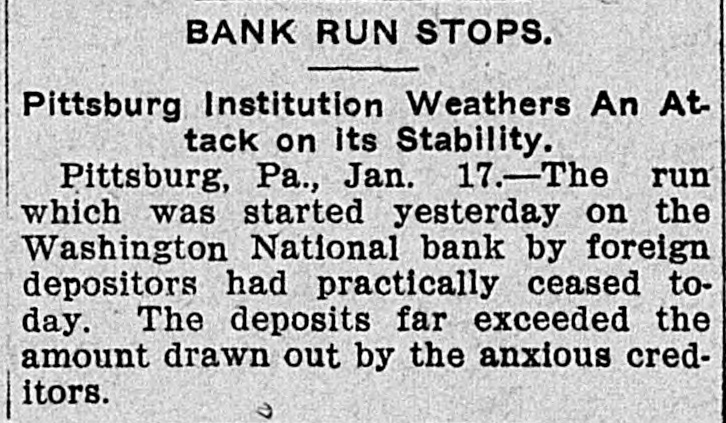
BANK RUN STOPS. Pittsburg Institution Weathers An Attack on its Stability. Pittsburg, Pa., Jan. 17.-The run which was started yesterday on the Washington National bank by foreign depositors had practically ceased today. The deposits far exceeded the amount drawn out by the anxious creditors.


Article from The Cairo Bulletin, January 18, 1906

Click image to open full size in new tab

Article Text

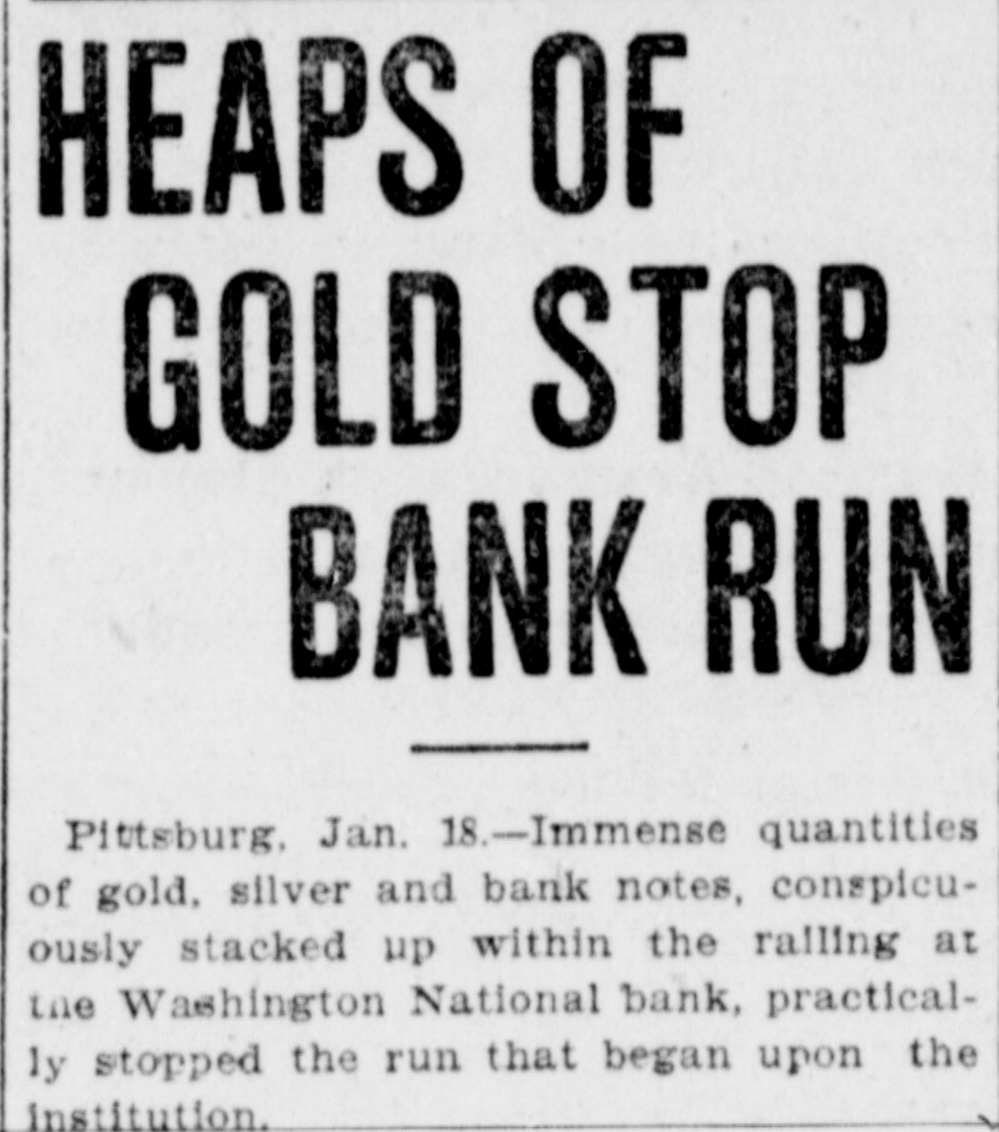
DEPOSITORS AWED BY PILES OF GOLD IT STOPS RUN ON BANK OF PITTSBURG FOLLOWING FLIGHT OF CASHIER. THE STORY IS DENIED By President That Missing Man Ab. sconded With Sum Rumored From $50,000 to $100,000. Pitsburg, Pa. Jan. -The run on the Washington National bank of Pittsburg, which began yesterday afternoon, continued throughout all today, but tonight it is thought the run has been broken. The sight of immense piles of gold, silver and bank notes piled inside the bank railings all days appears to have a good effect on the army of depositors, who dash. ed for the bank at all hours today, bank book in hand. The run was brought about by infor mation coming to depositors of the bank that Cashier S. C. Armstrong had disappeared some time ago and that every effort had ben made by the officers of the bank to keep this from the public. Th's was true. It developed that Cashier Armstrong mysteriously disappeared from the bank on the aftternoon of January 2. Since that time the authorities in different parts of the country have been loking for him. A poster with his picture and description has been sent out by Super intendent of Detectives McQuade, who tonight offered $200 reward for information regarding his whereabouts. Defalcation Rumored. The information also came to the stockholders that Armstrong had absconded with from $50,000 to $100,000 of the bank's money and it was this that started the run. When President Reilly tonight reached a spot where he could breathe he denied that Armstrong had taken one cent of the bank's money. He said the cashier had simply di sappeared mysteriously and that his accounts were found to be in the best of shape. President Reilly admitted that he had suppressed the news of the cashier's disappearance to prevent a run. When the run opened shortly after noon yesterday there were scores of depositors who drew their money be fore time for closing the bank. It was seen that the reaf trouble would come this morning when those who had heard the story of the missing cashier and the rumor of defalcation had time to scatter the inf rmation and the bank people made haste to get in shape to meet any contingency It is tonight claimed that as early as noon yesterday word was sent to New York for a consignment of money to be rushed to Pritsburg to meet the expected run. When the doors of the bank swung open at 9 o'clock this morning to ad mit about 100 scired depositors the counters simply groaned under the weight of gold and silver. One of the bank employes admitted tonight that there was just $700,000 in sight when the bank opened. The story that the bank was re-inforced by almost $1,000. 000 during the night finds credence in Pittsburg. Awed By Piles of Money. The money in sight seemed to have a good effect on the depositors, and the line soon fell off. but depositors kept coming all the day in little knots. One Hebrew merchant had been out of town when he heard of the cashier having gone, and he ran all the way from the country, almost dropping from exhaustion as he landed in the bank with his book. He took it all out and had to have three friends help him carry the money home. for his account netted $14,000. It was said at the bank this evening that as soon as the same merchant got his breath he came back with the money There were several scenes like this. but by the time to close the bank this even ing the scare seemed to have sub idea The Washington National Bank is considered one of the best banks in the vicinity of Pittsburg though a comnaratively young affair. It was organ ized in April, 1903. with a capital of $200,000. In connection with a trust company operated by the bank it has on deposit. according to last reports $1,250,000. John C. Reilly, the prestdent. is one of the city's most substan tial men and John Larkin city com troller, is one of the directors. There are no city or state funds in the bank


Article from Ottumwa Tri-Weekly Courier, January 18, 1906

Click image to open full size in new tab

Article Text

BANK RUN STOPS. Pittsburg Institution Weathers An Attack on its Stability. Pittsburg, Pa., Jan. 17.-The run which was started yesterday on the Washington National bank by foreign depositors had practically ceased today. The deposits far exceeded the amount drawn out by the anxious creditors.


Article from The Fulton County News, January 24, 1906

Click image to open full size in new tab

Article Text

THE LATEST NEWS BRIEFLY TOLD. DOMESTIC At a conference of representatives of the insurance departments of a dozen states and the Armstrong investigating committee in New York a movement was begun for uniform insurance laws in all the states. F. C. Hollister and A. W. Gentry, whose wives have recently been murdered in Chicago, appeared together before the grand jury to give evidence which led to the indictment of the two alleged murderers. Former Gov. James H. Peabody, wife and daughter, at Canyon City, Col., were food eaten at poisoned by breakfast. several The Governor recently received threatening lettlers. Capitalists of Duluth, Minn., have secured control of 1,700,000 acres of timberland in the Bahama Islands and lumbering operations will begin at once. A Philidelphia coroner's jury gave a verdict that Mrs. Anita McMurrow, who claimed to be the Countess de Bettancourt, died of heart disease. Henry Lear, former president of the (Pa.) National Bank, which Doylestown was five in the failed, sentenced to years penitentiary. A great library instead of a chapel may be established in Chicago as a memorial to President Harper. A score of people were injured, some seriously, by the fall of a part of a balcony during a minstrel performance at Fields' Opera House, Washington, Ga. The trial of a number of weighmasters at the Chicago Stockyards, accused of defrauding shippers, was begun. One of the men confessed. The wage scale committee of the Mineworkers' Convention is in receipt of large numbers of resolutions demanding an increase in wages. A crash of freight trains at Newton Falls, O., caused the death of two men and the fatal injury of a third. Heavy snow caused a railroad wreck near Denver, Col. Coroner Mix, of New Haven, Conn., has rendered a final decision, concurred in by the state's attorney, that Charles E. Edwards committeed suicide with laudanum and a bullet, owing to insomnia. At the request of Senator David B. Hill, the Bar Association of New York is investigating the payment of a $5,000 fee to the Senator by the Equitable Life Assurance Society. The government wireless telegraph station at Cape Elizabeth, Me., has received a message from the Dewey drydock tow that traveled 3,000 miles, breaking all records for distance. An official of the city of Chicago tied up two traction lines for two hours, claiming that open gates on the cars imperiled the lives of passengers. L. W. Burlen, secretary-treasurer of the Provident Securities and Banking Company, of Boston, has gone to Canada. The city of Chicago has sued two traction lines for overcrowding street cars. Four workmen in a tunnel under East River, New York, were drowned or suffocated by a bursted air pipe failing to keep up the required air pressure and permitting water to enter and flood a shaft. President Mitchell, of the United Mineworkers, in addressing the annual convention in Indianapolis, urged a demand for higher wages. The operators have agreed to meet Mitchell in conference. W. M. Wolfe, professor of theology in Brigham Young College, has renounced Mormonism, having found that the elders are still marrying plural wives in Mexico. The liabilities and forged stock certificates of Denison, Prior & Co., of Cleveland, now amount to $3,000,000. Knowledge that the cashier is missing caused a run on the Washington National Bank of Pittsburg. Mrs. Casie L. Chadwick, now in the Ohio penitentiary, has been put to work sewing buttonholes.


Article from Pierre Weekly Free Press, January 25, 1906

Click image to open full size in new tab

Article Text

Domestic. The general assembly of the Presbyterian church in the United States has appointed Jan. 25 as the day of prayer for schools and colleges throughout the country. A marriage license was issued at Noblesville, Ind., to Ellis Carey, 27 years old, and Mary Gentry, aged 47. Mr. Carey's first wife, who died a year ago, was a daughter of his present wife. The National Hardwood Manufacturers' association has elected William Wilms of Chicago president. The association decided to increase the price of hardwood from $1 to $2 per thousand. Joseph Brennan, an actor, was shot and probably fatally wounded in a quarrel with Michael J. Walsh, also an actor, at Chicago. Walsh surrendered to the police He says he acted in self-defense. W. M. Wolf, professor of theology in Brigham Young college, a Mormon institution at Logan, Utah, has caused a stir in Mormon circles by renouncing his belief in the Mormon faith, refusing to pay tithes and severing his relations with the college. As the result of the mysterious disappearance of F. C. Armstrong, cashier of the Washingt National bank of Pittsburg over three weeks ago, the depositors, mostly foreigners, have started a run on the bank. The officers of the bank say there is no discrepancy. The fight made by Senator E. T. Brackett of Saratoga, N. Y., against the life insurance grafters, and his demand that Chauncey M. Depew resign from the United States senate, has brought its own reward. His county is preparing to bring him to the front as the Republican candidate for governor to succeed Higgins. In an effort to stop the wave of crime which has become epidemic in Chicago, 500 patrolmen are to be added to the police department. This recommendation was made by the city council's committee which, was appointed to investigate the failure of the police department to give the proper protection to life and property. Gov. Joseph K. Toole announced that he will call a special session of the Montana legislature to remedy the bond situation along the lines proposed by Atty. Gen. Galen, providing for an extra Issue of bonds to cover the amount of those declared illegal


Article from Alma Record, November 6, 1907

Click image to open full size in new tab

Article Text

AS OTHERS SEE IT The following appeared as an ediorial in this mornings Grand Rapids Herald and in a clear and concise statement of the facts as relative to the present financial Hurry: "The end of the financial disturbance is believed to be in sight. The trouble originaed in New York. The "collapse of the copper corner pinched some of the brethren of high finance. Their embarrassment involved some of the banks with which they were connected. In a flash New York had a panic on hand. The New York banks. for their own protection. applied the 60-day rule for withdrawal of deposits and resorted to the use of clearing house certificates. This action was not necessarily an evidence of weakness. but was deemed essential to safety to prevent a blind. unthinking. unreasoning rush for money to be locked up in vaults or hoarded." New York is the country's great financial center. its money reservoir. When New York tied itself up in a knot. other cities were soon in a tangle, not through any fault of their own nor because of "local conditions.", but simply bceause New York had failed them. Chicago was the first to follow the New York example in applving th* 60-day rule_and resorting to clearing house certificates. And then Detroit. Pittsburg. Cleveland. Buffalo, St. Louis and the banks of nearly every other city did likewise. The banks of Grand Rapids are among the very few in the country that have continued to do business under anything approaching normal conditions. The banks here still pay cash on demand to satisfy all legitimate needs, but at the same time they are doing all they can to conserve their supplies of currency by the use of checks, certificates of deposit and exchange on New York and Chicago. But as stated, the end of the trouble. it is believed, is now in sight. The national banks all over the country are taking out additional circulation. is coming out of Washington at the rate of $1,000.000 to $1,500,000 a day. The government mints are working overtime on new coniage. and this money is being put into circulation as rapidly as possible. The greatest, factor of immediate relief. however. is the arrival of gold from Europe. The Kron Prinzessin Cecile brought $8,000,000 into New York yesterday. The Lusitania will arrive Friday with $10.000,000. Other ships are on the way