Click image to open full size in new tab
Article Text
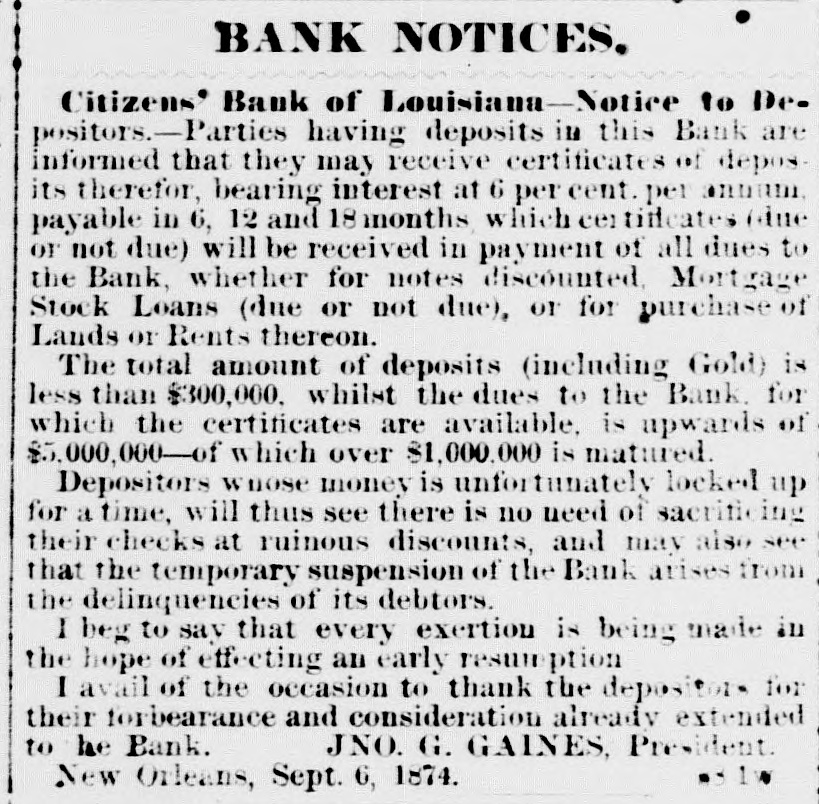
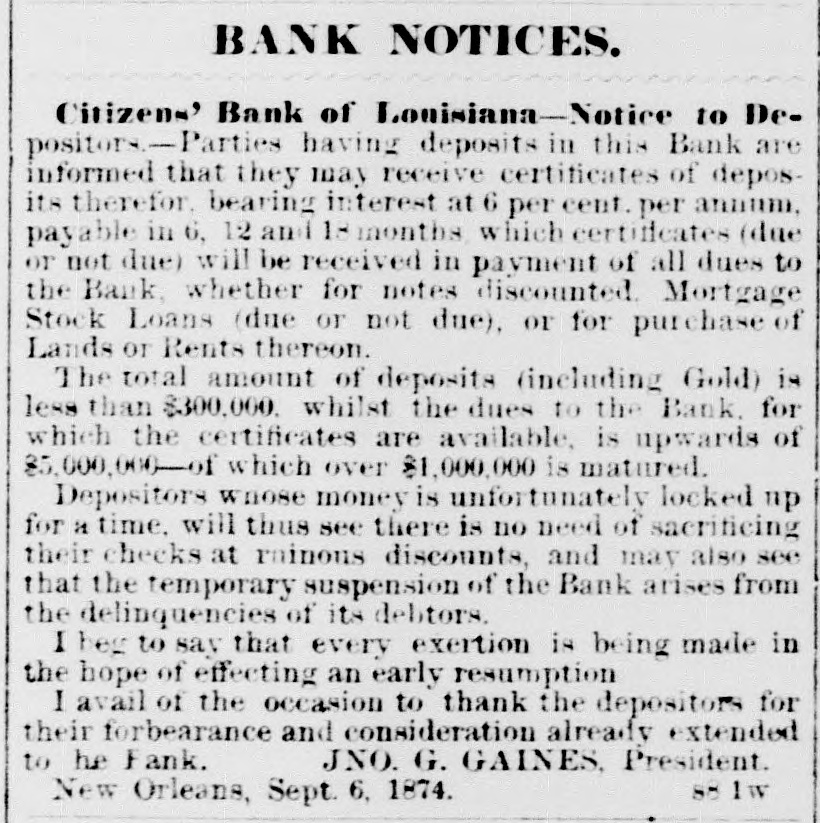
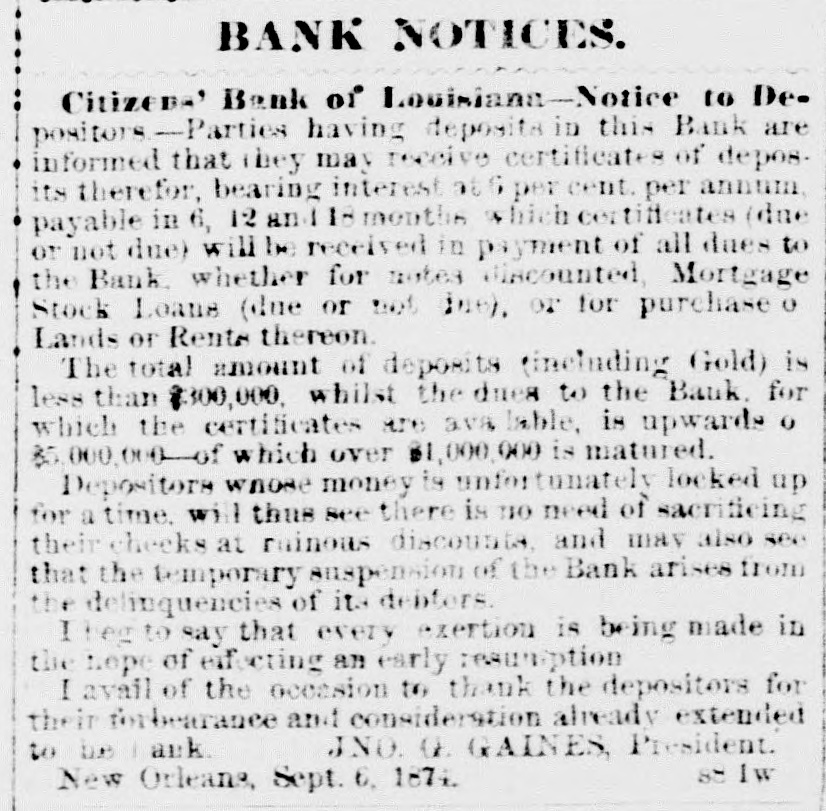
SATURDAY, SEPTEMBER 12, 1874. Cuperior District Courte The following petition was filed in cham bers: Louis Fix VS. Citizens' Bank of Louisiana. To the Henorable Judge of the Superior District Court for the Parish of Orleans: The petition of Louis Fir of this city, respectfully showeth: That he is a mortgage stockholder of the Citizens Bank of Louisiana, to wit, of twenty-three shares acquired by purchase from the succession of Mrs. R. Lamarque, by act before S. Magner. notary public, on the eighth of July, 1868, and of twenty-eight shares acquired by purchase from Mrs. Jane Armstrong and Thomas A. Murphy, by act before Joseph Cohn, notary public February 17, 1870. That said Citizens' Bank of Louisiana is a body politic and corporate established by authority of an act of the Legislature approved April 1, 1833; that the affairs thereof are managed by a president and board of directors, and the domicile of said corporation is in the parish of Orleans. That said bank was authorized to lend money upon mortgage or pledge of prop erty, movable or immovable. It was further authorized to receive as subscription, to stock, mortgages upon real estate by act approved thirtieth of January, 1836, and in pursuance of other statutes, bonds of the State were issued and loaned to said Citizens' Bank, secured by said mortgages, such bonds, amounting to over $7,000,000 whereof $4,297,333 33 in face are new outstanding. Petitioner further shows that the president, officers and board of directors of the said bank have failed absolutely in their duties to the stockholders. depositors, creditors, and to the State, and neglected to carry out the statutes passed for their government; and a liquidation by them or either of them is impossible. That they have 80 mismanaged the affairs of the bank as to place them in utter cenfusion. That on Wednesday, the second of September, 1874, said bank ceased to pay all checks or deposits. Petitioner further represents that by the acts of said president and board of directors, they have placed it out of their power to administer or conduct its affairs as a banking association, under the laws by which such an institution is governed in this State, and any administration otherwise or attempted liquidation by them would be and is illegal, and not binding upon parties in general interested in the bank. That the only method open is a liquidation under the equity powers of the court; that without such legal and judicial interposition and adjustment of its affairs, petitioner fears the destruction of his interests as a mortgage stockholder. the waste of the assets and resources of the bank, the fore. closure as a consequence of the mortgage against him, whereas by the due control and supervision by the court he reasonably claim and expect on his behalf. and other stockholders, a residuarcy interest of an amount equal to his stock as hereinbefore set forth. That to save the assets from waste and neglect, it is necessary that receivers and managers be appointed to act under the orders of the court: that liquidators be also appointed, first, for the ordinary banking affairs and assets of the corporation; second, for real estate, mortgage, and matters involving the connection of the bank with the State for the protection of all parties concerned. That conservatory orders be issued to such effect, and also a writ of sequestration to seize and take possession of all property and effects, and place them in the possession of the receivers. That said receivers and managers shall forthwith take charge of the bank and all its business and property, and direct its business under the control of the court for the interest of all parties con. cerned. Petitioner further alleges that a writ of injunction is necessary to prevent the president and directors from performing any of. ficial act, making any transfer or assignment of money or property of the bank, and from negotiating any exchange and discounting any commercial paper or pay. ing any checks drawn on said bank, or transacting any business on behalf of said bank from and after the taking and issuing of said writ. That in case of the non-issuance of said injunction, he would be sub. jected, as he fears, to irreparable injury. Whe refore petitioner prays the immediate issuance of the injunction and other conservatory orders set forth, and for such others as the case may require. That the Citizens' Bank of Louisiana be eited by its president to appear and answer this petition. That after these proceedings had the injunction, as hereinbefore set forth, be perpetuated. That the bank be placed in liquidation, and, after due proceedings had, there be judgment. decreeing the final liquidation of said bank, and on all the matters prayed for, and general relief to petitioner. Petitioner prays for costs in his favor. Alfred Shaw and Sambola & Ducros, at torneys. Louis Fix. being duly sworn. deposes and says that all the allegations of the foregoing petition are true and correct, and that a writ of injunction is necessary, as prayed for, to protect petitioner from irreparable LOUIS FIX. injury. Sworn to and subscribed before :ne this twelfth day of September, 1874. P. E. BURKE, Deputy Clerk. Judge Hawkins issued the following write in the subsequent order: Let a writ of injunction issue as prayed for on petitioner giving bond in the sum of $1000. JACOB HAWKINS, Judge. New Orleans, September 12, 1874. Let a judicial sequestration issue as prayed for. JACOB HAWKINS. Judge. New Orleans, September 12, 1874. Ordered that Benjamin F. Flanders, James F. Casey and Norbert A. Llambias be and they are hereby appointed receivers and managers of the Citizens' Bank. It is further ordered that each of said receivers execute a bond, with good and solvent security, in the of $10,000. JACOB HAWKINS. Judge. New Orleans, September 12, 1874. Personal.