6701. Bank of North America (New Orleans, LA)

Bank Information

Episode Type
Suspension โ†’ Closure
Bank Type
state
Start Date
November 7, 1895
Location
New Orleans, Louisiana (29.955, -90.075)

Metadata

Model
gpt-5-mini
Short Digest
45dbd46338e23005

Response Measures

None

Description

Multiple contemporaneous newspaper reports (Nov 7, 1895) state Judge Righter appointed a receiver and the bank's doors were closed; deposits were small (<$20,000). No article describes a depositor run prior to the closure. The bank was placed in receivership and closed permanently in these reports.

Events (2)

1. November 7, 1895 Receivership
Newspaper Excerpt
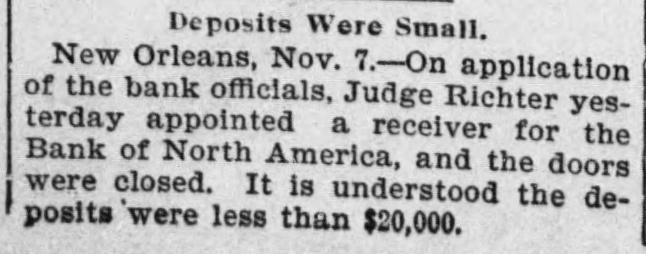
On application of the bank officials Judge Righter yesterday appointed a receiver for the Bank of North America and the doors were closed. It is understood the deposits were less than $20,000.
Source
newspapers
2. November 7, 1895 Suspension
Cause
Government Action
Cause Details
Judge Righter appointed a receiver and the bank's doors were closed on the application of bank officials; not a clearing-house member and had small deposits.
Newspaper Excerpt
On application of the bank officials Judge Righter yesterday appointed a receiver for the Bank of North America, and its doors were closed.
Source
newspapers

Newspaper Articles (11)

Article from The Topeka State Journal, November 7, 1895

Click image to open full size in new tab

Article Text

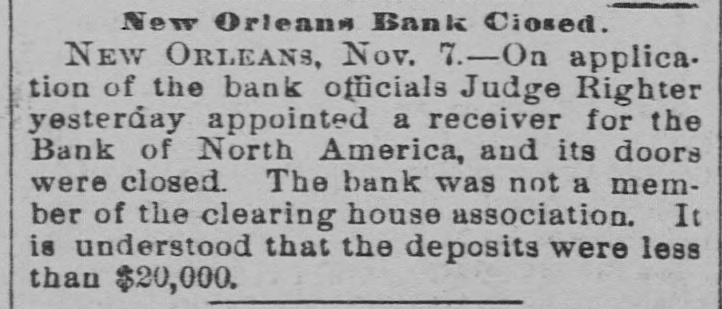
New Orleans Bank Closed. NEW ORLEANS, Nov. 7-On application of the bank officials Judge Righter yesterday appointed a receiver for the Bank of North America, and its doors were closed. The bank was not a member of the clearing house association. It is understood that the deposits were less than $20,000.


Article from San Antonio Daily Light, November 7, 1895

Click image to open full size in new tab

Article Text

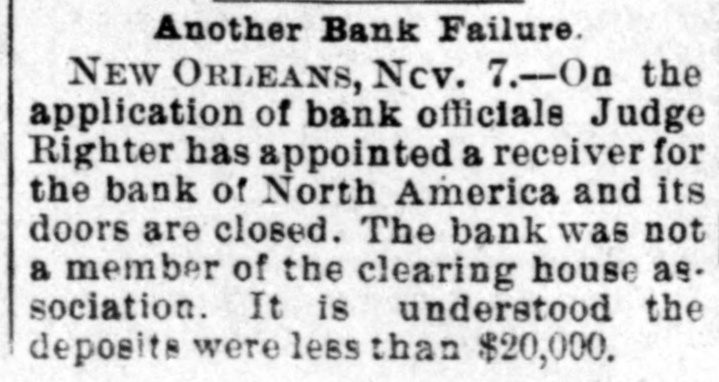
Another Bank Failure. NEW ORLEANS, Ncv. 7.-On the application of bank officials Judge Righter has appointed a receiver for the bank of North America and its doors are closed. The bank was not a member of the clearing house as. sociation. It is understood the deposits were less than $20,000.


Article from Deseret Evening News, November 7, 1895

Click image to open full size in new tab

Article Text

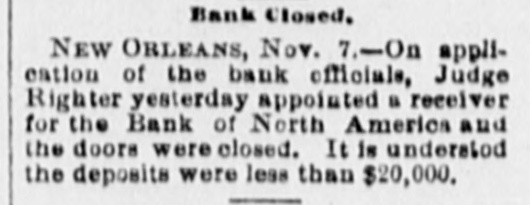
Bank Closed. NEW ORLEANS, Nov. 7.-On application of the bank officials, Judge Righter yesterday appointed a receiver for the Bank of North America and the doors were closed. It is understod the deposits were less than $20,000.


Article from The Indianapolis Journal, November 8, 1895

Click image to open full size in new tab

Article Text

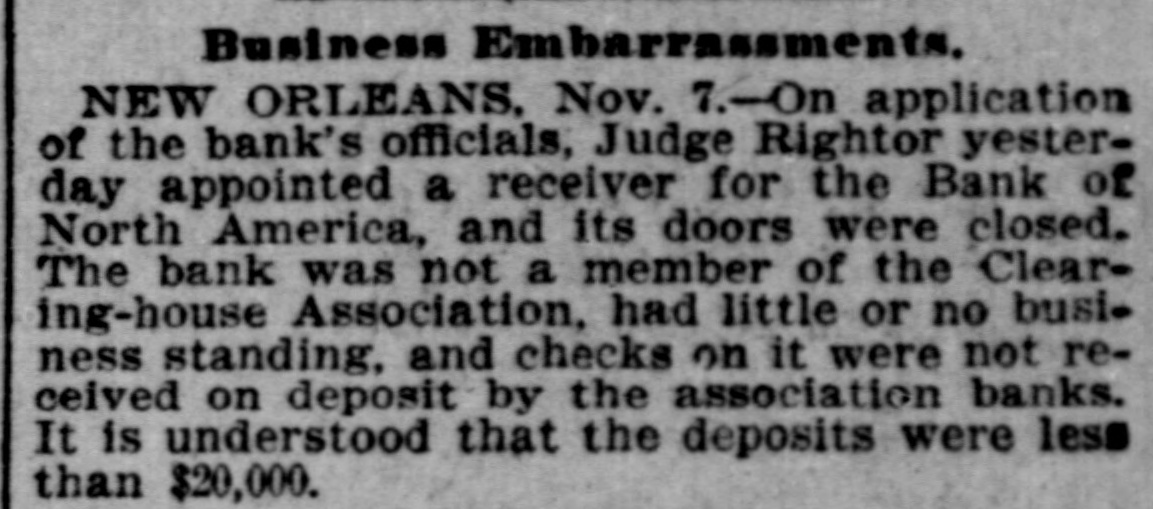
Business Embarrassments. NEW ORLEANS, Nov. 7.-On application of the bank's officials, Judge Rightor yesterday appointed a receiver for the Bank of North America, and its doors were closed. The bank was not a member of the Clearing-house Association, had little or no business standing, and checks on it were not received on deposit by the association banks. It is understood that the deposits were less than $20,000.


Article from The Salt Lake Herald, November 8, 1895

Click image to open full size in new tab

Article Text

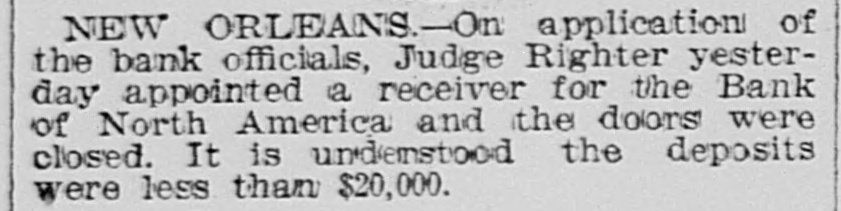
NEW ORLEANS.-On application of the bank officials, Judge Righter yesterday appointed a receiver for the Bank of North America and the doors were closed. It is understood the deposits were less than $20,000.


Article from St. Paul Daily Globe, November 8, 1895

Click image to open full size in new tab

Article Text

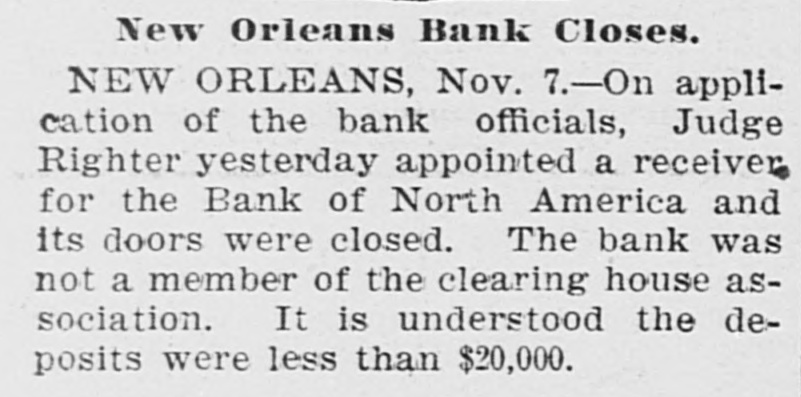
New Orleans Bank Closes. NEW ORLEANS, Nov. 7.-On application of the bank officials, Judge Righter yesterday appointed a receiver for the Bank of North America and its doors were closed. The bank was not a member of the clearing house association. It is understood the deposits were less than $20,000.


Article from St. Tammany Farmer, November 9, 1895

Click image to open full size in new tab

Article Text

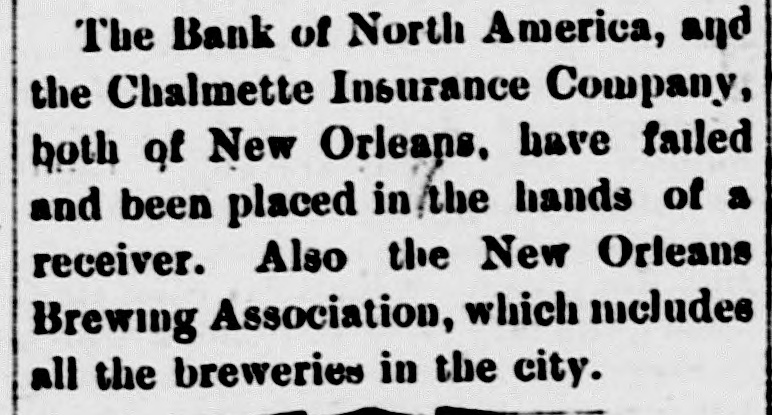
The Bank of North America, and the Chalmette Insurance Company, both of New Orleans, have failed and been placed in the hands of a receiver. Also the New Orleans Brewing Association, which mcludes all the breweries in the city.


Article from Highland Recorder, November 15, 1895

Click image to open full size in new tab

Article Text

THE Advices to the Merchants Exchange in San Francisco state that the British steamer Mineral, at Zoritas. laden with coal for San Francisco, has been burned, and is a total loss.W. B. Thompson, president Farmers' and a Merchants' Bank of Uhrichsville, 0., filed deed of assignment. It is said depositors will not loss a cent. -Tom Maher shot and fatally wounded Miss Maude Fessler, at a dance in Nebraska City, Neb. Albert Applegate was murdered in his cornfield, near Wilsonville, Neb. The New York and Buffalo express was partially wrecked at Pittston, Pa. The passengers were shaken up but nobody was hurt. steamer Puritan went ashore in the fog off Great Gull Island, Long Island Sound. -Edward Marrs was put on trial in Huntington, W. Va., on the charge of murdering his eightyear-old daughter. William Hall, a Pennsylvania oil operator, committed suicide in Parkersburg, W. Va. Dalhouse, acensed of killing Samuel Doom in Staunton, Va., was acquitted. Mrs. Rebecca T. Barnham and Miss Susie Sherman, who were missing from Dighton, Mass., for a year, were found in Nashua, N. H.-An anti-lynching provision was adopted by the South Carolina Constitutional Convention. A big pool is said to have been arranged to control all the traffle between Chicago and the seaboard. -The Chicago tourists to the Atlanta Exposition were entertained in Nashville, Tenn. -Tadman & Mickman's morocco factory in Wilmington. Del., was burned. Hill's cold storage warehouse on William street, in Montreal, caught fire. The damages were mostly caused by water, and amounted to between $80,000 and $100,000. Henry H. Kingston was appointed general traffic manager of the Lehigh Valley Railroad, to take the place of John Taylor, who recently died, J. W. Cadman, who shot himself several days ago in Chicago, died at the county hospital from the effects of the bullet wound in his head. He was Indian agent in South Dakota, and was a relative of President Cleveland's wife. -Freight No. 28, on the Kentucky Central division of the Louisville and Nashville Railway was wrecked by an open switch at Morningview, The seventeen miles from Cincinnati. venerable Judge Allen G. Thurman fell in his library at his home in Columbus, Ohio, and seriously injured hiship. The missing lake steamer Missonia, with a crew of seventeen men, has been given up for lost. She was owned by Captain Thomas Wilson, of Cleveland, valued at $80,000. Bernard Arena, thirty-six years old, of South Boston, while painting a smokestack, accidentally touched an electric wire, and was instantly killed. Burleigh Kitchen, aged seventeen years, of Newhope, Pa., was shot and accidentally killed on a gunning trip.-Theodore Durant was brought up for sentence in the San Francisco court, but the judge granted a continuance until November 22. Chauncey Depew made a speech on "The Wealth and Power of This Country" at a dinner given in his honor at Buffalo, W. E. G. Gilkinson, seventy years old, a lawyer of Charleston, W. Va., committed suicide by drowning in the Kanawha River.--The taking of evidence in the Addicks divorce case in Wilmington was concluded. At Columbus, O., the reorganized Culumbus, Sandusky and Hocking Railroad Company elected N. Monsarrat president; W. E. Guerin, vice president and general counsel: G. C. Hoover, treasurer; H. D. Turney, secretsry. -The American Inter-Seminary Missionary Alliance began its annual convention at Lancaster, Pa. A receiver was appointed for the Bank of North America of New Orleans Linford Overpeck and his son William, of Brodheadsville, Pa., were suffocated in a lime kiln about five miles from their home. They worked at the kiln and, not returning home at their usual hour. search was made and their bodies found. The money order dep artment of the postoffico at Chicago paid out $105,000, the largest amount ever pai. out in one day. was reported at Clevelan. that the Erie Railroad has been sold and will be reorganized. Snow and rain fell throughout Nebraska, and the farmers think the wet weather is in time to save the fall seeding. Frank Cross wa convicted of the murder of his sister, Mrs Cameron Taylor, at Ellenboro, W. Va., an sentenced to imprisonment for life.-More o than thirty dead bodies were taken out the wrecked Journal building in Detroit, of victims will b and the Ne braska the 40. -Revs. total Catholic number Fitzgerald Murphy, probably an priests leading the faction trouble with Bonacum Rooker, bitterly which has attack had Dr. Bishop secretary of th apostolic delegation, in a letter to edito -C. T. of Harrisburg, of letter the carrier. Omaha Bee, Householder, Pa., the was ar rested for stealing a registered letter. A party of miners from the head waters the Yukon River arrived at Port reported that the Canadian Wash., ernment and is establishing well-equipped Townsene fort go Acations on commanding bluffs on the strategic elsewhere points along supposed Forty-Mile international overlookin Creek an Coe Memphis, at Island 63, one boundary burg. plying sunk between line.-The steamer Tenn., hundred and Peter Vick an while h way to with a about twenty down miles below Vicksburg Memphis, cargo on one hundred and twenty tons of mi cellaneous freight. Rev. William E. Hi show, convicted at Danville, Ind., of th murder of his wife, was denied a new tria and will be sentenced to life imprisonment -Three little children playing on a sid N. Y., were a runaway team. Emma aged down I walk three in by Poughkeepsie, knock Jank years, was killed, and seven-year Lemka was cotton mill, erected years ago at and Simpson's old Aldred Norristown, Pa., badly injured. owned sixty-fl Dean & Mitchell, was destroyed by fire.
Article from Decorah Public Opinion, November 15, 1895

Click image to open full size in new tab

Article Text

GENERAL NEWS ITEMS The number of persons killed in the Detroit explosion was thirty-seven. Corbett has received $2,500 as his portion of the forfeit due from the Florida Athletic Club for failure to bring off the fight. They will not give Fitzsimmons any money, as they say he tried to prevent the fight. Peter Maher and Steve O'Donnell, Corbett's sparring partner, fought at Maspeth, L. I. The mill lasted just 63 seconds. O'Donnell was knocked down three times and the last time was counted out. The representatives of the powers at Constantinople held a meeting and decided to make fresh demands on the porte for protection for Armenians. The Kentucky legislature, on joint ballot, will have 68 republicans, 68 democrats and 2 populists. The latter two have it in their power to choose the successor of Senator Blackburn. Gen. Campos has recommended home rule for Cuba. Preacher Hinshaw, of Danville, Ind., who was convicted of murdering his wife. has gone to the penitentiary for life. Consuelo Vanderbilt was wedded to the Duke of Marlborough on the 6th. An explosion of the boilers in the building occupied by the Detroit Journal occurred, wrecking the building and hurling the three score occupants into the cellar. The wreckage at once took fire and many were burned to death before assistance could be rendered. A great many were taken out of the debris badly injured, and at last reports seventeen dead bodies had been taken from the ruins. while probably a score or more are still missing. At Milwaukee the Royal Areanum paid a $3,000 policy on the life of Arnold Brecher, the Chicago man whose body was recently exhumed at the instance of the life insurance companies on suspicion that he had been poisoned. The Illinois State Board of Health has licensed the following physicians: E. Ludlow, E. H. Mathewson, and C. E. Patterson, Chieago; M. L. Finley, Kirkwood: J. S. Pari, Jacksonville; C. L. Hamilton, Dwight; J. E. Miller, South America; and G. W. Johnsen, Dunning. At Wilmington, Del., the Addicks divorce suit closed and the decision will be announced in three weeks. The opening of the new steamship line from Pensacola, Fla., to Liverpool, was celebrated at Pensacola. At Pittsburg, Pa., the Supreme court affirmed the decision of the lower court forcing Mayor Warwick of Philadelphia to administer the oath of office to W. J. Roney as receiver of taxes. Senator Tillman made a sturdy but ineffectual effort to have a clause providing for bipartisan election boards incorporated in the suffrage article by the South Carolina constitutional convention. Henry H. Kingston has been appointed general traffic manager of the Lehigh Valley railroad, to succeed the late'John Taylor. He is a son of Stephen B. Kingston, formerly general freight agent of the Pennsylvania. There is much excitement and intense feeling between political factions in the Cherokee nation, and bloodshed will result unless compromised. The conditions are similar to those of eight years ago, when many men were killed. The national party is contesting the election of Sam Mayes as chief on the Downing ticket, and the Indians are collecting in the capital, armed to the teeth, determined to aid their friends. The executive council of the Ohio River Improvement Association, in session at Cincinnati, considered the advisability of asking congress for $20,000,000 to improve the Ohio river. The shoe factory of the Bentley Shoe company at Cazenovia, N. Y., has been closed by creditors. Retail stores in Syracuse and Rochester owned by the same company shared a similar fate. Rev. Cyrus T. Brady, rector of St. Paul's church, Manhattan, Kan., and archdeacon of Kansas, has been named by Bishop Whitaker to be archdeacon for the diocese of Pennsylvania. Governor Hastings of Pennsylvania has appointed Evan R. Penrose of Doylestown bank examiner. S At New Orleans a receiver was apI pointed for the Bank of North America


Article from Cottonwood Report, November 15, 1895

Click image to open full size in new tab

Article Text

Deposits Were Small. New Orleans, Nov. 7.-On application of the bank officials, Judge Richter yesterday appointed a receiver for the Bank of North America, and the doors were closed. It is understood the deposits were less than $20,000.


Article from The Indianapolis Journal, November 29, 1899

Click image to open full size in new tab

Article Text

GET-RICH-QUICKSCHEMES GREATER NEW YORK SEEMINGLY TEEMING WITH SWINDLES. Arrest of Louis Gourdain on the Charge of Violating the Banking Code-White's Bureau" Closed. NEW YORK, Nov. 28.-Louis Gourdain, who has a banking office in the Metropolitan Life Insurance building at No. 1 Madison avenue, and is alleged to have a scheme similar to that of the Franklin Syndicate, with which William F. Miller was connected, was arrested to-day on the order of Chief Devery. He was arraigned in Police Court on a charge of swindling and of violating the banking code. The magistrate fixed the bail at $10,000 and remanded Gourdain. Captain Price, who made the charge against Gourdain, when asked who he had captured in the offices where he found Gourdain, replied: "I got the whole company." In reply to a question as to who composed the company, he said: "That man (indicating Gourdain), his plug hat, a $5 note and a satchel full of fake papers." According to a statement by Chief Devery after the arrest of Gourdain, the man had opened the so-called Imperial National Bank in partnership with a D. M. Slocum. They came from New Orleans. He said that in 1892 Gourdain was connected with a Louisiana lottery scheme, which was suppressed. He then engaged in business under the name of J. H. Lumbard & Co., and was again suppressed. He then engaged in business successively under the name of D. M. Slocum, L. C. Stewart, C. V. Louis and R. Jackson, each business being suppressed, one after another. Later Gourdain was behind the Bank of North America in New Orleans, which failed. Then he started the Fire and Marine Insurance Company, which failed. Gourdain was then arrested in New Orleans on a lottery charge, but he escaped imprisonment on the plea of insanity. He is also said to have been arrested in Kansas City. Gourdain said to-day: "The men who are associated with me are D. M. Slocum, formerly With the First National Bank of Port Townsend, Wash., and G. M. McCurdy, of Detroit. Both men are now in the West buying out banks." According to the Herald, another "get-richquick" concern has been closed. White's Bureau, in the Cotton Exchange, stopped doing business on Monday, while the promoters of the firm are missing. Some $200,000 belonging to depositors is yet to be accounted for. The business of this bureau extended all over the United States, although it had only occupied its quarters in the Cotton Exchange for two months. W hite's Bureau was in many respects similar to the Franklin Syndicate. It offered tremendous dividends to depositors. It professed to be legitimate and to be an old established concern. It professed to have the strongest kind of recommendations from banks and bankers, and paid out "dividends" to depositors. Finally its backers took alarm and disappeared. ALLURING CIRCULARS. White's Bureau was operated by two young men who went under the name of Hyman. One of them gave the name of C. H. Hyman, and he is understood to have been C. H. White, whose bureau the concern purported to be. The offices are handsomely furnished and are partitioned off into smaller rooms. Many typewriters were employed, and when the business was first established an enormous quantity of letters and circulars was sent forth. The firm, in some of its advertisements in newspapers all over the country, promised that White's scheme would make money for anybody who would send his cash on to New York. The advertisements were as alluring as green goods circulars. The police say they believe White's Bureau was affiliated in some way with the Franklin Syndicate, and they are looking for the promoters of the concern. John R. Agnew, whose connection with the Washington Syndicate in Green Point, Brooklyn, led to his arrest yesterday, was up for arraignment to-day in a Brooklyn Police Court. In the absence of the district attorney the magistrate would not fix bail. Edward Nourney, a bookkeeper, who, as alleged, handled the prisoner's records, was placed on the stand with a view to ascertaining what the financial status of the concern has been and what assets were left, but no information of importance was gleaned from him. William F. Miller, who conducted the Franklin Syndicate in Brooklyn, has not yet been arrested, the so-called drag nets of the police evidently being out of order. The police have not the faintest idea where Miller is. The Franklin Syndicate safe, which was locked up by Miller the last thing before he took flight, was opened by a locksmith to-day in a Brooklyn police station. In it was found 190 shares of Brooklyn Rapid Transit stock and a few worthless scraps of paper. There was not a penny of cash and nothing of value except the stock. A majority of it had been purchased at 88% and the remainder at 88ยฝ. Postmaster Wilson, of Brooklyn, has received an order from the postmaster general directing him to return, SO far as possible, to the senders all letters addressed to the syndicate. About 1,500 pieces of mail, including over $12,000 worth of money orders, have accumulated since Saturday. Hubert G. Taylor, who was appointed receiver of the syndicate, has asked to be relieved of the appointment on the ground that he does not like to have his name associated in the public mind with that of Miller and his unsavory supporters. Involuntary bankruptcy proceedings against the syndicate were instituted in the United States Court to-day before Judge Thomas by attorneys representing depositors whose claim aggregates over $30,000. They allege in their petition that a large part of the syndicate's property has been concealed with intent to defraud creditors. These bankruptcy proceedings, it is said, will take precedence over all other claims filed against the syndicate. The police to-night arrested Chas. D. Hughes, forty-three years old, said to be a "get-richquick" banker, at his office, 69 Wall street. A patrol wogan was sent to Hughes's office, and It carried a load of books and papers to police headquarters. It is said to-night that since July, 1898. 500 complaints against Hughes have been lodged with the police, one by Delia Cooney, servant. who said she lost $1,400 brought him, and another woman who says she lost $600. The concern Hughes ran is called the "Hughes Investment Company. A man named Packer figured as the president. In April, 1897, a Charles Hughes was said to be a partner in the "Open Board of Brokers, a bucket shop closed by the police. Mr. Hughes came to New York