6682. Bank of Commerce (New Orleans, LA)

Bank Information

Episode Type
Run → Suspension → Closure
Bank Type
state
Start Date
September 11, 1896
Location
New Orleans, Louisiana (29.955, -90.075)

Metadata

Model
gpt-5-mini
Short Digest
aac9338b53e3d4ea

Response Measures

None

Description

Multiple contemporary articles (Sep 11–Oct 1896) report an extended run on the Bank of Commerce, the bank closing its doors (suspending) on Sept 11, 1896, and receivers/liquidators being appointed thereafter. Reports attribute the run both to panic from recent failures in New Orleans (American, Union, Mutual, etc.) and later revelations of mismanagement/overdrafts/embezzlement; ultimately the bank was placed in liquidation and officers were indicted/arrested.

Events (4)

1. September 11, 1896 Run
Cause
Local Banks
Cause Details
Run followed a wave of distrust after recent failures of other New Orleans banks (American, Union, Mutual) and panic in the city; reports also reference a run on Peoples' Bank and general local panic.
Measures
Bank consulted vice presidents of the clearing house, submitted a statement, paid depositors who presented themselves for a time; ultimately elected to close and liquidate to protect depositors and stockholders.
Newspaper Excerpt
Owing to the unprecedented run on the bank for the past six weeks... (President Nichols' explanation).
Source
newspapers
2. September 11, 1896 Suspension
Cause
Bank Specific Adverse Info
Cause Details
Management reported inability to realize assets rapidly enough to meet heavy withdrawals; subsequent investigations revealed grave irregularities and large overdrafts indicating mismanagement/insolvency.
Newspaper Excerpt
The Bank of Commerce ... did not open its doors this morning. President Nichols gives the following explanation...
Source
newspapers
3. September 12, 1896 Receivership
Newspaper Excerpt
Judge Theard this evening appointed two receivers for the Bank of Commerce, and its affairs will be immediately liquidated. It has ample assets, and this course was deemed best, in order to fully protect the bank's depositors and creditors.
Source
newspapers
4. September 24, 1896 Other
Newspaper Excerpt
Liquidators find that the affairs of the bank have been mismanaged; overdrafts amount to more than $300,000. The bank is insolvent and its capital and surplus is lost.
Source
newspapers

Newspaper Articles (24)

Article from Evening Star, September 11, 1896

Click image to open full size in new tab

Article Text

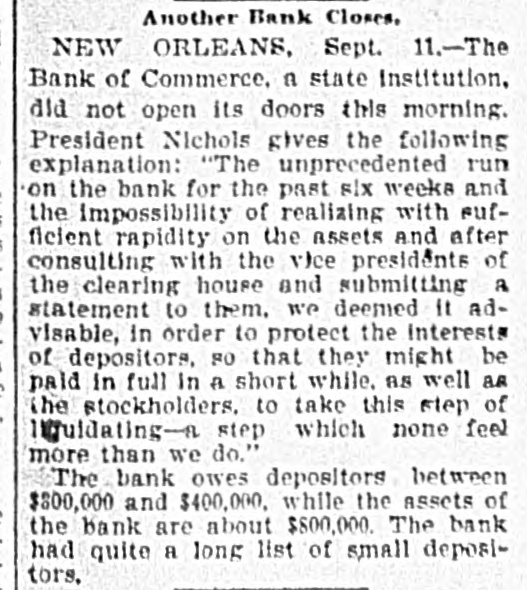
SUCCUMBED TO THE RUN. Failure of Another New Orleans Bank. NEW ORLEANS, September 11.-The Bank of Commerce, a state institution, did not open its doors this morning. President Nichols gives the following explanation: "Owing to the unprecedented run on the bank for the past six weeks and the impossibility of realizing with sufficient rapidity on the assets, and after consulting with the vice presidents of the clearing house and submitting a statement to them, we, deemed it advisable, in order to protect the interests of depositors, so that they might be paid in full in a short while, as well as the stockholders, to take this step of liquidating-a step which none feel more than we do." The bank owes depositors between $300,000 and $400,000, while the assets of the bank are about $800,000. The bank had quite a long list of small depositors.


Article from Alexandria Gazette, September 11, 1896

Click image to open full size in new tab

Article Text

TELEGRAPHIC BREVITIES. A receiver has been asked for the company building the trolley road between Baltimore and Washington. Peace, Atkins and Co., proprietors of the Franklin Cotton Mills, Cincinnati, assigned this morning. Liabilities $163,000. James Cherry, a cigarmaker of Norfolk, threw himself under a train of moving cars at the depot of the Norfolk and Western Railroad this morning, and was cut in two at the hips. The officers of the United Society of Christian Endeavor announce to-day that the next international Christian Endeavor convention will be held July 7-12, 1897. San Francisco has been se. lected as the place. Another New Orleans bank, the Bank of Commerce, closed its doors to-day. There W3S a great crowd about the bank building shortly atter the doors were closed. It is stated that the doors were closed as a matter of precaution, there having been 8 run on the bank yesterday. Depositors, it is understood, will lose but little. The steamship Fuerst Bismarck which ar. rived at New York last night brought $3,697,800 in gold. Aggregate arrivals thus far are $23,172,050. Lazaid Freres have deposited $3,000,000 gold in the subtreasury in exchange for greenbacks. An explosion occurred at the mills of the Ohio Gunpowder Company. at Youngstown, Ohio, this morning about 8 o'clock, in which two men lost their lives. The explosion was heard for miles.


Article from San Antonio Daily Light, September 11, 1896

Click image to open full size in new tab

Article Text

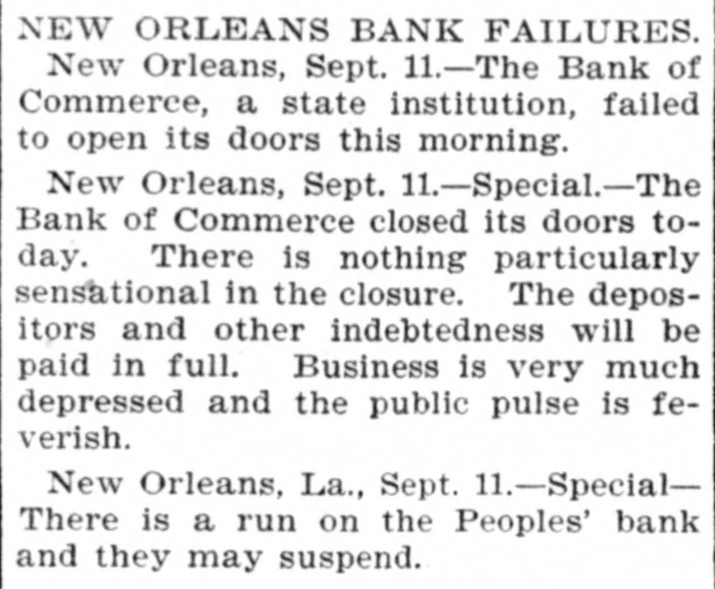
NEW ORLEANS BANK FAILURES. New Orleans, Sept. 11.-The Bank of Commerce, a state institution, failed to open its doors this morning. New Orleans, Sept. 11.-Special.-The Bank of Commerce closed its doors today. There is nothing particularly sensational in the closure. The depositors and other indebtedness will be paid in full. Business is very much depressed and the public pulse is feverish. New Orleans, La., Sept. 11.-SpecialThere is a run on the Peoples' bank and they may suspend.


Article from The Wheeling Daily Intelligencer, September 12, 1896

Click image to open full size in new tab

Article Text

Another Bank Closes, NEW ORLEANS, Sept. 11.-The Bank of Commerce, a state Institution. did not open its doors this morning. President Nichols gives the following explanation: "The unprecedented run on the bank for the past six weeks and the impossibility of realizing with sufficient rapidity on the assets and after consulting with the vice presidents of the clearing house and submitting a statement to them. we deemed it advisable, in order to protect the Interests of depositors, 80 that they might be paid in full In A short while. as well as the stockholders. to take this step of liguidating-n step which none feel more than we do." The bank owes depositors between $800,000 and $400,000. while the assets of the bank are about $800,000. The bank had quite a long list of small depositors,


Article from The Norfolk Virginian, September 12, 1896

Click image to open full size in new tab

Article Text

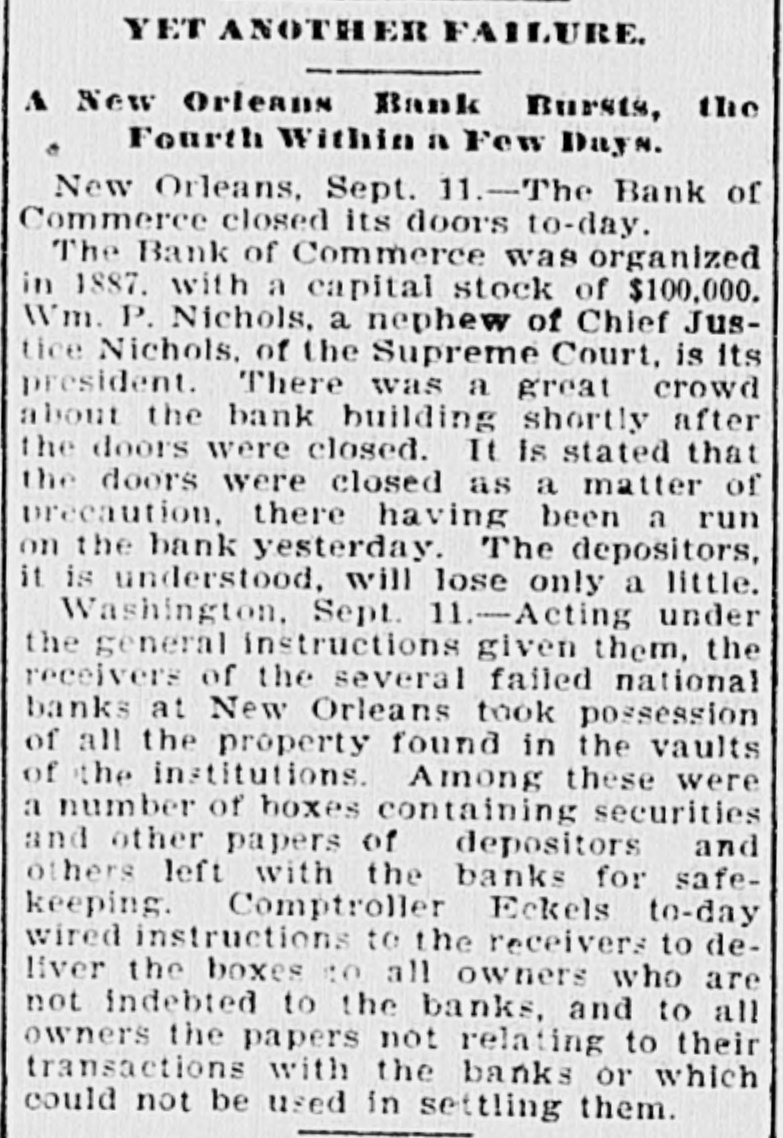
YET ANOTHER FAILURE. New Orleans Bank Bursts, the Fourth Within a Few Days. New Orleans, Sept. 11.-The Bank of Commerce closed its doors to-day. The Bank of Commerce was organized in 1887. with a capital stock of $100,000. Wm. P. Nichols, a nephew of Chief Justice Nichols, of the Supreme Court, is its president. There was a great crowd about the bank building shortly after the doors were closed. It is stated that the doors were closed as a matter of precaution, there having been a run on the bank yesterday. The depositors, it is understood, will lose only a little. Washington, Sept. 11.-Acting under the general instructions given them, the receivers of the several failed national banks at New Orleans took possession of all the property found in the vaults of the institutions. Among these were a number of hoxes containing securities and other papers of depositors and others left with the banks for safekeeping. Comptroller Eckels to-day wired instructions to the receivers to deliver the boxes :0 all owners who are not indebted to the banks, and to all owners the papers not relating to their transactions with the banks or which could not be used in settling them.


Article from Richmond Dispatch, September 12, 1896

Click image to open full size in new tab

Article Text

NEW ORLEANS, LA., September 11.The Bank of Commerce closed Its doors to-day. It was organized in 1887, with a capital stock of $100,000. William P. Nichols, nephew of Chief-Justice Nichols, of the Supreme Court, is its president. There was a great crowd about the bank building shortly after the doors were closed. It is stated that the doors were closed as a matter of *precaution, there having been a run on the bank yesterday. The depositors, it is understood, will lose but little.


Article from The Roanoke Daily Times, September 12, 1896

Click image to open full size in new tab

Article Text

TROUBLE IN THE CRESCENT CITY ANOTHER BANK WENT DOWN YESTERDAY. The Bank of Commerce Closed Its Doors. As Usual, the Assets Are Said to be More Than Liabilities-A Lively Run on Another Bank--Two Clerks of the Union National Placed Under Arrest. The Government Continues the Transfer of Money to Meet Demands.


Article from The Houston Daily Post, September 12, 1896

Click image to open full size in new tab

Article Text

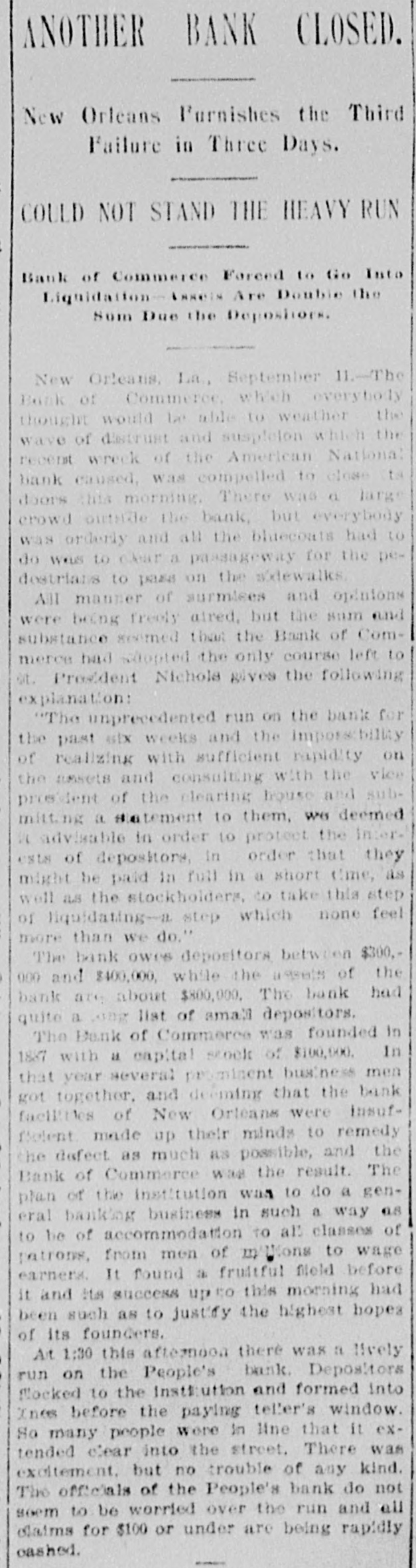
ANOTHER BANK CLOSED. New Orleans Purnishes the Third Pailure in Three Days. COULD NOT STAND THE HEAVY RUN Bank of Commerce Forced to Go Into Liquidation- 188018 Are Doubie the Sum Due the Depositors. New Orleans. La, September 11.-The Bank of Commerce. which overybody thought would be able to weather the wave of distrust and suspleton which the recent wreck of the American National bank caused, was compelled to close to doors this morning. There was a large crowd outside the bank, but everybody was orderly and all the bluecoats had to do was to char a passageway for the pedestrians to pass on the aldewalks All manner of surmises and opinions were being freely aired, but the sum and substance seemed than the Bank of Commerce had schopted the only course left to sit. President Nichole gives the following explanation: "The unprecedented run on the bank for the past six weeks and the impossibility of realizing with sufficient rapidity on the nasets and consulting with the vice president of the clearing house and submitting a statement to them, we deemed it advisable in order to protect the Interests of depositors, in order that they might be paid in full in a short time, as well as the stockholders, to take this step of liquidating-a step which none feel more than we do." The bank owes depositors between $300.000 and $400,000, while the ussets of the bank are about $800,000. The bank had quite a ong list of small depositors. The Bank of Commerce was founded in 1887 with a capital scook of $100,000. In that year several promisent business men got together. and deeming that the bank facilities of New Orleans were InsufBelent made up their minds to remedy the defect as much as possible, and the Bank of Commerce was the result. The plan of the institution was to do a general banking business in such a way as to be of accommodation to all classes of patrons, from men of m/Hons to wage earners. It found a fruitful fileld before it and its success up to this morning had been such as to justify the highest hopes of its founders. At 1:30 this afternoon there was a lively run on the People's bank. Depositors Blocked to the Institution and formed into Ince before the paying teller's window. So many people were In line that it extended clear into the street, There was excitement. but no trouble of any kind. The officials of the People's bank do not soem to be worried over the run and all claims for $100 or under are being rapidly cashed.


Article from The Indianapolis Journal, September 12, 1896

Click image to open full size in new tab

Article Text

OVER $470,000 STOLEN DEVELOPMENTS IN THE NEW ORLEANS BANK DEFALCATION. Two Bookkeepers of the Union National, the Looted Institution, Placed Under Arrest. SITUATION STILL PANICKY BANK OF COMMERCE COMPELLED TO CLOSE YESTERDAY. Receivers Appointed for Pearee, Atkins & Co. and Henry Pearce Sons Company, Cincinnati. NEW ORLEANS, Sept. 11.-Frank B. Leefe and Louis Colcombe, bookkeepers in the Union National Bank, were arrested to-day by United States deputy marshals. Colcombe was not taken into custody, as he was too sick to leave home. He is under arrest, however, at his house. Leefe was arraigned and held in $10,000 bonds for a hearing. His bond was immediately signed. He declined to make a statement. The charge is falsifying accounts. Two sets of books were kept. The defalcation is reported to be in the neighborhood of half a million dollars. The arrests were made in order to hold the men, pending a further investigation. The total defalcation so far discovered amounts to over $470,000, and the falsification of the books, if not done to cover up the actual losses of the bank by the failure of a prominent commercial firm, which occurred eight or ten years ago, show that the stealing has been going on for some years. The government believes that there was outside collusion and expects that the tracing up of the accounts doctored, together with other evidence sought, will reveal the conspiracy and result in the arrest of a number of other parties, some*very prominent. Bookkeeper Colombe took a dose of morphine this morning, and has been unconscious all day, which prevented his actual arrest. The Bank of Commerce, which everybody thought would be able to weather the wave of distrust and suspicion which the recent wreck of the American National Bank caused, was compelled to close its doors this morning. There was a large crowd outside the bank, but everybody was orderly and all the blue coats had to do was to clear a passage way for the pedestrians to pass on the sidewalks. All manner of surmises and opinions were being freely aired. but the sum and substance seemed to be that the Bank of Commerce had adopted the only course left to it. President Nichols gives the following explanation: "The unprecedented run on the bank for the past six weeks and the impossibility of realizing with sufficient rapidity on the assets embarrassed us. After consulting with the vice presidents of the clearing house and submitting a statement to them


Article from The Times, September 12, 1896

Click image to open full size in new tab

Article Text

NEW ORLEANS BANKS. ANOTHER CLOSES ITS DOORS FOR 'NOW F конд The Treasury Department Doing All In Its Power to Prevent Embarrassment to Business Men. NEW ORLEANS, Sept. 11.-The Bank of Commerce closed its doors to-day. The U with 1887 uj organized SUM bank tal stock of $100,000. William P. Nichols, nephew of Chief-Justice Nichols, of the Supreme Court, is its president. There was a great crowd about the bank building shortly fter the doors were closed. It is stated that the doors were closed as a matter of precaution there rueq am uo una B been Sujreq suo 0801 TITAL understand S1 11 Deposition email 30 WOOTS HHL Bank Examiner Escott arrived here today and took charge of the Union National Bank but his arrival has not dispelled the gloom of mystery, which hangs over that institution. Mr. Chalaron, the president of the Union Bank visited the bank building early this morning, but remained only a short while. His persistent silence in the face of SO many ugly rumors about the bank is severely criticised on all sides. Some of his warmest defenders have grown lukewarm to his interest and now say it is strange he does not talk. This afternoon two individuals bookkeepers of Union National bank, Messrs. Frank B. Leefe and A. Colomb. were arrested on affidavits made by Cashier Labarthe. Collarmb, it appears, is only "constructively" under arrest. The charge against Leefe is for violating section 5209 Revised Statutes United States of America by falsifying his books and accounts, and SE umour runeq eqf JO rood B up especially -prajpuj TO sepermins shall JO Hooq eui,, -pare B Summous accounts s14 pen it balance of $12,604.88, which should have been $196,163.60 The charge against CoI character, 'E JO ST 'quot was arraigned before United States Commissioner Craig. He pleaded not guilty '000'0T$ JO puoq depun perced STEM puu which he immediately furnished. These arrests, taken in connection with Prseident Chalaron's strange silence, are causing much comment to the effect that sq1 exem 01 opeur eq TIPM atternis 11ª book-keepers scapegoats. It is well known that the bank's book-keepers do not handle a cent of the bank's funds. CINIM SIH SI A reporter of the Southern Associated Press is informed to-night by an unim peachable source that a prominent physiclan, related to Book keeper Leefe, forced an interview with President Chalaron 1 07 up пооилодзъ spp case, and the doctor says to-night that President Chalaron's mind is unbalanced, and Mr. Chalaron does not know anyeq)) ou wern books eq: inoge эдош p[o we s] Chaldren "-W soop physiciant man, highly nervous in temperament, and 041 JO extstence em up dn paddram SUM bank It is beginning to be believed that our JO a our up change *4* bank, which was recently inaugurated, has had a tendency to confuse Mr. Chalbooks our дало Sujos up that puu 'UOJE 18 pedum[ pure become swy 04 the conclusion that there is a defalcation. Otherwise his precipitate actio nin clesing the bank without consulting the directors. and his silence is inexplicable up general 201 punors 200118 U S1 the physician's story. Judge Theard this evening appointed two receivers for the Bank of Commerce, and Its affairs will be immediately liquidated. It has ample assets, and this course was deemed best, in order to fully protect the bank's depositors and creditors. There was 2 persistent run to-day on the Peoples Bank and that institution is in peril. Messrs H and B Beer to-day ordered one hundred thousand dollars In currency by express from New York to MOU yours *** relleve 01 181880 exists in this market. INTERNATION WHL JO NOLLOV ASHINGTON D C. Sept. 11 -Referring to the New Orleans dispatch to the effect that much dissatisfaction existed there over the fact that Bank Examiner equ TO excess up person useq peq uosuyor falled Union National Bank, Comptroller Eckels this morning said to a reporter for peq personally our he known of Mr Johnson's connection with A. and V. Meyer. the firm, whose failure so seriously affected the Union bank, he would not have designated him to take charge. The assignment, how ever, Mr. Eckels said, was merely temporary, because Mr Johnson was already in charge of the affairs of the American IIV 0202ue 01 SUM 1641 pue runeq SMOTT SB uoos SV security pur own siy of the Union failure reached the bureau, Comptroller Eckels, directed Examiner Escott of Louisville, Ky to proceed to New Orleans and relieve Mr. Johnson, which had already been done. The preliminary report of Mr. Johnson upon the condition of the Union Bank, had not reached the Comptroller at noon but Mr. Eckels said state the JO unnut en JO ignop ou Req 04 MON word 24214 180 1098 10011 useq puq spooq JO 5108 0.05.1 req. kept and that a discrepancy of at least $600 exists between them. Ex Deputy required useq 884 Thomas receiver of the Mutual National Bank


Article from The Morning News, September 12, 1896

Click image to open full size in new tab

Article Text

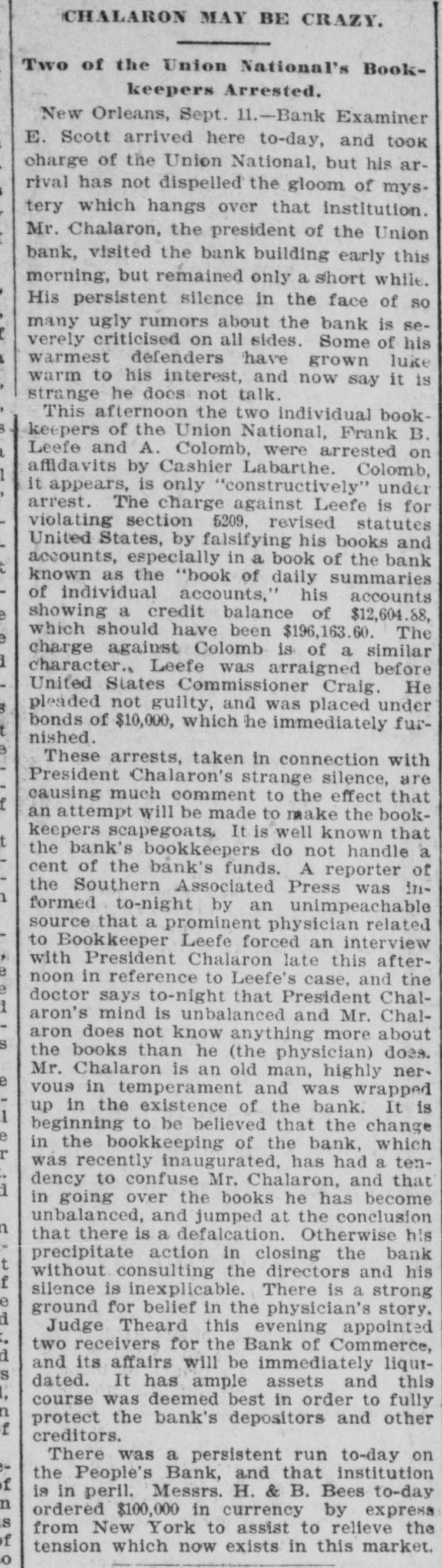
CHALARON MAY BE CRAZY. Two of the Union National's Bookkeepers Arrested. New Orleans, Sept. 11.-Bank Examiner E. Scott arrived here to-day, and took charge of the Union National, but his arrival has not dispelled the gloom of mystery which hangs over that institution. Mr. Chalaron, the president of the Union bank, visited the bank building early this morning, but remained only a short while. His persistent silence in the face of so many ugly rumors about the bank is severely criticised on all sides. Some of his warmest defenders have grown luke warm to his interest, and now say it is strange he does not talk. This afternoon the two individual bookkeepers of the Union National, Frank B. Leefe and A. Colomb, were arrested on affidavits by Cashier Labarthe. Colomb, it appears, is only "constructively" under arrest. The charge against Leefe is for violating section 5209, revised statutes United States, by falsifying his books and accounts, especially in a book of the bank known as the "book of daily summaries of individual accounts," his accounts showing a credit balance of $12,604.88, which should have been $196,163.60. The charge against Colomb is of a similar character., Leefe was arraigned before United States Commissioner Craig. He pleaded not guilty, and was placed under bonds of $10,000, which he immediately furnished. These arrests, taken in connection with President Chalaron's strange silence, are causing much comment to the effect that an attempt will be made to make the bookkeepers scapegoats. It is well known that the bank's bookkeepers do not handle a cent of the bank's funds. A reporter of the Southern Associated Press was informed to-night by an unimpeachable source that a prominent physician related to Bookkeeper Leefe forced an interview with President Chalaron late this afternoon in reference to Leefe's case, and the doctor says to-night that President Chal1 aron's mind is unbalanced and Mr. Chalaron does not know anything more about the books than he (the physician) does. Mr. Chalaron is an old man, highly nervous in temperament and was wrapped up in the existence of the bank. It is beginning to be believed that the change in the bookkeeping of the bank, which was recently inaugurated, has had a tendency to confuse Mr. Chalaron, and that 1 in going over the books he has become unbalanced, and jumped at the conclusion that there is a defalcation. Otherwise his precipitate action in closing the bank without consulting the directors and his silence is inexplicable. There is a strong ground for belief in the physician's story. d Judge Theard this evening appointed two receivers for the Bank of Commerce, d and its affairs will be immediately liquiS dated. It has ample assets and this course was deemed best in order to fully protect the bank's depositors and other f creditors. There was a persistent run to-day on the People's Bank, and that institution is in peril. Messrs. H. & B. Bees to-day n ordered $100,000 in currency by express S from New York to assist to relieve the f tension which now exists in this market.


Article from New-York Tribune, September 12, 1896

Click image to open full size in new tab

Article Text

SATURDAY, SEPTEMBER 12, 1896. SIXTEEN PAGES THE NEWS THIS MORNING. FOREIGN.-A military rebellion is threatened In Constantinople. Olaf Laudsem, the Norwegian novelist, was drowned at Scarborough, Owing to the failure of the LabEngland. rador fishery, hundreds of fishermen are leaving Newfcundland for the United States and Canada. DOMESTIC.-Large and enthusiastic delegations from Vermont, Pennsylvania and Ohio visited Canton and were addressed by Major McKinFrank S. Black, Lieutenant-Governor II ley. Saxton and other prominent Republicans attended the Columbia County Fair and addressed a mass-meeting in Chatham. The Bank of Commerce of New-Orleans, a State institution, closed its doors, being the fourth bank to suspend The memin that city within a few days. bers. of the Diamond Match pool in Chicago have raised $200,000 to settle the transactions of Moore Professor Francis J. Child, of Brothers. Harvard University, died in Boston. CITY AND SUBURBAN.-It was reported that arrangements had been made to secure about The bi$30,000,000 more gold in London. cycle firm of John McClave, ex-Police CommisMayor Strong sioner, made an assignment. declined to entertain the charges recently made against Superintendent Constable, of the DepartPolice Commissioner ment of Buildings. Theodore Roosevelt addressed the noonday meeting of the Commercial Travellers' Sound Money Chairman Jones of the Democratic League. National Committee arrived here to confer with = The the managers of the State campaign. stock market was strong and higher. THE WEATHER.-Forecast for to-day: Fair and cooler. The temperature yesterday: Highest, 85 degrees; lowest, 74; average, 78½.


Article from The Providence News, September 12, 1896

Click image to open full size in new tab

Article Text

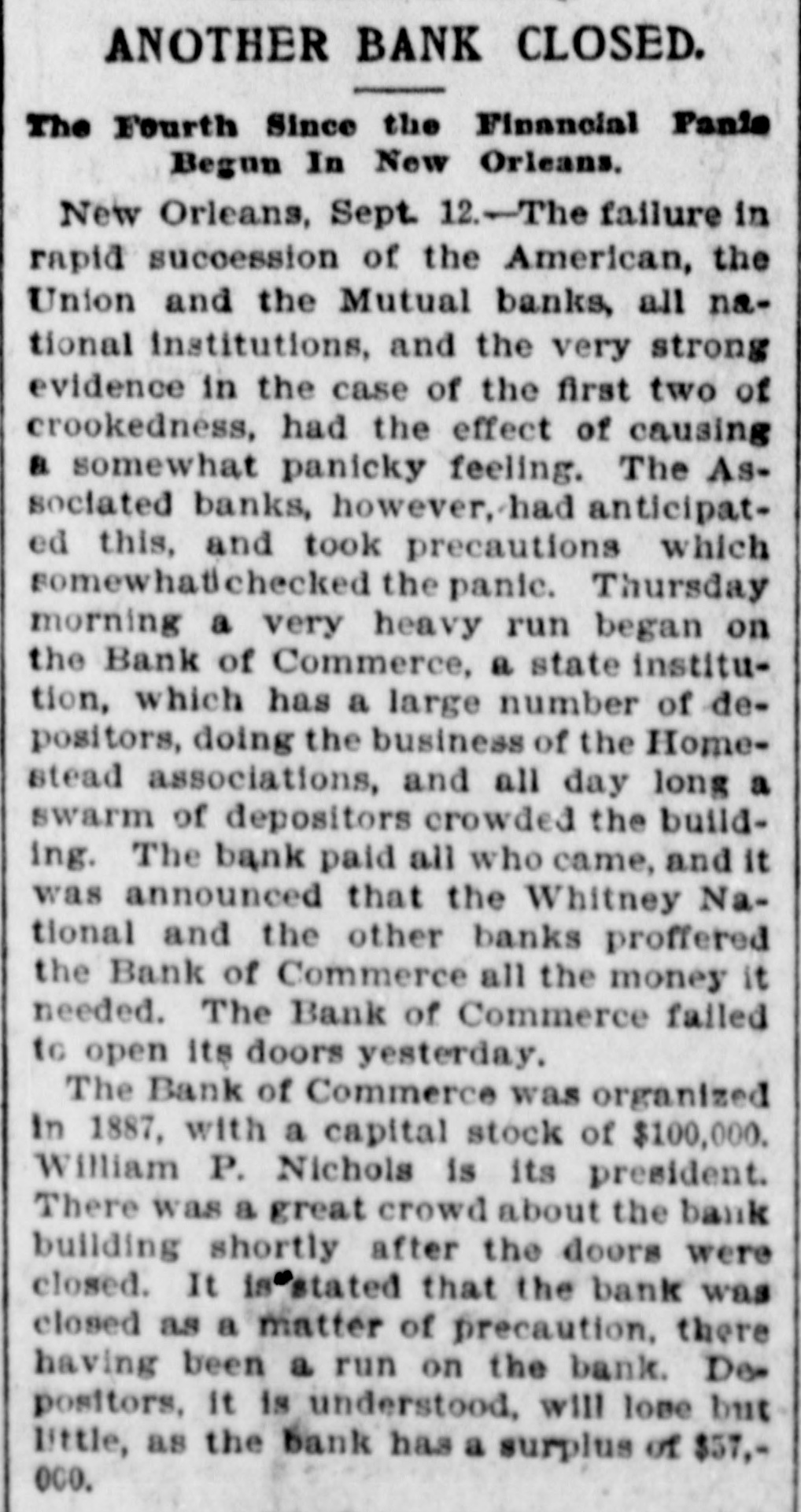
ANOTHER BANK CLOSED. The Fourth Since the Financial Fanis Begun In New Orleans. New Orleans, Sept. 12-The failure in rapid succession of the American, the Union and the Mutual banks, all national institutions, and the very strong evidence in the case of the first two of crookedness, had the effect of causing a somewhat panicky feeling. The Associated banks, however, had anticipated this, and took precautions which somewhatichecked the panic. Thursday morning a very heavy run began on the Bank of Commerce, a state institution, which has a large number of depositors, doing the business of the Homestead associations, and all day long a swarm of depositors crowded the building. The bank paid all who came, and it was announced that the Whitney National and the other banks proffered the Bank of Commerce all the money it needed. The Bank of Commerce failed to open its doors yesterday. The Bank of Commerce was organized In 1887, with a capital stock of $100,000. William P. Nichols is its president. There was a great crowd about the bank building shortly after the doors were closed. It is stated that the bank was closed as a matter of precaution, there having been a run on the bank. Depositors, it is understood, will lose but little, as the bank has a surplus of $57,000.


Article from The Daily Texarkanian, September 13, 1896

Click image to open full size in new tab

Article Text

New Orleans, La., is having a time with its banks. Four of them closed their doors in the past four days. The bank of Commerce was the first to go to the wall and the three others followed by runs being made on them. The people of all classes are heavy loosers, but will be paid their money back in time.


Article from Evening Star, September 14, 1896

Click image to open full size in new tab

Article Text

BANK-LOOTING SYNDICATE Seven Persons in the New Orleans Steal of $602,000. From the New York Sun. NEW ORLEANS, September 13.-There is only one more secret to come out in the wrecking of the Union National Bank and the bank panic which raged here last week, and it is announced that it will be disclosed within the next twenty-four hours. That is the names of the confederates, the men on the outside who drew out and appropriated the $602,000 of the bank's money. Colcomb and Leone, the bookkeepers, cooked the accounts so as to keep the bank always in debt to these confederates. The bank was robbed by a syndicate composed of seven persons, two on the inside of the bank and five oh the outside. The whole transaction was businesslike and systematic, including an agreement as to the amount to be drawn out or stolen each day, and the division of the funds. Colcomb, whose tack of nerve was shown Ly his suicide the moment suspicion pointed to him, was the organizer of the project and its director. It is reported tonight that a confession has been made; that three members of the syndicate have been named, and that the only reason their names are not now made public is to prevent any escape, as some of them are out of town. The money went mainly in riotous living; the balance on speculation with the hope of recovering the amount stolen. In the big cotton speculation last year when cotton went up so high, the syndicate was ahead of the game. The sudden collapse of the market prevented It from making good the bank's money and rendered a new raid necessary. The bank has been plundered more heavily than ever since. The outside members of the syndicate are said to be high livers. Not so Colcomb and Leone; they could not be so, for they were kept all the day at their desks working away to cover up the crookedness in their books. They had little time for a spree. Colcomb spent most of his share of the swag on his family. He lived most luxuriously, had ten servants, and a housekeeper to relieve his wife of the trouble of domestic affairs, a rather large household for a clerk on a salary of $150 a month. He had evidently anticipated that the defalcation would come out sooner or later, and had determined on suicide when it did, for he carried the poison on his person to be used at a moment's notice. He had many friends, and they all speak of him as generous and brave. To commit suicide is the only thing a gentleman could do under the circumstances, they say. Colcomb was interviewed on Thursday night about the bank's condition. He was calm and collected then and apparently in the best of humor, although it was only a few hours before his death, and he had then evidently determined on suicide. He did not tell his family of his intention, and it was not until several hours later that he took the poison and was discovered in an insensible condition. Once or twice in the next thirty-six hours he opened his eyes and looked around the room, but he neither spoke nor seemed to know any one. Colcomb's death renders the work of investigating the defalcation very difficult, and United States Bank Examiner Escott doubts whether it will ever be possible to know all the details. The receivers of the Bank of Commerce and American National Bank will take possession of them tomorrow. The other two closed banks, the Mutual National and Union National, still remain in the hands of the United States examiners. It is thought that the panic is over and that there will be no trouble tomorrow. United States Bank Examiner Escott completed his first trial balance of the Union National Bank tonight and found the amount stolen to be $602,687.07. This is subject to an increase when all the accounts are carefully examined.


Article from The Norfolk Virginian, September 24, 1896

Click image to open full size in new tab

Article Text

ANOTHER SENSATION SPRUNG In Connection With the New Orleans Bursted Bank. New Orleans, Sept. 23.-Another sensation was sprung this afternoon when the liquidators of the recently suspended Bank of Commerce came into the Civil District Court with a report. They find that the affairs of the bank have been mismanaged; that some of the accounts have not been properly kept and that grave irregularities have been committed. The overdrafts amount to more than $300,000. The bank is insolvent and its capital and surplus is lost. All that can be accomplished under most favorable circumstances will be the payment in full of depositors and bills payable by the bank. This, however, is not certain. There are some ugly rumors afloat reflecting severely against certain of the bank officers,


Article from Omaha Daily Bee, September 25, 1896

Click image to open full size in new tab

Article Text

Bank Was Dishonestly Managed. NEW ORLEANS, Sept. 24.-Messrs. Reynes and Bush, receivers of the Bank of Commerce, have filed a report in the civil district court in which they state that grave irregularities have been committed, and that the overdrafts amount to more than $300,000.


Article from Tensas Gazette, September 25, 1896

Click image to open full size in new tab

Article Text

THE NEW ORLEANS BANK FAILURES. The failure of four National Banks within a short time in New Orleans, to-wit: the American, Mutual, Union and Bank of Comшегсе, has alarmed the people throughout Eouisiana. The causes assigned for the-failure of two of them are gross mismanagement, and criminal conduct on the part of the officers in charge.. It is said that in China when a bank fails the law is to cut off the head of the man who is responsible for the management of the bank, and more than a thousand years have passed since one has failed in "The Flowery Kingdom." Every one thought when the $5,000,000 of sugar bounty money was paid into the vaults of the banks it would make them safe and sound, and nothing can make up for the criminal course pursued by the officers in charge of those institutions. A bank failed in Glasgow, Scotland, some years ago, the effects of which were felt far and wide and much distress and poverty was entailed upon the depositors on account of its failure. The law took hold of this matter, and every director, no matter how High his station in life, was held to strict accountability for the mismanagement of the Bank. But in this country it is unfortunate the case that when a man has money, power and influence through the ability of his law yers and influence of his friends,- no matter how guilty, he almost in every instance goes unwhipped of justice- How far the officers of these New Orleans institutions will be held accountable to the law for their shortcomings remaine to be seen- The truest test of a high covilization is the manthem enfureed


Article from The Salt Lake Herald, September 27, 1896

Click image to open full size in new tab

Article Text

PRESIDENT AND CASHIER. Bank Officials Who Are Liable to Come to Grief. NEW ORLEANS, La., Sept. 26.-Affidavits were made yesterday against President Nichols and Cashier De Blanc of the lately suspended Bank of Commerce, by one of the bank's depositors and shareholders, charging them, specifically. with receiving deposits after they knew the bank was insolvent. The penalty for violating the act is not less than five years in the penitentiary a/t hard labor. The president and cashier were arrested, pleaded not guilty and were held in bonds of $500 each. Bail was given.


Article from The Globe-Republican, October 1, 1896

Click image to open full size in new tab

Article Text

LATE NEWS NOTES. Seven cows were killed by lightning near Leavenworth. Miss Willard has issued an appeal to the W. C. T. U. for the Armenians. Jules A. Barron, brother-in-law of ex-Governor Lubbock of Texas, was killed by a trolley car at Galveston. Germany and Russia are endeavoring to uniform extradition laws in all Europe. with relation to Anarchists. The American representatives have finished their examination of English archives upon the Venezuelan boundary question. The Venezuela Commission will report to the President early in De. cember. Examiner Escott says that the liabilities of the Union National Bank of New Orleans are $1,635,700. C. L. Grimes was acquitted of the charge of murdering his son-in-law, Luther Whitmore, at Moberly, Mo. Two swell robbers held up five men in a Chicago office, got $1,600, shot a milkman and escaped in his wagon. President Nicholls and Cashier De Beane have been arrested at New Orleans for receiving deposits in the Bank of Commerce after it became insolvent. It is report d that England, Russia and France will act together as regards Turkey. A cloudburst struck the town of San Marcos, Texas, and washed away a large portion of the town. Treasurer George S. Morrison of Rensselaer county. N. Y., is a defaulter for $250,000. An anti-Masonic congress is in session at Trent, Southern Tyrol, with delegates from all European countries and Canada. Banks of Greeley and Argonia have failed. Mrs. Julia Lamb of Worth county has been convicted in the federal court at St. Joseph of pension frauds and fined $1,000 and costs of suit. Edward H. Mohnken. who resided near Sedalia, died from blood poisoning, the result of an accident wherein his ankle was fractured John W. Wicks of Topeka, who was married in St. Joseph last week, now mourns the loss not only of his wife but of $300 with which she skipped out. Four murderers were executed in New Mexico in one day. Bessie Bellwood. the well known music hall singer, is dead. Her death was due to syncope. Eugene C. Gregory, a Yale student, committed suicide in his home in New York by inhaling illuminating gas. Al Ruhman, the husband of Zella Nicolaus, has been sent to the Chicago bridewell on a fine of $100 for vagrancy. Harry M. Conway of Chicago was shot and killed by his 18-year-old wife, who then sent a bullet into her own heart. Li Hung Chang has sent a message to the secretary of state thanking the United States government for the many courtesies shown him on his visit to this country. A convention of delegates from the severalstateswill be held at Asheville, N. C., October 21-23 to petition Congress to adopt a "national flower of America," the convention to select the flower. D. D. Breckinridge of Watertown, N. Y., en route to Amesville. Ohio, to be married to Miss Ethel Gould, had his leg broken in a railway wreck at Athens. Miss Gould, on hearing of the accident, went to Athens, and the wedding took place at the appointed time. Callias Bey. the Arabian who married the widow of P. T. Barnum, is dead. Carnegie armor plate making secrets were learned by Russia through a small contract placed at Homestead. A Russian was present for eight months by stipulation in the contract, and learned the whole business. Carnegies were very accommodating, expecting new orders from Russia. James J. Joy of Detroit. famous railroad builder and financier, is dead. Burpee, Ramsey & Co., shoe manufacturers, of Lynn, Mass., have failed. They did d business of $1,000,000 a year. Because he slapped a 5-year-old white child James Hawkins was lynched and Alexander and Arthur Green shot dead near Gretna, La. All were colored. James A. Keaton has been appointed associate justice of the Oklahoma Supreme court. The lumber and mills of the Cascade Iowa, Lumber company were destroyed by fire. The loss is $105,000. A disastrous gale visited Great Britain. Much damage was done in London. Frank H. Johnson, a Chicago grain broker. killed himself in Lincoln park because of losses. National Sporting club, London, will not allow Corbett the premises, but will welcome Fitzsimmons. Allied Silver forces of Topeka will run C. K. Holliday for the Legislature against E. D. McKeever, Republican. A great locomotive on the Eig Four railroad blew up at Pekin, IIL, killing the fireman and wrecking a factory near by. Cattle Thief Kittrell, under arrest in Mexico and wanted in Indian Terretory. can not be extradited, his case not being covered by
Article from The Union Times, October 9, 1896

Click image to open full size in new tab

Article Text

# Bank Officers Indicted. At New Orleans, La., the grand jury brought in seven indictments for embezzlement against President Nicholls and Cashier DeBlanc of the suspended Bank of Commerce. The specified charges are that they at various times embezzled sums of money that had been deposited in the bank. Beginning on July 23d, 1893, when they took $23,500 and from that time until February, 1894, an aggregate of $96,000, is charged to have been taken by them. They have been arrested and are in the custody of the sheriff.


Article from The Union Times, October 9, 1896

Click image to open full size in new tab

Article Text

# NEWS OF THE WORLD. ARRANGED PARAGRAPHICALLY FOR THE BUSY READER. Happenings Both Home and Foreign as Taken From the Latest Dispatches. Notes From the South. The tugboat Dauntless, held at Brunswick, Ga., on the charge of filibustering, has been released on bond. The Southern railway reports for August the gross earnings of $1,442,001, a decrease of $109,551; net earnings of $420,908, decrease $44,425. D. Silver, a prominent merchant of Sparta, Ga., was assassinated on his way from his store shortly after dark. The murderer made his escape. Dr. W. L. Ryder, who assassinated Miss Sallie Emma Owen in Talbotton, Ga., on the night of April 5th has been convicted and sentenced to hang January 15th, 1897. At New Orleans, La., President Nichols and Cashier Deblane, of the lately suspended Bank of Commerce, have been arrested. They gave bond in the sum of $500 each. Reports received from all sections of Texas indicate that the cotton crop has been seriously damaged by heavy rains. Cotton was full flown and hundreds of acres are washed clean. A tremendous cloudburst struck the town of San Marcos, near San Antonio, Texas, and washed a large portion of the town away. Several people are missing and it is believed they have been drowned. Capt. George H. Berry, of the Effingham Hussars, a company of the First Regiment, Georgia cavalry, was assassinated while on his way from Savannah to his home in Effingham county, about three miles west of Savannah.


Article from New-York Tribune, October 14, 1896

Click image to open full size in new tab

Article Text

NEW-ORLEANS BANK OFFICERS INDICTED. SENSATIONAL DEVELOPMENTS LOOKED FOR IN THE CASES TO-DAY. New-Orleans, Oct. 13.-The Grand Jury late this afternoon returned eleven indictments in blank, but they are understood to be against the officers and directors of the suspended Bank of Commerce. It is said that sensational developments will follow to-morrow. The indictments against the directors are under Section 877 of the Revised Statutes of Louisiana, which relates to officers concealing the failing condition of a banking institution.


Article from The Morning News, October 14, 1896

Click image to open full size in new tab

Article Text

BANK OFFICERS IN DANGER. A Number of Indictments Returned at New Orleans. New Orleans, Oct. 13.-The grand jury late this afternoon returned indictments in blank, but they are understood to be against the officers and directors of the suspended Bank of Commerce. It is said that sensational developments will follow to-morrow. The indictments against the directors are under section 877 of the revised statutes of Louisiana. This section relates to officers concealing the failing condition of banking institutions. Quite a flurry has been caused among the friends of the directors.