Bank of Kentucky (Louisville, KY)

Episode Information

Episode UID
6680819291571
Episode Type
Run โ†’ Suspension โ†’ Closure
Bank Type
state
Bank ID
668081929 hash
Start Date
November 17, 1930
Location
Louisville, Kentucky (38.254, -85.759)

Metadata

Model
gpt-5-mini (chosen from majority vote of a three-model LLM ensemble)
Short Digest
5564eebc83cadf65

Response Measures

None

Description

Bank was suspended and placed in federal receivership Nov 1930 and did not resume operations.

Events (3)

1. November 17, 1930 Receivership
Newspaper Excerpt
Bank of Kentucky ... placed under resources receiver's control ... Paul C. Keyes, the comptroller of Washington (appointed receiver).
Source
newspapers
2. November 17, 1930 Run
Cause
Rumor Or Misinformation
Cause Details
Newspapers report wild rumors about the Bank of Kentucky precipitated heavy withdrawals across Louisville.
Measures
Numerous institutions issued statements reassuring depositors and opened accounts; directors issued precautionary statements.
Newspaper Excerpt
Alarmed the closing of the [National] Bank of Kentucky depositors today started run on virtually every bank in the city.
Source
newspapers
3. November 17, 1930 Suspension
Cause
Government Action
Cause Details
The Comptroller of the Currency appointed a receiver and the bank was suspended/closed by federal action.
Newspaper Excerpt
Bank of Kentucky ... placed under receiver's control ... Paul C. Keyes, the comptroller of the currency.
Source
newspapers

Newspaper Articles (14)

Article from Franklin Repository (Daily), November 17, 1930

Click image to open full size in new tab

Article Text

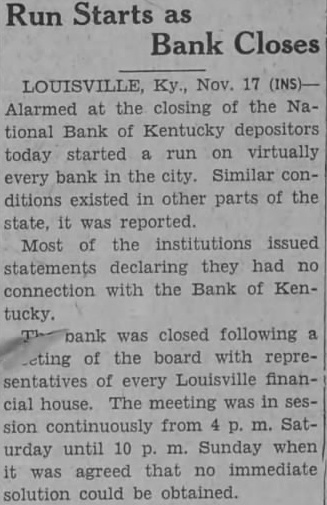
Run Starts as Bank Closes LOUISVILLE, Ky., Nov. 17 Alarmed the closing of the tional Bank of Kentucky depositors today started run on virtually every bank in the city. Similar ditions existed in other parts of the state, was reported. Most of the institutions issued statements declaring they had connection with the Bank of Kentucky. closed following of the board with representatives of every Louisville finanhouse. The meeting was in continuously from urday until m. Sunday when agreed that no immediate solution could be obtained.


Article from New Britain Herald, November 18, 1930

Click image to open full size in new tab

Article Text

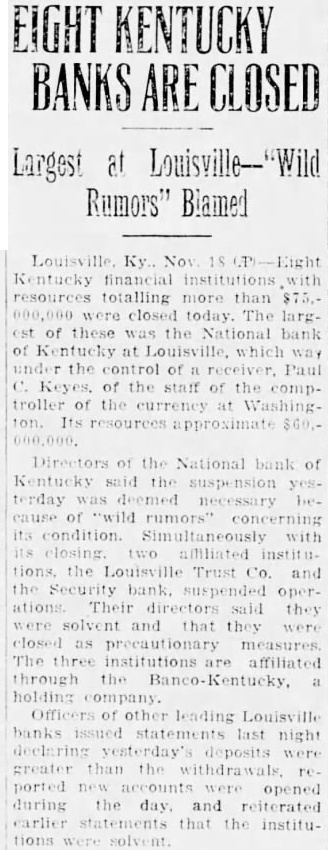
EIGHT KENTUCKY BANKS ARE CLOSED at Rumors" Blamed Louisville Ky Nov Kentucky financial resources totalling more than $75.closed today The largof these was bank of Kentucky at Louisville which under the of Paul Keyes, of the staff of the comptroller of the currency at WashingIts approximate Directors the National bank of said the terday was cause of "wild rumors" condition. with affiliated institutions the Louisville Trust Co and the operations Their directors said they and that they as precautionary measures The three institutions affiliated through other leading Louisville statements last night yesterday's deposits greater withdrawals ported opened during the day and reiterated that the institutions solvent


Article from The Dothan Eagle, November 18, 1930

Click image to open full size in new tab

Article Text

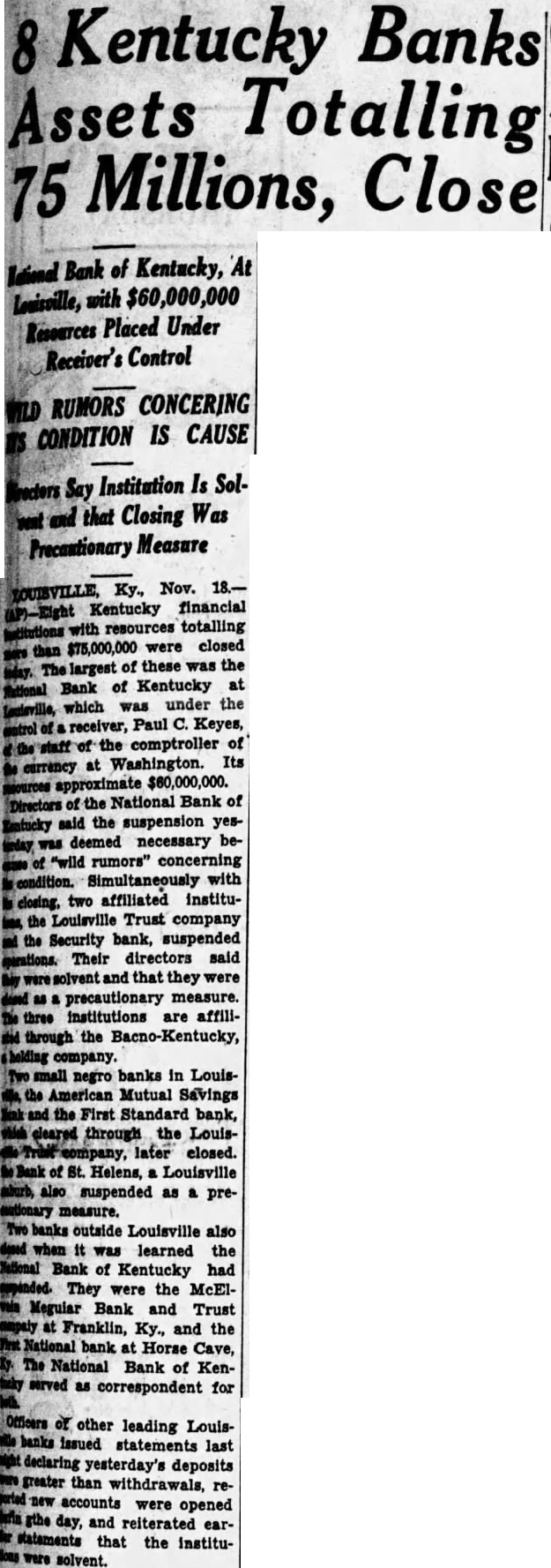
8 Kentucky Banks Assets Totalling 75 Millions, Close Bank of Kentucky, At with $60,000,000 Louisville, Placed Under Resources Receiver's Control RUMORS CONCERING IS CAUSE CONDITION Say Institution Is Solthat Closing Was and Measure Ky., Nov. 18.Kentucky financial with resources totalling than $75,000,000 were closed of these was the largest Bank of Kentucky at under the which was receiver, Paul C. Keyes, the comptroller of Washington. Its currency at approximate $60,000,000. Directors of the National Bank of Kentucky said the suspension yesdeemed necessary be"wild rumors" concerning Simultaneously with two affiliated instituthe Louisville Trust company the Security bank, suspended Their directors said that they were precautionary measure. institutions are affillthrough the Bacno-Kentucky, company. negro banks in LouisAmerican Mutual Savings the First Standard bank, through the Louislater closed. of St. Helens, Louisville also suspended as a premeasure. outside Louisville also when it was learned the Bank of Kentucky had They were the McElMegular Bank and Trust at Franklin, Ky., and the National bank at Horse Cave, The National Bank of Kenserved as correspondent for Officers of other leading Louisbanks issued statements last declaring yesterday's deposits greater than withdrawals, reaccounts were opened day, and reiterated earstatements that the institusolvent.


Article from The Knoxville Journal, December 6, 1930

Click image to open full size in new tab

Article Text

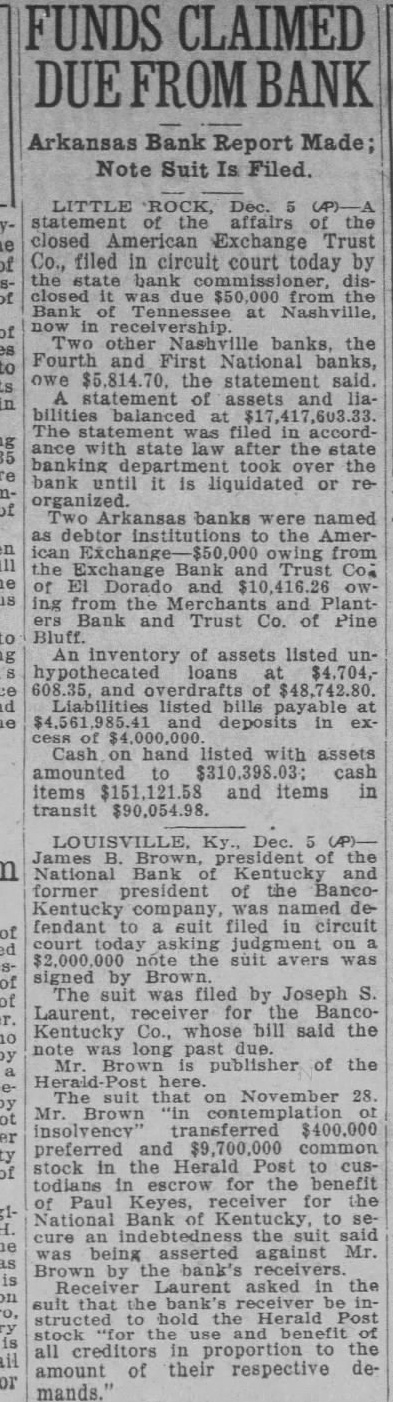
FUNDS CLAIMED BANK Arkansas Bank Report Made; Note Suit Is Filed. LITTLE ROCK, Dec. statement affairs the closed American Exchange Trust Co., filed in circuit court today by bank closed from the Bank at now Two other Nashville banks, the Fourth and First National banks, the statement said. statement assets and liabilities balanced The was filed accordance with state law after the state took over the bank it is liquidated or reorganized. Two Arkansas banks were named debtor institutions the American from the Exchange Bank Trust Co: of EH Dorado and owing from the and Plant Bank and Trust Co. of Pine Bluff. An inventory of assets listed unand overdrafts of Liabilities listed bills and deposits in Cash on hand listed assets amounted to cash items and items in transit $90,054.98. LOUISVILLE. Ky., Dec. James Brown of the National Bank Kentucky and former president of the BancoKentucky company, was named defendant to suit filed in circuit asking judgment suit avers was signed by The suit was filed by Joseph S. Laurent for BancoKentucky Co., whose bill said the long past Brown publisher of the here. that on November 28. Brown preferred and common stock in the Herald Post to cusfor the benefit Paul Keyes, receiver for the Bank of Kentucky, to cure the was being asserted against Mr. Brown by the bank's receivers Receiver Laurent asked in the that the hold the Herald stock all creditors in to the amount of their respective demands.


Article from The State Journal, January 14, 1931

Click image to open full size in new tab

Article Text

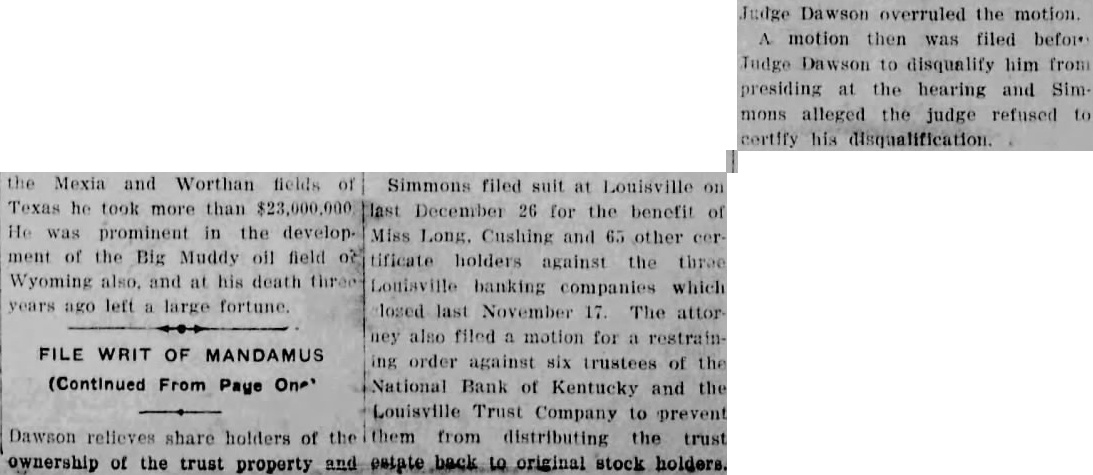
FILE WRIT OF MANDAMUS (Continued From Page One' Simmons filed suit at on December 26 for the benefit Miss Cushing and other cer tificate holders against the three banking companies which losed November 17. The attor also filed motion for restrainorder against six trustees of the Bank of Kentucky and the Louisville Trust Company to prevent Dawson relieves share holders from distributing the trust of the stock Judge Dawson overruled the motion. motion then was filed Judge Dawson to disqualify him from presiding the hearing and Simmons alleged the judge refused certify his


Article from The Courier-Journal, January 20, 1931

Click image to open full size in new tab

Article Text

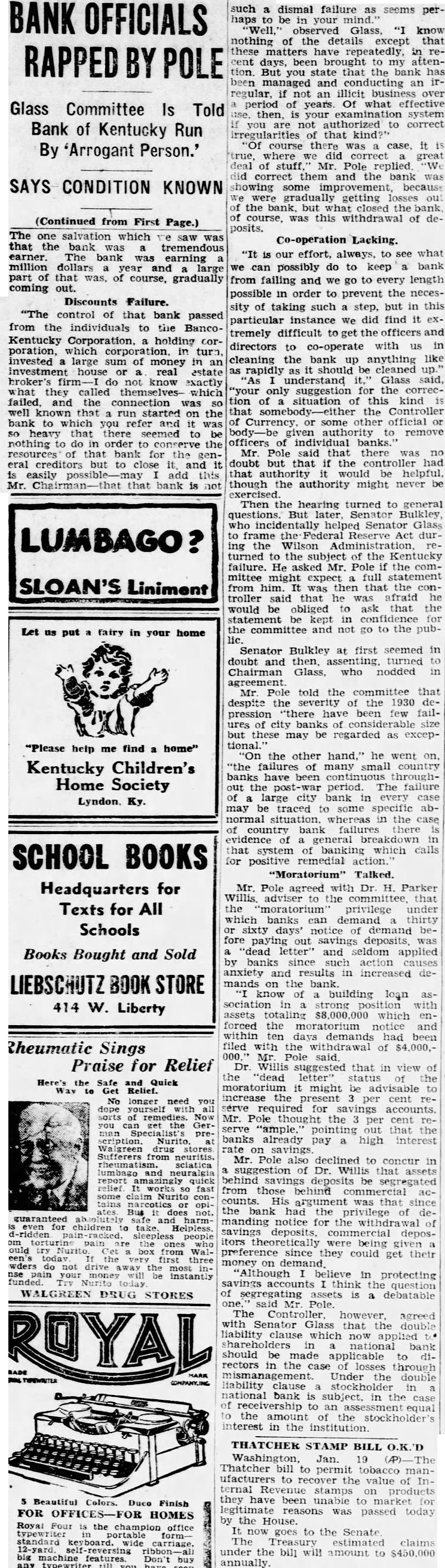
BANK OFFICIALS RAPPED BY POLE Glass Committee Is Told Bank of Kentucky Run By 'Arrogant Person.' SAYS CONDITION KNOWN (Continued from First Page.) The one salvation which saw was that the bank was tremendous earner. The bank was earning million dollars year and large part of that was, of course, gradually coming out. Discounts Failure. "The control of that bank passed from the individuals to the BancoKentucky Corporation. holding corinvested large sum of money in an investment house or real estate broker's firm-I do not know exactly what they called themselves- which failed, and the connection was well known that run started on the bank to which you refer and was so heavy that there seemed to be nothing to do order to the resources of that bank for the general creditors but to close and is easily possible-may add this Mr. that bank is not such a dismal failure as seems perhaps to be in your "Well," observed Glass, know nothing of the details except that these matters have repeatedly, in redays, been brought to my attenBut you state that the bank has been managed and conducting an irregular, if an illicit over period of years Of what effective then, your examination system you are not authorized Irregularities of that kind?" "Of course there was where did correct great of Mr. Pole correct them and the bank some improvement, were gradually getting losses the bank, but what closed the bank of course, was this withdrawal of deposits. Co-operation Lacking. "It is our effort. always, to see what we can possibly do to keep bank from failing and we go to every length possible in order to prevent the necessity of taking such step, but in this particular instance We did find it tremely difficult to get the officers and directors to co-operate with us in cleaning the bank up anything like as rapidly as should be "As understand Glass said, "your only suggestion for the correction of situation of this kind that somebody- the Controller of or some other official body-be given authority remove officers individual banks.' Mr. Pole said that there no doubt but that the controller had that authority it would be helpful, though the authority might never be exercised Then the hearing turned to general who incidentally helped Senator Glass to frame Federal Reserve Act during the Wilson Administra turned to the of the failure. He asked Mr. Pole the committee might expect full statement from him. It then that the controller said that he was afraid he would be obliged to ask that the statement be kept in for the committee and not go to the pubSenator Bulkley at first seemed in doubt and then. assenting. turned Chairman Glass, nodded in Mr Pole told the committee that despite the severity of the 1930 depression "there have been few of city banks of considerable size these may be regarded as exceptional. "On the other hand," he went on, "the failures of many small banks been continuous out the period. The failure large city bank in every case may be traced to some specific normal situation. whereas in the case of country bank failures evidence of general that system of banking which calls for positive remedial action. "Moratorium" Talked. Mr. Pole agreed with Dr. H. Parker adviser to the that the privilege which banks demand sixty days' notice of fore paying out savings a "dead letter" and seldom applied banks since such anxiety and results in increased mands the bank know of building loan sociation strong with totaling which the moratorium and ten days demands had been filed with the of $4,000,Mr. Dr. Willis suggested that in view of status of the moratorium it might be advisable to increase the cent rerequired savings accounts. thought the cent pointing that the pay high interest rate on Mr. Pole also declined to concur in suggestion of Dr. Willis that assets behind savings deposits be from behind commercial His argument was that the bank had the privilege demanding notice for the of itors theoretically given a since they could get their money on believe in protecting savings accounts think the of segregating assets debatable a Mr. Pole. The agreed with Senator Glass that the double liability clause which applied in national bank should be made to rectors in the case of losses through Under the double clause in a national bank is subject, in the receivership to equal case the amount the stockholder's interest in the institution. THATCHER STAMP BILL Washington, Jan. 19 The Thatcher bill to tobacco manto the of InRevenue stamps to market for legitimate reasons passed today the It now goes to the Senate The Treasury estimated claims under the bill will amount to annually.


Article from The Birmingham Post, February 18, 1931

Click image to open full size in new tab

Article Text

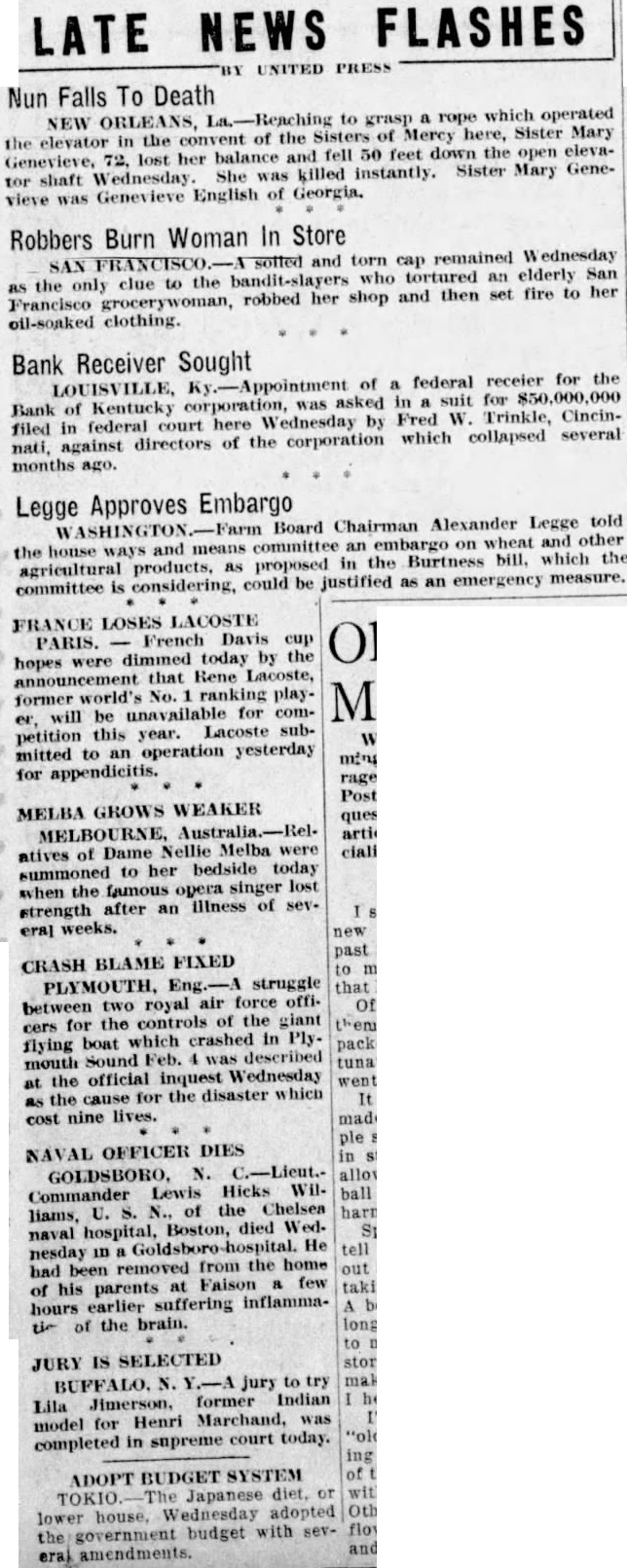
FLASHES LATE NEWS Nun Falls To Death which operated ORLEANS, to grasp rope NEW Mercy Sister Mary elevator in the convent of the the the open elevabalance fell 50 Genevieve, lost her Sister Mary GeneShe killed instantly. shaft Wednesday for vieve was English of Georgia. Robbers Burn Woman In Store remained Wednesday and torn who tortured elderly the Francisco the only clue to robbed her shop and then set fire to her oil-soaked clothing. Bank Receiver Sought federal receier for the of LOUISVILLE, Ky.-Appointment in for asked Bank of Kentucky W. Trinkle, Cincinby Fred federal court here Wednesday filed which collapsed several directors of the corporation nati, against months ago. Legge Approves Embargo Alexander Legge told Board Chairman and other committee on the house and which the proposed in the agricultural products, as emergency measure. could be justified as an committee is considering, FRANCE LOSES LACOSTE French Davis cup PARIS. by the were dimmed today hopes announcement that Rene Lacoste, for combe Lacoste subpetition this year. mitted to an operation yesterday for appendicitis. MELBA GROWS WEAKER MELBOURNE, Dame Nellie Melba were atives of her bedside today when the famous opera singer lost an illness of sevstrength after weeks. BLAME FIXED CRASH PLYMOUTH, struggle air force offibetween two royal controls of the giant cers the which crashed in Plyflying boat described mouth Sound at the official inquest Wednesday which for the disaster cause cost nine lives. OFFICER DIES Lewis Hicks Commander the Chelsea liams, Boston, died naval hospital, nesday the home He removed from had Faison few of his parents suffering inflammahours of the brain. IS SELECTED JURY jury to former Indian Lila Jimerson, for Henri Marchand, was model court "old in supreme today. completed ADOPT BUDGET SYSTEM Japanese Wednesday adopted house, budget with and


Article from The Courier-Journal, April 1, 1931

Click image to open full size in new tab

Article Text

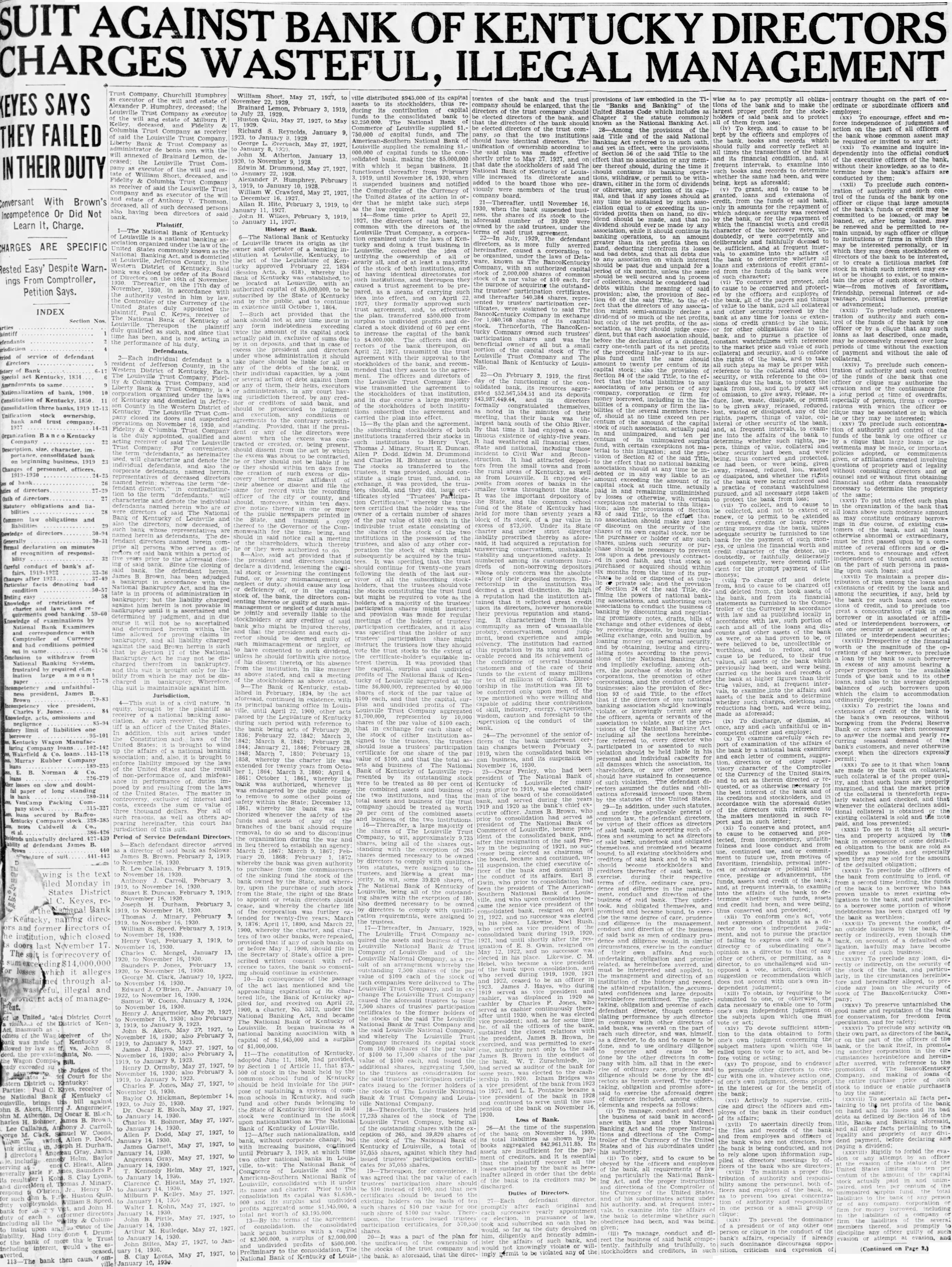
SUIT AGAINST BANK OF KENTUCKY DIRECTORS CHARGES WASTEFUL, ILLEGAL MANAGEMENT SAYS THEY FAILED THEIR DUTY Conversant With Brown's Incompetence Or Did Not Learn It, Charge. CHARGES ARE SPECIFIC Rested Easy' Despite Warnings From Comptroller, Petition Says. INDEX Section Nos service of defendant directors Bank 6-17 Special Kentucky 1834 Amendments Nationalization of bank, 1900. 10 Constitution of Kentucky. 1850 11 Consolidation three banks, 1919 Unification stock bank and trust company 1927 Organization Kentucky the duly Company 22 acting receiver Company bank used beginning business. 1919 23 individual Changes personnel, corporate bank 26 named fendant directors to the directors 27 characterize obligations and lia 28 directors Common obligations and Generally Formal declaration on minutes of responsi32 said Careful conduct bank's af. bank fairs, 1919-1922 James Changes 37-49 Particular denoting National condition 50-57 in Resting easy 58 Knowledge of restrictions of against him charter and good banking determined by Knowledge examinations by course will National Bank Examiners and with allowed Comptroller Currency bankruptcy and pointed against the withdraw from National Banking charged frustrated el.m and ination large paper charged and suit is ness James Brown president, Charles 84 receiver and ciation. negligence of liabilities addition 95-101 Wagon ManufacCompany loans 102-142 up 143-178 Murray Rubber Company enforce liability 189-225 the United Norman 226-279 losses on doubt by and paper standing 280-314 Packing exceeds pany thousand Kentucky Company 328-385 Caldwell defendant James B. 440 of suit 441-443 is the text Monday States District Stuart November Keyes, reJoseph naming direc1919 and lirectors of S. former William to November institution, which closed Henry doors last November 17 November The of Charles forrecovery Saunders losses hich alleges George M. through alNovember illegal and Edward rovident acts of manageent. November United District Court the District of to John edness of the Receiver of the was made Kentucky 1919, to John James the No. Wagon ady exceeded D. of the Henry Judges November Court for the District Kentucky Charles Parties receiver November 16, National Bank Kentucky Baylor bill against brings July 1923, Akers, Dr. Oscar Oscar M. to January Bohmer James B. Charles H. Lee Anthony to January Coons, M. Allen Allen January Joseph Durham. James James 14, January directors Baylor Angereau Saunders Kennedy severally Clay to January Minary Clarence Henry to January respond Huston Milburn such dhn William to January John H. Walter directors Columall the of the January Drum- Arthur M. Had done liability Trust to more tha the bank the would ceased, uary 14, Clay bank then cause ville Trust Company. Churchill Humphrey as of estate Alexander Humphrey deceased: the Louisville Trust Company as of the will and estate Milburn Kelley deceased Fidelity & Columbia Trust Company as receiver of said the Louisville Trust Liberty Bank Trust Company administrator bonis with the will annexed Brainard deceased: the Louisville Trust Company as executor the will and tate William Short deceased and Fidelity & Trust Company Company receiver said the Louisville Trust and will and Anthony deceased. of such persons also having directors of said November William Short May 27, 1927, to Brainard July 23. February 3, 1919, to Huston May 27, 1927, to May 1929. Richard S. Reynolds, January 9, to George May 1927, January John January to November 1928 Edwin M. Drummond, May 27, 1927, January 22, Alexander February 1919, 10. 1928. William W. Crawford, May 27, 1927, December Allan R. Hite, February 3, 1919, to January John H. Wilkes, February 3, 1919, to 1-The Bank of Kentucky of banking United under the States commonly as Banking Jefferson County the Western District of Kentucky bank was closed order its Board 16th Thereafter on the 17th day 1930 in accordance with the authority vested in law the Controller the Currency United States appointed plaintiff Paul receiver Bank of Kentucky plaintiff duly qualified such, and has and now acting in the duty. 2-Each individual defendant resident County the Western District of Kentucky The Louisville Trust Company Trust Company Liberty Bank Trust Company of Kentucky and domiciled in Jeffer County Western District The Louisville its doors and operations November Fidelity Columbia Trust qualified The Louisville hereinafter characterize and denote the named of the directors term "defendants and denote the individua said The Bank of Kentucky the directors now are named fendant named prise all di said within the defendant herein adjudged Bankruptcy and his of administra but the liability until it is and and ascertained and liability said herein the he may may bankruptcy against as plainofficer the United States suit arises under Constitution brought banking it brought imposed States the duties resulting the interest and For others aphas Period of Service Defendant Directors Each defendant served bank James Brown. February 1919 February February 3. 16. February 1919, February February 3. February 1919, February 3, 1919, to Mengel, January 13, February 13, January 10, 1922, 16. January November 16, 1930. Samuel W. Coons, January 8, 1924, 16, 1930. May 1927 Henry to November 1930; February January Akers, May November 16, February 1923. to November 1930 February 3, January February May 1927, 1930. September 14, Hickman, 1930. May 27, 1927, E. Bloch, May 27, 1927, Bohmer, 1930. 27, 1927, to Dodd, May 27, 1927, to Garnett, May 1930. 27, 1927, to Gray, May May 27, 1927, Helm, 14, 1930. May 27, Hieatt, May 1927. Kohn, May January John Pirtle, May 27, 1927, to May 1930. John January May 27, 1927, to Jan1927, to May 27, Lyons, January 10, 1930 History Bank. National Bank Kentucky of traces its owner and operator of banking stitution at Louisville, Kentucky the the Legislature of February 1834 Acts, 618) whereby the Bank located an authorized of subscribed the State of Kentucky in until October 7-Such act the bank incur any the its capital to due president and take be liable all action debt any administrators court hav ing jurisdiction itor creditors said be judgment and the notwithstanding the the were the being should the which was he not be liable the affidavit file the officer of the newspapers printed in the said act provided that the the loss stock the bank the neglect be jointly and any who and guilty of such like manner The Kentucky banking acts Kentucky February 836 February March March January February 1848 March February March 1861 whereby bank authorized, whenever was endangered by public enemy whereby the of funds and assets branches the the during the and war March March ruary 20. 1868 February 1872 whereby was authority to fund stock the bank and the State appoint whereby the charter life further tended April and whereby the and ters of banks, on May should file Secretary State's prescribed the ing In of the the act last mentioned and the apfor, and received April charter 5312, under the National became Kentucky Louisville as national with capital 1,645,000 and surplus of of Kentucky adopted had provided, Section of Article in common should held the comand such schools belonging the State of Kentucky said stock continued the stock The Bank of Kentucky of Louisville. nationalization, said without corporate change, but bank, with increasing business, continued until February 1919, at which time other banks in National Commerce Louisville National Bank under and charter to its name consolidation its capital 000 and its of the of the agreement consolidation. the consolidated capital bank began 2,000,000 of surplus profits of undivided and the The Preliminary of Kentucky of LouisNational Bank ville distributed $945,000 of its capital assets to its thus ducing its contribution of capital funds the consolidated bank $2,250,000. National Bank that Commerce 750,000 capital funds, National Bank of Louisville supplied the $1,of capital to the con- the solidated making the $5,000,000 with which began November 1930 suspended business and notified the Comptroller of the Currency of the United States its action that he might take steps as the the said bank, common with the directors Louisville Trust tion the laws Kentucky trust conceived idea unifying of nearly and majority the both institutions, and having directorates such thereupon they caused trust the as such ing means of carrying into 1927 the transferred $500,000 from and clared stock dividend per cent increase capital the diApril transmitted the agreement with their approval the stockholders of the and recommended The and the Louisville Trust Company likewise transmitted agreement the of and in due course majority the stockholders the agreement and as into the the of both By stocks Henry Thomas Stuart Charles H. Bohmer transferred to the trustees, was stitute and tificates Participa- It tion Certificates whereby the tees of shares par shares the last the stocks constituting the might required holders majority of the trustees participation and regular meetings was participation instruct the the that the The $100 plus The Trust aggregated the par $100 that stock institution signed the should trustees' participation certificate the par value and that the and The National Bank Kentucky resented 80 per the the two that and the company should be treated worth 20 the and institutions majority The Louisville Company approximately standing by 39,820 National Bank of Kentucky of ing the also deemed directors assigned the The Louisville the and The Louisville National Company Louisville Louisville National sult value The Louisville change The Louisville caused the certificates stocks National Bank said Louisville whereby Louisville Company its $100 additional the said Bank ville National trustees 17,235 the The Trust all the the exception of 265 and 39,820 shares the stock The National Bank Kentucky of Louisville, total 57,055 shares, against they had issued participation certificates 57,055 was agreed that par value each trustees share should $10 and the existing the ten such shares $10 par share $100 Theretrustees participation certificates for 570,550 was part the plan for the the the stocks of the trust company and the as that the direc- torates of bank and the trust company enlarged. that the directors of the trust should directors the bank. and the be the trust company. that the two institutions should directors. The unification of said plan made effective prior May and that date the said The ville directorate and added the board those who viously members of the trust board. until November when suspended shares its the number 39,820 were owned by under the terms agreement 1929, defendant fully averred the laws known The BancoKentucky Company authorized capital $10 each, purpose acquiring the outstandtrustees' participation tificates to said The Company 1,080,768 capital stock. The BancoKenCompany trustees' participation beneficial portion the stock The Louisville Trust Company and The National Bank of Kentucky of LouisFebruary the first the the solidated gated and its deposits its directors formally noted the of their bank was largest the that had enjoyed existence had weathered all financial and ReconIt had deposithe the areas from smaller throughout was the important depository Kentucky held liability as DiSo characterized had fit the industry to the wisdom, the conduct of the The personnel of the senior oftain changes bank beand its on gan business, November who been The Bank president many Kentucky chair1919 and officer Bank president consolidated the resignation said chairman executive affairs. Earl its National ville. the was his Likewise Noel his 1921 an during displaced who by thereafter was the closest the James the had as the for Isham Bridges of the vice November 16, of the 1930. Loss of Bank. 26-At the time the suspension the on 16, 1930. its total liabilities as shown by Its books aggregated insufficient for the creditors. plaintiff recover all the the sustained the as herealleged the debts inafter bank to its creditors may be Duties of Directors. director and his acting under defendant his authority. at frequent each original promptly into the yearly appointment each of the bank pursuance that he obedience had and was being. and devolved given: the duty (iii) To conduct and diand honestly admindiligently bank, and rect business said the affairs such tently faithfully and truthfully. would not knowingly stockholders and creditors, in such to be violated any of the ingly provisions law embodied in the Title "Banks Banking' the United States Code which includes as Chapter as the National Banking Act. the provisions the said Title the said National and Section 56 the said Title the during time peraeither the of dividends any portion its capand any any exceeding its divided idend should be made and that dividend by any association banking amount profits therefrom its and any on the be due and period six and the meaning of said Sec- ed ion said the fect any net profits, that each before its net the plus fund the the capital Section the total any association company including the liabilities of s of the lost centum the paid in ine terial this and the the said to the no at debted to amount capital actually paid and remaining indiminished otherwise the 83 of the effect of the said the powers ing ing bills and and the tion 93 banking knowingly any servants the association any including the referred participated held liable violation and capacity any person should consequence diassumed the and the United States addition. under and general directors said and obligated and creditors said who and creditors thereafter exercise. respective business They and bound to diligence direction the business said and in obligation and hereinbefore be and institution the confidences deposits defendant director, though contemblating director said bank, was part each and was, and be use ordinary diligence to done by pany with all that in the the The obligation and promise aforesaid To and direct the business of said bank in accordlaw and National the instrucand of the Comptroller of the Currency of the United States and of his subordinates under his authority: To to cause to be obeyed by the all of law and particularly the National Banking and the proper instructions directions Comptroller the Currency the United States as promptly obligations the bank and make the largest proper profit for the stockand protect and cause to kept by and employes which should and correctly reflect transactions the bank and its financial into whether the and were being, kept as aforesaid grant, cause to be of repayment adequate security was the repayment the character unand deliberately deemed sufficient, interaffairs of grantfunds were such and conserved and of things the or the bank for extenthe other obligations the bank. and pursue practice reference the such enforce collateral the take with reference and other with obdue act release, dissipate, permit reduced. the colthe bank, and examinto bank such rights, paand had protected. given rights taken of to extended repreunless monthe and unand the of the off and assets financial Compand locally portion and disthe bank true the which to affairs and were being, (ix) To discharge dismiss, at inany each rethe affairs port the bank examiner bank and each of suggesdirection supercharacter the Currency of States, and act or necessary the the and its creditors and and with the of the reference mentioned in such rethe port and cause conserved profrom unfaithand and from use, motives personal est political influprestige bank; examine into the affairs termine and had been being, and act, vote thought as diand independent judgand not to the as as that any opinion director, and unopposed suggestion which does own inrequiring to be one, the data the must To sufficient attention form judgment the called to and beconwith one in. proper in the interest or for the benefit of the bank; critiand and employes the bank in their conduct of its affairs; (xvii) ascertain directly from the files records and and officers the bank are not directors, how the bank and not rely alone upon information supplied meetings of the are (xviii) To maintain distribution authority and bility the both ficers and the too concentration person or group clique: (xix) To prevent the dominance any other one person the the bank's especially already such dominance discourages sition, criticism and expression of contrary thought on the part of COordinate or subordinate officers and employes: (xx) To encourage. effect and enforce independence and action on the part of all officers the bank whose assent may be required invited to any act: (xxi) To examine and inquire independently into the official conduct of the executive officers of the bank, without determine the bank's affairs are conducted (xxii) To preclude such concentration of authority and control of the funds the bank by one officer or that large amounts of the credit may be committed may be loaned. or, being may be renewed and be permitted to main unpaid, by such officer clique to institutions or firms in which they may be personally, or in which they stockholders or the bank be interested, or to create fictitious market for stock in which such interest may exthought to to maintain the price otherwise-from motives of favoritism, friendship. personal interest or advantage, political influence, prestige advancement: (xxiii) To such concentration authority control the funds the bank by one officer or by clique that any such loans as last described, once made, successively renewed over long periods the exaction of payment and without the sale of collateral. (xxiv) To preclude such concentration of authority such control funds the officer may authorize the creation the continuance for long time of overdrafts. especially persons, firms corporations with which the officer or clique may be which he may be (XXV) concentraof authority and control of the funds the bank by one officer clique or inimportant policies adopted, commitments given, affiliations involving questions of propriety and of legality without and or counsel obtaining financial and other reasonably necessary determine the propriety the same: put into effect such the the bank above moderate amount may constitute ordinary borrowings due existing customers the bank, and loans must be first committee officers and directors. encourage and effect independence thought action on the part such persons in passing upon such loans (xxvii) maintain proper distribution of risk the loans and extensions of credit by the bank and among the securities, any, held by the bank loans sions of credit, to preclude too great risk one borrower or in associated or affiliinterdependent or or affiliated (xxviii) Irrespective the financial worth the magnitude of the erations any borrower. preclude loan the bank to such borrower of bearing the available funds of the bank and to its other loans, and also to average deposit of such upon which claim accommodation ordinarily (xxix) To restrict the loans and extensions of credit bank to the without from the Federal Reserve Bank save neccessary to the normal and yearly curring seasonal demand the bank's and never otherwise except when the directors expressly permit; To see to that when loans made the bank collateral, such collateral is the proper quality. and that such are properly that the market price collateral thenceforth regularly watched and checked. and that whenever the collateral declines additional collateral is the and the note and prevented: (xxxi) see to that all securities property acquired by the and bank in of defaultthe bank are as speedily and especially when they for the amount of the defaulted obligation; (xxxii) To preclude the officers of the bank from time lending. the funds the bank borrower who has unable to existing ligations to the bank, and particularly borrower whose has been charged off by the bank as To prevent the conduct of an outside business by the bank, dior indirectly. though the account oblawfully may the To preclude any loan, dior the the and particularly circumstances hereinbefore and hereinafter alleged, preclude stock BancoKentucky Com(XXXV) To preserve untarnished the good name the bank freedom from and (xxxvi) any activity on part, on the part the officers of the the bank in promoting another corporation the and after averred. with reference to the promotion BancoKentucky and making loans the entire purchase to induce enable purchasers buy the To ascertain all facts pertaining the net profits the bank hand its losses and its bad on defined Section the title, Banking facts pertaining to the propriety divibefore and dend declaring paying (xxxviii) Rigidly to forbid the sion attempt of the United States limiting ten per centum the amount the capital stock actually paid and the total unimpaired liabilities any person company. corporation including liabilities the several members promptly to discipline any of evasion or attempt evasion, and (Continued on Page 2.)

Article from The Courier-Journal, September 14, 1931

Click image to open full size in new tab

Article Text

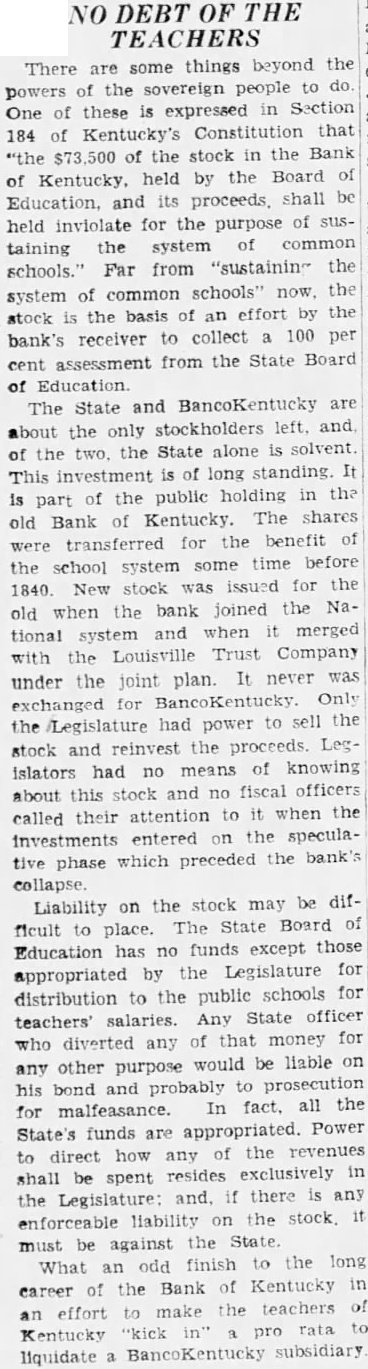
DEBT OF THE TEACHERS There are some things beyond the powers the these expressed in Section 184 Kentucky's Constitution that $73,500 of stock in Bank of Kentucky. held the Board Education. its proceeds, shall be for the of susthe common taining schools." Far from "sustainin" the system of common schools" now. the stock the basis an effort by the bank's receiver collect 100 from the State Board assessment of State and BancoKentucky are stockholders left. and about the only State alone solvent the This public holding in the part of the Kentucky. shares old Bank the benefit transferred the school system some time before issued for the 1840. New stock joined the Naold when the bank when merged the Louisville Trust Company under the joint plan. It never was exchanged for Only had to sell the Legislature power reinvest the Legstock and means of knowing islators fiscal officers about this stock no to it when the called their attention entered on the speculainvestments preceded the bank's phase which Liability on the stock may be dif. Board of ficult place. The State except those Education no Legislature for appropriated by schools for distribution the public State officer teachers' that money for who any any other would be liable on his prosecution all the for malfeasance. State's funds are appropriated. Power direct of the in shall spent resides there any Legislature: liability the enforceable must be against State. odd the long What an finish of Kentucky in career the Bank the teachers of make pro rata BancoKentucky subsidiary liquidate


Article from Lincoln Journal Star, December 21, 1931

Click image to open full size in new tab

Article Text

DIRECTORS MUST PAY Comptroller Pole Says Can Be Forced to Use Own Assets. (UP) Bank directors can be compelled in specific cases to compensate losses depositors to the full their own instead of just the amount of their Comptroller of the Currency Pole told the United Establishing the liability of bank directors for the full amount of their own assets may be one the laws evolved to protect money and reduce bank Such law would inflict heavy penalties The government is now conductcase against the directors of the Bank of Kentucky Louisville, to recover for great deal of this sum, if awarded, will come from private assets other than shares held by directors in the bank, which closed its doors Nov. 17, 1930. Should the government win its the effects will be ing. Money would be more secure and bank failures fewer.


Article from Detroit Free Press, March 27, 1933

Click image to open full size in new tab

Article Text

Coughlin, the Demagog The Rev. Father Charles E. Coughlin, the political radio haranguer, went far beyond his usual flamboyant demagoguery in his Sunday afternoon address. This man, who already stands rebuked by Cardinal of his Church for his political activities, after slandering the directors of the two outstanding banking groups of Detroit, directly charged that these holding companies were organized to "cheat the widow, rob the orphan and to oppress the poor"; that they were created to escape possibility of double liability in case their banks failed. As to the men assailed, the list of their names, printed elsewhere, is sufficient testimony as to their characters. They are known to all Detroit. Let the people judge between them and the demagog Coughlin. Many of them are outstanding members of the Catholic faith: in fact, pillars of the Church from whose teaching Coughlin has wandered so far afield. They have been the largest contributors to the Church and were carrying its burdens when Coughlin was a boy in Canada. As for the organization of the holding companies to dodge liability, the law itself will answer that slanderous utterance. By no stretch of the imagination could double liability be dodged, nor has there been any such idea on the part of the holders of Detroit Bankers stock or of that of the Guardian Group. The attorneys for the United States conservators have made that quite clear. Nobody is confused by it except Coughlin and those he seeks to dupe. Judge Robert S. Marx, Federal counsel for Conservator C. O. Thomas, of the First National Bank-Detroit, frequently has explained the liability of stockholders in holding companies. He said: procedure in such cases is to obtain judgment against the holding corporation. That entitles the conservator to dispose of its assets. If, when these assets have been disposed of, there are still insufficient funds to meet depositors' demands, suits may be instituted against the stockholders of such a holding company. This was the procedure in the case of the Bank of Kentucky, liquidated by Federal receivers at Louisville." Judge Frank E. Wood, counsel for Conservator B. C. Schram, of the Guardian National Bank of Commerce, has concurred in this opinion. Judge Wood said: "In the case of the Bank of Kentucky, the holding company's entire interest amounted to about 70 per cent interest in the bank. When judgments were obtained against these stockholders, 70 per cent of the amount collected was turned over to depositors in the bank. The remaining 30 per cent went to subsidiaries of the holding company." The political animus and the sinister newspaper influences guiding Coughlin are shown in his bitter personal assaults upon E. D. Stair, the publisher of The Detroit Free Press. Hiding behind his priestly garb, using the strength of the Church to give him prestige, Coughlin pulls the chestnuts out of the fire for political and newspaper interests the Free Press has always combatted and always will. The truth of Mr. Stair's connection with the Detroit Bankers could have been easily found if Coughlin had been seeking the truth-which he was not. There have been three presidents of the Detroit Bankers. The first was the late Julius Haass, who conceived it and organized it. The name of Mr. Haass needs no defenders. After his tragically untimely death, the presidency went to John Ballantyne. Upon his resignation, Mr. Stair was induced to take the presidency by the other directors of the company. This was last May. Mr. Stair took the office with great reluctance and only on the urging that it was civic duty. He consented to serve only on the condition that there would be no salary attached to the office. Mr. Haass was paid $100,000 year. Mr. Ballantyne was paid $50,000. Mr. Stair refused to accept cent. He took the office only on the agreement that the holding company would be little more than an auditing concern to cut down the expenses of the constituent bodies. This was accomplished by slashing millions from the overhead and reducing all executive salaries. He went in, against his own desire, to save the institution if he could, and the money of the depositors. The demagog Coughlin, raving over the radio for two years with his attacks on the banks, did much to bring about the present condition. He robbed the people of confidence in these directors and their banks and was one of the chief causes of withdrawals of funds from them during the past two years to total of over two hundred million dollars. And it is ironically true that while priest of the Church did his best to destroy the First National Bank with his radio bombast, the Church he misrepresents was the largest single debtor to that institution. One of the main reasons for the bank's troubles was the fact that tried to carry the load of the Catholic Diocese's with other churches, fraternal bodies and, above all, the hundreds of thousands of homes and little businesses. The directors of that institution, with many of the leading Catholic laymen in Detroit its board, considered the Catholic Church the finest risk that any bank could take. They still do. Nobody knows that better than Bishop Gallagher, who is supposed to have some degree of control over the Royal Oak firebrand. Read the names of these directors. They sat on the board. They elected Mr. Stair against his own desires. He has been singled out for attack for vicious political purposes. The Church is being used to sorry ends. If Coughlin spoke as a man and were not priest, with the prestige of his office to give him prominence, he would not be listened to. How long will this ecclesiastical Huey Long be allowed to slander decent citizens of this city in the name of God?


Article from The Lexington Herald, March 28, 1933

Click image to open full size in new tab

Article Text

MAY PLEAD FRAUD Judge Rules Misrepresentation Is Defense LOUISVILLE, Ky., March 27 (AP) -Federal Judge A. M. J. Cochran ruled today that purchasers of BancoKentucky Company stock may plead fraud and misrepresentation as a defense to non-payment of notes. The ruling was given in the suit of Paul C. receiver of the Bank of Kentucky, against J. P. Dant for $25,000. Dant denied liability on the ground he was deceived in making his purchase. The ruling was expected by at torneys to have far-reaching ef. fects, since the receiver has filed numerous similar suits.


Article from The Lexington Herald, March 30, 1933

Click image to open full size in new tab

Article Text

STOCK BOUGHT 85,966 Shares of American Turf Association Purchased From Bank Receiver at $8 Each TOTAL PRICE IS $667,728 LOUISVILLE, Ky., March of the of 85,966 shares of Turf Association stock by ceiver the Bank of Kentucky, to the turf at price of share, tained in order received Tues by the here from Federal Judge M. Cochran. In the order ratifying the deal. Judge will be for the best of the ceivership and and depositors the National Bank of The bank's receiver will receive $667,728 from the turf the sale. which been the center of proxy fight group of stockholders seeking change trol, will have the voting rights to the of power in the organization. believed certain, therefore, that the present board of directors up for at the annual next Monday in will Mr. will turn the shares over to the American Turf Associa. tion as legal details completed. Terms the 50 per cent cash; 26 per cent payable December 31, 1933, and the balance December 31, 1934. The payments are secured by all stock and first mortgage Lincoln Fields track Chicago. The notes bear interest of Funds for initial payment available from company's $500,cash balance, reported week M. Winn, executive director the association. Mr. Winn was stopping at the Brown hotel Tues. day but reported and could reached for statement on the Mr. Anderson his petition, said the bank had title to 70,700 shares of the stock, purchased by Paul Keyes, receiver for the bank. an average price $6.50 share. additional 15,966 shares collateral on rious notes in custody of the ceiver. The petition set out that the as. had no dividends for two years the "after diligent repeated efforts had unable obtain any other offer for the stated that the receiver believed the "was to the best interest of his trust that of the depositors bank." Officials sanctioned the sale after concluding that profits from race


Article from Alton Evening Telegraph, April 3, 1933

Click image to open full size in new tab

Article Text

Gallant Sir Wins Caliente Handicap in 2:02.8 Mile And a Quarter Race Is No Longer Richest in World But Still Has $25,000 Added PurseWinner Cracks Record Set By Phar Lap-Had Been Standout in Mediocre Field April Matt Winn today was president American Turf Association, the opposition at overthrowing stockholders' meeting. CHICAGO, April race of the American Turf for control Association entered the stretch with Col. Matt Winn wingday ing out in front, an apparent easy winer. Charging "mismanagement, waste of funds and extravagance,' group of stockholders recently opcampaign to remove Winn ened as president of the which controls and owns the Churchill Downs and Latonia tracks in Kentucky and Washington Park and Lincoln Fields Chicago. brisk skirmish was held for controlling shares as the annual election came today, Winn appeared certain re-election. It was reported on good authorithat the Winn group obtained balance of power in the organization by purchasing 85,966 shares of stock from the receiver of the Bank of Kentucky Louisville, which was holding it as colateral. "We do not know what will happen," said Maurice Galvin, one of the large stockholders of the American Turf Association and for years one Col. Winn's closest advisers. "We do know that about 75 per cent of the stock will be represented at today's meeting and from the outlook Col. Will and most of the present members of the board of directors will be reelected." Galvin said there was nothing reports that group of Chicagoan was fighting Winn in an effort wrest control of the four valuable tracks and the great classic Churchill Downs, the Kentucky Derby. Col. Winn, silent through all the fight for proxies and ings, been president of the American Turf Association since was formed four years ago. He long has been one of the guiding geniuses of the Kentucky Derby. witnessing every classic run off at Churchill Downs,