Article Text
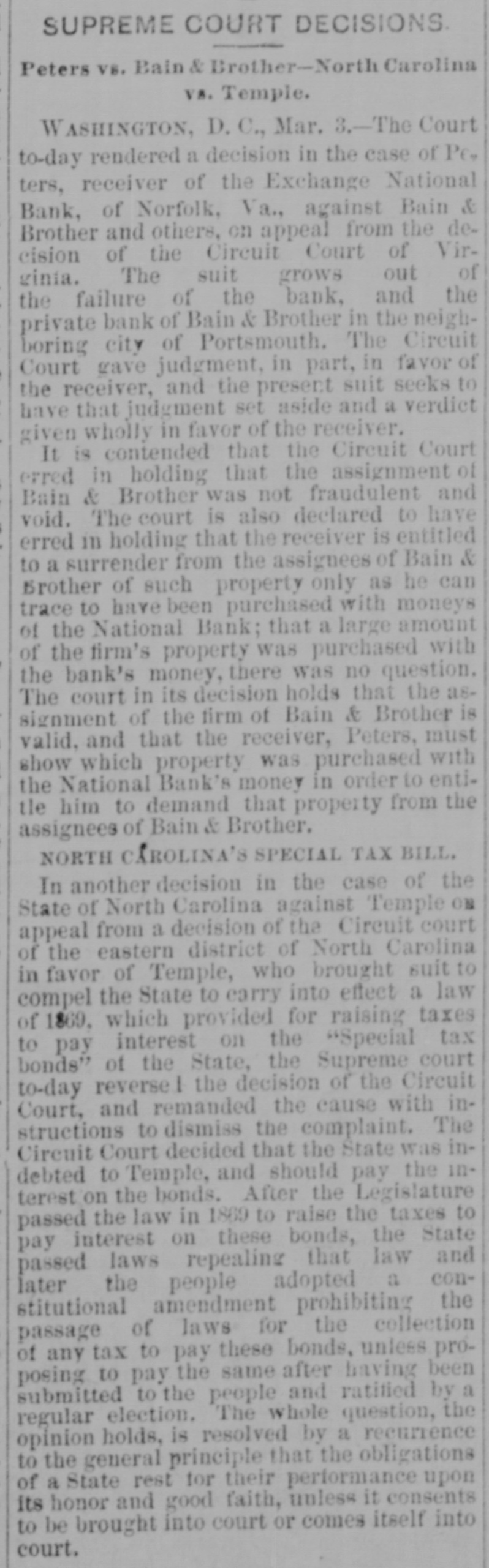
SUPREME COURT DECISIONS. Peters VB. Bain & Brother-North Carolina VA. Temple. WASHINGTON, D. C., Mar. 3.-The Court to-day rendered a decision in the case of Pe, ters, receiver of the Exchange National Bank, of Norfolk, Va., against Bain & Brother and others, on appeal from the decision of the Circuit Court of Virginta. The suit grows out of the failure of the bank, and the private bank of Bain & Brother in the neighboring city of Portsmouth. The Circuit Court gave judgment, in part, in favor of the receiver, and the present suit seeks to have that judgment set aside and a verdict given wholly in favor of the receiver. It is contended that the Circuit Court erred in holding that the assignment of Bain & Brother was not fraudulent and void. The court is also declared to have erred in holding that the receiver is entitled to a surrender from the assignees of Bain & Brother of such property only as he can trace to have been purchased with moneys of the National Bank: that a large amount of the firm's property was purchased with the bank's money, there was no question. The court in its decision holds that the assignment of the firm of Bain & Brother is valid, and that the receiver, Peters, must show which property was purchased with the National Bank's money in order to entitle him to demand that property from the assignees of Bain & Brother. NORTH CAROLINA'S SPECIAL TAX BILL. In another decision in the case of the State of North Carolina against Temple ON appeal from a decision of the Circuit court of the eastern district of North Carolina in favor of Temple, who brought suit to State to carry a of compel 1869. the which provided for into raising effect taxes law to pay interest on the "Special tax bonds" of the State, the Supreme court to-day reversel the decision of the Circuit Court, and remanded the cause with instructions to dismiss the complaint. The Circuit Court decided that the State was indebted to Temple, and should pay the interest on the bonds. After the Legislature passed the law in 1869 to raise the taxes to pay interest on these bonds, the State passed laws repealing that law and later the people adopted a constitutional amendment prohibiting the passage of laws for the collection of any tax to pay these bonds, unless proposing to pay the same after having been submitted to the people and ratified by a regular election. The whole question, the opinion holds, is resolved by a recurrence to the general principle that the obligations of a State rest for their performance upon its honor and good faith, unless it consents to be brought into court or comes itself into court.