6619. First National Bank (Fort Scott, KS)

Bank Information

Episode Type
Run → Suspension → Closure
Bank Type
national
Bank ID
1763
Charter Number
1763
Start Date
November 19, 1908
Location
Fort Scott, Kansas (37.840, -94.708)

Metadata

Model
gpt-5-mini
Short Digest
3506f05f

Response Measures

Full suspension

Other: Receiver appointed by Comptroller of the Currency; bank remained in receivership and did not reopen for business (only opened to file claims).

Description

Contemporary articles report a two-day run (deposits withdrawn ~$56,000) that prompted President Grant Hornaday to close the bank and request the Comptroller of the Currency appoint a receiver (James D. Bradley) on Nov 20, 1908. The cause is consistently described as malicious reports (rumors). The receiver was appointed and the institution remained in receivership; later opening on Dec 21 was for filing claims, not resumption of normal banking, so classification is run -> suspension -> closure (receivership).

Events (4)

1. November 19, 1908 Run
Cause
Rumor Or Misinformation
Cause Details
Malicious reports spread by enemies of the bank (described repeatedly in articles as the trigger for withdrawals).
Measures
Bank closed doors; president requested appointment of a receiver; appealed to Comptroller of the Currency.
Newspaper Excerpt
The closing followed a run on the bank yesterday, when depositors withdrew $56,000.
Source
newspapers
2. November 20, 1908 Receivership
Newspaper Excerpt
Comptroller of the Currency Murray today appointed James D. Bradley, bank examiner, as receiver of the First National bank of Fort Scott, Kan. Action was taken upon receipt of a telegram from the president asking that a receiver be appointed owing to the run on the bank which has lasted two days.
Source
newspapers
3. November 20, 1908 Suspension
Cause
Government Action
Cause Details
President Hornaday closed the bank and requested the Comptroller of the Currency appoint a receiver; the Comptroller appointed James D. Bradley as receiver.
Newspaper Excerpt
The First National bank of this city closed its doors today. The Washington authorities were requested to appoint a receiver.
Source
newspapers
4. December 21, 1908 Other
Newspaper Excerpt
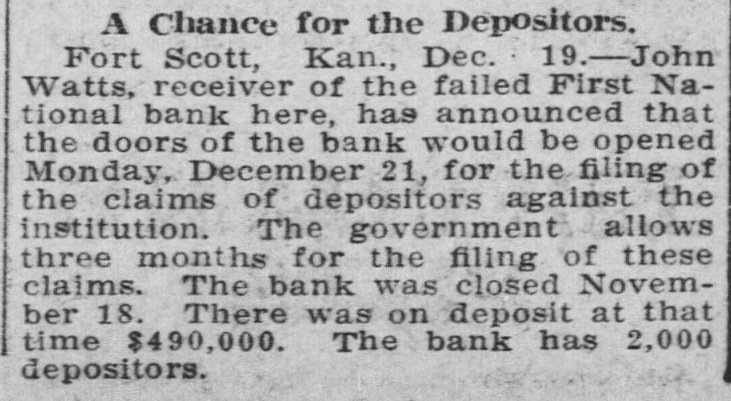
John Watts, receiver of the failed First National bank here, has announced that the doors of the bank would be opened Monday, December 21, for the filing of the claims of depositors against the institution.
Source
newspapers

Newspaper Articles (21)

Article from The Topeka State Journal, November 20, 1908

Click image to open full size in new tab

Article Text

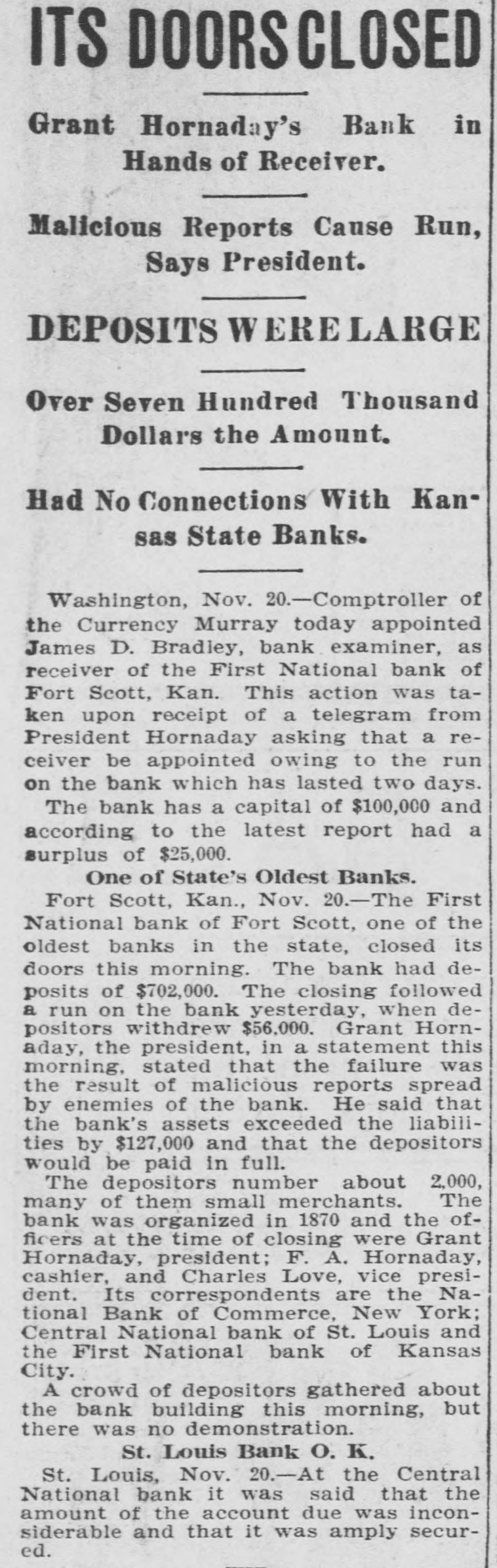
ITS DOORSCLOSED Grant Hornaday's Bank in Hands of Receiver. Malicious Reports Cause Run, Says President. DEPOSITS W ERE LARGE Over Seven Hundred Thousand Dollars the Amount. Had No Connections With Kansas State Banks. Washington, Nov. 20.-Comptroller of the Currency Murray today appointed James D. Bradley, bank examiner, as receiver of the First National bank of Fort Scott, Kan. This action was taken upon receipt of a telegram from President Hornaday asking that a receiver be appointed owing to the run on the bank which has lasted two days. The bank has a capital of $100,000 and according to the latest report had a surplus of $25,000. One of State's Oldest Banks. Fort Scott, Kan., Nov. 20.-The First National bank of Fort Scott, one of the oldest banks in the state, closed its doors this morning. The bank had deposits of $702,000. The closing followed a run on the bank yesterday, when depositors withdrew $56,000. Grant Hornaday, the president, in a statement this morning, stated that the failure was the result of malicious reports spread by enemies of the bank. He said that the bank's assets exceeded the liabilities by $127,000 and that the depositors would be paid in full. The depositors number about 2,000, many of them small merchants. The bank was organized in 1870 and the officers at the time of closing were Grant Hornaday, president; F. A. Hornaday, cashier, and Charles Love, vice president. Its correspondents are the National Bank of Commerce, New York; Central National bank of St. Louis and the First National bank of Kansas City. A crowd of depositors gathered about the bank building this morning, but there was no demonstration. St. Louis Bank O. K. St. Louis, Nov. 20.-At the Central National bank it was said that the amount of the account due was inconsiderable and that it was amply secured.


Article from The Topeka State Journal, November 20, 1908

Click image to open full size in new tab

Article Text

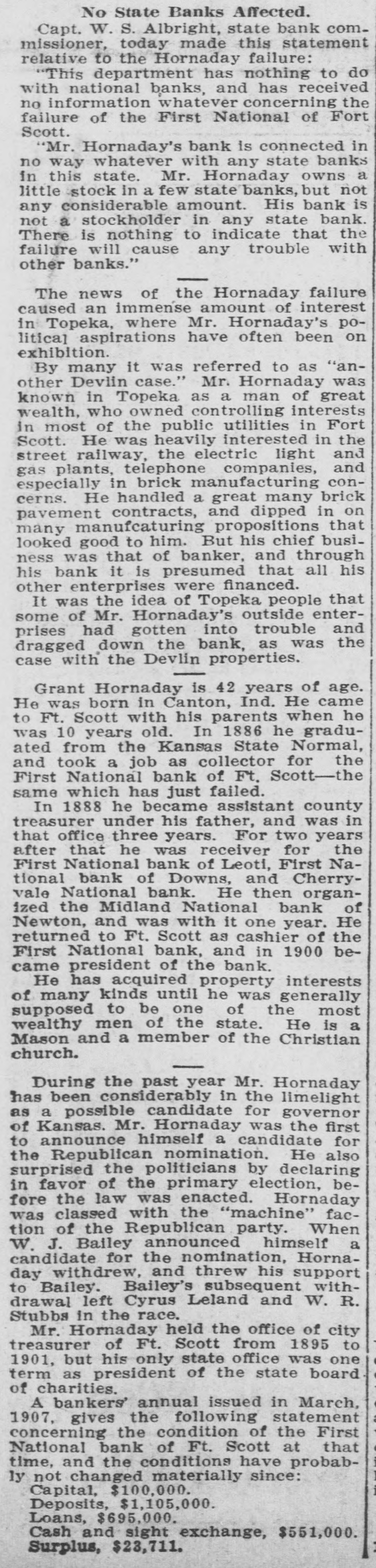
No State Banks Affected. Capt. W. S. Albright, state bank commissioner, today made this statement relative to the Hornaday failure: This department has nothing to do national banks, and has received with information whatever concerning the no failure of the First National of Fort Scott. 'Mr. Hornaday's bank is connected in whatever with any state banks state. Mr. little stock in a few state banks, in no this way Hornaday owns but not is a any considerable amount. His bank bank. not a stockholder in any state There is nothing to indicate that the failure will cause any trouble with other banks." The news of the Hornaday failure caused an immense amount of interest in Topeka, where Mr. Hornaday's political aspirations have often been on exhibition. By many it was referred to as "another Devlin case." Mr. Hornaday was known in Topeka as a man of great who owned controlling interests of the public in wealth, most interested utilities in in Fort the Scott. He was heavily street railway, the electric light and gas plants, telephone companies, and in brick manufacturing conHe handled a great many contracts, and pavement cerns. especially dipped in brick on many manufcaturing propositions that looked good to him. But his chief business was that of banker, and through his bank it is presumed that all his other enterprises were financed. It was the idea of Topeka people that some of Mr. Hornaday's outside enterprises had gotten into trouble and the dragged down the bank, as was case with the Devlin properties. Grant Hornaday is 42 years of age. He was born in Canton, Ind. He came to Ft. Scott with his parents when he was 10 years old. In 1886 he graduated from the Kansas State Normal, and took a job as collector for the First National bank of Ft. Scott-the same which has just failed. In 1888 he became assistant county treasurer under his father, and was in that office three years. For two years after that he was receiver for the First National bank of Leoti, First National bank of Downs, and Cherryvale National bank. He then organized the Midland National bank of Newton, and was with it one year. He returned to Ft. Scott as cashier of the First National bank, and in 1900 became president of the bank. He has acquired property interests of many kinds until he was generally supposed to be one of the most wealthy men of the state. He is a Mason and a member of the Christian church. During the past year Mr. Hornaday has been considerably in the limelight as a possible candidate for governor of Kansas. Mr. Hornaday was the first to announce himself a candidate for the Republican nomination, He also surprised the politicians by declaring in favor of the primary election, before the law was enacted. Hornaday was classed with the "machine" faction of the Republican party. When W. J. Bailey announced himself a candidate for the nomination, Hornaday withdrew, and threw his support to Bailey. Bailey's subsequent withdrawal left Cyrus Leland and W. R. Stubbs in the race. Mr. Hornaday held the office of city treasurer of Ft. Scott from 1895 to 1901, but his only state office was one term as president of the state board of charities. A bankers' annual issued in March, 1907, gives the following statement concerning the condition of the First National bank of Ft. Scott at that time, and the conditions have probably not changed materially since: Capital, $100,000. Deposits, $1,105,000. Loans, $695,000. Cash and sight exchange, $551,000. Surplus, $23,711.


Article from Evening Times-Republican, November 20, 1908

Click image to open full size in new tab

Article Text

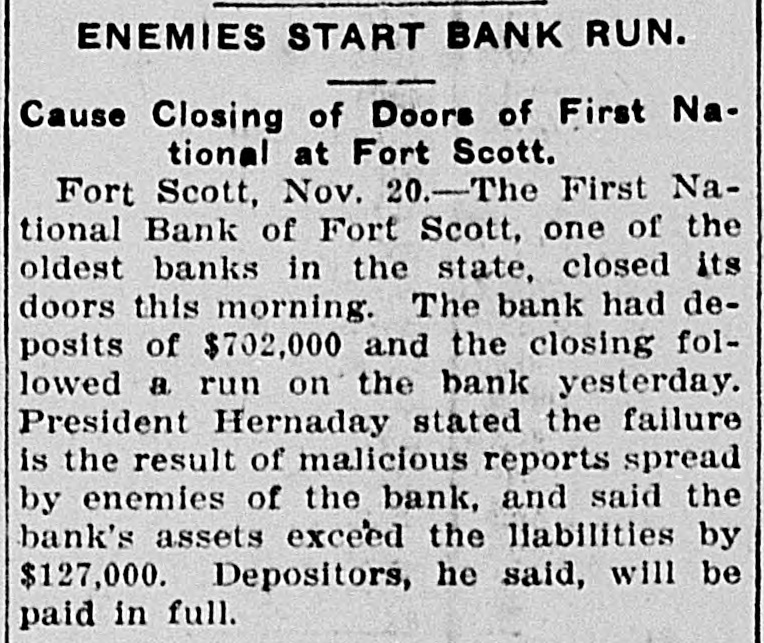
ENEMIES START BANK RUN. /Cause Closing of Doors of First National at Fort Scott. Fort Scott, Nov. 20.-The First National Bank of Fort Scott, one of the oldest banks in the state, closed its doors this morning. The bank had deposits of $702,000 and the closing followed a run on the bank yesterday. President Hernaday stated the failure is the result of malicious reports spread by enemies of the bank, and said the bank's assets exceed the liabilities by $127,000. Depositors, he said, will be paid in full.


Article from The Roswell Daily Record, November 20, 1908

Click image to open full size in new tab

Article Text

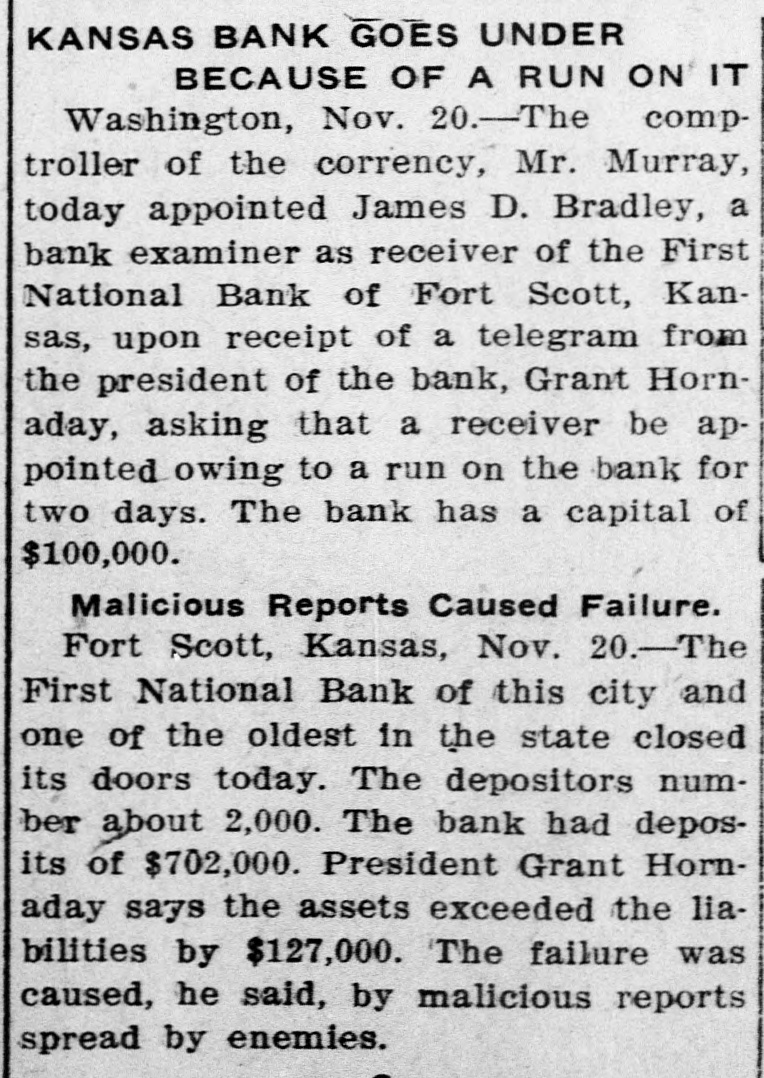
KANSAS BANK GOES UNDER BECAUSE OF A RUN ON IT Washington, Nov. 20.-The comptroller of the corrency, Mr. Murray, today appointed James D. Bradley, a bank examiner as receiver of the First National Bank of Fort Scott, Kansas, upon receipt of a telegram from the president of the bank, Grant Hornaday, asking that a receiver be appointed owing to a run on the bank for two days. The bank has a capital of $100,000. Malicious Reports Caused Failure. Fort Scott, Kansas, Nov. 20.-The First National Bank of this city and one of the oldest in the state closed its doors today. The depositors number about 2,000. The bank had deposits of $702,000. President Grant Hornaday says the assets exceeded the liabilities by $127,000. The failure was caused, he said, by malicious reports spread by enemies.


Article from Lewiston Evening Teller, November 20, 1908

Click image to open full size in new tab

Article Text

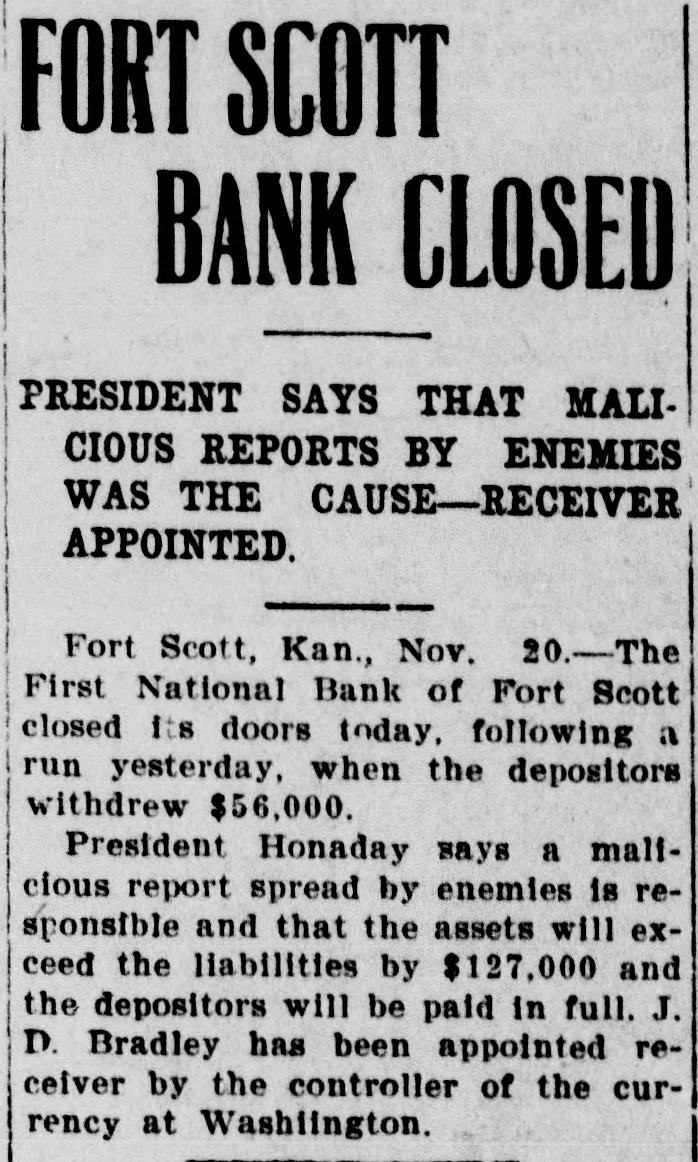
FORT SCOTT BANK CLOSED PRESIDENT SAYS THAT MALICIOUS REPORTS BY ENEMIES WAS THE CAUSE-RECEIVER APPOINTED. Fort Scott, Kan., Nov. 20.-The First National Bank of Fort Scott closed its doors today, following a run yesterday, when the depositors withdrew $56,000. President Honaday says a malicious report spread by enemies is responsible and that the assets will exceed the liabilities by $127,000 and the depositors will be paid in full. J. D. Bradley has been appointed receiver by the controller of the currency at Washington.


Article from The Spokane Press, November 20, 1908

Click image to open full size in new tab

Article Text

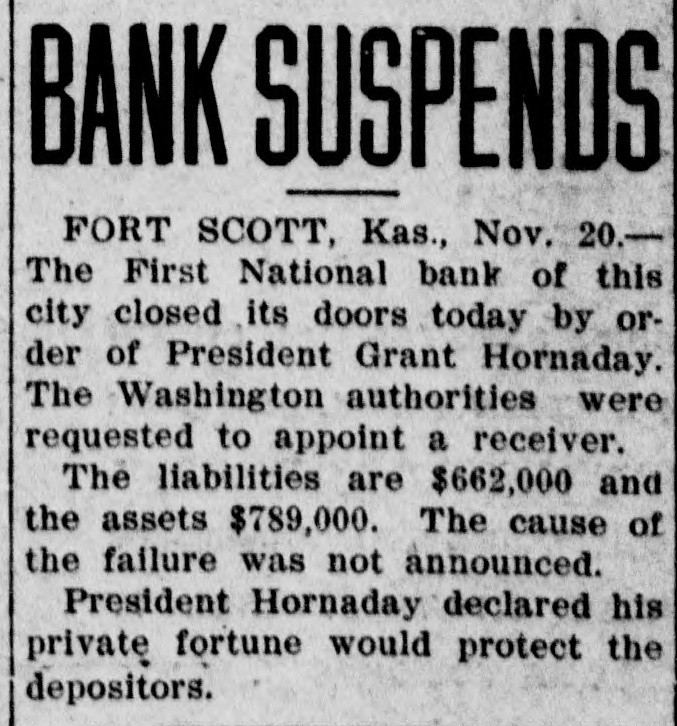
BANK SUSPENDS FORT SCOTT, Kas., Nov. 20.The First National bank of this city closed its doors today by order of President Grant Hornaday. The Washington authorities were requested to appoint a receiver. The liabilities are $662,000 and the assets $789,000. The cause of the failure was not announced. President Hornaday declared his private fortune would protect the depositors.


Article from Rock Island Argus, November 20, 1908

Click image to open full size in new tab

Article Text

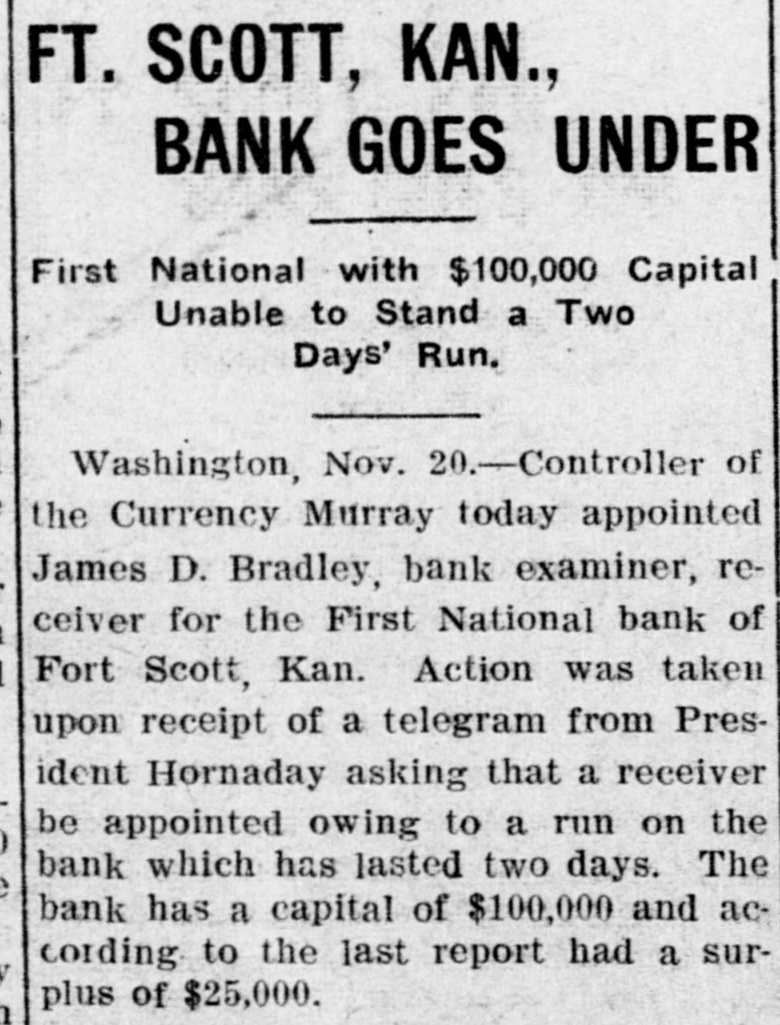
FT. SCOTT, KAN., BANK GOES UNDER First National with $100,000 Capital Unable to Stand a Two Days' Run. Washington, Nov. 20.-Controller of the Currency Murray today appointed James D. Bradley, bank examiner, receiver for the First National bank of Fort Scott, Kan. Action was taken upon receipt of a telegram from President Hornaday asking that a receiver be appointed owing to a run on the bank which has lasted two days. The bank has a capital of $100,000 and according to the last report had a surplus of $25,000.


Article from Deseret Evening News, November 20, 1908

Click image to open full size in new tab

Article Text

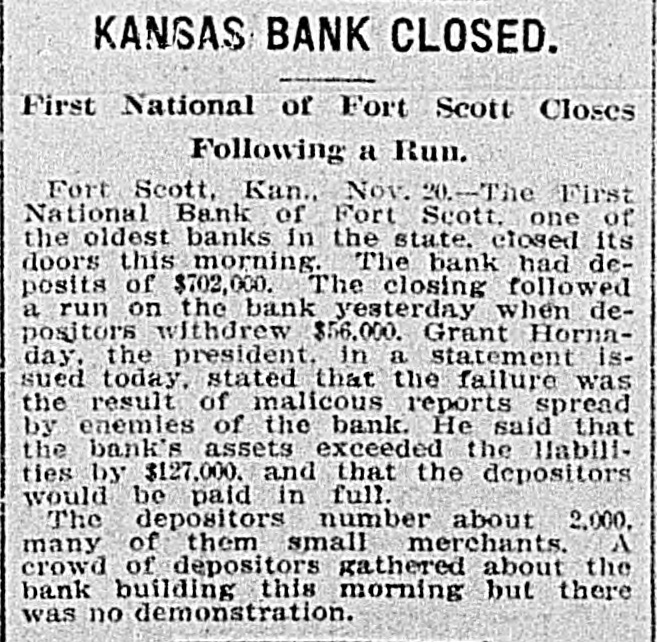
KANSAS BANK CLOSED. First National of Fort Scott Closes Following a Run. Fort Scott, Kan., Nov. 20.-The First National Bank of Fort Scott. one of the oldest banks in the state. closed its doors this morning. The bank had deposits of $702,000. The closing followed a run on the bank yesterday when depositors withdrew $56,000. Grant Hornaday. the president. in a statement issued today. stated that the failure was the result of malicous reports spread by enemies of the bank. He said that the bank's assets exceeded the Habilities by $127,000. and that the depositors would be paid in full. The depositors number about 2,000, many of them small merchants. A crowd of depositors gathered about the bank building this morning but there was no demonstration.


Article from The Montgomery Advertiser, November 21, 1908

Click image to open full size in new tab

Article Text

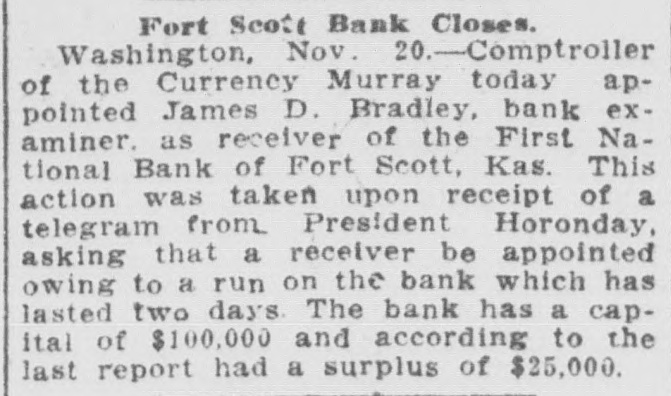
Fort Scott Bank Closes. Washington, Nov. 20.-Comptroller of the Currency Murray today appointed James D. Bradley, bank examiner. as receiver of the First National Bank of Fort Scott, Kas. This action was taken upon receipt of a telegram from President Horonday, asking that a receiver be appointed owing to a run on the bank which has lasted two days. The bank has a capital of $100,000 and according to the last report had a surplus of $25,000.


Article from Los Angeles Herald, November 21, 1908

Click image to open full size in new tab

Article Text

EASTERN Westinghouse Electric company to reorganize with $12,000,000 and new board of directors; has $4,000,000 from sales. State concludes its case in trial of Ray Lamphere, alleged slayer of Mrs. Gunness, Laporte's arch-murderess. First National bank of Fort Scott, Kan., closed by run of depositors. Gompers expected to support Keefe as candidate for re-election to vice presidency of American Federation of Labor this morning. Three dead and six missing in mine disaster at Red Lodge, Mont. Twenty-five believed dead and twenty more reported missing as result of terrific gas explosion in Brooklyn, tearing up earth for blocks in each direction. John D. Rockefeller subjected to severe grilling by federal counsel in suit to dissolve Standard Oil company; president of trust admits enormous earnings of company, which run into billions of dollars. Lumber men appear at tariff hearing in Washington and urge reduction or elimination of tariff; Champ Clark asks several questions that prove hard for lumber trust to answer.


Article from Omaha Daily Bee, November 21, 1908

Click image to open full size in new tab

Article Text

DOMESTIC. Frank B. Kellogg in his cross-examination of John D. Rockefeller is making an effortto find out what risks the oil company runs in its highly profitable Page 1 business. An explosion of a gas main under a Brooklyn street engulfed workmen and men, women and children who were on the street at the time, over twenty, it is Page 1 believed, being killed. The Department of Agriculture is making a determined effort to disinfect all possible places where foot and mouth disease infection exists. Foreign ports are already closed to American hay and cattle from northern cities. Page 1 The police officials who guarded Morris Haas in his cell are charged with conduct unbecoming officers in refusing to admit an agent of the prosecutor. Page 1 Senator Scott, after a visit to Judge Tart, says he is confident the presidentelect has plans for a progressive and Page 2 courageous administration. The First National bank of Fort Scott, Page 2 Kan., failed yesterday. Richard Croker returned to New York yestrday on his first visit to America in Page 2 four years. Robbers at Attica, O., held the citizens at bay while they went ahead with work Page 1 that netted them $6,000. The defense outlined its case in the Lamphere trial yesterday, claiming that Mrs. Gunness is still alive and has been seen on several occasions. Page 1 FOREIGN. The French cruiser Conde struck the rocks off Corsica and is in a perilous position. Page 1 Chancellor von Buelow is tired of his place and is anxious to resign and assume the comforts foprivate life. Page 1 NEBRASKA. The station agent of Milford was robbed of $80 while he was attending a Burlington train at the station platform. Page 3 LOCAL. Mexicans who are coming to the Corn show are anxious to know what kind of clothing it will be necessary to wear. Page 9 Bishop Scannell will sail Thursday for Page 9 Europe on a visit to the pope. Army officer who saw service in China speaks in terms of high praise of the late Page 4 empress dowager. Street cars meet in collision during the early morning hours and several people Page 9 are slightly injured. Commissioner McVann of the Omaha Grain exchange talks to Ames students Page 12 on the marketing of grain. COMMERCIAL AND INDUSTRIAL Page 17 Live stock markets. Page 17 Grain markets. Page 17 Stocks and bonds. MOVEMENT'S OF OCEAN STEAMSHIPS.


Article from The Detroit Times, November 21, 1908

Click image to open full size in new tab

Article Text

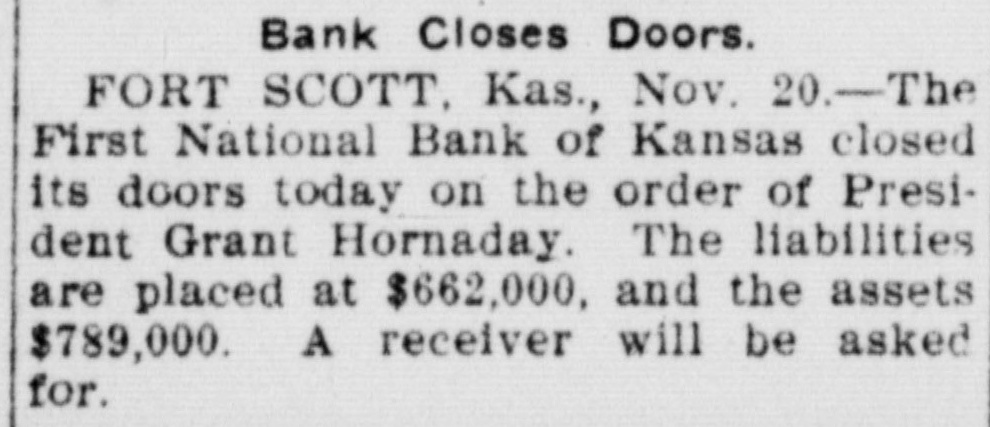
Bank Closes Doors. FORT SCOTT. Kas., Nov. 20.-The First National Bank of Kansas closed its doors today on the order of President Grant Hornaday. The liabilities are placed at $662,000, and the assets $789,000. A receiver will be asked for.


Article from Los Angeles Herald, November 21, 1908

Click image to open full size in new tab

Article Text

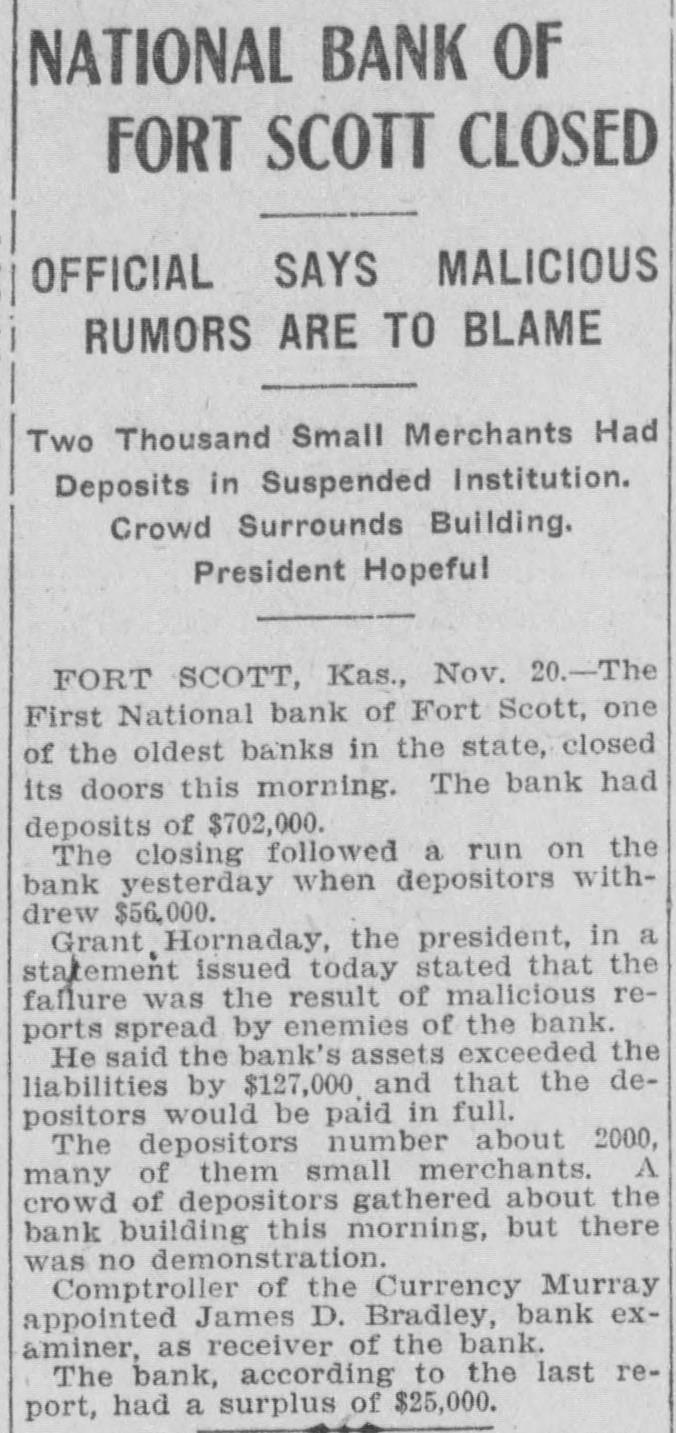
NATIONAL BANK OF FORT SCOTT CLOSED OFFICIAL SAYS MALICIOUS RUMORS ARE TO BLAME Two Thousand Small Merchants Had Deposits in Suspended Institution. Crowd Surrounds Building. President Hopeful FORT SCOTT, Kas., Nov. 20.-The First National bank of Fort Scott, one of the oldest banks in the state, closed its doors this morning. The bank had deposits of $702,000. The closing followed a run on the bank yesterday when depositors withdrew $56,000. Grant Hornaday, the president, in a statement issued today stated that the failure was the result of malicious reports spread by enemies of the bank. He said the bank's assets exceeded the liabilities by $127,000 and that the depositors would be paid in full. The depositors number about 2000, many of them small merchants. A crowd of depositors gathered about the bank building this morning, but there was no demonstration. Comptroller of the Currency Murray appointed James D. Bradley, bank examiner, as receiver of the bank. The bank, according to the last report, had a surplus of $25,000.


Article from New-York Tribune, November 21, 1908

Click image to open full size in new tab

Article Text

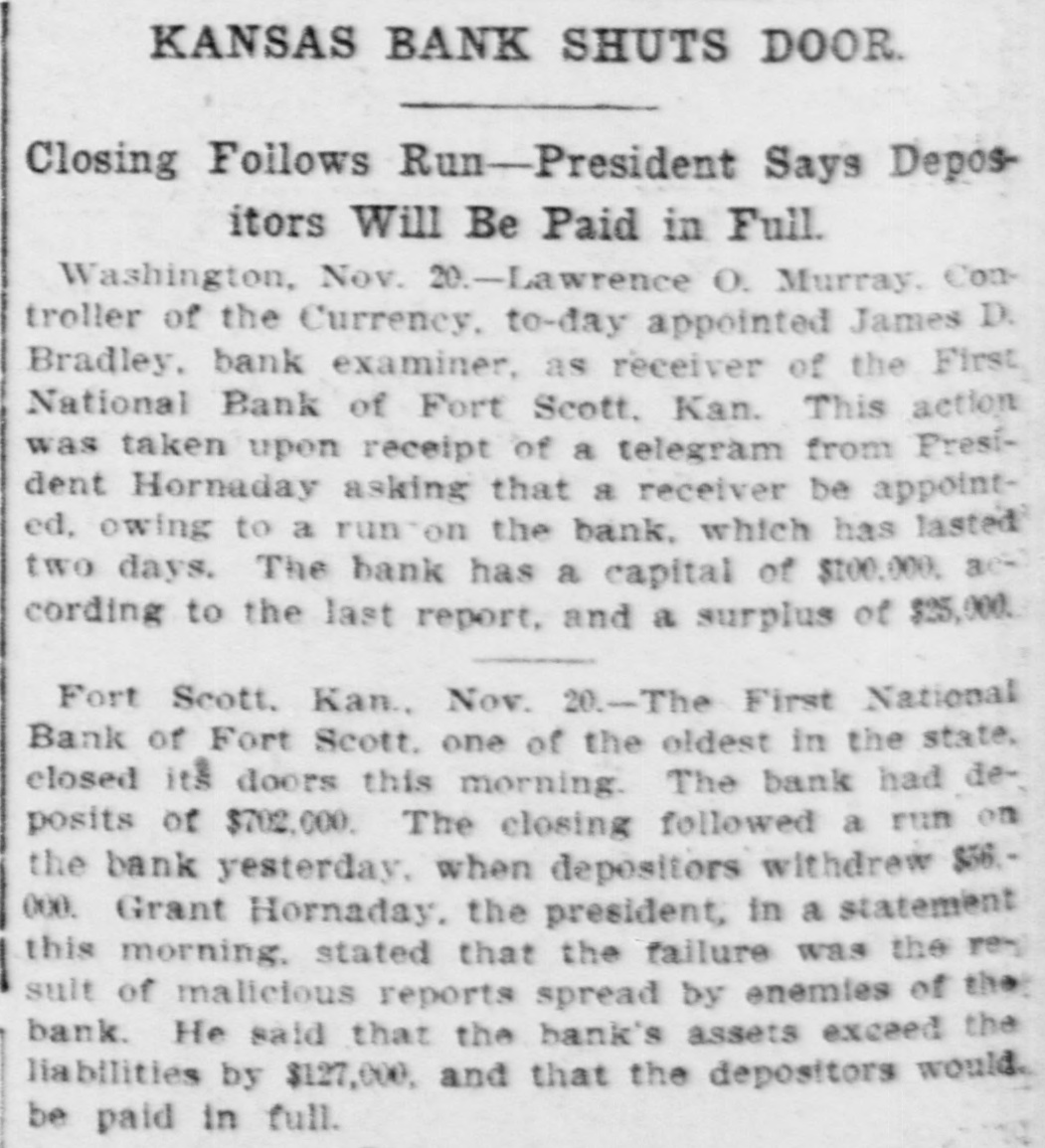
KANSAS BANK SHUTS DOOR. Closing Follows Run-President Says Depositors Will Be Paid in Full. Washington, Nov. 20.-Lawrence O. Murray. Controller of the Currency, to-day appointed James D. Bradley, bank examiner, as receiver of the First National Bank of Fort Scott. Kan. This action was taken upon receipt of a telegram from President Hornaday asking that a receiver be appointed, owing to a run on the bank, which has lasted two days. The bank has a capital of $100,000. according to the last report, and a surplus of $25,000. Fort Scott. Kan., Nov. 20.-The First National Bank of Fort Scott. one of the oldest in the state, closed its doors this morning. The bank had deposits of $702,000. The closing followed a run on the bank yesterday. when depositors withdrew $56.000. Grant Hornaday, the president, in a statement this morning, stated that the failure was the rey sult of malicious reports spread by enemies of the bank. He said that the bank's assets exceed the liabilities by $127,000. and that the depositors would be paid in full.


Article from University Missourian, November 23, 1908

Click image to open full size in new tab

Article Text

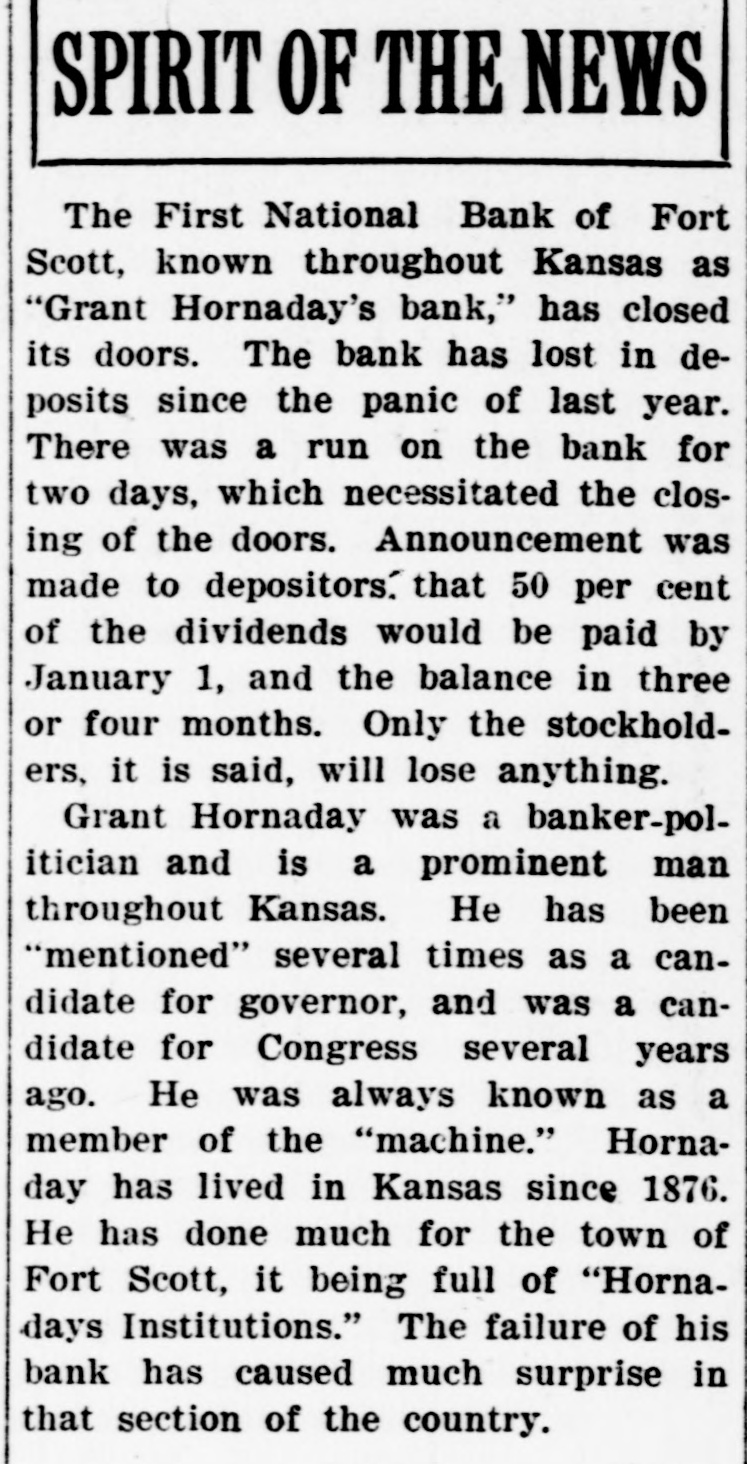
SPIRIT OF THE NEWS The First National Bank of Fort Scott, known throughout Kansas as "Grant Hornaday's bank," has closed its doors. The bank has lost in deposits since the panic of last year. There was a run on the bank for two days, which necessitated the closing of the doors. Announcement was made to depositors. that 50 per cent of the dividends would be paid by January 1, and the balance in three or four months. Only the stockholders, it is said, will lose anything. Grant Hornaday was a banker-politician and is a prominent man throughout Kansas. He has been "mentioned" several times as a candidate for governor, and was a candidate for Congress several years ago. He was always known as a member of the "machine." Hornaday has lived in Kansas since 1876. He has done much for the town of Fort Scott, it being full of "Hornadays Institutions." The failure of his bank has caused much surprise in that section of the country.


Article from The Bemidji Daily Pioneer, November 23, 1908

Click image to open full size in new tab

Article Text

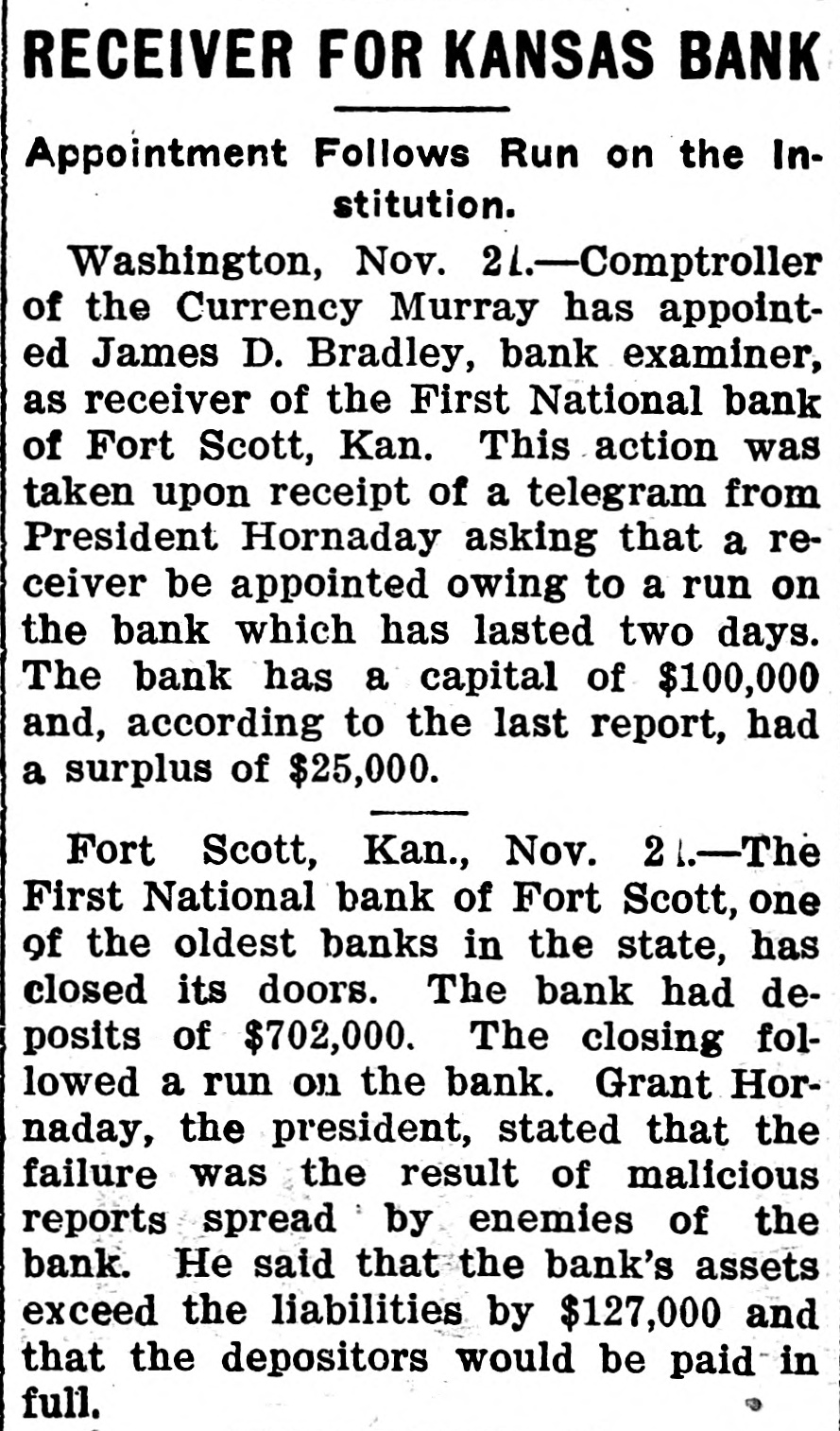
RECEIVER FOR KANSAS BANK Appointment Follows Run on the Institution. Washington, Nov. 21.-Comptroller of the Currency Murray has appointed James D. Bradley, bank examiner, as receiver of the First National bank of Fort Scott, Kan. This action was taken upon receipt of a telegram from President Hornaday asking that a receiver be appointed owing to a run on the bank which has lasted two days. The bank has a capital of $100,000 and, according to the last report, had a surplus of $25,000. Fort Scott, Kan., Nov. 21.-The First National bank of Fort Scott, one of the oldest banks in the state, has closed its doors. The bank had deposits of $702,000. The closing followed a run on the bank. Grant Hornaday, the president, stated that the failure was the result of malicious reports spread by enemies of the bank. He said that the bank's assets exceed the liabilities by $127,000 and that the depositors would be paid in full.


Article from River Falls Journal, November 26, 1908

Click image to open full size in new tab

Article Text

GENERAL NEWS. The lives of more than 500 persons were imperiled in New York harbor when the fruit steamer Admiral Dewey, inward bound from Jamaica, crashed into the steamer Mount Desert, outward bound from Bay Ridge for the fishing banks. There were no casualties. The Democratic national,committee received in all $620,644.77 and spent $619,410.06 during the recent presidential campaign, leaving a balance in hand of $1,234.71. Fire in a mine at Red Lodge, Mont., caused the death of nine miners. Scores of others were rescued with great difficulty. Juniors in the Grand Rapids, Mich., Veterinary college struck because two colored students were admitted in accordance with a court ruling. Robbers in Attica, O., held several citizens at bay, blew open the safe of a store and escaped with $6,000. Herbert Grigg, alleged accomplice of Cline Wheeler and Walter Zeller in the murder of William Read at Vineland, N. J., was arrested in Philadelphia. Following a two days' run, a receiver was appointed for the First Nationat bank of Fort Scott, Kan. Mrs. Alphia M. Shevalier, convicted of perjury in connection with the Horn will case, was sentenced to five years in prison by Judge Lincoln Frost at Lincoln, Neb. Lewis Fletcher was hanged at Charlotte, N. C., for the murder of George Boyd. Both were negroes. The balloon Yankee, which sailed from St. Louis in an effort to win the Lahm cup, failed to do so, landing near Tiger, Gaw after traveling 375 miles.


Article from Abilene Weekly Reflector, November 26, 1908

Click image to open full size in new tab

Article Text

TELEGRAPHIC BREVITES. Sixteen Chinese were killed and sev. eral injured Sunday night in a wreck on the Chinanfu and Tsingtau railroad. In St. Louis 61 "Ild-lifting" clubs were raided and 832 men were arrest ed and hauled to the various police stations. Charles H. Grasty, formerly of Kan. sas City and later of the Baltimore News, has purchased a half interest in the St. Paul Dispatch. An explosion in a 5-cent theater in Chicago, caused a panic among the audience and one man and four wom en were dangerously injured. One German workman and 30 Chi nese were killed Monday, as the result of an accident in the works of a Ger man mining company near Hungshan, China, W. L. Pickrell, a resident of Otta wa, Kan., since 1865, and widely known in that part of the state, was fond dead in bed. Heart disease was the cause, Because he was crowded in an aisle at a "Holy Roller" church in Wichita Kan., "Spider" McCune stabbed and fatally injured Loney Thomas, a 16 year-old boy. The state of Kansas had $10,375.70 on deposit in the failed First National bank of Fort Scott, which is secured by $20,000 worth of municipal bonds . which the state treasurer holfsWeekle Reflector


Article from The Yale Expositor, November 27, 1908

Click image to open full size in new tab

Article Text

to quarantine Pennsylvania and New York. The East Buffalo stock yards were closed. Several children at Danville, Pa., were reported to have contracted the foot and mouth disease, an outbreak of which among cattle caused the states of New York and Pennsylvania to be quarantined. Fire in a mine at Red Lodge, Mont., caused the death of nine miners. Scores of others were rescued with great difficulty. The state having rested its case in the trial of Ray Lamphere at Laporte, Ind., the defense opened with a statement to the jury by Attorney Worden and the hearing of several witnesses whose evidence tended to disprove the supposition that the body of an adult found in the ruins of the farmhouse was that of Mrs. Gunness. Juniors in the Grand Rapids, Mich., Veterinary college struck because two colored students were admitted in accordance with a court ruling. Robbers in Attica, O., held several citizens at bay, blew open the safe of a store and escaped with $6,000. Following a two days' run, a receiver was appointed for the First Nationat bank of Fort Scott, Kan. Lewis Fletcher was hanged at Charlotte, N. C., for the murder of George Boyd. Both were negroes. One man was killed and five were fatally injured by a dynamite explosion in the Simpson coal mine near Brownsville, Pa. The Cairo (Ill.) city council granted a 50-year interurban franchise and a 20-year street railway franchise to the McKinley syndicate. An interurban line will be built to connect Cairo with Mounds, Mound City and Villa Ridge. Hugh Thompson, a wealthy young farmer living near Danville, Ky., became suddenly insane and shot and killed his nephew, Frederick Garrison, aged 18 years. The boy after being shot seriously wounded his uncle. Eileen Orme, a musical comedy actress, was married in London to Hon. Morris Hood, heir of Viscount Bridport. The greatest transaction in leaf tobacco ever made in America was closed at Louisville, Ky., when the Burley Tobacco society sold to the American Tobacco Company the crop of 1906 and part of that of 1907. The American company pays an average of 201/2 cents a pound for the former and 17 cents for the latter, the total being about $14,000,000. Malcolm Stewart, who was wanted in Duluth on a charge of being short $1,700 in his accounts with the Universal Milling Company, leaped head foremost through a lavatory window on the Omaha's Twilight limited and escaped. Mrs. Mary Harbour, accused of the murder of Miss Rose Adams, her foster daughter, was found guilty of murder in the second degree at Sioux City, Ia. John Krauss, said to have been connected with the Pacific State and Sunset Telegraph Company of San Francisco, committed suicide on the steamer Adriatic as it was entering Queenstown harbor. The balloon Yankee, which sailed from St. Louis in an effort to win the Lahm cup, failed to do so, landing near Tiger, Ga., after traveling 375 miles. J. B. Walton, representing the Corn Products Company, known as the "starch trust," had a most uncomfortable time trying to answer the questions of the house ways and means committee at the tariff revision hearing and to explain why his company sold its products much cheaper in England than here. Herbert Grigg, alleged accomplice of Cline Wheeler and Walter Zeller in the murder of William Read at Vineland, N. J., was arrested in Philadelphia. The supreme court of South Dakota granted a new trial to Mrs. Emma Kauffman, wife of the Sioux Falls brewer, who was found guilty in the circuit court of manslaughter on a charge of causing the death of a servant through beating. Mrs. Alphia M. Shevalier, convicted of perjury in connection with the Horn will case, was sentenced to five years in prison by Judge Lincoln Frost at Lincoln, Neb. In view of the fact that an interesting event is expected next spring, Queen Wilhelmina of Holland has been forbidden by her physicians to hold her customary private audiences. The body of Brent Woodall, secretary of the University of Cincinnati, and former newspaper man of that city, was found in the Ohio river at Louisville, Ky. Fifty state convicts employed in the mines at Pratt City, Ala., formed a conspiracy to set No. 3 mine afire and escape during the confusion, and as a result eight of them were burned to death, one is missing and the other 41 were safely locked in the stockade. At an interview between Emperor
Article from Iowa County Democrat, December 3, 1908

Click image to open full size in new tab

Article Text

Milwaukee to Beaver Dam. The party is working eastward. The First National bank of Fort Scott, Kansas, one of the oldest banks in the state, closed its doors. The bank had deposits of $702,000. The closing followed a run on the bank when depositors withdrew $56,000. It is stated on what seems good authority that negotiations are pending for the sale of the lines of the Kenosha Electric Railway company, owned by A. C. Frost of Chicago and Milwaukee fame, to John I. Beggs of Milwaukee. Scarcity of water for the boilers has caused a suspension of three washeries and four collieries of the Lehigh Valley Coal company in the Shenandoah district, throwing over 2,000 men and boys out of employment. The city authorities of Chippewa Falls ordered "Old Billy," a horse employed by the fire department for over twenty years, sent to the poorhouse for the remainder of his life. A special pension fund for the support of the horse has been created by the council. Heavy rail shipments of logs are being received by the Marinette saw mills and within a few weeks it is expected that special trains will be run on the Milwaukee and the Wisconsin and Michigan roads to accommodate the traffic. Following close upon the action of the city council of Fond du Lac ordering the removal of all but two telephones in the city hall, and these two to be on a party line, the board of supervisors ordered the removal of half of the telephones in the county buildings. A raise in rates is responsible for the action.


Article from The Topeka State Journal, December 19, 1908

Click image to open full size in new tab

Article Text

A Chance for the Depositors. Fort Scott, Kan., Dec. 19.-John Watts, receiver of the failed First National bank here, has announced that the doors of the bank would be opened Monday, December 21, for the filing of the claims of depositors against the institution. The government allows three months for the filing of these claims. The bank was closed November 18. There was on deposit at that time $490,000. The bank has 2,000 depositors.