Article Text
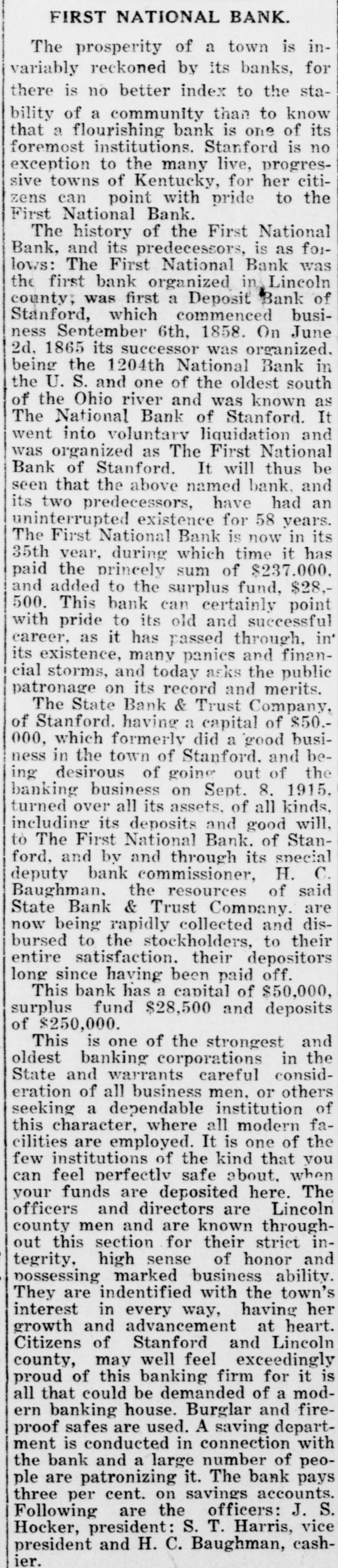
FIRST NATIONAL BANK. The prosperity of a town is invariably reckoned by its banks, for there is no better index to the stability of a community than to know that a flourishing bank is one of its foremost institutions. Stanford is no exception to the many live, progressive towns of Kentucky, for her citizens can point with pride to the First National Bank. The history of the First National Bank, and its predecessors, is as foilows: The First National Bank was the first bank organized in Lincoln county, was first a Deposit Bank of Stanford, which commenced business Sentember 6th, 1858. On June 2d, 1865 its successor was organized. being the 1204th National Bank in the U. S. and one of the oldest south of the Ohio river and was known as The National Bank of Stanford. It went into voluntarv liquidation and was organized as The First National Bank of Stanford. It will thus be seen that the above named bank. and its two predecessors, have had an uninterrupted existence for 58 years. The First National Bank is now in its 35th year, during which time it has paid the princely sum of $237.000. and added to the surplus fund, $28,500. This bank can certainly point with pride to its old and successful career, as it has passed through, in' its existence, many panics and financial storms, and today asks the public patronage on its record and merits. The State Bank & Trust Company, of Stanford. having a capital of $50.000, which formerly did a good business in the town of Stanford. and being desirous of going out of the banking business on Sept. 8. 1915. turned over all its assets. of all kinds, including its deposits and good will, tò The First National Bank. of Stanford, and by and through its special deputy bank commissioner, H. C. Baughman. the resources of said State Bank & Trust Company. are now being rapidly collected and disbursed to the stockholders, to their entire satisfaction. their depositors long since having been paid off. This bank has a capital of $50,000, surplus fund $28,500 and deposits of $250,000. This is one of the strongest and oldest banking corporations in the State and warrants careful consideration of all business men, or others seeking a dependable institution of this character, where all modern facilities are employed. It is one of the few institutions of the kind that you can feel perfectlv safe about. when your funds are deposited here. The officers and directors are Lincoln county men and are known throughout this section for their strict integrity, high sense of honor and nossessing marked business ability. They are indentified with the town's interest in every way, having her growth and advancement at heart. Citizens of Stanford and Lincoln county, may well feel exceedingly proud of this banking firm for it is all that could be demanded of a modern banking house. Burglar and fireproof safes are used. A saving department is conducted in connection with the bank and a large number of people are patronizing it. The bank pays three per cent. on savings accounts. Following are the officers: J. S. Hocker. president: S. T. Harris. vice