Central Bank & Trust Company (Asheville, NC)

Episode Information

Episode Type
Run → Suspension → Closure
Start Date
November 19, 1930
Location
Asheville, North Carolina (35.601, -82.554)
Bank Type
trust
Routing Number
66-0038

Metadata

Notes

Receivership and prosecutions followed the November run and suspension; failure was widely reported.

Events (3)

1. November 19, 1930 Run
Cause
Bank Specific Adverse Info
Cause Details
Heavy withdrawals driven by revelations of the bank's insolvency, alleged misappropriations and ties to failing investment interests (Caldwell & Co.).
Measures
Accepted deposits from city and county after banking hours; sought loans and liquidated assets to meet withdrawals.
Newspaper Excerpt
Wednesday, November 19 ... heavy withdrawals ... any one of 50 or more depositors could have taken all the approximately $7,000 in silver.
Source
newspapers
2. November 20, 1930 Suspension
Cause
Bank Specific Adverse Info
Cause Details
Directors closed the bank due to inability to meet heavy withdrawals and lack of liquid assets amid insolvency allegations.
Newspaper Excerpt
the board of directors voted early Thursday morning, November 20, not to open the doors.
Source
newspapers
3. December 24, 1930 Receivership
Newspaper Excerpt
receivers for the Central Bank and Trust company of Asheville ... announced Dr. Crouch's appointment ... receivers for the Central Bank and Trust company of Asheville were plaintiffs in suits and proceedings reported Dec. 24 articles indicate receivers named or acting by this date.
Source
newspapers

Newspaper Articles (23)

Article from Springfield Leader and Press, November 21, 1930

Click image to open full size in new tab

Article Text

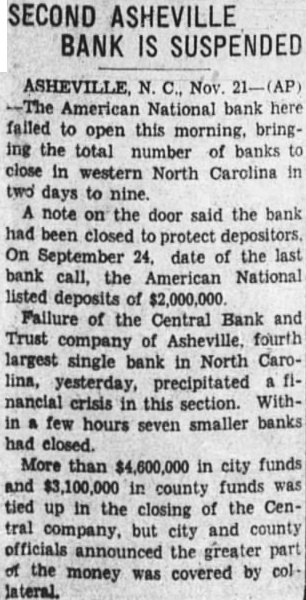
SECOND ASHEVILLE BANK IS SUSPENDED

ASHEVILLE. N. C., Nov 21-(AP) -The American National bank here falled to open this morning, bringing the total number of banks to close in western North Carolina in two days to nine. A note on the door said the bank had been closed to protect depositors. On September 24, date of the last bank call, the American National listed deposits of $2,000,000. Failure of the Central Bank and Trust company of Asheville, fourth largest single bank in North Carolina, yesterday, precipitated a financial crisis in this section. Within few hours seven smaller banks had closed. More than $4,600,000 in city funds and $3,100,000 in county funds was tied up in the closing of the Central company, but city and county officials announced the greater part of the money was covered by col


Article from The Greensboro Record, December 9, 1930

Click image to open full size in new tab

Article Text

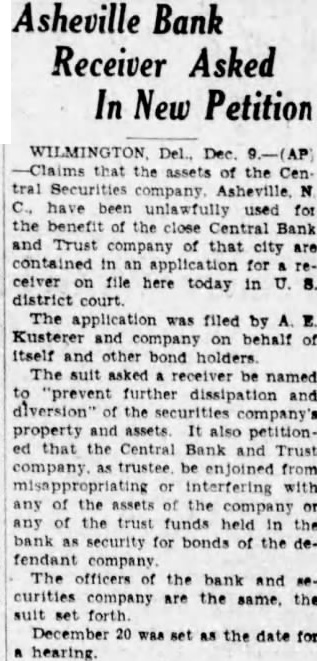
Asheville Bank Receiver Asked In New Petition

WILMINGTON Del., Dec. that the assets the tral company. Asheville have unlawfully used for the benefit the close Central Bank and Trust company that city contained in application for ceiver file here today in district court. The application was filed by Kusterer and company on behalf of itself and other bond holders. The asked named "prevent further dissipation diversion the company's property and assets also petitionthat the Central Bank and Trust company. trustee enjoined from interfering with the the company any of the trust funds held the bank security for bonds of the defendant The officers the bank and curities company are the same. the suit set December set as the date for hearing.


Article from Statesville Record and Landmark, December 18, 1930

Click image to open full size in new tab

Article Text

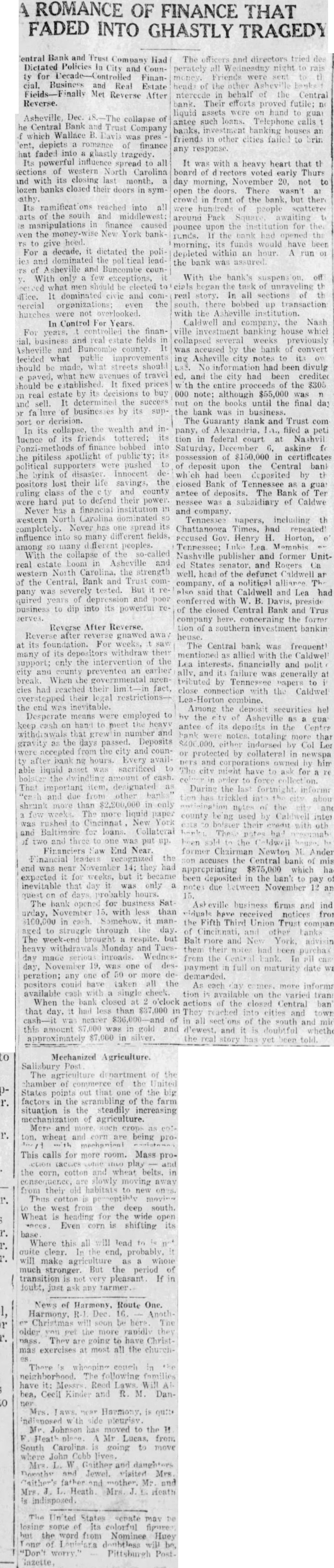
1 ROMANCE OF FINANCE THAT FADED INTO GHASTLY TRAGEDY entral Bank and Trust Company Had Dictated Policies In City and County for Decade-Controlled Financial, Business and Real Estate Finally Met Reverse After Reverse.

Asheville Dec. collapse of he Central Bank and Trust Company if which Wallace B. Davis was pres ent, depicts a romance of finance hat faded into a ghastly tragedy. Its powerful influence spread to all sections of western North Carolina and with its closing last month, lozen banks closed their doors in symIts ramificat ons reached into all arts of the south and middlewest: is manipulations in finance caused ven the money-wise New York bankrs to give For a decade, it dictated the poliies and dominated the pol tieal leadrs of Asheville and Buncombe counWith only a few exceptions, it sereed what men should be elected to ffice. It dominated civic and comthe hurches were not overlooked. In Control For Years. For years, the finanial, business and real estate fields Asheville and Buncombe county It decided what public improvements should be made, what streets should paved, what new avenues of travel should be established. It fixed prices on real estate by its decisions to buy and sell. It determined the success or fa lure of businesses by its support or derision. In its collapse, the wealth and inluence of its friends tottered: its Ponzi-methods of finance bobbed into the pitiless spotlight of public ty; its political supporters were pushed to of disaster Innocent de the brink lost their life savings, the positors ruling class of the and county were hard put to defend their power. Never has financial institution in western North Carolina dominated so completely Never has one spread its influence into so many different fields, among so many Ifferent peoples. With the collapse of the called real estate boom in Asheville and western North Carolina, the strength of the Central, Bank and Trust company was severely tested. But it required years of depression and poor business to dip into its powerful reserves.

Reverse After Reverse. Reverse after gnawed away at its foundation. For weeks, saw many of its depositors withdraw then support; only the intervention of the city and county prevented an earher break When the governmental agencies had reached their lim fact, overstepped their legal restrictionsthe end was inevitable. Desperate means were employed to keep cash on hand to meet the heavy withdrawals that grew in number and gravity as the days passed. Deposits were accepted from the city and county after bank ng hours. Every availliquid asset was sacrificed to able the dwindling amount of That important item, designated as and due from other shrunk more than $2,200,000 in only few The more liquid paper rushed to Cincinnat New York was Baltimore for loans. Collateral and of two and three to one was put up. Financiers Saw End Near. Financial recognized the end near November 14; they had was expected it for weeks, but it became inevitable that day it was only a quest on of days, probably hours. The bank opened for business Sat urday, November 15, with less than $100,000 in cash. Somehow. it managed to struggle through the day. The week-end brought respite. but heavy withdrawals Monday and Tuesday made serious inroads. Wednesday, November 19. was one of desperation; any one of 50 or more depositors could have taken all the approximately $7,000 in silver.

The officers and directors tried des perately all Wednesday night to rais money. Friends were sent to ti interecde in behalf of the Central bank. Their efforts proved futile; no liquid assets were on hand to gua antee such loans. Telephone calls banks, investment hanking houses an friends in other cities failed to brin any response.

It was with a heavy heart that th board of rectors voted early Thurs day morning, November 20, not to open the doors. There wasn't at crowd in front of the bank, but there were hundreds of people scattere around Pack awaiting to pounce upon the institution for the runds. If the bank had opened the morning, its funds would have been depleted within an hour. A run 01 the bank was assured.

With the bank's suspens'o off cials began the task of unraveling th real story. In all sections of th south. there bobbed up transaction with the Asheville institution. Caldwell and company, the Nash ville investment banking house which collapsed several weeks previously was accused by the bank of convert ing Asheville city notes to its on use. information had been divulg ed, and the city had been credited W th the entire proceeds of the $305 000 note: although $55,000 was n nut on the books until the final day the bank was in business. The Guaranty Bank and Trust com pany, of Alexandria, La., filed a peti tion in federal court at Nashvil Saturday, December 6. asking fr possession of $150,000 in certificates of deposit upon the Central bank wh ch had been deposited by th closed Bank of Tennessee as a gual antee of deposits. The Bank of Ter nessee was a subsidiary of Caldwe and Tennessee papers, including th Chattanooga Times, had repeated! accused Gov. Henry H. Horton, Nashville publisher and former United States senator. and Rogers Ca well, head of the defunct Caldwell ar company. of nolitical alliance The also said that Caldwell and Lea had conferred with W. B. Davis, preside of the closed Central Bank and Trus company here. concerning the forms tion of southern investment bankin heuse. The Central bank was frequent mentioned as allied with the Caldwell Lea interests. financially and polit allv, and its failure was generally at tributed by Tennessee дрегв to close connection with the Caldwel Lea-Horton combine. Among the deposit securities hel by the tv of Asheville as a gua antee of its deposits in the Centre bank were notes. totaling more than $40 000. either indorsed by Col Ler or protected by collateral in newspa Ders and corporations owned by him The city might have to ask for a re order to force During the last fortnight. informr tion has trickled into the city about the county be ng used by Caldwell inter former Chairman Newton M. Ander son accuses the Central bank of mis apprepriating $875,000 which had been deposited in the bank to pay of notes due between November 12 an 15.

Asheville business firms and ind viduals have received notices from the Fifth Third Union Trust compan of and other Balt more and New York, advisin them their notes had been purchas payment in full on maturity date WE demanded. As each day cames. more informs the real story has yet been told.

Mechanized Agriculture. Salisbury Post The agriculture donartment of the chamber of commerce of the United States points out that one of the big factors in the scrambling of the farm situation is the steadily increasing mechanization of agriculture. Mere and more such crops as ton. wheat and corn are being proThis calls for more room. Mass prothe corn, cotton and wheat belts. in consequence are slowly moving away from their old habitats to new ones. Thus cotton is perseptibly moving to the west from the deep south. Wheat is heading for the wide open *nces Even corn is shifting its base Where this all will lend to is quite clear. In the end, probably will make agriculture as whole much stronger. But the period of joubt, just ask any tarmer

News of Harmony, Route One. Harmony, R-1 Dec. 16. Anothen Christmas will soon be here The older you pet the more rapidly they nass. They are going to have Christ mas exercises at most all the churches neighborhood. The following families have it: Messrs Reed Laws. Will bea, Cecil Kinder and R. M. Dan- indisposed th side pleurisy Mr. Johnson has moved to the H F Heath place. A Mr Lucas, from South Carolina is going to move where John Cobb lives. Mrs L. W Gaither and daughters Borothy and Jewel. visited Mrs. Caither's father and mother. Mr and Mrs. J. L. Heath Mrs. J. L. Heath is indisposed

The United States senate may be losing some of its colorful figures but the word from Nominee Huey of will Pittsburgh Post.
Article from Evening Star, December 21, 1930

Click image to open full size in new tab

Article Text

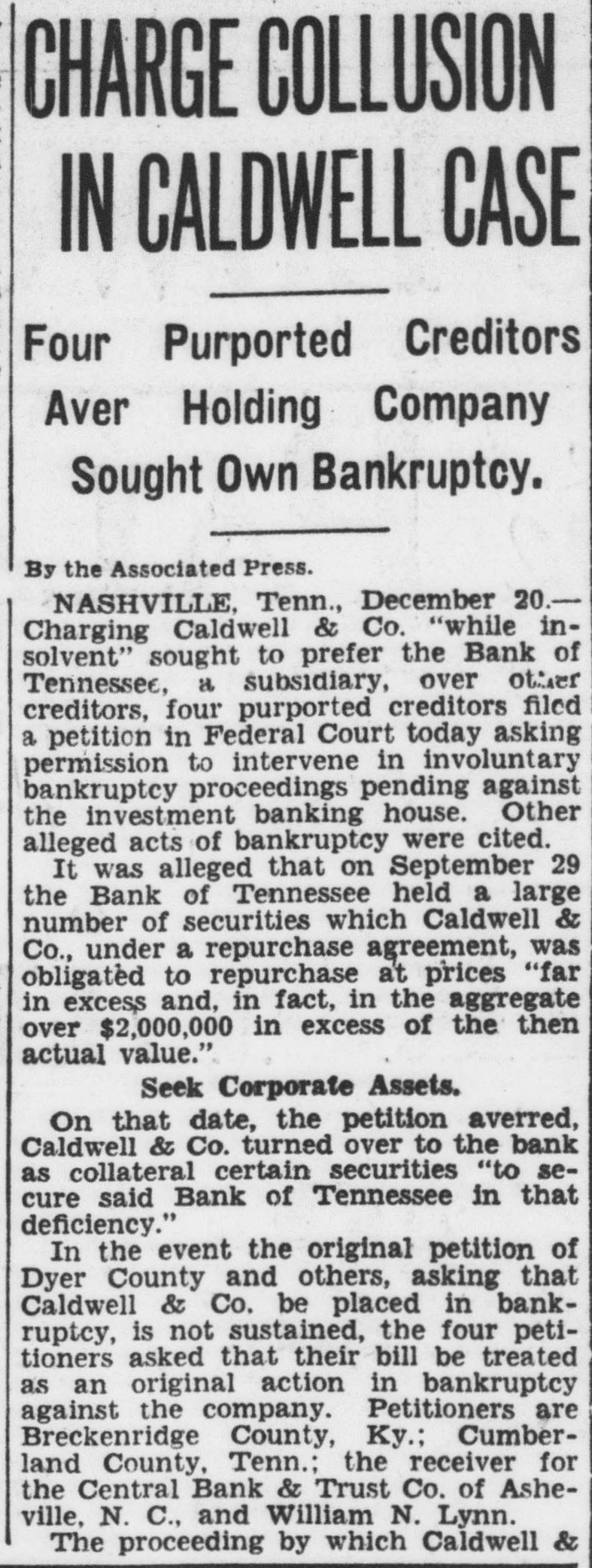
CHARGE COLLUSION
IN CALDWELL CASE

Four Purported Creditors Aver Holding Company Sought Own Bankruptcy.

By the Associated Press. NASHVILLE, Tenn., December 20.- Charging Caldwell & Co. "while insolvent" sought to prefer the Bank of Tennessee, a subsidiary, over other creditors, four purported creditors filed a petition in Federal Court today asking permission to intervene in involuntary bankruptcy proceedings pending against the investment banking house. Other alleged acts of bankruptcy were cited. It was alleged that on September 29 the Bank of Tennessee held a large number of securities which Caldwell & Co., under a repurchase agreement, was obligated to repurchase at prices "far in excess and, in fact, in the aggregate over $2,000,000 in excess of the then actual value."

Seek Corporate Assets. On that date, the petition averred, Caldwell & Co. turned over to the bank as collateral certain securities "to secure said Bank of Tennessee in that deficiency." In the event the original petition of Dyer County and others, asking that Caldwell & Co. be placed in bankruptcy, is not sustained, the four petitioners asked that their bill be treated as an original action in bankruptcy against the company. Petitioners are Breckenridge County, Ky.; Cumberland County, Tenn.; the receiver for the Central Bank & Trust Co. of Asheville, N. C., and William N. Lynn. The proceeding by which Caldwell &


Article from New Britain Herald, December 24, 1930

Click image to open full size in new tab

Article Text

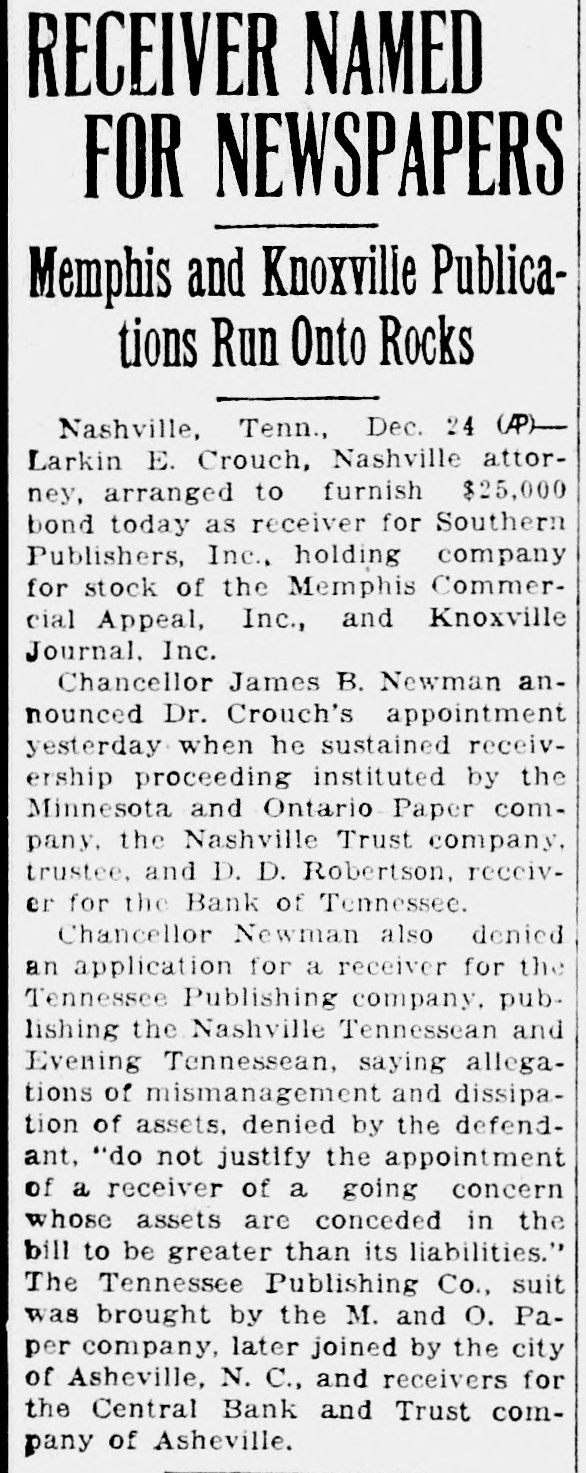
RECEIVER NAMED
FOR NEWSPAPERS

Memphis and Knoxville Publications Run Onto Rocks

Nashville, Tenn., Dec. 24 (AP)— Larkin E. Crouch, Nashville attorney, arranged to furnish $25,000 bond today as receiver for Southern Publishers, Inc., holding company for stock of the Memphis Commer- cial Appeal, Inc., and Knoxville Journal, Inc.

Chancellor James B. Newman announced Dr. Crouch's appointment yesterday when he sustained receiv- ership proceeding instituted by the Minnesota and Ontario Paper com- pany, the Nashville Trust company, trustee, and D. D. Robertson, receiv- er for the Bank of Tennessee.

Chancellor Newman also denied an application for a receiver for the Tennessee Publishing company, pub- lishing the Nashville Tennessean and Evening Tennessean, saying allega- tions of mismanagement and dissipa- tion of assets, denied by the defend- ant, "do not justify the appointment of a receiver of a going concern whose assets are conceded in the bill to be greater than its liabilities." The Tennessee Publishing Co., suit was brought by the M. and O. Pa- per company, later joined by the city of Asheville, N. C., and receivers for the Central Bank and Trust com- pany of Asheville.


Article from The Item, December 26, 1930

Click image to open full size in new tab

Article Text

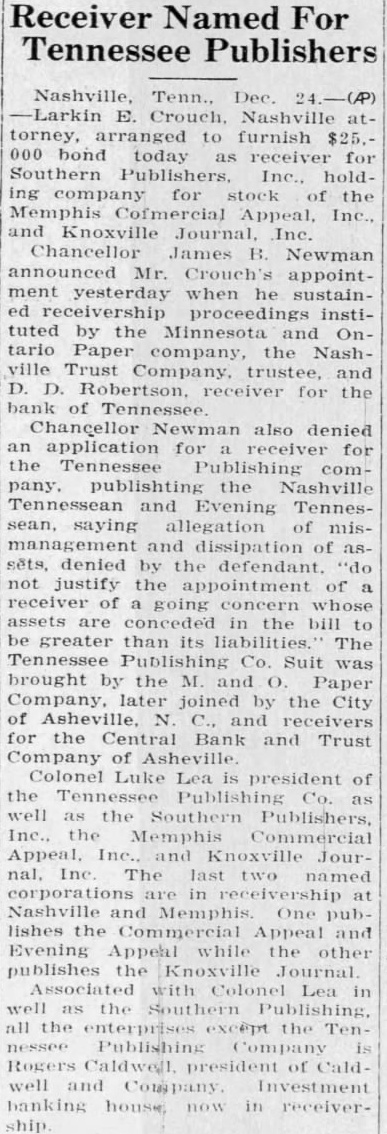
Receiver Named For Tennessee Publishers

Nashville, Tenn., Dec. Crouch, Nashville torney, arranged to furnish 000 bond today Southern holding company the Memphis Cofmercial Appeal, and Knoxville Journal, Inc. Chancellor James Newman announced Mr. Crouch's appointment yesterday when he sustained instituted by the Minnesota Ontario Paper company, the Nashville Trust Company, and receiver for the bank of Chancellor Newman also denied application for receiver the Tennessee Publishing company. publishting the Tennessean and Evening Tennessean, saying allegation misand dissipation of sets, denied by defendant. justify appointment of receiver going whose conceded the bill be greater than its liabilities. The Tennessee Publishing Suit was brought by the Paper Company, later joined by the City of and receivers for Central Bank and Trust Company of Asheville Colonel Luke Lea president the well the Publishers, Memphis Commercial and Memphis lishes Appeal Evening Appeal other publishes Lea Southern the the Publishing Rogers Caldwell president well and


Article from Evening Star, April 2, 1931

Click image to open full size in new tab

Article Text

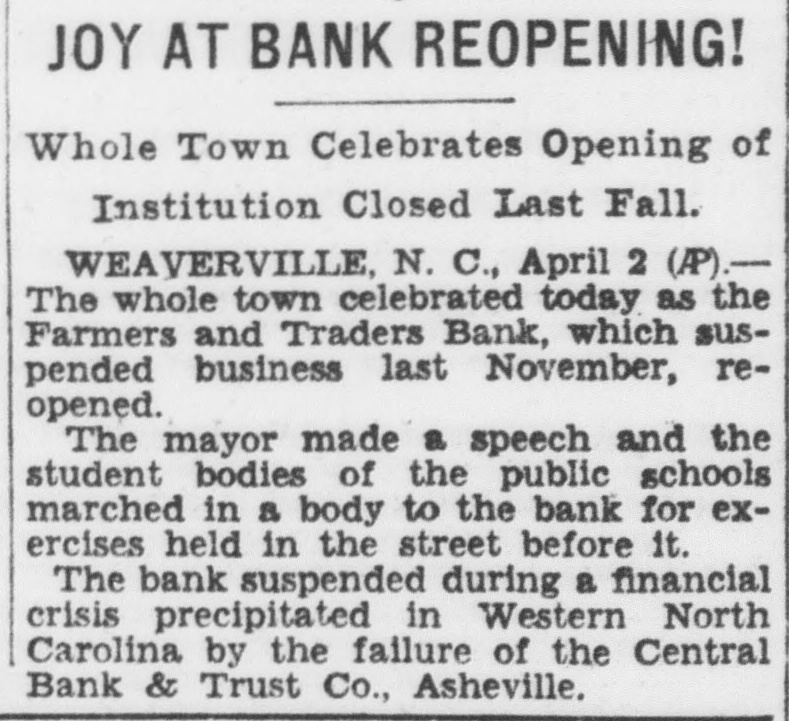
JOY AT BANK REOPENING! Whole Town Celebrates Opening of Institution Closed Last Fall. WEAVERVILLE, N. C., April 2 (P).The whole town celebrated today as the Farmers and Traders Bank, which suspended business last November, reopened. The mayor made a speech and the student bodies of the public schools marched in a body to the bank for exercises held in the street before 1t. The bank suspended during a financial crisis precipitated in Western North Carolina by the failure of the Central Bank & Trust Co., Asheville.


Article Text

NO LIGHTS Weaverville, N. C., April 2. (AP) The whole town celebrated today as the Farmers and Traders Bank here which suspended business last November reopened. The mayor made a speech and the student body of the public schools marched in a body to the bank for exercises held in the street before it. The bank suspended during financial crisis precipitated in Western North Carolina by the failure of the Central Bank and Trust Company, Asheville.


Article Text

TOWN CELEBRATES WHEN BANK REOPENED

Weaverville, N. C., April 2-(AP)The whole town celebrated today as the Farmers' and "raders' bank here which suspended business last November reopened. The mayor made a speech and the student bodies of the public schools marched in body to the bank for exercises held in the before it. The bank suspended during a financial crisis precipitated in western North Carolina by the failure of the Central Bank and Trust company of Asheville.


Article Text

The whole town celebrated today y the Farmers and Traders Bank here. which suspended business last November, reopened. The mayor made a speech and the student bodies of the public schools marched body to the bank for exercises held in the street before it. The bank suspended during financial crisis precipitated in Western North Carolina by the failure of the Central Bank and Trust Company Asheville

Mrs. Peters said last night that her son returned home from Duke University, Durham. N. C., to recover from recent illness


Article Text

TWO MORE HELD INBANK INQUIRY

New Indictments Bring in Two New Names, Raising Total of Defendants to 27

ASHEVILLE N added already day list charges brought by voluminous the result of the of the fall with than on latest include The names and 27 the new against whom tal number charges pending of superior will begin with Judge court of Rocky Mount. M. presiding for the trial of the cases Solicitor Zeb V. Nettles will be As sisted in the by several prominent of the state Prominent in yesterday's grand jury action were tments charging Col. Luke Lea Luke Lea. and E. P. B Davis, president, and Charles Bradford cashier of the closed Central Bank and Trust company with conspiracy to defraud the institution of more than The Leas. Charlet and Davis al(Continued on Page Nine. Col. 8)


Article Text

followed the state's motion yesterday for change of venire Counsel for defense contendpublicity bank failures subsequent ceedings bank and county officials, the most persons suffered financial resided in Buncombe county, would fair trial for the defendants here. Davis president the Central and Trust Company, the failure which other thousands of appeared unmoved his attorneys argued for moval from the tense atmosphere Buncombe county. lawyer's table stheargu lawyers' table the though without his


Article Text

SEES ON DEBTS

Goes to 'Make Acquaintance' Of a State Commissioner.

United N. Nashville, Tenn., banker and publisher, visited of Banks Gurney P. Hood here today to Lea's to the Bank and Trust Co., defunct Asheville The Luke and E. Charlet, will go on trial July 27 Asheville. to defraud the Central Bank leged of certificates deposit, notes and cashiers checks. With Lea at his conference with Hood was Albert L. Cox, Raleigh, his Lea informed Hood that If he were to his fairs in an orderly and manner was not pressed too closely he believed could all obligaHood withany of his creditors will held soon, early in out plan for his said. The Central Bank and Asheville failed last Nov. 19. in public funds on and precipitated total approximately Lea said his visit here today nature and to make of Commissioner Hood.


Article Text

LEA IS SILENT UPON PROPOSAL

Son of Publisher Says No Comment to Be Made Yet Upon Cash Demand. see publisher and financier said here today no comment would be made on the action of North Carolina creditors in demanding 10 per cent of his father's obligations in that state before liquidating proposal would be considered until official notice of that action had been received here The North Carolina creditors yesterday proposition submitted by Colonel Lea would not be considered until 10 per cent of the indebtedness had been paid. Colonel Lea had suggested plan whereby his obligations would be gradually retired The creditors agreed consider the plan after 10 per cent paid The total more than and are alleged due the receivers of the defunct Central Bank and Trust company of Asheville, and the City of Asheville


Article Text

STATE NEARING END OF LEA BANK TRIAL

ASHEVILLE, N. Aug. 18. (U S. Coursey, state bank investigator, was by the defense today in the trial of Col. Luke Lea, Nashville publisher, and three other defendants, on charges of conspiracy to defraud the now closed Central Bank and Trust Co., in an fort to show that the bank lost no money in its with Lea. His testimony summed up the entire case, and the state is expected to rest when he leaves the stand.


Article Text

$300,000 CUT FROM FRAUD CHARGE AGAINST LUKE LEA

ASHEVILLE N. C., Aug. 24. By I. N. S. Delivering hour charge to the jury, Judge M V. Barnhill today reduced by $300,000 the sum of which Col. Luke Lea Tennessee publisher and three other men are charged with conspiring to defraud the closed Central Bank and Trust Company The amount now is $1,000,000


Article Text

TO REPORT ON CASE TODAY

Instructed By Judge To Come Into Court At Nine o'Clock

(Continued From Page One) and of Attorney Curtis for Harris heard When arguments completed shortly Judge Webb when he charge Judge Webb read the tentions the then contentions of the defendant Harris. later contentions defined law as It applies to evidence in the That Davis and Harris devised scheme to defraud: that the ported fraudulent scheme was to Central Securities company bonds the United States scheme defraud: that while the mails used by only one of the defendants in both collaborated the purported fraudulent scheme; that Central Bank Trust condition greatly the boom 1925-26 bank was insolvent and that Davis then conceived the Idea of getting money through sale of Central curities bonds for bolstering the bank: by Davis directors the company concerning mortgage panies acquired the untrue. and that Davis' recommendations part scheme his prevent withdrawal mortgage from the Central Bank; concerning the condition the tral Bank Trust company. sent out by mail, were untrue; that Central Securities company stock was sold on that the comwas being organized for industrial in North Caroand these were from those made in selling bonds; that Central Securities bonds were not guaranteed, there were surety bonds for bonds sold and the bonds and the company wise that the tral Securities being prosperous firm and dividends were paid when the company was in reality operating

Claims Outlined The contentions as submitted by counsel cited the letters, statements and other dence supporting the charges of In answer, counsel for Davis submitted the following which were read to the jury "The defendant contends in this that the Central Securities organized conducted for an purpose: and his honesty purpose by the which he used in securing the Board the highest character and best business ability available in the city of Asheville: he contends that man intending to defraud would not careful select smartest most honest men he could control the company the best legal he could secure and the trust and bonds were prepared by Francis Heazel lawyer highest standing and ability.

Purpose of Frm "The defendant contends the purpose of the securities was and sell mortbonds and in financing that the did to Western North Carolina desirable mortgage company bonds became difficult beuncertainty tate values. but large mortgage bonds falling due in November and Decemand in and 1932 that these bonds must be paid and account of the difficulty securing new mortgage bonds, the money the Central the off the maturities big and purchasing take their place: that he and the board directors considered that Central Bank and Trust company would carry and that the funds the that the Mr. Davis thought would merge the strong chain make the deposits absolutely safe beyond any doubt and also was carrying negotiations secure trusts to give liquid to the capital bank that had assurances from Caldwell and the and all of Lea's paid and money for November which would the bank ample that failure of and November plans entirely Central Bank funds the that run on his bank After the

10,000 PEOPLE

Every day 10,000 people are changing to St. Joseph's Genuine Pure pirin. This tremendous swing Joseph's due to the fact that realize is neither sensible necessarry to more tablets of "Et Joseph's both now proof cellophane preserve purity full Joseph's you lets be druggist for Joseph's recommended physicians druggists everywhere the largest ing aspirin world failure of Caldwell and company caused the failure of his and prevented from paying off the which due in and and many account causes beyond control not carry the plans they and that inability his plans not that money in faith and all the members of the the fact that character did not protest strong evidence you should find.

Out Copies that sent the dealers of the showed on its that deposit be that every was and that he had intended to all this the bonds cash would used: that matters legal counsel authorized by the board of directors defendant further contends that every statement truth and bond buyer ment fact the fendant contends that all his he was acting good faith that he believed his would carry that business conditions would money safe and that he had defrauding was of circumstance caused worldwide which has caused many banks business to fail, and beyond his return "The defendant that you should that he acted good faith every act done committed by him connection with Central Securities Company its very inception of the Bank Trust Comand resulting failure of Central Securities Company The defendant contends the original idea conceived by him. in the of Central Comwould which would valuable need the community would able to render service Asheville and Western North Carolina. The defendant contends that he spent considerable of his personal time and money of kinds in Western Carolina, and he had planned use the company in financing business and industry which would rehabiliWestern North Carolina, bring prosperity to the inhabitants The that after labor along became apparent due the general and pression in the States where was extremely to launch and were to fields or large Successfully Operated "The should find that became parent the industrial aims and plans the then conceived Central engage in the issuance and and the refinancing and refunding mortgage company bonds mortgage companies, had been profitably operated The Mortgage the part standing large financial and ready issued sold and twenty their The contends by the founder that the mortgage there was an tunity Asheville local pany. to engage the refinancing the pany and large cial in Baltimore Mary which making large its the and profits be made stock holders Thought Sound "The that such was entirely legitimate every and financial was fundamentally economically and defendant further that after part the vinced business and that he believed would benefit both the stockholders company the the company and The defendant contends that find the was the for placed charge board the leading and business men Central Securities began the its you the the Central was necessary for the Central curities company to put quate financial and itself the for take the the bonds The that should find that the Trust company subof the United States Fidelity and which had previously doing refinancing Companies and that Central of curities possessed sufficient handle the various and

To Create Funds that you should find


Article Text

COMMISSION MEETS

Raleigh, May North Carolina Park Commission held meeting here discuss rontine business. Attorney General Brummitt told it to to recover the it lost in the failure of the Central Bank and Trust Company in Asheville will probably be tried in July.


Article Text

(By Associated Press) ASHEVILLE, N. C., July 28.—Judge John H. Clements today overruled a motion for a new trial for Col. Luke Lea, Luke Lea, jr., and Wallace B. Davis, convicted last August of violation of the state bank laws.

The judge gave the defendants the right to appeal to the state supreme court and granted a continuance of bond for the trio.

Judge Clement set a limit of 45 days for the Leas and Davis to prepare their appeals and gave the state 30 days to answer.

The ruling was handed down immediately after court opened.

Judge Clement said the new evidence offered in the motion for a new trial would not change the verdict convicting the defendants, as "ample evidence was offered" in the original trial.

Bond of $30,000 for Lea, sr., former Tennessee senator and Nashville financier; $20,000 for his son and $20,000 for Davis, former president of the defunct Central Bank and Trust company here, was continued.

This permits the defendants to remain at liberty until their appeal comes up before the state supreme court.

Judge Clements' decision came after he had heard a mass of testimony designed to show that a new trial should be granted the three defendants.

Affidavits, some alleging prejudice against the three men by the jurors that heard the case and others contending the defense made efforts to tamper with members of the jury, were read into the records.


Article Text

LUKE LEA, HIS SON AND DAVIS DENIED RETRIAL

July 28 Luke Lea, former Tennessee senator and publisher. denied trial Thursday on violating the state banking New trials also denied Lea and Wallace Davis. former head the closed Central Bank and Trust Co. of Asheville.


Article Text

ARREST LEAS

N. C. Court Mails Judgment To Asheville Today

RALEIGH, Dec. The state supreme court this ternoon mailed Buncombe court the judgment the perior Luke Lea bank fraud case. As papers reach county take steps imprison the nessee and former Unit ed States collect $25,000 fine from Luke Lea, or imprison The judgment was certified to the lower court receipt notification from supreme court the United States of the termination of the futile Lea ap peal in that court. The supreme court had ordered its judgment which affirmed conviction the Leas in the $17,000.000 crash of the Central Bank and Trust company of Ashe ville. withheld until final action in the nation's highest tribunal.


Article Text

ARRESTED SET,

Clarksville, few minutes after they had rested here today, Luke Nashville publisher and former United and his son, were granted by corpus County Judge John who set the hearing for Monday The arrests were made on warsigned Gov. Hill several weeks honored requisition from the governor North Carolina. were convicted at Asheville August, conspiracy to violate banking connection the failure of Central Bank Trust company. Colonel sentenced to serve six years given the option paying fines costs serving two to years prison.


Article Text

LEA AND SON [Continued From Page One of violating State banking laws in connection with the collapse of the Central Bank and Trust Company. Lea was sentenced to from six to ten years in the State penitentiary and Lea, Jr., was given an alternative sentence of two to six years $25,000 in fines and costs. They were taken into custody warrant signed by Governor Hill McAlister on February when he honored requisition from the Governor of North Carolina for their removal to that State. Sheriff E. Beaumont of Montgomery county (Clarksville) made the arrests at the request of Sheriff Laurence E. Brown and Deputy Sheriff Frank Lakey, of Asheville, designated in the warrant as agents to return the Leas to North Carolina. Immediately after the Leas' arrest,

County Judge John Cunningham granted writ of habeas corpus and set the hearing for 10 m. Monday. However, the judge refused application of the Leas' counsel for bond and they were placed in separate cells in the conty jail. Judge Cunningham also denied request by the Leas' counsel for an extension of time before the hearing. but said that necessary" continuance might be granted Monday. In their efforts to escape the sentences, the father and son carried their fight to the North Carolina Supreme Court and States Supreme Court, but without success.