Bank For Savings (New York, NY)

Episode Information

Episode UID
6564452891369
Episode Type
Run Only
Bank Type
state
Bank ID
656445289 hash
Start Date
January 30, 1914
Location
New York, New York (40.714, -74.006)

Metadata

Model
gpt-5-mini (chosen from majority vote of a three-model LLM ensemble)
Short Digest
65321060b9f65060

Response Measures

None

Events (1)

1. January 30, 1914 Run
Cause
Rumor Or Misinformation
Cause Details
Malicious or mischevious rumors (including gossip by a servant) allegedly sparked withdrawals; detectives sought the rumor-monger.
Measures
Added extra tellers to speed payments; directors declined offers of assistance; decided not to invoke sixty-day withdrawal rule.
Newspaper Excerpt
After Nearly $1,000,000 Has Been Paid to Depositors...the inexplicable run on the Bank for Savings... More than 2,000 men and women... withdrew their deposits.
Source
newspapers

Newspaper Articles (10)

Article from The Evening World, January 30, 1914

Click image to open full size in new tab

Article Text

EXTRA TELLERS TO MEET THE UNUSUAL DEMAND. Three tellers, an addition of two to the regular force, have been set to work paying every one as fast as the line can move. In some instances depositors who came to withdraw experienced a change of heart when they saw the alacrity with which the bank was paying out and decided to let their money stand. President Trimble in an interview with an Evening World reporter said that he was not worrying in the least, but was sorry that so many people should have been imposed upon by wild rumors. One woman depositor had told him, he said, that the failure of the Siegel banks and the fact that the Bank for Savings was not under Federal control had alarmed her. The rumor-monger, who is supposed, either from malice or pure mischief, to have started the run on the bank will be traced and properly dealt with. Detectives are now looking for him. NOT WORRIED WITH LOAD OF CASH ON HAND. About $1,000,000 in round figures has been paid out by the bank since Tuesday, when the rush to withdraw began. The bank has been overwhelmed by offers of assistance, but with the enormous amount of cash in the vaults the officials are not worrying. The Board of Trustees met to-day before the bank opened and decided not to take any advantage of the sixty-day rule for withdrawing de-


Article from The Topeka State Journal, January 30, 1914

Click image to open full size in new tab

Article Text

BANK RUN GOES ON. After Nearly $1,000,000 Has Been Paid to Depositors. New York, Jan. 30.-The inexplicable run on the Bank for Savings, the oldest and one of the strongest savings institutions in the state continued today notwithstanding assurances from the state banking department that its Boundness was above question. More than 2,000 men and women, most of them of the poorer classes, withdrew their deposits during the forenoon. Nearly $1,000,000 has been paid out by the bank since the run was started on Tuesday. The directors have been offered assistance from other banks but have declined with thanks.


Article from The Sun, January 31, 1914

Click image to open full size in new tab

Article Text

The Mind of a Bank Depositor. The psychology of the ignorant bank depositor will remain as one of the inexplicable and enigmatical problems in the mental makeup of human beings. That a run should start upon the oldest savings institution in New York city, founded in 1819, is worthy of comment chiefly because it proves that no fiduciary institution is beyond the reach of the rumor monger. But in this case the officials of the bank seem powerless to discover even what the rumors were. The depositors who withdrew their savings appeared to be "dazed" and actually at a loss to explain their actions. It is this blind impulse, not unlike the spirit of the mob, which is unaccountable. Yet the fact remains that the Bank for Savings, with assets amounting to nearly $108,000,000, found itself confronted with a run, small, of course, but none the less a run. Its president and vice-president were able to hear but three rumors, each of which served to establish in an amazing fashion the psychology of the depositors who were doing an act whereby they knew they would lose their interest. A news report yesterday gave these three rumors in the words of the officials themselves: "According to President TRIMBLE and Vice-President STEVENS, no clue to the origin of the rumors that caused the run has been discovered. 'One depositor,' said Mr. STEVENS, 'asserted that he had heard that our treasurer had absconded. We have no treasurer. Another depositor had heard that one of our trustees was a defaulter. Our trustees have nothing to do with handling the cash or securities.' "A maid servant.' added Mr. TRIMBLE. 'said she had heard I had told my wife that I intended to withdraw funds which I had deposited here as a trustee for my children. I have no wife and I have no children.'' Perhaps never in the history of bank runs have three such rumors been more extraordinary in view of their potentiality to produce an actual run. SHAKESPEARE was unconsciously greater than our modern psychologists, for instead of trying to explain human nature he contented himself with describing it. His frequent reference to the power of rumor showed how well he knew what an awful part it plays in our lives. In "Macbeth" we find these lines: "But cruel are the times. when we are traitors And do not know ourselves. when we hold rumor From what we fear, yet know not what we fear." Try as we may, no analysis could more accurately describe unthinking bank depositors than to say that they know not what they fear.


Article from The Evening World, February 2, 1914

Click image to open full size in new tab

Article Text

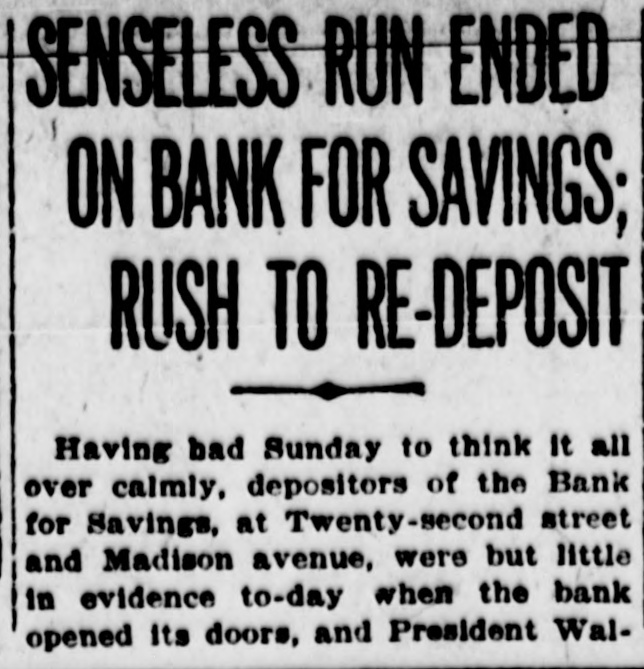
CENCELESS SENSELESS RUN ENDED ON BANK FOR SAVINGS; RUSH TO RE-DEPOSIT Having bad Sunday to think It all over calmly, depositors of the Bank for Savings, at Twenty-second street and Madison avenue, were but little in evidence to-day when the bank opened its doors, and President Wal-


Article from Audubon Republican, February 5, 1914

Click image to open full size in new tab

Article Text

Millions of dollars of the resources of city financial institutions were offered to the Bank for Savings of New York when depositors began a run for which the bank's officers could not account except that it might have resulted from malicious rumors circulated by enemies.


Article from Iron County News, February 7, 1914

Click image to open full size in new tab

Article Text

Forty-one persons aboard the Old Dominion liner Monroe perished when that vessel collided with the steamer Nantucket during a dense fog off Norfolk, Va. Ninety-nine person were rescued by the crew of the Nantucket. The final session of the convention of the United Mine Workers of America at Indianapolis, Ind., was marked by disorder. Duncan McDonald of Illinois declared that Samuel Gompers, president of the American Federation of Labor, was "gloriously drunk" at the Seattle convention of that organization. These remarks were interrupted by cries of "Liar," "Slanderer" and "Libelous" from Mr. Gompers. Yeggmen dynamited the vault of the bank of Lyerly at Lyerly, Ga., after engaging in a fusillade with citizens, and made a successful escape with $4,000. Elaborate receptions were held in honor of the party of 100 Nobles of the Mystic Shrine who have arrived at Manila from Seattle. A counterfeiters' den in the state prison at Joliet, Ill., was discovered. Five convicts who have been making counterfeit five-cent pieces in the machine shop were detected. The nickels were passed in the prison store. Millions of dollars of the resources of city financial institutions were offered to the Bank for Savings of New York when depositors began a run for which the bank's officers could not account except that it might have resulted from malicious rumors circulated by enemies. Frederick W. Vanderbilt's yacht Warrior was wrecked off the northwest coast of Colombia, between Savanilla and Santa Marta. Mr. and Mrs. Vanderbilt and their guests, the duke and duchess of Manchester, were taken off the yacht by the United Fruit steamer Almirante. After two days of conferences with political leaders Thomas Taggart, Indiana's member of the Democratic national committee, issued a formal statement that he would not be a candidate for the United States senate. Rev. G. E. Tidwell, pastor of a Baptist church at Macon, Ga., was killed at his home in East Macon when a pistol dropped from his pocket and exploded as he was leaning down to kiss his two-year-old baby good-by. The temperature at Pittsburgh January 29 reached 72 degrees. Sanford H. Ferree, aged seventy-nine, of Coraopolis, Civil war veteran, was overcome by the heat and died of exhaustion. More than 1,000 unemployed men and women in the Ghetto district of Chicago fought policemen, who, with revolvers drawn, sought to force them to leave mass meetings being held in the streets. Two I. W. W. men, alleged leaders in the rioting, were arrested. Policemen were fired upon by gunmen. The scout cruiser Birmingham was badly damaged by fire at Philadelphia. Fifteen hundred bluejackets fought heroically, and it was by their efforts that the entire reserve fleet was saved from destruction. Donald Patridge, aged eleven, was killed, another boy was fatally hurt and several other boys and two girls were injured when a "bob sled" crashed into a telephone pole at Honesdale, Pa. ### Mexican Revolt

Article from The Idaho Recorder, February 12, 1914

Click image to open full size in new tab

Article Text

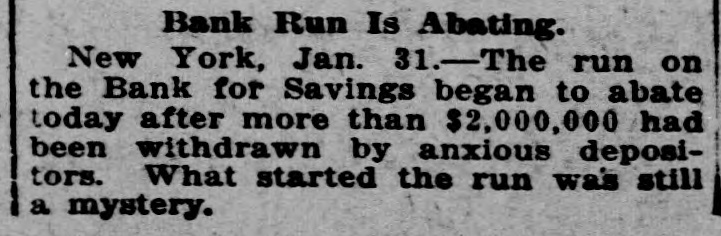
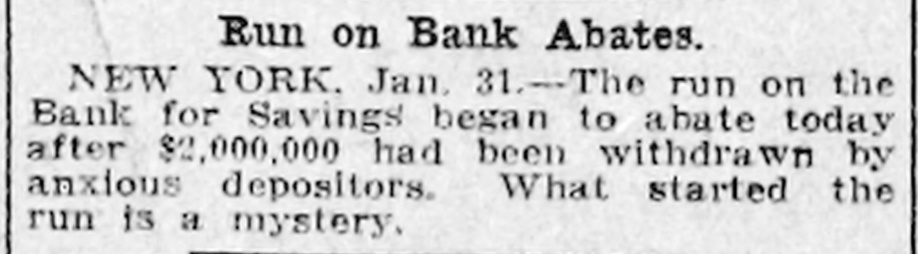
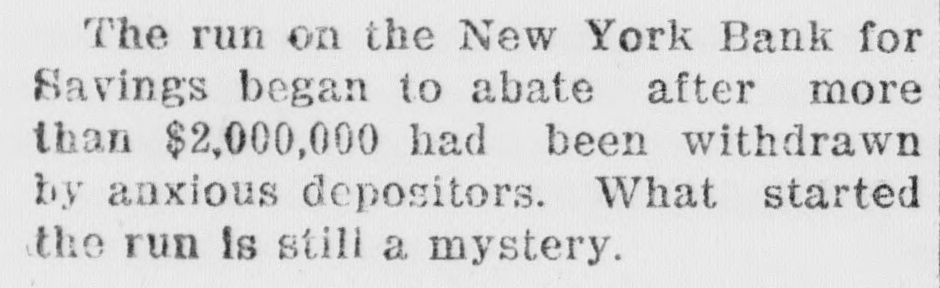
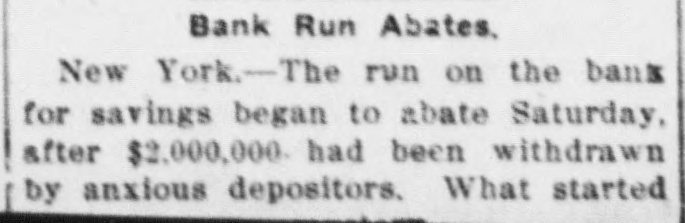
# Bank Run Abates. New York. The run on the bank for savings began to abate Saturday, after $2,000,000. had been withdrawn by anxious depositors. What started


Article from Iowa State Bystander, January 29, 1915

Click image to open full size in new tab

Article Text

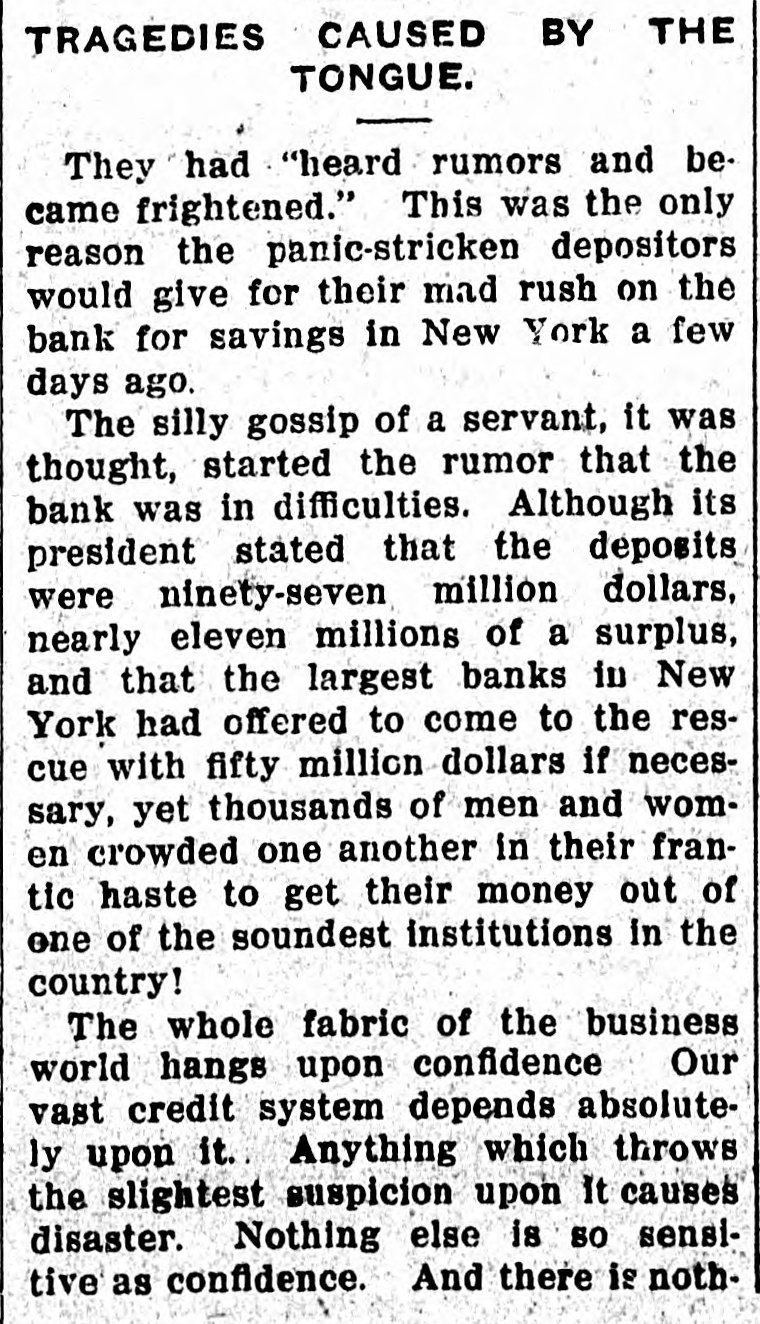
# TRAGEDIES CAUSED BY THE TONGUE. They had "heard rumors and became frightened." This was the only reason the panic-stricken depositors would give for their mad rush on the bank for savings in New York a few days ago. The silly gossip of a servant, it was thought, started the rumor that the bank was in difficulties. Although its president stated that the deposits were ninety-seven million dollars, nearly eleven millions of a surplus, and that the largest banks in New York had offered to come to the rescue with fifty million dollars if necessary, yet thousands of men and women crowded one another in their frantic haste to get their money out of one of the soundest institutions in the country! The whole fabric of the business world hangs upon confidence Our vast credit system depends absolutely upon it. Anything which throws the slightest suspicion upon it causes disaster. Nothing else is so sensitive as confidence. And there is noth-


Article from Northern Wisconsin Advertiser, January 29, 1915

Click image to open full size in new tab

Article Text

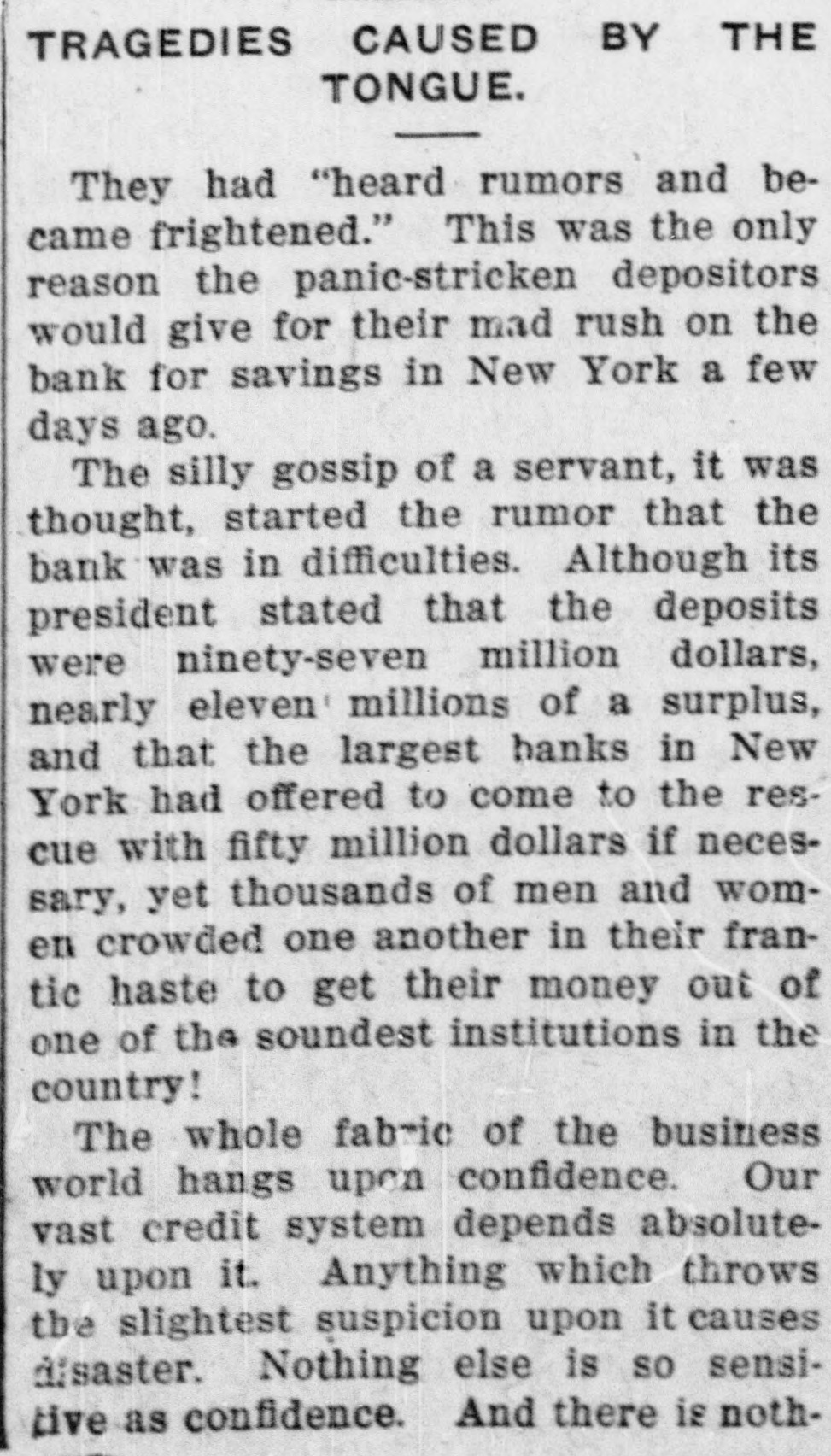
# TRAGEDIES CAUSED BY THE TONGUE. They had "heard rumors and became frightened." This was the only reason the panic-stricken depositors would give for their mad rush on the bank for savings in New York a few days ago. The silly gossip of a servant, it was thought, started the rumor that the bank was in difficulties. Although its president stated that the deposits were ninety-seven million dollars, nearly eleven millions of a surplus, and that the largest banks in New York had offered to come to the rescue with fifty million dollars if necessary, yet thousands of men and women crowded one another in their frantic haste to get their money out of one of the soundest institutions in the country! The whole fabric of the business world hangs upon confidence. Our vast credit system depends absolutely upon it. Anything which throws the slightest suspicion upon it causes disaster. Nothing else is so sensitive as confidence. And there is noth-


Article from Baxter Springs News, February 4, 1915

Click image to open full size in new tab

Article Text

# TRAGEDIES CAUSED BY THE TONGUE. They had "heard rumors and became frightened." This was the only reason the panic-stricken depositors would give for their mad rush on the bank for savings in New York a few days ago. The silly gossip of a servant, it was thought, started the rumor that the bank was in difficulties. Although its president stated that the deposits were ninety-seven million dollars, nearly eleven millions of a surplus, and that the largest banks in New York had offered to come to the rescue with fifty million dollars if necessary, yet thousands of men and women crowded one another in their frantic haste to get their money out of one of the soundest institutions in the country! The whole fabric of the business world hangs upon confidence. Our vast credit system depends absolutely upon it. Anything which throws the slightest suspicion upon it causes disaster. Nothing else is so sensitive as confidence. And there is noth-