Multiple contemporary newspaper notices (April 24–29, 1908) report the Daviess County Bank & Trust Co. declining deposits and suspending cash payments on Apr 24–25; within days the bank filed a general assignment/was taken in charge by an assignee/receiver (Apr 29). Subsequent reporting documents alleged misappropriation by the president and insolvency. Although some articles mention a run on the Owensboro Savings Bank (due to false rumors), there is no clear evidence of a depositor run on Daviess County Bank prior to suspension — the suspension appears driven by poor collections/insolvency and later fraud allegations. OCR variants of the name appear in the press (Davies), which I corrected to the provided name.
Events (4)
1.April 24, 1908Suspension
Cause
Bank Specific Adverse Info
Cause Details
Suspended because of inability to make regular collections and concerns about solvency; later disclosures alleged misappropriation by the bank president and insolvency.
Newspaper Excerpt
The Daviess County Bank and Trust company . . . are declining to receive deposits and have suspended cash payments pending a proposed reorganization of both institutions.
Source
newspapers
2.April 25, 1908Other
Newspaper Excerpt
Two of the largest banks in the city suspended yesterday because of their inability to make regular collections. . . The institutions will be reorganized and reopened.
Source
newspapers
3.April 29, 1908Receivership
Newspaper Excerpt
The Davies County Bank and Trust company . . . was today taken in charge by Assignee Henry Cline. The bank has a capital of $50,000 and deposits of over $600,000. The assignment followed that of the Owensboro Savings Bank and Trust company.
Source
newspapers
4.May 19, 1908Other
Newspaper Excerpt
T. S. Anderson, president of the Davies County Bank & Trust Company . . . was arrested. Anderson is charged with appropriating $20,000 of the bank's funds to his own use and with receiving deposits when he knew the bank was insolvent.
Source
newspapers
Newspaper Articles (22)
1.April 24, 1908Evening Times-RepublicanMarshalltown, IA
Click image to open full size in new tab
Article Text
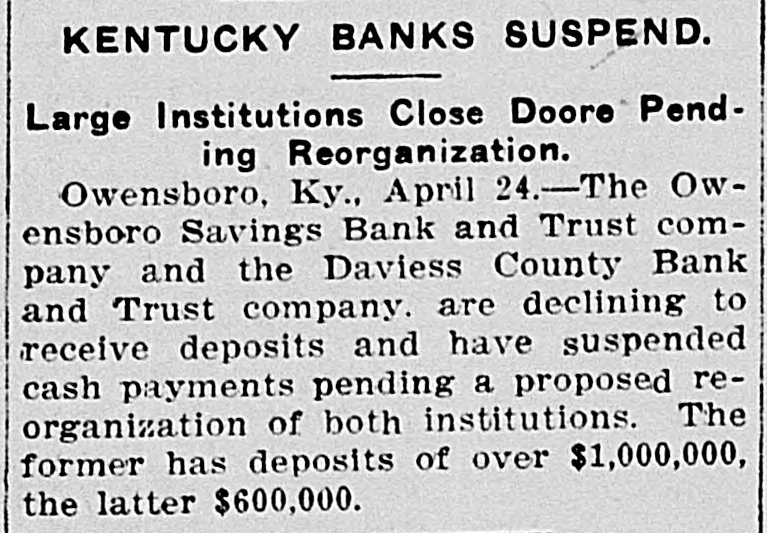
KENTUCKY BANKS SUSPEND. Large Institutions Close Doore Pending Reorganization. Owensboro, Ky., April 24.-The Owensboro Savings Bank and Trust company and the Daviess County Bank and Trust company. are declining to receive deposits and have suspended cash payments pending a proposed reorganization of both institutions. The former has deposits of over $1,000,000, the latter $600,000.
2.April 24, 1908The Daily SentinelGrand Junction, CO
Click image to open full size in new tab
Article Text
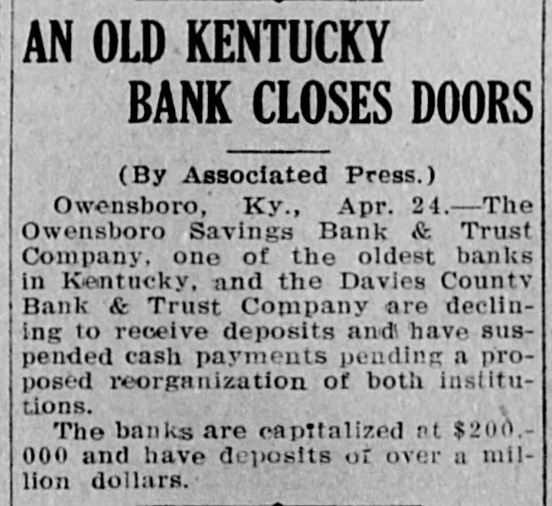
AN OLD KENTUCKY BANK CLOSES DOORS (By Associated Press.) Owensboro, Ky., Apr. 24.-The Owensboro Savings Bank & Trust Company, one of the oldest banks in Kentucky, and the Davies Countv Bank & Trust Company are declining to receive deposits and have suspended cash payments pending a proposed reorganization of both institutions. The banks are capitalized at $200.000 and have deposits of over a million dollars.
3.April 24, 1908East Oregonian : E.OPendleton, OR
Click image to open full size in new tab
Article Text
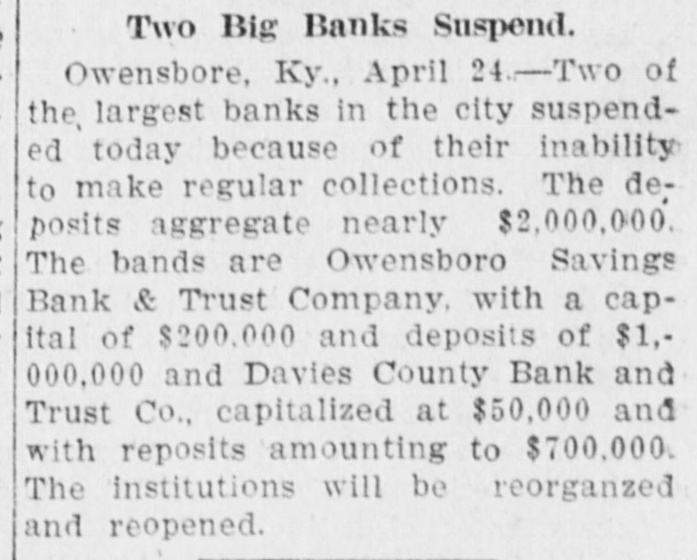
Two Big Banks Suspend. Owensbore, Ky., April 24.-Two of the, largest banks in the city suspended today because of their inability to make regular collections. The deposits aggregate nearly $2,000,000. The bands are Owensboro Savings Bank & Trust Company, with a capital of $200,000 and deposits of $1,000.000 and Davies County Bank and Trust Co., capitalized at $50,000 and with reposits amounting to $700,000. The institutions will be reorganzed and reopened.
4.April 25, 1908The Evening StatesmanWalla Walla, WA
Click image to open full size in new tab
Article Text
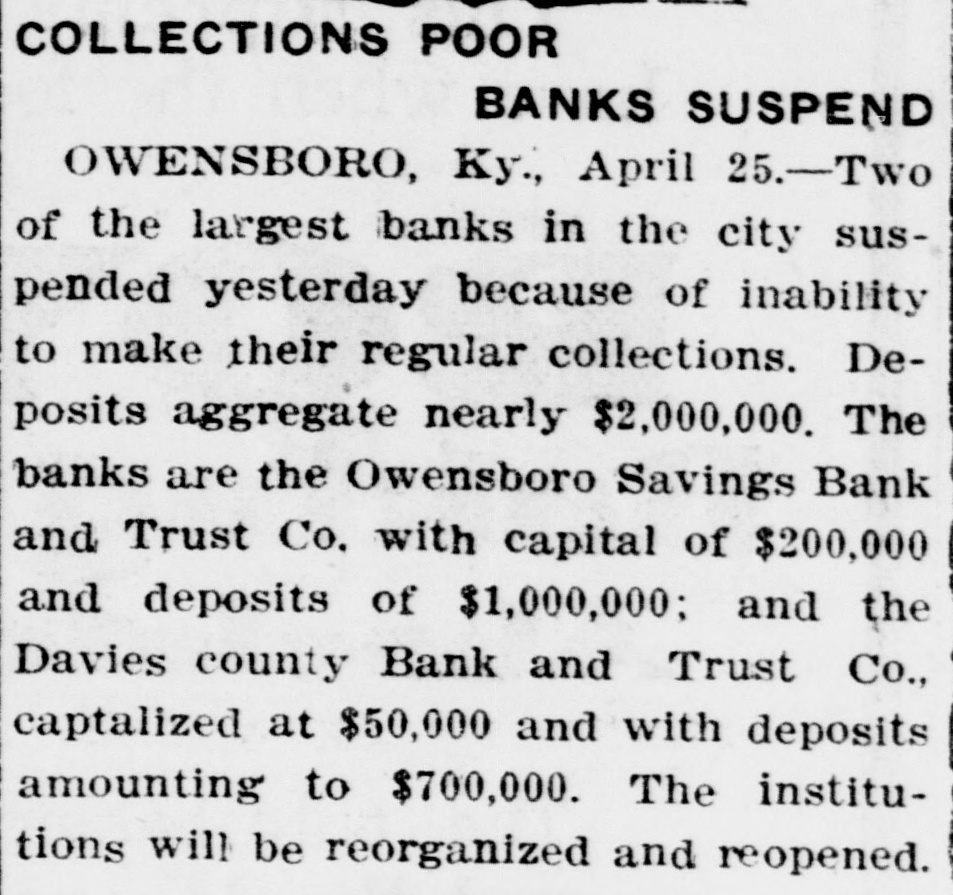
COLLECTIONS POOR BANKS SUSPEND OWENSBORO, Ky., April 25.-Two of the largest banks in the city suspended yesterday because of inability to make their regular collections. Deposits aggregate nearly $2,000,000. The banks are the Owensboro Savings Bank and Trust Co. with capital of $200,000 and deposits of $1,000,000; and the Davies county Bank and Trust Co., captalized at $50,000 and with deposits amounting to $700,000. The institutions will be reorganized and reopened.
5.April 25, 1908New-York TribuneNew York, NY
Click image to open full size in new tab
Article Text
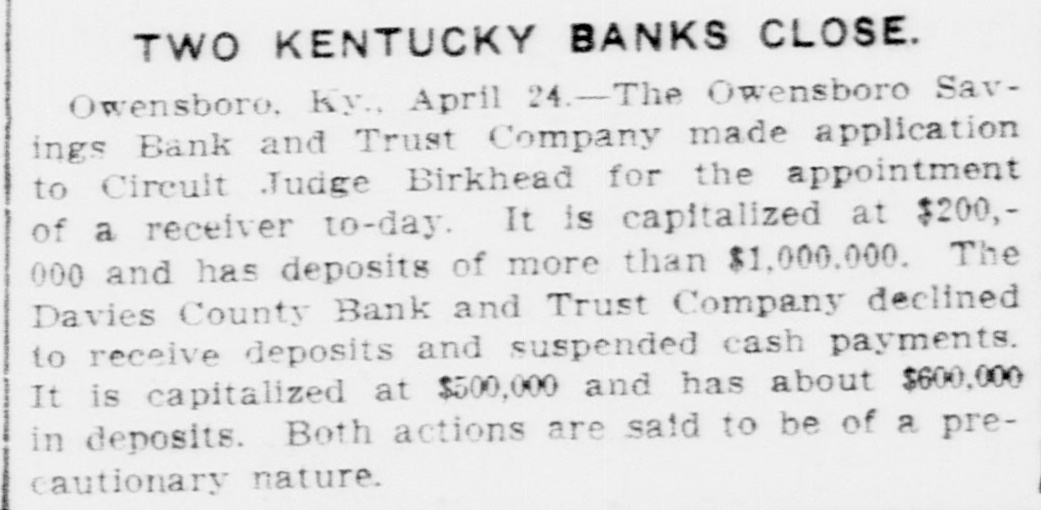
TWO KENTUCKY BANKS CLOSE. Owensboro, Ky., April 24. - The Owensboro Savings Bank and Trust Company made application to Circuit Judge Birkhead for the appointment of a receiver to-day. It is capitalized at $200,000 and has deposits of more than $1,000,000. The Davies County Bank and Trust Company declined to receive deposits and suspended cash payments. It is capitalized at $500,000 and has about $600,000 in deposits. Both actions are said to be of a precautionary nature.
6.April 26, 1908Los Angeles HeraldLos Angeles, CA
Click image to open full size in new tab
Article Text
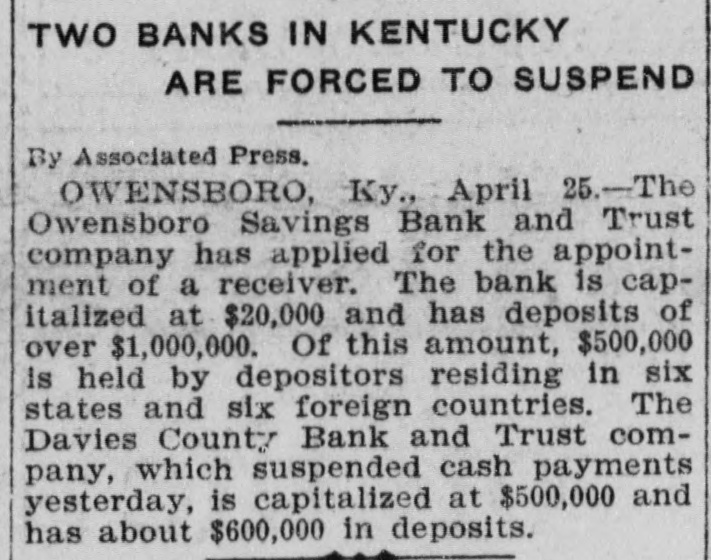
TWO BANKS IN KENTUCKY ARE FORCED TO SUSPEND By Associated Press. OWENSBORO, Ky., April 25.-The Owensboro Savings Bank and Trust company has applied for the appointment of a receiver. The bank is capitalized at $20,000 and has deposits of over $1,000,000. Of this amount, $500,000 is held by depositors residing in six states and six foreign countries. The Davies County Bank and Trust company, which suspended cash payments yesterday, is capitalized at $500,000 and has about $600,000 in deposits.
7.April 28, 1908Hopkinsville KentuckianHopkinsville, KY
Click image to open full size in new tab
Article Text
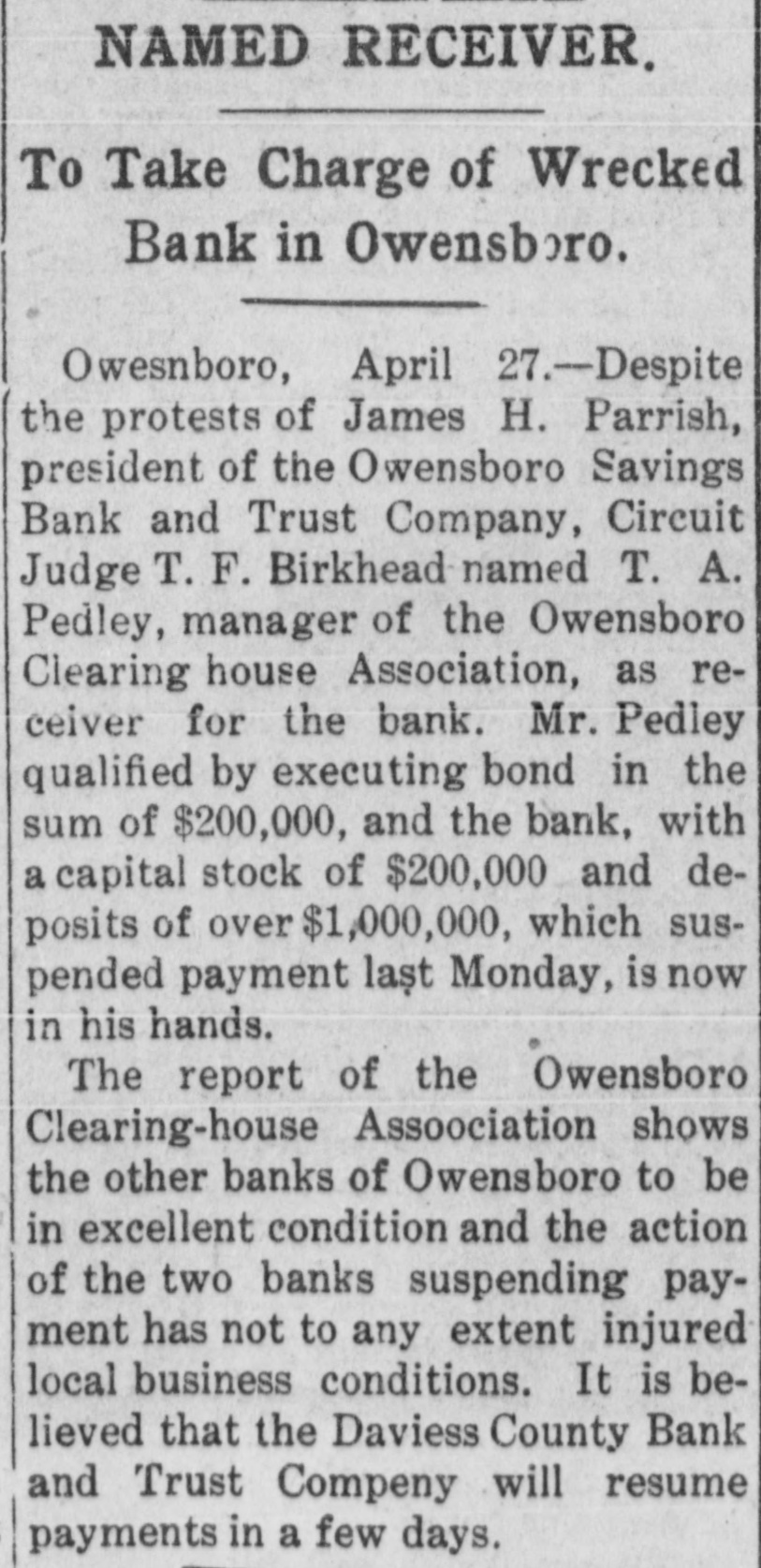
NAMED RECEIVER. To Take Charge of Wrecked Bank in Owensboro. Owesnboro, April 27.-Despite the protests of James H. Parrish, president of the Owensboro Savings Bank and Trust Company, Circuit Judge T. F. Birkhead named T. A. Pedley, manager of the Owensboro Clearing house Association, as receiver for the bank. Mr. Pedley qualified by executing bond in the sum of $200,000, and the bank, with a capital stock of $200,000 and deposits of over $1,000,000, which suspended payment last Monday, is now in his hands. The report of the Owensboro Clearing-house Assoociation shows the other banks of Owensboro to be in excellent condition and the action of the two banks suspending payment has not to any extent injured local business conditions. It is believed that the Daviess County Bank and Trust Compeny will resume payments in a few days.
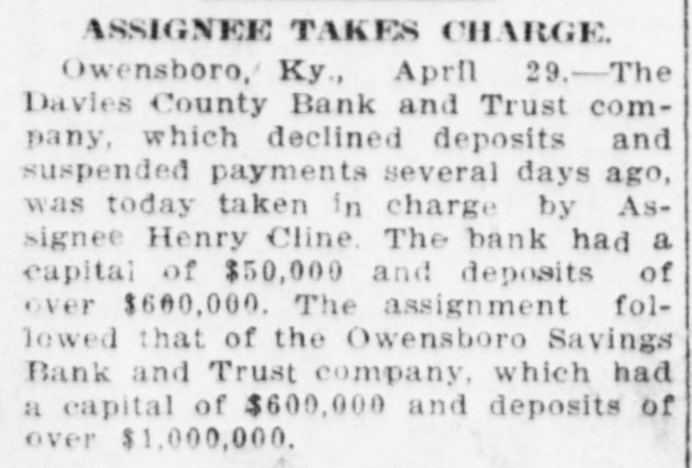
ASSIGNEE TAKES CHARGE Owensboro, Ky., April 29.-The Davies County Bank and Trust company, which declined deposits and suspended payments several days ago, was today taken in charge by Assignee Henry Cline The bank had a capital of $50,000 and deposits of over $600,000. The assignment followed that of the Owensboro Savings Bank and Trust company, which had a capital of $600,000 and deposits of over $1,000,000.
9.April 29, 1908Evening Times-RepublicanMarshalltown, IA
Click image to open full size in new tab
Article Text
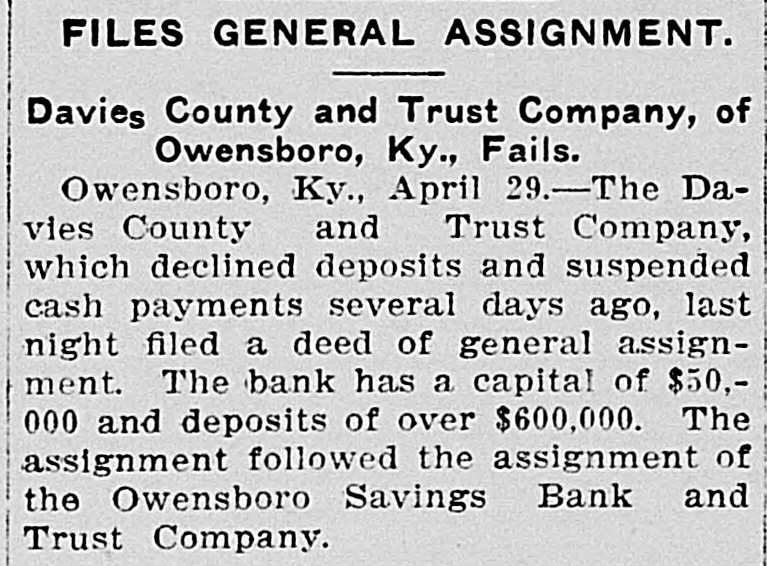
FILES GENERAL ASSIGNMENT. Davies County and Trust Company, of Owensboro, Ky., Fails. Owensboro, Ky., April 29.-The Davies County and Trust Company, which declined deposits and suspended cash payments several days ago, last night filed a deed of general assignment. The bank has a capital of $50,000 and deposits of over $600,000. The assignment followed the assignment of the Owensboro Savings Bank and Trust Company.
10.April 29, 1908Rock Island ArgusRock Island, IL
Click image to open full size in new tab
Article Text
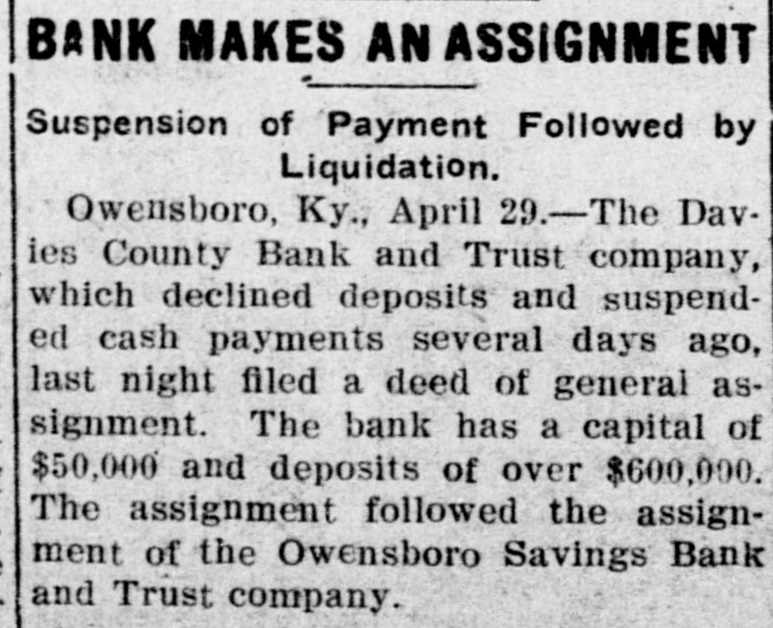
BANK MAKES AN ASSIGNMENT Suspension of Payment Followed by Liquidation. Owensboro, Ky., April 29.-The Davies County Bank and Trust company, which declined deposits and suspended cash payments several days ago, last night filed a deed of general assignment. The bank has a capital of $50,000 and deposits of over $600,000. The assignment followed the assignment of the Owensboro Savings Bank and Trust company.
11.April 29, 1908The Mt. Sterling AdvocateMount Sterling, KY
Click image to open full size in new tab
Article Text
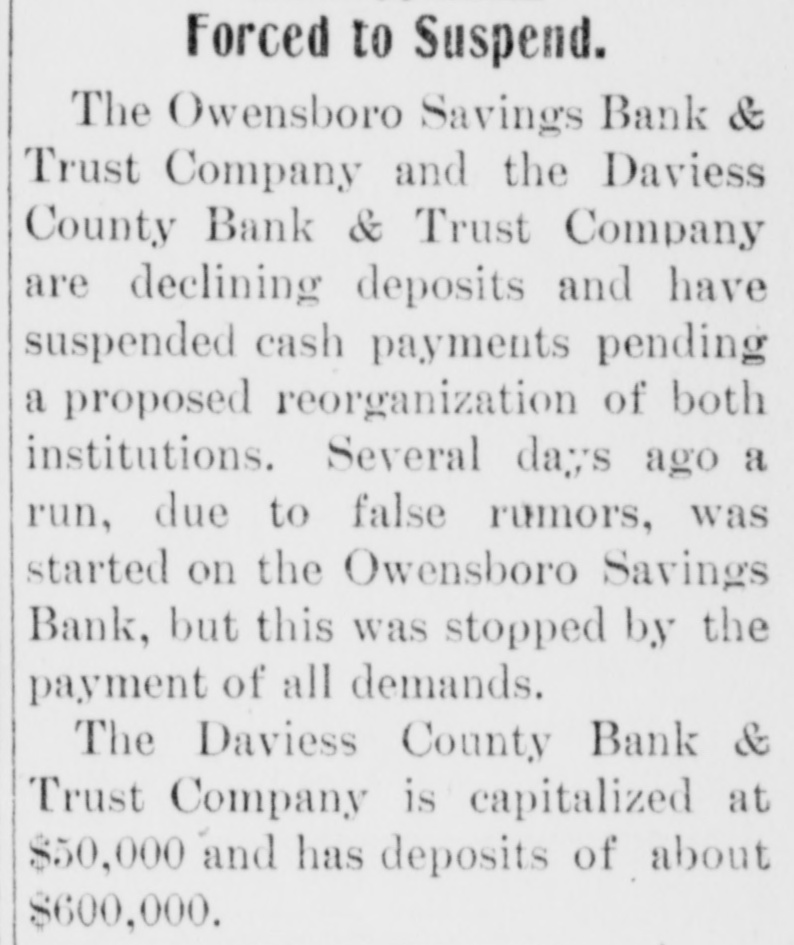
Forced to Suspend. The Owensboro Savings Bank & Trust Company and the Daviess County Bank & Trust Company are declining deposits and have suspended cash payments pending a proposed reorganization of both institutions. Several days ago a run, due to false rumors, was started on the Owensboro Savings Bank, but this was stopped by the payment of all demands. The Daviess County Bank & Trust Company is capitalized at $50,000 and has deposits of about $600,000.
12.April 30, 1908The Paducah Evening SunPaducah, KY
Click image to open full size in new tab
Article Text
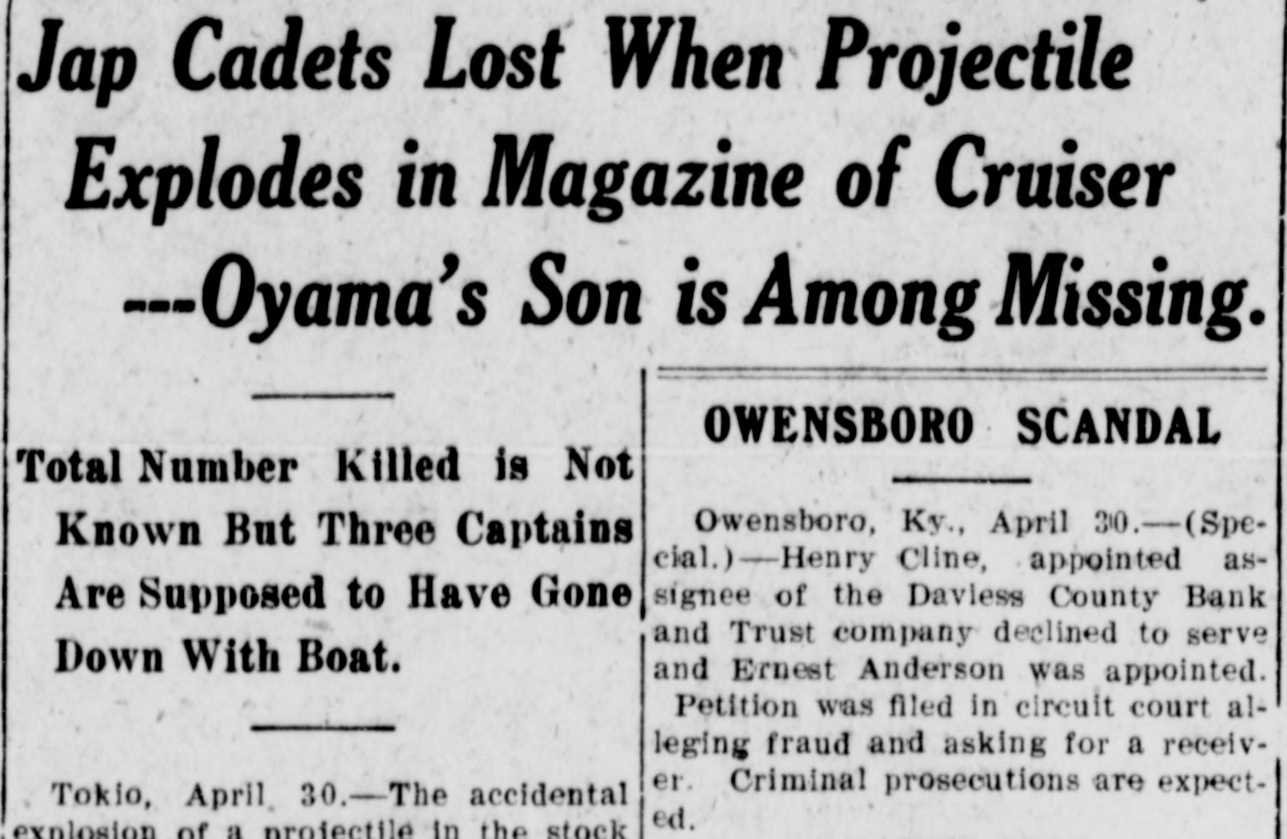
Jap Cadets Lost When Projectile Explodes in Magazine of Cruiser --Oyama's Son is Among Missing. OWENSBORO SCANDAL Total Number Killed is Not Owensboro, Ky., April 30.-(SpeKnown But Three Captains cial.)-Henry Cline, appointed assignee of the Daviess County Bank Are Supposed to Have Gone and Trust company declined to serve Down With Boat. and Ernest Anderson was appointed. Petition was filed in circuit court alleging fraud and asking for a receiver. Criminal prosecutions are expectTokio, April 30.-The accidental ed. explosion of a projectile in the stock
13.April 30, 1908Los Angeles HeraldLos Angeles, CA
Click image to open full size in new tab
Article Text
Receiver in Charge of Bank By Associated Press. OWENSBORO, Ky., April 29.-The Davies County Bank and Trust company, which declined deposits and suspended payments several days ago, was today taken in charge of by Assignee Henry Cline. The bank has a capital stock of $50,000 and deposits of over $600,000.
14.May 1, 1908The Billings GazetteBillings, MT
Click image to open full size in new tab
Article Text
TAKES CHARGE OF BANK. Suspended Institution Passes Into Hands of Assignee. Owensboro, Ky., April 29.-The Davies County Bank & Trust company, which declined deposits and suspended payments several days ago, was today taken in charge by Assignee Henry Cline. The bank has a capital stock of $50,000 and deposits of over $600,000. Its assignment followed that of, the Owensboro Savings Bank & Trust company, which had a capital stock of $600,000 and deposits of over $1,000,000.
15.May 19, 1908The Daily SentinelGrand Junction, CO
Click image to open full size in new tab
Article Text
TWO BIG BANKERS ARE UNDER ARREST [By Associated Press.] Owensboro, Ky., May 19.-T. S. Anderson, president of the Davies County Bank & Trust Company, and James H. Parrish, president of the Owensboro Savings Bank & Trust Company, were arrested yesterday. Anderson is charged with appropriating $200,000 of the bank's funds to his own use and with receiving deposits when he knew the bank was insolvent. Parrish was arrested on two warrants charging him with receiving deposits when he knew the bank to be insolvent. Both banks recently assigned. Anderson once was president of a bank in Detroit, but the employment of a watchman on Sunday night was against his religious scruples and he resigned, returning to Owensboro.
16.May 20, 1908Pine Bluff Daily GraphicPine Bluff, AR
Click image to open full size in new tab
Article Text
BANK PRESIDENT UNDER ARREST Owensboro, Ky., May 19.-T. S. Anderson, president of the Davies County Bank and Trust Company, and James H. Parrish, president of the Owensboro Savings Bank and Trust Company, were arrested yesterday. Anderson is charged with appropriating $20,000 of the bank's funds to his own use and with receiving deposits when he knew the bank to be insolvent. Parrish was arrested on two warrants charging him with receiving deposits when he knew the bank was insolvent. Both waived examining trials and were bound over to the grand jury under $15,000 bond. Both banks recently assigned. Anderson once was president of a bank in Detroit, but the employment of a watchman Sunday night was against his religious scruples and he resigned and returned to Owensboro.
17.May 20, 1908The Detroit TimesDetroit, MI
Click image to open full size in new tab
Article Text
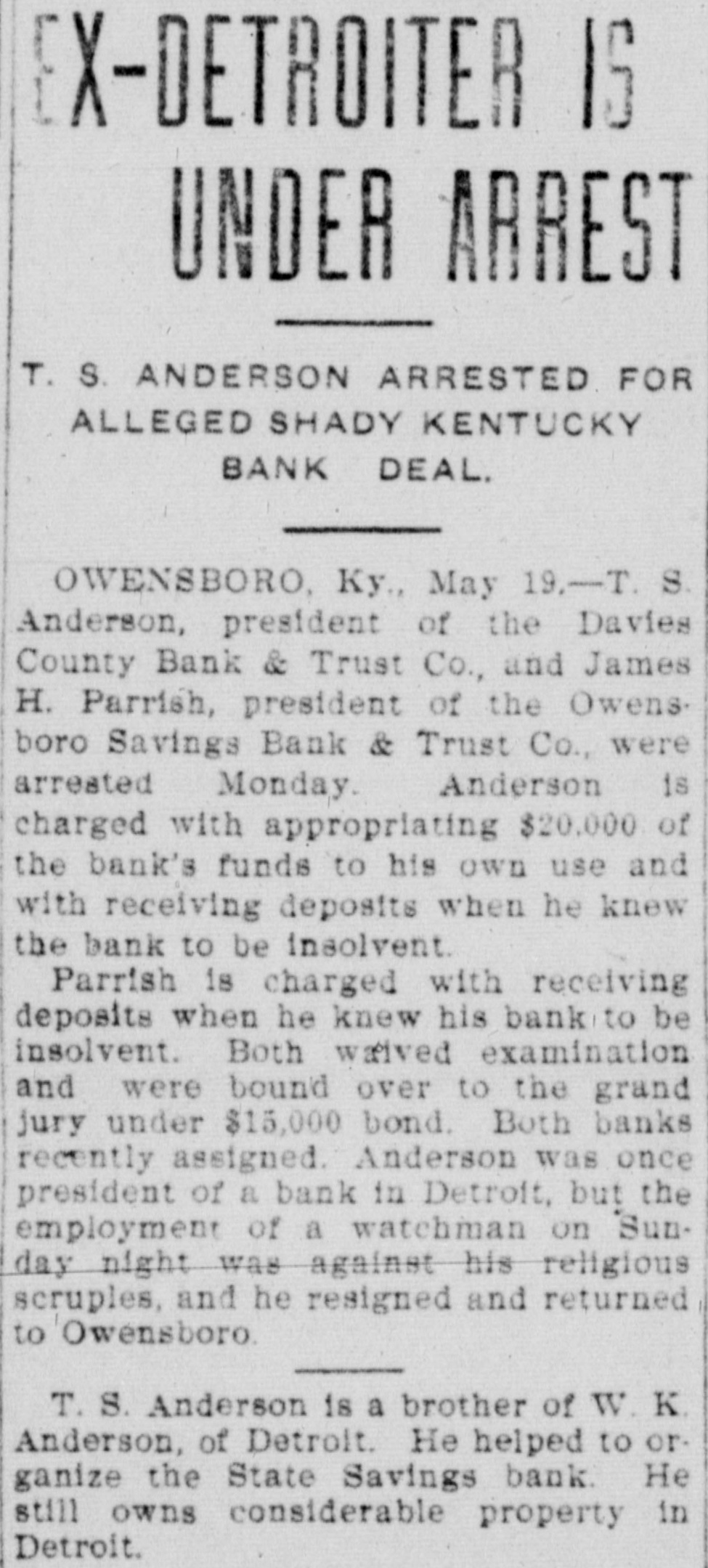
EX-DETROITER IS UNDER ARREST T. S. ANDERSON ARRESTED FOR ALLEGED SHADY KENTUCKY BANK DEAL. OWENSBORO, Ky., May 19,-T. S. Anderson, president of the Davies County Bank & Trust Co., and James H. Parrish, president of the Owens. boro Savings Bank & Trust Co., were arrested Monday. Anderson is charged with appropriating $20,000 of the bank's funds to his own use and with receiving deposits when he knew the bank to be insolvent. Parrish is charged with receiving deposits when he knew his bankito be insolvent. Both waived examination and were bound over to the grand jury under $15,000 bond. Both banks recently assigned. Anderson was once president of a bank in Detroit, but the employment of a watchman on Sunday night was against his religious scruples, and he resigned and returned to Owensboro. T. S. Anderson is a brother of W. K. Anderson, of Detroit. He helped to organize the State Savings bank. He still owns considerable property in Detroit.
18.May 20, 1908The Hartford HeraldHartford, KY
Click image to open full size in new tab
Article Text
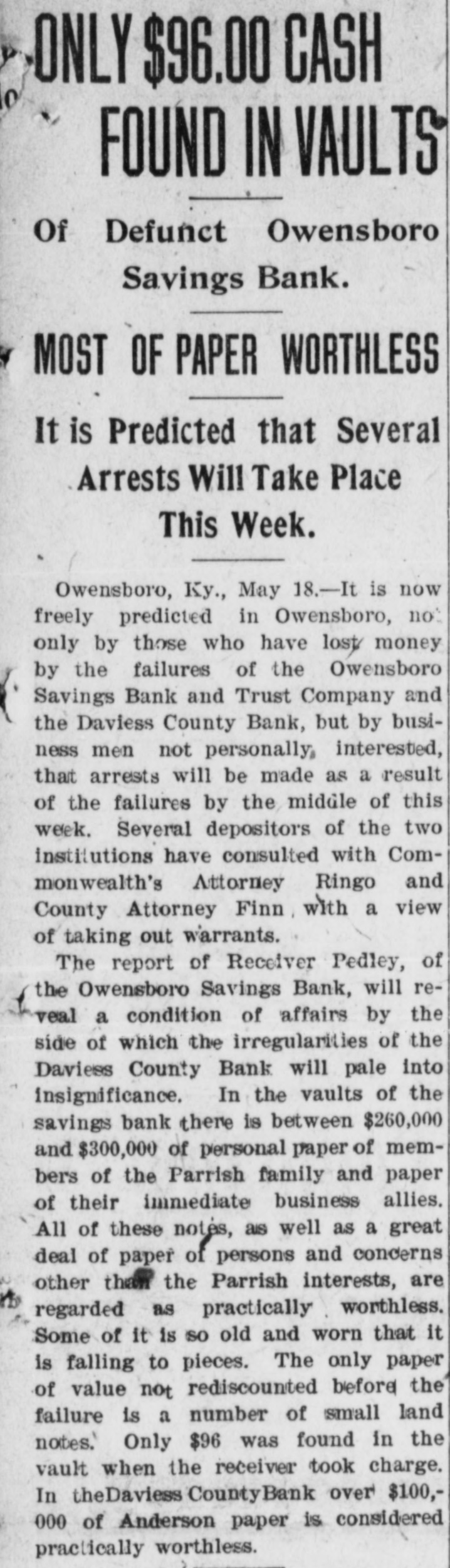
ONLY $96.00 CASH FOUND IN VAULTS Of Defunct Owensboro Savings Bank. MOST OF PAPER WORTHLESS It is Predicted that Several Arrests Will Take Place This Week. Owensboro, Ky., May 18.-It is now freely predicted in Owensboro, not only by those who have lost money by the failures of the Owensboro Savings Bank and Trust Company and the Daviess County Bank, but by business men not personally® interested, that arrests will be made as a result of the failures by the middle of this week. Several depositors of the two institutions have consulted with Commonwealth's Attorney Ringo and County Attorney Finn with a view of taking out warrants. The report of Receiver Pedley, of the Owensboro Savings Bank, will reveal a condition of affairs by the side of which the irregularities of the Daviess County Bank will pale into insignificance. In the vaults of the savings bank there is between $260,000 and $300,000 of personal paper of members of the Parrish family and paper of their immediate business allies. All of these notes, ais well as a great deal of paper of persons and concerns other that the Parrish interests, are regarded as practically worthless. Some of it is so old and worn that it is falling to pieces. The only paper of value not rediscounted before the failure is a number of small land notes. Only $96 was found in the vault when the receiver took charge. In theDaviess County Bank over $100,000 of Anderson paper is considered practically worthless.
19.May 22, 1908Dakota Farmers' LeaderCanton, SD
Click image to open full size in new tab
Article Text
The Owensboro Savings Bank and Trust Company and the Daviess County Bank and Trust Company, both of Owensboro, Ky., are declining to receive deposits and have suspended cash payments pending a proposed reorganization of both institut one,
20.May 22, 1908The Hartford RepublicanHartford, KY
Click image to open full size in new tab
Article Text
It CRIMINAL PROSEn is CUTION BEGUN. g S Parrish and Anderson Arrese ted at Owensboro. d a Revelations of Receivers Cause d S Issue of Warrants and are Held under $15,000 Bonds. 11 d Owensboro, Ky., May' 18.-James H. Parrish. president of the Owensboro Saving Bank and Trust Company and T.S. Anderson. president of the Daviess County Bank and Trust Company, were both arrested yesterday as a result of the disclosures following the recent failures of the two institutions. Both men waived examination and were held under bonds of $15,000 each to await the action of the grand jury. Thirty-one years ago James H. Parrish began work as a clerk in the bank owned at that time by T. S. Anderson. He learned the banking business from Mr. Anderson. His advancement was rapid. In 1884 he purchased the bank from Mr. Anderson. The latter moved to Detroit, Mich., and opened a bank. The rise of James H. Parrish in the financial world was phenominal. A few months ago his bank had a capital stock of $200,000 and deposits of over $1,000,000. Mr. Anderson quit the banking business in Detroit a few years ago and returned to Owensboro and opened another bank. He. too, a few weeks ago, had deposits of $640,000. To-night, James H. Parrish,president and largest stockholder of the Owensboro Savings Bank and Trust Company, and T. S. Anderson,president of the Daviess County Bank and Trust Company, the teacher and the pupil, are both under bond of $15,000 to appear before the August Daviess county grand jury. Anderson was arrested on two warrants. One charges him with fraudulently converting to his own use $20,000 of the funds of the bank. The other warrant charges him with receiving deposits when he knew his bank to be insolvent. Párrish was also arrested on two warrants, both charging him with receiving deposits when he knew his bank to be insolvent. The arrest of Parrish and Anderson did not come as a surprise to the citizens of Owensboro. However, it created one of the most profound sensations in the history of the county. On April 24, a motion was made for a receiver for the savings bank. T. A.
21.May 26, 1908Wausau PilotWausau, WI
Click image to open full size in new tab
Article Text
The Owensboro Savings Bank and Trist Company and the Daviess County Bank and Trust Company, both of Owensbore. Ky., are declining to receive deposits and have suspended cash payments pending a proposed reorganization of both institutions.
22.July 15, 1909The Paducah Evening SunPaducah, KY
Click image to open full size in new tab
Article Text
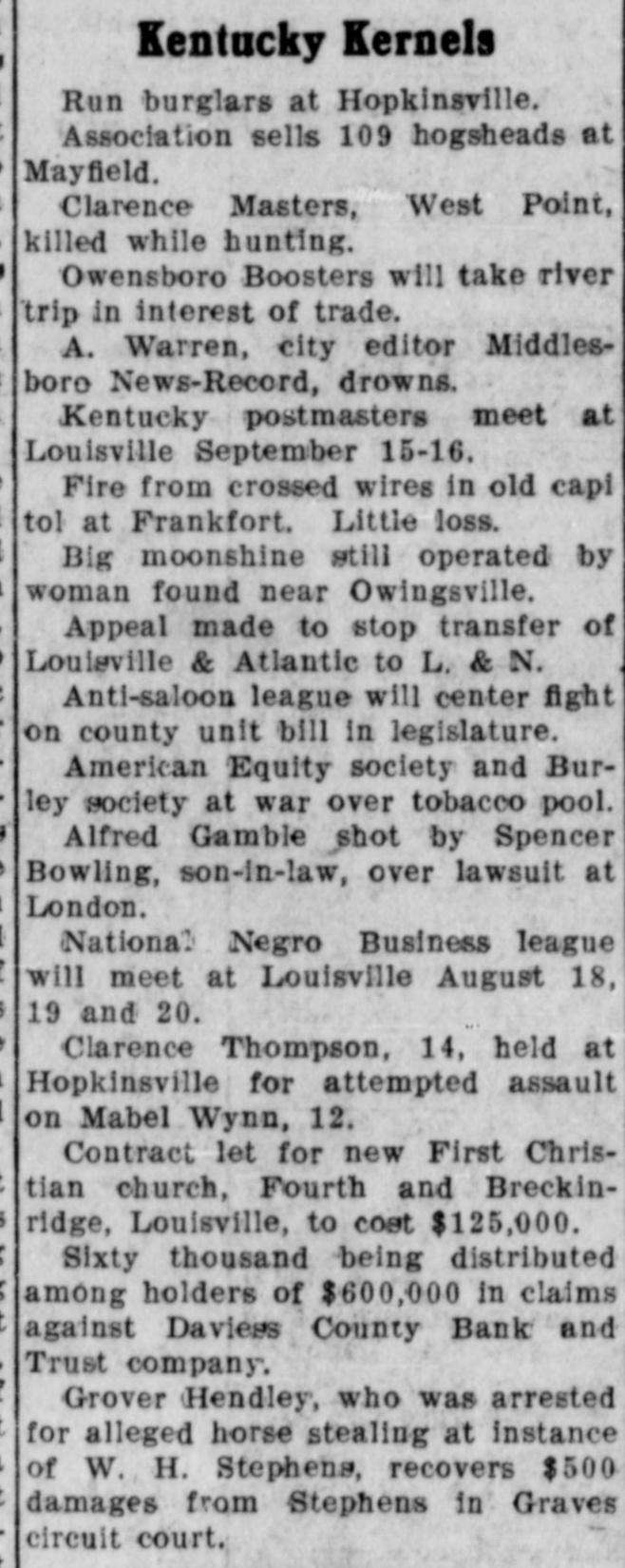
Kentucky Kernels Run burglars at Hopkinsville. Association sells 109 hogsheads at Mayfield. Clarence Masters, West Point, killed while hunting. Owensboro Boosters will take river trip in interest of trade. A. Warren, city editor Middlesboro News-Record, drowns. Kentucky postmasters meet at Louisville September 15-16. Fire from crossed wires in old capi tol at Frankfort. Little loss. Big moonshine still operated by woman found near Owingsville. Appeal made to stop transfer of Louisville & Atlantic to L. & N. Anti-saloon league will center fight on county unit bill in legislature. American Equity society and Burley society at war over tobacco pool. Alfred Gamble shot by Spencer Bowling, son-in-law, over lawsuit at London. National Negro Business league will meet at Louisville August 18, 19 and 20. Clarence Thompson, 14, held at Hopkinsville for attempted assault on Mabel Wynn, 12. Contract let for new First Christian church, Fourth and Breckinridge, Louisville, to cost $125,000. Sixty thousand being distributed among holders of $600,000 in claims against Daviess County Bank and Trust company. Grover Hendley, who was arrested for alleged horse stealing at instance of W. H. Stephens, recovers $500 damages from Stephens in Graves circuit court.