Article Text
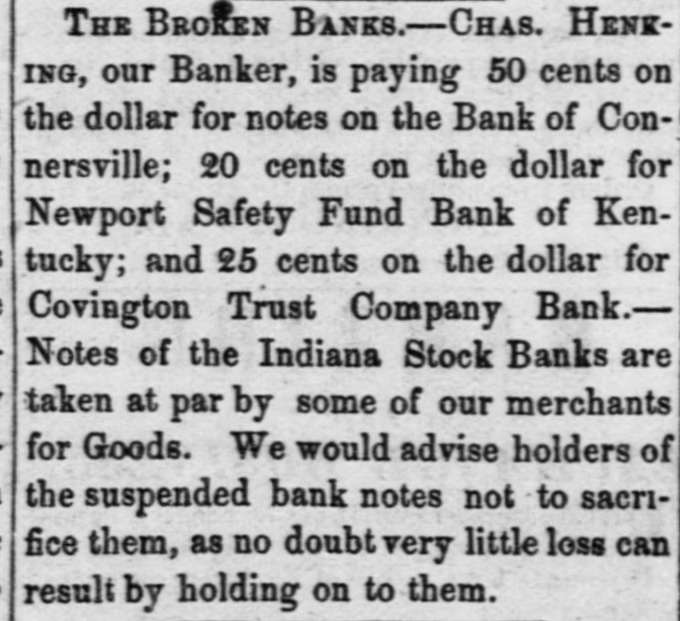
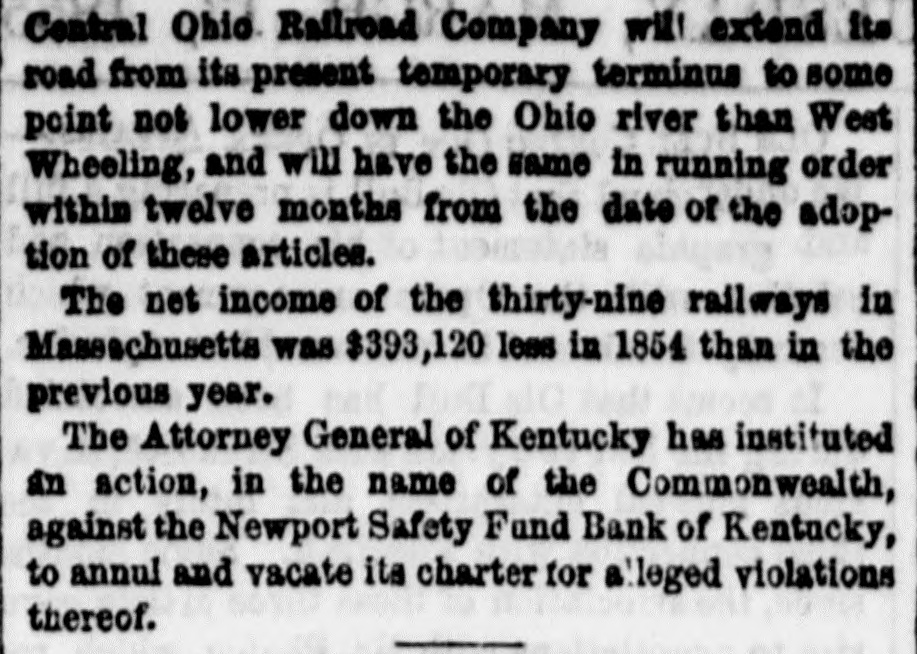
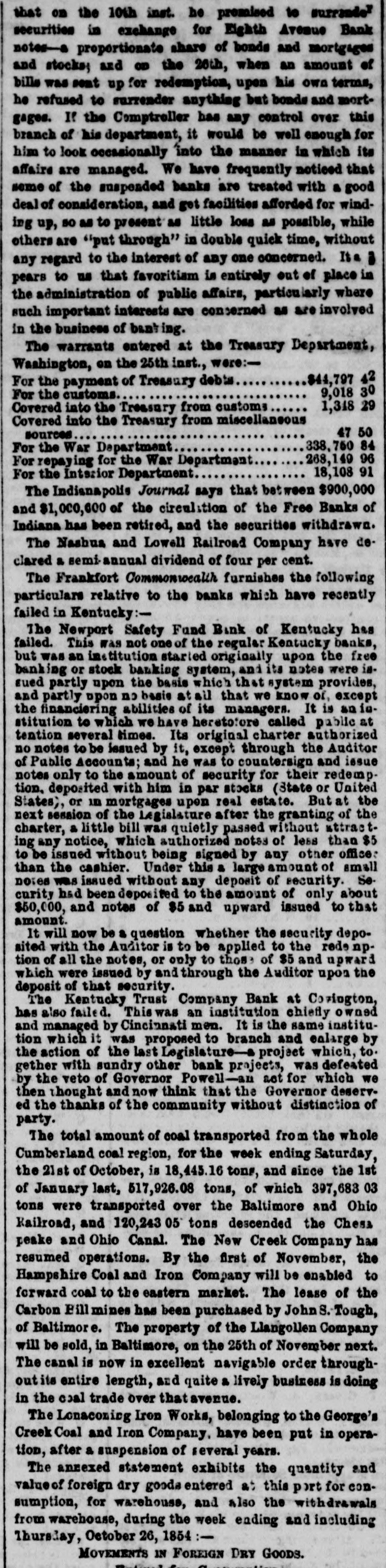
that on the 10th inst. he premised to surrande" securities in exchange for Eighth Avenue Bank notes-a proportionate share of bonds and mortgages and stocks; and OD the 26th, when an amount of bills was sent up for redemption, upon his own terms, he refused to surrender anything but bonds and mortgages. If the Comptroller has any control over this branch of his department, it would be well enough for him to look occasionally into the manner in which its affairs are managed. We have frequently noticed that some of the suspended banks are treated with a good deal of consideration, and get facilities afforded for winding up, so as to present as little loss as possible, while others are "put through" in double quick time, without any regard to the interest of any one concerned. It a B pears to us that favoritism is entirely out of place in the administration of public affairs, particularly where such important interests are concerned as are involved in the business of banking. The warrants entered at the Treasury Department, Washington, on the 25th inst., were:$44,797 42 For the payment of Treasury debts 9,018 30 For the customs 1,318 29 Covered into the Treasury from customs Covered into the Treasury from miscellaneous 47 50 sources 338,750 84 For the War Department 268,149 96 For repaying for the War Department 18,108 91 For the Interior Department The Indianapolis Journal says that between $900,000 and $1,000,000 of the circulation of the Free Banks of Indiana has been retired, and the securities withdrawn. The Nashua and Lowell Railroad Company have declared a semi-annual dividend of four per cent. The Frankfort Commonwealth furnishes the following particulars relative to the banks which have recently failed in Kentucky:The Newport Safety Fund Bank of Kentucky has failed. This was not one of the regular Kentucky banks, but was an institution started originally upon the free banking or stock banking system, and its notes were issued partly upon the basis which that system provides, and partly upon no basis at all that we know of, except the financiering abilities of its managers. It is an isstitution to which we have hereto:ore called public at tention several times. Its original charter authorized no notes to be issued by it, except through the Auditor of Public Accounts; and he was to countersign and issue notes only to the amount of security for their redemption, deposited with him in par stocks (State or United States), or in mortgages upon real estate. But at the next session of the Legislature after the granting of the charter, a little bill was quietly passed without uttrac ing any notice, which authorized notss of less than $5 to be issued without being signed by any other office: than the cashier. Under this a large amount of small notes was issued without any deposit of security. Security had been deposited to the amount of only about $50,000, and notes of $5 and upward issued to that amount. It will now be a question whether the security deposited with the Auditor is to be applied to the rede nption of all the notes, or only to those of $5 and upward which were issued by and through the Auditor upon the deposit of that security. The Kentucky Trust Company Bank at Covington, has also failed. This was an institution chiefly owned and managed by Cincinnati men. It is the same institution which it was proposed to branch and enlarge by the action of the last Legislature-s project which, to. gether with sundry other bank projects, was defeated by the veto of Governor Powell-an act for which we then thought and now think that the Governor deserved the thanks of the community without distinction of party. The total amount of coal transported from the whole Cumberland coal region, for the week ending Saturday, the 21st of October, is 18,445.16 tons, and since the 1st of January last, 517,926.08 tons, of which 397,683 03 tons were transported over the Baltimore and Ohio Railroad, and 120,243 05 tons descended the Chesa peake and Ohio Canal. The New Creek Company has resumed operations. By the first of November, the Hampshire Coal and Iron Company will be enabled to forward coal to the eastern market. The lease of the Carbon Pill mines has been purchased by John Tough, of Baltimore. The property of the Llangollen Company will be sold, in Baltimore, on the 25th of November next. The canal is now in excellent navigable order throughout its entire length, and quite a lively business is doing in the coal trade over that avenue. The Lonacoxing Iron Works, belonging to the George's Creek Coal and Iron Company. have been put in operation, after a suspension of several years. The annexed statement exhibits the quantity and value of foreign dry goods entered at this port for consumption, for warehouse, and also the withdrawals from warehouse, during the week ending and including Thursday, October 26, 1854 :MOVEMENTS IN FOREIGN DRY GOODS.