6537. First National Bank (Newport, KY)

Bank Information

Episode Type
Run β†’ Suspension β†’ Closure
Bank Type
national
Bank ID
2276
Charter Number
2276
Start Date
January 18, 1897
Location
Newport, Kentucky (39.091, -84.496)

Metadata

Model
gpt-5-mini
Short Digest
6e005b55cadffb27

Response Measures

Borrowed from banks or large institutions, Public signal of financial health, Capital injected, Full suspension, Books examined

Receivership Details

Depositor recovery rate
87.5%
Date receivership started
1897-01-21
Date receivership terminated
1909-09-30
OCC cause of failure
Fraud
Share of assets assessed as good
25.2%
Share of assets assessed as doubtful
42.4%
Share of assets assessed as worthless
32.4%

Description

The First National Bank of Newport (KY) failed to open on Jan 18, 1897 amid heavy withdrawals and depositor clamoring. The bank was effectively suspended/closed by the national bank examiner and the Comptroller appointed a receiver (George P. Wilshire). Later investigations revealed large misappropriation by cashier T. B. (or T.) Youtsey, supporting that the cause was adverse bank-specific information/insolvency. Receiver later paid depositors in full after directors raised funds; but the bank was put into receivership and taken out of operating control.

Events (7)

1. June 15, 1875 Chartered
Source
historical_nic
2. January 18, 1897 Run
Cause
Bank Specific Adverse Info
Cause Details
Bank officers said solvent but lacked ready cash; earlier refusal to pay a $5,000 withdrawal and reported shortages; later shown to be misappropriation by cashier Youtsey.
Measures
Directors attempted to secure loans and to underwrite liabilities (directors agreed to give personal endorsements); officers issued statements claiming solvency; banks in Covington offered a loan of $60,000 (later rejected).
Newspaper Excerpt
The First National Bank, of Newport, Ky., did not open its doors this morning ... there was a crowd of excited depositors assembled in front of the bank clamoring for an explanation.
Source
newspapers
3. January 19, 1897 Suspension
Cause
Government Action
Cause Details
Bank closed for want of available funds and was subsequently taken into charge by the national bank examiner/Comptroller (examiner Tucker; Comptroller Eckels appointed receiver).
Newspaper Excerpt
The First National Bank, which closed its doors yesterday, received deposits up to the closing hour Saturday... The comptroller of the currency received a telegram stating that the First National bank of Newport, Ky., has suspended.
Source
newspapers
4. January 21, 1897 Receivership
Source
historical_nic
5. January 21, 1897 Receivership
Newspaper Excerpt
George P. Wilshire has been appointed receiver of the First National Bank of Newport, Ky., which failed a few days ago. Receiver Wilshire, appointed by Comptroller Eckels, is still in charge.
Source
newspapers
6. April 1, 1897 Other
Newspaper Excerpt
Receiver Wilshire ... has announced that on next Thursday, April 1 he will pay all depositors in full, the directors having raised the necessary $200,000.
Source
newspapers
7. May 14, 1897 Other
Newspaper Excerpt
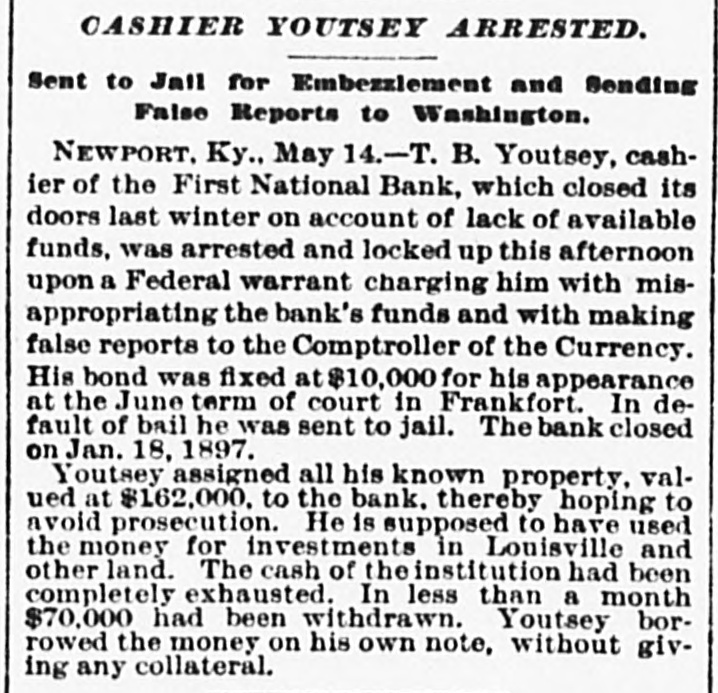
T. B. Youtsey, cashier of the First National Bank ... was arrested ... charging him with a misappropriation of the bank's funds and making false reports to the Comptroller of the Currency.
Source
newspapers

Newspaper Articles (23)

Article from Morning Appeal, January 19, 1897

Click image to open full size in new tab

Article Text

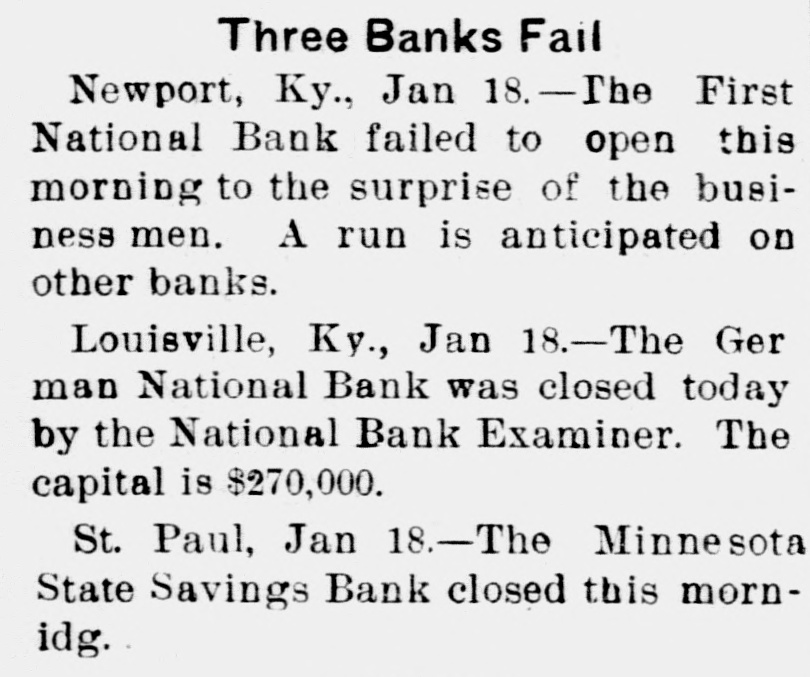
Three Banks Fail Newport, Ky., Jan 18.-The First National Bank failed to open this morning to the surprise of the business men. A run is anticipated on other banks. Louisville, Ky., Jan 18.-The Ger man National Bank was closed today by the National Bank Examiner. The capital is $270,000. St. Paul, Jan 18.-The Minnesota State Savings Bank closed this mornidg.


Article from The Roanoke Daily Times, January 19, 1897

Click image to open full size in new tab

Article Text

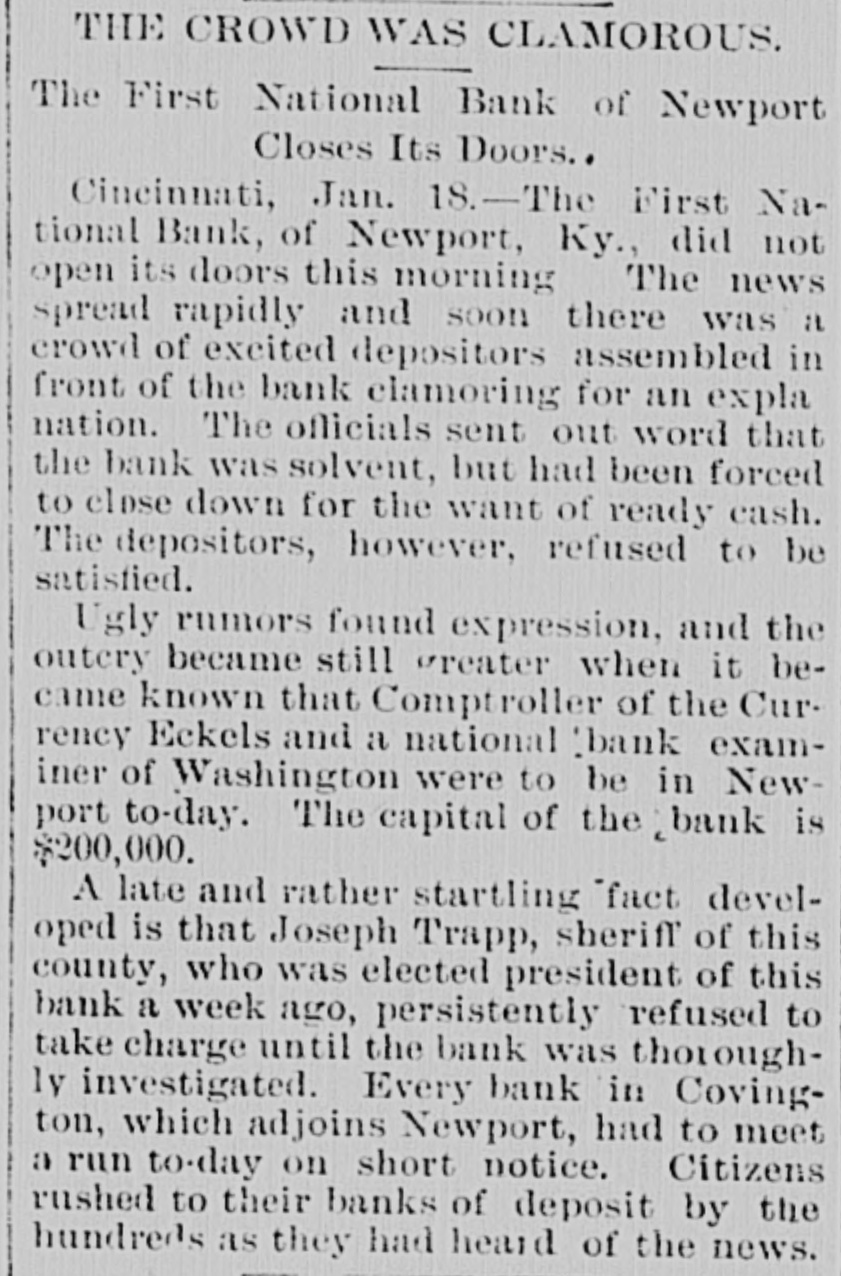
THE CROWD WAS CLAMOROUS. The First National Bank of Newport Closes Its Doors., Cincinnati, Jan. 18.-The First National Bank, of Newport, Ky., did not open its doors this morning The news spread rapidly and soon there was it crowd of excited depositors assembled in front of the bank elamoring for an expla nation. The officials sent out word that the bank was solvent, but had been forced to close down for the want of ready cash. The depositors, however, refused to be satisfied. Ugly rumors found expression, and the outery became still greater when it became known that Comptroller of the Currency Eckels and a national "bank examiner of Washington were to be in Newport to-day. The capital of the bank is $200,000. A late and rather startling fact developed is that Joseph Trapp, sheriff of this county, who was elected president of this bank a week ago, persistently refused to take charge until the bank was thoroughly investigated. Every bank in Covington, which adjoins Newport, had to meet a run to-day on short notice. Citizens rushed to their banks of deposit by the hundreds as they had heard of the news.


Article from The Houston Daily Post, January 19, 1897

Click image to open full size in new tab

Article Text

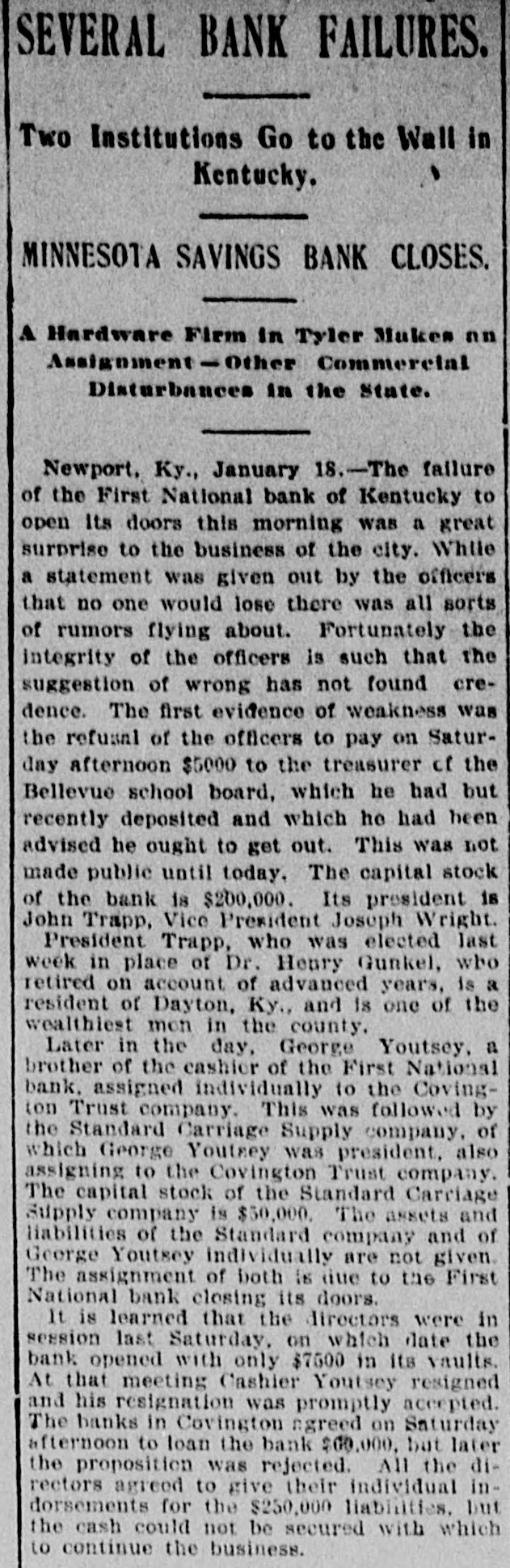
SEVERAL BANK FAILURES. Two Institutions Go to the Wall in Kentucky. MINNESOTA SAVINGS BANK CLOSES. A Hardware Firm in Tyler Makes nn Assignment Other Commercial Disturbances in the State. Newport, Ky., January 18.-The failure of the First National bank of Kentucky to open Its doors this morning was a great surprise to the business of the city. While a statement was given out by the officers that no one would lose there was all sorts of rumors flying about. Fortunately the integrity of the officers is such that the suggestion of wrong has not found credence. The first evidence of weakness was the refusal of the officers to pay on Saturday afternoon $5000 to the treasurer of the Bellevue school board, which he had but recently deposited and which he had been advised he ought to get out. This was not made public until today. The capital stock of the bank is $200,000. Its president is John Trapp, Vice President Joseph Wright. President Trapp, who was elected last week in place of Dr. Henry Gunkel, who retired on account of advanced years, is a resident of Dayton, Ky,, and is one of the wealthiest mon in the county. Later in the day, George Youtsey, a brother of the cashier of the First National bank. assigned individually to the Covington Trust company. This was followed by the Standard Carriage Supply company, of which George Youtsey was president, also assigning to the Covington Trust company. The capital stock of the Standard Carriage Supply company is $50,000. The assets and liabilities of the Standard company and of George Youtsey individually are not given. The assignment of both is due to the First National bank closing its doors. It is learned that the directors were in session last Saturday, on which date the bank opened with only $7600 in its vaults. At that meeting Cashier Youtsey resigned and his resignation was promptly accepted. The banks in Covington agreed on Saturday afternoon to loan the bank $60,000, but later the proposition was rejected. All the directors agreed to give their individual indorsements for the $250,000 liabilities, but the cash could not be secured with which to continue the business.


Article from The Record-Union, January 20, 1897

Click image to open full size in new tab

Article Text

NEWPORT BANK. Accepted Deposits Up to the Close of Business Saturday. NEWPORT (Ky.). Jan. 19.-The First National Bank, which closed its doors yesterday, received deposits up to the closing hour Saturday. Doubt was freely expressed on Friday whether the bank would open Saturday. Bank Inspector Tucker, who is in charge of the bank, says that if it can be proved that the bank was insolvent, and that its officials knew it, then the acceptance of the deposits was a violation of the law. Comptroller Eckels says that Bank Examiner Tucker criticised the management of the bank in his October report, and that the Directors were promptly notified on the subject. Another failure to-day resulted from the closing of the bank. J. H. & L. H. Shaffer & Co. assigned as commission merchants. Liabilities and assets not large. The other Newport banks were not subjected to runs to-day, and had they been would have easily met every demand on them.


Article from The Morning News, January 20, 1897

Click image to open full size in new tab

Article Text

FOLLOWING THE BANK FAILURE. A Cincinnati House Closed on Account of the Newport Bank. Cincinnati, O., Jan. 19.-J. H. & Leonard Shaffer & Co., commission merchants, assigned to-day as a result of the First National Bank of Newport failure yesterday. The liabilities and assets are not large. The other Newport banks were not subjected to runs to-day, but had they been, would have easily met every demand on them.


Article from The Salt Lake Herald, January 20, 1897

Click image to open full size in new tab

Article Text

NEWPORT BANK FAILURE, Officers Accepted Deposits Up to the + Closing Hour. Newport, Ky., Jan. 19.-The First National bank which closed its doors yesterday accepted deposits up to the closing hour Saturday. Doubt was freely expressed Friday whether the bank would open Saturday. Bank Inspector Tucker, who is in charge of the bank, says that if it can be proved that the bank was insolvent, and that its officers knew it, then the acceptance of the deposits was a violation of the law. Comptroller Eckels says that Bank Examiner Tucker criticised the management of the bank in his October report, and that the directors were promptly notified on the subject. Another failure today resulted from the closing of the bank. J. H. and Leonard H. Shafer & Co., assigned as commission merchants. Liabilities and assets not large. The other Newport banks were not subjected to runs today and had they been would have easily met every demand on them.


Article from Jamestown Weekly Alert, January 21, 1897

Click image to open full size in new tab

Article Text

WASHINGTON. Jan. 19.-The comptroller of the currency received a tele. gram stating that the Firat National bank of Newport, Ky., has supended. The bank had a capital of $200,000 and da Dec. 17, the date of its last report, it had a surplus and undivided protite amounting to $79,453, owed depocitors $419,805, owed other banks about $26,000. Later in the day George Youtsey, brother of the cashier of the First National, assigned individually to the Covington Trust company. This was followed by the Standard Carriage Supply company, in which Geo. Youtsey was president, also assigning to the Covington Trust company.


Article from The Butler Weekly Times, January 21, 1897

Click image to open full size in new tab

Article Text

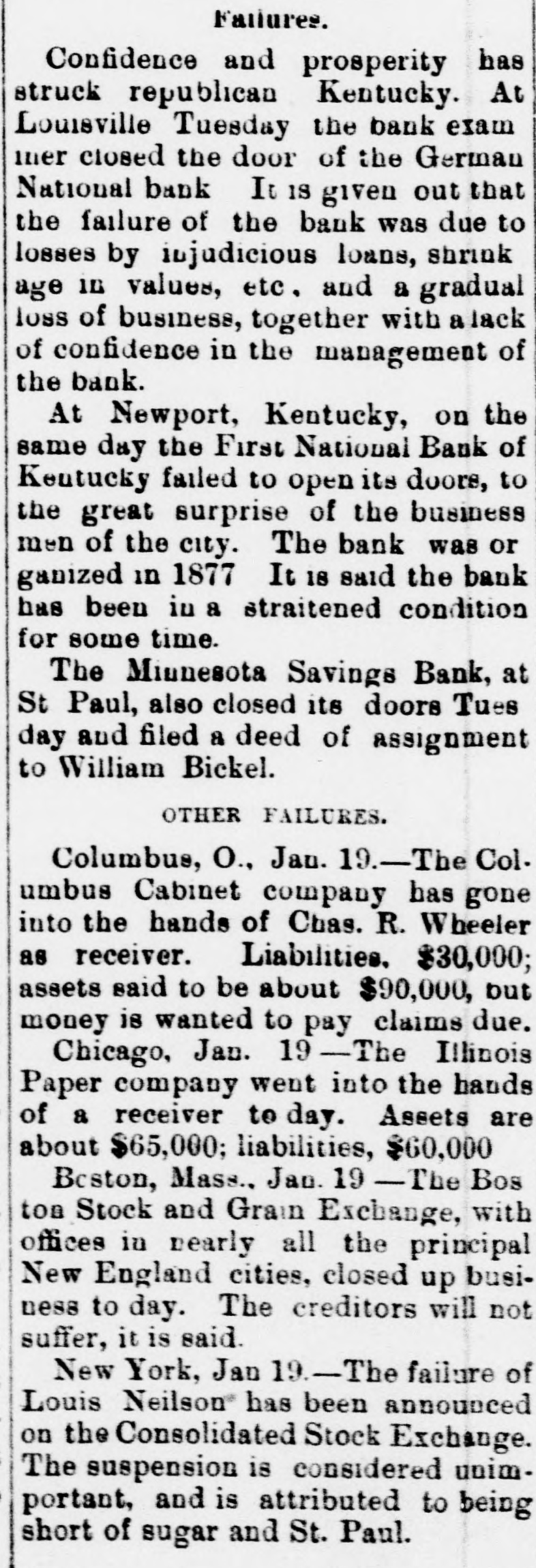
Fatiures. Confidence and prosperity has struck republican Kentucky. At Louisville Tuesday the bank exam mer closed the door of the German National bank It IS given out that the failure of the bank was due to losses by injudicious loans, shrink age in values, etc. and a gradual loss of business, together with a lack of confidence in the management of the bank. At Newport, Kentucky, on the same day the First National Bank of Keutucky failed to open its doore, to the great surprise of the business men of the city. The bank was or ganized in 1877 It 18 said the bank has been in a straitened condition for some time. The Miunesota Savings Bank, at St Paul, also closed its doors Tues day and filed a deed of assignment to William Bickel. OTHER FAILURES. Columbus, O., Jan. 19.-The Col. umbus Cabinet company has gone into the hands of Cbas. R. Wheeler as receiver. Liabilities. $30,000; assets said to be about $90,000, but money is wanted to pay claims due. Chicago, Jan. 19-The Illinois Paper company went into the hands of a receiver to day. Assets are about $65,000; liabilities, $60,000 Boston, Mass., Jan. 19 -The Bos ton Stock and Grain Exchange, with offices in nearly all the principal New England cities, closed up business to day. The creditors will not suffer, it is said. New York, Jan - -The failure of Louis Neilson has been announced on the Consolidated Stock Exchange. The suspension is considered unimportant, and is attributed to being short of sugar and St. Paul.


Article from The Houston Daily Post, January 22, 1897

Click image to open full size in new tab

Article Text

Appointed Receiver. Washington, January 21.-George P. WIIshire has been appointed receiver of the First National bank of Newport, Ky., which failed a few days ago.


Article from Perrysburg Journal, January 23, 1897

Click image to open full size in new tab

Article Text

BANK DOORS CLOSED. utions at Newport and Louisville y., and St. Paul, Minn., Suspend. wport, Ky., Jan. 19.-The First nal bank of Newport has closed ors. The bank will be reorganized. deposits are about $370,000 and deors will be paid in full. Director les Spinks says the bank closed be, of the recklessness of Cashier sey and Director McCracken. ate and rather startling developis that Mr. John Trapp, ex-sherthe county, who was elected presof the bank a week ago to succeed unkel, who precipitately resigned. ed to accept the office unless the 's affairs were thoroughly investi1. It seems that C. W. Nagel, who elected to succeed Youtsey er, had made sufficient investigahimself to warrant him in warnis friend Trapp that all was not should be. Therefore the bank been week. without a president for nearery bank in Covington had to meet 1 Monday as best it could on short e. Citizens rushed to their places eposit by the hundreds as soon as heard the news that the First na1 had not opened its doors in the ing and drew their savings. Many y depositors were among these. uisville, Ky., Jan. 19.-The German nal bank at First and Market ts did not open its doors for busiand the announcement was made the institution was in the hands of < Examiner James Escott. The tal stock is $251,500, with a surplus 1,000. J.M. McKnight is president. e bank has been in a shaky condifor three years owing to the failof the Louisville deposit bank, by h it lost $75,000 and there are also een $250,000 and $300,000 worth of suits pending, growing out of the 's connection with the failure. e the first of the year $75,000 in ts have been withdrawn and several ago Bank Examiner Escott began nvestigation. Saturday he wired esult to the comptroller of the y and the order came for the bank e closed at once. e bank's last statement, made Deer 17, showed loans of $442,832.62 deposits of $380,375.23. The e was 8 per cent. below the 25 - One suspicious item was ties, stocks, etc.," $113,025.29. The "causing much comment. President night says depositors will be paid ill. The bank bas on hand $60.000 ish. The deposits subject to check about $205,000. There are also ficates of deposits for $60,000. Mr night hopes to have the bank nized and ready for business in ** onday night the directors decided nize the Southern national bank the business of the German al, and the comptroller of the y was telegraphed for the neces


Article from The Ely Miner, January 27, 1897

Click image to open full size in new tab

Article Text

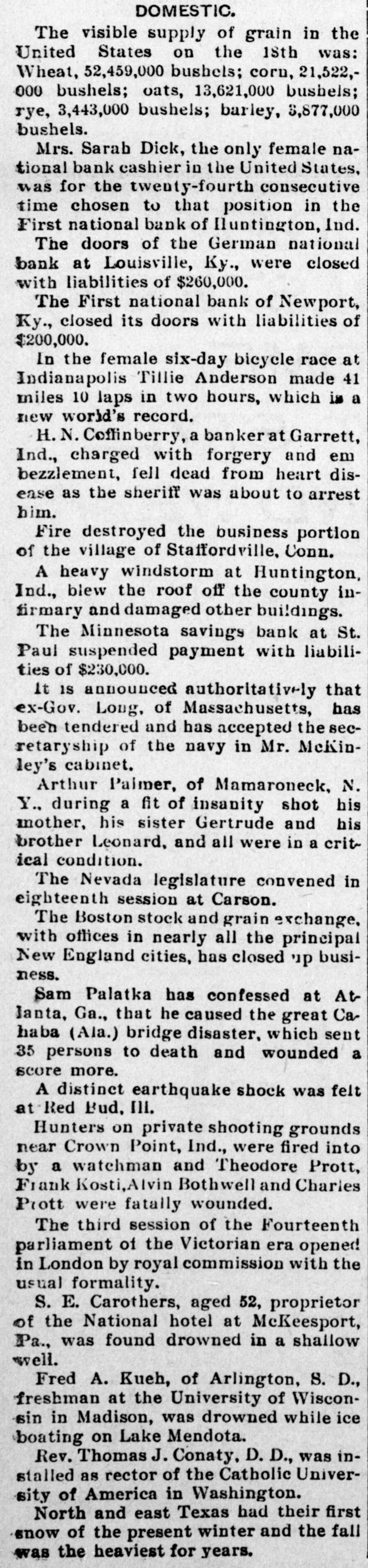
DOMESTIC. The visible supply of grain in the United States on the 18th was: Wheat, 52,459,000 bushels; corn, 21,522,000 bushels; oats, 13,621,000 busbels; rye, 3,443,000 bushels; barley, 3,877,000 bushels. Mrs. Sarab Dick, the only female national bank cashier in the United States, was for the twenty-fourth consecutive time chosen to that position in the First national bank of Iluntington, Ind. The doors of the German national bank at Louisville, Ky., were closed with liabilities of $260,000. The First national bank of Newport, Ky., closed its doors with liabilities of $200,000. In the female six-day bicycle race at Indianapolis Tillie Anderson made 41 miles 10 laps in two hours, which is a new world's record. H. N. Coffinberry, a banker at Garrett, Ind., charged with forgery and em bezzlement, fell dead from heart disease as the sheriff was about to arrest him. Fire destroyed the business portion of the village of Staffordville, Conn. A heavy windstorm at Huntington, Ind., blew the roof off the county infirmary and damaged other buildings. The Minnesota savings bank at St. Paul suspended payment with liabilities of $230,000. It is announced authoritatively that ex-Gov. Long, of Massachusetts, has been tendered and has accepted the secretaryship of the navy in Mr. McKinley's cabinet. Arthur Palmer, of Mamaroneck, N. Y., during a fit of insanity shot his mother, his sister Gertrude and his brother Leonard, and all were in a critical condition. The Nevada legislature convened in eighteenth session at Carson. The Boston stock and grain exchange, with offices in nearly all the principal New England cities, has closed up business. Sam Palatka has confessed at AtJanta, Ga., that he caused the great Cahaba (Ala.) bridge disaster, which sent 35 persons to death and wounded a score more. A distinct earthquake shock was felt at Red Bud, III. Hunters on private shooting grounds near Crown Point, Ind., were fired into by a watchman and Theodore Prott, Frank Kosti,Alvin Bothwell and Charles Prott were fatally wounded. The third session of the Fourteenth parliament of the Victorian era opened in London by royal commission with the usual formality. S. E. Carothers, aged 52, proprietor of the National hotel at McKeesport, Pa., was found drowned in a shallow well. Fred A. Kueh, of Arlington, S. D., freshman at the University of Wisconsin in Madison, was drowned while ice boating on Lake Mendota. Rev. Thomas J. Conaty, D. D., was installed as rector of the Catholic University of America in Washington. North and east Texas had their first snow of the present winter and the fall was the heaviest for years.
Article from Reporter and Farmer, January 28, 1897

Click image to open full size in new tab

Article Text

People in Print. Joel T. Headley, the well known historian, died at Newburgh, N. Y., of paralysis. United States Senator Edward O. Wolcott is the guest of Baron Rothschild at his country seat. Edward W. Emerson of Concord, son of Ralph Waldo Emerson, has been chosen as poet for Phi Beta Kappa day at Harvard, next June. Ex-Empress Frederick received Mrs. Uhl, wife of the United States ambassador to Germany, in audience at Berlin. George P. Wilshire has been appointed receiver of the First National Bank of Newport, Ky., which failed a few days ago. Jerome R. Bingham, a prominent member of the Milwaukee bar, died very suddenly after returning to his home from a short walk. He was 71 years of age. Louis Centencin, chevalier of the crown of Italy, formerly president of the Italian chamber of commerce in New York, and formerly Italy's consul general to the two Sicilles, died at New York. Charles D. Owens, vice president and general manager of the Atlantic & Danville railway, was found dead in the bath room at his residence at Norfolk, Va. Heart disease was the cause. He was sixty-three years of age.


Article from The Stark County Democrat, January 28, 1897

Click image to open full size in new tab

Article Text

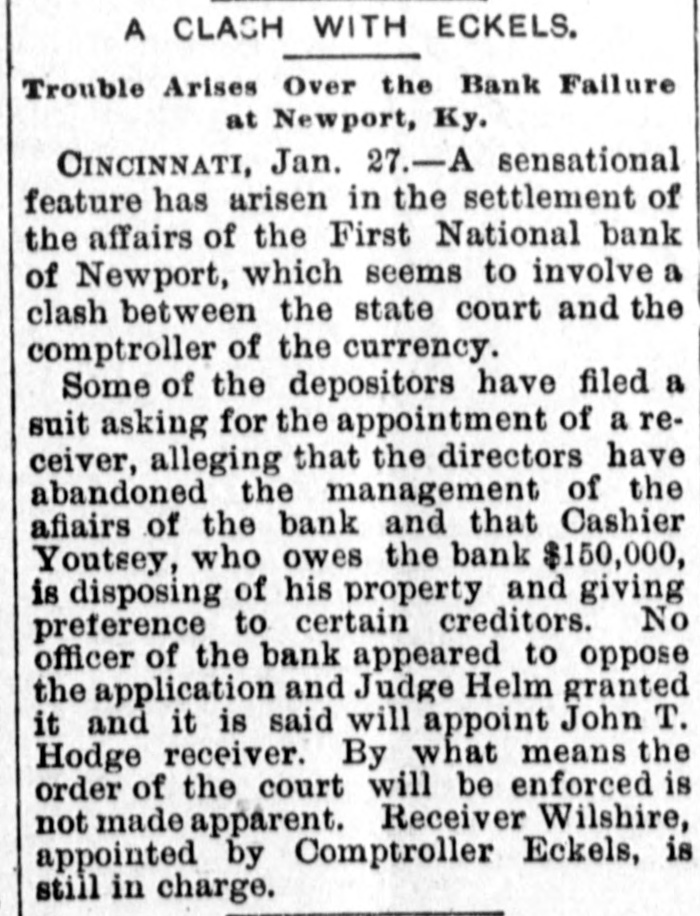
A CLASH WITH ECKELS. Trouble Arises Over the Bank Failure at Newport, Ky. CINCINNATI, Jan. 27.-A sensational feature has arisen in the settlement of the affairs of the First National bank of Newport, which seems to involve a clash between the state court and the comptroller of the currency. Some of the depositors have filed a suit asking for the appointment of a receiver, alleging that the directors have abandoned the management of the afiairs of the bank and that Cashier Youtsey, who owes the bank $150,000, is disposing of his property and giving preference to certain creditors. No officer of the bank appeared to oppose the application and Judge Helm granted it and it is said will appoint John T. Hodge receiver. By what means the order of the court will be enforced is not made apparent. Receiver Wilshire, appointed by Comptroller Eckels, is still in charge.


Article from The Indianapolis Journal, February 1, 1897

Click image to open full size in new tab

Article Text

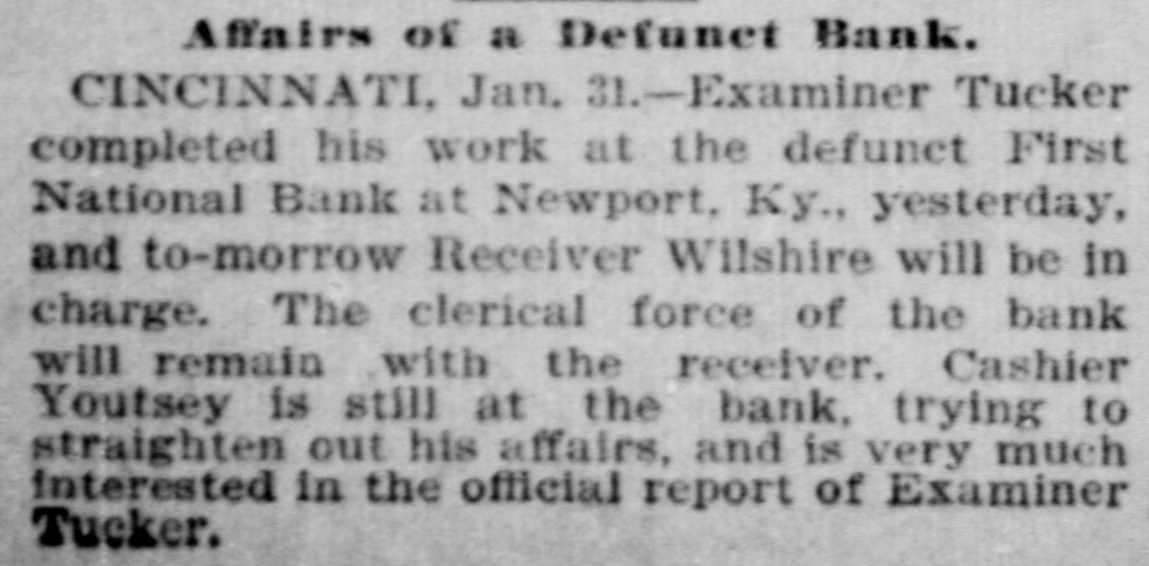
Affairs of a Defunet Bank. CINCINNATI, Jan. 31.-Examiner Tucker completed his work at the defunet First National Bank at Newport, Ky., yesterday, and to-morrow Receiver Wilshire will be in charge. The clerical force of the bank will remain with the receiver. Cashier Youtsey is still at the bank, trying to straighten out his affairs, and is very much interested in the official report of Examiner Tucker.


Article from The Houston Daily Post, February 1, 1897

Click image to open full size in new tab

Article Text

Receiver to Take Charge. Cincinnati, Ohio, January 31.--Examiner Tucker completed his work at the defunct First National bank in Newport, Ky., yesterday, and tomorrow Receiver Wilshire will be in charge. The clerical force of the bank will remain with the receiver. Cashier Youtsey is still at the bank trying to straighten out his affairs and is very much Interested in the official report of Examiner Tucker.


Article from The Princeton Union, April 1, 1897

Click image to open full size in new tab

Article Text

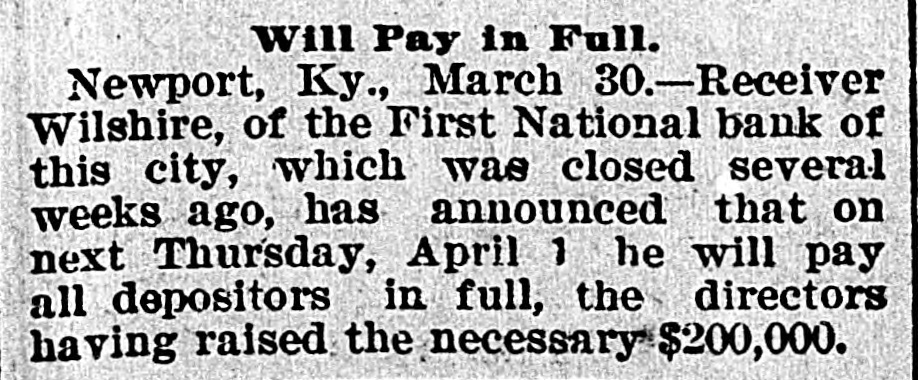
Will Pay in Full. Newport, Ky., March 30.-Receiver Wilshire, of the First National bank of this city, which was closed several weeks ago, has announced that on next Thursday, April 1 he will pay all depositors in full, the directors having raised the necessary $200,000.


Article from The San Francisco Call, May 15, 1897

Click image to open full size in new tab

Article Text

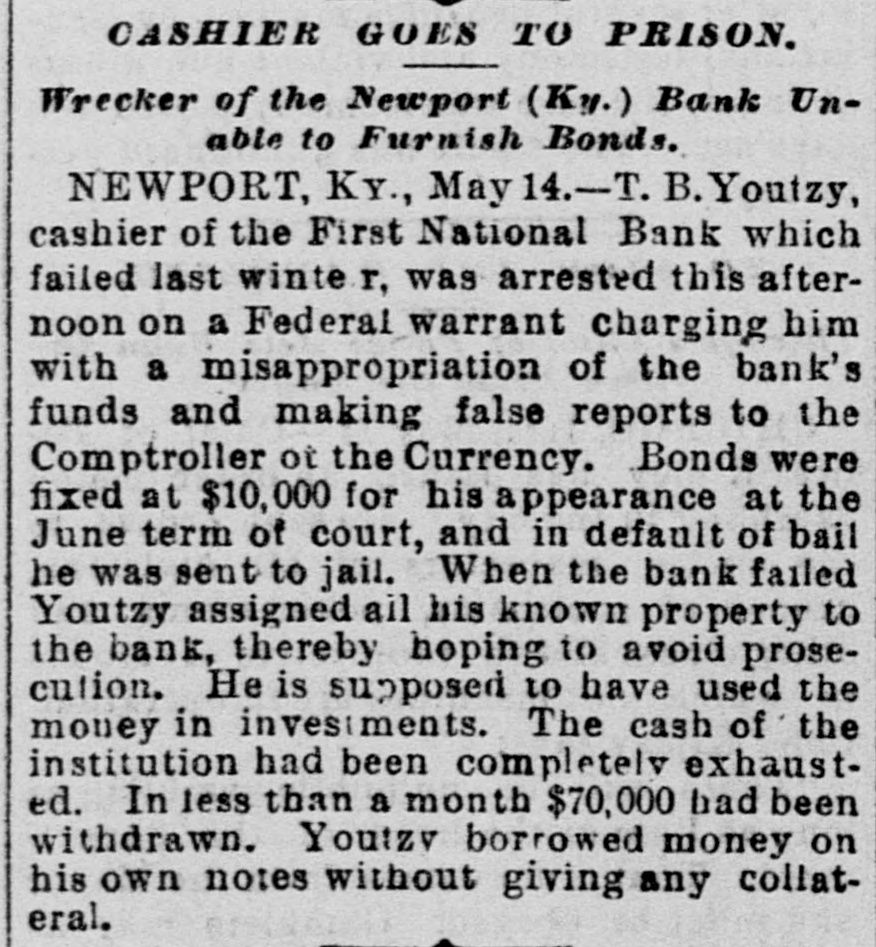
CASHIER GOES TO PRISON. Wrecker of the Newport (Ky.) Bank Unable to Furnish Bonds. NEWPORT, Ky., May 14.-T. B. Youtzy, cashier of the First National Bank which failed last winte r, was arrested this afternoon on a Federal warrant charging him with a misappropriation of the bank's funds and making false reports to the Comptroller ot the Currency. Bonds were fixed at $10,000 for his appearance at the June term of court, and in default of bail he was sent to jail. When the bank failed Youtzy assigned ail his known property to the bank, thereby hoping to avoid prosecution. He is supposed to have used the money in investments. The cash of the institution had been completelv exhausted. In less than a month $70,000 had been withdrawn. Youtzv borrowed money on his own notes without giving any collateral.


Article from The Sun, May 15, 1897

Click image to open full size in new tab

Article Text

CASHIER YOUTSEY ARRESTED. Sent to Jail for Embezziement and Sending False Reports to Washington. NEWPORT. Ky., May 14.-T. B. Youtsey, cashier of the First National Bank, which closed its doors last winter on account of lack of available funds, was arrested and locked up this afternoon upon a Federal warrant charging him with misappropriating the bank's funds and with making false reports to the Comptroller of the Currency. His bond was fixed at $10,000 for his appearance at the June term of court in Frankfort. In default of bail he was sent to jail. The bank closed on Jan. 18, 1897. Youtsey assigned all his known property, valued at $162,000, to the bank. thereby hoping to avoid prosecution. He is supposed to have used the money for investments in Louisville and other land. The cash of theinstitution had been completely exhausted. In less than a month $70,000 had been withdrawn. Youtsey borrowed the money on his own note, without giving any collateral.


Article from The Washburn Leader, October 23, 1897

Click image to open full size in new tab

Article Text

General. Rukeyser & Bash, neckwear, failed for $100,000. Creedon and McCoy are matched for a finish fight between Dec 1 and 30. The firm of Goldberg & Rich of Nashville, has assigned. Liabilities, $76,000; assets believed to be far less. Chief Justice Tait of Montreal and former Chief Justice Hagarty of the Province of Ontario, have been gazetted knights. An epidemic of measles prevails at Webster City, Iowa. The health officer says over seventy cases have SO far been reported. A delegation of Tennessee citizens called on Secretary Long and presented arguments in favor of establishing an armor plant in that state. The European edition of the New York Herald asserts that the Indian government declines to reopen the Indian mints to silver. Maj. Benjamin H. Rogers, Eighth infantry, has been retired and Capt. Casper H. Conrad, Thirteenth in fantry, was promoted to major. The charge of lese majeste brought* against the Frankfurter Zeitung for criticising the alleged erratic course of Emperor William has been dismissed. Marcus Daly denies that he has, with other Anaconda officials, purchased a controlling or any other interest in the Butte & Boston property. At Oakland, Cal., Joe Wheeler made a new world's record for four-year-old pacing geldings by pacing a mile in 2:07 1-2 over a track that was two seconds slow. George P. Lawrence of North Adams, Mass., has been nominated for congressman by the Republicans of the First district to succeed A. B. Wright, deceased. Col. Guy v. Henry, who has been with his old regiment, the Third cavalry, since his promotion, has been ordered to join his new regiment, the Tenth cavalry. E. C. Stanton, former manager of the Metropolitan house, New York, has been declared a bankrupt at London, with liabilities amounting to Β£825 and no assets. Maj. Moses P. Handy has secured 25 per cent additional space for the American exhibits at Paris, making the space of the United States equal to that of other big nations. All but four of the thirty-three sailors on the United States revenue cutter Perry, at Seattle, Wash., quit because of a reduction in wages from $28 to $25 per month. Oscar Gardner knocked out Johnny Van Heest in the eleventh round of what was to be a twenty-round fight at 120 pounds before the Navarre Athletic club at Lexington, Ky. The Farmers' Loan and Trust company has brought suit at New York against the Hudson River Tunnel company to foreclose a first mortgage deed of trust amounting to $2,750,000. Lieut. Henry C. Cabel, Fourteenth infantry, has been ordered to report to the governor of Oregon for duty with the national guard of that state, relieving Lieut. Col. James Jackson, First cavalry. Two hundred of the 300 employes of the Bradford mills at Philadelphia, conducted by John and James Dobson, manufacturers of dress goods and worsted cloth, have gone on a strike because of a refusal of an increase of 10 per cent in wages. The controller of the currency has declared dividends in favor of the creditors of insolvent national banks, as follows: First National Bank of Newport, Ky., 15 per cent; National Bank of North Platte, Neb., 5; Chemical National Bank of Chicago, 5. The local manufacturers at St. Louis have announced their intention of manufacturing smoking tobacco, thereby developing a new phase in the bitter fight now raging between the Western Tobacco companies and the American Tobacco company. The wheat trimmers at the terminal elevator plant at West Superior have struck for an advance of 25 cents over the present wages of $1.75 per day. They did not get it, the management securing new men at the old wages and resuming work after a few hours' delay.


Article from The Seattle Post-Intelligencer, November 19, 1900

Click image to open full size in new tab

Article Text

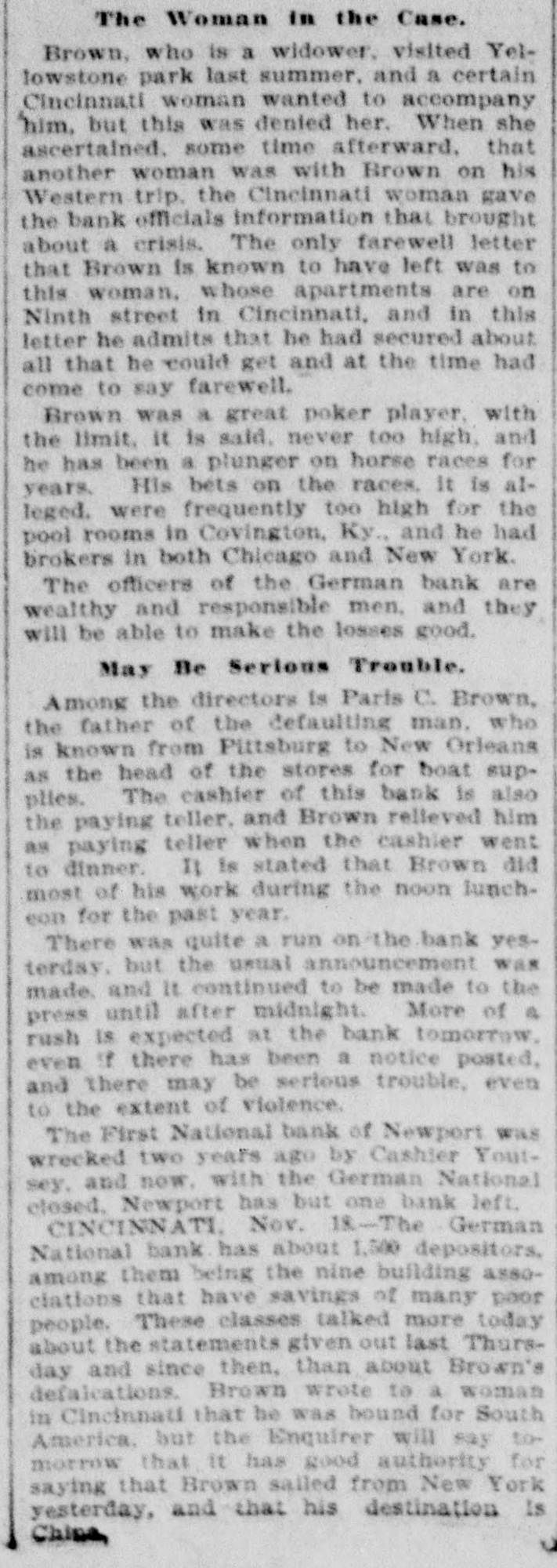
The Woman in the Case. Brown, who is a widower. visited Yellowstone park last summer, and a certain Cincinnati woman wanted to accompany him, but this was denied her. When she ascertained. some time afterward. that another woman was with Brown on his Western trip. the Cincinnati woman gave the bank officials information that brought about a crisis. The only farewell letter that Brown is known to have left was to this woman. whose apartments are on Ninth street in Cincinnati, and in this letter he admits that he had secured about all that he could get and at the time had come to say farewell. Brown was a great poker player, with the limit. it is said. never too high, and he has been a plunger on horse races for years. His bets on the races, it is alleged. were frequently too high for the pool rooms in Covington, Ky., and he had brokers in both Chicago and New York. The officers of the German bank are wealthy and responsible men. and they will be able to make the losses good. May Be Serious Trouble. Among the directors is Paris C. Brown, the father of the defaulting man. who is known from Pittsburg to New Orleans as the head of the stores for boat supplies. The cashier of this bank is also the paying teller. and Brown relieved him as paying teller when the cashier went to dinner. It is stated that Brown did most of his work during the noon luncheon for the past year. There was quite a run on the bank yesterday. but the usual announcement was press made. until and It after continued midnight. the to bank be made More to of the a rush is expected at tomorrow. even if there has been a notice posted, and there may be serious trouble, even to the extent of violence. The First National bank of Newport was wrecked two years ago by Cashier Youtsey. and now. with the German National closed. Newport has but one bank left. CINCINNATI, Nov. 18-The German National bank has about 1,500 depositors, among them being the nine building assoclations that have savings of many paor people. These classes talked more today about the statements given out last Thursday and since then, than about Brown's defalcations. Brown wrote to a woman in Cincinnati that he was bound for South America. but the Enquirer will say tomorrow that it has good authority for saying that Brown sailed from New York yesterday, and that his destination Is Chipa


Article from Wheeling Register, November 19, 1900

Click image to open full size in new tab

Article Text

SO much to go on and seems gone the full limit for a small bank in a city of less than 30,000 inhabitants. The First National bank of Newport was wrecked two years ago by Cashier Youtsey, and now with the German National closed Newport has only one bank left. For two weeks there have been rumors that Brown was short and some depositors withdrew their accounts. Three weeks ago the bank examiners made a good statement for the bank, and the officers and directors allayed suspicion by referring to the report of this examination and to their last statement. Last Wednesday Brown left and it was announced that he had gone hunting on a vacation. He got a ticket for Odin, Ills., but it is learned now that he did not go there, and it is generally believed that he is out of this country with plenty of money in his possession. It is learned that Brown was suspended last Tuesday pending an investigation and that experts have been at work all the past week while the officers and directors have been making announcements that everything was all right. Last Friday the officers and directors over their own names published in the papers of this city a statement that the bank had been found to be all right and that the rumors about Brown were false. They continued making these statements to the press as late as last midnight, but the statements were not accepted by the Commercial Tribune, which exposed the alleged shortage and caused a panic in Newport to-day, SO that the bank had to be taken in charge by the examiner. The wildest scenes were witnessed in Newport to-day and serious trouble is feared to-morrow. Brown, it is alleged, was living a fast life with wine, women and gΓ mbling in his repertoire. His career was not cut short by any discovery at the bank till a jealous woman gave him away. Brown is a widower with one son, aged ten years, who lives with Brown's father, Paris G. Brown, ex-Mayor of Newport, and one of the leading business men of Cincinnati. Last summer Brown visited Yellowstone Park and a certain Cincinnati woman wanted to accompany him, but this was denied her. When she ascertained some time afterward that another woman was with Brown on his western trip the Cincinnati woman gave the bank officials some information that brought about a crisis. The only farewell letter that Brown is known to have left was to this woman, whose apartments are on Ninth street, in Cincinnati, and in this letter he admits that he had secured about all that he could get and that the time had come to say farewell. Brown, it is said, was a great poker player with the limit never too high and he had been a plunger on horse races for years. His bets on the races, it is reported, were frequently too high for the pool rooms in Covington, Ky., and he had brokers in both Chicago and New York. The officers of the German National Bank are wealthy and responsible men and they will be able to make the losses good. Among the directors is Paris C. Brown, father of the missing bookkeeper, who is known from Pittsburg to New Orleans at


Article from The Indianapolis Journal, November 20, 1900

Click image to open full size in new tab

Article Text

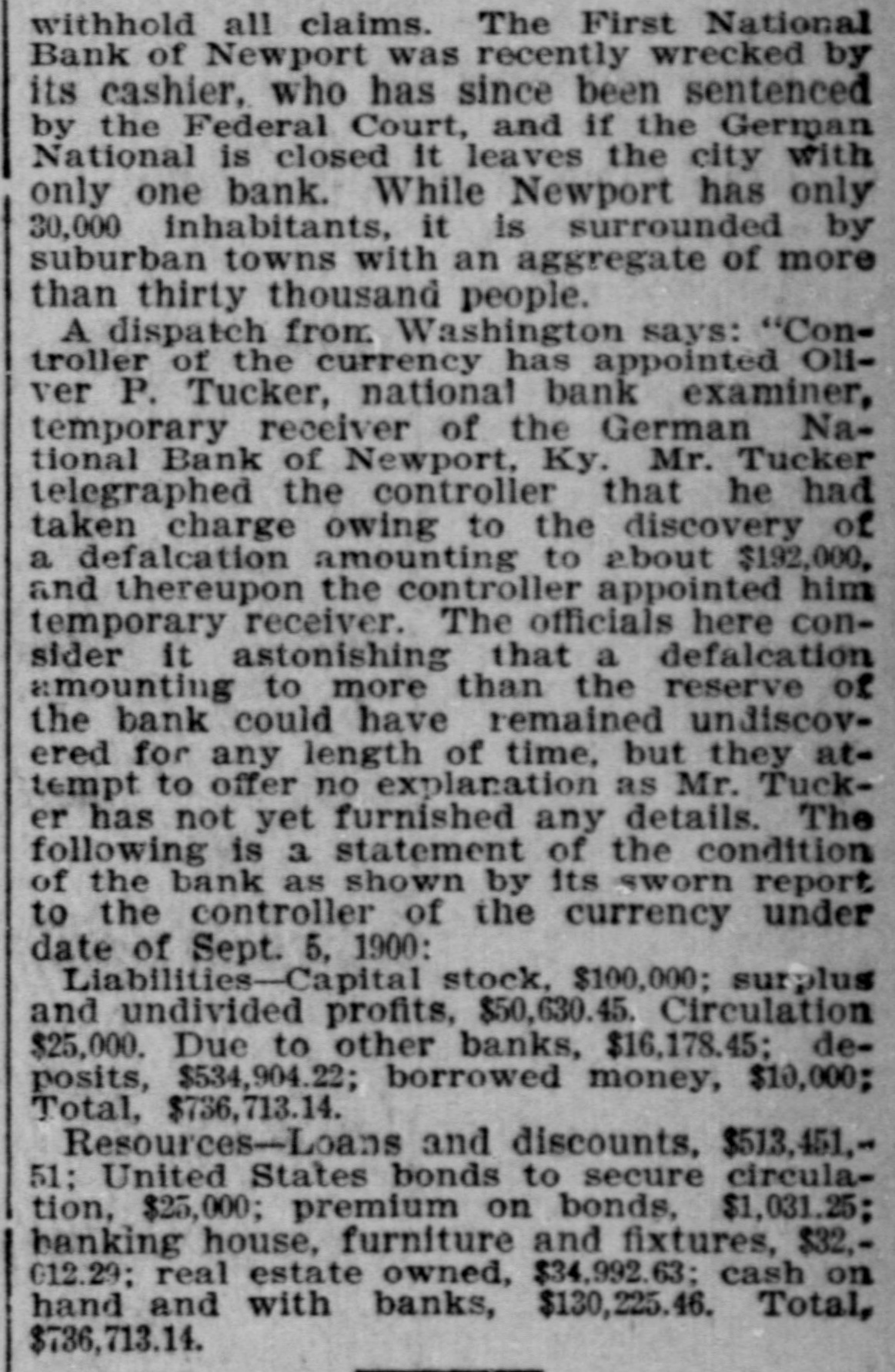
withhold all claims. The First National Bank of Newport was recently wrecked by its cashier, who has since been sentenced by the Federal Court, and if the German National is closed it leaves the city with only one bank. While Newport has only 30,000 inhabitants, it is surrounded by suburban towns with an aggregate of more than thirty thousand people. A dispatch from Washington says: "Controller of the currency has appointed Oliver P. Tucker, national bank examiner, temporary receiver of the German National Bank of Newport, Ky. Mr. Tucker telegraphed the controller that he had taken charge owing to the discovery of a defalcation amounting to about $192,000, and thereupon the controller appointed him temporary receiver. The officials here consider it astonishing that a defalcation amounting to more than the reserve of the bank could have remained undiscovered for any length of time, but they attempt to offer no explanation as Mr. Tucker has not yet furnished any details. The following is a statement of the condition of the bank as shown by its sworn report to the controller of the currency under date of Sept. 5, 1900: Liabilities-Capital stock, $100,000; surplus and undivided profits, $50,630.45. Circulation $25,000. Due to other banks, $16,178.45; deposits, $534,904.22; borrowed money, $10,000; Total, $736,713.14. Resources-Loans and discounts, $513,451.51; United States bonds to secure circulation, $25,000; premium on bonds, $1,031.25; banking house, furniture and fixtures, $32,012.29; real estate owned, $34,992.63; cash on hand and with banks, $130,225.46. Total, $736,713.14.


Article from Watertown Republican, November 21, 1900

Click image to open full size in new tab

Article Text

HE WRECKS A BANK. Old and Trusted Employe Accused of Embezzlement. Assistant Cashier of a Newport (Ky.) Institution Missing-Said to Be Guilty of a Shortage Exceeding Every Asset. Cincinnati, Nov. 19.-United States Bank Examiner Tucker took possession of the German national bank at Newport, Ky., and posted a notice that the bank would remain closed pending an examination. Examiner Tucker also announced unofficially that Frank M. Brown, the individual bookkeeper and assistant cashier, was missing and that a partial investigation showed that Brown's alleged shortage was about $201,000. Brown had been with the bank 18 years, was one of the most trusted men ever connected with this old bank, and it is stated by the experts that his operations extended back as far as ten years. Went the Limit. The captial stock of the bank is only $100,000. Brown's shortage is double that amount and more than the reserve and all the assets, including their real estate. While Alvord got away with $700,000 in New York he did it in a large bank, but Brown did not have so much to go on and seems to have gone the full limit for a small bank in a city of less than 30,000 inhabitants. The First national bank of Newport was wrecked two years ago by Cashier Youtsey, and now with the German national closed Newport has only one bank left. For two weeks there have been rumors that Brown was short and some depositors withdrew their accounts. Three weeks ago the bank examiners made a good statement for the bank and the officers and directors allayed suspicion by referring to the report of this examination and to their last statement. Last Wednesday Brown left and it was announced that he had gone hunting on a vacation. He did get a ticket for Odin, Ill., but it is learned now that he did not go there, and it is generally believed that he is out of this country, with plenty of money in his possession. Caused a Panic. It is learned that Brown was suspected last Tuesday, pending an investigation, and that experts have been at work all the past week, while the officers and directors have been making announcements that everything was all right. Last Friday the officers ant! directors over their own names published in the papers of this city' a statement that the bank had been found to be all right and that the rumors about Brown were false. They continued making these statements to the press as late as Saturday midnight. but the statements were not accepted by the Commercial Tribune, which exposed the alleged shortage and caused a panic in Newport, so that the bank had to be taken in charge by the examiner. The wildest scenes were witnessed in Newport Sunday and serious trouble is feared to-day. Brown, it is alleged, was living a fast life, with wine, women and gambling in his repertoire. His career was not cut short by any discovery at the bank till a jealous woman gave him away. Stampede Expected. Bank Examiner Tucker took possession on Sunday because of the panic in Newport that followed at once on the publication of Brown's flight and alleged defalcations. The bank examiner posted notice that the bank would not be opened to-day pending investigation, but it is generally believed that this proceeding on Sunday will not prevent a stampede to-day, as the excitement in o late hour in