6473. Atchison National Bank (Atchison, KS)

Bank Information

Episode Type
Suspension → Closure
Bank Type
national
Bank ID
2082
Charter Number
2082
Start Date
September 5, 1899
Location
Atchison, Kansas (39.563, -95.122)

Metadata

Model
gpt-5-mini
Short Digest
a7bbd350

Response Measures

None

Receivership Details

Depositor recovery rate
50.0%
Date receivership started
1899-09-05
Date receivership terminated
1901-10-25
OCC cause of failure
Excessive lending
Share of assets assessed as good
30.9%
Share of assets assessed as doubtful
35.0%
Share of assets assessed as worthless
34.1%

Description

Comptroller of the Currency closed the Atchison National Bank on or about Sept 5, 1899 and a receiver was appointed. Closure is attributed to bad investments (bank-specific adverse information). There was one notable preferential withdrawal (~$14–17k) by the Atchison & Eastern Bridge Company just before the doors were closed; this was the subject of later litigation, but it does not change the fact the bank was closed by the comptroller and placed in receivership (permanent closure).

Events (4)

1. February 8, 1873 Chartered
Source
historical_nic
2. September 5, 1899 Other
Newspaper Excerpt
It is said that the Atchison & Eastern Bridge company withdrew $16,000 to $17,000 this morning before the failure was announced. Receiver later sues to recover $14,260 withdrawn after the bank closed; reported as a tip to the bridge company an hour before doors were closed.
Source
newspapers
3. September 5, 1899 Receivership
Source
historical_nic
4. September 5, 1899 Suspension
Cause
Bank Specific Adverse Info
Cause Details
Closed by Comptroller because of bad investments (impairment of capital from prior losses carried on bank's books).
Newspaper Excerpt
The comptroller of the currency today closed the Atchison National Bank, Atchison, Kan.... The suspension is due to bad investments.
Source
newspapers

Newspaper Articles (23)

Article from Evening Times-Republican, September 5, 1899

Click image to open full size in new tab

Article Text

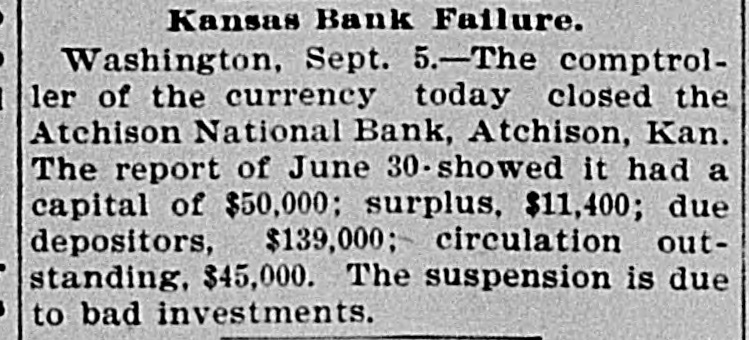
) Kansas Bank Failure. Washington, Sept. 5.-The comptroller of the currency today closed the Atchison National Bank, Atchison, Kan. The report of June 30-showed it had a capital of $50,000; surplus, $11,400; due depositors, $139,000; circulation outstanding, $45,000. The suspension is due to bad investments.


Article from The Topeka State Journal, September 5, 1899

Click image to open full size in new tab

Article Text

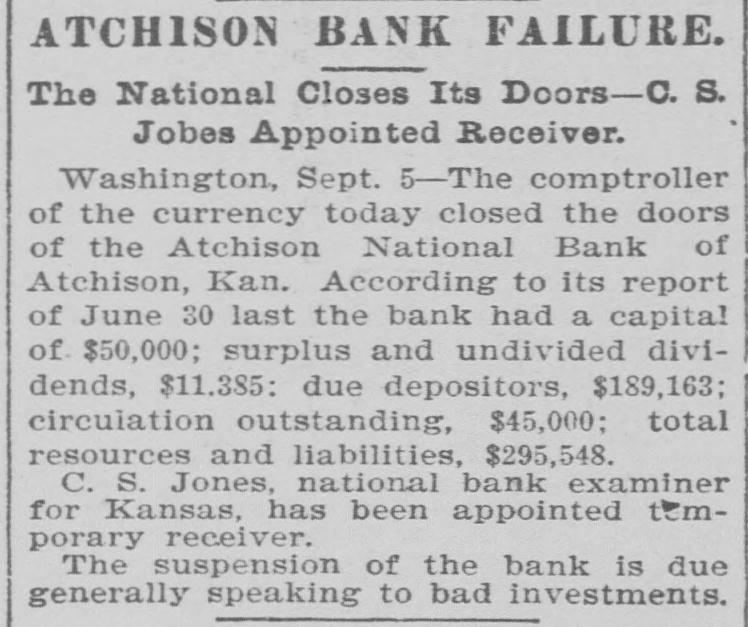
ATCHISON BANK FAILURE. The National Closes Its Doors-C. S. Jobes Appointed Receiver. Washington, Sept. 5-The comptroller of the currency today closed the doors of the Atchison National Bank of Atchison, Kan. According to its report of June 30 last the bank had a capital of. $50,000; surplus and undivided dividends, $11.385: due depositors, $189,163; circulation outstanding, $45,000; total resources and liabilities, $295,548. C. S. Jones, national bank examiner for Kansas, has been appointed temporary receiver. The suspension of the bank is due generally speaking to bad investments.


Article from The Wichita Daily Eagle, September 6, 1899

Click image to open full size in new tab

Article Text

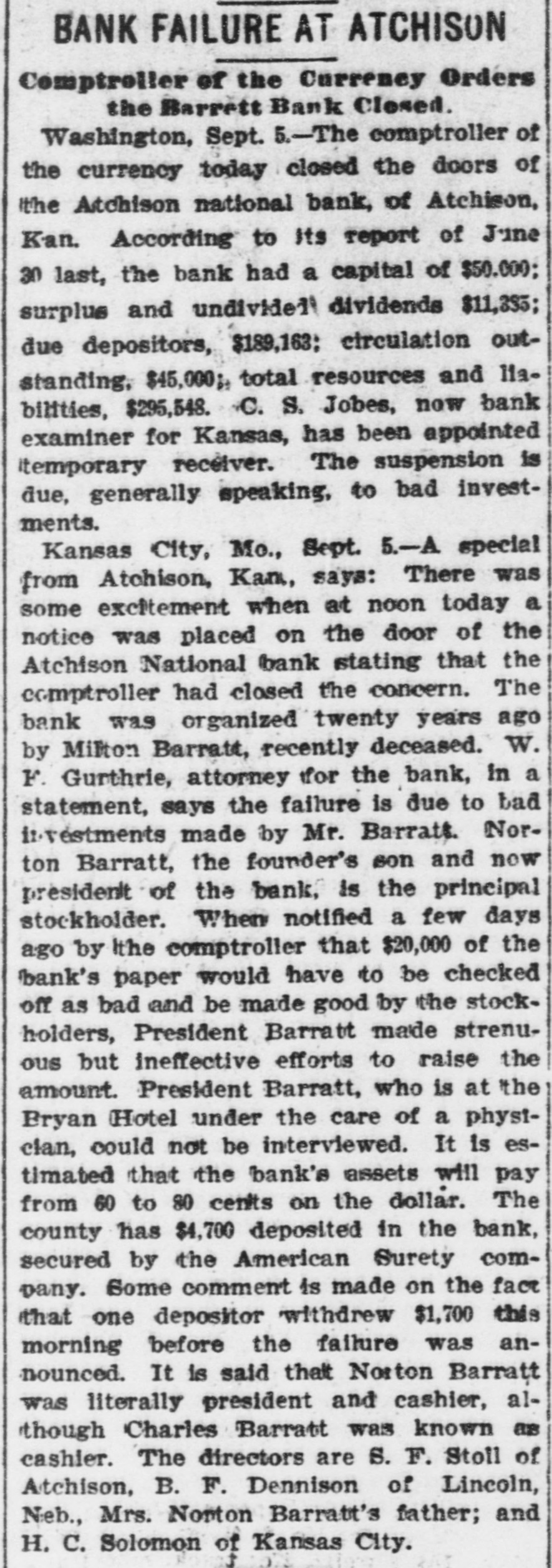
BANK FAILURE AT ATCHISON Comptroller of the Currency Orders the Barrett Bank Closed. Washington, Sept. 5.-The comptroller of the currency today closed the doors of the Atchison national bank, of Atchison, Kan. According to Its report of June 30 last, the bank had a capital of $50.000; surplus and undivided dividends $11,395; due depositors, $189,163; circulation outstanding, $45,000;+ total resources and llabilities, $295,548. C. S. Jobes, now bank examiner for Kansas, has been appointed itemporary receiver. The suspension is due, generally speaking, to bad investments. Kansas City, Mo., Sept. 5.-A special from Atchison, Kan, says: There was some excitement when at noon today a notice was placed on the door of the Atchison National bank stating that the comptroller had closed the concern. The bank was organized twenty years ago by Milton Barratt, recently deceased. W. F. Gurthrie, attorney for the bank, in a statement, says the failure is due to bad investments made by Mr. Barratt. Norton Barratt, the founder's son and now president of the bank, is the principal stockholder. When notified a few days ago by the comptroller that $20,000 of the bank's paper would have to be checked off as bad and be made good by the stockholders, President Barratt made strenuous but ineffective efforts to raise the amount. President Barratt, who is at the Bryan Hotel under the care of a phystclan, could not be interviewed. It is estimated that the bank's assets will pay from 60 to 80 cents on the dollar. The county has $4,700 deposited in the bank, secured by the American Surety company. Some comment is made on the fact that one depositor withdrew $1,700 this morning before the failure was announced. It is said that Norton Barratt was literally president and cashier, although Charles Barratt was known as cashier. The directors are S. F. Stoll of Atchison, B. F. Dennison of Lincoln, Neb., Mrs. Norton Barratt's father; and H. C. Solomon of Kansas City.


Article from The Saint Paul Globe, September 6, 1899

Click image to open full size in new tab

Article Text

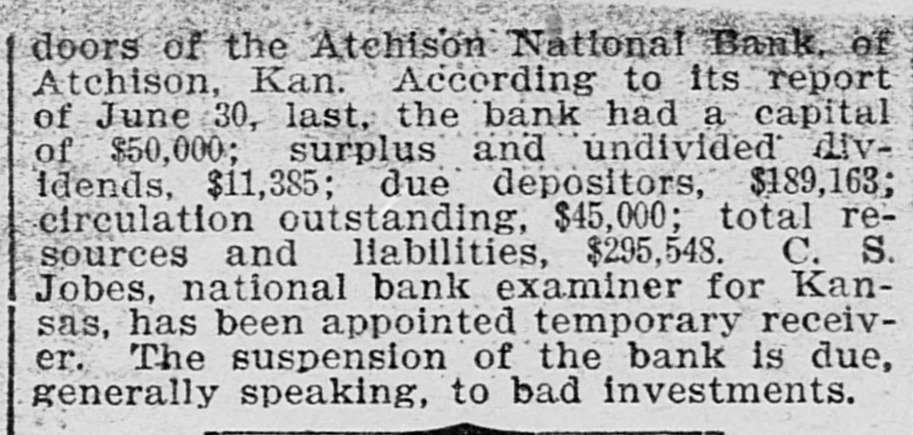
doors of the Atchison National Bank. of Atchison, Kan. According to its report of June 30, last, the bank had a capital of $50,000; surplus and undivided dividends, $11,385; due depositors, $189,163; circulation outstanding, $45,000; total resources and liabilities, $295,548. C. S. Jobes, national bank examiner for Kansas, has been appointed temporary receiver. The suspension of the bank is due, generally speaking, to bad investments.


Article from Bryan Morning Eagle, September 6, 1899

Click image to open full size in new tab

Article Text

Kansas Bank Closed. Washington, Sept. 5.-The comptrol ler of currency has closed the doors of the Atchison National bank. at Atchison, Kas. According to the report of June 30, the bank had a capital of $50,000; surplus and dividend. $11,385 due depositors, $189, 103; circulation outstanding, $45,000; total resources and liabilities, $295,548. Suspension of the bank was due, generally speaking, to bad investments.


Article from Barre Evening Telegram, September 6, 1899

Click image to open full size in new tab

Article Text

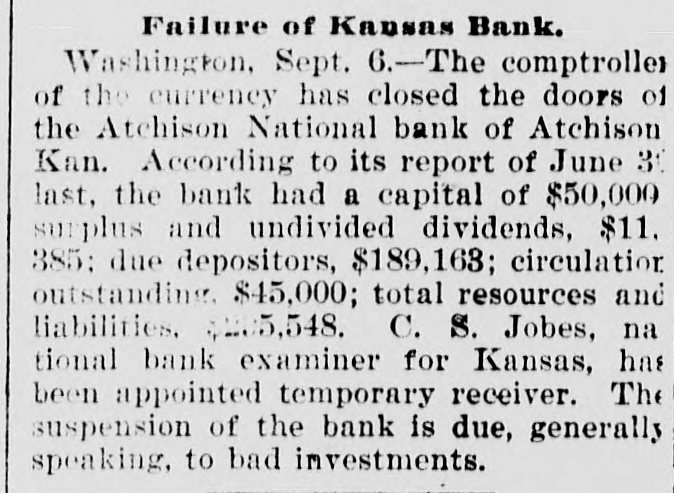
Failure of Kansas Bank. Washington, Sept. 6.-The comptroller of the currency has closed the doors of the Atchison National bank of Atchison Kan. According to its report of June 3€ last, the bank had a capital of $50,009 surplus and undivided dividends, $11. 385: due depositors, $189,163; circulation outstanding. $45,000; total resources and liabilities, $205,548. C. S. Jobes, na tional bank examiner for Kansas, has been appointed temporary receiver. The suspension of the bank is due, generally speaking, to bad investments.


Article from The Topeka State Journal, September 6, 1899

Click image to open full size in new tab

Article Text

Will Pay Depositors From 60 to 80 Per Cent. BRIDGE CO. GETS TIP. Withdrew a $17,000 Deposit Before the Doors Closed. Corn Carnival Funds In the Sum of $607 Lost. Atchison County Had $47,000 on Deposit Fully Protected. Atchison, Sept. 6.-It is now thought that the assets of the defunct national bank which closed its doors yesterday will pay the depositors from 60 to 80 per cent. W. F. Guthrie, who was in temporary charge before Mr. Jobes, the receiver arrived, said: Milton Barratt, who was president of the bank until his death at Hot Springs a little over a year ago, made some heavy losses. The Barratt paving brick plant was one of them, and a Kansas City ice business was another. These losses were made from ten to fifteen years ago, and bad been carried by the bank, being gradually reduced by the personal paper of Mr. Barratt and by the earnings of his different in. terests. Still, the losses had not been made up to any material extent. and it seems that no objection was made by the bank examiners to the assets until a few days ago, when an examiner notifled the bank that it would have to charge off $20,000 of its paper as bad, and make an assessment on the stockholders to make good the impairment of the bank's capital. Norman Barratt, who succeeded his father as president of the bank, was practically the sole stockholder. He had no means of raising the money that he felt justified in resorting to, and concluded that if he had to quit business ultimately, the sooner he did it the better for all concerned. Mr. Guthrie says that Norman Barratt consequently sent a telegram to Mr. Jobes Monday afternoon, the telegram being sent to Wichita, where Mr. Jobes was supposed to be. No reply was received from Mr. Jobes, and W. F. Guthrie says that at 8:30 o'clock Monday night he wired the comptroller of the currency at Washington, that Mr. Barratt had broken down; could not look after the bank, and that if the bank was not taken care of by the comptroller at once that the assets might be eaten up by preferences secured by attachments. No word having been received from the comptroller, at that hour, the bank was opened for business as usual at 9 o'clock Tuesday morning, although all deposits tendered that morning and collections made, were kept separate, and afterwards taken to the First National to be paid back to the parties from whom or for whom they were received. Mr. Guthrie says that immediately upon the receipt of word from the comptroller, which was not until 11:40 a. m., the bank was closed. At 10 o'clock Tuesday morning the balances of the Atchison & Eastern Bridge company and N. D. Todd, personally, amounting to between $16,000 and $17,000, were drawn from the bank. This was the only "run." The closing of the bank was a surprise to the other depositors. Being attorney for the bridge company, he says he is placed in an awkward position, but that he is not responsible for the knowledge of the bridge company. He says he even lost his personal account. Mr. Guthrie says he hasn't any idea of what there is due the bank, but there should be about $25,000 in cash and sight exchange on hand. There was due depositors this morning, $165,000. The Atchison National was the depository for county funds. Atchison county had $47,000 on deposit, but is protected by the bond of the American Surety company. Among the depositors are the following: Mrs. Cosgrove, said to have from $10,000 to $15,000 in the bank; Mrs. D. N. Wheeler, from $4,000 to $5,000; Louis W. Voigt, $4,000: James M. Chisham, $1,200; Mrs. J. L. Bliss, $5,000; Mrs. John M. Crowell, amount not known, but said to be very large; R. B. Drury, $1,000; Dr. Bogle, $400; Fritz Heckelnkaemper, $300. Harouff Bros., $800: Charley Crawford, Bosanko & Poehler, Jacob George, J. J. Ingalls, J. J. Kelley, Joseph Symns, A. W. Simpson, Mart Miller, M. E. Seitz, and B. O. Running; A. A. Webber, Sheffield Ingalls, Ellsworth Ingalls, T. C. Treat, Fred Townsend, who had $450 on deposit; the Standard Oil company, $300. The bank has lost no money during the past year. People who claim to know, say that in the past twelve months $12,000 of the bank's indebtedness has been paid. The Corn Carnival committee had
Article from Kansas City Journal, September 7, 1899

Click image to open full size in new tab

Article Text

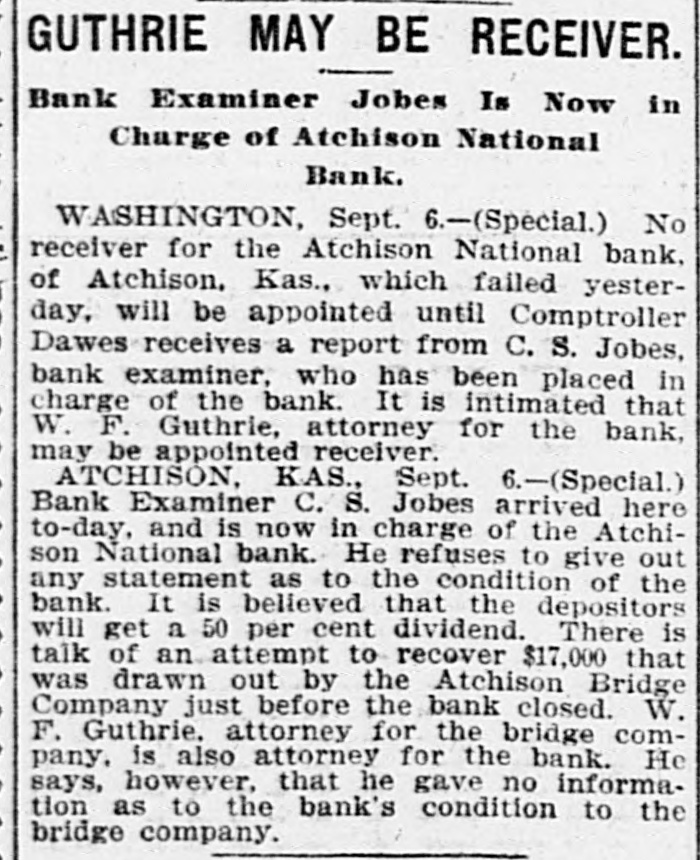
GUTHRIE MAY BE RECEIVER. Bank Examiner Jobes Is Now in Charge of Atchison National Bank. WASHINGTON, Sept. 6.-(Special.) No receiver for the Atchison National bank. of Atchison. Kas., which failed yesterday, will be appointed until Comptroller Dawes receives a report from C. S. Jobes, bank examiner, who has been placed in charge of the bank. It is intimated that W. F. Guthrie, attorney for the bank, may be appointed receiver. ATCHISON, KAS., Sept. 6.-(Special.) Bank Examiner C. S. Jobes arrived here to-day. and is now in charge of the Atchison National bank. He refuses to give out any statement as to the condition of the bank. It is believed that the depositors will get a 50 per cent dividend. There is talk of an attempt to recover $17,000 that was drawn out by the Atchison Bridge Company just before the bank closed. W. F. Guthrie. attorney for the bridge company. is also attorney for the bank. He says, however, that he gave no information as to the bank's condition to the bridge company.


Article from The Topeka State Journal, September 7, 1899

Click image to open full size in new tab

Article Text

GUTHRIE FOR RECEIVER. Bank Examiner Jobes Now In Charge of Atchison National Bank. Washington, Sept. 7.-The receiver of the Atchison National bank, of Atchison, Kan., will not be appointed until Comptroller Dawes receives a report from C. S. Jobes, bank examiner, who has been placed in charge of the bank. It is intimated that W. F. Guthrie, attorney for the bank, may be appointed receiver. Atchison, Kan., Sept. 7.-Bank Examiner C. S. Jobes arrived here last evening and is now in charge of the Atchison National bank. He refuses to give any statement as to the condition of the bank. It is believed that the depositors will get a 50 per cent dividend. There is talk of an attempt to recover $17,000 that was drawn out by the Atchison Bridge company just before the bank closed. W. F. Guthrie, attorney for the bridge company, is also attorney for the bank. He says, however, that he gave no information as to the bank's. condition to the bridge company.


Article from The Diamond Drill, September 9, 1899

Click image to open full size in new tab

Article Text

Richard Kessee, in jail at Springfield, Mo., under sentence of death for killing Dave Shelby at Marshfield, committed suicide. At Bayonne, N. J., John Flanagan, the world's champion hammer thrower, made a new world's record, flinging the missile 164 feet 6 inches. Consul Bedloe, whose status as our representative in Canton, China, is in question, arrived in Washington to confer with the state department. The corn crop of the United States for 1899 is estimated at 2,500,000,000 bushels, breaking all previous records. The United States and Great Britain have about concluded a modus vivendi covering the disputed boundary of Alaska. In Boston J. Mahoney broke the world's professional record for the onehanded 56-pound weight throw, landing it 30 feet 7 inches. The first-class battleship Kearsarge was given her builders' trial trip at Newport News, Va., and made a maximum speed of 17½ knots, showing her to be the fastest boat in the navy. The number of yellow fever cases at Key West, Fla., is increasing steadily. The doors of the Atchison national bank of Atchison, Kan., were closed, with liabilities of $189,163. Bad investments caused the suspension. The twenty-fifth annual convention of the American Bankers' association commenced in Cleveland, O. Gold in large quantities has been discovered on Lookout mountain at Chattanooga, Tenn. At the Hawthorne race track in Chicago Carnero established a new world's record for one mile and a sixteenth, the time being 1:45. The amount of net gold in the United States treasury on the 5th was $249,246,254, exceeding all records. The visible supply of grain in the United States on the 5th was: Wheat, 34,768,000 bushels; corn, 6,738,000 bushels; oats, 5,085,000 bushels; rye, 528,000 bushels; barley, 944,000 bushels. The steamer Douglas Houghton, the largest ship on the lakes, sunk across the channel of St. Mary's river at Sault Ste. Marie, Mich., stopping all navigation. Frederick Max Brookhouse was hanged at Wethersfield, Conn., for complicity in the murder of Daniel N. S. Lambert in Wilton, December 17, 1897. Advices from Illinois, Iowa, Missouri, Nebraska and Kentucky tell of intense heat, the mercury ranging from 96 degrees to 103 degrees. The cruiser Marblehead, Capt. Colby in command, arrived in San Francisco from her long cruise of 14,000 miles from New York around Cape Horn. By the capsizing of the yacht Ahadia in Sheepscot bay at Bath, Me., five persons were drowned. Forty thousand grand army veterans passed in review before President McKinley at the national encampment in Philadelphia. The yacht Buckeye was lost off Amherstburg, O., with six prominent Toledo people aboard.


Article from The Topeka State Journal, September 12, 1899

Click image to open full size in new tab

Article Text

WANT CROWELL FOR RECEIVER Depositors of Defunct Atchison National Bank Agree. Atchison, Sept. 12. - At a meeting of the depositors of the Atchison National bank last night it was agreed to indorse Frank G. Crowell of Atchison for permanent receiver. The depositors will also make an attempt to have the affairs of the bank wound up in short order and as economically as possible. The scramble of Kansas politicians for the position of receiver makes the depositors fear that a large portion of the assets are to be eaten up in costs. Properly handled the assets will pay 60 and perhaps 70 cents on the dollar. The number of depositors, which was at first believed to be less than 200, has turned out to be double that number. Many farmers had money there. Norman Barratt, president of the defunct bank, has made a bill of *sale conveying all his property, real and personal, to C. S. Jobes, temporary receiver, for the benefit of the creditors. Mr. Barratt has left town for a few days, and it is said that he hopes to secure money from relatives to reorganize the bank. The bank lost nothing under his management, the debts which wrecked it having been created by his father, the late Milton Barratt.


Article from The Saratoga Sun, September 14, 1899

Click image to open full size in new tab

Article Text

TELEGRAPH ITEMS. W. J. Bryan is visiting California. The notorious John Y. McKane died at Coney Island on the 5th. General Jiminez has arrived in Santo Domingo. He was received with enthusiasm and peace prevails. Senator Hanna is about to return from Europe, much improved in health. The French government is taking extraordinary precautions to prevent serious disturbances at the close of the Dreyfus court martial. The Havana papers express dissatisfaction with the proclamation of President McKinley calling for a census. They say that it is too vague in regard to independence. Although the Dewey home fund is increasing only by mail contributions. and has not yet reached the $20,000 mark, Treasurer Roberts says there are $15,000 additional in sight for the fund. This amount has been promised from New York, Pittsburg, Cleveland, Chicago, Milwaukee and other western cities. A dispatch to the World from Hong Kong says: Private advices from Manila state that General Joseph Wheeler. in a conversation last Monday said he had repeatedly applied to General Otis for something to do. Otis, he declared, had staved him off under various pretexts with the evident determination of side-tracking him. President Schafer of the Amalgamated Association has ordered the striking tin plate men at Anderson, Gas City and Atlanta, Indiana, to return to work to-day. These men were out on a sympathetic strike on account of the Elwood trouble. The Elwood men have not returned. but it is expected they will be at work soon. C. B. Jones, national bank examiner for Kansas, has been appointed receiver of the Atchison National Bank of Atchison. Kansas. The bank closed Tuesday by order of the comptroller on account of its being in a bad condition. The last report of the bank made June 30, 1899, shows nominal assets amounting to $295,548. The deposits amounted to $190,000. The weavers' syndicate of Gera. Germany. is planning the erection of large mills in America. following the example of Brubms' Sons of Gera, whose am up buipping MOU 81 Jactory 200-1001 United States. The Leipsic Tageblatt objects to this extension of the syndicate's operations, urging that it will but strengthen the American weaving industry and aid in building up foreign competition with the fatherland. The only woman president of a railway company in the United States was formally committed to the county jail at San Francisco for five days for contempt of court by Judge Troutt. The woman in question is Mrs. Annie Kline Rikert. The railway corporation of which she is the head is the Stockton


Article from The Ely Miner, September 15, 1899

Click image to open full size in new tab

Article Text

All the News of the Past Seven Days Condensed. HOME AND FOREIGN ITEMS News of the Industrial Field, Personal and Political Items, Happenings at Home and Abroad. THE NEWS FROM THE WORLD DOMESTIC. The National Woman's Christian Temperance union will hold its twentysixth annual convention in Seattle, Wash., October 20-25. The national convention of the Letter Carriers' association was formally opened in Scranton. Pa. Senator Carter, of Montana, in an interview in Washington said that in his opinion the war in the Philippines would be ended by January 1. At Greentown, Ind., James Ball, a laborer, fatally shot his father-in-law, Henry Murden, a well-known real estate and insurance man, and then killed himself. Family trouble was the cause. The central Porto Rican relief committee in New York has issued another appeal to the people of the United States on behalf of the sufferers from the hurricane. Ten persons were seriously injured by the running away of a team in Burlington, Wis. At a meeting of the president's cabinet President Schurman, of the Philippine commission, made a comprehensive statement of the situation on the islands. Richard Kessee, in jail at Springfield, Mo., under sentence of death for killing Dave Shelby at Marshfield, committed suicide. The corn crop of the United States for 1899 is estimated at 2,500,000,000 bushels, breaking all previous records. At Bayonne, N. J., John Flanagan, the world's champion hammer thrower, made a new world's record, finging the missile 164 feet 6 inches. Consul Bedloe, whose status as our representative in Canton, China, is in question, arrived in Washington to confer with the state department. The United States and Great Britain have about concluded a modus vivendi covering the disputed boundary of Alaska. In Boston J. Mahoney broke the world's professional record for the onehanded 56-pound weight throw, landing it 30 feet 7 inches. The first-class battleship Kearsarge was given her builders' trial trip at Newport News, Va., and made a maximum speed of 171/4 knots, showing her to be the fastest boat in the navy. The number of yellow fever cases at Key West, Fla., is increasing steadily. The doors of the Atchison national bank of Atchison, Kan., were closed, with liabilities of $189,163. Bad investments caused the suspension. The twenty-fifth annual convention of the American Bankers' association commenced in Cleveland, O. Gold in large quantities has been discovered on Lookout mountain at Chattanooga, Tenn. At the Hawthorne race track in Chicago Carnero established a new world's record for one mile and a sixteenth, the time being 1:45. The amount of net gold in the United


Article from The Topeka State Journal, September 28, 1899

Click image to open full size in new tab

Article Text

EASTMAN FOR RECEIVER Emporia Man Probably Be Placed In Charge Atchison Bank. The latest rumor concerning the receivership of the Atchison national bank, which recently failed is that D. W. Eastman of Emporia is to have the place. It is said that Frank Crowell of Atchi-


Article from The Goodland Republic, October 6, 1899

Click image to open full size in new tab

Article Text

# The Blossom House Political Gang The Topeka Capital, which is the leading republican paper of Kansas and which is the law and gospel to a considerable part of Kansas, tells some wholesome truths in the following: "Mr. Leland's political gang, that decides who shall be appointed to all federal offices from bank receivers down to $100 postmasters, meets at the Blossom house in Kansas City, Mo. It is at this rendezvous that United States senators, congressmen, state senators and representatives are also elected. During these meetings of the gang, which is composed of the county bosses, it is determined what decoy ducks shall be brought out to rally local strength for the state convention. "The Kansas City Journal of yesterday contained an account of the meeting on Sunday, in which, among other questions to be decided, was, who should be selected from the gang to fill the place of receiver of the Atchison National bank. The Journal indicated that the position was not to be filled for the benefit of the unfortunate stockholders and depositors, but with a view to assisting Mr. Bailey in his congressional fight in Atchison county, and securing for the gang a position, where there was little work and large pay. Stockholders and depositors no doubt understand that their interests are secondary to those of the gang. "Another question at the Sunday meeting was the selection of a successor to Senator Harris in 1903, Mr. Baker having been decided upon to succeed himself in 1901. Then the boss desires to succeed himself as member from Kansas of the national committee as an endorsement for his successful conduct of the national campaign of 1896 and the Cuban war. The plan of distributing the supervisors of the census among those who had been faithful in doing the dirty work of the boss and his gang was also determined upon. The Journal stated that the sentiment of the gang was favorable to mollifying Mr. J. M. Simpson, of McPherson, who failed to get the position of warden of the United States penitentiary, and later on was disappointed in not securing the appointment of railroad commissioner. The opposition to Mr. Simpson is Frank Crowell, who it is believed could


Article from Kansas City Journal, October 12, 1899

Click image to open full size in new tab

Article Text

BRIDGE COMPANY SUED. Receiver Jobes Seeks to Recover the Big Deposit Withdrawn at Last Minute. ATCHISON KAS., Oct. 11.-(Special.) Receiver C. S. Jobes, of the Atchison National bank. filed suit in the district court to-day against the Atchison and Eastern Bridge Company to recover $14,260 drawn from the bank after it closed its doors. September 5. Similar suits were brought against Superintendent Todd, of the bridge company, to recover $3,131 and one to recover $514 from Wilham Kiff, bridge keeper. The bank was turned over by President Barratt to W. F. Guthrie on the evening of September 4. Guthrie being attorney for the bank and also for the bridge company. Guthrie opened the bank doors next morning. and the parties sued, it is claimed, drew their deposits from the bank, after which the doors were closed. Waggener, Horton & Orr are attorneys for the receiver.


Article from The Topeka State Journal, October 23, 1899

Click image to open full size in new tab

Article Text

# CURTIS EXPLAINS. For First Time He Tells About That "Agreement." The Curtis and Bailey congressional contest will now be carried into Atchison county since C. D. Walker has announced that he will not be a candidate for the office this year. Pending this decision on the part of Walker the county has been debatable ground and the politicians were hiding behind each other in a manner calculated to worry a venerable worker among them. Now the various forces will line up and Bailey and Curtis will fight it out. Congressman Curtis in an interview Saturday in Atchison made his first public statement concerning the Horton agreement and states that A. K. Rodgers, A. H. Horton and Dave Mulvane were not authorized to sign an agreement keeping him out of the race this year and next. Curtis said: "That 'Horton agreement' was no agreement. It never was signed by John Schilling and Ira Collins did not sign it for days after the convention. Cyrus Leland was the only one on that side who signed at the time, and he knew very well that he and M. A. Low had had an understanding before that. I was not sent my copy for a month after the convention. At the proper time I will, if necessary, produce letters and telegrams proving clearly that there was a 'Low agreement.' Mr. Low only was authorized to act for me, and I appointed him at the request of Cyrus Leland. Mr. Low went to Horton, but satisfied that I would be nominated, returned to Topeka. There never was any doubt of my nomination by the Horton convention. Mr. Low and Cyrus Leland were agreed on that the day before the convention met. Then why the 'Horton agreement?'" Mr. Curtis is quoted also as follows by a reporter in Atchison: "The only way to win a fight is to fight, and the first necessity is to know who your enemies are. For a man in politics there can be no middle ground. He must take sides if he expects to hold his influence. I am in this contest to a finish, and I believe I am sure to win. I told Chisham only a few days ago that while a seat on the fence is very comfortable sometimes, he cannot stay there much longer. He must get down on one side or the other." "How about Frank Crowell?" "Oh, I guess Frank will line up all right. I was not far away when he was appointed receiver of the Atchison National bank." "You are sure of winning the nomination?" "Sure. Shawnee, Jefferson and Atchison will do it, or Shawnee, Brown and


Article from The Topeka State Journal, November 29, 1899

Click image to open full size in new tab

Article Text

FIGHT OVER DEPOSITS. Atchison National Bank Case In Federal Court. Two suits involving the Atchison National bank failure have been filed in the United States circuit court here on transcripts from Atchison county. Both suits are brought by C. S. Jobes, national bank examiner for Kansas, who was first appointed receiver of the bank pending the selection of a permanent receiver. Waggener, Horton & Orr are the attorneys for the plaintiff. The defendant in the larger suit of the two is the Atchison & Eastern Bridge company, and the other is against Newell D. Todd. It is alleged that when the president of the bank determined to close the bank, W. F. Guthrie, the bank's attorney, wired the comptroller of the currency of the fact, and stated further that the information had been wired to Wm. Jobes at Wichita, but that he had not replied. Mr. Guthrie explained that flood of garnishments might follow the closing of the bank if some one were not designated by the comptroller to take immediate charge, and he asked that the comptroller appoint him to take charge of the bank's affairs until Mr. Jobes should arrive. The comptroller replied, appointing Mr. Jobes as receiver, but giving Mr. Guthrie authority to act as his agent until Mr. Jobes could get to Atchison. The next morning, the petition alleges, Mr. Guthrie took possession and opened the bank long enough to pay the bridge company $14,260.40, which it had on deposit, and Todd $3,131.98, which was the sum of his deposit. Then Mr. Guthrie closed the bank. The action of Mr. Guthrie, it is claimed, was virtually giving those two depositors the preference over all other creditors, and the suits are brought to compel them to pay the money back into the receivers' hands so that all creditors shall fare equally well.


Article from Evening Journal, December 11, 1899

Click image to open full size in new tab

Article Text

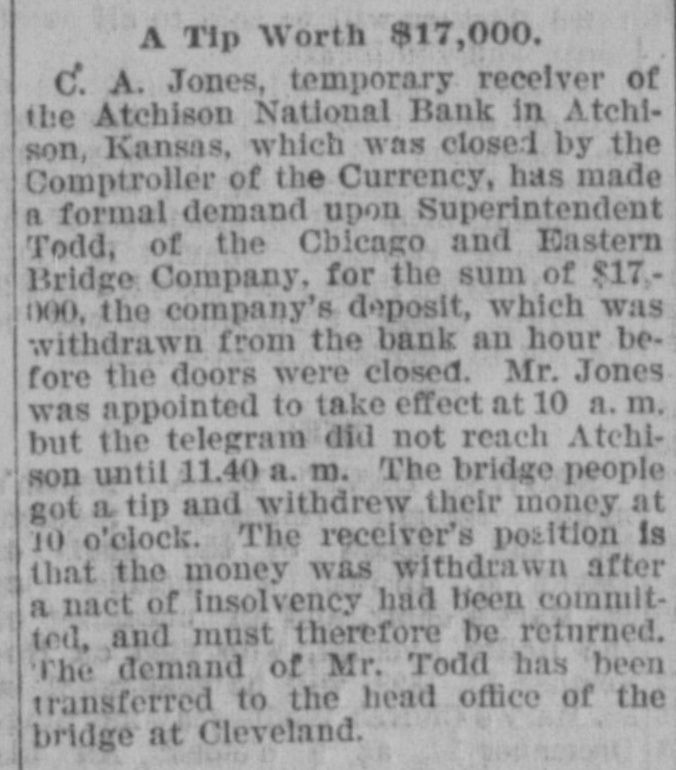
A Tip Worth $17,000. d. A. Jones, temporary receiver of the Atchison National Bank in Atchison, Kansas, which was closed by the Comptroller of the Currency, has made a formal demand upon Superintendent Todd, of the Chicago and Eastern Bridge Company, for the sum of $17,000, the company's deposit, which was withdrawn from the bank an hour before the doors were closed. Mr. Jones was appointed to take effect at 10 a. m. but the telegram did not reach Atchison until 11.40 a. m. The bridge people got a tip and withdrew their money at 10 o'clock. The receiver's position is that the money was withdrawn after a nact of insolvency had been committed, and must therefore be returned. The demand of Mr. Todd has been transferred to the head office of the bridge at Cleveland.


Article from The Topeka State Journal, December 15, 1899

Click image to open full size in new tab

Article Text

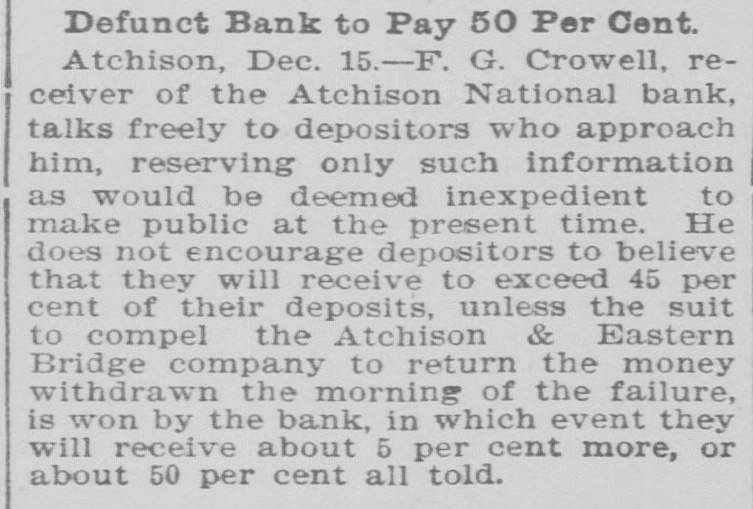
Defunct Bank to Pay 50 Per Cent. Atchison, Dec. 15.-F. G. Crowell, receiver of the Atchison National bank, talks freely to depositors who approach him, reserving only such information as would be deemed inexpedient to make public at the present time. He does not encourage depositors to believe that they will receive to exceed 45 per cent of their deposits, unless the suit to compel the Atchison & Eastern Bridge company to return the money withdrawn the morning of the failure, is won by the bank, in which event they will receive about 5 per cent more, or about 50 per cent all told.


Article from The Globe-Republican, February 8, 1900

Click image to open full size in new tab

Article Text

KANSAS ITEMS OF INTEREST. Kansas Day is President McKinley's birthday also. He was born January 29, 1843. The amount of oleomargarine shipped into Kansas during the fiscal year 1899 was 1,658,544 pounds. The Citizens' bank at Altoona has been robbed of $720 in silver. The burglars failed to get the currency. Employes of the Santa Fe who wish to obtain transportation must now make application to the division superintendent. It is said that another milling company is being organized for the purpose of grinding gold out of the shale along the Smoky. Nothing has grown in Kansas in the last year like the free library sentiment. No less than twenty towns are discussing the plan. The "fast mail" made the run, recently, from Emporia to Newton, a distance of 73 miles, in 72 minutes running time. Bert Cole was driving in a buggy near Goffs, and collided with a Central Branch train at a crossing. He is in a critical condition. An ex-probate judge of Logan county is charged with forging the names of two men to affidavits in proving up on some government land. The amount of real estate mortgages in Sedgwick county filed in January was $64,931.30, while releases footed up a total of $106,524.40. Superintendent Frank Nelson has announced three series of dates for normal institutes, viz: Ending June 29, July 27 and August 24. Thirty-eight merchants of Abilene have signed an agreement to close their stores at 6:30 for seven months, commencing with February 1. James O'Neal Gleason, a Twentieth Kansas volunteer, was shot and killed recently in a San Francisco saloon where he was tending bar. Dr. Fischer, veterinarian at the Agricultural college believes the diseased cattle on Swift's ranch, near Hoyt, were suffering from the effect of too much cottonseed meal instead of hydro-phobia. The prevalence of chickenpox in Kansas towns has cut off opportunities to get small jobs by the poor. Fear of contagion is the cause. Poor commissioners' supplies are overtaxed from this cause. Kansas Republicans will hold a double state convention at Topeka, on May 16, to nominate a state ticket and to name delegates to the national convention. There will be 850 delegates in the Kansas convention. The comptroller of the currency has declared a second dividend of 10 per cent in favor of the creditors of the Atchison National bank, of Atchison, Kan., making in all 40 per cent on claims proved, amounting to $166,299. There was shipped from the Florena stone quarries, near Irving, in the year just closed, 1,279 carloads of stone, there was such a demand for this stone that the proprietor couldn't fill all the orders. Recently capitalists from Beatrice, Neb., have purchased several acres of stone lands, and will at once open another quarry, which will give employment to a large number of hands. The most of this stone has been shipped to other states. Dr. Elizabeth McIntyre, a graduate of the Kansas Medical college, has struck a rich find of lead and zinc in northern Arkansas. Dr. McIntyre had an office in Topeka at one time, but will now devote her time to her interests in Northern Arkansas. Lieutenant Uline left Wichita with seven more men and that during the last month, recruiting stations have been open at Kansas City, Topeka and two Kansas towns, and only 22 men have been secured, compared to 36 men for the Wichita station alone. Mrs. Louisana H. Delahay, widow of the late Mark W. Delahay, the first federal district judge of Kansas, is very low, and her recovery is not expected. This venerable woman has reached the age of 77 years and has been ill for some time. The State Teachers' association will recommend that the next legislature pass a law providing for the study of agriculture in the common schools. Should this succeed, Secretary F. D. Coburn will be asked to write a text book. Mrs. H. A. Brown has been postmistress at Homestead, Chase county, for almost twenty-five years. She is now


Article from The Chanute Times, February 9, 1900

Click image to open full size in new tab

Article Text

Abilene's new Masonic hall is completed. It is funrishsd in grand style. Kansas Day is President McKinley's birthday also. He was born January 29, 1843. It cost Harvey county only $62.33 to run its poor farm the last twelve months. Kansas towns are generally torming commercial elubs. The latest to do so is Pleasanton. The contempt case of John P. Reese In fail at Ft. Scott, will be taken to the Federal supreme court. The amount of oleomargarine shipped into Kansas during the fiscal year 1899 was 1,658,544 pounds. The Citizens' bank at Altoona has been robbed of $720 in silver. The burglars failed to get the currency. Representative Ridgeley has a bill before the house for an appropriation of $100,000 for a public building at Pittsburg. Mormon elders are said to be making many converts in Coffey county. They are given crowded houses and respectful attention. 2Leavenworth has about given up getting the $300,000 appropriation for building cell houses at the new federal penitentiary site. Bert Cole was driving in a buggy near Goffs, and collided with a Central Branch train at a crossing. He is in a critical condition. James O'Neal Gleason, a Twentieth Kansas volunteer, was shot and killed recently in a San Francisco saloon where he was tending bar. Jacob Dewit, past grand commander Knight Templars and past grand high priest and past grand master A. F. and A. M., of the state of Kansas, is dead. Dr. Fischer, veterinarian at the Agricultural college believes the diseased cattle on Swift's ranch, near Hoyt, were suffering from the effect of too much cottonseed meal instead of hydrophobia. The prevalence of chickenpox in Kansas towns has cut off opportunities to get small jobs by the poor. Fear of contagion is the cause. Poor commissioners' supplies are overtaxed from this cause. The assistant attorney gdneral rules that clerks of district courts cannot legally charge the county a fee for keeping the minutes of the court. Several district clerks have been collecting fees for this work. Kansas Republicans will hold a double state convention at Topeka, on May 16, to nominate a state ticket and to name delegates to the national convention. There will be 850 delegates In the Kansas convention. The comptroller of the currency has declared a second dividend of 10 per cent in favor of the creditors of the Atchison National bank, of Atchison, Kan., making in all 40 per cent on claims proved, amounting to $166,299. There was shipped from the Florena stone quarries, near Irving, in the year just closed, 1,279 carloads of stone, there was such a demand for thisstone that the proprietor couldn't fill all the orders. Recently capitalists from Beatrice, Neb., have purchased several acres of stone lands, and will at once open another quarry, which will give employment to a large number of hands. t The most of this stone has been shipped to other states. Dr. Elizabeth McIntyre, a graduate of the Kansas Medical college, has struck a rich find of lead and zinc in i northern Arkansas. Dr. McIntyre had et an office in Topeka at one time, but will now devote her time to her interI ests in Northern Arkansas. Lieutenant Uline left Wichita with seven more men and said that during the last month, recruiting stations a have been open at Kansas City, Topeka b and two Kansas towns, and only 22 a men have been secured, compared to 86 men for the Wichita station alone. Mrs. Louisana H. Delahay, widow of H the late Mark W. Delahay, the first 03 federal district judge of Kansas, is very a low, and her recovery is not expected. This venerable woman has reached the 1 age of 77 years and has been ill for in some time. t The State Teachers' association will recommend that the next legislature pass a law providing for the study of S agriculture in the common schools. a Should this succeed, Secretary F. D. M Coburn will be asked to write a text book. 00 Mrs. H. A. Brown has been postmistress at Homestead, Chase county, for S almost twenty-five years. She is now o succeeded by Mrs. John Findley. Pren.


Article from Hutchinson Gazette, November 29, 1900

Click image to open full size in new tab

Article Text

STATE NEWS PARAGRAPHED. It took Judge Monroe just four hours to dispose of the court business at the recent term in Logan county. The average age of school-teachers in Morton county is 30 years. In some counties the ages run as low as 18. The canning factory at Girard has shut down for the season, after putting up 20,000 cans of tomatoes and 16,000 cans of apples, Running out of Topeka on the Santa Fe is a locomotive engineeer who is paying alimony to no less than three divorced wives. Norman Baratt, eashier of the defunct Atchison national bank, has been indicted by the federal grand jury for misappropriating funds of the bank. Capt. W. A. Bonner, who is dead at Concordia at the age of 81, was born on the high seas, while his parents were coming from England to America. A bust of Louisa M. Alcott has been presented to the state university and will be placed in the library with appropriate exercises sometime during December. The next legislature will be pooltioned to allow the coal taken from the penitentiary mine at Leavenworth to be sold to the public. It is now all used up by state institutions. The state bank commissioner has issued a charter for the Burns state bank, capital $6,000. Burns is n little village in Marion county, and two hours after the bank opened for business it had received deposits of $10,000. 1 Two brothers by the name of Coe were candidates in the recent election, one for clerk of the district court on the republican ticket, and the other for probate judge on the populist ticket. in Stafford county. They were both defented. Gov. Stanley's move to abolish the live stock sanitary board has brought an avalanche of protests down upon him. The governor believes that one state sanitary commissioner is enough, SO long as the federal government has a board that does all and more than the state board can do. In Rush county there was a tie in the votes received by Mr. McCormick and Mr. Anderson for the office of county attorney. Before drawing straws as provided by law the men agreed that the winner should make the loser his deputy and equally divide his salary. A boiler in the Clipper flour mills at Eldorado exploded, completely wrecking the mill. A. N. Crowther and Grant Rogers, owner of and engineer at the mill, were seriously scalded. Charles Dye, a patron, was blown against the wall and received fatal injuries. Kansas millers are protesting against the action of the Santa Fe railroad in making an order that the milling-in-transit rate would not be given them unless they consigned their flour over the road as far east as Chicago. The millers prefer to have the railroads compete for their business at Kansas City. A sensation was created in church circles at Kansas City when Mrs. John F. Von Herlich, wife of the rector of St. Paul's Episcopal church, announced her intention of going on the operatic stage. Her husband fully approves of her course and declares he has $10,000 to spend in preparing her voice for grand opera. Republicans are depending upon 300 soldier votes in the Philippines to elect George Wheatley to congress in the Third district, but John S. Gilmore, the Fredonia editor, says not more than 50 Third district soldiers are in the islands. The majority of Judge Jackson, Wheatley's opponent, is about 175, so Wheatley's only chance to beat Jackson is to make a contest. Lee Johnson, state labor commissioner, will cause to be introduced in the legislature a bill for the prevention of child labor. He says the factories and other industries of the state are full of boys and girls who ought to be in school, and that in planing and other mills where edged tools and SITWS are used nearly all the boys employed have mutilated hands. An organized effort will be made to have a creditable educational exhibit at the Kansns seii expée