6465. Farmers State Bank (Arkansas City, KS)

Bank Information

Episode Type
Suspension → Closure
Bank Type
state
Start Date
*
Location
Arkansas City, Kansas (37.062, -97.038)

Metadata

Model
gpt-5-mini
Short Digest
e39dd8d1

Response Measures

None

Description

Articles (Feb 1912) refer to the receiver of the Farmers' State Bank of Arkansas City and a suit by the receiver relating to the missing cashier Kimmel. No run or reopening is mentioned; bank had a receiver, consistent with a suspension and permanent closure/receivership.

Events (1)

1. * Receivership
Newspaper Excerpt
suit brought by the receiver of the Farmers' State Bank of Arkansas City, Kas., against a New York insurance company to recover the amount of an insurance policy held by George A. Kimmel, who was cashier of the bank at the time of his mysterious disappearance in 1898
Source
newspapers

Newspaper Articles (2)

Article from Bisbee Daily Review, February 3, 1912

Click image to open full size in new tab

Article Text

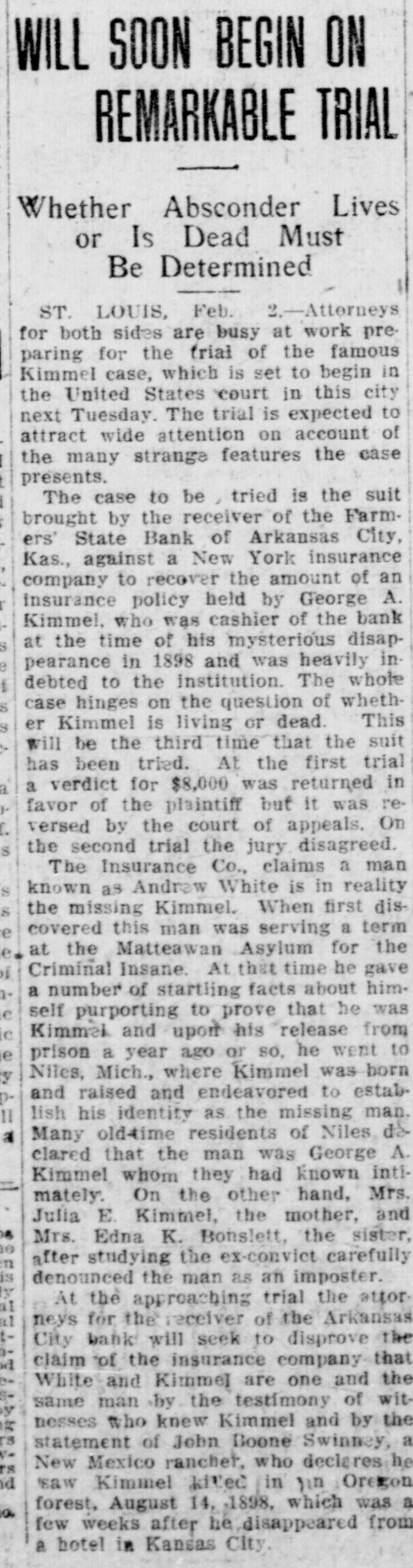
# WILL SOON BEGIN ON # REMARKABLE TRIAL Whether Absconder Lives or Is Dead Must Be Determined ST. LOUIS, Feb. 2.-Attorneys for both sides are busy at work pre- paring for the trial of the famous Kimmel case, which is set to begin in the United States court in this city next Tuesday. The trial is expected to attract wide attention on account of the many strange features the case presents. The case to be tried is the suit brought by the receiver of the Farm-ers' State Bank of Arkansas City, Kas., against a New York insurance company to recover the amount of an insurance policy held by George A. Kimmel, who was cashier of the bank at the time of his mysterious disappearance in 1898 and was heavily indebted to the institution. The whole case hinges on the question of whether Kimmel is living or dead. This will be the third time that the suit has been tried. At the first trial a verdict for $8,000 was returned in favor of the plaintiff but it was reversed by the court of appeals. On the second trial the jury disagreed. The Insurance Co., claims a man known as Andrew White is in reality the missing Kimmel. When first discovered this man was serving a term at the Matteawan Asylum for the Criminal Insane. At that time he gave a number of startling facts about himself purporting to prove that he was Kimmel and upon his release from prison a year ago or so, he went to Niles, Mich., where Kimmel was born and raised and endeavored to establish his identity as the missing man. Many oldtime residents of Niles declared that the man was George A. Kimmel whom they had known intimately. On the other hand, Mrs. Julia E. Kimmel, the mother, and Mrs. Edna K. Bonslett, the sister, after studying the ex-convict carefully denounced the man as an imposter. At the approaching trial the attorneys for the receiver of the Arkansas City bank will seek to disprove the claim of the insurance company that White and Kimmel are one and the same man by the testimony of witnesses who knew Kimmel and by the statement of John Boone Swinney, a New Mexico rancher, who declares he saw Kimmel killed in an Oregon forest, August 14, 1898, which was a few weeks after he disappeared from a hotel in Kansas City.


Article from The Richmond Palladium and Sun-Telegram, February 6, 1912

Click image to open full size in new tab

Article Text

TODAY THE START OF KIMMEL TRIAL After Numerous Postponements Famous Case Will Receive a Hearing. (National News Association) ST. LOUIS, Feb. 6.-After numerous postponements the now famous Kimmel case, one of the most puzzling cases of recent time, involving a question of double identity, was called for its third trial before the United States district court in this city today. The suit is by the receiver for the Arkansas City, Kas., Farmers' State bank, of which George A. Kimmel was cashier when he disappeared in July 1898, against a prominent life insurance company of New York, in which Kimmel was insured for $25,000. At the first trial a verdict for $8,000 in favor of the plaintiff was given, but the verdict was reversed later on by the court of appeals and the case remanded for retrial. At the second trial the jury disagreed. The Kimmel case has been given wide publicity on account of the strange features which distinguished it. It hinges upon the question of whether George A. Kimmel, the principal character of the case is really dead as is claimed by the plaintiff, or alive, as is asserted by the insurance company, which has produced a man, formerly a convict in the Auburn (N. Y.) penitentiary under the name of Andrew J. White, of whom it is claimed that he is identical with George A. Kimmel. George A. Kimmel was born in Niles, Mich., in February, 1867. After receiving his education in the public schools of that city he entered the employ of his uncle, Chas. A. Johnson, as a bank clerk. Later he engaged in real estate and investments in Omaha, and still later he became cashier of the Farmer's State bank at Arkansas City, Kas. In July, 1898, while being cashier of the bank, Kimmel disappeared, leaving a considerable shortage. After seven years, during which time no trace of Kimmel could be found, the Kimmel family attempted to collect the $25,000 for which Kimmel had insured his life a few months before his disappearance. Were Not Satisfied. The insurance company, by no means satisfied that Kimmel was actualiy dead, started an investigation and its agents succeeded in finding a prisoner in Auburn prison, who claimed to be the missing George A. Kimmel, with whom he had a remarkable resemblance. The man had been living in the state of New York under the name of Andrew J. White and seemed to have quite a criminal record, which began in 1904, when he was committed to the Erie county prison. He served several sentences, the last, for larceny, at the Auburn penitentiary. For some reason White was sent from Auburn to the Matteawan hospital for the criminal insane, but he obtained his release upon a habeas corpus. Upon his release White was taken to Niles, Mich., where, however, the relatives of Kimmel refused to admit the identity of White with the missing Kimmel. Some of the relatives of Kimmel, however, changed their mind after they had talked with White and became so convinced that he was really Kimmel, that they received him at their homes. The residents of Niles, many of whom had personally known Kimmel, were also divided in their views. While some believed that White was identical with Kimmel, others were inclined to doubt this and considered White a pretender. The proofs White's identity with Kimmel, which the insurance company submitted at the first and second trials