6461. American National Bank (Arkansas City, KS)

Bank Information

Episode Type
Run → Suspension → Closure
Bank Type
national
Bank ID
3992
Charter Number
3992
Start Date
December 9, 1890
Location
Arkansas City, Kansas (37.062, -97.038)

Metadata

Model
gpt-5-mini
Short Digest
4e8e7f8e

Response Measures

Full suspension

Other: Receiver and dividend actions occurred later; events indicate permanent suspension leading to receivership and later dividend distributions.

Receivership Details

Depositor recovery rate
84.8%
Date receivership started
1890-12-26
Date receivership terminated
1908-10-31
OCC cause of failure
Fraud
Share of assets assessed as good
32.3%
Share of assets assessed as doubtful
59.0%
Share of assets assessed as worthless
8.7%

Description

Multiple contemporary dispatches (Dec 9–10, 1890) report the American National Bank of Arkansas City closed its doors for lack of funds; several accounts attribute the failure to the money stringency and inability to collect loans and to withdrawals of cattlemen who vacated the Cherokee Strip. The bank did not resume business — later records show receivers (H. F. Hatch, J. Sam Brown) and a comptroller's dividend in 1894 — consistent with permanent closure and receivership. I classify the immediate trigger as heavy withdrawals tied to local cattle interests (local_shock). Exact receivership date not stated in the provided clips; receivers and liquidation activity appear in subsequent years.

Events (6)

1. March 15, 1889 Chartered
Source
historical_nic
2. December 9, 1890 Run
Cause
Local Shock
Cause Details
Large withdrawals by cattlemen forced to vacate the Cherokee Strip; combined with general money stringency and inability to collect loans.
Measures
None reported in contemporaneous dispatches.
Newspaper Excerpt
it is understood the failure was caused by the withdrawal of the funds of cattle men who had to vacate the Cherokee Strip.
Source
newspapers
3. December 9, 1890 Suspension
Cause
Local Shock
Cause Details
Bank closed (suspended) due to lack of funds caused by heavy withdrawals (cattlemen) and general money stringency/inability to collect loans.
Newspaper Excerpt
The American National Bank ... closed its doors this morning for lack of funds to meet its obligations.
Source
newspapers
4. December 26, 1890 Receivership
Source
historical_nic
5. November 1, 1894 Receivership
Newspaper Excerpt
The comptroller of the currency has declared a dividend of 10 per cent. in favor of the creditors of the suspended American national bank of Arkansas City, Kan.
Source
newspapers
6. August 4, 1897 Other
Newspaper Excerpt
Hiram F. Hatch, receiver of the American National Bank of Arkansas City, plaintiff in error, vs. S. C. Smith ... REVERSED.
Source
newspapers

Newspaper Articles (20)

Article from The Portland Daily Press, December 10, 1890

Click image to open full size in new tab

Article Text

A Kansas Bank Suspends. ARKANSAS CITY, Kans., December 9.The American National Bank of this city closed its doors this morning for lack of funds to meet its obligations. The stringency of the times and inability to collect money loaned, are assigned as causes of the failure, The bank claims it will pay all its obligations in a very few days. The amount of liabilities and assets cannot be obtained.


Article from Los Angeles Herald, December 10, 1890

Click image to open full size in new tab

Article Text

FINANCIAL CRASHES. Failures Multiplying in the Business World. NEW YORK, Dec. 9.-Nightingale Bros. & Nights, silk manufacturers of Paterson, N. J., have assigned. Liabilities not less than $400,000. and assets believed to be only about half that amount. The firm has been in financial difficulty for some time, and for a week or two past has been trying to effect a compromise with its creditors, but the latter insisted on an assignment. The firm has been laboring under difficulties forseven or eight years, and the failure of their chief support, J. T. Walker, Sons & Co., last month, precipitated the crash. The failure of Collerson, Chauncey & Co. was announced today on the stock exchange. The suspension had no effect on the stock market. The firm's capital was $50,000 to $75,000. The sheriff has closed the factory of the Standard White Lead Manufacturing company, on executions. The company was formed in 1889, with an authorized capital stock of $200,000. Birchall & Hodges, builders, assigned today, with liabilities $100,000. BOSTON, Dec. 9.-Whitten, Burdett & Young, wholesale clothiers, have assigned. Liabilities, $70,000. Mr. Whitten says the failure will not affect the clothing trade in general. It was caused partially by the failure of Potter, Lovell & Co. and Gardner, Chase & Co., and the tight money market. He could not give a definite statement. The firm is rated by Bradstreet at $750,000 to $1,000,000. One gentleman, believed to be well informed, says he thinks the liabilities will be over a million. There is no verification of this statement. The firm has been in business thirty years. G. W. Ingalls, shoe dealer, has failed, liabilities, $200,000. Ingalls is unable to state the amount of the assets yet. He thinks they may equal or exceed the liabilities. The direct cause of the failure is the stringency of the money market and inability to secure accommodation from banks. The firm has twenty small stores in New England and New York. KANSAS CITY, Mo., Dec. 9.-A special from Arkansas City, Kan., says: The American National bank has failed. Stringency in the money market and inability to collect caused the suspension. Assets and liabilities unknown. The bank claims it will be able to resume in a few days. It is understood the failure was caused by the withdrawal of the funds of cattle men who had to vacate the Cherokee Strip. No statement has yet been made. MONTREAL, Dec. 9.-Lannalico Bros., wholesale fancy dry goods dealers, assigned today. Liabilities, $75,000. LIVERPOOL, Dec. 9.-Joseph Boumphrey & Co., commission merchants, have failed, with liabilities of £50,000. SAN FRANCISCO, Dec. 9.-Eastland, Fowler & Co., wholesale crockery and glassware dealers, failed today. Liabilities, $192,000; assets, $53,600.


Article from The Wheeling Daily Intelligencer, December 10, 1890

Click image to open full size in new tab

Article Text

A Kansas Bank Falls. ARKANSAS CITY, KAS., Dec. 9.-The American National Bank of this city closed its doors this morning for a lack of funds to meet their obligations. The stringency of the times and the inability to collect money that they have loaned are assigned as the causes of the failure. They claim they will be able to pay all of their obligations in a very few days. Assets and liabilities unknown.


Article from The Morning News, December 10, 1890

Click image to open full size in new tab

Article Text

BANK DOORS SWING TO. A Claim That Everybody Will Be Paid in a Few Days. NEW YORK, Dec. 9-A special from Arkansas City. Kan., says: "The American National Bank, of this city, closed its doors this morning for lack of funds to meet their obligations. The stringency of the times and inability to collect money that they have loaned are assigned as the causes of the failure. The-claim that they will be able to pay all their obigations in a very few days. The amount of the liabilities cannot be obtai ed."


Article from The Cheyenne Daily Leader, December 10, 1890

Click image to open full size in new tab

Article Text

SPARKS FROM THE WIRES. G. W. Ingalls, a Boston shoe dealer, has failed. Liabilities, $200,000. Whitten, Burdett & Young, Boston wholesale clothiers, have assigned. Liabilities, $700,000. Dr. Norvin Green, president of the Western Union, says the usual dividend of 11 per cent will be declared today. Bullion to the amount of £50,000 was withdrawn from the Bank of England yesterday for shipment to Bahia, and £477,000 for shipment to New York. the gross earnings of the entire Atchison system, including the St. Louis & San Francisco (approximated), for November were $3,610,000, an increase of $341,000. Bond offerings yesterday footed up $2,548,000. All those at 1251, aggregat. ing $1,841,000, were accepted. necessitating the disbursement of over $2,000,000. A special from Arkansas City, Kas, says the American National bank has failed. The stringency of money and inability to collect caused the suspension. Assets and liabilities unknown. The priests on Achill island have ap. pealed to Baltour to aid 400 families reduced to distress by the failure of the potato crop. They are compelled to eat diseased potatoes to keep from starvation. The funeral of Joe Coburn, the old time pugilist, took place in New York yesterday from the church of the Holy Innocents. It was attended by a large gathering of sporting men. The interment was in Calvary cemetery.


Article from The Morning Call, December 10, 1890

Click image to open full size in new tab

Article Text

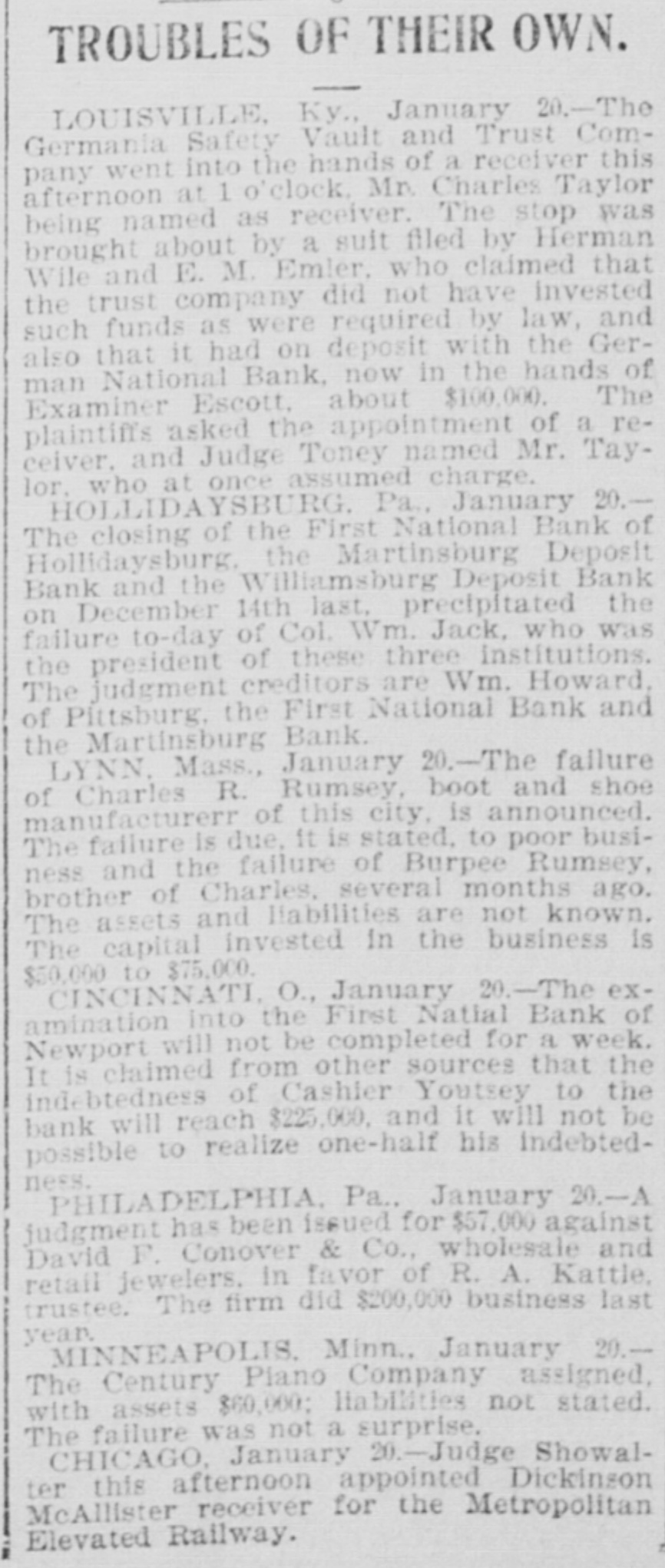
FINANCIAL STRESS. Action of the National Bank of Commerce of New York. NEW YORK, Dec. 9.-The Board of Directors of the National Bank of Commerce this morning took action, and resolutions were read with a view to relieving the present financial depression and keeping the commercial machinery of the country in healthy activity, authorizing the purchase of a large amount of sterling exchange and the taking out -such learing-house certificates as may be necessary to carry the resolution into effect. The Commercial Advertiser says: A Heading dry-goods commission mérchant spent an hour or two yesterday among the dry-goods trade, canvassing the sentiment with regard to the financial situation. The conclusion reached is that the dry-goods trade throughout the United States is in an easy, prosperous and healthy condition. This merchant's experience is that fully 90 per cent of his customers are meeting their bills four. five or six days before due. WASHINGTON, Dec. 9.-The Cabinet met to-day. It is understood the financial situation was the principal question considered. The President and others expressed satisfaction at the success of Secretary Windom's efforts toward relieving the money stringency. MORE FAILURES. NEW YORK, Dec. 9.-Schedules in assignment of the banking firm of P. W. Gallaudet show liabilities of $783,000; contingent liabilities, $117,000 nominal assets, $1,759.000; actual assets, $548,000, and assets held by banks as collateral, $40,000. NEW YORK, Dec. 9.-- The failure of Colburn, Chauncey & Co. has b en announced. The suspension had no effect on the stock market. The firm's capital was $50,000 to $75,000. Nightingale Bros. & Night, silk manufacturers of Paterson, N. J., have assigned. The liabilities are not less than $400, and the assets are believed to be only about half that amount. The firm has been in a financial difficulty for some time, and for a week or two past has been trying to effect a compromise with their creditors, but the latter insisted on an assignment. The firm has been laboring under difficulties for seven or eight years, And the failure of the chief support, J. T. Walker, Sons & Co., last month precipitated the crash. Birchall & Hodges, builders, assigned today, with liabilities at $100,000. The Sheriff has closed the factory of the Standard White Lead Manufacturing Company on executions. The company was formed in 1889, with an authorized capital stock of $200,000. MEADVILLE, Dec. 9.-The statement of the assignees of the Delamater Bank is not satisfactory, and gives no great degree of hope to the depositors. It is said a warrant has been issued for the arrest of Victor M. Delamater, late cashier of the bank, he being charged with accepting money from depositors after banking hours and with a full knowledge that an assignment was to nounced in less than twenty-four lou NEW YORK, Nov. 9.-Over $3,000,000 in gold will start this week from Europe for New York. This will tend very strongly to relieve the money stringency in this country, the extent of which was shown -day, when rates for money advanced to onequarter per cent and interest for no apparent cause except fear on the part of capitalists. KANSAS CITY, Dec. 9.-A special from Arkansas City, Kans., says the American National Bank has failed. The stringency of money and inability to collect debts caused the suspension. The assets and liabilities are unknown. The bank claims to be able to resume in a few days. It is understood the failure was caused by the withdrawal of funds of the cattle men who had to vacate the Cherokee strip. No statementshas yet been made. BOSTON, Dec. 9.-Whitter, Burdett & Young, wholesale clothiers, have assigned. Their liabilities were $70,000. Mr. Whitten says the failure will not affect the clothing trade in general. It was caused partially by the failure of Potter, Lovell & Co. and Gardner, Chase & Co. and the tight money market. He could not give a definite statement. The firm is rated by Bradstreet at $750,000 to $1,000,000. One gentleman, believed to be well informed, says he thinks the liabilities will be over $1,000,000. There is no verification of this statement. The firm has been in business thirty years. G. W. Ingalls, a side dealer, has failed. Liabilities $200,000. Ingalls was unable to state the amount of his assets yet. He thinks they may equal or exceed his liabilities. The direct cause of his failure are the stringency of the money market and his inability to secure accommodation from banks. The firm has twenty small stores in New England and New York. MONTREAL, Dec. 9.-Lannalico Fros. wholesale fancy dry-goods dealers, assismed to-day. The liabilities are $75,000. LIVERPOOL, Dec. 9.-Joseph Boumphrey & Co., commission merchants, have tailed, with liabilities at £50,000. BULLION SHIPMENT. LONDON, Dec. 9.-Ballion to the amount of £50,000 was withdrawn from the Bank of


Article from New-York Tribune, December 10, 1890

Click image to open full size in new tab

Article Text

A NATIONAL BANK CLOSES ITS DOORS. Kansas City, Mo., Dec. 9.-A dispatch from Arkansas City, Kan., says: "The American National Bank of this city closed its doors this morning for a lack of funds to meet its obligations. The stringency of the times and inability to collect money that it has loaned are assigned as the causes of the failure. The


Article from Evening Star, December 10, 1890

Click image to open full size in new tab

Article Text

GOLD FROM EUROPE. Large Shipments Expected-News of the Business World. Over $3,000,000 in gold will start from Europe this week for New York. Nearly all of this will come by the steamship Majestic, which sails today. On Saturday and Monday gold to the amount of $1,500,000 had been ordered. Yesterday's orders were as follows: Lazard Freres, $500,000; August Belmont, $500,000; agents Bank of Montreal, $250,000; Produce Exchange Bank, $125,000; Kuhn, Loeb & Co., $250,000; Heidelbach, Ickelheimer & Co., $100,000. Total, $1,725,000. It was stated on Wall street yesterday that owing to the extreme ease of money in London the Bank of England is willing to lose from $5,000,000 to $10,000,000 of gold in the settlement of her trade balances, consequently little fear is entertained that the bank's discount rate will be advanced in consequence of these shipments. John A. Burchell and John E. Hodges, composing the firm of Burchell & Hodges, builders, No. 26 East 56th street. New York, assigned yesterday to John J. Burchell. The sheriff has closed up the factory of the Standard White Lead Manufacturing Company, at West and Jane streets, New York, on executions for $10,000 in favor of the St. Nicholas Bank. Two large failures occurred yesterday in Boston. One was the firm of Whitten, Burdett & Young, clothiers. The liabilities are estimated at a million. The trouble dates back to the Lovell failure. The other failure was that of C. W. Ingalls & Co., large shoe dealers. Mr. Ingalls constitutes the present firm and has twenty small stores scattered about Boston, New England and New York. Nightingale Brothers and Knight, silk manufacturers at Paterson, N. J., have assigned to John S. Burkalow. The liabilities are reported to be about $400,000. A special from Arkansas City, Kan., says: "The American National Bank of this city closed its doors this morning for a lack of funds to meet their obligations. An Evansville, Ind., dispatch says: "Thos. Scantlin & Son, founders of stoves, mantels, grates, &c., manufacturers of sorghum machinery, have assigned to Alexander Gilchrist, with preferences in favor of workmen. The concern was old and widely known, and did a large business. Lo ses years ago on surety debts and expensive litigation on patents are the principal causes of failure. Assets are very valuable."


Article from The Stark County Democrat, December 11, 1890

Click image to open full size in new tab

Article Text

Another Bank Closes Its Doors. ARKANSAS CITY, KAN., Dec. 10.-The American National bank, of is city closed its doors yesterday for a lack of funds to meet their obligations. The stringency of the times and inability to collect money that they have loaned are assigned as the causes of the failure. They claim that they will be able to pay all of their obligations in a very few days. The amount of the liabilities and assets cannot be obtained.


Article from Spokane Falls Review, December 11, 1890

Click image to open full size in new tab

Article Text

KANSAS CITY, Dec. 9.-A special from Arkansas City, Kan., says the American National bank has failed. The stringency of money and inability to collect caused the suspension. The assets and liabilities are unknown. They claim they will be able to resume in a few days.


Article from Iron County Register, January 8, 1891

Click image to open full size in new tab

Article Text

AN EVENTFUL YEAR. Many Things That Happened During 1890. RECORD OF NOTABLE OCCURRENCES. Disastrous Business Failures-Fatal Casualties and Startling Crimes-Leading Political and Social Events-Necrology-Disastrous Fires, Etc. BUSINESS FAILURES. [INVOLVING $300,000 AND OVER, ON BANKS GENERALLY.] Jan. 6-R. Deimel & Co., Chicago furniture dealers: $300,000. Jan. 14-Smith Middlings Purifier Co., Jackson, Mich.: $484,000: Jan. 16-Bank of H. R. Pierson & Son, Albany. N. Y. Jan. 21-State Bank of Irwin, Kan. Jan. 27-John B. Lollande, New Orleans, cotton merchant: $600,000. Feb. 4-Joseph P. Murphy, Phila delphia, manufacturer of cotton and woolen goods: $500.000. Feb. 11-Franklin Woodruff & Co., dealers in fish and salt. New York City; $400,000. Mar. 13-Harrison & Loder, wholesale dry goods, New York City: $350,000. Mar. 19-John F. Plummer & Co., wholesale dry goods, New York City: $1,000,000. Apr. 7-George K. Sistare's Sons, bankers. New York City; $500,000. Apr. 8-Manhattan Bank, Manhattan, Kan. $561,000. Apr. 17-Louis Franke & Co., silk merchants, New York City: $900,000. , Apr. 30-Bank of America and twelve branches, Philadelphia: $700,000. May 1-Fechheimer, Rau & Co., shirt manufacturers, New York City: $400,000. May 13-Plattsburg Bank. Plattsburg, Mo. May 14-J. F. Reynolds, broker, New York City: $300,000. May 19-Public Grain and Stock Exchange. New York City; largest bucket-shop in United States. May 22-Bank of Middle Tennessee. Lebanon, Tenn. May 23-Owego (N. Y.) National Bank. Jun. 20-Park National Bank. Chicago. Jun. 24-Bank of Hartford. Hartford, Wis. Jul. 29-J. E. Tygert & Co., fertilizer manufacturers, Philadelphia, Pa.: $317,000. Aug. 6-State National Bank, Wellington, Kan. Aug. 27-Potter, Lovell & Co., bankers, Boston: $5,000,000. Aug. 29-City National Bank, Hastings, Neb. Sep. 3-Hoxie & Mellor, Wisconsin lumber dealers. $500,000. Sep. 4-Sawyer, Wallace & Co., New York, Louisville and London, commission merchants and brokers: $2,000,000. Sep. 6-National bank at Kingman, Kan. Sep. 17-Gardner. Chase & Co., bankers and brokers. Boston; $2,000,000. Sep. 27-Bank of Madison, Jackson, Tenn.: $200,000. Oct. 4-Fleming Bros., patent medicine firm, Pittsburgh, Pa.: $500,000. Oct. 10-Indianapolis (Ind.) Car Manufacturing Company: $600,000. Oct. -Wallace, Waggoner & Co., wholesale grocers, Houston, Tex.; $300,0000 J. H. Hagerty & Co.'s bank. Aberdeen, S. D.; $230,000. Oct. 16-R. G. Peters' Salt and Lumber Co., Manistee, Mich. $3,000,000. Oct. 31-Leopold Bros., wholesale clothiers, Chicago, $300,000. Nov. 11-Panic in Wall st., N. Y., caused the failure of brokers Decker. Howell & Co. ($10,000.000): C.M. Whitney & Co. ($300.000), and Daniel Richmond ($200,000) John T. Walker & Co., silk importers, of New York City, $900,000. Nov. 14-Kansas City Packing Co., Armourdale, Kan.: $500,000. Nov. 15-Kansas City Packing & Refrigerating Co., Boston: $1,000,000. Mills. Robeson & Smith, brokers. New York City: $350,000. Nov. 18-P. W. Gallaudet & Co., New York City, brokers: $1,000,000. Nov. 20 -Barker Brothers & Co., bankers, Philadelphia; $3,000,000. Nov. 21-Banking firm of Ragsdale & Co., Oklahoma City. O. T. Nov. 22-First National Bank of Alma, Kan. Bank of Waverly, Waverly, Kan. Nov. 24-Edward Brandon, New York broker: $1,500,000. Thomas Fawcett & Co., extensive coal dealers. Pittsburgh. Pa.: $400,000. Nov. 25-Thomas H. Allen & Co., cotton commission firm. Memphis, Tenn.: $750,000. Nov. 27-H. H. Bell, banker, Duluth, Minn.; $750,000. Nov. 28-B. K. Jamison & Co., bankers and bro kers, Philadelphia: $1,000,000. Dec. 3-Rittenhouse Manufacturing Co., Passaie, N.J.: $800,000. Dec. 5-V. & A. Meyer, cotton dealers, New Orleans: $2,500,000. Delameter & Co., Meadville. Pa., bankers; $400,000 Chicago Safe & Lock Co.: $700,000. Dec. 8-Roberts, Cushman & Co., dealers in bolters' materials, of New York City, $500,000. Dec. 9-American National Bank, Arkansas City. Kan Nightingale Bros. & Knight, silk manufacturers, Paterson, N. J.; $400,000 Whitten, Burdett & Young, Boston, wholesale clothiers: $700,000. Kendriol Bettug


Article from Barton County Democrat, November 1, 1894

Click image to open full size in new tab

Article Text

The comptroller of the currency has declared a dividend of 10 per cent. in favor of the creditors of the suspended American national bank of Arkansas City, Kan.


Article from The Iola Register, November 2, 1894

Click image to open full size in new tab

Article Text

The comptroller of the currency has declared a dividend of 10 per cent. in favor of the creditors of the suspended American national bank of Arkansas City, Kan.


Article from Western Kansas World, November 3, 1894

Click image to open full size in new tab

Article Text

LATEST NEWS. Condensed for Convenience of Hurried Readers. Nebraska had a bad snow storm on Octoper 28: especially bad on cattle. Cattle from old Mexico have begun to ar:ive at Kansas City, Kansas, stock yards. They now come in free of tariff. Exequateurs have been duly issued. and the new republic of the Pacific is now duly recognized in all its functions. Hail Hawaii. Snow fell in Japan on September 22. which is the earliest in ten years. The cold weather may put a stop to the campaign until spring. Kansas City, Kansas' cattle receipts last Friday were greater by 2,000 than Chicago's, and greater by 3,600 than those of St. Louis and Omaha together. President Cleveland has returned to Washington and Gray Gables, at Buzzard S Bay, is closed. One account says he stopped in New York to register. An earthquake shock did wide-spread damage in the Argentine republic, October 27. Governor McKinley while doing campaign work in New York last week was hauled from Syracuse to Utica, between speeches, at the speed of ninety miles an hour. Attorney General Olney decides that the repeal of the force bill killed every provision of law giving United States courts jurisdiction in cases of frauds connected with any elections. A Kentucky court decides that the Pullman company is not a common carrier and not therefore responsible for any injuries that might be sustained in a wreck by passengers on its cars. The striking weavers of Fall River. Mass., voted to return to work. All of the inmates of the White house have been vaccinated, as a precaution, in view of smallpox in Washington. The comptroller of the currency has declared a dividend of 10 per cent in favor of the creditors of the American National bank, of Arkansas City, Kan. Four men robbed every store and the postoffice in the village of Watova, a station on the Kans S & Arkansas Valley railroad, 125 miles west of Fort Smith, Ark. A large Hungarian boarding house at Laurel Run, Pa., was blown to atoms in the night by dynamiters and three of the inmates killed outright, four fatally injured and a half dozen seriously hurt. Rev. Sheldon Jackson, commissioner of education for Alaska, reports that the herd of Siberian reindeer at Port Clarence had been increased by 700 head. and that they are thriving splendidly, very few dying. Fire which started in a Monticello, Ia., livery stable burned fifteen high priced horses, destroyed half a dozen residences and barns and badly dainaged the Central hotel. Loss about $50,000; partly insured. Between March, 1893, and October, 1894, the government paid bills for transporting gold between sub-treasuries, mints and banks, to the amount of $95,480. Theamount 60 moved for exportation was $147,307,500. The interior department Was closed two days so that every room might be fumigated. Every case of smallpox is traced to that department, where it was spread by a messenger whose duty it is to distribute documents to all rooms. The T. Green Grocer company, of Kansas City, Mo., was burned out October 30. Their usual invoice was about $75,000 and their building cost $30,000 nine years ago. The firm has been in business since 1861 and this is its first fire. Increase in the gold reserve October 24, of over $500,000. was caused in part by the receipts at the New York sub-treasury of $200,000 in gold to retire national bank circulation, and $100,000 at Phitadelphia in exchange for notes. Twenty-five members of an alleged gang of Whitecaps who have been creating a reign of terror in St. Francis county, Arkan-as. are on trial at Helena, Ark. There are over 100 witnesses to be examined and the trial will continue several days. The Kansas University Glee club has about completed its plans for its winter tour. The trip planned this year will include all the principal towns of Kansas, and St. Joseph and Kansas City in Missouri. The southern part of the state will also be visited. The effect of the new American tariff is being felt in increased trade with northern Mexico. Largeexportationsof dressed hides, mules, horses, etc.. has been added to the usual exports heretofore made, and there are prospects of a large spring business. H. W. Damme's grocery store, at the corner of Biddle and Ninth streets. St. Louis, Mo., was blown to ruins by an explo-ion and five persons were badiy hurt, the injuries of one being thought fatal. The explosion was probably caused by a leaking gas main. The Santa Fe stockh Iders' meeting, October 25, in Topeka, resulted in adjournment one week. This was caused by an order from Judge Foster restraining the election of directors unless the minority of stockholders are represented by a cumulative election. Dr. H. T. Helmbold, of extract of Buchu fame, died suddenly of apoplexy October 25 in the state asylum for insane in Trenton, N. J. He was 57 years of age, and has been an inmate of the institution about three years. Dr. Helmbold became insane about fifteen years ago. Miss Anna Jones, who had entered a tract of land several miles north of Perry. O. T.. shot and perhaps f itally wounded Ham Bartell. Miss Jones says Bartell had jumped her claim while she was away and had taken possession of her house. Bartell shot at Miss Jones once, but missed. By an agreement now in effect the railways east of the Missouri river are not allowed to issue free transportation or give reduced rates to any one to influence passenger traffic in any way. This is in addition to the freight agreement entered into by the general managers in St. Louis. Over 6,300 sheep were in the Kansas City, Kan., stock yards October 29, most of them from Colorado, and Utah ranges. As the


Article from The Wichita Daily Eagle, March 6, 1895

Click image to open full size in new tab

Article Text

# OF THE EASTERN STATES-THE FAMOUS HIGHLAND HALL CASE IS DECIDED--THE MAN WHO HOLDS A MORTGAGE ON SOME WICHITA PROPERTY COMES OUT ON TOP. There were two decisions handed down by Judge Reed yesterday that are of more than ordinary interest to the lawyers and to a good many people directly interested. One is popularly known as the Highland Hall case and the other was a suit involving the title to the fine residence of Hardy Solomon on College Hill in this city. The decision in the Highland Hall case is too long to attempt to give the language of the learned judge. The opinion of the court in this case covered fourteen large closely type written pages and nothing more than a summary can be given. Briefly stated, there was a company incorporated in Arkansas City called the Highland Hall company. Frank J. Hess owned about all the stock in the company and he was the power behind the throne, and whatever Mr. Hess wanted the company to do was done. Frank J. Hess was worth a haif million of dollars and an energetic business man of unbounded credit, but the recent shrinkage process through which the country has been passing for the past two or three years depreciated the value of Mr. Hess' assets the same as other people's property was reduced in value, and he may not be worth quite a half million now. When times began to get close Mr. Hess borrowed large amounts of money and pawned his stock in the Highland Hall company as colloteral and finally when the American National bank of Arkansas City became dissatisfied with its collateral for the amount of its claim against Mr. Hess it demanded more security, and Hess had the officers of the Highland Hall company execute a mortgage on some very valuable real estate in Arkansas City to the bank for $20,000. There were numerous other claims all amounting to something like $50,000 and finally a suit was commenced in the United States court, the title of which is: H. F. Hatch as receiver of the American National bank of Arkansas City vs. The Johnson Loan and Trust company, First National bank of Arkansas City, the Highland Hall company and others. This was a suit in chancery by which Hatch attempted to enforce his lien on the property of the Highland Hall company in Arkansas City. Numerous other parties were made parties to the suit and the claim was sent up that the mortgage given by the Highland Hall company was a fraud because the Highland Hall company did not owe the bank anything at the time the mortgage was given. The reporter for the Eagle understood the decision to be that the American National could only claim the $10,000 of Highland Hall stock deposited by Hess and the cash actually advanced on the mortgage given by the Highland Hall company which was only a small per cent of the mortgage. This may make a good deal of difference to depositors in the American National, as the property in Arkansas City covered by the mortgage is said to be very valuable. The other case while involving less money is more interesting to the people of Wichita. When Hardy Solomon erected his fine residence on College Hill he executed a mortgage to Bernd who afterwards commenced foreclosure proceedings in the United Staes court against Hardy Solomon. John Hume was counsel for Solomon and before the case was decided in the United States court, Wallenstein, who was a brother-in-law of Solomon, obtained a tax deed to the property and commenced a suit in the district court of Sedgwick county and obtained a judgment quieting his title after which he sold the property to Alexander. Bernd never discovered the judgment in the state court until about the time he was going to get a judgment in the federal court foreclosing his mortgage. He then made Wallenstein and Alexander parties to the suit and these latter parties set up their judgment obtained in the district court as a defense against Bernd's right to foreclose his mortgage. This raised the whole question of jurisdiction between the federal and state court and the prominent lawyers present seemed to be highly pleased with Judge William's decision in the matter, and some of them agreed that the matter of jurisdiction was made plainer in this case than they had ever understood it before. The substance of a lengthy opinion delivered by Judge Williams was that the tax deed could not interfere with the United States court because when the proceedings were commenced in the United States court it had jurisdiction of the case and that jurisdiction could not be removed by a later proceeding commenced in another court. The commencement of the foreclosure case in the federal court was a notice to Wallenstein and Alexander that the federal court had jurisdiction of the case and every other court must refrain from any act which would disturb the jurisdiction of this court. This decision renders of no force the proceedings in the district court and Mr. Bernd seems to have the best claims to the Solomon residence. Judge Williams explained at length how courts were zealous of their rights and one court seldom encroaches upon the jurisdiction of another. The idea seemed to prevail among the lawyers that the district court had no knowledge of the case in the federal court when he passed upon the case.


Article from The Advocate, August 4, 1897

Click image to open full size in new tab

Article Text

Kansas Court of Appeals, Southern Department, Central Division. No. 213. Hiram F. Hatch, receiver of the American National Bank of Arkansas City, plaintiff in error, vs. S. C. Smith, defendant in error. Error from Cowley County District Court. REVERSED. SYLLABUS. A residence once shown to have been established is presumed to continue until it is clearly shown to have been abandoned. The residence of a man having a family, which he maintains, is prima facie where that family dwells. A man's acts and conduct are more to be considered in determining the question of a change of residence than any mere declaration of intent; and when the question of residence or non-residence is doubtful, the question should be so determined as will best secure the rights of creditors and others having dealings with such party. (Keith v. Stet-ter, 25 Kas., 70.) Opinion by Schoonover, J.


Article from The Wichita Daily Eagle, September 15, 1897

Click image to open full size in new tab

Article Text

# OVER RULED ALL EXCEPTIONS Judge Williams Finally Decides ths Highland-Hall Company. There was a long, weary session of the federal court yesterday, which interested seemingly no one but the attorneys employed. It was the Highland-Hall case and it has been pending in the court for six years. After the attorneys got through arguing it didn't take Judge Williams long to make known his decision, which was in favor of the First National bank of Arkansas City. J. Sam Brown, receiver of the American National bank at Arkansas City, brought suit through his attorneys, Peters & Nicholson, against the Highland-Hall company. The Highland-Hall company were represented by F. L. Rosmond of Cambridge, O., and C. L. Brown of Arkansas City. John A. Eaton of Kansas City and J. C. Pollock of Winfield represented the First National bank. Special Master Sherman found that the Highland-Hall company owed about $3,200, but the court found them in debt about $13,000. Judge Williams overruled all exceptions and sustained his former ruling.


Article from The Guthrie Daily Leader, October 10, 1897

Click image to open full size in new tab

Article Text

Political Points. Walter Fields is booked for a place in the Indian service. Tom Smith will get a $2,000 position as custodian of the department ware house at New York. J. Sam Brown has resigned as receiver of the American National bank of Arkansas City. Governor Barnes, Attorney-General Cunningham and Treasurer Thompson attended the soldlers' reunion at Ponca yesterday.


Article from The Wichita Daily Eagle, March 8, 1899

Click image to open full size in new tab

Article Text

# LONG LIST OF CREDITORS Andrew J. Gilbert Files a Bankruptcy Petition in U. S. Court. Andrew J. Gilbert of Arkansas City has sent in a bankruptcy petition for the consideration of Judge Wall. He asks to be declared a bankrupt under the provisions of the new bankruptcy law, and files his schedules of liabilities and resources, which exhibit something out of the ordinary, in that they represent such a large amount of debt without a cent's resource of any kind whatever. The liability schedule contains several items of arrearages for subscriptions to newspapers. Mr. Gilbert's statements are as follows: LIABILITIES. J. E. Torrance, Winfield, judgment rendered for legal services, $309.45. Searing & Mead, Arkansas City, judgment on account for supplies that went into a railroad, $926.16. George S. Howard, Arkansas City, judgment based on account for goods that went into the construction of a railroad, $988. John Watts, Wichita, receiver of the American National bank, of Arkansas City, judgment based on a note, $572.25. H. Y. Wagner, Carl Junction, Mo., judgment based on a note for which he was security, $834.82. Charles A. Scruton, Arkansas City, costs for judgment in a law suit, $7.80. O. P. Houghton, Purcell, I. T., note, $325. Newman Dry Goods company, Arkansas City, note, dated 1890, $284.69. Heron Haughton, Arkansas City, note, $300. T. J. Kimmel, Arkansas City, note dated 1888, $30. McDermott & Johnson, Winfield, note dated 1889, $40. F. M. Strong, administrator, Arkansas City, merchandise, $23.04. Arkansas City Investment company, interest on money borrowed, principal having been paid, $1,000. Walter A. Wood Harvester company, Minneapolis, Minn., notes given for farm machinery, $145. White, Hill & Co., Arkansas City, note, $110.24. Sallot & Swartz, Arkansas City, book account, $5.50. McDowell & Co., Arkansas City, book account, $70. J. H. Park, Zanesville, O., note, $55.59. Charles A. Scruton, Arkansas City, notes, $67.95. Perry, Mason & Co., Boston, back subscription for a newspaper, $15.25. Winfield Free Press, back subscription account, $9.50. The Democrat, Arkansas City, back subscription, $9. The Dispatch, Arkansas City, back subscription, $9. A. F. Huse, Arkansas City, book account, $15. O. H. Lent, Arkansas City, book account, $10. ASSETS. I have no property of any kind or description whatever. ANDREW J. GILBERT. Judge Wall has recommended that Mr. Gilbert be declared a bankrupt according to the petition, and also recommends that a meeting of the creditors as listed in the foregoing schedule be held at Arkansas City on March 31 at 10 o'clock a. m., for the purpose of presenting their claims.


Article from The Wichita Daily Eagle, March 17, 1899

Click image to open full size in new tab

Article Text

# WON A BIG CASE Mrs. Williams of Texas Wins Her Suit in Federal Court. VERDICT IS $42,586.83 American Bank of Arkansas City Loses Its Case. The federal court was occupied with the case of Lizzie E. Williams most of the day yesterday. The jury was sent out after dinner, and shortly before 3 o'clock brought in the largest verdict that has been recorded in the courts of Kansas for a long time. The verdict was in favor of Mrs. Williams for the amount of $42,586.83. Several cases of importance have been docketed for trial in the United States court, but none will attract the attention of the public so much as the one that was settled yesterday. The judgment is against the American National bank of Arkansas City and the case has been pending since 1890. Governor Stanley, Judge Pollock and other well known attorneys were interested in the case. Judge Peters being attorney for the defendants. Mrs. Williams has all the time insisted that she deposited $25,000 in the American National bank, instead of buying stock in the bank. Judge Peters tried hard to show the jury that Mrs. Williams was an educated woman and that it was impossible for her to have come into possession of bank stock instead of a certificate of deposit without knowing exactly what she was doing. His pointed questions brought from her the admission that she was an educated women and that she had written for the press. However, she denied that she was posted in regard to banking or that any of her writings were on matters of finance. Her nervousness caused her to attempt too many elaborate explanations of business with her bank. Interest in the case, however, culminated in the evidence of the bank's receiver, Mr. Watt. Judge Peters had him identify some of the records of the American National bank. They, he said, showed that stock of the bank had been issued to Mrs. Williams and that she had been paid three dividends on it. This was the money that Mrs. Williams claimed had been paid to her as interest on her deposits. He also identified the stock book and showed by the stub that certificates of stock had been issued to Mrs. Lizzie E. Williams. When Governor Stanley arose to cross-question the receiver there was the most intense interest shown in the case. The attorneys and spectators present were greatly interested. "You have been put on the witness stand as an expert," said the governor, "and you have shown by the books of the bank that Mrs. Williams was paid a divi-