Article Text
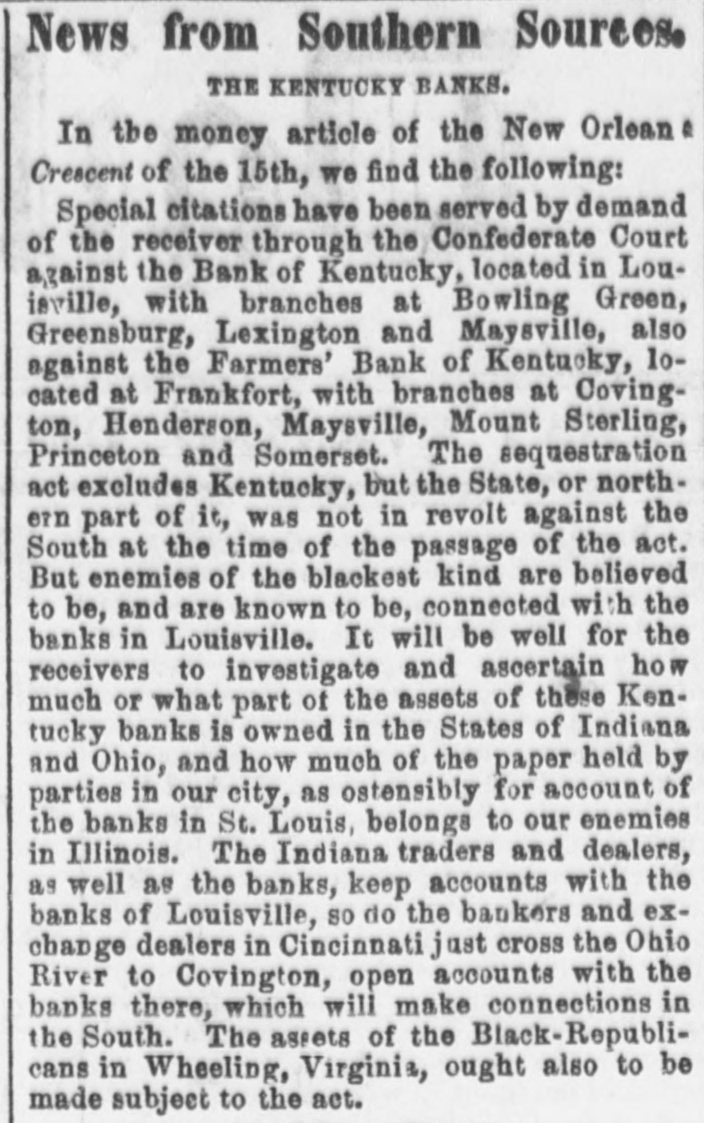
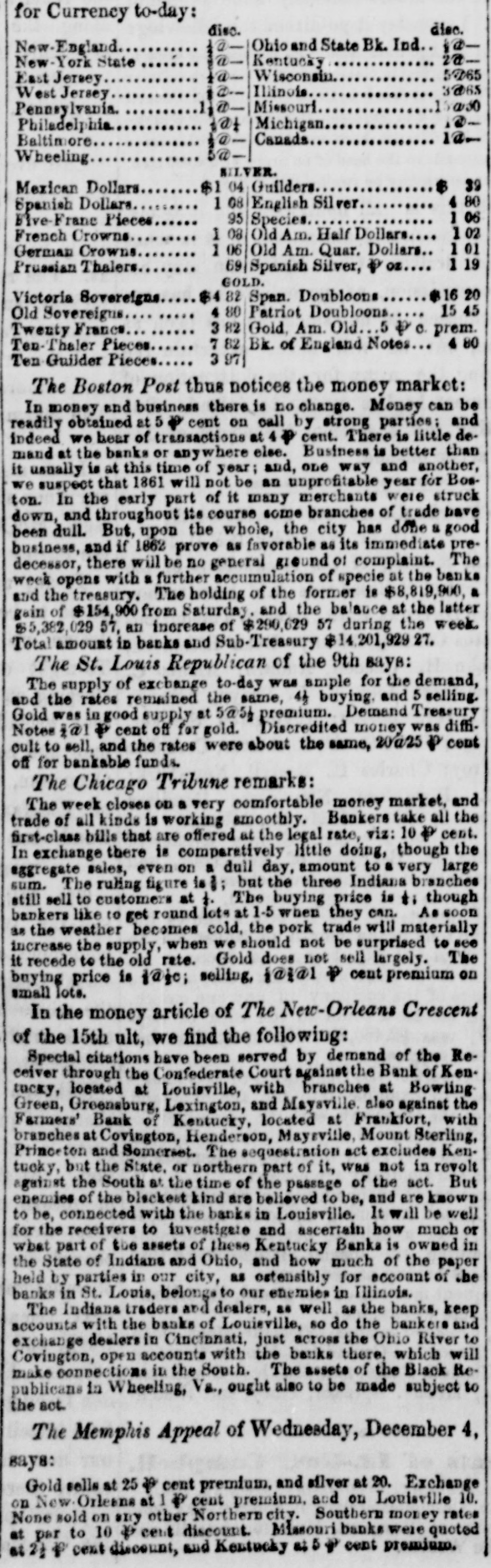
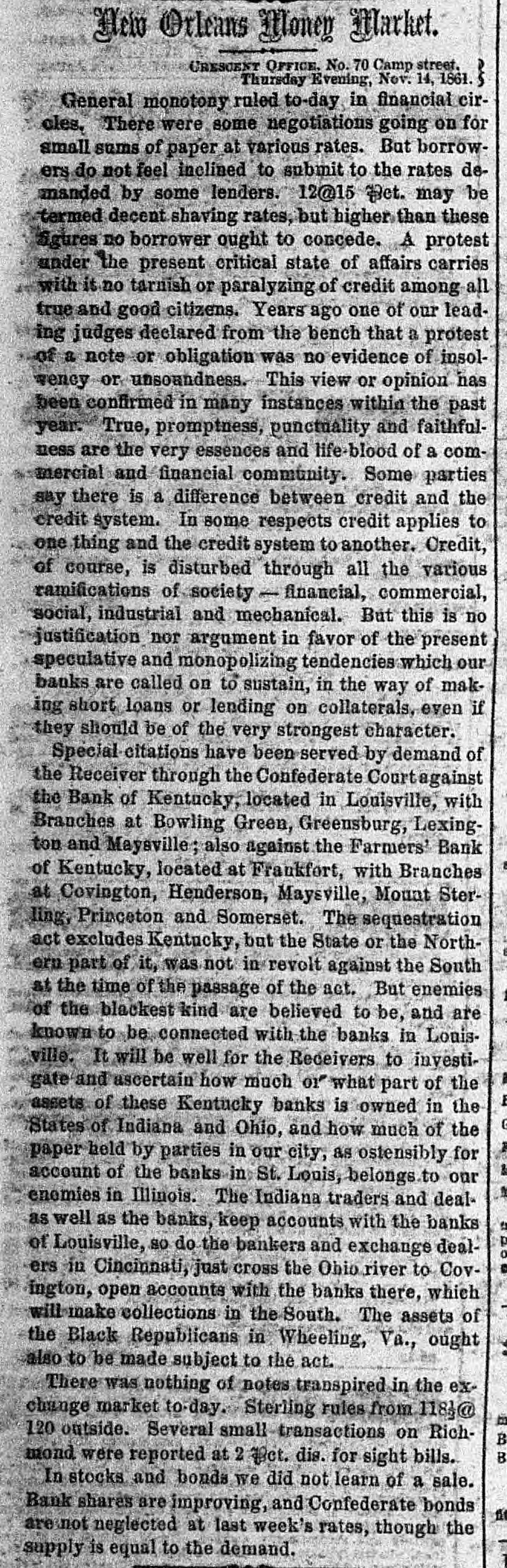
New Orleans Money Market. CRESCENT OFFICE. No. 70 Camp street. Thursday Evening, Nov. 14, 1861. General monotony ruled to-day in financial circles, There were some negotiations going on for small sums of paper at various rates. But borrowers do not feel inclined to submit to the rates demanded by some lenders. 12@15 Pet. may be termed decent shaving rates, but higher than these figures no borrower ought to concede. A protest under the present critical state of affairs carries with it no tarnish or paralyzing of credit among all true and good citizens. Years ago one of our leading judges declared from the bench that a protest of a note or obligation was no evidence of insolvency or unsoundness. This view or opinion has been confirmed in many instances within the past year. True, promptness, punctuality and faithfulness are the very essences and life-blood of a commercial and financial community. Some parties say there is a difference between credit and the credit system. In some respects credit applies to one thing and the credit system to another. Credit, of course, is disturbed through all the various ramifications of society - financial, commercial, social, industrial and mechanical. But this is no justification nor argument in favor of the present speculative and monopolizing tendencies which our banks are called on to sustain, in the way of making short loans or lending on collaterals, even if they should be of the very strongest character. Special citations have been served by demand of the Receiver through the Confederate Court against the Bank of Kentucky, located in Louisville, with Branches at Bowling Green, Greensburg, Lexington and Maysville ; also against the Farmers' Bank of Kentucky, located at Frankfort, with Branches at Covington, Henderson, Maysville, Mount Sterling, Princeton and Somerset. The sequestration act excludes Kentucky, but the State or the Northern part of it, was not in revolt against the South at the time of the passage of the act. But enemies of the blackest kind are believed to be, and are known to be connected with the banks in Louisville. It will be well for the Receivers to investigate and ascertain how much or what part of the assets of these Kentucky banks is owned in the States of Indiana and Ohio, and how much of the paper held by parties in our city, as ostensibly for account of the banks in St. Louis, belongs to our enomies in Illinois. The Indiana traders and dealas well as the banks, keep accounts with the banks of Louisville, so do the bankers and exchange dealo ers in Cincinnati, just cross the Ohio river to Covington, open accounts with the banks there, which will make collections in the South. The assets of the Black Republicans in Wheeling, Va., ought also to be made subject to the act. There was nothing of notes transpired in the exchange market to day. Sterling rules from 118$@ m 120 outside. Several small-transactions on RichB B mond were reported at 2 Oct. dis. for sight bills. In stocks and bonds we did not learn of a sale. Bank shares are improving, and Confederate bonds fit are not neglected at last week's rates, though the supply is equal to the demand.