6420. Abilene State Bank (Abilene, KS)

Bank Information

Episode Type
Suspension → Closure
Bank Type
state
Start Date
January 1, 1910*
Location
Abilene, Kansas (38.917, -97.214)

Metadata

Model
gpt-5-mini
Short Digest
ab55df94

Response Measures

None

Description

The Abilene State Bank closed its doors as a result of large defalcations by cashier John A. Flack. The bank's affairs were turned over to a receiver (Edward Makins) and depositors were later paid from the Kansas state bank guaranty fund. No contemporaneous run is mentioned in the articles; this is a failure followed by receivership and payout.

Events (3)

1. January 1, 1910* Receivership
Newspaper Excerpt
When the affairs of the bank were turned over to Edward Makins, receiver, there was a deficit of $90,000 after the available cash had been returned to the depositors. Receiver Makins has just finished winding up the affairs of the Flack bank, and his report to the bank commissioner is expected this week. (1913 article describing earlier receivership).
Source
newspapers
2. January 1, 1910* Suspension
Cause
Bank Specific Adverse Info
Cause Details
Closed due to irregularities/defalcations by Cashier John A. Flack; articles state about $90,000 shortage discovered, leading to closure.
Newspaper Excerpt
closed its doors three years ago as the result of the operations of Cashier John A. Flack
Source
newspapers
3. November 22, 1913 Other
Newspaper Excerpt
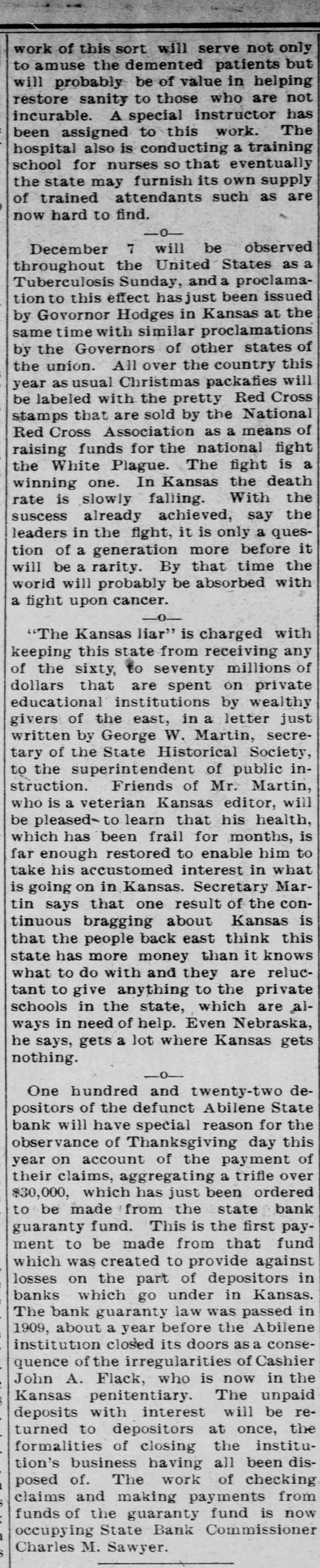
One hundred and twenty-two depositors of the defunct Abilene State bank will have special reason for the observance of Thanksgiving day this year on account of the payment of their claims, aggregating a trifle over $30,000, which has just been ordered to be made from the state bank guaranty fund. (payment of guaranty certificates).
Source
newspapers

Newspaper Articles (6)

Article from Abilene Weekly Reflector, November 6, 1913

Click image to open full size in new tab

Article Text

Flack's Shortage to Be - Finally Paid Topeka, Nov. 4.-Depositors in be in the neighborhood of $30,000, which will have to be made up from the Abilene State bank, which closthe guaranty fund. There is $112,ed its doors three years ago as the 000 in the fund at present." result of the operations of Cashier John A. Flack, will be the first to How the Law Works. benefit from the bank depositors' Under the operation of the law guaranty fund of the state of Kanevery bank that takes advantage of sas. A warrant for about $30,000 the depositors' guaranty fund prothe exact amount has not been revision deposits one-fifth of one per ported by the receiver-will be cent of its average deposits for the drawn this month on the state treasyear in the guaranty fund. Then if urer by Charles M. Sawyer, bank a bank fails, its available cash is commissioner, to take up certifidistributed pro rata among the cates issued when the bank failed. depositors. For the balance of his When the affairs of the bank were deposit each depositor is given a turned over to Edward Makins, recertificate against the guaranty fund ceiver, there was a deficit of $90,bearing six per cent interest. Then 000 after the available cash had when the bank's affairs finally are been returned to the depositors. Rewound up, whatever cash the assets ceiver Makins has just finished windof the bank have realized is used to ing up the affairs of the Flack bank, take up these certificates; the baland his report to the bank commisance of the certificates are taken up sioner is expected this week. The from the guaranty fund. This is statement, it is understood, will the system by which Kansas proshow a deficit of $30,000. This sum tects her bank depositors. will be taken from the depositors' No bank has to take advantage guaranty fund. of the guaranty fund law, but as a No Depositors Suffer. matter of fact practically every This guaranty fund has been acstate bank in Kansas has come uncumulating for four years, and now der its provisions, with the result totals $112,000; no inroads have that no depositor, in the long run, been made upon it since the law has lost out from back failure since went into effect. But for this law the law was put on the statute book. the $30,000 deficit of the Abilene
Article from Abilene Weekly Reflector, November 20, 1913

Click image to open full size in new tab

Article Text

Interest on the certificates issued depositors when the Abilene State bank went into the hands of a receiver will cease November 22 and the certificates will be redeemed upon presentation to State Bank Commissioner Charles M. Sawyer at Topeka, who made this announcement today. The total amount to be paid is $28,646.50. The defalcations of John A. Flack amounted to about $90,000. The double liability of the stockholders and the value of the assets held by the


Article from Abilene Weekly Reflector, November 20, 1913

Click image to open full size in new tab

Article Text

Flack Depositors Are Paid by Guarantee Interest on the certificates issued bank and sold by Receiver Ed. Makdepositors when the Abilene State ins brought the actual loss down to bank went into the hands of a re- $22,455.98. In the amount now to ceiver will cease November 22 and be paid holdeis of the certificates the certificates will be redeemed $6,190.60 is interest. Most of the paper is held by upon presentation to State Bank Commissioner Charles M. Sawyer Dickinson county people. The reat Topeka, who made this announce- fund is made possible by the state bank guaranty fund, a fund comment today. The total amount to posed of the one-fifth of one per be paid is $28,646.50. The defalcations of John A. Flack amount- cent assessments paid by 487 of the ed to about $90,000. The double 930 state banks in the state. Memliability of the stockholders and the bership in the guaranty association value of the assets held by the is voluntary.


Article from Western Kansas World, November 22, 1913

Click image to open full size in new tab

Article Text

work of this sort will serve not only to amuse the demented patients but will probably be of value in helping restore sanity to those who are not incurable. A special instructor has been assigned to this work. The hospital also is conducting a training school for nurses so that eventually the state may furnish its own supply of trained attendants such as are now hard to find. -0December 7 will be observed throughout the United States as a Tuberculosis Sunday, and a proclamation to this effect has just been issued by Govornor Hodges in Kansas at the same time with similar proclamations by the Governors of other states of the union. All over the country this year as usual Christmas packafies will be labeled with the pretty Red Cross stamps that are sold by the National Red Cross Association as a means of raising funds for the national fight the White Plague. The fight is a winning one. In Kansas the death rate is slowly falling. With the suscess already achieved, say the leaders in the fight, it is only a question of a generation more before it will be a rarity. By that time the world will probably be absorbed with a fight upon cancer. -0"The Kansas liar" is charged with keeping this state from receiving any of the sixty, to seventy millions of dollars that are spent on private educational institutions by wealthy givers of the east, in a letter just written by George W. Martin, secretary of the State Historical Society, to the superintendent of public instruction. Friends of Mr. Martin, who is a veterian Kansas editor, will be pleased- to learn that his health, which has been frail for months, is far enough restored to enable him to take his accustomed interest in what is going on in Kansas. Secretary Martin says that one result of the continuous bragging about Kansas is that the people back east think this state has more money than it knows what to do with and they are reluctant to give anything to the private schools in the state, which are always in need of help. Even Nebraska, he says, gets a lot where Kansas gets nothing. One hundred and twenty-two depositors of the defunct Abilene State bank will have special reason for the observance of Thanksgiving day this year on account of the payment of their claims, aggregating a trifle over $30,000, which has just been ordered to be made from the state bank guaranty fund. This is the first payment to be made from that fund which was created to provide against losses on the part of depositors in banks which go under in Kansas. The bank guaranty law was passed in 1909, about a year before the Abilene institution closed its doors as a consequence of the irregularities of Cashier John A. Flack, who is now in the Kansas penitentiary. The unpaid deposits with interest will be returned to depositors at once, the formalities of closing the institution's business having all been disposed of. The work of checking


Article from Abilene Weekly Reflector, November 27, 1913

Click image to open full size in new tab

Article Text

PAYMENT OF GUARANTY CERTIFICATES NOW MADE Closing Up of Abilene State Bank's Affairs Ended. payment of the certificates the of indebtedness The that will complete dedue depositors of the amounts Abilene State bank commenc- comfunct Saturday. The state bank ed has drawn from the guar- state missioner fund held by the 487 State anty of which the Abilene cancel banks, was one, $28,640.50 to is bank claims. Of this $6,184.52 all on the certificates which since interest been drawing interest cent. November have 1, 1910, at 6 per loss entailed by the failure part was The $90,000 but the larger While about on the stockholders. came deposits were in excess of $140,the some of this was county money protected 000, by bond and not participating in the guaranty fund. When the certificates were origissued they amounted to $46,- the inally but assets from the sale of 809, bank's property, the real estate the turned over to the directors by and defaulting cashier, J. A. Flack, double liability of the stock- the h holders the paid 52 per cent of time 0 amount, credited from time to d the ctrtificates, leaving certi- $22,455.98 on as the balance. The the t ficates were used by many of at g depositors as collateral for loans banks S local banks or sold to the cent E outright the and probably 75 per W of the amount is so held. tl A long list of lawsuits grew out a the failure, owing to the careless h of bookkeeping that did not indicate cl who were the real stockholders. Men who had disposed of their beC stock years before were sued had the transfer of the stock by cause been entered on the books never the cashier and manager. They ri compelled to pay their share n of were the liability. The heaviest loser iz J. L. Kruger, one of the directi was who had $700 in stock. He was for m tors, of the signers of eight notes 1 one $5000 each given the day after was ga Flack's disappearance when it thought that this would rehabilitate P the bank, it being considered that pr with the property turned over by tr the cashier after his defalcation was discovered would make up the difwa ference. Instead, it was found that ne there was a shortage of nearly $90,L. 000 and the doors were closed. Three W of the notes Kruger paid. The Γa other five remained among the Af bank's assets. In closing the afrie fairs all the assets remaining were ho sold to Mr. Kruger for $7500. He sei received the five notes, all the small sp assets, including some stock in a in Texas land company, some building Mr and loan association stock, the house E. owned by Flack, known as the Tayor residence on Fifth street. His FR oss was $23,900 less the value of hese assets. The receiver, Edward Makins, been paid $125/ a month for wil hree as years and two months, a tosul al of $4750. Many long contested son awsuits over the tangled affairs tra ave dragged out the proceedings to f receivership. The county deposits bric ere protected by bonding compancon es and Flack's property was all sold an good figures except the Taylor the Dav ouse mentioned. The estate of reco resident, I. S. Hallam, who died the the shock of the failure and in vise lack's house where he had gone see inspect the property, was wiped pro ut by the disaster. inst While many theories have been fair dvanced to account for the actual han sappearance of some $90,000 in twe period of three or four years, none pan is been verified. There is no incation that Flack had any propermore than he returned to the T nk, selling for about $25,000. The now mainder is unaccounted for in any figh finite way. It is doubtful if Flack could give any accounting, provide


Article from Abilene Weekly Reflector, January 8, 1914

Click image to open full size in new tab

Article Text

Bank Commissioner Sawyer has the right idea. He says there will be no more soft snaps in bank receiverships; he will put his assistants in charge and save the depositors the salary of a receiver when a bank is in difficulty. The Abilene State bank receiver's salary was over $5000 and all this could have been saved by following Sawyer's sensible plan.