Click image to open full size in new tab
Article Text
-Ernst Davy, of Chicago, is here on a visit to his parents, Mr. and Mrs. Wm. Davy.
-Every man longs to be a woman just long enough to show what a good wife he would be.
-The Sterling Cyle works shipped a large consignment of wheels to California Friday night.
-It may be stated as a business fact that Cupid doesn't always pay the debts he contracts.
-If a man could run out of debt as easily as he can run into it, times would not be so hard.
-For the sake of depriving others of pleasure, some people are willing to endure hardships themselves.
-It was a very jolly crowd who took in the dance of the Brownie club at Simmons hall Friday evening.
-The question in some communities is not whether a young man can do anything, but whether he can do anybody.
-"I am cured since taking Hood's Sarsaparilla," is what many thousands are saying. It gives renewed vitality and vigor.
-Citizens of Kenosha have been so good the past day or two that the police might as well be given indefinite leave of absence from duty.
-By using Hall's Hair Renewer, gray, faded or discolored hair assumes the natural color of youth, and grows luxuriant and strong, pleasing everybody.
-The claim of Ex-Sherif Weyhe for overtime was again considered by the county board Friday. It was not deemed a proper bill and was disallowed.
-Property owners along Park avenue are discussing the advisability of requesting that the new electric road be laid down the whole length of the street and out of the city limits by that route.
-The follyof prejudice is frequently shown by people who prefer to suffer for years rather than try an advertised remedy. The millions who have no such notion, take Ayer's Sarsaparilla for blood diseases, and are cured. So much for common sense.
-A farmer has two rows of corn of one hundred hills in a row and hires A. and B. to do the job. A. is a faster man with the hoe than B. so he hoes six hills for B. as a starter, B. finishes out his row and hoes three hills for A How many more hills does A. hoe than B?
-The snow gives the country the aspect of winter but it cuts no figure on the "going." It has been beaten down so that the wheeling is even better than it was before the snow came. It begins to look as though this winter would pass into history as one of practically no sleighing.
-The committee consisting of Supervisors Haigh, Pacey aud Crow having investigated the Brighton road matter reported that the chairman of the board should go ahead and build the road, as provided by law. So Chairman Curtis finds himself in the apacity of a road builder.
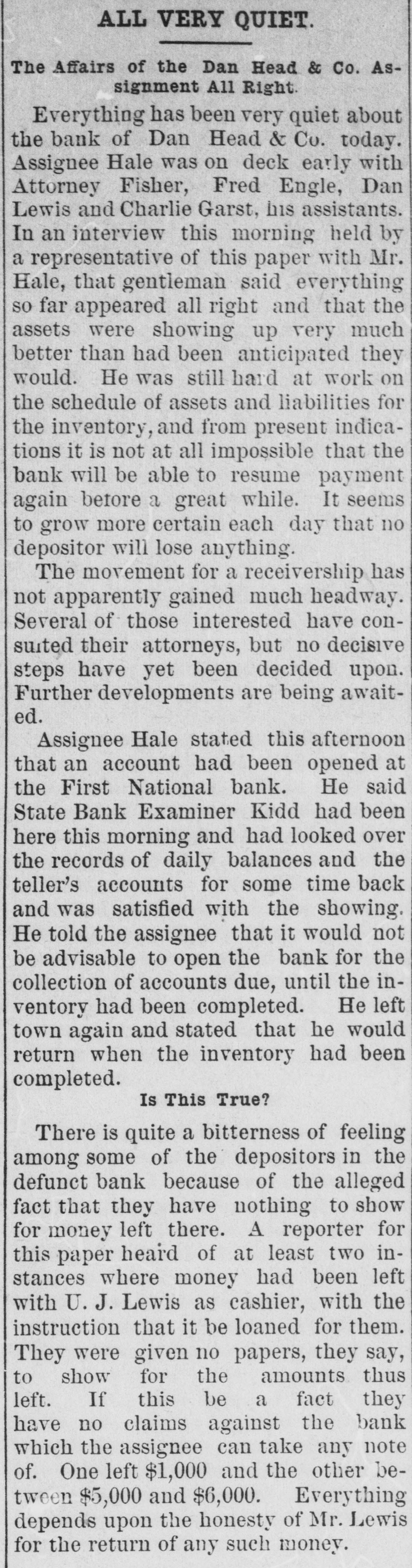
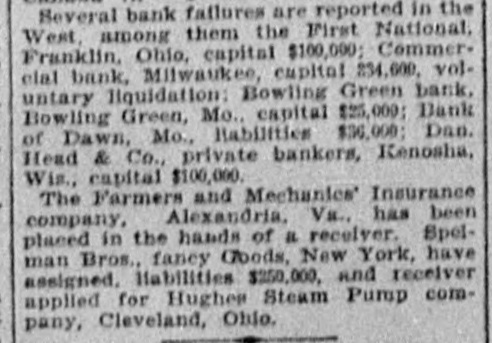
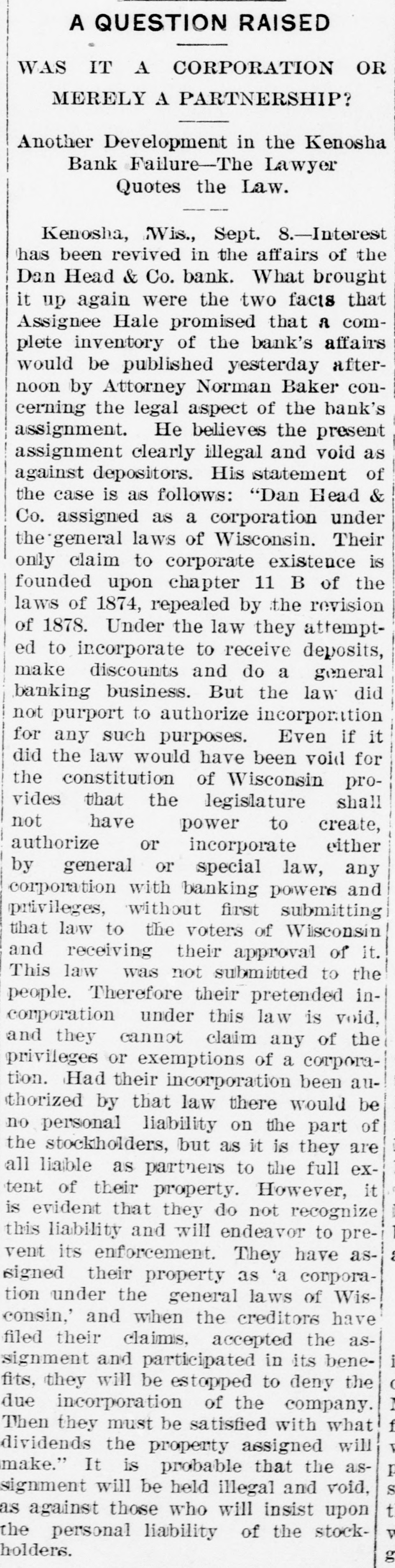
-The are several parties who are looking over the Dàn Head & Co. building who have in view the starting of another bank here. One party has been here for a company and looked over the building and city and was very favorably impressed with both. So a deal may be looked for before long in this matter.
-The bondsmen who are liable for the county funds tied up by the Dan Head failure, were before the county board this afternoon to talk over the manner in which the bond should be made good. The final action of the board was that the treasurer be instructed to recover from the bondsmen the amount due the county, which is between $600 and $700.
-George A. Lomas got in a solution of the cattle puzzle run in this paper some time ago which is entirely wrong. The correct answer in by all the others has been that a farmer took 19 cattle, 1 sheep and 80 chickens to market for which he got the $500. Mr. Lomas evidently has forgotten that there were only 100 of the animals all told. His answer is 14 cattle, 20 sheep. and 200 chickens which makes 234 altogether.
-Suiphume baths are unexcelled by the most celebrated sulphur springs with the additional advantage of being taken at home. The medicinal effect of sulphur baths, by absorption of sulphur through the glands, acts directly upon the blood, purifying it, and removing all unhealthy secretions and odors from the body. Sulphume is the greatest blood purifier known. Try it. For sale by Woodward & Conles. dwtf
-The board of directors of the public library at the meeting Friday evening considered that the best way to get at all the people with the reference to the membership of the Kenosha Public Library would be to place a